

There are 5,829 accredited higher-education institutions in the United States. There are 58,213 higher-education locations on Google Maps. That gap of 52,384 is where every serious colleges and universities mailing list actually gets built — and where every broker's list quietly falls short.
Quick disclaimer before we go further. If you landed here hoping colleges will mail you a brochure — wrong article. Sorry. This one is for people selling to universities, not applying to them. Vendors, founders, sales leads chasing higher-ed budgets. If that's you, keep reading.
Here's the setup. A broker sells you a "verified" college list compiled from federal directories. You send. Half of it bounces, the rest lands on generic mailboxes nobody checks. Then you're the one explaining the 62% bounce rate to your boss. In this guide: three methods to build a mailing list of colleges, the real cost of each, the compliance rules that actually apply, and a reproducible method with screenshots. No fluff.
Table of Contents
- What Is a Colleges and Universities Mailing List?
- 58,213 US Higher-Ed Locations: The Numbers Nobody Publishes
- Who Actually Buys a Colleges and Universities Mailing List?
- Where to Get a Mailing List of Colleges: 3 Methods Compared
- What a Live Extraction Actually Gives You (Column by Column)
- K-12 vs Higher Ed: Never Mix the Two Lists
- Data Quality: Why Bought Higher-Ed Lists Bounce
- CAN-SPAM, FERPA and GDPR: Emailing Universities Legally
- How to Actually Get Replies from Higher-Ed Decision-Makers
- Real Companies Selling to Colleges and Universities
- Frequently Asked Questions
What Is a Colleges and Universities Mailing List?
Ask ten vendors what's on their college mailing list and you'll get ten different answers. That's the whole problem.
Stripped down, a colleges and universities mailing list is a structured file of contact details for higher-education organizations — names, addresses, phone numbers, websites, emails. Simple enough. Except "contact details" hides four completely different objects that people mix up constantly:
- Institutions — the campus, the department, the library as an entity. B2B.
- Staff — deans, IT directors, procurement officers, the humans who sign the PO. Also B2B, and the ones you actually want.
- Students — a totally different legal universe (and not what we're doing here). B2C.
- Alumni — donor and fundraising territory.
This article covers the first two. When someone sells you a college and university email database, that's the ambiguity you're paying to sort out — because most "lists" dump generic info@ mailboxes on you and call it a day. A useful list gets you to a real person at a real department. Everything else is decoration.
58,213 US Higher-Ed Locations: The Numbers Nobody Publishes
The NCES says 5,829. Google Maps says 58,213. Both are right.
That's not a typo. The National Center for Education Statistics counted 5,829 Title IV institutions in its 2024-25 IPEDS collection (source: NCES / IPEDS). Meanwhile, as of August 2026, Scrap.io indexes 58,213 higher-education locations across the US on Google Maps. Exactly ten times more points of contact. Here's the full breakdown:
| Metric | Value | Share |
|---|---|---|
| Total US higher-ed locations indexed | 58,213 | 100% |
of which category university |
32,789 | 56.3% |
of which the college family (8 subtypes) |
29,338 | 50.4% |
| With a public email on the website | 29,349 | 50.4% |
| With a website | 36,632 | 62.9% |
| With a phone number | 41,338 | 71.0% |
Source: Scrap.io platform data, August 2026.
So how many colleges and universities are there in the US, really? Depends what you're counting. And that's the point. IPEDS counts institutions. Google Maps counts doors.
Because a university isn't one listing. It's a main campus, plus a business school, plus a law school, plus a library, plus a research center, plus an admissions office, plus a residence hall — each with its own address, its own listing, and often its own email. IPEDS sees one institution. Google Maps sees a dozen entry points. And in prospecting, an entry point is a contact.
Why does this matter beyond a fun stat? Because the money behind higher-ed is enormous and growing. The higher-education technology market sits at $53.72 billion in 2026 and is projected to hit $272.42 billion by 2034 (Fortune Business Insights). Education IT infrastructure spending alone reached $82 billion in 2025, up 14% year over year (Searchlab). Roughly 47% of higher-ed institutions now use AI structurally, and 70%+ of colleges plan to launch an online program within three years. Translation: a lot of buying, a lot of budgets, a lot of people who need what you're selling. (For the national picture across every sector, our US business email database page tracks the wider count.)
Video: How to Scrape Local Leads at the Country Level
Who Actually Buys a Colleges and Universities Mailing List?
A lab furniture supplier in Ohio. An AI tutoring startup in Austin. A campus food-service group in Georgia. Three completely different businesses, one identical bottleneck: getting a working email for the person who signs the purchase order.
That's the pattern. The buyers of a higher education email list are wildly varied, but they share the same headache. Here's the short version of who's prospecting into campuses:
- Edtech publishers and LMS platforms (a college email list for edtech companies is basically a core asset for them)
- Lab equipment and furniture vendors
- International student recruitment agencies
- Campus insurers and risk providers
- Food-service and dining groups
- Security and access-control installers
- IT and cybersecurity providers
- Construction and renovation firms
- Textbook and e-learning publishers
- Career-services and placement platforms
One thing ties all of them together, and most people ignore it: the academic calendar runs everything. July through September, budgets are fresh and POs move. January and February, planning season. March through May? Exams. Nobody answers. Time your university mailing list outreach against that rhythm or watch it disappear into the void.
Where to Get a Mailing List of Colleges: 3 Methods Compared
Two of these three methods will burn your domain reputation. Let's be specific about which.
| Method | Cost per contact | Data freshness | Effort | Bounce risk |
|---|---|---|---|---|
| Buy a pre-built list (BookYourData, IInfotanks, LeadsPlease, ExactData) | $0.40–$1.00 | Compiled, refreshed quarterly at best | 🟢 Low | 🔴 High |
| Build it manually (IPEDS + institutional sites) | ~$1.00 in time | Fresh, but stale before you finish | 🔴 Extreme | 🟡 Medium |
| Real-time extraction (Scrap.io) | ~$0.005 | Real-time, at the moment of export | 🟢 Low | 🟢 Low |
Method 1: Buying a Pre-Built College Email List
Most people start here. It's fast, and where to buy a college email list isn't a hard question — brokers are everywhere. BookYourData is the most polished of the bunch. Their prices, for the record: the full US package runs $4,999, 500k contacts $2,999, 250k $1,999, 100k $999, 50k $699, and a custom list starts at $99 for 250 leads — that's $0.40 per contact. Advertised deliverability: 97%.
Here's the critical part they say quietly. BookYourData sources its data from NCES, IPEDS and AACRAO — administrative directories that are static by construction. It's clean, it's legal, and it is not fresh. A directory updated once a year cannot reflect the dean who moved departments in June. If you want the wider picture on this, we broke it down in our guide on buying email lists in 2026.
Method 2: Building It Manually
Free. On paper.
You export IPEDS, visit each institutional website, dig into "Contact us" pages, copy-paste. Realistic for 50 institutions. Impossible for 5,000. And here's the kicker: institutional directories overwhelmingly publish generic addresses — admissions@, info@ — rarely the direct line to a decision-maker. So even after all that labor, you're building a list of college admissions email addresses that mostly rings the front desk. Try assembling a real university procurement contact list this way. I'll wait.
Method 3: Extracting It Live from Google Maps
This is where the economics flip. Instead of buying a frozen file, you pull the data yourself from Google Maps — live, at the moment you export. Scrap.io is built for exactly this, and four things make it work for higher-ed specifically: you can extract an entire country in two clicks (no per-city quota), the data is refreshed in real time on every export, filters apply before credits are consumed (so you don't pay for listings without an email), and you can carve out any zone — a state, a county, a hand-drawn polygon — without even specifying a category. The full technical walkthrough lives in our Google Maps scraping guide.
Video: Scrap.io - How to Start?
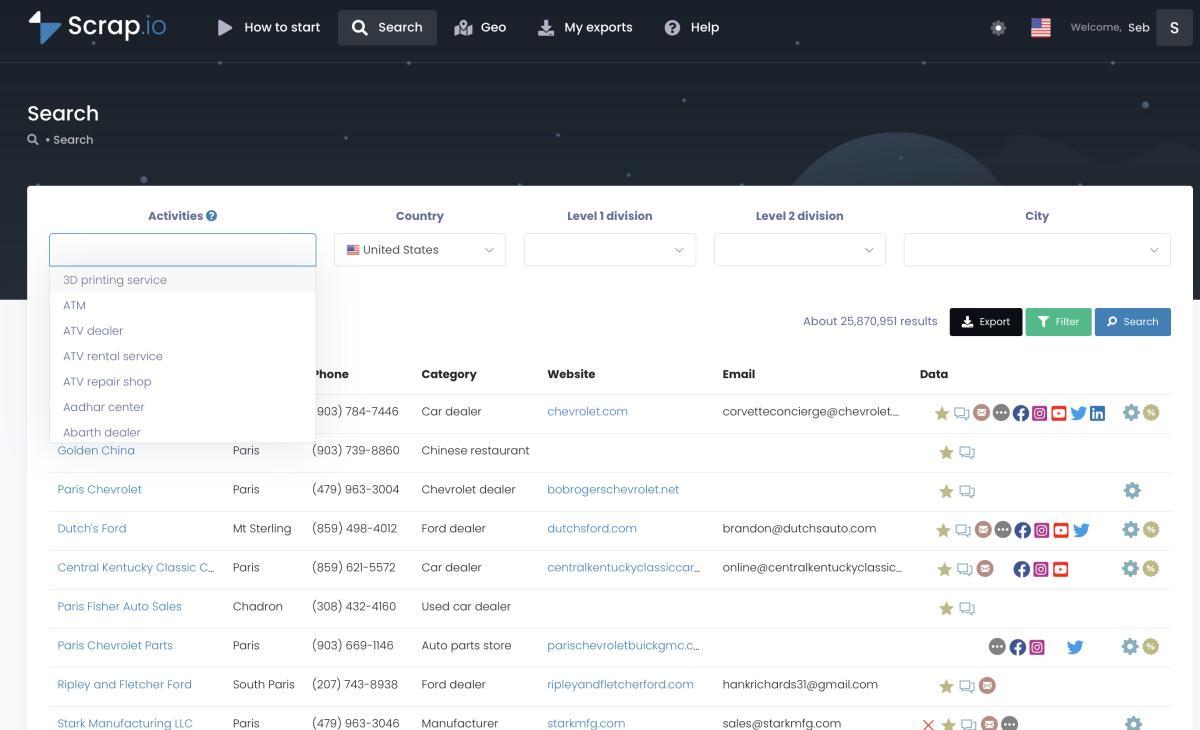
Curious what your slice of those 29,349 emails looks like? The free 7-day trial includes 100 export credits — enough to pull every community college email list in a mid-sized state and see the actual data before you commit to anything. Start your free trial — 7 days, 100 leads.
What a Live Extraction Actually Gives You (Column by Column)
A CSV with 58,000 rows is worthless if the only column you can use is "name." So let's talk about what actually comes out.
Every export includes: the institution name, full address, city, ZIP, state, GPS coordinates, primary category plus subcategories (drawn from the full list of 4,000+ Google Maps categories), website, hours, claim status, average rating, review count, and the phone number with its type (landline / mobile / special). Then the part that matters most for a campus — automatic email classification. Scrap.io doesn't just hand you one blurry mailbox. It splits emails into Individual Email (with First Name and Last Name extracted), Contact Email, Sales Email, Marketing Email, Finance Email, and Administration Email.
Why does that split change everything? Because on a campus, admissions@ and procurement@ are not the same pitch. Not even close. The classification does that sorting at export time, not after — which is how you go from a raw dump to a segmented, targetable list of verified higher education contacts. You also get detected website technologies, ad pixels, and whether a contact form exists. Handy when you want to know how to email university department heads without spraying the whole switchboard.
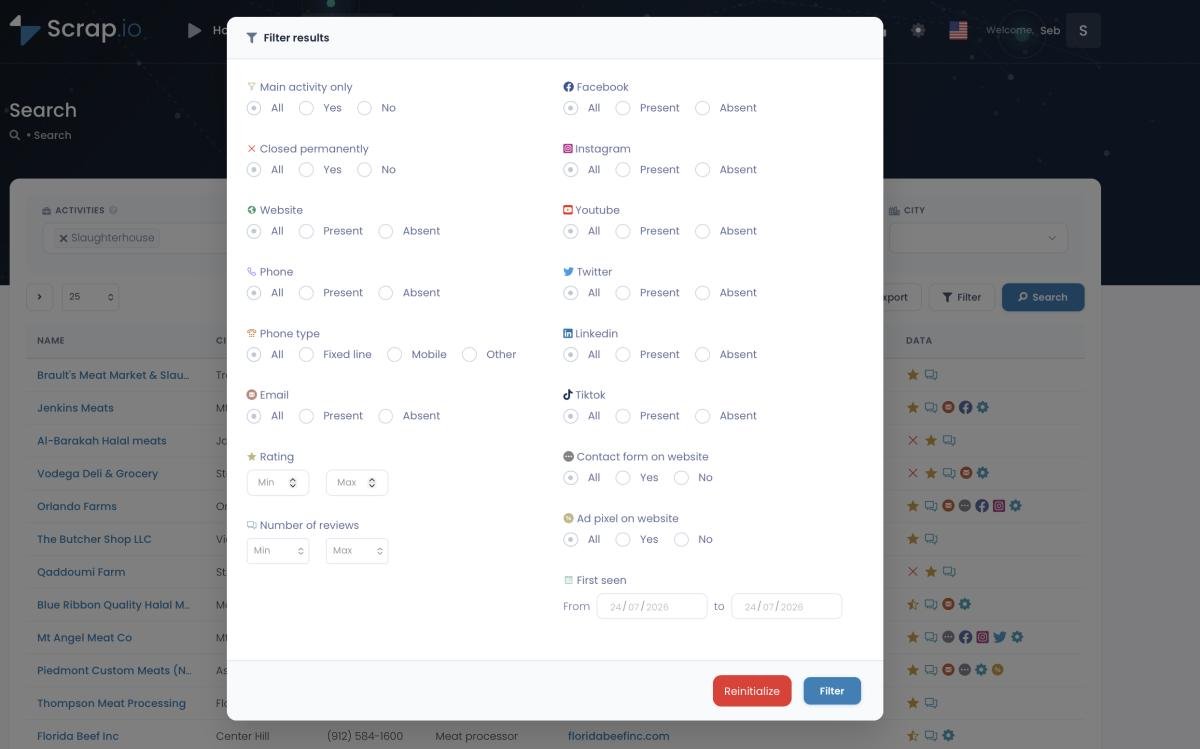
And the geography is granular. Only need California? Filter by state, county, city, radius, or a polygon you draw by hand — you only spend credits on what you export. That's the part that turns "58,000 rows" into "the 400 institutions in my exact target zone."
Video: Finding Clients Through Google Maps Filters
Set your filters, hit export, open the CSV. That's the whole workflow. At roughly $0.005 a contact, the full filtered US higher-ed list runs about $150 — versus $4,999 for the equivalent broker package. Start your free trial — 7 days, 100 leads.
K-12 vs Higher Ed: Never Mix the Two Lists
LeadsPlease sells you "schools and universities" in one file. That single file is why your reply rate is 0.4%.
K-12 and higher-ed are not the same market wearing different hats. The buying cycle is different (a centralized district vs an autonomous department). The basket size is different. The person you're emailing is different — a superintendent on one side, a department chair or procurement officer on the other. The budget calendar is different. Even the regulatory weight is different; FERPA looms larger over K-12. Jam them into one list and every message is wrong for half your recipients.
The numbers make the split obvious, too. Scrap.io indexes 237,527 K-12 schools in the US versus 58,213 higher-ed locations. Different scale, different game. If K-12 is actually your target, don't force it here — go read our K-12 school email database guide instead, which is built for that exact audience. Keep the two lists apart and both perform better.
Data Quality: Why Bought Higher-Ed Lists Bounce
A 62% bounce rate is not a copywriting problem. As one blunt summary from the r/Sales community put it — "a 62% bounce rate on a scraped list is not a copywriting problem" (via Tomba). It's a data problem, and it has two roots.
First, academic turnover. People rotate through departments constantly, and the summer and January windows churn staff hard. Second, the source. When a broker compiles from static administrative directories, the file is already aging the day it ships. Combine the two and you get a higher education contact database that decays faster than you can send to it.
So the rules for 2026 are non-negotiable. Keep bounce under 2%. Authenticate your domain with SPF, DKIM and DMARC — Gmail and Microsoft will reject unauthenticated bulk mail outright now, not spam-folder it, reject it. Re-verify quarterly, aligned to the turnover windows (summer and January). And validate before you send; even fresh data benefits from a pass. Our guide to verifying your email list covers the mechanics.
For context on what "good" looks like: cold email in 2026 runs a 38% median open rate and a 2.1% median reply rate, with education, government and nonprofit sectors hitting 30-42% opens (Clodura.AI). The higher-ed marketing benchmark specifically lands at 38.5% open rate (CUFinder). Universities read their email. They just ignore the bad ones.
CAN-SPAM, FERPA and GDPR: Emailing Universities Legally
Right. The least fun section of this article, and the one that costs the most to skip.
Is it legal to email universities? Yes — provided you follow CAN-SPAM: an honest subject line, a physical postal address in the footer, and a working opt-out you honor within 10 business days. Contacting a procurement officer at their publicly listed address is fine. Here's how the main regulations actually map onto a college mailing list:
| Regulation | Applies to | What it means for a college mailing list |
|---|---|---|
| CAN-SPAM | All commercial email in the US | Functional opt-out, physical postal address, honest subject. Up to $51,744 per non-compliant email (FTC) |
| FERPA | Student education records | Does not apply to public staff contacts |
| GDPR | EU / UK contacts | Explicit consent or documented legitimate interest, plus right to erasure |
| CCPA | California residents | Right to know, delete, opt out. California has the highest density of institutions |
One nuance worth internalizing: universities themselves are wary of compiled lists. The University of Minnesota's own policy bars units from using purchased or rented lists "unless they have a good faith basis to believe that such lists are reputable, reliable, and of the sort used by institutions of higher education" (source). Read that again. The buyers you're targeting distrust the exact product most brokers sell.
That's where source traceability becomes an argument, not a footnote. Scrap.io only extracts publicly available business data, each field traceable to its source — a fundamentally different legal position from a compiled list of unknown origin. GDPR and CCPA compliant, by design. You know exactly where every line came from.
How to Actually Get Replies from Higher-Ed Decision-Makers
What happens when a department chair opens the 40th vendor email of the week? They delete 39 of them in about four seconds. Getting into the surviving 1 is the entire job.
Timing first, because it beats everything else. July through September is prime — fresh budgets, active POs. January and February, secondary. March through May, forget it; exams eat every calendar. Then the message itself: a problem-first subject line under 50 characters, personalization by role (a CFO and an IT director care about opposite things), and a tight sequence of three to four touches over two weeks. Not ten emails in a month. Three or four, spaced, relevant.
And stop mailing info@. Those addresses convert badly because nobody owns them — they're a shared inbox where pitches go to die. Aim for the classified individual or department email instead. If you want the full teardown on structure and follow-ups, our guide on how to write a cold email that gets replies walks through it line by line.
Real Companies Selling to Colleges and Universities
Ellucian now serves 2,800 institutions across 50 countries and 20 million students. That did not start with a LinkedIn connection request.
Ellucian, a SIS/ERP publisher for higher education, closed its acquisition of Anthology's SIS and ERP business on December 31, 2025 — transferring 260+ Anthology clients in the process (PRNewswire). Companies at that scale run on contact databases, not luck.
They're far from alone. BookYourData sells a "Colleges and Universities Email List" claiming 2,965,867 verified contacts, with packs from $699 to $4,999 (product page). IInfotanks, ranked #9 organically, advertises a sub-3% bounce rate and 1.2 million phone verifications a month — but publishes no prices at all (product page). LeadsPlease is the cautionary tale: it sells a single "Schools & Universities" file that blends K-12 and higher-ed, forcing you to segment after you've paid. And in the edtech deal flow, Instructure (Canvas LMS) bought Parchment for $275 million in October 2025, while Apollo.io spun up a dedicated college email database landing page — both signals that higher-ed contact data is a market everyone's chasing.
One more, because it frames the whole intent problem: a 2019 r/ApplyingToCollege thread titled "here is a list of over 1700 college emails" still ranks on page one for this keyword (source). It's students chasing free t-shirts. On a keyword with a $75 CPC. That's how confused this SERP is — and how wide open the B2B side remains.
Ellucian, Instructure and every serious higher-ed vendor runs on a contact database. The only variable you control is how fresh yours is. Pull the current list — from 225M+ businesses across 195 countries, filtered before you pay. Start your free trial — 7 days, 100 leads.
Frequently Asked Questions
How many colleges and universities are there in the United States?
The NCES counted 5,829 Title IV institutions in the 2024-25 IPEDS collection. But Google Maps indexes 58,213 higher-education locations across the US — because a single university shows up as a main campus, a law school, a library, an admissions office and a research center, each with its own listing and contact details.
How much does a colleges and universities mailing list cost?
It depends entirely on the method. Data brokers charge $0.40 to $1.00 per contact — BookYourData's full US package runs $4,999, with smaller packs from $699. Manual research costs roughly $1 per contact in time. Real-time extraction through Scrap.io works out to about $0.005 per contact, or roughly $150 for the full filtered US higher-ed list.
Is it legal to email colleges and universities?
Yes, provided you follow CAN-SPAM: honest subject lines, a physical mailing address, a working opt-out honored within 10 business days. Penalties reach $51,744 per non-compliant email. FERPA covers student records, not publicly listed staff contacts — so emailing a procurement officer at their published address is fine. GDPR applies if you're contacting EU or UK institutions.
What's the difference between a college mailing list and a K-12 school list?
Different buyers, different cycles, different budgets. K-12 purchasing is often centralized at the district level around a superintendent; higher-ed purchasing is fragmented across departments, IT, facilities and procurement, each with its own budget. Mixing both into one file — which several brokers do — is why generic education campaigns underperform.
Can I get a free list of college email addresses?
Free lists exist — IPEDS exports, forum dumps, "free college email address list" download pages. They're incomplete, undated, and heavily weighted toward generic info@ addresses. IPEDS in particular gives you institutions, not contacts. Scrap.io's 7-day free trial includes 100 export credits, which is enough to test real extracted data against whatever free file you're considering.
The Bottom Line
Four things to take away. One: a real colleges and universities mailing list targets people, not info@ mailboxes. Two: the cost gap between a broker file and a live extraction is roughly $4,999 versus $150 — for fresher data. Three: keep K-12 and higher-ed apart, always. Four, and this is the whole game — freshness beats volume, because a 58,000-row file compiled last fiscal year is just an expensive way to bounce.
That gap of 52,384 between the IPEDS count and what's actually on the map? It's still sitting there. The only question left: do you pull today's version of it, or someone else's from last year?
Pull the list today, not the one someone compiled last fiscal year. Free trial — 7 days, 100 leads, no commitment. Start your free trial.
Generate a list of college with Scrap.io