

On July 26, 2026, we ran one search on Google Maps for the entire United States. The count came back: 15,238 golf courses. Of those, 11,659 had a website. And 8,603 had a public email address sitting right there, ready to be extracted.
That last number is the one that should make you sit up. Eight thousand six hundred golf courses you could contact tomorrow.
Yet if you type "golf course database" into Google, you get almost none of that. You get slope ratings. You get GPS scorecards built for phone apps. You get list vendors trying to sell you a frozen spreadsheet from who-knows-when. Nobody's actually showing you how to build a fresh golf course contact database you own outright. So that's what this guide does.
- What Is a Golf Course Database, Exactly?
- How Many Golf Courses Are There in the US?
- The 3 Types of Golf Course Database
- Why Buying a Golf Course Email List Is a Trap
- How to Build Your Own Golf Course Database in 2026
- Who Actually Needs a Golf Course Database?
- Filtering: Keep Only Courses You Can Contact
- Is This Legal? GDPR, CCPA & Golf Course Data
- FAQ
What Is a Golf Course Database, Exactly?
Type "golf course database" into Google and you'll get three completely different things. That's the whole confusion in one sentence.
One person means a lookup for course ratings — the slope and rating numbers golfers use to calculate a handicap. Another means a GPS and scorecard feed, the kind of data that powers a rangefinder app. And a third — usually someone in sales or marketing — means a golf course contact database: names, addresses, phones, emails of the businesses themselves.
Those aren't variations of the same thing. They're three separate products that happen to share a keyword.
Here's the part nobody says out loud. The first two categories are crowded — the USGA runs a free rating lookup, and half a dozen companies sell GPS data to developers. But the third one, the one that actually matters if you sell to golf courses? Barely covered. That's the gap. A real database of golf courses in the US that you can email, call, and pitch — built from public data, not rented from a broker. And that's exactly the kind you can build yourself. Stick with me.
How Many Golf Courses Are There in the US?
There are 13,782 operating golf courses in the United States, according to the National Golf Foundation's 2026 census. That's the number of real, functioning facilities where people actually tee off.
And it's not a dying market, whatever you've heard. Golf is having a moment. Some 48.1 million Americans engaged with the game in 2025, with 29.1 million playing on an actual course — a record, and the eighth straight year of growth (NGF). The industry pulls in roughly $35.5 billion a year across golf courses and country clubs (IBISWorld, 2026). Golf tourism alone is projected to grow at a 10.1% CAGR through 2033 (Grand View Research, 2026). Money is moving.
Where are these courses? Concentrated, mostly. Three states dominate.
| Rank | State | Golf courses |
|---|---|---|
| 1 | Florida | 1,252 |
| 2 | California | 924 |
| 3 | Texas | 891 |
Source: National Golf Foundation, 2026.
Now here's a fun wrinkle. When we counted on Google Maps, we got 15,238 — about 1,500 more than the NGF's operating-course figure. Why the gap? Because Google Maps also indexes driving ranges, practice facilities, a few closed courses that haven't been delisted, and the odd duplicate. That difference matters, and we'll come back to it when we talk about filtering. (Spoiler: it's the reason you filter before you extract, not after.)
The 3 Types of Golf Course Database
Most "golf course databases" are built for golfers, not for people who sell to golf courses. Get this distinction wrong and you'll waste a week chasing data that can't do what you need. So let's split them cleanly.
Type 1 — Rating & Slope (the golfer's lookup)
This is the golf course rating lookup world. The USGA's National Course Rating Database lets any golfer search a course and pull its Course Rating and Slope for handicap math. Free, official, genuinely useful — if you're a golfer. For prospecting? Worthless. There's not a single email or phone number in it. It tells you a course is hard, not who runs it.
Type 2 — GPS & Scorecard API (the developer's feed)
Then there's the golf course database API category: hole-by-hole GPS coordinates, scorecards, tee data. Services like golfapi.io advertise 42,000+ courses worldwide. This is the stuff that powers rangefinder apps and simulators. If you're building a golf app, great. But again — no business contacts. It's geometry and yardage, not owners and inboxes.
Type 3 — Contact & Prospecting (the one you need for B2B)
And then the one almost nobody indexes properly: a golf course owners database with real contact data. Business name, address, phone, email, website, ratings. This is what a sales team, a SaaS founder, or a marketing agency actually needs. It's also the hardest to buy fresh — which is why building it yourself wins. More on that in a minute.
| Type | What it contains | Built for | Good for B2B? |
|---|---|---|---|
| Rating & Slope | Course/slope ratings | Golfers, handicaps | ❌ |
| GPS & Scorecard API | Coordinates, yardage | App developers | ❌ |
| Contact & Prospecting | Emails, phones, owners | Sales & marketing | ✅ |
What about a golf course database free option? Fair question. Free databases exist in spades for Types 1 and 2 — golfers are well served. Free contact data, though? Almost nonexistent, because that's the version that costs money to collect and keep current. You can get close to free by extracting it yourself, and Scrap.io's trial (7 days, 100 export credits) is about as near to "free golf course database online" as the contact version gets.
Want to see what Type 3 actually looks like? Here's a real golf course export — names, classified emails, phones, the works. Counting golf courses on Google Maps costs zero credits, so you can size your market before spending a cent. Try Scrap.io free.
Why Buying a Golf Course Email List Is a Trap
That 18,000-contact golf course email list you found for $350? Part of it was dead the day you paid for it.
I'm not being dramatic. Static lists rot. Vendors like BookYourData (18,040 golf contacts advertised), Megaleads, and BizProspex sell pre-built golf course mailing list files, and the pitch is always the same: instant, done-for-you, thousands of contacts. What they don't put on the label is the collection date. Because there usually isn't one you'd want to see.
Golf businesses change hands. General managers move on. Courses close, rebrand, get bought by a management group. Every one of those events kills an email address. A list compiled 14 months ago has been quietly decaying the entire time — and you're the one who eats the bounce rate.
And bounces aren't a minor annoyance. Push past a 2% bounce rate and mailbox providers start reading you as a spammer. Your whole domain reputation takes the hit. So you paid $350 to torch your own deliverability. Masochism, basically.
There's a second problem, quieter but just as bad: you're not the only buyer. That "exclusive" list got sold to a dozen other people pitching the same golf courses. By the time your email lands, the owner has already seen five versions of it and reported two. Fun.
The alternative isn't "don't prospect golf courses." It's "stop renting a frozen file." Build a fresh one, filtered to the courses you can actually reach, updated the moment you extract. That's the whole game. If you want the deeper breakdown on why building a cold email list beats buying one, we wrote a full guide on it.
How to Build Your Own Golf Course Database in 2026
Meet Mark. He sells POS software to golf courses, and last spring he tried to build his prospect list by hand — clicking through Google Maps, one course at a time, copying emails into a spreadsheet. He got about 40 before he wanted to throw his laptop into a water hazard. There are 15,238 courses. Do that math.
Here's the version that doesn't end in a broken laptop. Four steps.
Step 1 — Search by category and location. Open Scrap.io, type "golf course," and pick your zone. A single city, a county, a whole state, or the entire US in one shot. The platform mirrors Google Maps' own categories, so you're pulling the same 15,238 listings — just all at once instead of 120 at a time.
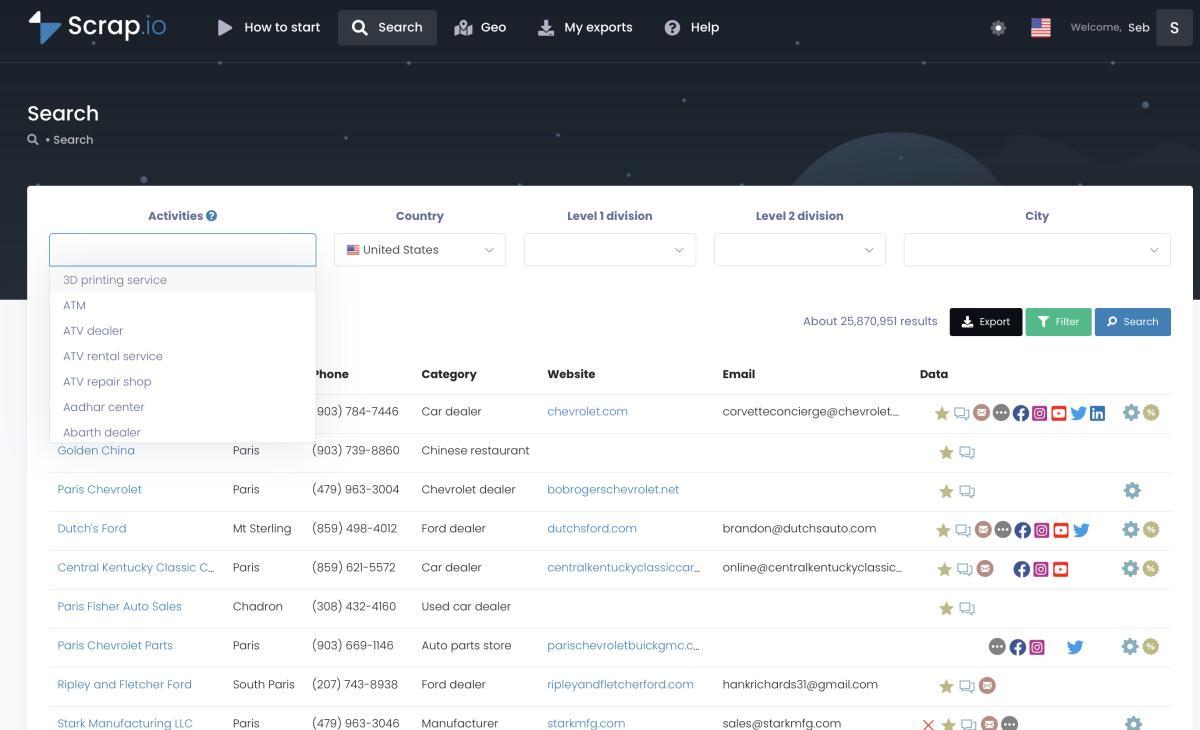
Step 2 — Count for free. Hit the count button. It tells you exactly how many golf courses match, across a whole country if you want, and it costs zero credits. This is how you size a market before committing anything. Try doing that with a purchased list.
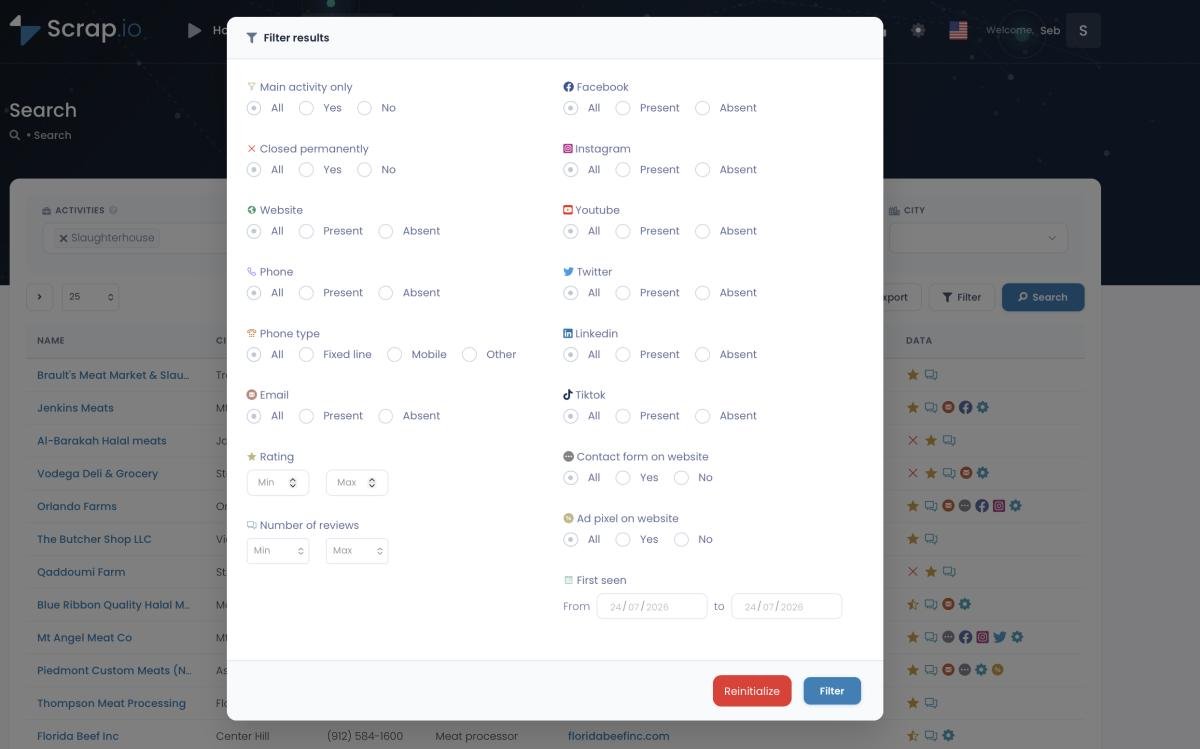
Step 3 — Filter before you pay. This is the step that saves your budget, so don't skip it. Toggle "email present" and only courses with a real address get counted. Want just the ones with a website? Or a minimum review count? Stack the filters. Your credits get spent on contactable golf courses only — never on dead-end listings.
Step 4 — Export to CSV or Excel. One click. The file lands ready for your CRM or cold-email tool, with map data plus enriched website data. Done before lunch.
Video: Scrap.io - How to Start?
Want the whole country, not one city? That's where this gets genuinely powerful. Scrap.io is the only tool that extracts every listing in a territory — up to a full nation — in two clicks, no code. And when your target doesn't fit tidy administrative borders, GeoSearch handles it: draw a radius around a point, or sketch a custom polygon on the map by hand. Every golf course inside a metro area, a resort corridor, a specific county — your call.
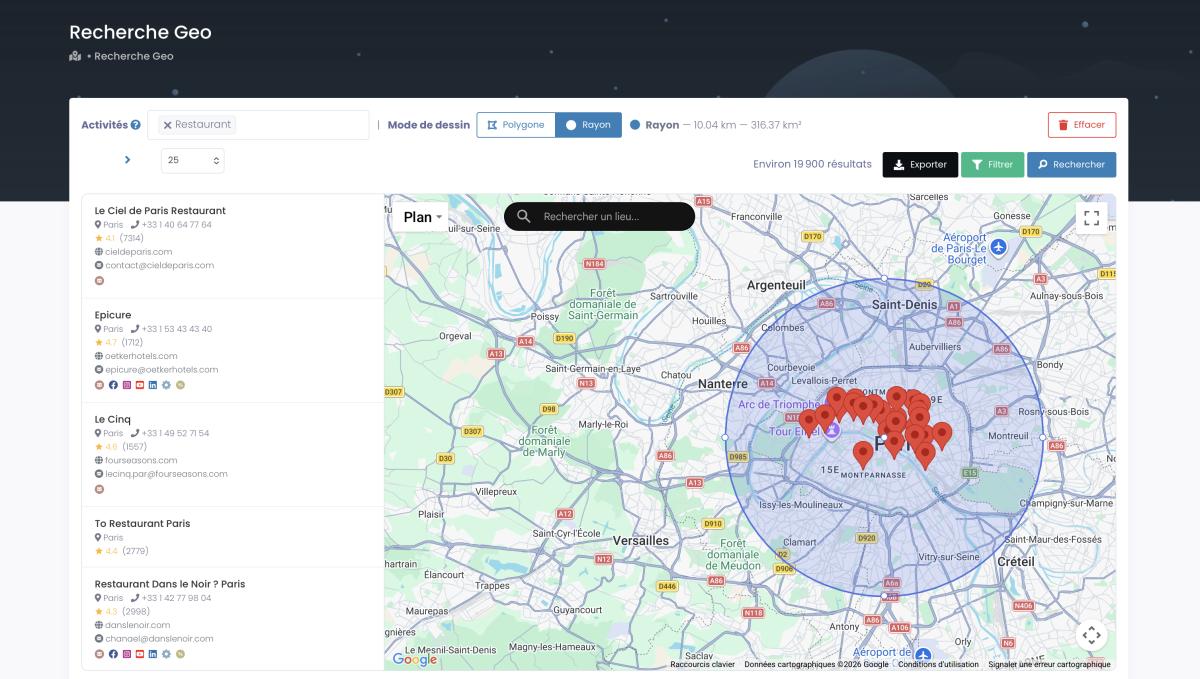
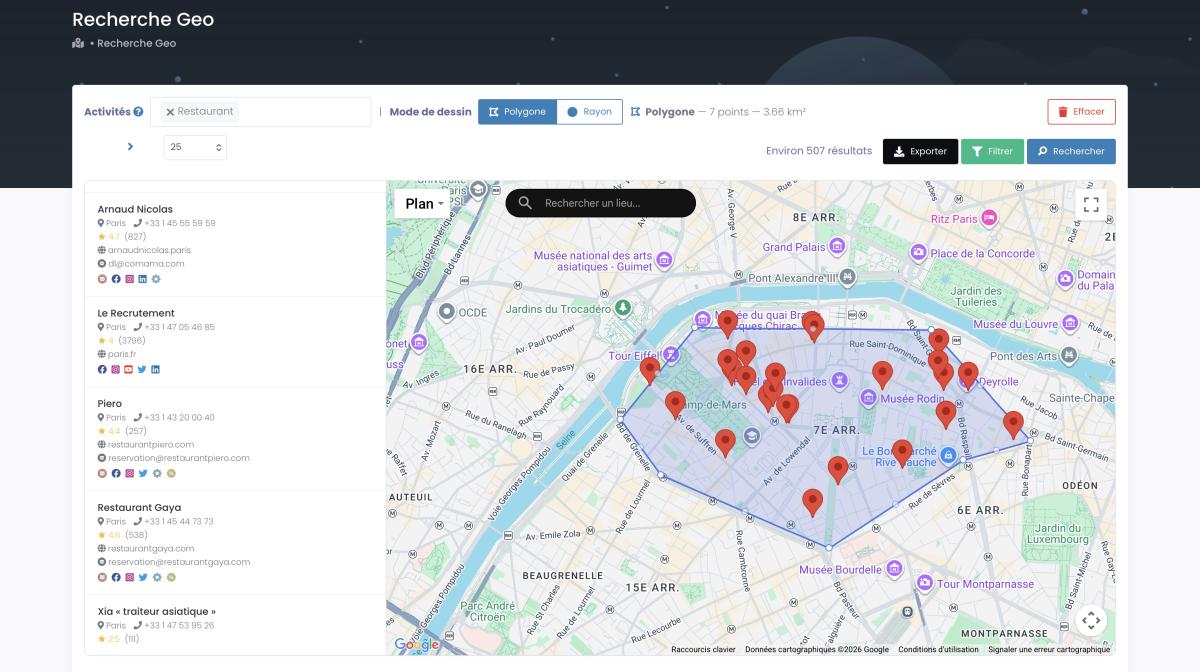
How fast is fast? One agency client pulled 11,734 businesses in 45 minutes. The whole US golf market is a fraction of that. And no, you don't need to build your own scraper to do it — the DIY-versus-professional math almost never favors DIY. For a step-by-step on national extraction, here's the guide on how to extract every business from Google Maps, the walkthrough on finding emails on Google Maps, and the broader playbook on generating Google Maps leads at scale.
Video: How to Scrape Local Leads at the Country Level
Build your first golf course list free. Scrap.io covers 225M+ businesses across 195 countries — golf courses included. Start the 7-day free trial with 100 export credits, filter to email-present courses, and pull a fresh, CRM-ready list today. No code, no stale file. Start free →
Who Actually Needs a Golf Course Database?
Your entire addressable market, on one screen. That's the pitch for anyone whose customers happen to run golf courses. And there are more of those businesses than you'd think.
Start with software. The golf-tech space is crowded and hungry for leads. Lightspeed Golf — tee sheet, POS, marketing — works with over 2,000 courses and wants more. GolfNow (GOLF Business Solutions) runs tee-time marketing and management at national scale. Then there's Teesnap, foreUP, Agilysys — all selling all-in-one golf management platforms, all needing a steady pipeline of course owners to pitch. Every one of these companies lives or dies on golf course leads — the same way a fitness-software vendor lives on a gym email list or a supplier lives on an email list by industry. Golf is just another vertical with the same playbook.
But it's not just SaaS. Think about who else sells into a course:
- Equipment and turf suppliers targeting golf course superintendent contacts
- Marketing and web agencies building sites for courses with a weak online presence
- Insurance, payment processors, and F&B distributors working the hospitality angle
- Event planners and corporate-outing organizers assembling a regional golf course directory
For any of them, a fresh golf course marketing database beats a bought list every time — because you can slice it. Every course in Florida with a website but no booking widget. Every muni course in three states. Every recently opened facility. That's not a lead list. That's a targeting weapon.
The NGF knows this, by the way. Their member Clubhouse database holds 29,000+ golf courses and businesses with 71,000 individual contacts — a genuine industry reference. It's also members-only and static. Useful for research; less useful when you need a filtered CSV of email-present courses in your sequencer by this afternoon.
Filtering: Keep Only Courses You Can Contact
Only 8,603 of those 15,238 golf courses have a public email. Roughly 56%. Which means if you extract everything blind, more than four in ten rows are contacts you literally cannot email. You'd be paying for data you can't use.
That's the case for filtering before extraction, and it's not a small thing. Most scraping tools make you export the whole mess first, then clean it in Excel afterward — deleting the no-email listings, the closed courses, the driving ranges. You pay full freight for all of it, then throw a third away. Backwards.
Scrap.io flips it. Filters apply before a single credit is spent. Here's what that looks like for a golf course database specifically:
- Email present — drop the 6,635 courses with no public address before they cost you anything.
- Website present — 11,659 courses have one; target the ones with a digital footprint to work with.
- Rating and review count — prioritize established courses over ghost listings.
- Main activity only — strip out the practice facilities and duplicates that pad the Google Maps count.
And the emails you do get come classified, which is the part that quietly changes your outreach. Scrap.io splits them into individual emails (with the first and last name pulled out), contact@ addresses, sales@, and so on. Writing to a named GM reads nothing like blasting a generic info@ inbox. You know who's on the other end before you hit send.
Video: How to Extract Every Business in 1 Click (No Category)
Golfers keep asking for versions of this data, too — just aimed the wrong way. Over on Reddit's r/datasets, someone posted "Looking for a database of golf courses with tee data and course/slope ratings." On r/golf, the recurring ask is "Does anyone know of a large database that has courses…?" They want Type 1 and Type 2. But the same underlying reality applies: the map has the courses, and once you can extract and filter it, the contact version is a filter toggle away. One last cleanup step before you send, though — always verify your email list. Fresh data bounces less, but a validation pass is still non-negotiable. Then, when the list is clean, spend your energy on the part that actually converts: writing a cold email that gets replies.
Only 8,603 of 15,238 golf courses have an email. Pre-extraction filters mean you spend credits on those — and only those. No wasted budget, no dead rows. Filter and export your golf course list free for 7 days →
Is This Legal? GDPR, CCPA & Golf Course Data
Can you legally scrape and email golf courses? Yes — if you do it right. Let me be specific, because "it depends" helps nobody.
The data you're collecting is publicly available business information: a course's name, address, phone, and the email it published on its own website. Under CCPA in California, publicly available business data is carved out of scope entirely. Under GDPR, a course's generic contact address generally isn't "personal data," and B2B prospecting typically leans on the legitimate-interest basis — though a named individual's personal email triggers stricter handling. US courts, from hiQ v. LinkedIn onward, have consistently held that scraping public data doesn't break the Computer Fraud and Abuse Act.
So the collection is on solid ground. What you do after is where the rules bite: every outreach email needs a working opt-out, and you honor removal requests immediately. No exceptions, no "I'll get to it."
Scrap.io only extracts publicly available business data, is GDPR and CCPA compliant, and keeps every data point traceable to its source. That makes documenting your legitimate-interest basis a lot easier than explaining where a broker's mystery list came from. Compliance is the floor here, not the ceiling — respect the inbox and your reply rates go up anyway.
FAQ
Is there a golf course database?
Yes — three kinds, actually. Rating and slope databases (like the USGA's NCRDB), GPS and scorecard feeds (for golf apps), and contact databases (for B2B prospecting). For sales and marketing, the third is the one that matters, and you can build a fresh one from Google Maps instead of buying a static list.
How many golf courses are there in the US?
About 13,782 operating courses, per the National Golf Foundation's 2026 census. On Google Maps, Scrap.io indexes 15,238 listings — the extra ~1,500 are driving ranges, practice facilities, and duplicates, which is exactly why filtering before extraction matters.
Is there a free golf course database?
Free options exist for golfers — course info, GPS, slope ratings. Free databases with business contacts are rare, because that data costs money to keep current. For golf course emails, extraction is the move: Scrap.io's 7-day free trial includes 100 export credits, which is about as close to free as the contact version gets.
Where can I get golf course email addresses?
Two routes. Buy a pre-made list (fast, but often outdated and shared with your competitors), or extract them yourself from Google Maps. On Scrap.io, 8,603 US golf courses have a public email — all extractable with the email filter applied before you spend a single credit.
Can I download a golf course database as CSV or Excel?
Yes. Scrap.io exports to CSV or Excel with map data plus enriched website data — emails classified as contact@, sales@, or individual (with first and last name) — so the file drops straight into a CRM. Need a golf course database download for a whole state? One export, ready to load.
Stop renting stale lists. There are 15,238 golf courses on the map and 8,603 with a public email — waiting. Try Scrap.io free for 7 days, get 100 export credits, and pull your own fresh, filtered golf course database today: any state, any zone, email-present courses only, before you spend a credit. Build your golf course list now →
Generate a list of golf club with Scrap.io