

Video: How to Find the Best Email to Contact
Table of Contents
Take Marco. He sells POS systems to restaurants, and last month he fired off 400 emails to info@ addresses. Eleven replies came back. Not one of them from a person who could actually sign a check.
That's the whole problem, right there. An info@ inbox lands on a gatekeeper, and in a small business the person you actually need is the owner: the one whose name is on the lease, the bank account, and the decision. Reach them and the deal moves. Miss them and you're just noise in a shared mailbox someone checks on Thursdays.
So this guide does two jobs. First, how to find the owner of a business the free way: nine methods, one business at a time, no credit card and no magic tool required. Then the part nobody else on this page bothers with: how to find out who owns a business when you're staring at a thousand of them and fifteen minutes each is not a plan, it's a resignation letter.
Ready? Good.
Who owns a business? First, know which "owner" you need
Half the people who type "who owns this business" into Google are hunting the wrong record. No exaggeration.
Because "owner" is three different questions wearing the same coat. There's who owns the legal entity (the LLC, the corporation, the sole proprietorship). There's who owns the building, which is very often a landlord who has nothing to do with the business inside it. And there's who you actually need to contact, which might be the owner, might be a general manager, might be someone's cousin who answers the phone.
A business owner is whoever holds the legal stake in the company: a sole proprietor who is the business, a partner in a partnership, a member or manager of an LLC, or a shareholder in a corporation. A CEO or a president runs the company day to day, but running it and owning it are not the same thing. Keep that straight before you search, and you'll save yourself an afternoon.
Here's the quick map:
| Entity type | Who "owns" it | Where it's recorded |
|---|---|---|
| Sole proprietorship | The proprietor (one person) | DBA / fictitious-name filing |
| Partnership | The partners | Partnership agreement, DBA, sometimes the state |
| LLC | Member(s) or manager | Secretary of State (not every state lists them) |
| Corporation | Shareholders; officers run it | State officers list; SEC filings if public |
How to find out who owns a business: 9 free methods
There are 36,207,130 small businesses in the United States, which the SBA Office of Advocacy puts at 99.9% of all US businesses. Not one database lists every owner. So you cross-check. That's the job.
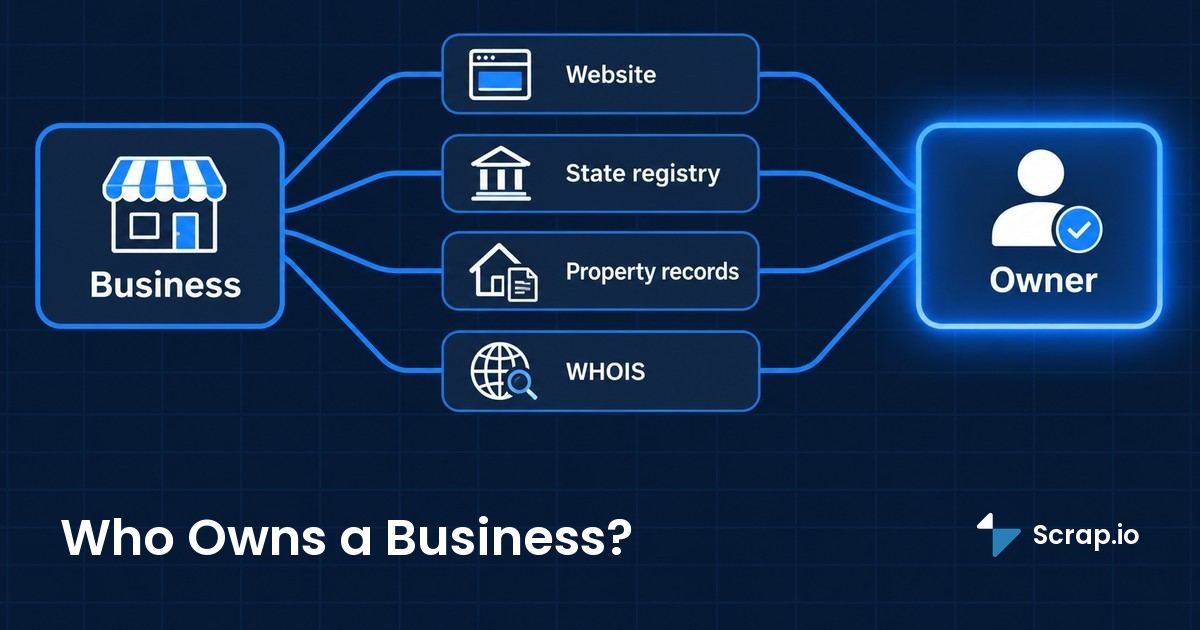
Short version before the detail. To look up who owns a business, you work down a ladder: website footer first, then the Secretary of State registry, then county DBA records, then the professional license boards. Those four are free and settle most cases inside fifteen minutes. Here's the full set:
- Check the website footer, About and Team pages
- Read the Google Business Profile
- Search the Secretary of State registry
- Search DBA / fictitious-name filings
- Use professional license lookups
- Check county property records
- Run a WHOIS lookup
- Try the BBB, the Chamber of Commerce and local news
- Run a reverse lookup from a phone, email or website
1. Check the website footer, About and Team pages
Start at the bottom. Literally. The footer of a business website usually carries the legal entity in tiny grey type: "© 2026 Riverside Plumbing LLC." That string is gold, because it's the exact name you'll feed into the next steps. The About and Team pages often name the founder outright, sometimes with a photo and a bio that tells you how long they've run the place. What you get: the legal name and, if you're lucky, the owner. The limit: plenty of small sites say nothing but a phone number.
2. Read the Google Business Profile
Owners leave fingerprints on their Google listing. Review replies signed "Response from the owner." Posts written in the first person. A "claimed" badge that tells you someone is actually minding the profile. None of it names them directly, but it tells you whether a human is home. 💡 Scrap.io's "claimed listing" filter lets you separate the businesses someone actively manages from the ghost listings nobody has touched since 2019. Handy when you want owners who'll actually read your email. The free Scrap.io Chrome extension shows emails and socials right on the Google Maps interface, too, so you don't have to click into each site.
3. Search the Secretary of State registry
This is the backbone move. Every state runs a free business search where you type the entity name and get back its status, formation date, and registered agent, sometimes its officers or managers. It confirms the business is real and current, which already filters out a lot of dead ends. Rather than reprint all fifty portals here, we keep a running list: the Secretary of State business search for all 50 states. Florida's portal at search.sunbiz.org is a clean example of the format, letting you search by entity name, officer, or registered agent.
Who owns an LLC? (registered agent vs owner)
Here's the trap that burns everyone. The registered agent is not the owner. The agent is just whoever gets served legal papers, often a lawyer or a paid service at a shared downtown address. So can anyone find out who owns an LLC? Sometimes. Many states list the members or managers in the formation docs or the annual report, and an LLC ownership lookup or an LLC search by owner name works fine there. But New York, for one, does not list LLC members in its public database at all. And a barbershop in Ohio can perfectly legally be a Delaware LLC, which means the paper trail leaves the state entirely. Is an LLC public record? Its existence is. Its owner, that depends on the state.
4. Search DBA / fictitious-name filings
When a business trades under a name that isn't its legal one, it files a DBA ("doing business as"). These live at the county clerk in places like California, Texas and New York, or at the state level in Florida and Pennsylvania. Why bother? Because this is the one place a sole proprietor gets named. No LLC, no corporation, just a person and a trade name. If you're wondering how do I find the owner of a small business that's clearly one guy and a van, this is usually your answer.
5. Use professional license lookups
Contractors, electricians, barbers, cosmetologists, anyone pouring you a drink: they're licensed, and licenses are typically issued to a named human. State boards publish searchable databases. Often this is the single fastest route to a name, faster than the registry, because the license holder and the owner are frequently the same person. Underrated. Genuinely.
6. Check county property records
County assessor and recorder sites show who owns the parcel. Useful, with one giant asterisk: property records tell you who owns the building, not the business. Looking up the owner of a business by address will very often hand you a commercial landlord or a holding company, not the person running the shop. Read it as a clue, never as a conclusion.
7. Run a WHOIS lookup
Once upon a time you could pull a domain owner's name and email straight from WHOIS. That era is basically over. Only 13.5% of domains still show an actual registrant in WHOIS, which means 86.5% of registrants can't be identified that way at all (Interisle Consulting, a 2021 study). Later academic work backs this up: over 85% of large WHOIS providers redact records at scale, and more than 60% redact non-EEA records too ("From WHOIS to WHOWAS," NDSS Symposium). Try it, sure. Just don't count on it.
8. Try the BBB, the Chamber of Commerce and local news
Old-fashioned, still works. Better Business Bureau profiles sometimes name a principal. Local chambers list member owners. And a quick search of the town paper can surface a "local plumber celebrates 20 years" piece that names the founder, their spouse, and the dog. Small-town press is a quietly excellent source. Nobody uses it. Their loss.
9. Run a reverse lookup from a phone, email or website
Sometimes you've got a number or a domain and no name. Flip the search. Scrap.io's reverse search tools let you paste in a phone number or a website and get the business behind it, no credit spent. From there a quick LinkedIn or Facebook check confirms the person. For the API-minded, there's a whole field of reverse phone lookup APIs that turn a number into a name and carrier. Find a business owner by phone number this way and you've closed the loop from the opposite direction.
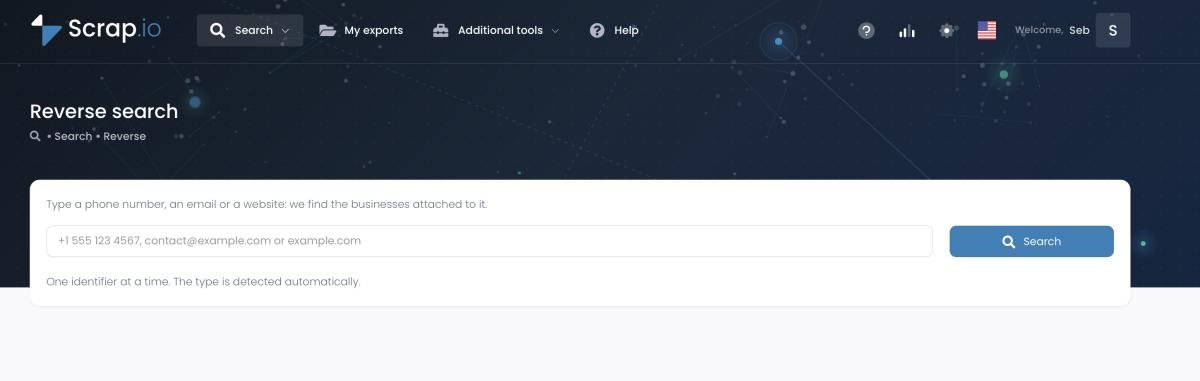
Reverse Search: paste a number or a domain, get the business behind it.
Still chasing one business? Reverse Search is free on Scrap.io: paste a phone number or a domain and see the exact listing behind it, no credit used, no sign-up gymnastics. Try it on your trickiest lead.
So which method wins? Depends what you've got and how fast you need it. Here's the honest scorecard:
| Method | Cost | Speed | Reliability | Names a sole proprietor? |
|---|---|---|---|---|
| Website footer / About | Free | Fast | 🟡 | 🟡 |
| Google Business Profile | Free | Fast | 🟡 | 🟡 |
| Secretary of State | Free | Medium | 🟢 | ❌ |
| DBA / fictitious name | Free (small fee to copy) | Medium | 🟢 | ✅ |
| Professional license | Free | Fast | 🟢 | ✅ |
| County property records | Free | Medium | 🟡 (landlord risk) | ❌ |
| WHOIS | Free | Fast | 🔴 (86.5% hidden) | ❌ |
| BBB / Chamber / news | Free | Slow | 🟡 | 🟡 |
| Reverse lookup (phone/domain) | Free | Fast | 🟢 | 🟡 |
When public records hit a wall
So the registry spits back "Corporate Filing Services Inc." as the owner. Now what?
Welcome to the messy middle, where the public trail runs cold. It happens more than you'd think. Franchises are the classic: the sign says a national brand, but the business belongs to a local franchisee whose name is nowhere on the storefront. Holding companies stack entities like Russian dolls, so you follow the ownership up one level, then another. Multi-owner businesses split the stake four ways. And registered agents parked at a shared address tell you precisely nothing about the actual humans involved.
Don't sit around waiting for a federal owner registry to fix this, either. It isn't coming. Beneficial-ownership (BOI) data under the Corporate Transparency Act was never public to begin with, and on August 11, 2026, FinCEN issued a final rule that permanently eliminates BOI reporting for US companies and US persons, and says the BOI already reported by US persons will be deleted (Davis Polk, 2026). Translation: the public tools you have now are the public tools you'll have.
My rule when the records go quiet? Two independent sources have to agree, or it isn't confirmed. A license plus an annual report. A review reply plus a Facebook page. One source is a guess with good posture. Two is an answer.
Business owner lookup at scale: 1,000 owners without 1,000 searches
In theory, fifteen minutes a business. In practice, 500 plumbers is three weeks of browser tabs and a mild existential crisis. This is where the whole "nine free methods" thing quietly falls apart, and where every other guide on the topic just... stops.
Some numbers to frame it, pulled fresh from Scrap.io on November 3, 2026. Across the US, Google Maps lists 26,935,834 businesses. Of those, 15,267,383 have a website (56.7%), and only 9,208,522 show an email anywhere on that site (34.2%). Narrow it to one trade and the shape holds: 78,328 US plumbers, of which 29,306 have an email (37.4%), and a measly 6,683 link a LinkedIn page from their website (8.5%). So roughly two in three US businesses have no email you can find. Which is exactly why you filter before you pay, not after.
Here's how a business owner lookup actually works at volume. Scrap.io crawls the website behind each Google Maps listing and classifies the emails it finds. When the site names a person, it drops that email into an Individual Email column and splits out the First Name and Last Name. Generic addresses (info@, contact@) get sorted into a separate Contact Email column, so you're not guessing which is which. The owner's name arrives attached to the email, no LinkedIn required.
The flow, step by step:
- Pick a category and an area (a city, a county, a whole country).
- Apply filters before extraction: has email, has website, claimed listing, LinkedIn present.
- Check the count. It's free, so you size the market before spending a cent.
- Export to CSV or Excel.
- Sort by Individual Email first, then verify your top rows with methods 3 to 5 above.
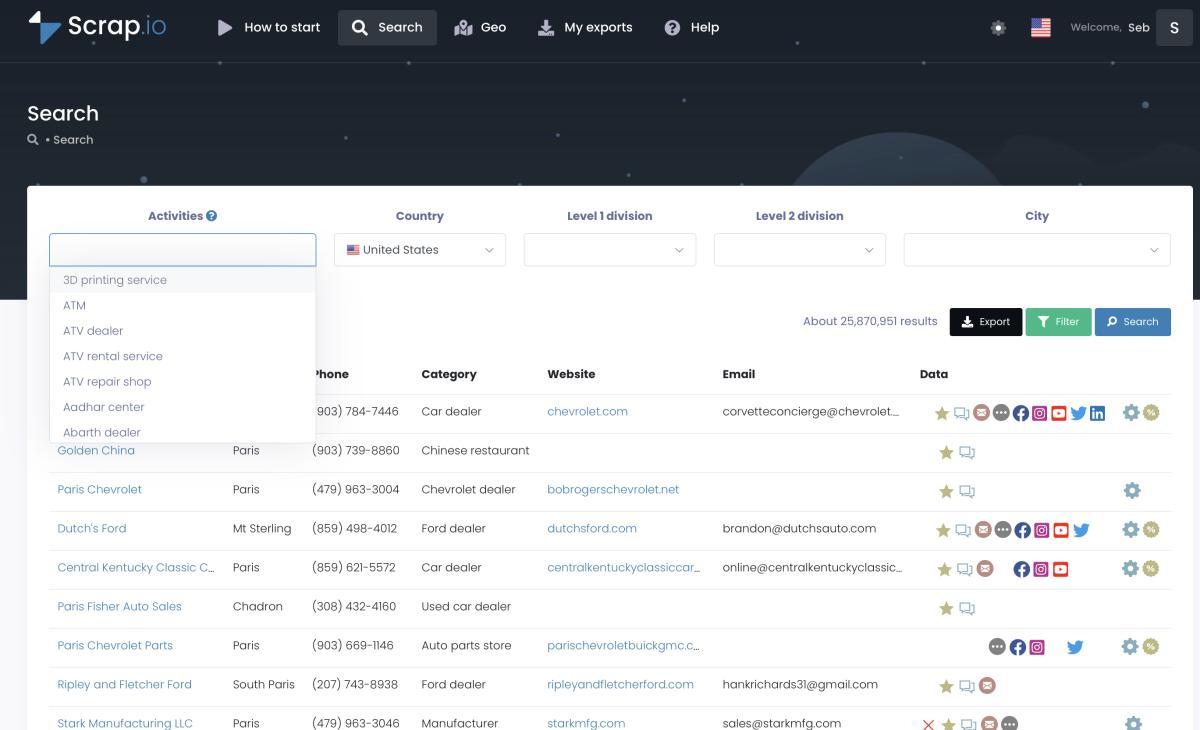
Pick a category and a location, down to a single city or up to a whole country.
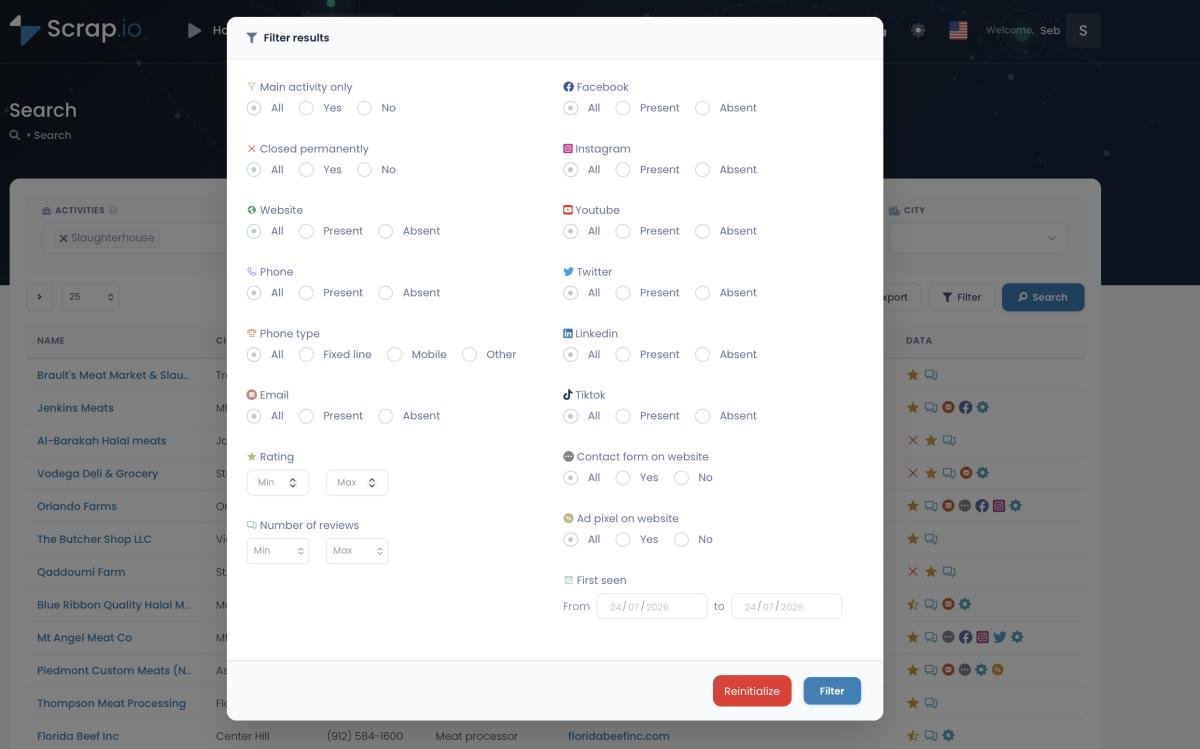
Filter for "has email" before you extract, so you only pay for contactable rows.
Now the honest part, because overselling helps nobody. Not every website names a person. When the Individual Email column comes back empty, you fall back: the generic contact email, the phone, the socials, and the free methods above to fill the gap. This is the exact wall a Clay community user hit, posting on August 28, 2025:
"I need help finding the name of business owners. I am using the 'enrichment' for ai to read the 'about us' page on the website. But it keeps failing saying it cannot find the linkedin. Most of the businesses I track do not have a linkedin." (Clay community)
That's the trap with LinkedIn-first tools in one paragraph. The demand for owner names is real enough that whole tools have sprung up to chase it: LocalProspects.ai, for one, was built by an agency owner specifically to attach owner names and emails to local Google Maps data. 8.5% LinkedIn coverage, remember? Google Maps doesn't have that blind spot, because the data comes off the business's own website. For the full walkthrough, here's how to find emails on Google Maps. And if LinkedIn-only finders keep letting you down, the Hunter.io alternative for local leads breakdown spells out why.
Already sitting on a list of businesses? You don't have to re-extract. 💡 Scrap.io's Enrich a file feature takes a CSV of emails, phones or websites and fills in the missing data, one credit per enriched row.
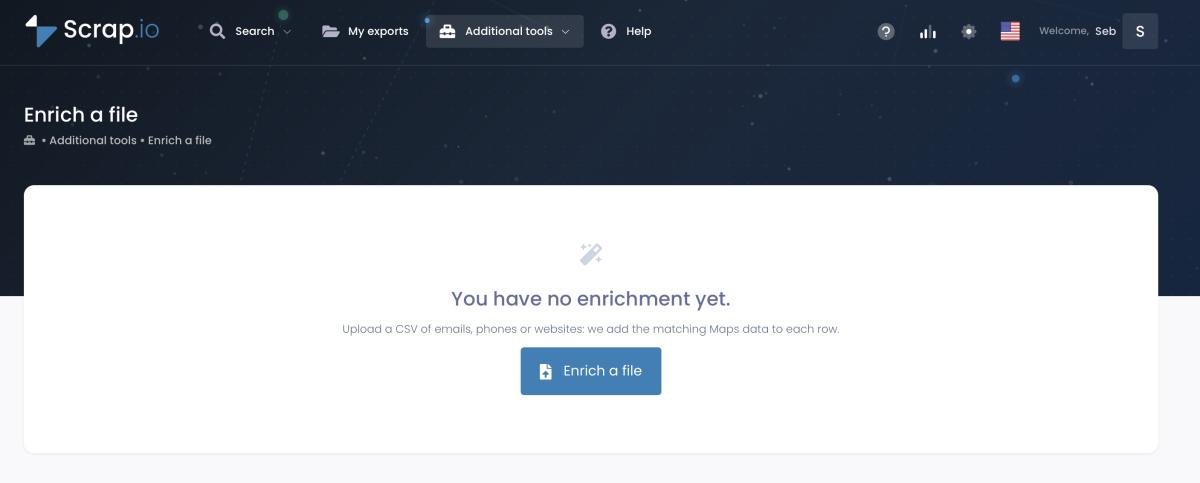
Already have a list? Enrich a file instead of starting over.
Video: How to Scrape Local Leads at the Country Level
One owner the slow way takes about fifteen minutes, as the team at Rocketship found when they traced a barbershop manager through the barber board, the annual report and Facebook. They put the scale problem bluntly: "Doing this for one shop is quick. For a hundred, it is a week." Exactly. That's the week we're trying to give you back.
Count the plumbers in your area with an email. Then the dentists. Then the roofers. Scrap.io indexes 225M+ businesses across 195 countries and 4,000+ categories, and the count is always free. The 7-day trial includes 100 leads, so you can pull a real list today. Start free, 100 leads included.
From an owner's name to a reply
Only 8.5% of US plumbers even link a LinkedIn page from their website (Scrap.io, November 3, 2026). That one stat is why LinkedIn-first tools miss most local owners, and why getting the name is only half the battle. The other half is turning it into a reply. Finding a business owner name is step one. Getting that person to write back is step two, and honestly it's the harder half.
First, verify the email before you send anything. A bounce hurts your sender reputation and buys you nothing, so run it through a check that confirms the mailbox without hitting send: here's how to verify an email address without sending an email. Then personalize with whatever you dug up: the license, a specific review reply, how many years they've been in business. "Saw you've run the shop since 2009" beats "Dear Business Owner" every single time. Keep a source-and-date column while you're at it, so future-you knows where each name came from.
And when you genuinely aren't sure the person is the owner? Say less. That's the honest move, and it's exactly what a buyer on Searchfunder landed on. The original poster wrote:
"I've started building a pipeline of companies to cold-call/cold-email and realized quickly how difficult it is to confirm that a person is truly the owner of a company." A reply nailed the fix: "I have also a different email template that I use when I am truly not sure whether the person is the owner, that is much more vague and designed just to get the foot in the door." (Searchfunder)
Smart. A softer, vaguer first email when you're uncertain gets you a reply without putting words in the wrong person's mouth. If you want the full teardown, here's how to write a cold email that gets replies.
Video: How to Find Someone's Phone Number by Name in 2026
Is it legal to look up a business owner?
OK, the slightly less fun but absolutely essential part.
Consulting public business records is legal. Full stop. These are filings governments publish on purpose. What's regulated is what you do next, specifically if you start contacting people. In the US, CAN-SPAM governs commercial email: you need honest sender details, a working opt-out, and a real physical address in every message (the FTC's CAN-SPAM guide lays out the specifics). California residents get extra protection under CCPA. And one hard line worth tattooing somewhere: stick to business contact details, never home addresses. Those parcel records from method 6? A mailing address there can be someone's house. Leave it alone.
The clean foundation here is sourcing. Pull owner data from public business listings and every record traces back to a source you can name, which is most of the compliance battle. If you want it chapter and verse, here's the full cold email compliance guide, and a plain-English take on whether scraping Google Maps is legal (short answer: public business data, court-backed). For the KYB and vendor-screening crowd, by the way, Middesk covers the compliance-verification angle rather than the prospecting one.
FAQ
Can anyone find out who owns an LLC?
Often, yes. Most states publish the registered agent, and many also list the managers or members in the formation documents or the annual report, so an LLC ownership lookup usually gets you somewhere. Some states, New York being the headline example, don't list members publicly. When that happens, fall back to DBA filings, professional licenses, or the business's own website.
Is an LLC public record?
The LLC's existence, status, formation date and registered agent are public in its home state. Owner names depend on the state. Federal beneficial-ownership (BOI) data was never public, and since FinCEN's August 2026 rule, US companies no longer file it at all.
How do I find out who owns a business for free?
Work the free ladder: the website footer first, then the Secretary of State registry, then county DBA records, then the professional license boards. All four cost nothing and answer most cases inside fifteen minutes. If they come up short, a reverse lookup from the phone number or domain is your next free move.
Does a CEO own the company?
Not necessarily. In a small business the CEO or president is very often the owner. In a larger company the CEO can be a hired employee with little or no ownership stake. To know for sure, check the officers and members listed in the state registry, or the shareholder filings if the company is public.
How do I find the owners of many businesses at once?
Extract the businesses from Google Maps with a tool like Scrap.io, which crawls each website and isolates the individual email with the first and last name attached. Filter for "has email" before you export so you only pay for contactable rows, then verify your most important targets in public records. That turns a week of manual lookups into an afternoon.
The short version
Finding out who owns a business isn't one trick, it's a ladder. Footer, registry, DBA, license, and a reverse lookup when you're stuck. Confirm with two sources, respect the line between business and personal data, and you'll have a real name more often than not.
But when "a business" becomes "a thousand businesses," the manual ladder breaks, and that's the gap worth closing.
Try Scrap.io free for 7 days: 100 leads, owner names included when the website has them. Search any category in any of 195 countries, filter for "has email" before you spend a credit, and export a clean list with the individual email, first name and last name split out. Pull your first 100 leads.
Generate a list of restaurant with Scrap.io