

Video: Scrap.io - How to Start? A 2-minute walkthrough of the lead scoring data source.
- The Problem With Treating Every Lead the Same
- The Numbers Behind Lead Scoring in 2026
- Build Your Lead Scoring Model for Local Leads
- Fit, Interest, Urgency: A Scoring Framework That Works
- Companies That Actually Did This (With Real Results)
- B2B Lead Scoring Tools, What's Worth Using
- AI Lead Scoring: Does It Live Up to the Hype?
- Legal Stuff You Can't Skip
- FAQ
Okay so listen. Only 27% of leads that get sent to sales are actually qualified. Twenty-seven percent. And 79% of marketing leads? They never convert into sales. Ever. That's not a rounding error. That's most of your pipeline going straight into the garbage.
I talked to this guy last month. Runs a web design agency out of Denver. Nice guy. He pulled something like 10,000 restaurant leads from Google Maps. Emails, phone numbers, review scores, everything. Sat there looking at his spreadsheet like... now what? Who do I call first? The five-star Italian place with 800 glowing reviews? Or the taco joint with 2.1 stars and a website that looks like it was built in 2006?
He didn't know. Because he didn't have a lead scoring system. He was basically guessing. And guessing doesn't pay rent.
The Problem With Treating Every Lead the Same
Lead scoring for local leads is the practice of ranking businesses by how likely they are to buy, using Google Maps signals instead of website behavior. You score three things: fit (do they match your ICP), interest (how digitally mature they are), and urgency (visible pain like bad ratings or no website). Higher score, higher priority.
Most lead scoring guides out there, and I've read way too many of them, were written for SaaS companies. They talk about tracking page views. Form fills. Ebook downloads. How many times someone visited your pricing page. Very neat. Very digital.
Completely useless if you're prospecting local businesses.
Take Mike. Mike runs a small marketing agency. He scraped 8,000 local businesses last month for a campaign. Dentists, restaurants, auto shops, whatever. His CRM has zero behavioral data on any of these people. No page views. No form submissions. Nothing. Just a business name, maybe an email, and a Google Maps listing. That's it.
So how do you prioritize 10,000 restaurant leads when you can't track their website behavior? Good question. Almost nobody answers it. I spent like three hours on Google trying to find a decent guide on this. Found nothing useful. Everything's about HubSpot workflows and Marketo scoring rules. Cool for software companies, I guess. This is exactly why solid lead qualification frameworks built for local prospecting are so rare. Almost everyone copies the SaaS playbook and calls it a day.
And the waste is real. Martal published data showing that 98% of MQLs never become actual deals. Ninety-eight. So out of every hundred leads marketing says are "ready", two make it. Two! Now, that number is deliberately dramatic. The median MQL-to-SQL conversion sits closer to 9.8% across industries (Data-Mania, 2026), which is still brutal. Either way, most of the leads your team sweats over were never going anywhere.
Someone on Reddit's r/CRM nailed it: "CRM lead scoring is built for marketers. I needed it to work like an analyst." Yep. That's the frustration everyone feels but nobody in the scoring software industry seems to care about fixing.
The Numbers Behind Lead Scoring in 2026
The lead scoring software market is big and getting bigger. Most analysts peg it in the low billions today, heading toward tens of billions by the early 2030s. The exact figure depends entirely on who's counting and what they lump in, so take any precise projection with a grain of salt. The direction, though? Not in doubt. This thing is growing fast.
The stat I keep coming back to: companies using lead scoring hit 138% ROI versus 78% for those who don't (Landbase, 2025). That's nearly double. Nearly double! And yet... only 44% of organizations even bother with lead scoring. Less than half. Which honestly just means there's a massive opportunity sitting right there for anyone willing to actually implement it.
Then there's the speed thing. Leads contacted within one hour convert at 53%. Wait 24 hours? That drops to 17% (Data-Mania, 2026). Brutal difference. The higher someone scores, the faster you should be picking up that phone. Pretty straightforward.
Where the scoring signals actually live. Every input in the framework below (rating, review count, website, ad pixel, social profiles, claimed status) sits on Google Maps. Scrap.io indexes 225,676,406 businesses across 195 countries and 4,000+ categories, pulled in real time at export. That's not a stale database from last quarter. It's the raw signal layer your scoring model runs on. Grab your first 100 leads free (7-day trial) and score them yourself.
But here's what bugs me. Taft Love posted something on LinkedIn recently that stuck with me: "Lead scoring. It's one of those RevOps requests that feels standard... until you interrogate it. Teams want it because 'every company we've worked at had it.' But no one pauses to ask if it's even solving a problem."
He's not wrong. Most lead scoring implementations are just checkboxes. The ones that actually work? They're built on data signals that matter. Not vanity metrics.
Build Your Lead Scoring Model for Local Leads
Alright, this is where we get into the actual useful stuff.
Standard lead scoring advice says track email opens, website visits, content downloads. Works great if you're selling software to marketers who browse your blog. Does absolutely nothing when you're cold prospecting plumbers from Google Maps.
What you need is a lead scoring framework built around the data you actually have. And when you're working with local leads? Google Maps is sitting on a goldmine that almost nobody scores properly.
Before anything though, you need to define your ideal customer profile. I can't stress this enough. If you don't know what your best customer looks like, your scores are meaningless. You're just assigning random numbers to random businesses. Pointless. The sharpest way to do it is to build your ICP from Google Maps geographic data, so your profile matches businesses that actually exist in your target zones.
Once you've got that locked down, you can extract business data at scale and start scoring right away. Run a category plus a location, and you've got every listing in a city, or a whole country, in front of you.
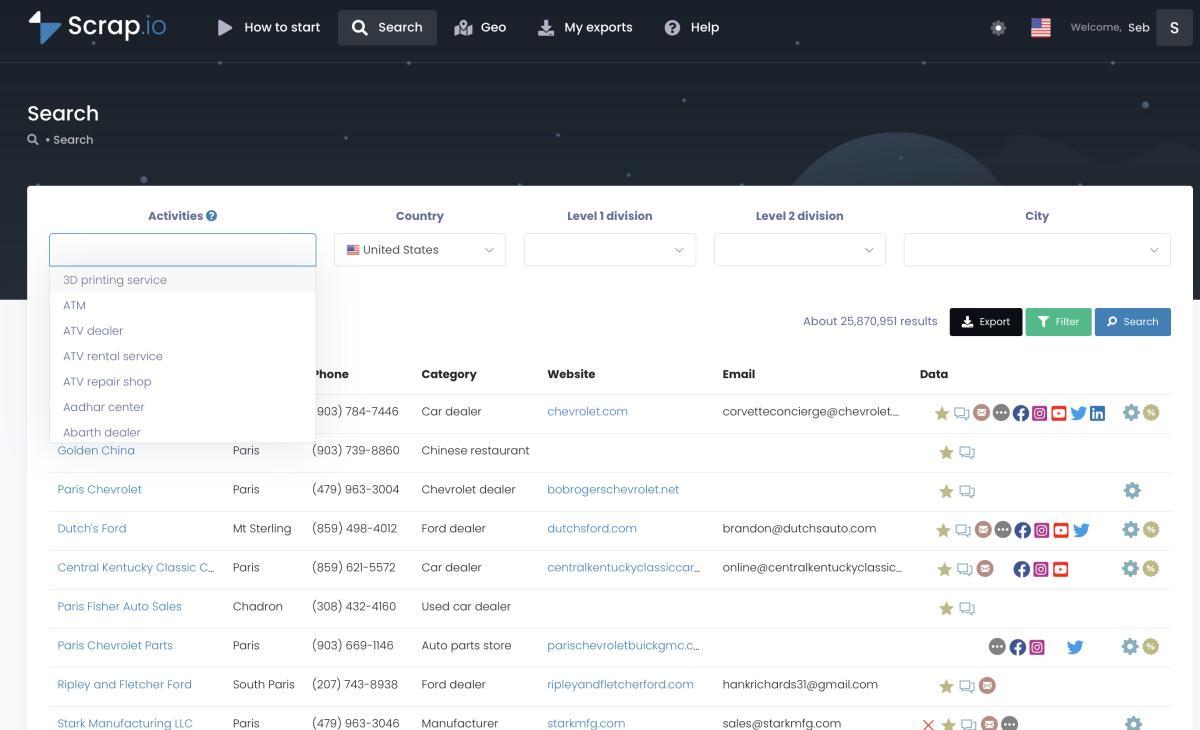
Watch the workflow end to end here, pulling local leads with an AI assistant, then scoring them:
Video: How to Scrape Local Leads with Claude & Vibe Prospecting.
Fit, Interest, Urgency: A Scoring Framework That Works
I've been thinking about this for a while and I think most scoring models are too complicated. Fourteen criteria, weighted averages, normalization formulas... nobody actually maintains that stuff after week two. So here's something simpler. Three dimensions. Each one answers a different question about the lead.
Dimension 1: Fit Score. Basically: should you even be talking to this business?
| Signal | Points |
|---|---|
| Business category matches your ICP | +20 |
| Price range $$-$$$ (means they have actual budget) | +10 |
| Located in your target geography | +15 |
Nothing fancy. A freelance copywriter isn't selling enterprise accounting software to a food truck. Fit score eliminates the obvious mismatches before you waste anyone's time. And if your "target geography" is a trade area rather than a whole city, GeoSearch lets you draw a radius or a polygon straight on the map and score only what's inside it.
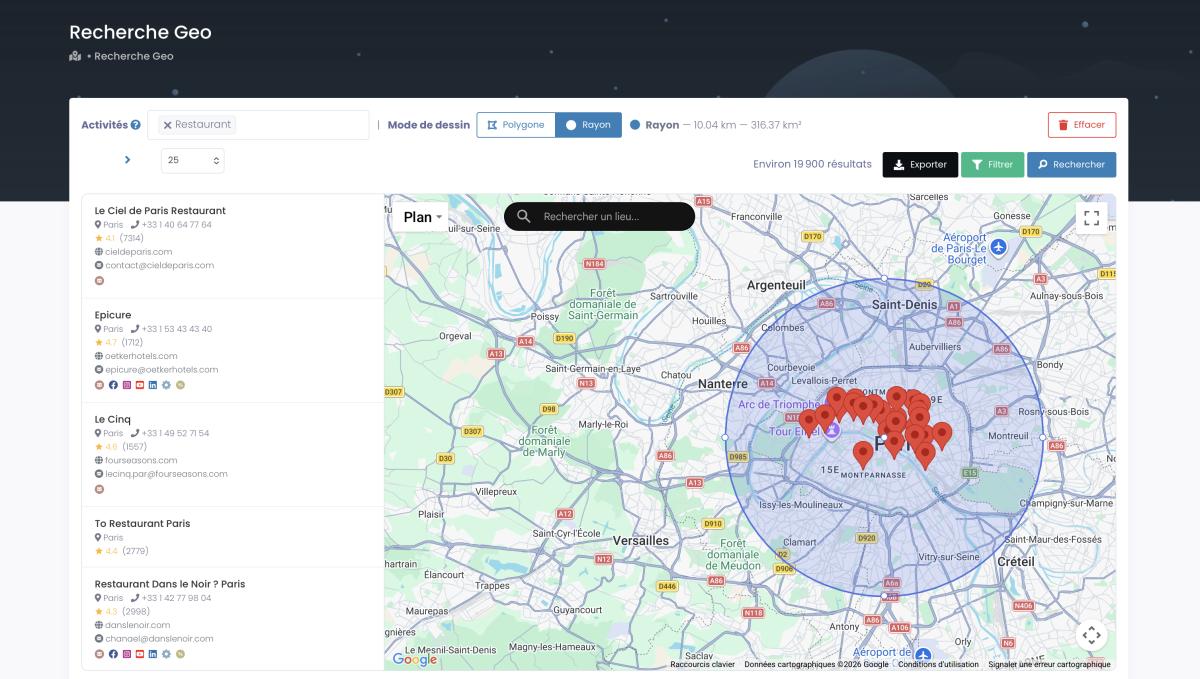
Dimension 2: Interest Score. How digitally mature are they?
| Signal | Points |
|---|---|
| Has a website | +10 |
| Email available | +15 |
| Active Facebook or Instagram | +5 each |
| Ad pixel detected on site (= they spend on marketing) | +20 |
| Contact form on website | +5 |
I call this "interest" but it's really about digital sophistication. A business already running ads and tracking conversions? They get marketing. They understand paying for services. Way easier sell than someone who doesn't even have a website.
Here's the part that saves you money: you filter on these signals before you export, so you only spend credits on businesses worth scoring. Only want listings with an email and an ad pixel? Set two filters and that's all you pay for.
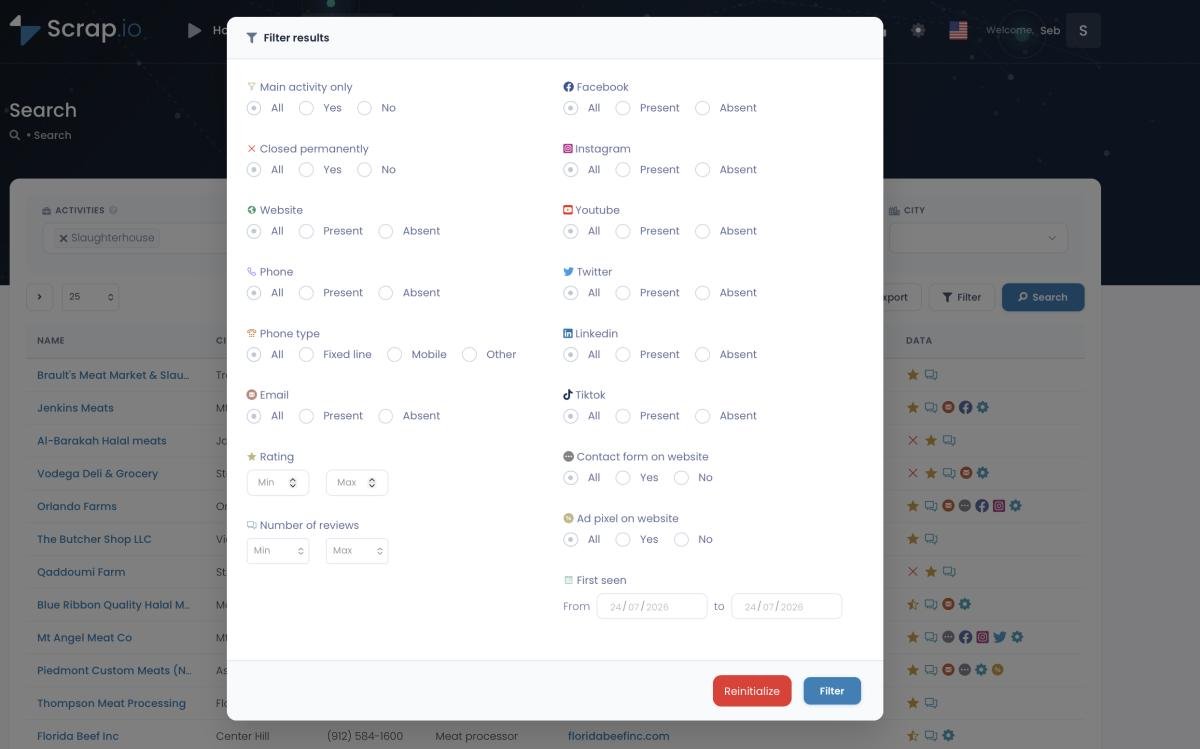
Pair those digital-maturity signals with a verified email pulled from Google Maps and you've got a lead you can actually reach. Not just a name on a map.
Dimension 3: Urgency Score. This is the killer one. Do they need help RIGHT NOW?
| Signal | Points |
|---|---|
| Google rating under 3.5 stars (reputation is hurting them) | +25 |
| Less than 10 reviews (barely visible) | +15 |
| No website whatsoever | +20 |
| Business profile not claimed on Google | +15 |
| Less than 5 photos on listing | +5 |
Nobody in the lead scoring world talks about this dimension. Literally nobody. I checked. Every single guide out there focuses on behavioral intent signals: did they visit your pricing page, did they open your email three times.
But a business sitting at 2.3 stars with no website? They need help yesterday. That urgency is real. It's not theoretical intent based on email clicks. It's visible, measurable pain. This is the whole idea behind signal-based selling: you reach out to the businesses whose problems you can literally see on the map. Target the low-rated ones specifically, the businesses bleeding customers over negative reviews, and your conversion rates go through the roof, because you're calling people who already know they have a problem.
The scoring thresholds I'd recommend:
0-30 = Cold. Don't bother right now.
31-60 = Warm. Worth a personalized email, see what happens.
61-80 = Hot. Get them on the phone this week.
81+ = Priority. Call them today. Like, right now. Stop reading this article.
How to calculate lead score? Honestly it's just addition. Add up points across all three dimensions. Done. A restaurant in your target zone (+15) with a website (+10), email available (+15), Facebook page (+5), 2.8-star rating (+25), and only 6 reviews (+15) = 85 points. Priority lead. That's someone whose business is literally hurting from bad online presence. Call them.
The formula, if you want it in one line:
Lead Score = Fit points + Interest points + Urgency points. Then map the total to a tier: Cold (0-30), Warm (31-60), Hot (61-80), Priority (81+). That's the entire lead scoring formula. No weighted averages, no normalization, no spreadsheet that needs a PhD to maintain. Add the three dimensions, read the tier, move on.
Want a head start instead of building columns from scratch? We put together a demo Google Sheet with the scoring already set up, so you can grab the exportable columns as a starting template. Export your leads from Scrap.io, paste them in, and the tiers calculate themselves. Copy it, tweak the point values to match your offer, and you're done. This is the part most scoring guides quietly skip: they hand you the criteria but never the actual math or a working template to run it in.
Build your model against real data. Scrap.io pulls every scoring signal (reviews, ratings, website, ad pixels, social profiles, claimed status) for thousands of local businesses in minutes, and filters them before you spend a credit. Test it with a free 7-day trial and 100 leads: extract every scoring signal for your area →
Companies That Actually Did This (With Real Results)
Theory doesn't pay bills. So let's talk about what happened when real companies actually implemented lead scoring.
Clay is doing something interesting. They use Google Maps data scraping to score and prioritize leads in niches like HVAC, salons, restaurants. Built automated formulas that enrich data and spit out scores. Thousands of leads, scored automatically, no manual sorting required.
HighLevel took it a step further. They went and built a native "Prospect Score" right into their platform. Based entirely on Google Business Profile signals. GBP claimed or not. Website present or not. Review count. Review score. Users literally sort their lead lists by Prospect Score. That's a major SaaS company saying "yeah, scoring local leads from Maps data is legit enough to build into our core product." Validation doesn't get much clearer than that.
MarketingSherpa documented an HR consultancy that implemented scoring on their marketing automation. What happened? They sent 52% fewer leads to sales. Revenue went up 41%. Conversions jumped 79%. Read that again: fewer leads but way more money. That's the entire point of scoring. Stop drowning your sales team in garbage and give them fewer, better prospects.
Smartlead AI published case studies across a bunch of industries. Conversion improvements ranged from 25% all the way up to 215% across different sectors. A FinTech startup saw 215% more qualified leads after switching to AI-based scoring. Two hundred fifteen percent. I double-checked that number because it seemed crazy.
Einspahr Auto Plaza: family-owned dealership in Brookings, South Dakota. Small town, small business. They set up lead scoring on their email leads to automatically qualify prospects. Hot leads route straight to sales. Cold ones get nurtured. It's the exact local business + lead scoring + email nurturing setup that actually works in the real world. Not some enterprise case study from a Fortune 500 company. A car dealership in South Dakota.
All that to say, this stuff works. A SaaS platform crunching thousands of leads uses it. So does a family dealership in South Dakota trying to figure out who to call first. Same framework, wildly different scale.
Run this framework on your own list. Grab 100 free leads on Scrap.io (reviews, ratings, website data, contact info, all exportable in columns), then score them with the Fit/Interest/Urgency model above. See what comes out. Start free, 100 leads included →
B2B Lead Scoring Tools, What's Worth Using
The b2b lead scoring tools market is honestly kind of overwhelming. Everyone and their cousin has a "scoring solution" now. But for local lead scoring specifically? The options narrow down fast.
HubSpot is what everyone thinks of first. Lead scoring HubSpot is probably the most searched combination in this whole space. And look. HubSpot's scoring is solid if you're running inbound SaaS with tons of CRM behavioral data. But it wasn't built for what we're doing here. No Google Maps integration. No review scoring. No website tech detection. It scores based on what leads do on YOUR website. If they've never visited your website (which... most cold local leads haven't), HubSpot's scoring doesn't have much to work with. Salesforce lead scoring, via Einstein, has the same blind spot: great on CRM behavior, blind to local signals.
Scrap.io approaches this from a completely different angle. It's not a CRM. It's where you get the raw data. Reviews, ratings, emails, website status, social media, ad pixels, contact forms. Everything comes from Google Maps and associated websites. You run a search, apply filters, export, and you've got every data point you need to score leads. Then you build a sales pipeline for your scored leads in whatever CRM you're already using. Curious how it stacks up against LinkedIn-based tools? Here's the Google Maps vs LinkedIn breakdown.
HighLevel bridges both worlds with its built-in Prospect Score for local businesses. If you're already on HighLevel, this is kind of a no-brainer.
Honestly? The smart setup is probably Scrap.io for extraction and initial scoring, pushed into HubSpot or whatever CRM you use for nurturing. Best of both worlds. One for data, one for workflow. And if you're scoring at scale, an entire state or country, here's how that extraction actually runs:
Video: How to Scrape Local Leads at the Country Level.
AI Lead Scoring: Does It Live Up to the Hype?
Short version: yes, when you feed it good data. And that's a bigger "when" than the vendors admit. Predictive lead scoring and machine-learning models genuinely catch weird patterns humans miss. First Page Sage and others have published benchmarks showing ML-based scoring pulling ahead of manual methods on conversion. Like the fact that businesses with exactly 3-star ratings and an active Facebook page but no Instagram convert better for web design services. Nobody sits down and figures that out manually. The AI finds it in the data and you're like... huh. Okay then.
But here's the catch. AI scoring is only as good as what you feed it. Bad data in, bad scores out. Every single time. Which is exactly why starting with rich data from Google Maps (actual signals like review counts, star ratings, website tech, ad pixels) gives models so much more to chew on versus just CRM click data. This is really just google maps lead scoring wearing an ML hat.
Saw a thread on Reddit's r/b2bmarketing recently where someone asked: "Is lead scoring still kind of broken for most B2B teams?" Most of the replies said the same thing: yes, but mostly because people score the wrong signals. Better inputs, better outputs. Not rocket science.
This is a deep topic on its own: the tools, the accuracy math, the pitfalls. Rather than cram it all in here, read the dedicated AI lead scoring guide for the full B2B walkthrough. It goes way further than I can in one section.
Legal Stuff You Can't Skip
This part's boring but skip it at your own risk.
Scoring leads from Google Maps data means you're working with publicly available info. Businesses published their own listings. Reviews are public. Websites are public. All legal under US and EU law.
When you start emailing your scored leads though, CAN-SPAM kicks in. Honest subject lines. Clear identification of who's sending the email. Working unsubscribe link. Your actual business address in the footer. Process opt-outs quickly. None of this is optional. (If you want the outreach side done right, these cold email templates bake compliance in.)
Targeting EU businesses? GDPR applies. Work with providers who understand these regulations. Don't wing it.
Scrap.io only pulls publicly available data: stuff businesses posted themselves. RGPD and CCPA compliant, and every data point is traceable to its source. No gray areas, no questionable data sources. Pretty clean from a legal perspective.
FAQ
What is lead scoring?
Lead scoring assigns numerical values to your leads based on specific criteria so you can figure out who's most likely to buy. Instead of calling everyone in the same order they showed up in your spreadsheet, you prioritize by data: things like Google Maps ratings, review volume, website presence, how digitally mature the business is. Higher score means higher priority.
How to calculate lead score?
Score across three dimensions and add the points up:
- Fit: does this business match your ideal customer profile? (category, budget, geography)
- Interest: what does their digital presence look like? (website, email, social, ad pixel)
- Urgency: are there signs they need help right now? (low rating, few reviews, no website)
- Add the points from all three into a single total.
- Map the total to a tier: Cold (0-30), Warm (31-60), Hot (61-80), Priority (81+).
Quick example:
| Criteria | Signal | Points |
|---|---|---|
| Fit | Category matches ICP | +20 |
| Fit | Target geography | +15 |
| Interest | Email available | +15 |
| Interest | Ad pixel detected | +20 |
| Urgency | Rating below 3.5 stars | +25 |
| Total | 95 = Priority |
What is an example of a lead score?
Sure. Mexican restaurant in Austin. Google rating 2.8 stars. That's +25 for urgency. Only 7 reviews. Another +15. They've got a website (+10) and an email you can reach them at (+15). No social media though, so +0 there. Located in your target zone, +15. Total: 80 points. Hot lead. They clearly need help with online reputation and digital presence. Get them on the phone this week.
What are the stages of lead scoring?
Five stages, in order:
- Define your ICP: nail down who your best customer actually is.
- Pick your scoring signals: for local leads, that's Google Maps data: rating, reviews, website, email, ad pixel, claimed status.
- Assign point values: weight each signal by how much it predicts a sale.
- Set threshold tiers: Cold, Warm, Hot, Priority.
- Automate it: pull the signals at scale and route scored leads to the right action.
What is the 5-minute rule for leads?
The idea is you should reach out to high-priority leads within five minutes of identifying them. Sounds aggressive, but the data backs it up. Leads contacted within one hour convert at 53%, while waiting 24 hours drops that to 17% (Data-Mania, 2026). The higher someone scores, the faster they deserve a response.
What is the 10-3-1 rule in sales?
The 10-3-1 rule is a simple prospecting ratio: for every 10 qualified leads you contact, roughly 3 will engage in a real conversation, and about 1 will convert. It's a reality check on volume. Hitting one solid deal means feeding ten scored, qualified leads into the top of the funnel, which is exactly why scoring first saves you from wasting effort on the wrong nine.
Is lead scoring still worth it in 2026?
The numbers say yes pretty clearly. 138% ROI with scoring versus 78% without (Landbase, 2025). Behavioral and ML-based scoring consistently beat manual methods on conversion. And still, only 44% of organizations even bother implementing it. So yeah, it's worth it. And you'll be ahead of more than half the market just by doing it at all.
Look, lead scoring isn't complicated when you strip away the jargon and the enterprise software demos. Doing lead scoring for small business clients? Ranking 10,000 restaurants? Same move either way: score based on real data, then prioritize the people who need you most and fit your ICP best. Reach out fast. Local lead prioritization done right is basically the entire playbook.
For local leads specifically, the stuff sitting inside Google Maps listings is honestly more useful than most CRM behavioral signals. Reviews. Ratings. Website presence. Digital maturity. These signals tell you who needs help right now. Not who clicked your email twice. Want the wider prospecting picture? Our guide to local business lead generation covers the channels feeding your scored pipeline. And once the leads are flowing, track the local prospecting KPIs that tell you whether your scoring is actually paying off.
Try Scrap.io free for 7 days. You get 100 verified local business leads with every signal you need to build your first scoring model: reviews, ratings, website tech, ad pixels, emails, across 225M+ businesses in 195 countries. Start scoring smarter →
Alright, enough reading. Go score some leads. The framework's sitting right there. Your competitors are already sorting their prospects by priority while you're still treating a 5-star restaurant and a 2-star pizza shop like they're the same opportunity. They're not. And now you know how to tell the difference.
Generate a list of restaurant with Scrap.io