

- What Is a LinkedIn Scraping Tool (and Why You Need One in 2026)?
- Best LinkedIn Scrapers in 2026: A No-BS Comparison
- The Missing Piece: Why LinkedIn Data Alone Isn't Enough
- How to Enrich LinkedIn Leads with Google Maps Data
- Real-World Results: What the Data Says About LinkedIn Scraping in 2026
- Is LinkedIn Scraping Legal? Compliance Guide for 2026
- FAQ
What Is a LinkedIn Scraping Tool (and Why You Need One in 2026)?
LinkedIn generates 75–85% of all B2B leads from social media (Martal, 2026). And yet, I kid you not, most sales teams still copy-paste profiles into spreadsheets like it's 2014.
A linkedin scraping tool is software that automatically extracts profile data from LinkedIn: names, job titles, company names, emails, connection counts, activity history. Think of it as a linkedin lead scraper for sales teams that does in 10 minutes what used to take an afternoon of copy-pasting. Instead of squinting at screens and clicking through 200 profiles, you let a script or extension handle the grunt work.
Why now? Because the numbers have gotten ridiculous.
LinkedIn crossed 1.2 billion users in 2025 (LinkedIn official). That's a goldmine, if you can actually mine it. Meanwhile, 79% of B2B decision-makers actively ignore cold DMs (Linkmate, 2026). So generic outreach is dead. The only way to stand out is hyper-personalized messaging, and that requires data you can't get by hand. On top of all that, the B2B sales intelligence market hit $4.51 billion in 2025 and is racing toward $7.68B by 2030 at a 14.3% CAGR (Fortune Business Insights, 2025). The tooling keeps getting cheaper. If you're not using it, your competitors definitely are. Want the full picture on the platform itself? We pulled together the LinkedIn statistics for 2026 in a separate deep-dive.
A linkedin scraping tool vs manual prospecting? It's not even close. Doing it by hand is volunteering for a job a bot does better. No shame in admitting it.
Best LinkedIn Scrapers in 2026: A No-BS Comparison
I've tested 15+ linkedin scrapers over the past two years. Most of them overpromise and underdeliver. If you're looking for the best linkedin scraping tool for lead generation, here's what actually works, sorted by approach, not by who paid for the best affiliate review.
Video: ScrapIn.io vs Scrap.io: How to Scrape Leads at Scale?
Quick answer for the skimmers. The best tool depends entirely on how you work:
- Evaboot if you live inside Sales Navigator and want clean exports.
- Skrapp if email finding is your main game (92% accuracy claimed).
- PhantomBuster if you want full automation workflows, not just scraping.
- Bright Data or ScrapIn.io if you need API-scale volume.
- Scrap.io if you want to enrich those LinkedIn leads with verified local business data LinkedIn never gives you.
| Tool | Type | Starting Price | Best For | Limits |
|---|---|---|---|---|
| Evaboot | Chrome Extension | $29/mo | Sales Navigator scraping | Requires Sales Navigator subscription |
| Skrapp | Chrome Extension | $42/mo | Email finding (92% accuracy) | Credit-based; limited bulk export |
| PhantomBuster | No-Code Platform | $69/mo | Full LinkedIn automation workflows | Execution-time pricing can add up fast |
| Waalaxy | No-Code Platform | $43/mo | Connection + messaging automation | Less flexible than PhantomBuster |
| Bright Data | API | $1.50/1K records | Enterprise-scale volume | Complex setup; steep learning curve |
| ScrapIn.io | API | Custom | Reliable LinkedIn data API | Developer-focused; no UI |
| Apify | Cloud/API | $29/mo | Pre-built actors, flexible | Requires some technical comfort |
Not all scrapers are equal. Let me break them down by category.
Chrome Extensions: Quick & Easy
If you want to scrape linkedin profiles without touching a line of code, a linkedin scraper chrome extension is your best bet. Evaboot is the go-to for Sales Navigator users. 50,000+ professionals use it daily to pull lead lists of 2,000 to 20,000 contacts per plan. It cleans data automatically, which saves you the usual post-export headache. Skrapp doubles as a linkedin email extractor with a claimed 92% accuracy rate, solid if email outreach is your primary channel.
The downside? Extensions live and die with LinkedIn's UI changes. One update and your linkedin scraping tool might break overnight. It happens.
No-Code Platforms: Power Without Code
PhantomBuster and Waalaxy sit in the sweet spot between ease of use and flexibility. PhantomBuster offers complete LinkedIn workflows, from linkedin profile scraper to auto-connection to message sequencing. Waalaxy is simpler, almost plug-and-play, but you trade some power for convenience.
My honest take: PhantomBuster is better for growth teams who need to scrape linkedin sales navigator leads at scale and chain multiple actions. It's a proper linkedin data extraction tool for B2B that handles the full pipeline. Waalaxy is fine if you just want to automate connection requests without overthinking it.
API-Based Scrapers: Scale Without Limits
Bright Data serves 20,000+ customers and starts at $1.50 per 1,000 records. That's enterprise-grade. ScrapIn.io and Scrapingdog offer cleaner linkedin scraping API options if you don't need Bright Data's entire ecosystem. The catch: you need a developer (or at least someone comfortable with API calls) to make these work.
But if volume is your game (we're talking tens of thousands of profiles per day), APIs are the only serious option.
LinkedIn Scraping API & Python Scripts: For Developers
Open-source options exist. The linkedinscraper Python library on GitHub has an active community, and Apify's pre-built actors let you run automated linkedin data collection without writing everything from scratch. People use these to scrape linkedin contacts for cold email campaigns at scale, and for linkedin profile data extraction for outreach that actually converts. Cost? As low as $0.03–$0.17 per lead (Apify, 2026). Compare that to $5–15 for manual research.
Here's what nobody tells you, though: a free linkedin scraping tool without coding sounds great in theory. In practice, free tools hit rate limits fast, break often, and give you data that's already stale by the time you export it. You get what you pay for.
The Missing Piece: Why LinkedIn Data Alone Isn't Enough
You just scraped 5,000 LinkedIn profiles. Congrats. But here's the uncomfortable truth: most of that data is useless without context.
Video: B2B Lead Gen: Google Maps vs LinkedIn
What does a LinkedIn profile actually give you? A name, a job title, a company name. Maybe a generic company email if you're lucky. But it doesn't give you the phone number that actually rings, the physical address, Google reviews, business category, operating hours, or the owner's direct email. For anyone targeting local businesses (restaurants, clinics, law firms, contractors), that's exactly the data you need.
And the email problem is worse than you think. Standard email enrichment tools only discover emails for 55–70% of SMB contacts. That means 30–45% of your scraped list is essentially dead on arrival. You need to combine sources. There's a whole breakdown on this in our comparison of Google Maps vs LinkedIn for B2B lead generation, and if you want to go deeper on the tooling, we ranked the best data enrichment tools for 2026.
Bref. LinkedIn scraping is step one. But if you stop there, you're working with half the picture.
As one user on Reddit r/SaaS put it: "Do you know any tool that enables scraping of LinkedIn [data]?" The comments were full of people asking for exactly this: a way to go beyond names and titles.
How to Enrich LinkedIn Leads with Google Maps Data
Meet Sarah, an SDR at a B2B SaaS company. She scraped 2,000 LinkedIn profiles of restaurant owners using PhantomBuster. Names, titles, company names. All there. But when she tried to email them, 40% bounced. The missing ingredient? Verified business data.
Video: Scrap.io - How to Start?
How to Scrape a LinkedIn Profile in 2026 (Step by Step)
OK, so how to scrape linkedin profiles in 2026 and actually end up with usable data? I've seen a dozen broken approaches. This is the one that doesn't waste your time:
- Scrape LinkedIn. Use any of the tools above to export your target profiles (name, title, company). Export as CSV.
- Cross-reference with Google Maps data. Feed your company names into a Google Maps scraping tool. This pulls the business's verified email, phone number, physical address, Google reviews, website, category, and opening hours.
- Enrich and merge. Combine both datasets. Now each LinkedIn lead has a full business profile attached, not just a name and title.
- Import to CRM. Push the enriched list into your CRM. You've got complete contact records ready for outreach. (New to this part? Here's how to build a cold email list that doesn't torch your domain.)
What does Google Maps data actually add that LinkedIn doesn't? A lot:
- Verified email addresses: pulled directly from business listings, not guessed
- Phone numbers that work: direct business lines, not generic switchboards
- Physical addresses: critical for local targeting or direct mail campaigns
- Google reviews: instant social proof and conversation starters ("I saw your 4.8-star rating…")
- Business website: for personalized outreach referencing their actual business
- Category and hours: helps segment by industry and operating schedule
This is especially powerful when you're targeting local businesses: restaurants, dental clinics, HVAC contractors, real estate agencies. LinkedIn tells you who the owner is. Google Maps tells you everything about their business. Together, you've got a linkedin scraper that works with google maps, and your lists become 3x more complete. And that's where a linkedin scraping tool stops being a toy and starts being a real sales weapon.
One more thing worth knowing, and it's the part that makes the difference on freshness: Scrap.io indexes 225M+ businesses across 195 countries and 4,000+ categories, with data refreshed in real time at each extraction. So you're never working off a frozen file the way you are with an exported LinkedIn list that started aging the second you downloaded it.
For a detailed walkthrough on extracting Google Maps data, check out our Google Maps scraping guide. And if email extraction is your main goal, here's how to find email addresses from Google Maps.
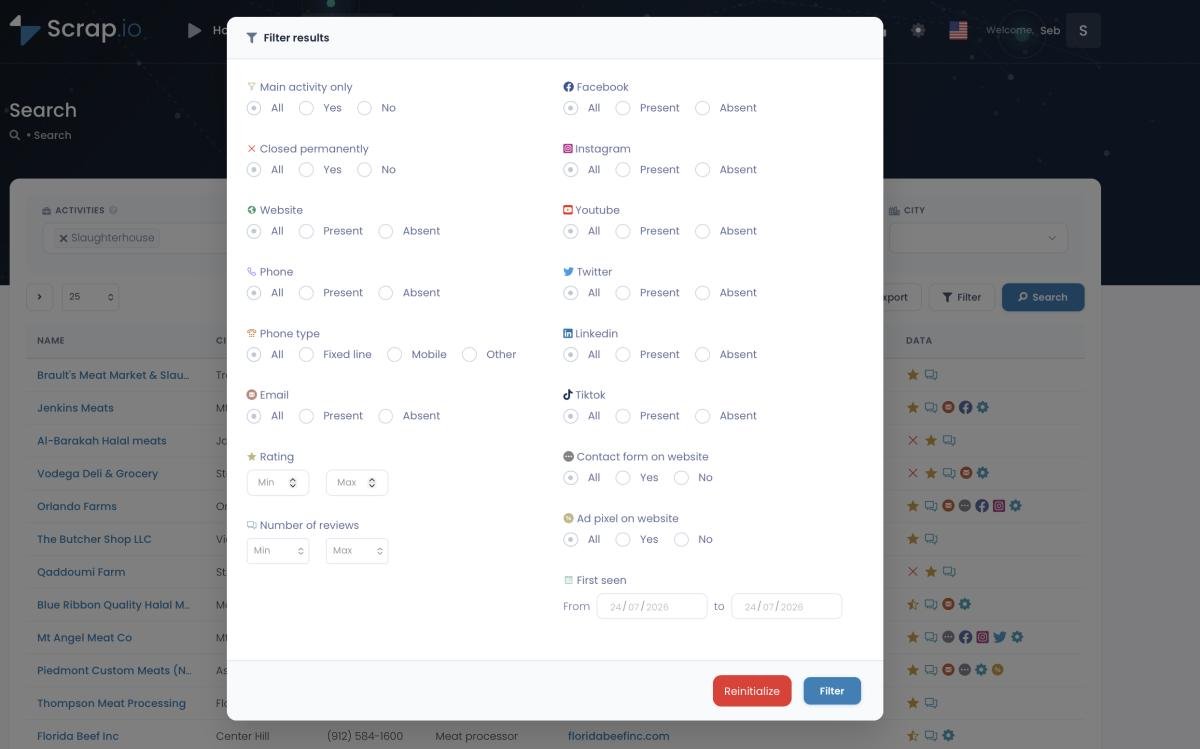
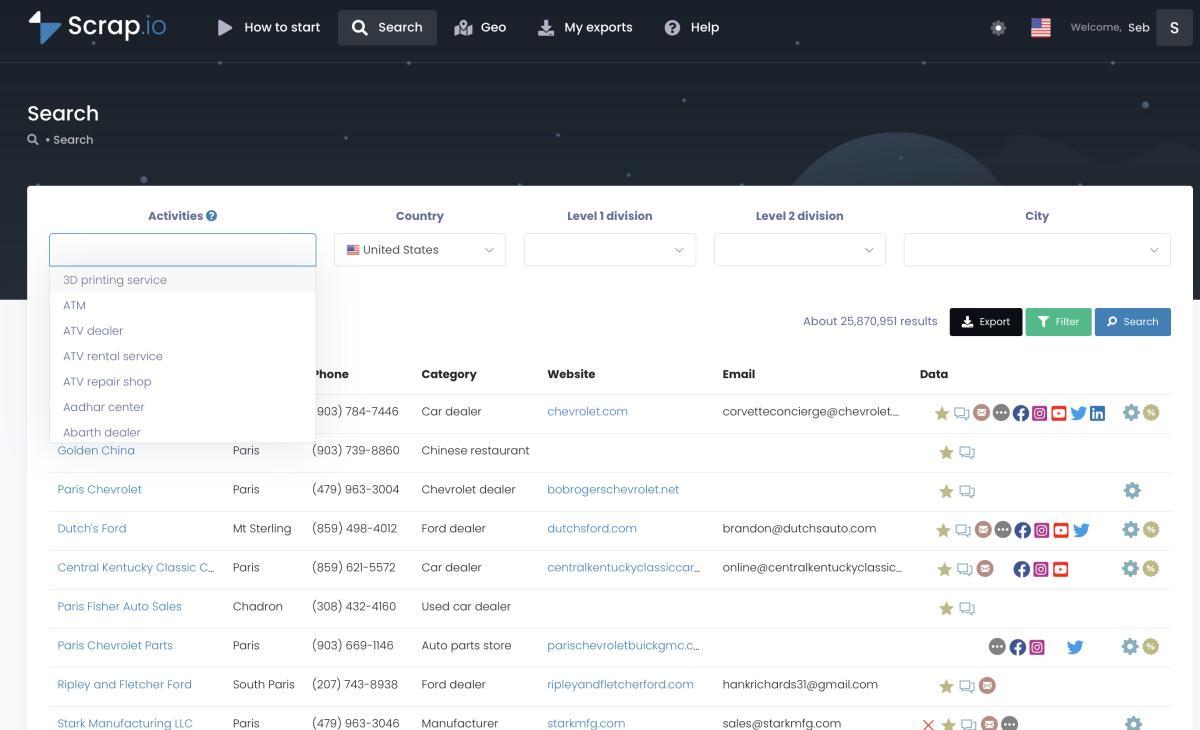
Once enriched, you can push everything straight into your CRM. Our CRM automation guide walks through that step by step.
Real-World Results: What the Data Says About LinkedIn Scraping in 2026
Personalized LinkedIn outreach gets 2–3x higher reply rates. But only if your data is clean. Let's look at what the numbers actually say. No hand-waving, just sourced data.
PhantomBuster's December 2025 survey of B2B sales teams revealed some eye-opening benchmarks (source):
- Teams that personalize every touchpoint are 4–5x more likely to exceed 40% connection acceptance rates compared to template-only outreach
- Signal-based personalization (referencing a recent post, job change, or shared interest) makes reps 3.5x more likely to book 5+ meetings per month
- Pre-engagement ("warming" contacts before pitching) boosts acceptance rates by +15–18 percentage points
- Messages under 75 words get +8 pp higher response rates than longer ones
- Median pipeline uplift with AI-driven personalization: +35–40%
That's not theory. That's survey data from real sales teams.
Clay's waterfall enrichment approach confirms the multi-source advantage: by aggregating 75+ data providers (including Google Maps), they report a 3x enrichment rate versus single-provider setups, with 80%+ email discovery rates. One of their documented wins: LegalOn's CEO saved $250K on a single renewal by identifying the right contact with enriched data. If you want to understand where multi-source stacking works and where it falls apart, our waterfall enrichment guide covers exactly that.
And the cost argument is a no-brainer. According to Apify's 2026 benchmarks, automated lead scraping costs $0.03–$0.17 per lead. Manual research? $5–15 per lead. That's a 30–50x cost difference. One B2B team documented in GigRadar's roundup cut their list-building time from 6 hours to 45 minutes per week and doubled their qualified pipeline within 60 days.
Oh, and also, the Reddit community at r/webscraping is bursting with discussions about building linkedin scraping tools. One thread about an open-source linkedin scraping tool got 110+ comments. People want this. The demand is real.
For tips on combining enriched data with AI-powered cold email personalization, we wrote a full guide. And if you're comparing pricing models between scraping platforms, that article breaks down execution-time vs. lead-based pricing.
A LinkedIn Pulse article put it best: "B2B Lead Generation secret: Scrape Google Maps + video prospecting." The playbook is becoming mainstream. The question is whether you adopt it now or play catch-up later.
Is LinkedIn Scraping Legal? Compliance Guide for 2026
Can you legally scrape LinkedIn? The short answer: it's complicated. The long answer might surprise you.
The landmark case is hiQ Labs v. LinkedIn (2022). The Ninth Circuit Court ruled that scraping publicly available data does not violate the Computer Fraud and Abuse Act (CFAA). In plain English: if a LinkedIn profile is public, grabbing that data isn't a federal crime. Big relief for every sales team running a linkedin scraping tool.
But (and this is important) LinkedIn's Terms of Service still prohibit scraping. That's a contractual issue, not a criminal one. LinkedIn can restrict your account if they detect automated access. So the legal answer and the practical answer are two different things.
Will LinkedIn Ban You for Scraping?
Not if you use the right approach. Traditional LinkedIn scrapers automate your logged-in account, which is exactly what triggers restrictions and bans. Scrap.io sidesteps that entirely: it pulls publicly available Google Maps data and never touches your LinkedIn login, so there's no account to flag, throttle, or ban.
For EU-based prospects, GDPR applies. You need a legitimate interest basis for processing personal data, and you must offer an opt-out mechanism. For California contacts, CCPA gives similar rights. In practice, here's what responsible teams do:
- Only scrape publicly available data, never behind login walls
- Document your legitimate interest for B2B prospecting
- Include opt-out links in every outreach message
- Practice data minimization, collect only what you need
- Respect rate limits and don't hammer LinkedIn's servers
Worth noting: tools like Scrap.io focus on publicly available Google Maps data, which sidesteps the LinkedIn ToS issue entirely. You're enriching leads with data that's already freely accessible to anyone with a browser. For more on the legal side of web scraping, see our piece on whether it's legal to scrape Google Maps. And if you're emailing EU prospects, our GDPR cold email B2B guide covers what legitimate interest actually requires.
My advice? Scrape smart, stay compliant, and always give people a way to say "stop."
FAQ
What is the best LinkedIn scraping tool in 2026?
It depends on your use case. Evaboot is best for Sales Navigator users who need clean exports. PhantomBuster wins for complete automation workflows. Bright Data handles enterprise-scale API scraping. And for enriching LinkedIn leads with verified local business data (emails, phones, addresses, reviews), combine any of these with Scrap.io.
Is it safe to scrape LinkedIn?
Yes, if you follow best practices: only target public profiles, use reasonable rate limits, and avoid aggressive automated connection requests. The main risk isn't legal. It's account restriction. LinkedIn can flag and limit accounts that exhibit bot-like behavior. Use dedicated tools with built-in throttling to minimize this risk, or enrich from public Google Maps data (via Scrap.io) so your LinkedIn account is never in the loop at all.
How do I extract emails from LinkedIn profiles?
Tools like Skrapp (92% accuracy) and Evaboot include built-in email finders that match LinkedIn profiles to verified email addresses. For local business emails specifically, Scrap.io extracts emails directly from Google Maps listings. These tend to be more accurate for SMBs than LinkedIn-derived guesses.
Can I combine LinkedIn data with Google Maps data?
Absolutely, and if you're wondering how to build a B2B prospect list from linkedin that actually works, this is it. Use any linkedin scraping tool to extract names, titles, and company names. Then enrich linkedin leads with business data via Scrap.io: verified emails, phone numbers, physical addresses, and Google reviews. The result: contact records that are 3x more complete than LinkedIn alone.
How much does a LinkedIn scraper cost?
From free (open-source GitHub libraries) to $500+/month (Bright Data enterprise plans). Most SaaS linkedin scraping tools start between $29–$99/month. The real cost to consider isn't the linkedin scraping tool itself. It's the $5–15 per lead you spend on manual research if you don't automate. Automated scraping brings that down to $0.03–0.17 per lead.
Generate a list of restaurant with Scrap.io