

LinkedIn just crossed 1.3 billion members. That's roughly one new person joining every single second of 2026. Let that sink in for a moment.
Now here's the part nobody puts on a slide: most of those members never actually show up. And the businesses you probably want to sell to? A huge chunk of them aren't on LinkedIn at all. We'll get to that. It's the most useful number in this whole article, and almost nobody quotes it.
This is a roundup of the LinkedIn statistics 2026 actually gives us. Members, demographics, engagement, B2B lead data, ad benchmarks, revenue. Every figure here is sourced. No vendor fluff, no "our clients see 80% open rates" nonsense. Just the LinkedIn statistics for 2026 that change how you spend your time and budget, plus one stat that should change your whole prospecting strategy.
Video: Scrap.io Product Tour
- Key LinkedIn statistics 2026 (at a glance)
- LinkedIn user statistics 2026 (members & active users)
- LinkedIn demographics 2026
- LinkedIn usage & engagement statistics 2026
- LinkedIn B2B & lead generation statistics 2026
- LinkedIn advertising statistics & benchmarks 2026
- LinkedIn revenue & business statistics 2026
- The stat nobody quotes: the 70% of businesses LinkedIn doesn't show you
- How to actually use these LinkedIn statistics in 2026
- FAQ
Key LinkedIn statistics 2026 (at a glance)
Short on time? Here's the headline version. What are the LinkedIn statistics for 2026 that matter most? LinkedIn has 1.3 billion members, around 310 million monthly active users, and roughly 134.5 million daily active users. It drives about 80% of all B2B social media leads, counts 65 million decision-makers, and pulled in $18.7 billion in revenue. Bookmark this section. It's the year-over-year snapshot you'll want to screenshot, drop into a graph, or paste into a PDF for your next deck.
| Metric | 2026 Figure | Source |
|---|---|---|
| Total members | 1.3 billion | LinkedIn / Leadfeeder |
| Monthly active users (MAU) | ~310 million | Business of Apps |
| Daily active users (DAU) | ~134.5 million | Social Shepherd |
| Share of B2B social leads | ~80% | Leadfeeder / Martal |
| Decision-makers on platform | 65 million | LinkedIn / Cognism |
| Company pages | 71 million+ | Business of Apps |
| Annual revenue (2025) | $18.7 billion | Business of Apps |
Want the deeper version of each number, plus the one that flips the whole picture? Keep reading.
LinkedIn user statistics 2026 (members & active users)
1.3 billion members. But only around 310 million show up monthly, and that gap tells you more than the headline number ever will.
Let's start with the LinkedIn user statistics everyone repeats. The platform crossed 1.3 billion total members in January 2026, growing at roughly three new sign-ups every second (LinkedIn / Leadfeeder). Impressive. Genuinely. It's the largest professional network on Earth and it isn't close.
Here's where the asterisk goes. "Members" is a cumulative count: every account ever created, including the dormant ones, the duplicate ones, and the profile your uncle made in 2014 and never touched again. The number that actually matters for reach is active users. LinkedIn sees about 310 million monthly active users and roughly 134.5 million daily active users (Business of Apps / Social Shepherd).
Do the math. Daily actives are about one in ten of the total member count.
So when someone tells you "you can reach a billion people on LinkedIn," they're technically right and practically wrong. Your real addressable audience on any given day is a fraction of that, and most of them are scrolling, not engaging. That's not a knock on the platform. It's just the difference between a vanity metric and a planning metric. Use the second one.
LinkedIn demographics 2026
If your buyer is a 28-year-old marketing manager in the US earning six figures, LinkedIn was practically built for you. If your buyer runs a plumbing business in Ohio? Keep reading. This section is where the cracks start showing.
Age and gender breakdown
The LinkedIn demographics 2026 data skews young-professional. The 25–34 age group dominates at roughly 47% of users (some estimates push the broad working-age band as high as 60%), while 18–24 year-olds make up about 28% (Statista / Cognism). On gender, it's 56.8% men and 43.2% women (Statista).
Where the members are (and where they aren't)
Geographically, the US leads with ~257 million members, followed by India at 150 million (adding around 30 million a year), Brazil at 81 million, and the UK at 45 million (Cognism / DemandSage). For context, about 53% of US college graduates are on the platform.
| Country | Members (2026) |
|---|---|
| United States | ~257 million |
| India | 150 million |
| Brazil | 81 million |
| United Kingdom | 45 million |
Income and seniority, the part competitors skip
This is where LinkedIn earns its B2B reputation. A striking 34% of US members earn $100,000+ per year, and 52% earn $75,000 or more (DemandSage). High purchasing power, concentrated in one place.
And the seniority data is the real headline. LinkedIn counts roughly 65 million decision-makers and 10 million C-suite executives, with the platform reporting that four out of five members drive business decisions at their company (LinkedIn / Cognism). These LinkedIn decision makers statistics are exactly why a $5 click here can still beat a $0.50 click somewhere else. You're paying for who's on the other end.
LinkedIn usage & engagement statistics 2026
Only 3 to 5% of LinkedIn's daily users post anything in a given week. The bar to stand out has never been lower. Read that twice.
Let's talk LinkedIn usage statistics, because the engagement picture in 2026 is genuinely lopsided, in your favor, if you actually publish. Snov.io's data puts weekly posters at just 3% to 5.2% of daily active users (Snov.io). Everyone consumes. Almost nobody creates. Which means the supply of content is tiny relative to the audience that's there to read it.
What works once you do post? The format data is clear. Carousels pull around 6% engagement, posts from personal profiles get roughly 8× the reach of company pages, and employee posts outperform brand posts by about 2× (Brenton Way / Martal). So if you've been pouring effort into your company page and wondering why it's a ghost town. That's why. Push your people forward instead.
Best time to post on LinkedIn in 2026
The best time to post on LinkedIn 2026 data comes from Kanbox's study of 4.8 million posts (the one Google's AI Overview keeps citing): Tuesday through Thursday, between 10 AM and 2 PM in your audience's time zone (Kanbox). Not Monday morning. Not Friday at 5 PM. Mid-week, mid-day.
| Day window | Best time | Notes |
|---|---|---|
| Tuesday–Thursday | 10 AM – 2 PM | Peak engagement window |
| Monday | Skip mornings | Inbox catch-up day |
| Friday PM | Avoid | Everyone's checked out |
One caveat on the LinkedIn engagement rate 2026 figures: "best time" is an average across millions of accounts, not a law. Your audience might be founders in three time zones who read at 9 PM. Test it. The data is a starting point, not gospel.
LinkedIn B2B & lead generation statistics 2026
Around 80% of all B2B leads from social media come from one platform. Spoiler: it's not the one with the dancing videos.
Here are the LinkedIn B2B statistics that justify the whole channel. LinkedIn generates roughly 80% of all B2B social media leads (Leadfeeder / Martal). When people ask what percentage of B2B leads come from LinkedIn social channels? That's the answer, and it's not close to second place.
The LinkedIn b2b lead generation statistics get better when you look at conversion. LinkedIn converts visitors to leads at 2.74%, versus 0.77% for Facebook, a roughly 277% edge over Facebook and Twitter (Martal). That LinkedIn conversion rate vs Facebook gap is the entire argument for the platform in one stat. And on cost, despite the higher entry price, LinkedIn comes in around 28% cheaper than paid search at equivalent lead quality.
If you want the deeper playbook on turning these numbers into actual pipeline, our data-backed cold emailing strategy breaks down the outreach side, and our guide on what an ICP actually is covers who you should be targeting in the first place.
LinkedIn owns ~80% of social B2B leads. But what about the buyers who never log in? The ones running businesses that don't have a content calendar? See how teams reach the other side of the market →
LinkedIn advertising statistics & benchmarks 2026
LinkedIn ads are expensive. A $5–8 CPC will make your Google Ads manager wince. So why do B2B teams keep paying? The conversion numbers, mostly. And a little bit of stubbornness.
Let's put real LinkedIn ads benchmarks 2026 on the table. Expect a cost-per-click of $5–8 (averaging around $5.26), Lead Gen Forms converting at 6.1%, and a cost-per-lead of $50–130 with the median landing somewhere between $75 and $110 (Meet-Lea / Stackmatix). Yes, that CPL would horrify a performance marketer used to Google Search. But a 6.1% form conversion rate is the kind of number that keeps the budget flowing.
There's also a softer metric worth knowing. LinkedIn's own Social Selling Index data claims reps with a high SSI see 45% more opportunities and are 51% more likely to hit quota (LinkedIn / Martal). Take vendor self-reported numbers with a grain of salt, but the directional point holds.
📌 A real example, not a made-up one: MobyCap, a B2B finance company, ran LinkedIn Ads and posted a 1,733% increase in conversions over 11 months, with Lead Gen Forms beating landing pages by 40–60% (Upgrow case study). And on the benchmarking side, Dreamdata's 2026 LinkedIn Ads Benchmarks Report analyzed 66 million+ sessions and 3.5 million+ customer journeys (Dreamdata). Worth a read if you're planning spend.
Before you commit a single dollar, know your math. If a $90 LinkedIn lead sounds steep, compare it against your blended customer acquisition cost benchmarks across channels. The "expensive" channel is sometimes the cheap one once you account for close rates.
LinkedIn revenue & business statistics 2026
LinkedIn pulled in $18.7 billion in 2025 and recently crossed $5 billion in a single quarter. Microsoft's quiet money machine, basically.
LinkedIn revenue 2026 outlook
The LinkedIn revenue 2026 trajectory is steep. The platform generated $18.7 billion in 2025 (up 9.2% year-over-year), crossed the $5 billion-per-quarter mark in Q4 2025, now counts more than 71 million company pages, and its advertising revenue alone is projected to hit $9.7 billion in 2026, an 18.5% jump (Business of Apps / WARC).
Why should you care about a Microsoft subsidiary's earnings report? Because ad revenue growing at 18.5% means one thing for you: more advertisers, more competition for the same feed, and rising costs. The cheap days are behind us. If LinkedIn is part of your mix, lock in your process now. It won't get less crowded.
The stat nobody quotes: the 70% of businesses LinkedIn doesn't show you
Only about 30% of small businesses actively use LinkedIn. The other 70% are invisible to you there. That's the b2b linkedin statistic that should reframe everything you just read.
Every roundup parrots the 1.3 billion figure. Almost none of them mention this one: roughly 30% of small businesses actively use LinkedIn, which means around 70% of them simply aren't there, and on top of that, about 18% of business leaders have no social media presence at all (Statista / The Alternative Board). So when people ask how much of business is on LinkedIn, the honest answer is: a visible, well-documented minority.
Here's the fresh number that makes it concrete. As of September 2026, Scrap.io indexes over 26 million US businesses on Google Maps, and about 86% of them (roughly 22.4 million) show no LinkedIn presence at all (Scrap.io, September 2026). Read that again. Nearly nine in ten American businesses on the map leave zero trace on LinkedIn. If your prospecting lives on LinkedIn, that's the slice you never see. For a deeper playbook on reaching them, our guide to local business lead generation walks through the whole system.
Think about who that 70% actually is. The HVAC contractor with a 4.6-star rating and zero LinkedIn footprint. The family restaurant. The local accounting firm. The auto shop, the dental clinic, the landscaping crew. These businesses have revenue, budgets, and problems you can solve. They're just not posting carousels about it on Tuesday at noon.
Discussions across communities like r/sales and r/smallbusiness circle this exact frustration: reps hunting for local clients keep hitting the wall that those businesses aren't searchable on LinkedIn (you can browse the threads yourself; we won't put fake quotes in your mouth). The substitute is the hard data above: the gap is real, and it's about 70% wide.
So where do those businesses live, if not on LinkedIn? On the map. Almost every one of them has a Google Maps listing (name, phone, website, reviews, category) whether or not they ever touch social media. That's the angle most B2B marketers miss entirely. There's a whole comparison worth reading on Google Maps vs LinkedIn for B2B lead generation, and a related breakdown of Google Maps vs Facebook for B2B.
Video: B2B Lead Gen: Google Maps vs LinkedIn
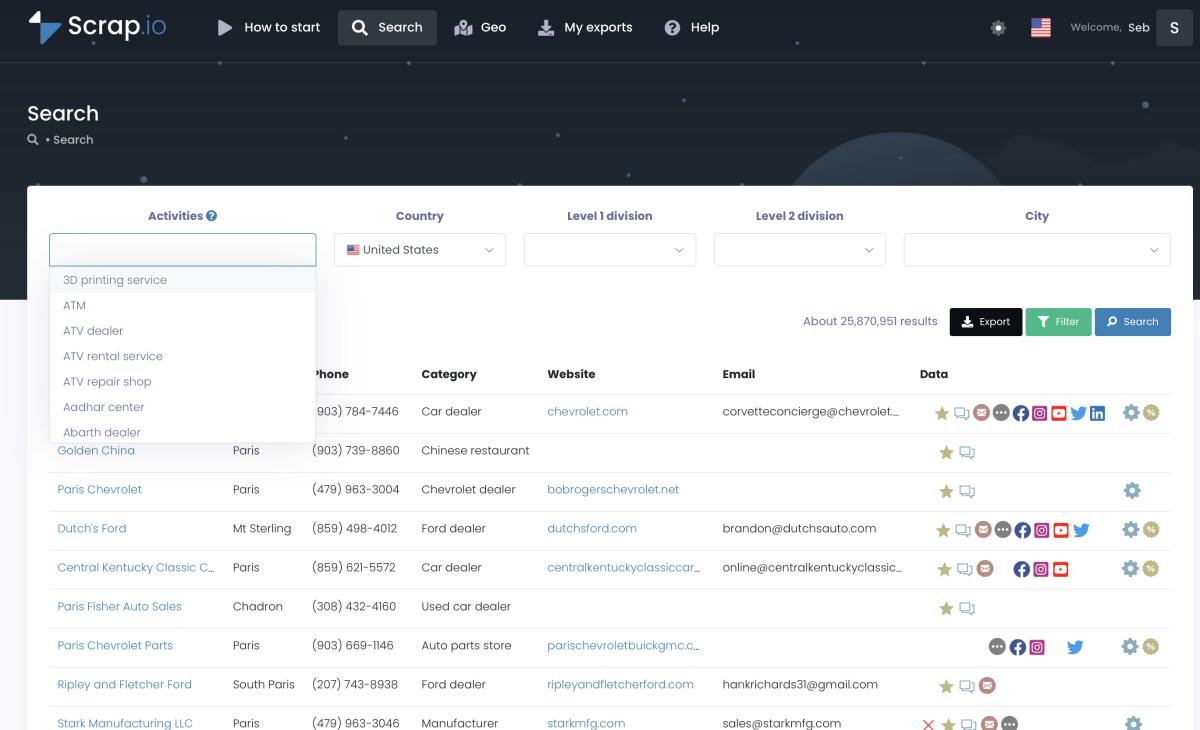
This is exactly what tools like Scrap.io are built for. Look, instead of fishing in the 30% of businesses that bothered to set up a LinkedIn page, you extract the full picture from Google Maps. There's a full walkthrough on how to scrape Google Maps for leads if you want the step-by-step. Try doing that manually, you know. I'll wait.
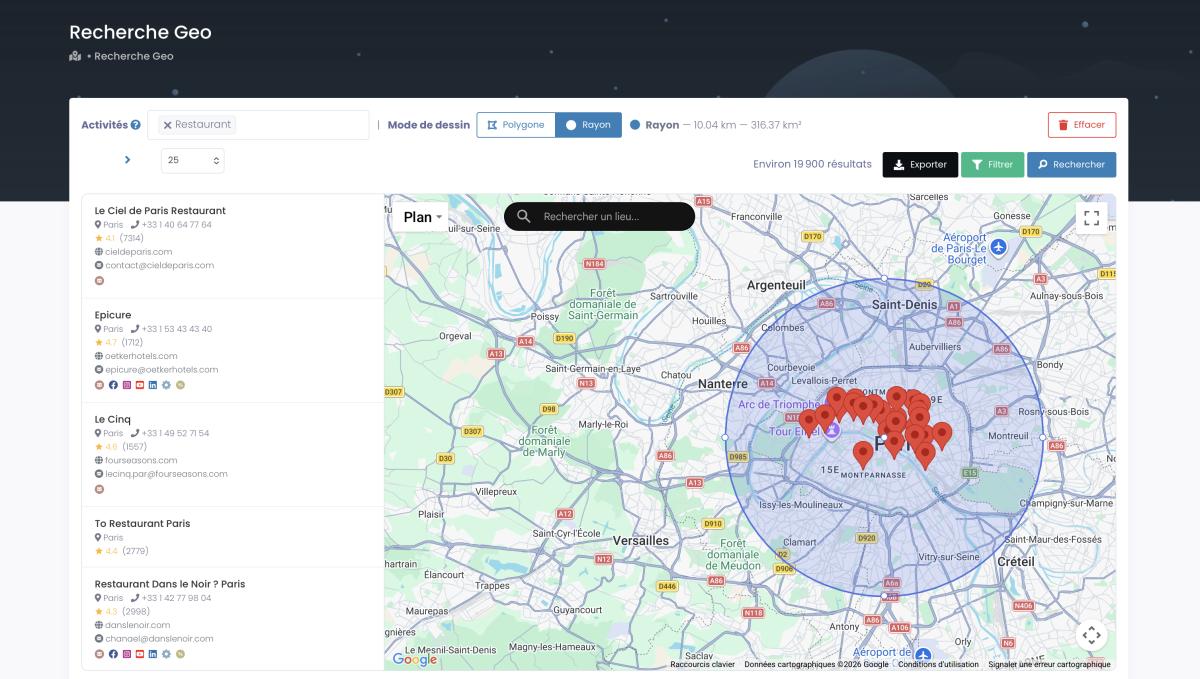
Scrap.io indexes 225M+ businesses across 195 countries and 4,000+ categories. Most of them never appear on LinkedIn. Data is pulled in real time at each extraction (no stale files), it's GDPR- and CCPA-compliant, and you filter before spending a credit so you only pay for useful contacts. See the coverage for yourself →
How to actually use these LinkedIn statistics in 2026
Picture Sarah. She read every stat above, nodded along, closed the tab… and changed exactly nothing on Monday. Don't be Sarah. Stats are only worth the action they trigger.
So, concretely, what do you do with all this? Here's the short version. Bref, three moves.
Lean into the engagement gap. Only 3–5% of users post weekly, and personal profiles out-reach company pages 8 to 1. If you've got salespeople, get them publishing from their own accounts, Tuesday to Thursday, 10 AM to 2 PM. Cheapest lead source you'll ever build.
Use LinkedIn for the 30% it does well. Corporate buyers, SaaS decision-makers, enterprise committees. The 65 million decision-makers and 10 million C-suite execs are genuinely reachable there. Don't abandon the channel. Just stop pretending it's the whole market.
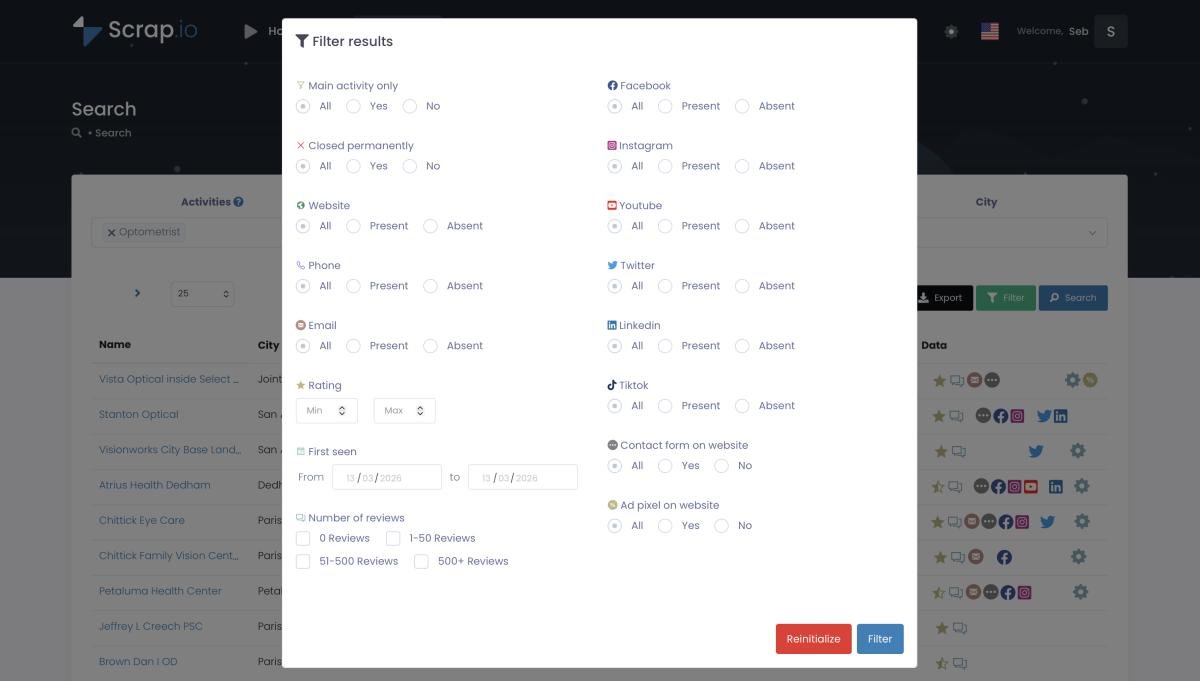
Cover the other 70% on the map. For local and SMB prospecting, build your list from Google Maps where those businesses actually exist. Filter by category, location, rating, whether they have a website or email, then export and start your sales prospecting sequence. Pair it with the right AI sales tools and one person can do the work of five.
The play that actually wins in 2026 isn't LinkedIn or Google Maps. It's both. Find the company on the map, then find the decision-maker with a LinkedIn scraping tool, and reach out where they're most likely to answer. This kind of coordinated omnichannel outreach beats single-channel every single time. Anyway, enough theory.
Build your first list of LinkedIn-invisible prospects in two clicks: pick a category, pick a location, filter, export. Try Scrap.io free. 7-day trial, 100 leads included. Start now →
FAQ
How many users does LinkedIn have in 2026?
LinkedIn has 1.3 billion members as of January 2026, with approximately 310 million monthly active users and 134.5 million daily active users. The total member count includes dormant and duplicate accounts, so active users are the more useful planning number.
Is LinkedIn still relevant in 2026?
Yes. For B2B, it's still the #1 social channel. LinkedIn drives about 80% of B2B social media leads and converts visitors to leads at 2.74% (versus 0.77% for Facebook). The catch: it only reaches the roughly 30% of small businesses that are active there, so it works best alongside a channel that covers the other 70%.
What are the most important LinkedIn stats for B2B marketers in 2026?
The big ones: 1.3 billion members, ~80% of social B2B leads, 65 million decision-makers, and a 6.1% Lead Gen Form conversion rate. The flip side that matters just as much: about 70% of small businesses aren't on LinkedIn at all.
What's the best time to post on LinkedIn in 2026?
Tuesday through Thursday, 10 AM to 2 PM in your audience's time zone, based on a Kanbox study of 4.8 million posts. Carousels and posts from personal profiles consistently outperform company-page content, personal profiles by roughly 8×.
What is the golden hour for LinkedIn posts?
The "golden hour" is the first 60 minutes after you publish. Early engagement in that window signals the algorithm whether to push your post to a wider audience or bury it. So reply to every comment fast, and publish when your people are active (Tuesday to Thursday, 10 AM to 2 PM) to make that first hour count.
Generate a list of restaurant with Scrap.io