

There are more than 57,000 licensed haulage companies in the UK. Almost 90% of them run fewer than five trucks. Good luck finding that lot on LinkedIn.
That number is the whole problem in one line. The UK haulage sector is enormous, it's fragmented into tens of thousands of tiny operators, and most of them are invisible to the tools everyone reaches for first. So when you go looking for a list of haulage companies in the UK, whether to sell them fuel cards or to find a carrier for your pallets, you hit a wall fast. The directories are stale. Companies House has names but no way to reach anyone. And the "Top 100" lists only ever show you the 100 you already knew.
This article does two things. First, the lay of the land: how many haulage companies there actually are, where they sit, and which ones are the giants. Then the part nobody else bothers with, which is how to build your own fresh, contactable list of UK hauliers in 2026 instead of renting a spreadsheet that started rotting the day it was compiled. Fair warning before we start: we build exactly this kind of list for a living at Scrap.io, so yes, we have a horse in this race.
- How many haulage companies are there in the UK?
- The biggest haulage companies in the UK (2026)
- Where to find a list of UK haulage companies (and why most lists fail)
- How to build your own fresh list of UK haulage companies
- Who needs a list of haulage companies, and why
- Turning the list into results: outreach that works
- Is scraping haulage company data legal? (GDPR)
- FAQ
How many haulage companies are there in the UK?
So how many haulage companies actually operate in the UK? The honest answer: it depends who's counting.
(Quick definition first, because people genuinely type it into Google: what is a haulage company? It's a firm that moves goods by road for other businesses, a haulier, rather than one shifting only its own stock. Everything below is about building a usable list of those.)
Count active goods vehicle operator licences and you land at roughly 57,000 licensed haulage companies at the end of 2024, according to Haulage Exchange, drawing on the Office of the Traffic Commissioner. Count road freight enterprises the way the trade body does and the Road Haulage Association puts it at 58,262. Two methods, two numbers, same ballpark. Call it around 57,000 to 58,000 firms either way.
Why does that matter for a list of haulage companies uk? Because the total tells you the opportunity, and the shape of it tells you the catch. Here's the shape.
The UK haulage market in numbers (2026)
| UK haulage market | Figure | Source |
|---|---|---|
| Licensed haulage companies (2024) | ~57,000 | Haulage Exchange |
| Road freight enterprises | 58,262 | RHA |
| Run fewer than 5 trucks | ~90% of the sector | Haulage Exchange |
| HGVs on the road | ~625,800 | RHA |
| HGV drivers | ~684,000 | RHA |
| Freight moved by road | 89% | RHA |
| Food & farm goods by road | 98% | RHA |
| Transport & logistics share of UK GDP | 5.6% | RHA |
| "Trucking company" listings on Google Maps | 7,069 | Scrap.io, 30 Sept 2026 |
Nearly nine in ten firms running fewer than five trucks. Sit with that for a second, because it's the single fact that breaks most prospecting plans. These aren't blue-chip logistics groups with a procurement portal and a press office. They're owner-drivers, family firms, a bloke with three artics and a mobile that rings while he's on the M6. You don't reach people like that through a gated webinar. You reach them with a phone number and an email address, which is precisely what the registers don't hand you.
The sector itself is no minnow, mind. Road freight moves 89% of everything in the UK and 98% of food and farm goods, runs on around 625,800 HGVs and 684,000 drivers, and accounts for 5.6% of GDP (RHA, 2025). For deeper vehicle-park numbers there's a standing Statista topic page on HGVs in the UK. The demand is real. The reachability is the hard part.
Micro-fleets vs the big players
Geography splits the way you'd guess, roughly by population. England holds about 49,000 of those licensed firms, Scotland around 5,000, Wales near 2,000, and Northern Ireland about 1,000 (Haulage Exchange, 2024). So a national list is really dozens of local lists stacked together, which matters the moment you want hauliers in one place rather than the whole country. People do search that way, too: haulage companies birmingham uk, haulage companies in norfolk uk, a specific depot, a specific corridor. The mix matters as well: alongside domestic firms you'll find international haulage companies (UK operators running European routes), so any serious uk haulage companies list has to cover European haulage companies among them, not just the local runs.
And here's the bit the market structure is quietly telling you. A handful of giants carry the brand recognition, and a very long tail of micro-fleets carries the actual tonnage. If your list only contains the names you can already recall, you've captured the 0.1% and missed the 90%. That long tail is where the reachable, winnable business lives, and it's exactly the slice a static directory handles worst.
The biggest haulage companies in the UK (2026)
Everyone knows Eddie Stobart. Almost nobody can name the other 56,999.
Which is fine if you just want the household names. People searching for the biggest haulage companies uk or the largest road haulage companies uk usually want a quick sense of who the majors are, so here's the shortlist. Then a word on why the shortlist is a trap if prospecting is your actual goal.
Top 10 UK haulage & logistics companies
A rough roll-call of the largest road transport and logistics operators active in the UK, the kind of names that dominate any top 10 uk haulage companies or top 20 biggest haulage companies uk list:
- Eddie Stobart (the one everyone pictures, lorries with names on the cab)
- XPO Logistics
- Wincanton
- GXO Logistics
- DHL Supply Chain
- Kuehne + Nagel
- DPD
- Culina Group
- Gregory Distribution
- Turners (Soham)
Want the ranked, revenue-weighted version that the trade press updates every year? That's the Motor Transport Top 100, the reference most people mean when they talk about uk transport companies top 100 or the top 100 logistics companies uk. It's a genuinely useful read for market context. It is also, for lead generation, close to useless. More on that in a second.
What the Top 100 lists leave out
Here's the thing about the giants. They have procurement teams, framework agreements, and a receptionist whose entire job is making sure you don't reach the decision-maker. Pitching them cold is a six-month slog with a gatekeeper at every door.
Not where you want to start.
The Top 100 also quietly excludes almost the entire industry. Ninety-nine-point-something percent of UK hauliers never appear on it, because they're too small to rank and too numerous to list. Those are the firms that answer the phone. The curiosity searches, famous haulage companies uk, famous lorry companies uk, big lorry companies uk, lorry company names uk, all point at the same thin slice of the market. Even transactional ones like haulage companies for sale uk, typed by people hunting acquisition targets, circle that same handful of names. Even heavy haulage companies uk, the specialists shifting abnormal loads and oversized plant, are a niche within a niche. Good to know they exist. Not where your pipeline comes from.
So the real question isn't "who are the biggest?" It's "how do I get all the others, with contact details, without copy-pasting for a week?" Right.
Where to find a list of UK haulage companies (and why most lists fail)
The problem isn't finding a list of UK haulage companies. It's that every list you find is already out of date.
Run the usual search and you'll meet the usual suspects. Aging directories that haven't been properly refreshed in years. Companies House filing histories with no phone, no email, nothing you can actually contact. Freight exchanges, which are brilliant for matching loads but aren't a prospecting database. A TikTok "top 10". Each one gives you a sliver. None gives you a fresh, contactable, whole-of-UK list. Let's line them up honestly.
| Source | Emails & phones? | Fresh / real-time? | Whole UK in one export? | Filter before you pay? |
|---|---|---|---|---|
| Online directories | Patchy | No, often years old | Region by region | No |
| Companies House | No contacts at all | Monthly snapshot | Bulk file, names only | No |
| Freight exchanges | Members only | Live, but closed | No export | No |
| Scrap.io (Google Maps) | Yes, classified | Yes, at extraction | Yes, 2 clicks | Yes, 17 filters |
The pattern jumps out once they're side by side. Companies House is the worst offender for this specific job, and it's worth understanding why, because it's the "free" option everyone tries first. The register is the official record of who legally exists, millions of firms, completely free. It also holds exactly zero email addresses and zero phone numbers, by design. You end up with a column of company names and a registered office, and no way to write to any of them. The fix isn't a better directory; it's to enrich Companies House data against a live source that actually carries contact details.
Freight exchanges are a different animal. Haulage Exchange, for instance, runs a genuine load-matching marketplace with around 10,000 active members and 15,000 loads posted daily. Fantastic if you're a haulier chasing backloads. Not a thing you can export and prospect. And the directories? A listing gives you a name and maybe a postcode, the same shallow data problem you hit building any contactable UK business list from a static site.
The map is the one source that was built the other way round. Every haulier chasing work puts itself on Google Maps, with a phone number, often a website, sometimes an email on that site. Pull from there and you get the contact data the register was never designed to hold.
Curious how many hauliers sit in your patch? See the live count for any UK region on Scrap.io before you commit to anything. Counting is free, no credits spent, no card charged just to look.
How to build your own fresh list of UK haulage companies
Meet Dan. He sells fuel cards to hauliers. Last month he spent three days copy-pasting company names off a tired directory, chasing numbers that rang out, emailing addresses that bounced. Three days. For a list that was wrong before he finished it. Here's what he should have done instead, start to finish, in under fifteen minutes.
Fifteen minutes, not three days.
The headline figures first, because they frame the whole job. On 30 September 2026, Scrap.io counted 7,069 businesses listed as "Trucking company" on Google Maps across the UK. Of those, 2,345 had a website, 6,423 had a phone number, and 1,994 carried a usable email. That last number is the one that saves your budget, and you'll see why in step two.
Step 1: Search "Trucking company" across the UK
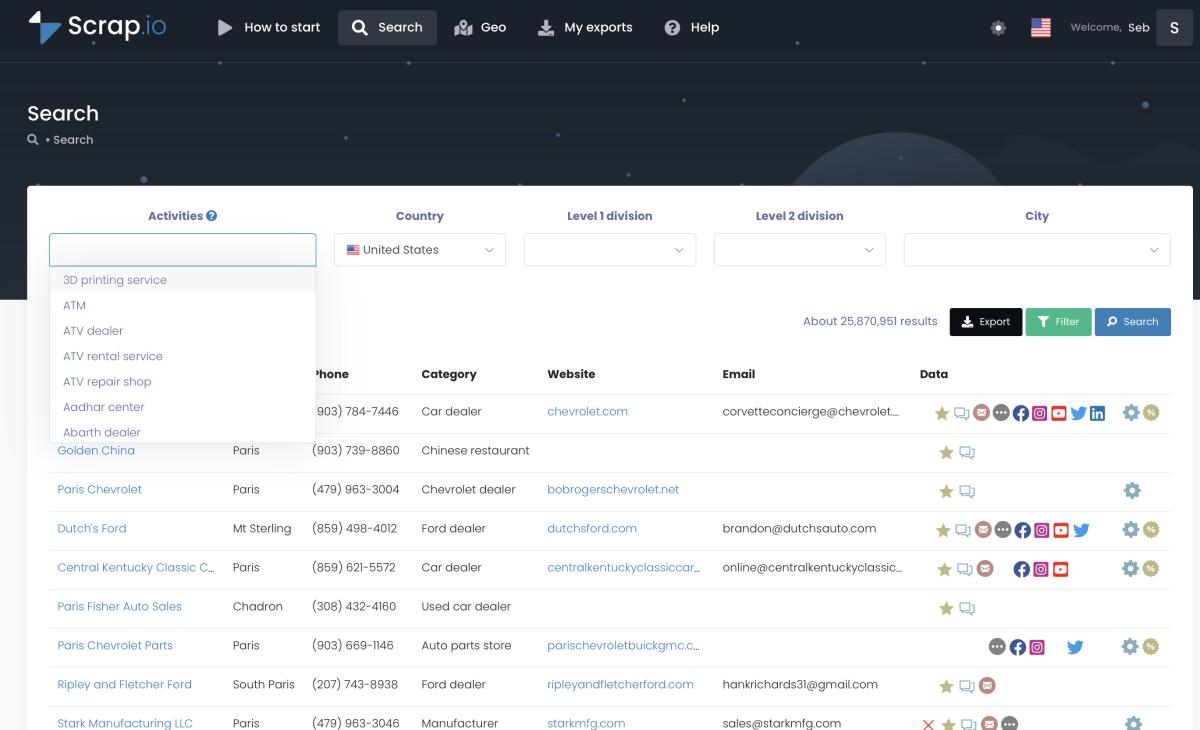
Open Scrap.io, pick the category (Google Maps files hauliers under "Trucking company", so that's your term), and set the location. A single city, a county, a region, or the entire United Kingdom in one go. The count appears instantly, before you spend anything. On a country-wide plan that's one search for all 7,069; on a smaller plan you work city by city or county by county, which maps neatly onto those regional splits from earlier.
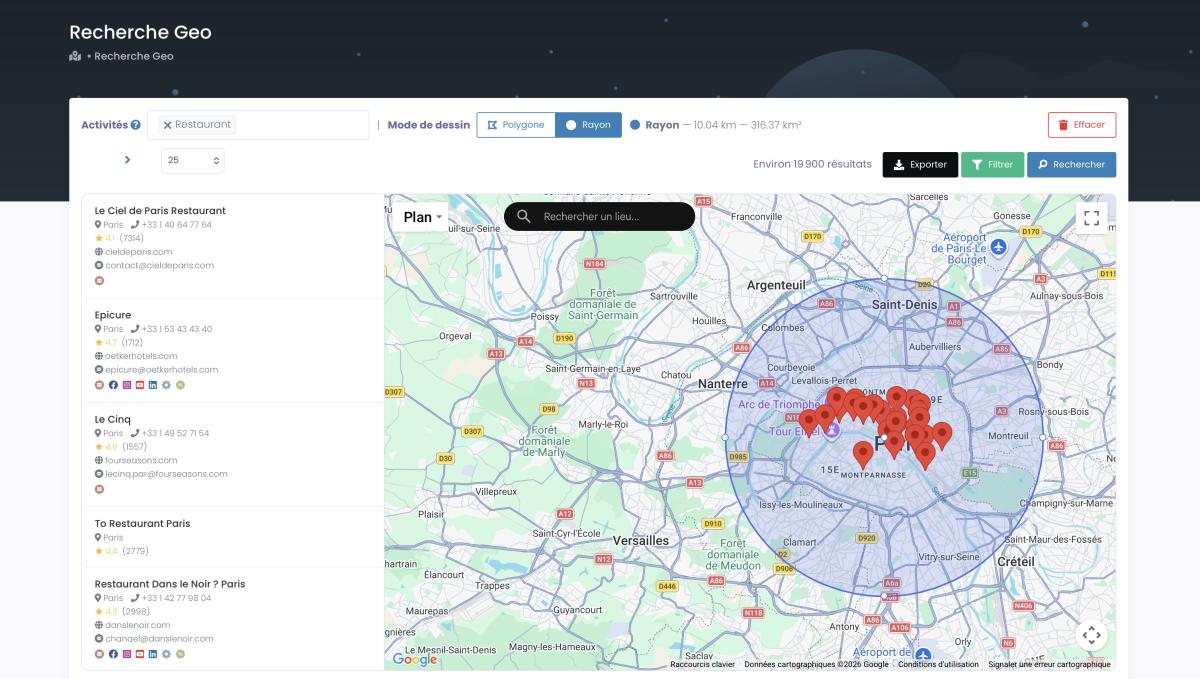
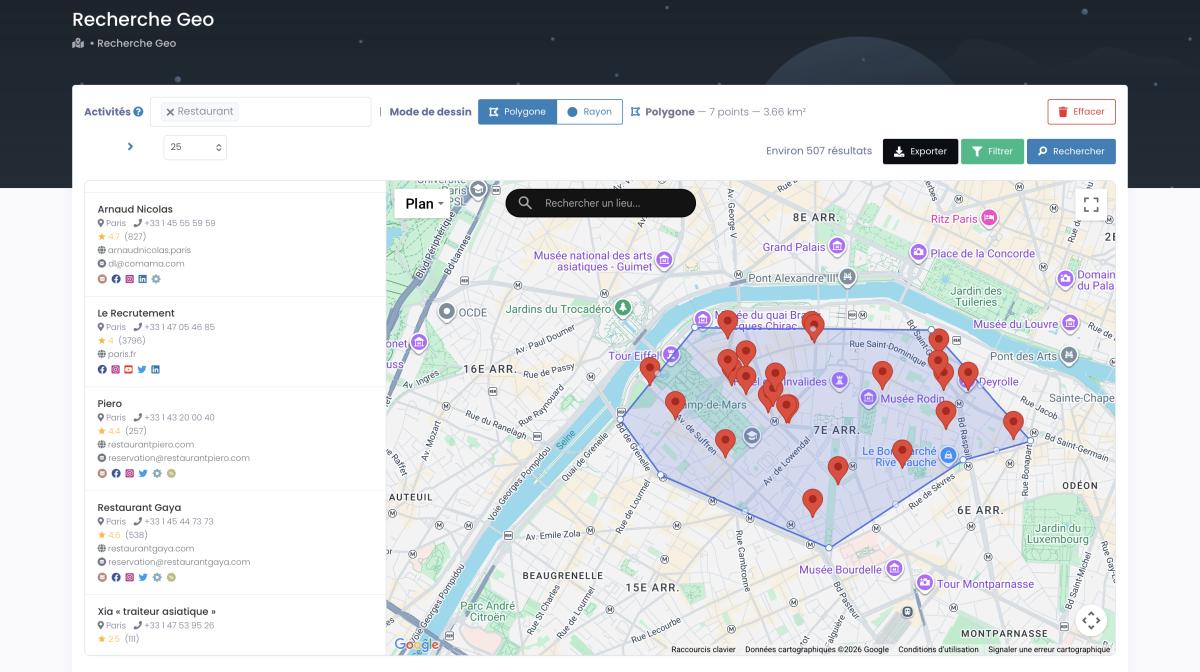
And you're not limited to tick-box administrative areas. If your patch is a radius around a distribution hub, or a hand-drawn shape along the M62 corridor, GeoSearch handles it, and every filter still applies inside that zone. The mechanics are the same whether you want one depot's worth or the whole country extracted in a couple of clicks.
Step 2: Filter before you extract (email, phone, website)
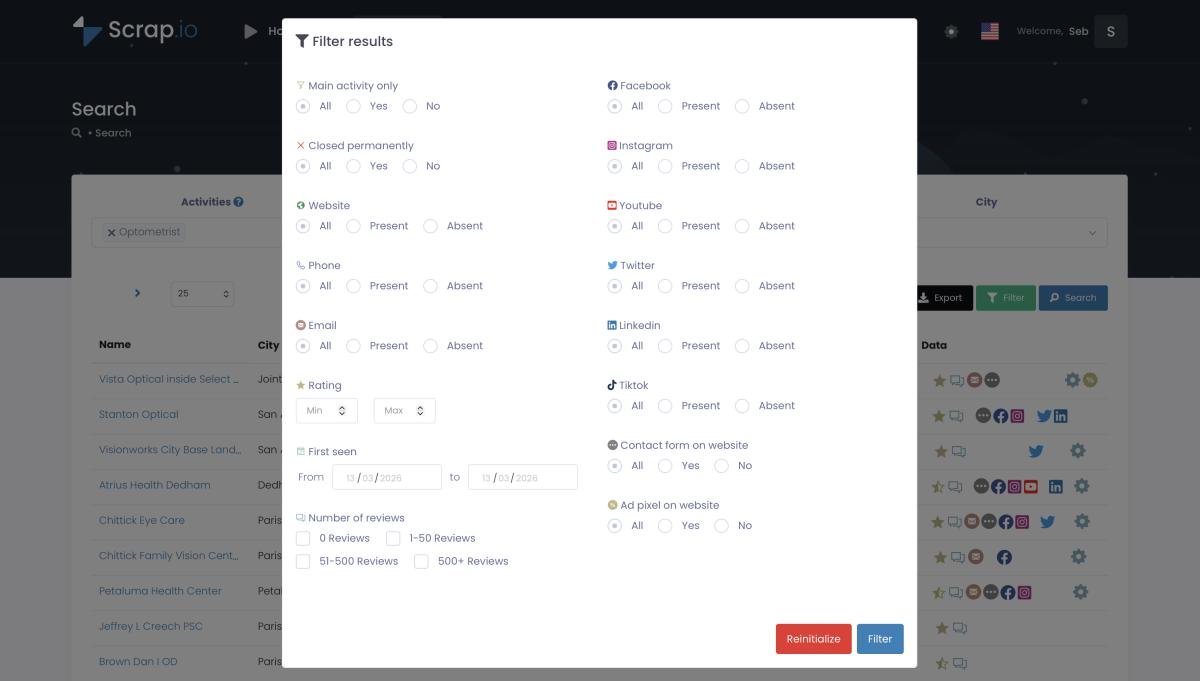
This is the money step. Toggle "email present" and the count drops from 7,069 to the 1,994 hauliers who actually have an email you can write to. Only chasing the phone? Filter to the 6,423 with a number and run a calling or SMS campaign. Targeting firms with no website, because you sell web design? There's a filter for that too, and it's a ready-made pitch.
The important part: Scrap.io applies every filter before a single credit is spent. You never pay to export a dead row and bin it afterwards. That's the opposite of buying a static file, where you pay for all 7,000 and then discover a third of them are unreachable. If you want the full menu of what you can narrow by, the guide to filtering your data before extracting goes deep, and there's a dedicated walkthrough on how to find emails on Google Maps specifically.
Video: Finding Clients Through Google Maps Filters
Step 3: Export a clean CSV or Excel (real-time data)
Hit export. CSV or Excel, ready to drop into your CRM or cold email tool. Each row carries far more than a name: the full address, phone number with its type (fixed, mobile, or special), up to several classified emails per business, social profiles, website tech, rating and review count. And it's extracted live at the moment you export, not pulled from a frozen database compiled months ago. Re-export the same haulier within 30 days and it costs no extra credit.
That's the loop. Search, filter, export. Two clicks and no code, and Dan's three days become an afternoon. Here's the country-level version running end to end:
Video: How to Scrape Local Leads at the Country Level
Build your UK haulage list now. Start a free 7-day Scrap.io trial, 100 export credits included, and pull a fresh, filtered, email-present list of hauliers from a single county or the entire UK, updated the moment you extract it. Start your free trial →
Who needs a list of haulage companies, and why
If your customers drive trucks for a living, they're not filling in your web form. They're on the road. So you go to them, and a clean list is how.
The clearest proof that this is a real, paying audience? There's a whole software industry built on selling to hauliers. Mandata has sold transport management software exclusively to UK and Irish hauliers since 1974, and now supports more than 950 haulier customers, counting itself TMS partner to 45% of the UK's Top 100 road transport operators. Microlise, the LSE-listed telematics firm, sells fleet and compliance tech straight to HGV operators. These companies live or die on reaching hauliers. They are not guessing that the market exists.
Who else needs the list, and the angle each one plays:
- Fleet and fuel card providers. Every one of those 7,069 operators burns diesel. A card that shaves pennies a litre on a route they already run is an easy yes, and owner-drivers make that call themselves.
- Insurance and finance. Truck cover and asset finance are big-ticket, recurring, and shopped around. A fresh list beats a broker's recycled one every time.
- Fleet, TMS and compliance software. See Mandata and Microlise. The market's been proven for fifty years.
- Recruiters and training providers. With 684,000 drivers and constant churn, staffing firms need to reach operations managers and owners, not drivers.
- Web and marketing agencies. Remember the filter for "no website"? Of 7,069 hauliers, only 2,345 have one. That gap is a prospect list with the pitch built in.
The reach-them-where-they-are logic isn't unique to the UK, either. If your market is American carriers, the same playbook powers a trucking company email list for the US, where there are tens of thousands of carriers on the map rather than thousands. Same method, different border.
Turning the list into results: outreach that works
A list is potential, not pipeline. What you do next decides whether it converts or just sits in a CSV. And logistics is a patient game, so plan for patience.
The numbers from Cleverly, who run lead generation for logistics firms, are worth tattooing somewhere visible. It takes 6 to 8 touchpoints to book a single meeting in this sector, deals run on 30 to 90 day cycles, and teams who keep going past the second email see roughly three times the results of those who quit early. Speed matters too: leads contacted within five minutes close at around 32%, versus 12% after a day or more. And clean data on its own lifts response rates by about 40%. That last stat is the quiet argument for building fresh over buying stale.
Fresh data does the heavy lifting here.
A few things that actually move the needle with hauliers:
- Be specific, fast. "Cut your fuel spend on the A1 corridor" beats "transport solutions for your business". Reference the region, the route, the pain.
- Go multi-channel. You've got the phone type and the email classification in the export. Use the mobiles for SMS, the fixed lines for calls, the named individual emails for the personal touch.
- Follow up like you mean it. Six to eight touches, remember. One email is not a campaign.
- Segment before you send. A three-truck firm in Norfolk and a 200-lorry operation in the Midlands are not the same prospect. Split the list and change the message.
Spend any time reading hauliers talk among themselves, on Trucknet UK and similar forums, and the same theme comes up again and again: most work arrives through the freight exchanges, and landing a direct customer is harder but far more profitable. That tells you something about how to pitch them. You're offering a way off the treadmill of lowest-bid load boards, and that framing lands. If you want the full method for turning raw contacts into a sequence that converts, the guide on how to build a cold email list walks through verification, warm-up and segmentation step by step.
Same fresh data, filtered to the hauliers you can reach. The 1,994 UK trucking firms with an email on file, or the 6,423 with a phone, pulled live and ready for outreach, is the same real-time source 50,000+ Scrap.io users already prospect with. See it on your target region →
Is scraping haulage company data legal? (GDPR)
Is any of this actually legal? Short version: yes, if you do it right.
You're working with business contact data, company names, addresses, and the emails and phone numbers that hauliers chose to publish on their own listings and websites. Under UK GDPR, processing publicly available business contact data for B2B outreach generally rests on the "legitimate interest" basis, provided every message carries an easy opt-out. Under PECR, marketing to corporate subscribers (limited companies and LLPs) has more headroom than marketing to sole traders, and plenty of small hauliers are sole traders, so know who's on your list and keep the opt-out clean. Scrap.io only extracts publicly available business data, stays GDPR and CCPA compliant, and keeps every record traceable to its source.
None of that is legal advice, and if there's real money riding on a campaign, talk to an actual lawyer rather than a blog post. But the panic around this is mostly recycled fear from people who never read the rules. Stick to public business data, respect opt-outs, document your basis, and you're on solid ground. For the line-by-line version, there's a dedicated guide to GDPR cold email compliance for B2B.
FAQ
How many haulage companies are there in the UK?
Around 57,000 licensed haulage companies operate in the UK (2024), and roughly 58,000 road-freight enterprises in total. About 7,000 are listed as trucking companies on Google Maps (Scrap.io, 2026). Nearly 90% of them run fewer than five trucks, which is why most are far smaller than the household names suggest.
What are the biggest haulage companies in the UK?
The majors include Eddie Stobart, XPO Logistics, Wincanton, GXO, DHL Supply Chain, Kuehne + Nagel, DPD, Culina, Gregory Distribution and Turners (Soham). The ranked, revenue-weighted list is the Motor Transport Top 100. Bear in mind that the vast majority of UK hauliers, roughly 90%, are micro-fleets running fewer than five trucks and never appear on those rankings.
Where can I get a list of UK haulage companies?
Directories, Companies House and the Motor Transport Top 100 all exist, but they're either static, incomplete, or missing contact details entirely. For a fresh, contactable list you extract "Trucking company" across the UK (or a single region) with a tool like Scrap.io, filter for an email or phone before you pay, and export to CSV. That gives you current data instead of a directory that stopped being accurate months ago.
Is it legal to scrape haulage company contact data in the UK?
Yes, when it's public business data used correctly. UK GDPR allows B2B outreach to publicly listed business contacts under legitimate interest, and PECR gives more latitude for corporate subscribers than for sole traders. You must offer a clear opt-out in every message. Scrap.io returns only publicly available business data, keeps it traceable to its source, and stays GDPR and CCPA compliant. (Not legal advice.)
How do I find haulage companies with an email or phone?
Filter before you extract. Of the 7,069 UK trucking companies on Google Maps, about 1,994 have a usable email and 6,423 have a phone number (Scrap.io, 30 Sept 2026). Toggle "email present" or "phone present" before exporting, so your file only contains firms you can actually contact and you never spend a credit on a dead row.
The bottom line
So where does that leave you? The UK has around 57,000 haulage companies, almost all of them small, and almost none of them reachable through the lists you'll find on page one of Google. The giants are on the Top 100 and behind a gatekeeper. The long tail, the 90% that answers the phone, is on the map. Build from there: search "Trucking company", filter to the ones with an email or a number, export fresh, and start a sequence that follows up.
Stop copy-pasting dead directories. Pull a live list of UK haulage companies in minutes, and spend your week selling instead of scraping by hand.
Build your list of UK haulage companies today. Start your free 7-day Scrap.io trial, 100 export credits included. Pick "Trucking company", pick a region or the whole UK, filter to the hauliers you can actually reach, and export in a couple of clicks. Try Scrap.io free →
Generate a list of trucking company with Scrap.io