

A guy I know sells ELD compliance software. Decent product. Good team. Last year he bought a $2,800 "premium" trucking company email list from one of those database vendors everyone recommends. Sent his first campaign to 6,000 contacts.
1,900 bounced. Another 1,200 went to generic dispatch@ addresses nobody reads. His sender reputation tanked. Three months of recovery, and he still hasn't climbed back to where he was.
That story plays out every week in this industry. And it's wild, because the opportunity is enormous. The US trucking market pulled in $906 billion in gross revenues in 2024, per the ATA's American Trucking Trends 2025 report, an industry that moves 72.7% of all domestic freight tonnage. There are over 2 million active USDOT-registered motor carriers on record at FMCSA right now.
But getting quality transportation company contacts? That's the part nobody has figured out. Or rather: most people are still solving it the 2019 way in a 2026 market.
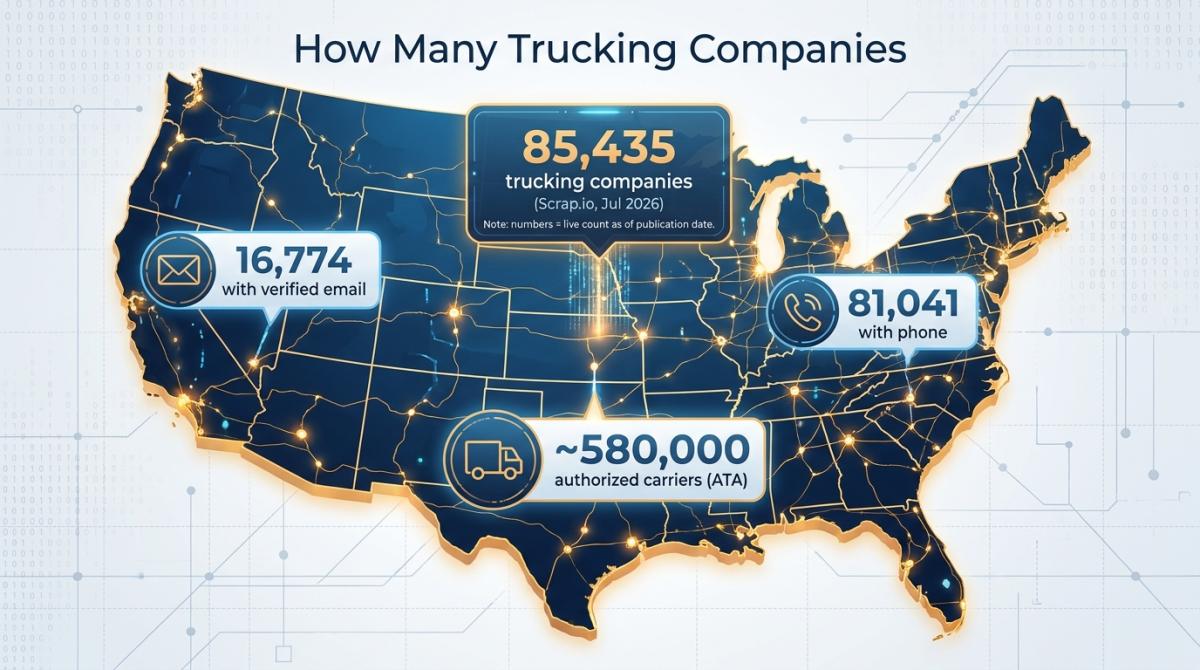
Scrap.io's real-time database currently indexes 85,472 trucking businesses with an active Google Maps presence across the United States. Not DOT registrations from three years ago. Not recycled Yellow Pages entries. Live data, updated at the moment you extract it. Of those, 81,165 have a phone number on file and 17,068 carry a usable email, which tells you something important we'll get to in a minute.
This guide breaks down how to actually use a trucking companies email list that works: who needs one, where to get it, how to build your own, what it costs, and how to dodge the mistakes that cost my ELD buddy three grand and a quarter of his year.
- What Is a Trucking Company Email List?
- How Many Trucking Companies Are in the US? (2026)
- Who Needs a Trucking Company Email List? (Top 5 Use Cases)
- Where to Get a List: Paid Providers Compared
- Free & Official Sources: FMCSA/SAFER and Directories
- Build Your Own List in Real Time with Scrap.io
- Best Practices for Trucking Industry Email Outreach
- Is It Legal? CAN-SPAM & TCPA
- FAQ
What Is a Trucking Company Email List?
Start with the plain definition, because people use the term to mean three different things.
A trucking company email list is a structured set of business contacts (carriers, fleets, owner-operators) with verified email addresses used for B2B outreach. The best ones are pulled from public sources like Google Maps in real time, filtered to companies that actually have a working email, and segmented by fleet size or location so the message lands with the right operator.
Notice what that definition rules out. A dusty CSV a broker sold to 400 other buyers isn't really a list. It's a liability with a "verified" sticker on it. And a raw dump of every carrier in a state, half of them with no email at all? That's a spreadsheet, not a campaign.
Quick distinction worth nailing down, because it trips people up: a trucking company database and an email list aren't the same thing.
| Email list | Trucking company database |
|---|---|
| Contacts + emails for outreach | Adds firmographics: fleet size, DOT/MC number, reviews, location |
| Built to send | Built to research and segment |
| You email it | You query and slice it |
The good news? A proper Scrap.io export gives you both in one file: the contact and the firmographics. More on that later.
How Many Trucking Companies Are in the US? (2026)
Numbers first. Then strategy.
The American Trucking Associations reported $906 billion in industry gross revenues for 2024 in its American Trucking Trends 2025 report, down from $1.004 trillion the year before. That drop matters. Carriers are feeling margin pressure, smaller operators are consolidating or closing, and the ones still standing are actively shopping for anything that cuts costs.
The same report counts 8.4 million people working in trucking-related jobs, including 3.58 million professional drivers, in 2024. That's a lot of small businesses to reach, and most of them aren't reachable the way you'd think.
That's your opening if you sell to trucking companies. A stressed buyer with a real problem is the best lead you'll ever get.
Here's what the industry actually looks like right now:
| US Trucking Market: 2026 Snapshot | Data |
|---|---|
| Industry gross revenues (2024) | $906 billion (ATA Trends 2025) |
| Industry employment (2024) | 8.4M jobs, incl. 3.58M drivers (ATA Trends 2025) |
| Active USDOT-registered carriers (Jan 2026) | 2,079,041 (FMCSA) |
| Interstate for-hire (authorized) carriers | ~580,000 (ATA / FMCSA est.) |
| Companies operating at least one truck | ~1.86 million (ATA 2025) |
| Trucking businesses on Google Maps | 85,472 (Scrap.io, Sept 2026) |
| …with a verified email | 17,068 (Scrap.io, Sept 2026) |
| …with a phone number | 81,165 (Scrap.io, Sept 2026) |
| …with a website | 27,397 (Scrap.io, Sept 2026) |
| Carriers operating ≤10 trucks | 91.5% (ATA 2025) |
| Carriers operating <100 trucks | 99.3% (ATA 2025) |
| Share of US domestic freight tonnage | 72.7% (ATA) |
So which number is the "real" count of trucking companies? Depends what you're counting. FMCSA shows 2,079,041 active USDOT registrations, and roughly 97% of those run fewer than 20 trucks. Around 580,000 are interstate for-hire carriers, the ones most people mean when they say "trucking company." And 85,472 have a visible, active Google Maps presence, companies you can actually find and email today.
That 91.5% figure is the one people miss. The vast majority of carriers run 10 trucks or fewer. These aren't Fortune 500 outfits with procurement portals. They're small businesses. Owner-operators. Family operations. A guy with three rigs and a QuickBooks account.
You're not reaching them through LinkedIn InMail. You reach them through email. And if you sell fuel cards, insurance, or fleet software, that trucking industry email database is quite literally the difference between pipeline and crickets.
The freight trucking market keeps expanding too. Global Market Insights projects strong growth through 2035. More carriers entering, more churn, more turnover. Which is exactly why when your data was collected matters as much as what's in it.
Curious how many carriers are in your state? See the live count for any US state on Scrap.io. Counting is free, no credits spent, no card charged to look.
Who Needs a Trucking Company Email List? (Top 5 Use Cases)
Different sellers, wildly different angles. Here's who's buying trucking leads and why.
Fuel Providers & Fleet Card Companies
The US diesel market runs north of $150 billion. Every one of those 85,472 trucking businesses burns fuel. Lots of it.
Fleet card companies have a specific obsession with owner operator email list data, because independent drivers make their own fuel-purchasing decisions. No corporate procurement contract to fight through. Pitch them a 4-cent-per-gallon discount on a route they already drive, and you've got a customer. Geographic segmentation is everything here. Why blanket the country when you can target carriers running the I-10 corridor where your fuel stops actually are?
Fleet Management & ELD Software Vendors
The ELD mandate forced the industry digital basically overnight. The companies with good commercial trucking contacts at the time made absurd money. It's happening again: emissions tracking, route optimization, predictive maintenance. Software vendors who reach decision makers early in that transition are sitting on a wave.
Commercial Truck Insurance Brokers
Truck insurance is brutally expensive. Eight to twelve grand per truck annually for long-haul operators. A mid-size fleet of 30 trucks is $240K–$360K in annual premiums. One client. That's why brokers fight over trucking leads like wolves. The same real-time logic behind a good insurance agency email list applies to sourcing carriers to quote: if you don't have a fresh list, someone else is quoting your prospect while you're still emailing a dispatcher who quit eight months ago.
Equipment Financing & Factoring Services
Trucking runs on capital. A single Class 8 truck costs $150K–$180K. Owner-operators often can't get traditional bank loans, so factoring companies (the ones advancing payment on invoices) are huge here. New carriers pop up monthly, and they need financing immediately, not six months from now when a stale database gets refreshed.
Recruiting & Staffing Agencies
The driver shortage isn't a future problem, though the framing has shifted. The ATA's driver shortage report tracked a gap that peaked at a record high around 80,000 in 2021. More recently, Chief Economist Bob Costello has argued the real issue is quality over quantity, with tens of thousands of drivers and carriers exiting the market since the 2022 freight peak. Either way, the survivors are stretched thin and fighting over the same qualified drivers. Staffing agencies need to reach operations managers and owners, not drivers. A trucking company email list filtered by fleet size and geography lets you pitch the companies feeling the most pain. A 3-truck operation in rural Arkansas hires very differently than a 200-truck carrier in Dallas. Same problem, wildly different pitch.
The best angle? Reference the specific pain. "Your state lost 12% of its carriers last year and the survivors are all fighting for the same drivers" hits harder than "we offer staffing solutions for the transportation industry." Way harder.
Where to Get a List: Paid Providers Compared
Let's be honest about the market. Search "best trucking company email list" and you'll hit a wall of vendors selling pre-built static files. Some are fine as a starting seed. Most sell you data that started rotting the day it was compiled.
Here's the landscape, stacked against real-time extraction:
| Provider | Model | Freshness | Notes |
|---|---|---|---|
| Scrap.io | Subscription, extract-your-own | Real-time (live Google Maps) | Filter before you pay; 85,472 US listings |
| DataCaptive | One-time list purchase | Static | 417K+ contacts advertised; no bounce transparency |
| TruckerDB | Subscription | Daily updates on new DOT carriers | Good for brand-new authority filings |
| AverickMedia | One-time list purchase | Static | ~53,741 logistics contacts advertised |
| DMDatabases | One-time list purchase | Undated | Owner-operator segments; no filter-before-pay |
| SEO Gone Wild | Per-lead ($0.18, min 1,000) | Static | Cheap per contact, no real-time |
The pattern jumps out once you line them up. The static vendors sell you a snapshot. The moment it's compiled, it starts decaying: people quit, companies fold, emails deactivate. And that "exclusive" file? It went to a dozen other buyers who already burned those inboxes.
Scroll through r/Truckers or r/FreightBrokers and you'll see the same complaint on repeat: bought a "verified" carrier list, half of it bounced, the rest went to dispatch@ nobody reads. It's not a rare horror story. It's the default outcome of static data in a high-churn industry.
Why pay per stale contact? Compare a purchased file against real-time Scrap.io data. On 85,472 US trucking businesses, you filter to the 17,068 with a verified email before spending a credit, so you never pay for a dead row. See the difference free →
Free & Official Sources: FMCSA/SAFER and Directories
Can you build a trucking company email list for free? Sort of. There are legitimate free sources. They just cost you time instead of money.
FMCSA SAFER System. The FMCSA SAFER database is the official record for US motor carriers. You can run an fmcsa carrier search by name, pull a DOT number lookup by name, and see safety ratings, fleet size, and operating authority. It's the source of truth for carrier legitimacy. The catch: email addresses are rarely included, and there's no bulk "download the fmcsa new carrier list" button for outreach. You're looking up carriers one at a time, or paying for FMCSA's licensed data files.
Business directories & contact pages. You can manually work through Google Maps or trade directories, collecting a truck driver contact list one listing at a time. Free. Also mind-numbingly slow. A truck driver database template in a spreadsheet helps you stay organized, but it doesn't solve the actual bottleneck: finding current emails at scale.
Free PDFs and "list of trucking companies in USA" downloads. They exist. A trucking company email list pdf floating around a forum, a free truck driver database someone posted in 2022. They're almost always outdated, incomplete, and shared with thousands of other people. You get what you pay for.
Here's the honest middle path. Use SAFER to verify a carrier's authority and safety record, then use a real-time tool to actually build the contactable list. That's how you get the "free source" credibility without spending three weeks copy-pasting. For a broader take on assembling contacts without buying a broker file, the guide on how to build a cold email list walks through every method, trucking included.
Build Your Own List in Real Time with Scrap.io
OK, full transparency: you're on the Scrap.io blog, so obviously I'm going to show you our tool. But the logic holds regardless: fresh beats bought. Here's the actual workflow.
Video: Scrap.io - How to Start?
Traditional list providers scrape DOT registrations and directories once (maybe twice a year), package it, and sell it to 500 buyers. By the time you open the CSV, it's six months old and shared with your competitors.
Real-time extraction works differently. Search "trucking company," pick your zone, and Scrap.io pulls what businesses are publishing right now on Google Maps.
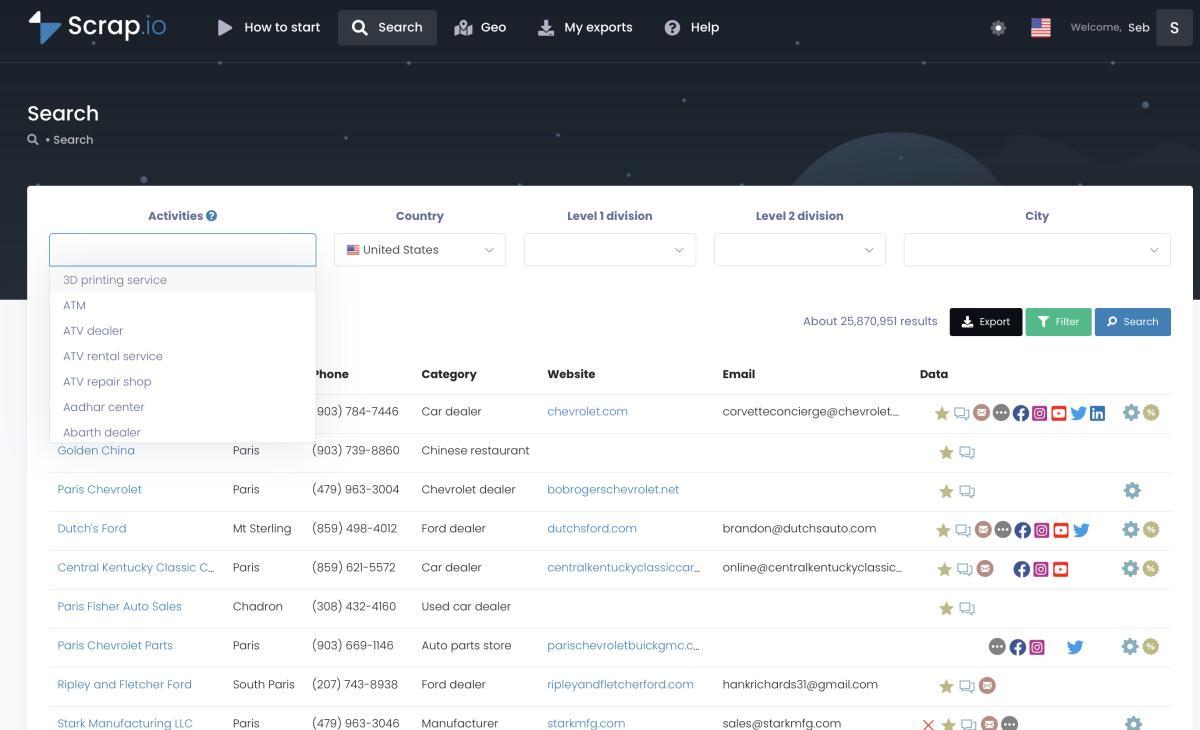
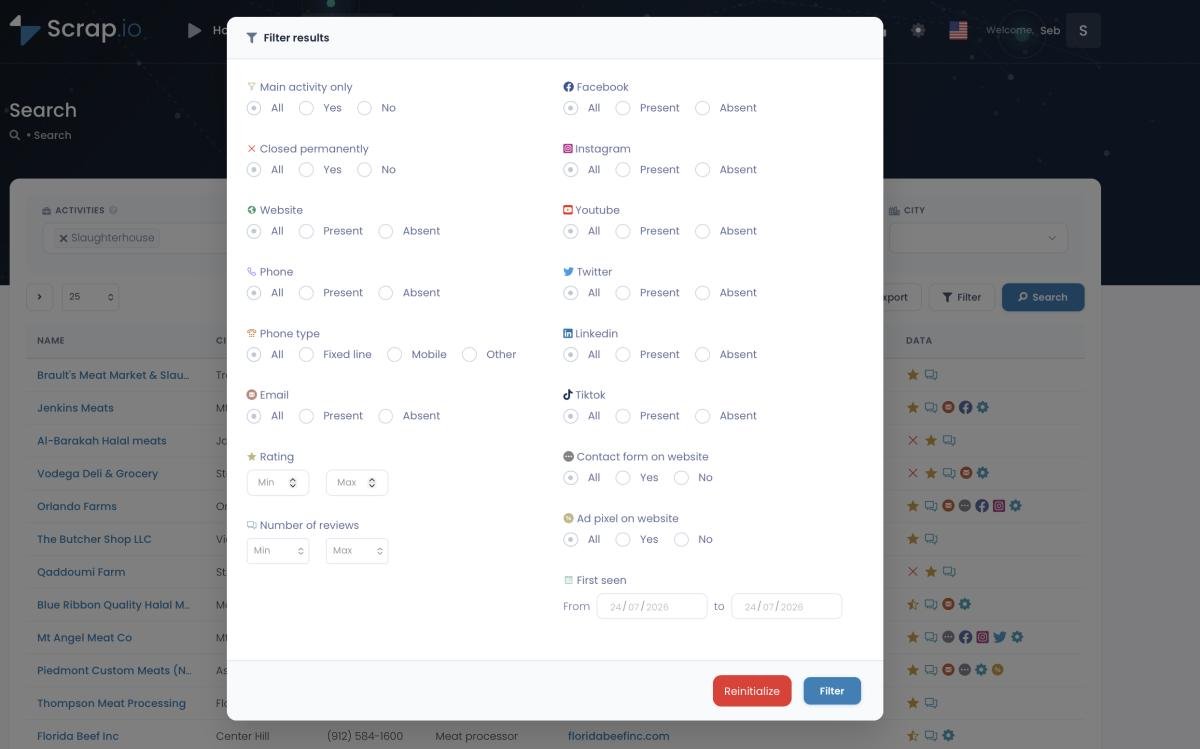
Then, and this is the part that saves your budget, you filter before extracting. Toggle "email present" and the count drops from 85,472 to the 17,068 carriers that actually have a usable email. You only spend credits on contacts you can reach. No paying for empty rows.
Video: Finding Clients Through Google Maps Filters
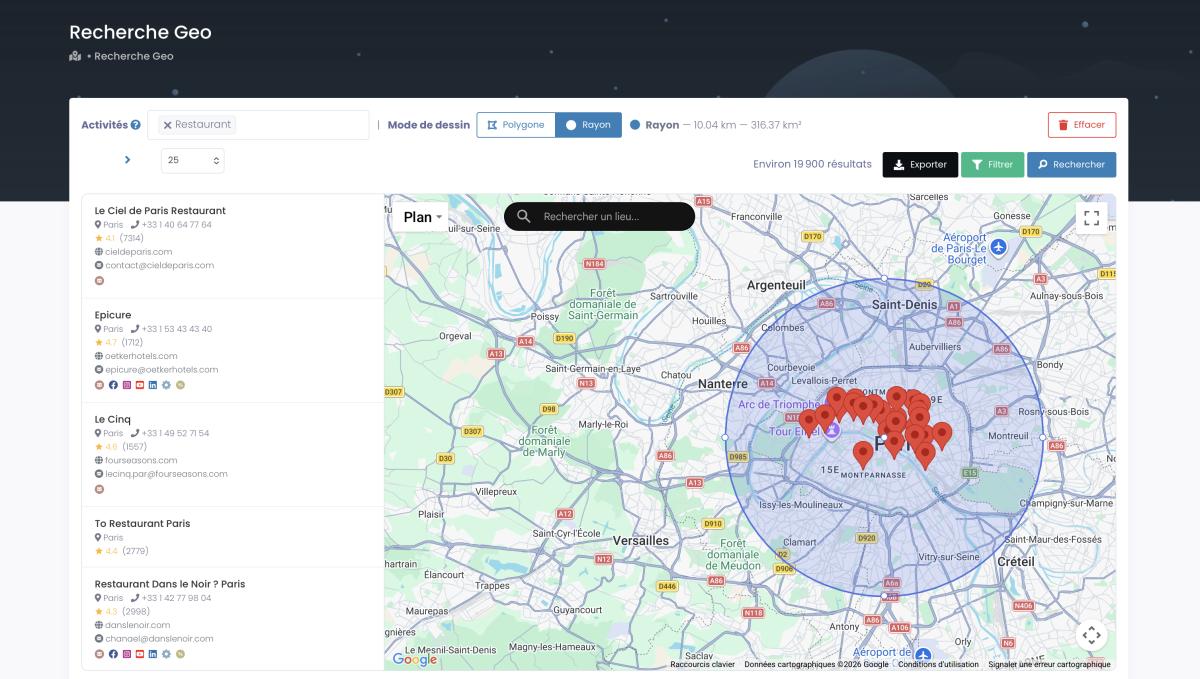
Geographic targeting is where it gets fun. Want every carrier within 50 miles of the Port of Los Angeles? Draw a radius. Every trucking business along the I-95 corridor from Miami to New York? Sketch a polygon on the map. Building a trucking company email list California-only? Search the state and export. Two clicks, no code.
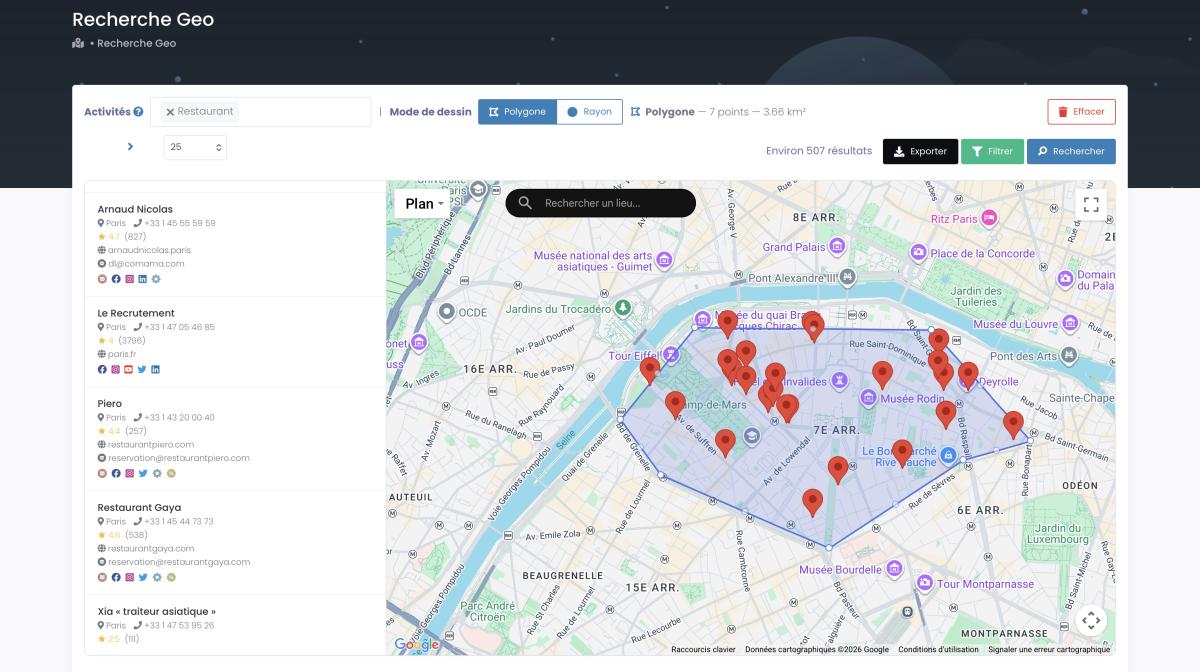
And you're not stuck at the city level. Scrap.io is the one tool I've seen that extracts every listing in an entire country in two clicks, so you can pull one state or the whole US in a single job.
Video: How to Scrape Local Leads at the Country Level
The onboarding takes about three minutes. Not exaggerating:
- Sign up for the free trial (100 export credits included).
- Search "trucking company" and zoom to your target area (or go nationwide).
- Filter for email present, phone present, rating, review count, claimed listing.
- Export your first batch to CSV or Excel.
- Import into your CRM or email platform.
The export isn't just an email column, either. You get the business name, address, phone number and its type, rating, review count, social links, website data, and Scrap.io's email classification, which separates an individual decision-maker's address (with first and last name) from the generic contact@ / sales@ / dispatch@ buckets. That last part is the whole game. The technique that saves you is the same one from any solid guide on finding emails on Google Maps: filter for a website plus a verified email, then target the nominal address, not the shared inbox.
One logistics software company I spoke with automated the entire thing. New trucking contacts feed their pipeline weekly, zero manual work after setup. If you want the mechanics, the complete Google Maps scraping guide covers the API and automation side.
Try Scrap.io free: 7 days and 100 export credits, no code. Pull a fresh, filtered, email-present trucking list from any state or the entire US, updated the moment you extract it. Start your free trial →
Best Practices for Trucking Industry Email Outreach
Good data gets you in the door. Your cold emailing strategy decides whether you stay there. A handful of things move the needle more than everything else combined in trucking, so start with these.
Subject Lines That Work
Truckers and fleet owners are drowning in vendor email. DOT alerts, fuel price warnings, insurance renewals: their inbox is a war zone. Your subject line has about two seconds.
What works: "Cut fuel costs by 12% (Dallas fleet saved $47K)." "Driver shortage solution: 3 Texas companies hiring faster." "ELD compliance without the headache." What gets deleted on sight: "Revolutionary logistics solution!!!" See the pattern? Specificity wins. Numbers win. A real problem in a real place wins. Generic excitement loses.
Timing Your Campaigns
After watching a lot of trucking campaigns, the pattern is consistent. Best days: Tuesday, Wednesday, Thursday. Best times: 5–7 AM or 7–9 PM. Drivers and owner-operators check email before and after driving hours, not during. Avoid: Monday mornings (weekend inbox pileup) and Friday afternoons (mentally clocked out). January through March is budget-planning season, perfect for software and service pitches. December? Nobody's signing contracts. Don't waste your best copy on it.
Deliverability & Verification
The trucking industry has a dirty secret: a lot of those "10,000 verified trucking contacts" you see advertised are 40%+ generic emails. dispatch@, info@, contact@. Shared inboxes nobody monitors closely.
Before you send anything, run your file through an email verification process. Remove hard bounces. Flag role-based addresses. Then warm up your sending domain: start at 50 emails a day, build to 200 over two weeks. A brand-new domain firing 2,000 emails on day one screams spam. And plan for a sequence, because one email won't cut it. Build a cold email follow-up sequence of 3–4 touchpoints over 2–3 weeks. The same warm-up logic applies across verticals. The manufacturer email list guide covers an identical process if you want a second walkthrough.
One honest note, since we're being straight with each other. We don't sell you a pre-built file and tell you it's clean. We hand you the extraction tool so the data is fresh at the moment you pull it. If you're comparing approaches across sectors, the broader USA business email database and email list by industry guides show the same real-time logic applied everywhere.
Is It Legal? CAN-SPAM & TCPA
Most articles skim this section. Don't. Especially in trucking, where regulators pay attention and carrier contacts are getting warier about unsolicited outreach.
CAN-SPAM (email). Clearly identify yourself, use honest subject lines, include a physical mailing address, provide a working unsubscribe link, and honor opt-outs within 10 business days. That's it. This applies to every commercial email sent to US recipients. The FTC's CAN-SPAM guide has the full checklist, and there's a deeper breakdown on cold email compliance if you want the walkthrough.
TCPA (calls and texts). This is the one people forget, and it can hurt badly. The Telephone Consumer Protection Act regulates robocalls, text messages, and some pre-recorded voicemails. Planning SMS outreach to trucking phone numbers (and a lot of people do, because truckers live on their phones) means you need express consent for autodialed calls and texts. Violations run $500–$1,500 per message. For a list of 5,000 contacts, that's bankruptcy-level risk if you get it wrong. B2B exemptions exist but they're narrower than most assume, and owner-operators often use a personal cell for business. Get legal advice specific to your use case before mass-texting carriers. Seriously.
Where the data comes from. Scrap.io only collects publicly available information that businesses chose to display on Google Maps. It's GDPR and CCPA compliant, and every record is traceable to its source. You're not buying scraped personal data from a shady broker. These companies listed their contact info publicly because they want to be found. That doesn't exempt you from honoring opt-outs at send time, but it puts you on solid legal ground.
FAQ
How many trucking companies are there in the US?
Depends how you count. FMCSA shows 2,079,041 active USDOT-registered motor carriers as of January 2026, including everyone from massive fleets to a guy with one box truck. Roughly 580,000 are interstate for-hire carriers, the ones most people mean by "trucking companies." Scrap.io's real-time database indexes 85,472 trucking businesses with active Google Maps listings, reflecting companies with a visible online presence you can actually contact.
What are the top trucking companies in the US?
It depends on how you slice revenue. By less-than-truckload and truckload revenue, the biggest names are FedEx Freight, Old Dominion Freight Line, and Estes Express Lines. Measured by total company revenue across every segment (parcel, logistics, dedicated), the ranking flips to UPS, FedEx, and J.B. Hunt Transport, per the Transport Topics Top 100. Here's the catch for outreach, though: those giants have procurement portals and gatekeepers. The 91.5% of carriers running 10 trucks or fewer are the ones you actually reach by email.
How do I get a trucking company email list for free?
Two honest routes. Use public sources (FMCSA/SAFER, business directories, company contact pages) and collect contacts manually. Or start a free Scrap.io trial (100 export credits) and pull a real, current batch to test. Free static lists and PDFs exist, but they're usually outdated, incomplete, and shared with thousands of others, which is why they bounce 25–35%.
Are trucking company email lists legal?
Yes, when built from public business data and used correctly. In the US, B2B cold email is legal under CAN-SPAM (identify yourself, include a physical address, honest subject line, working unsubscribe). SMS and phone outreach fall under TCPA, which is stricter and needs consent. Scrap.io collects only publicly displayed business data and is GDPR/CCPA compliant, with sources traceable. Always check current rules for your specific use case.
What's the difference between a trucking email list and a trucking company database?
A list is contacts and emails for outreach. A database adds firmographics (fleet size, DOT/MC number, reviews, location) for research and segmentation. A trucking database search helps you decide who to email; the list is how you reach them. A Scrap.io export includes both in one file, so you can segment a truck driver email list by fleet size and still have the contact ready to send.
How do I avoid generic dispatch@ emails?
Filter for a website plus a verified email, then lean on Scrap.io's email classification, which separates an individual decision-maker's address (with first and last name) from generic buckets like dispatch@, info@, and sales@. Personal emails outperform generic ones by 2–3x on open rate. Targeting the owner of a 15-truck fleet about rising insurance costs lands very differently than a message buried in a shared dispatch queue nobody checks before 10 AM.
What's the average bounce rate for a trucking email list?
From traditional static lists, expect 25–35% hard bounces, sometimes higher, well above the 2–3% considered acceptable in most industries. Trucking's high turnover and rapid carrier churn are the culprits. Live sources like Scrap.io typically deliver under 10%, because you're pulling current listings rather than historical records.
Can I filter a trucking company email list by state?
Yes. Search "trucking company," then zoom to any state (Texas, California, Florida, Illinois, wherever the density is) or draw a custom area on the map to follow a freight corridor. If you're building a list of owner operator truck drivers or a fleet manager email list for one region, this is the fastest way to get it with current data instead of a static directory.
Stop buying lists that bounce. Extract a fresh trucking company email list today: 85,472 US carriers on Google Maps, filtered to verified emails before you spend a credit, updated in real time. Try Scrap.io free: 7 days + 100 export credits →
Generate a list of trucking company with Scrap.io