

- What Are Cold, Warm, and Hot Leads?
- Why Lead Temperature Changes Everything
- Cold Leads: How to Build Trust From Scratch
- Warm Leads: How to Nurture Without Losing Momentum
- How to Turn Cold Leads Into Warm Leads
- Cold Calling vs Warm Calling in 2026
- Compliance: Staying Legal With Cold Outreach
- FAQ: Warm Leads vs Cold Leads
79% of leads never convert to sales, and I bet you already knew that, at least intuitively, because you've watched it happen in your own pipeline.
The reason isn't complicated. Most sales teams just… don't adjust. They write one email sequence, point it at every contact they have, and hope for the best. Doesn't matter if someone's been reading your blog for three months or if they have genuinely zero idea who you are. Same message. Same cadence. Same desperate "just checking in!" follow-up on day seven.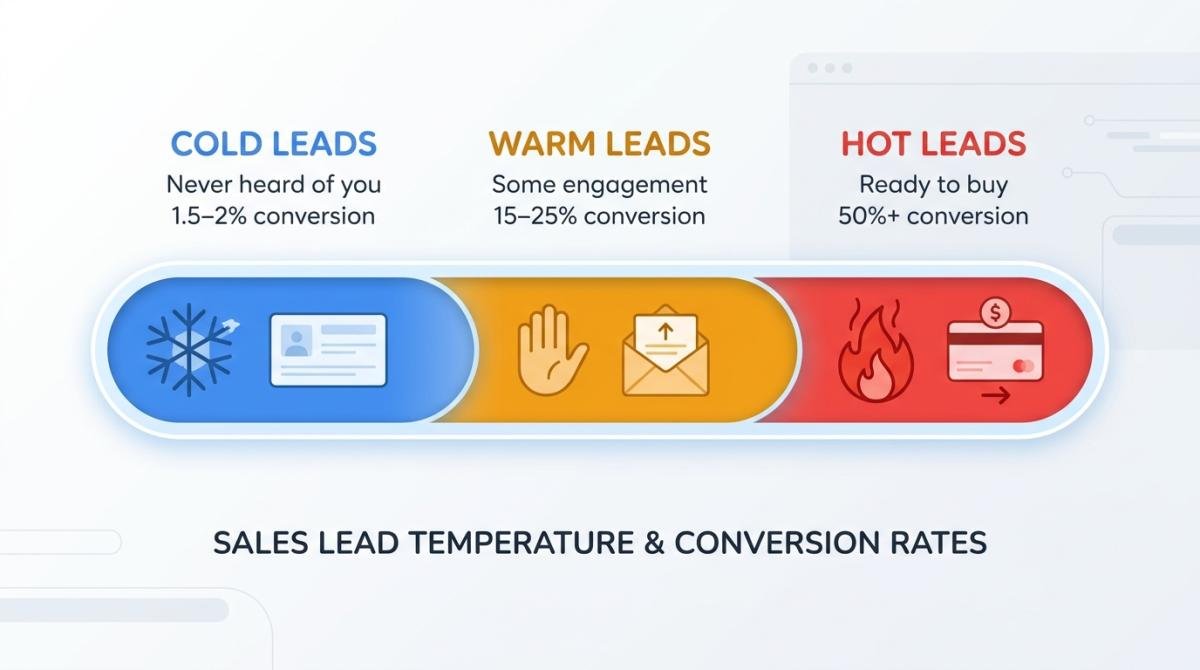
I watched a guy (we'll call him Jake) do exactly this last year. Jake runs a decent B2B SaaS company, project management tool, nothing revolutionary but it works. He had around 5,000 contacts in a spreadsheet. Some of those people had signed up for his webinar the previous week. They were warm, engaged, ready to hear more. The rest? Scraped from some directory. Never heard of Jake. Never asked for anything. Jake sent every single one of them the same "Book a demo today!" email and then couldn't figure out why his response rate was basically zero. The warm people felt rushed and annoyed. The cold people felt confused and a little creeped out. Nobody booked anything.
And look. Jake's not dumb. He just made the mistake that almost everybody makes, which is treating warm leads vs cold leads as if they're the same thing. They're not. Not even a little bit. Gong Research found that warm calls are 4.2× more likely to result in a meeting than cold ones. That's not a marginal improvement. That's a completely different sport.
Video: Scrap.io: How to Start? A two-minute look at building a fresh cold list before you ever think about warm leads vs cold leads.
What Are Cold, Warm, and Hot Leads? (Definitions That Actually Matter)
I know "lead temperature" sounds like one of those things a marketing VP says in a meeting to seem smart. But stick with me because the framework is genuinely useful once you strip away the jargon. There are three types of leads, and each one wants a different conversation:
- Cold leads: no relationship, no awareness. You reached out first.
- Warm leads: some awareness or interest. They took a voluntary step toward you.
- Hot leads: active buying intent. They're asking about pricing and timelines.
Cold Leads: Starting From Zero
Cold leads have no idea you exist. None. They haven't been to your website, haven't opened an email from you, haven't stumbled across your LinkedIn content. You got their name from a list or a database or Google Maps, and you decided to reach out. The relationship (if you can even call it that) goes one direction only.
So what is a cold lead in sales, practically? It's a name and an email address. Maybe a phone number. It's the business card you grabbed at a conference from someone who was clearly just trying to escape the conversation. Cold leads aren't worthless (far from it), but they're strangers. You have to treat them like strangers.
Warm Leads: Interest Without Commitment
What's considered a warm lead? A warm lead is a prospect who has taken at least one voluntary action that signals awareness or interest, opening a couple of your emails, visiting your site, downloading a resource, or replying to outreach. They already know who you are. They haven't committed to anything, but they've raised their hand slightly, which puts them worlds ahead of a cold contact who's never heard your name.
A warm lead has done something. Could be small: opened a couple of your emails, visited your site, downloaded a PDF. Could be bigger: replied to an outreach email, attended a webinar, spent ten minutes on your pricing page. The warm lead definition basically comes down to this: they know who you are, and they've taken at least one voluntary step in your direction. That's it. A warm prospect meaning in sales is just someone who raised their hand slightly. They're not waving. But the hand is up.
Hot Leads: Ready to Buy
Hot leads fill out "contact sales" forms at weird hours. They ask about pricing unprompted. They want to know about implementation timelines. These people have budget, authority, need, and timeline: all the BANT stuff sales managers love talking about. And here's a stat that should change how you operate: responding to a hot lead within 5 minutes makes you 10× more likely to actually reach them (SalesHive 2025). Five minutes. Most teams don't respond in five hours.
The warm leads vs hot leads distinction comes down to urgency. A warm lead knows your brand and shows mild interest, but isn't ready to buy. A hot lead is actively evaluating: requesting demos, asking about pricing, close to a decision. Warm leads are browsing. Hot leads already have their credit card half out of their pocket.
Quick Comparison Table
| Cold Leads | Warm Leads | Hot Leads | |
|---|---|---|---|
| Awareness | Never heard of you | Recognizes your brand | Actively researching you |
| Engagement | Zero | Some (email opens, site visits, downloads) | High (demo requests, pricing inquiries) |
| Intent | Unknown | Mild to moderate | Strong |
| Conversion Rate | 1.5-2% (SalesHive 2025) | 15-25% (SalesHive 2025) | 50%+ with fast response |
| Approach | Educate, build trust | Nurture, personalize | Act fast, close |
| Timeline | Weeks to months | Days to weeks | Hours to days |
| Email Reply Rate | 5.1-5.8% (Snov.io 2026) | ~21% (Marketing LTB 2025) | Direct response |
Stare at the conversion column for a second. We're talking about 1.5% versus 25%. That's not a "we should probably try harder" gap. That's a "we're fundamentally doing this wrong" gap. And it exists purely because of how you handle different types of leads in sales. Not because cold leads are bad people.
Why Lead Temperature Changes Everything About Your Approach
The Data Behind the Temperature Gap
Martal Group published something in 2025 that stuck with me: only 27% of B2B leads are sales-ready when you first get them. Which means three out of four people in your pipeline aren't ready to buy anything yet. So when you hit them with a "Book a demo!" email on day one, you're essentially asking someone who just walked into a bookstore if they'd like to purchase the building.
Here's what really sold me on the temperature approach though. Forrester research (cited by UserGems) showed that proper lead nurturing (meaning actually treating cold and warm differently) generates 50% more sales-ready leads at 33% less cost. You get more while spending less. I don't know why more teams don't do this. Actually, I do. It requires patience, and most sales orgs reward speed over strategy.
Cold Lead Conversion Benchmarks (2026)
Let's get specific. Cold lists convert at roughly 1.5 to 2%. Cold email reply rates sit around 5.1 to 5.8% based on Snov.io's 2026 numbers. Cold calls average 2-3% conversion, though the experienced reps with genuinely good targeting can push 5-8% (Cognism 2025, Cleverly 2025). None of these numbers are exciting on their own. But cold outreach was never supposed to be exciting, it's supposed to be the first step in a longer process.
Warm Lead Conversion Benchmarks (2026)
Warm emails, by contrast, pull about a 21% reply rate (Marketing LTB 2025). Warm calls are 4.2× more likely to get you a meeting. Warm introductions convert somewhere between 15 and 25%, compared to that 1.5-2% on the cold side. The gap is enormous and it should inform everything about how you build your outreach.
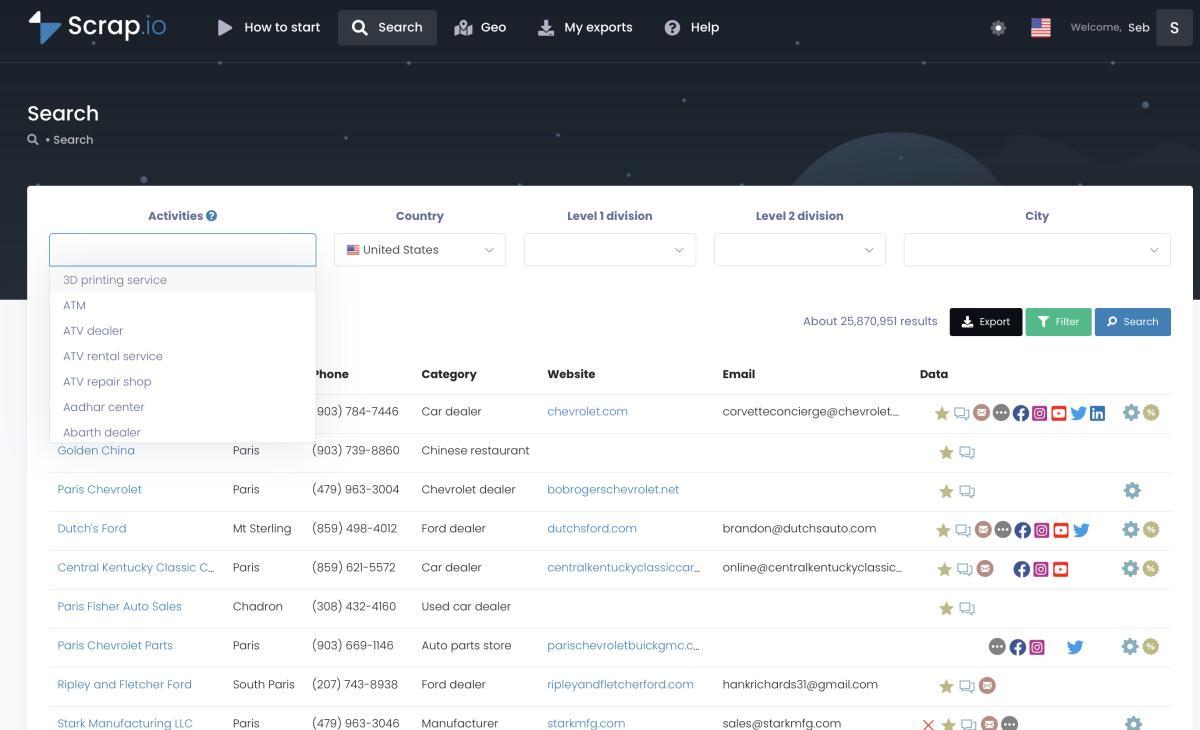
Your starting list decides half the game. Scrap.io builds cold prospect lists in real time from Google Maps: 225M+ businesses across 195 countries, filtered before you spend a credit so you only pay for contacts worth warming up. Free 7-day trial, 100 leads included.
Cold Leads: How to Build Trust From Scratch
Cold Email Strategy (Subject Lines, Sequences, Personalization)
Everything rides on the subject line. Cold leads give you maybe two seconds before they decide whether to open or archive, and Snov.io's 2026 data says personalized subject lines improve reply rates by 30.5%. That's a massive lift from something that takes thirty extra seconds to write.
The cold email outreach strategies that actually work tend to be embarrassingly simple. Subject line: "Quick question about [their specific problem]." Body: three sentences. What you do, why it matters to them specifically, one clear next step. Done. That's your first email. Save the detailed pitch for email three or four. If you want the full breakdown, our guide on how to write a cold email walks through the five-part framework line by line, and these cold email templates show what a $20M cold email pipeline actually looks like in practice.
A good cold lead email strategy runs 3 to 5 touches over a few weeks. Each one needs to bring something new to the table, different angle, new stat, relevant case study, whatever. The moment you send "just following up on my last email" without adding any value, you become noise. Everyone's inbox is already full of noise. If you're not sure how to space those touches, our cold email follow-up guide for 2026 lays out the exact cadence, email by email.
Cold Calling in 2026 (Scripts, Timing, Success Rates)
Cold calling is not dead, despite what LinkedIn influencers keep saying. What's dead is lazy cold calling: the kind where someone reads a monotone script at you for 45 seconds before you can get a word in.
The numbers: 2-3% average conversion rate, with the top 20% of reps hitting 5-8%. The gap comes down to preparation, mostly. Reps who look at cold calling script examples and then adapt them to sound like actual human conversation do dramatically better than people who treat the script as sacred text. Best time to call is Tuesday through Thursday, either early morning or around 4-5pm when people have wrapped up their meetings and have a spare moment to actually talk.
The Multi-Touch Cold Outreach Framework
One channel doesn't cut it anymore. Email plus LinkedIn plus phone: three different touchpoints over two weeks, each one adding value without applying pressure. That coordinated, cross-channel motion is what a real omnichannel outreach sequence looks like. The whole key to how to approach a cold lead is remembering that you're starting from zero trust. Everything you do in those first few interactions needs to deposit goodwill before you ever try to make a withdrawal. Industry insights, useful benchmarks, relevant content. Give before you ask.
Warm Leads: How to Nurture Without Losing Momentum
The trap with warm leads is treating them like they're either cold or hot, when they're actually neither. Go too soft and you lose the momentum they've already built up. Go too hard and you spook them. It's a balancing act, and honestly most companies are terrible at it.
Lead Scoring Basics
Not every warm lead is equally warm, someone who opened a single email last month is very different from someone who hit your pricing page three times this week. You don't need expensive software to track this. Email open, one point. Link click, three points. Pricing page visit, ten. Content download, five. Cross twenty points and you can be more direct. Stay below it and keep nurturing. Simple enough that you could run it in a spreadsheet if you had to.
Warm Email & Calling Techniques
The warm outreach course we put together goes deep on this, but here's the short version: reference what they actually did. "Saw you downloaded our guide on X. A lot of people who start there end up wanting to know about Y, want me to walk you through it?" That's warm calling in a nutshell, and our full warm calling guide breaks down the 5-step framework and scripts. When someone already knows your name, you skip the entire credibility-building phase and jump straight into relevance.
From Warm to Hot: Acceleration Tactics
Warm lead nurturing best practices boil down to speed and specificity. Follow up within 24-48 hours of any engagement. Match your content to their interest. Show proof from companies similar to theirs. And make the next step absurdly easy to say yes to, not "let's schedule a 45-minute demo" but "I can send over a two-minute video that shows exactly how this works."
What makes a lead warm enough to accelerate? Look for compound engagement: when someone does more than one thing across more than one channel in a short window. A pricing page visit plus an email click plus a LinkedIn profile view in the same week? That person is considering you. Move.
How to Turn Cold Leads Into Warm Leads (The Warming Playbook)
This is the section most people actually came here for. How to turn cold leads into warm leads is not a mystery and it's not magic. It's a repeatable sequence with documented results behind it.
Real Case Studies: JAMF, DocuSign, ServiceNow
I want to show you some real cold lead vs warm lead examples, because abstract advice only goes so far.
JAMF is an Apple device management company. Qualent Media ran their lead scoring program, and here's what they found: first-time cold contacts converted into MQLs at around 12-15%. Not terrible, but not amazing either. After running those same contacts through 3-4 nurturing touches (educational emails, industry-relevant content, a bit of personalization), conversion jumped above 40%. Same people. Completely different outcome. The only thing that changed was how they were approached.
DocuSign saw something similar. Qualent Media combined content syndication with structured lead nurturing and generated $9.3 million in influenced pipeline, with 38% better conversion rates than their previous approach. That's not pocket change. That's serious revenue attributable to the simple act of matching your message to where someone actually is in their buying journey.
ServiceNow went all-in on the classification of sales leads hot warm cold and it paid off massively: 600+ qualified leads identified, over $15M in pipeline. And then there's Belkins, a lead management agency that ran ICP-driven cold campaigns and generated 1,000+ pipeline leads and 120 new appointments through systematic warming sequences.
A broader benchmark from SPP.co's 2025 agency report puts numbers to what should already be obvious: agencies that match tactics to lead temperature report 30-50% better conversion and 20-40% shorter sales cycles. The data is not ambiguous here.
Same leads, 12% → 40% once warmed. The warming only works if the list underneath it is clean and pre-qualified. Start with a filtered, real-time list from Scrap.io: pick your category and location, keep only the businesses that fit your ICP, and export fresh Google Maps data validated at the moment of extraction. Free 7-day trial, 100 leads offered.
The 5-Touch Warming Sequence
Here's how to warm up cold prospects in practice:
- Value-first email: Something genuinely useful with absolutely no pitch attached. An industry report, a benchmark they'd care about, an insight that shows you understand their world. The bar here is: would this be worth reading even if they never bought from you?
- Social proof touch: Send a case study from a company that looks like theirs, or connect on LinkedIn with a note that references something specific about their business. Not the generic "I'd like to add you to my professional network" template that nobody reads.
- Content engagement: Show up in their world without asking for anything. Comment on a LinkedIn post. Share something they wrote. Let them see your name in a context that isn't "person trying to sell me stuff."
- Direct value offer: A free audit, a custom analysis, a personalized report. Something that clearly required effort on your end and demonstrates you actually know their business.
- Conversation starter: Now you've built enough trust to ask for time. Reference the previous touches so they know this isn't coming from nowhere. Keep the ask small: fifteen minutes, not an hour.
Video: Finding Clients Through Google Maps Filters, how to segment a cold list before you start warming it.
Using Data to Personalize at Scale
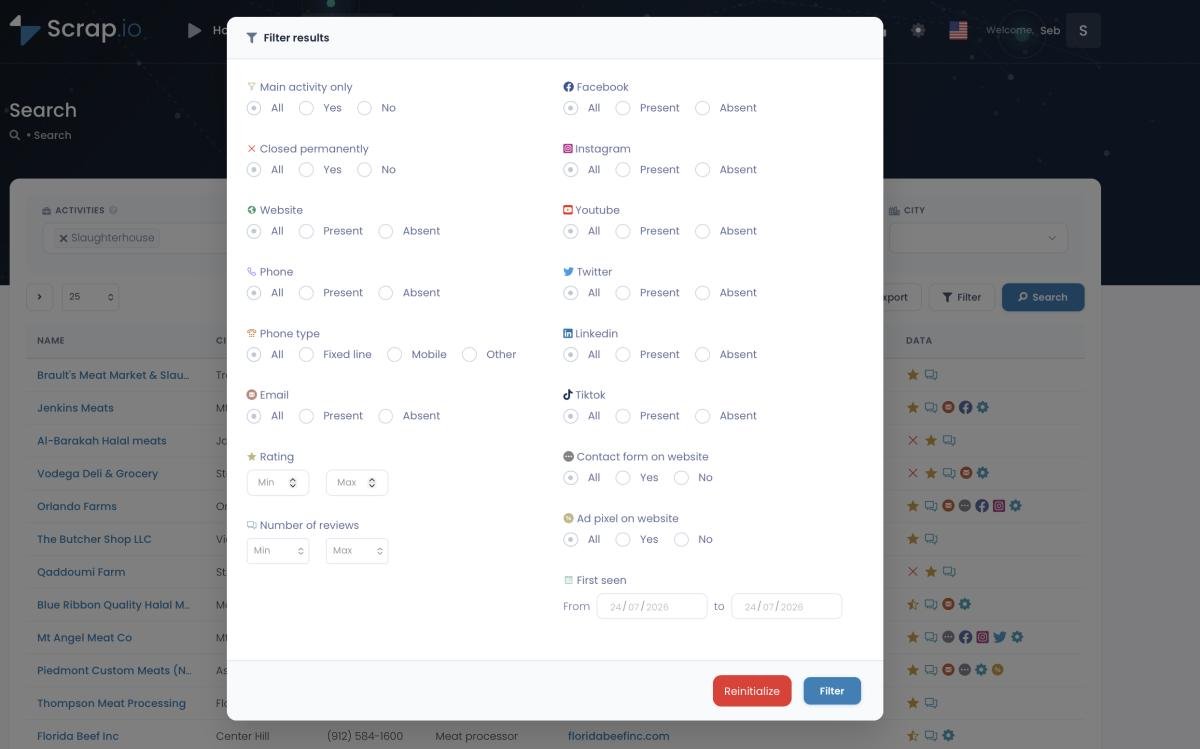
The whole thing falls apart if you can't personalize beyond first-name tokens. Start with your ideal customer profile (really nail down who you're targeting), and then break your cold list into micro-segments by industry, size, geography, whatever makes sense for your product. With Scrap.io you filter before extraction, so you only ever pay for the contacts that match those micro-segments. If you're building that list from scratch, here's exactly how to find emails on Google Maps without clicking through listings one by one.
Someone on r/LeadGeneration put it bluntly: "I've only ever bought cold leads. These usually average between $100-$600 per 1,000 leads." That's the cost of entry. But the cold lead conversion rate benchmark data tells us that raw lists only work when you invest in actually warming the contacts. A big discussion on r/salestechniques this past January (about 30 comments' worth) compared cold and warm approaches across industries and the consensus was pretty clear: cold works for volume, warm works for conversion, smart teams use both. And on r/sales, the perennial "where do you draw the line between cold and warm" debate keeps landing in the same place, warm means the prospect did something, cold means they didn't.
Over on r/Entrepreneur, the recurring advice is to lead with a lead magnet to build trust before any cold outreach, which tracks with what we cover in our lead nurturing guide about turning cold prospects into buyers. Once the replies start coming in, the next skill is turning those exports into revenue, which is the whole point of our guide on how to convert scraped leads into customers.
If you want to build your own pipeline, Scrap.io gives you 100 free leads from their real-time database of over 225M businesses: fresh Google Maps data, not recycled lists from six months ago where half the contacts have already changed jobs.
Cold Calling vs Warm Calling: Which Works Better in 2026?
Success Rates Compared
The cold calling success rate numbers are unambiguous. Cold calls: 2-3% average, 5-8% for the best reps in the room. Warm calls: 4.2× more likely to get a meeting, per Gong Research. When someone recognizes your name before you even start talking, the entire dynamic shifts. Higher pick-up rate, deeper conversation, faster path to a commitment.
Video: Scrap.io vs Apollo: which tool fits which type of prospecting, and how the data source shapes whether you're working cold or warm.
When to Use Each
Cold calling has its place: when you're entering a totally new market with zero brand recognition, or when your product solves such an obvious pain point that even a stranger can see the value in thirty seconds. Volume play, numbers game, requires thick skin.
Warm calling is for everything else. Post-webinar follow-ups. People who engaged with your content. Mutual introductions. Anywhere there's existing context, warm calling outperforms cold by a wide margin. The question of warm calling vs cold calling which is better sort of misses the point. The real question is which one matches the situation you're in right now.
The Hybrid Approach
What actually works in 2026: use cold outreach to generate the first spark of awareness, then pivot to warm tactics the moment someone engages. Cold email goes out, they click a link, you call them warm the next morning referencing the specific thing they clicked on. Cold LinkedIn DM, they view your profile, you follow up with a relevant email. The transition from cold to warm doesn't have to take weeks. Sometimes it happens in 24 hours if you're paying attention.
Compliance: Staying Legal With Cold Outreach
I know nobody reads this section for fun, but getting cold outreach compliance wrong can cost you way more than a few lost deals.
CAN-SPAM Requirements
If you're emailing US contacts: honest subject lines, real sender info, working unsubscribe in every message, your physical business address. Process opt-outs within ten business days. And for the love of god, don't use "Re: our conversation" as a subject line when you've never spoken to the person. That's both deceptive and illegal under CAN-SPAM. The FTC's CAN-SPAM compliance guide spells out every requirement, including the penalties (up to $53,088 per email).
GDPR Considerations for B2B
European contacts add GDPR to the mix. You need legitimate interest as your legal basis, documented properly. Clean data sources. Easy opt-outs. Using publicly available information (the kind businesses post voluntarily on Google Maps or their own websites) keeps you on firm legal ground. That's the approach Scrap.io takes, which is why the data comes out GDPR- and CCPA-compliant from the start, with every record traceable to its public source.
Email Authentication (SPF, DKIM, DMARC)
Gmail, Yahoo, and Microsoft are all aggressively filtering unauthenticated senders in 2026. If you haven't set up SPF, DKIM, and DMARC for your sending domain, a big chunk of your emails (cold and warm alike) are landing in spam folders that nobody checks. Google's own sender guidelines now make authentication mandatory, and our email validation guide covers the technical side plus list cleaning best practices. Bounced emails tank your sender reputation fast, and once that reputation's gone, recovering it is painful.
FAQ: Warm Leads vs Cold Leads
What is the difference between a cold and warm lead?
A cold lead has never interacted with your business: no emails opened, no website visits, no engagement at all. A warm lead has taken some kind of action that shows awareness or interest: visiting your site, downloading content, replying to an email. Cold leads need trust-building from scratch. Warm leads already have enough context that you can skip ahead to relevance and value.
What is an example of a cold lead vs a warm lead?
Cold: you export 500 marketing agencies from a directory and email them. They've never heard of you. Warm: someone reads a blog post, clicks through to your pricing page, then subscribes to your newsletter over a week. That person took three deliberate actions, so your messaging should meet them further along the journey than a cold contact.
How do you turn a cold lead into a warm lead?
Structured nurturing over 3-5 touchpoints. Value first, no pitch. Social proof second. Content engagement third. Personalized offer fourth. Conversation request fifth. JAMF's case study is the cleanest example: cold contacts converted at 12-15%, then jumped to 40%+ after just three or four nurturing interactions. Same leads, radically different outcomes, because the approach changed.
What is the conversion rate of warm leads vs cold leads?
The numbers across multiple 2025-2026 sources are pretty consistent:
| Metric | Cold Leads | Warm Leads |
|---|---|---|
| List Conversion Rate | 1.5-2% | 15-25% |
| Email Reply Rate | 5.1-5.8% | ~21% |
| Call-to-Meeting Rate | 2-3% avg | 4.2× higher |
| Cost Per Lead | Lower upfront | Higher, but better ROI |
Sources: SalesHive 2025, Snov.io 2026, Marketing LTB 2025, Gong Research.
What is the 5-minute rule for leads?
Respond to an inbound or hot lead within 5 minutes of their action. Waiting longer collapses your odds of reaching them. SalesHive's 2025 data shows a five-minute response makes you up to 10× more likely to connect than a five-hour one. For engaged leads, speed is the single biggest lever on conversion. Nothing else in your sequence matters if you show up a day late.
Is cold calling still effective in 2026?
It is, but the bar for "effective" has moved way up. The average rep converts at 2-3%, while the best in the business push 5-8% through better research, actual personalization (not just reading a name off a screen), and multi-channel coordination. Cold calling as a standalone tactic is rough. Cold calling as one part of a broader system that includes email and social? Still absolutely viable.
What Should You Do Right Now?
The gap between warm leads vs cold leads isn't theoretical. It's the gap between a 2% conversion rate and a 25% one. Between spending money on outreach that goes nowhere and building relationships that actually turn into contracts.
Lead nurturing generates 50% more sales-ready leads at 33% less cost. JAMF saw cold contacts go from 12% to 40%+ conversion. DocuSign influenced $9.3M in pipeline. These aren't hypothetical outcomes from a whitepaper. They're documented results from real programs.
Go look at your pipeline right now. Tag everything as cold, warm, or hot. Then ask yourself: am I actually approaching each group differently, or am I just sending the same message to everyone and hoping? Because if it's the second one, you already know what's going wrong.
Need a cold prospect list that isn't stale? Give Scrap.io a shot: free 7-day trial, 100 verified business leads from live Google Maps data across 195 countries and 4,000+ categories. Filter by rating, email, phone type or social presence before you spend a credit, and see for yourself whether fresh contacts make a difference. Your first 100 leads are free.
Now close this tab and go work your pipeline. Reading one more guide isn't what's going to move the needle.
Generate a list of restaurant with Scrap.io