

There are 5,479,045 companies on the UK register. Not a single one comes with an email address.
Read that again. The most complete record of British business on the planet — every limited company, every director, every registered office — and there's not one phone number or inbox you can actually write to. It's public. It's free. And for prospecting, it's half a tool.
So here's the plan. We'll cover what Companies House data actually contains, how to download it for free (three ways), where it quietly falls apart the second you try to sell to anyone, and how to turn those bare names into leads you can email and call. Fair warning: we do this for a living at Scrap.io, so we have opinions.
- What is Companies House data (and what's actually in it)?
- How to download Companies House data for free
- The honest limits: what Companies House data won't give you
- From raw records to reachable leads: enriching Companies House data
- Step-by-step: enrich UK company data with Scrap.io
- UK business data at scale: what the map reveals
- Is it legal? Using UK company data for prospecting (GDPR)
- FAQ
What is Companies House data (and what's actually in it)?
Companies House is the UK's official registrar of companies. Every limited company and LLP in the country has to register there and file information under the Companies Act 2006. The result is a single public record — the Companies House register — that banks, journalists, credit agencies, and prospectors all lean on daily. It's the UK companies register in its rawest, most official form.
So what's inside a record? Each company profile carries the company number, the registered office address, the current status (live, dormant, in liquidation, dissolved), the incorporation date, the SIC code describing the nature of the business, key filing dates (last accounts, next confirmation statement due), previous names, mortgage charges, and a URI that links straight to the machine-readable version. That's the skeleton of a business. Legal, structural, administrative.
How big is it? At the end of March 2026 the total register held 5,479,045 companies, of which 4,930,634 sat on the effective register — the live ones, excluding those in the process of dissolution or liquidation (GOV.UK, 2026). Across the 2025–26 financial year, roughly 815,000 new incorporations landed against about 787,000 dissolutions. The register breathes. Companies appear, companies die, and the file you downloaded last month is already slightly wrong.
Quick summary for anyone skimming: Companies House data is the free, official record of who legally exists in UK business — company numbers, addresses, statuses, SIC codes, and filing dates — covering nearly 5.5 million companies. What it tells you is who exists. Not how to reach them. Keep that distinction. The whole article hangs on it.
How to download Companies House data for free
Yes, all of it is free. No paywall, no premium tier, no "contact sales" button. There are three real ways to get all of it out, and which one you pick depends entirely on whether you want a bulk snapshot, a single lookup, or a live feed into your own software.
Method 1 — The Free Company Data Product (bulk download)
This is the big one for anyone who wants everything at once. The Free Company Data Product is a monthly snapshot of every live company on the register, published as a set of ZIP files containing plain CSV. You grab it from download.companieshouse.gov.uk, unzip, and you're staring at millions of rows. This is what people mean when they say companies house bulk data — one giant companies house data download, ready for a spreadsheet or a database.
One catch worth knowing upfront: the snapshot is compiled to the end of the previous month and posted within five working days of month-end. So it's a photograph, not a live feed. More on why that matters in a minute.
Method 2 — Find and update company information (single lookups)
Need to check one company right now? Use the Find and update company information service. Type a name or number, and up comes the profile — status, address, filing history, officers, the lot. Filings are free to download as PDFs. It's brilliant for due diligence on a business you already know about. But the Companies House data search only accepts a company name or number — so for discovery, building a list from scratch, it's close to useless. Want filing alerts on companies you follow? You'll need a Companies House data login (just an email and password) to set those up. Handy for monitoring. Useless for prospecting. We'll get to that.
Method 3 — The Companies House API (real-time, programmatic)
If you're a developer, or you're feeding another system, the Companies House API is the move. It's free, fully documented, and returns live, real-time data on any company on demand — the opposite of the monthly snapshot. You register an application, generate a companies house api key, and query with a Bearer token. The companies house api documentation covers every endpoint.
A basic profile lookup looks like this:
Back comes clean JSON — company name, status, registered address, SIC codes, accounts dates. Great for validating records or enriching a CRM with legal status. Great for companies house data api workflows. Still no email. Still no phone. (Told you.) Which brings us to the part nobody in the SERP wants to say out loud.
The honest limits: what Companies House data won't give you
Let's be honest about the thing that gets buried. Companies House was built to record legal existence, not to help you sell anything. And it shows.
No emails. No phone numbers. None. This isn't an oversight you can work around with the right endpoint — it's by design. When a developer asked the official Companies House developer forum whether there was a request type for business email and phone, the answer was blunt: "Company, email address and phone number are not prescribed under the Companies Act 2006. Therefore, they are not captured by Companies House." Another user, years earlier, asked simply where to find the telephone number for a company or director. The staff reply: "The only contact information collected for both companies and directors is a postal address, we do not collect telephone numbers." A postal address. In 2026. That's your contact channel — a letter.
No verified director contact — and director search is name-only
You'd think companies house director search would be the loophole. It isn't. You can find a director's name, date of birth (month and year), nationality, and their other appointments — but no way to reach them. You can't even search by anything except a name. So the answer to "how to get company directors email addresses uk" from Companies House alone is: you can't. The register gives you a person's name and a list of companies. Not an inbox.
Unverified, PDF-locked, and only a monthly snapshot
Then there's data quality. Companies House doesn't verify what's filed — the responsibility sits with the company. Beauhurst, a paid UK data platform, puts it plainly in their own guide: "Companies House covers all UK companies, but data is unverified, search tools are basic, and filings are often locked in PDFs" (Beauhurst, 2025). The Data City makes a similar point about the SIC codes underpinning the register — they "are outdated and often fail to describe modern tech sectors accurately" (The Data City, 2024). And the bulk file? A monthly snapshot, refreshed within five working days of month-end. Not real time. Not close.
Here's the gap, side by side.
| ✅ In the register | ❌ Missing from the register |
|---|---|
| Company number | Email address |
| Registered office address | Phone number (landline or mobile) |
| Company status & incorporation date | Verified director contact details |
| SIC code & filing dates | Website, social profiles |
| Previous names, mortgage charges | Real-time updates (it's a monthly snapshot) |
The register tells you who exists. It refuses to tell you how to reach them. So if your goal is prospecting, you've got a list of names and a wall. The good news? There's a way through it.
From raw records to reachable leads: enriching Companies House data
Here's the counterintuitive bit. The best source of UK business contact data isn't a company register at all. It's a map.
Think about it. Every business that wants customers puts itself on Google Maps — with a website, a phone number, opening hours, reviews. And that website almost always has an email somewhere. So the enrichment principle is simple: take the legal record from Companies House (name + registered address), match it to the live Google Maps listing, and pull the contact data the register never held. That's companies house data enrichment in one sentence. The register says a company exists; the map says how to call it.
This is exactly what Scrap.io does, and it's where the "raw record to reachable lead" jump happens. A few things make it work at UK scale. It extracts in real time — every export is freshly scraped, not pulled from some database built six months ago. It lets you find emails on Google Maps and scrape phone numbers on Google Maps (classified as landline or mobile) across an entire country in two clicks. And — this is the part that saves money — it filters before extraction, so you only spend credits on businesses that actually have the contact detail you need. No paying for 10,000 rows to discover 6,000 are dead ends. If you want the full technical picture, the Google Maps scraping guide and the Google Maps Scraper API both go deeper.
Watch it once and it clicks:
Video: Scrap.io - How to Start
See what enriched UK company data actually looks like. Try Scrap.io free for 7 days — 100 leads included. Pull a category, pick the UK, and watch names turn into emails and phone numbers before you spend a cent.
Step-by-step: enrich UK company data with Scrap.io
A Manchester agency we know had the classic problem. They'd downloaded the whole Companies House bulk file, filtered it to local marketing agencies and web studios, and ended up with a beautiful spreadsheet of names and registered addresses. Then they tried to run a campaign. Nothing to email. Nothing to call. Two weeks of work, zero contactable leads. Painful to watch.
Here's the workflow that would've saved them an afternoon.
Step 1 — Pick a category and a UK zone (or skip the category entirely)
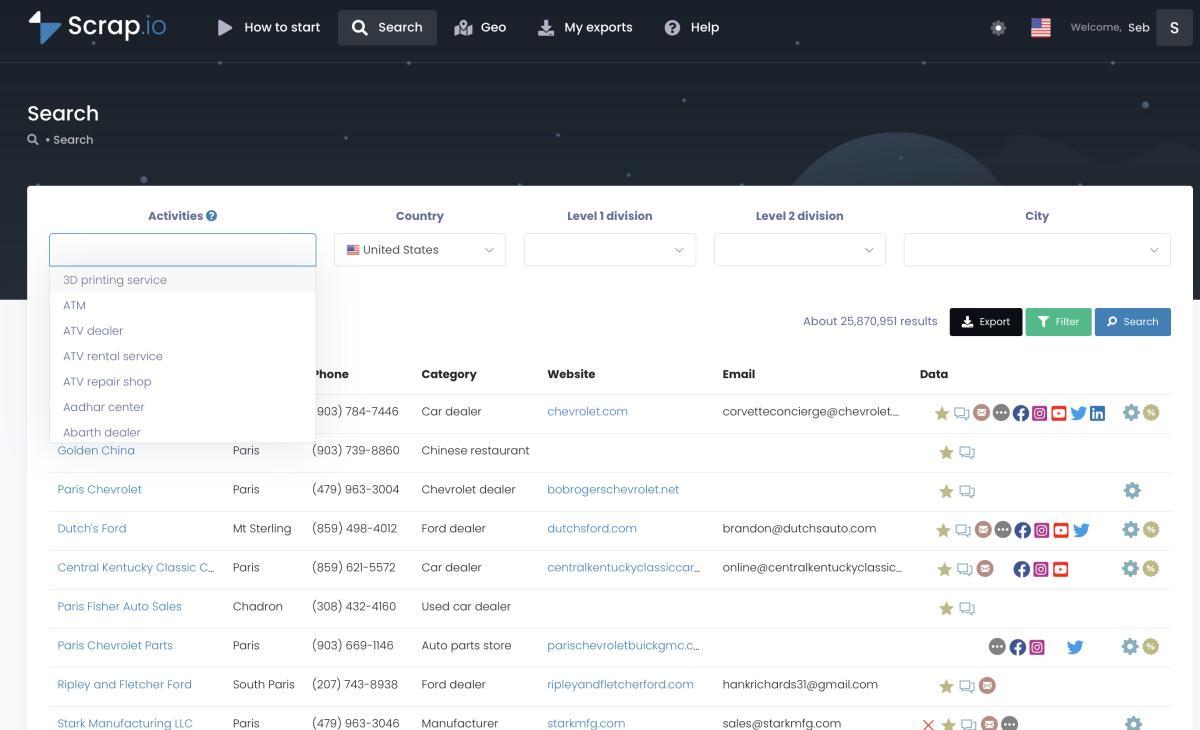
Open Scrap.io, choose a business type from 4,000+ categories, and set your location — a single city, a county, a region, or all of the United Kingdom. Don't have a category in mind? Skip it. You can pull every business in a zone — a full economic map of a town or region, which the register can't do and a category-by-category scraper can't either. The count shows instantly, before you spend anything. Counting is always free.
Step 2 — Filter before you extract
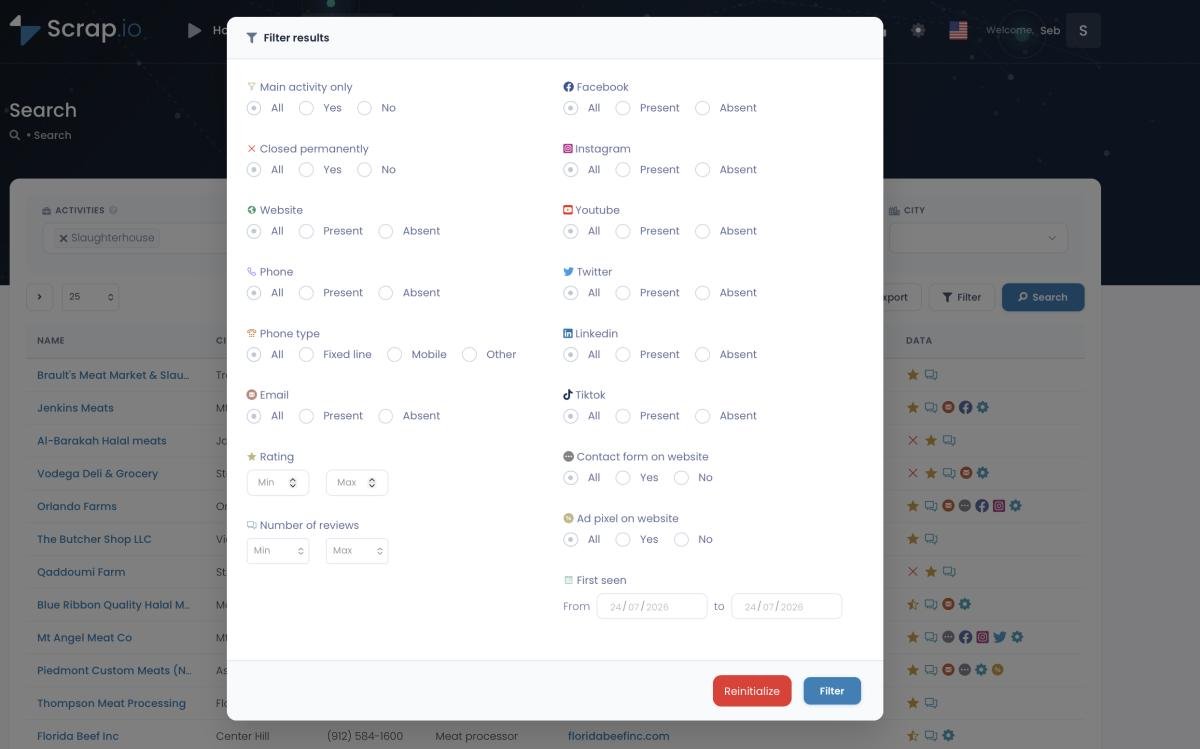
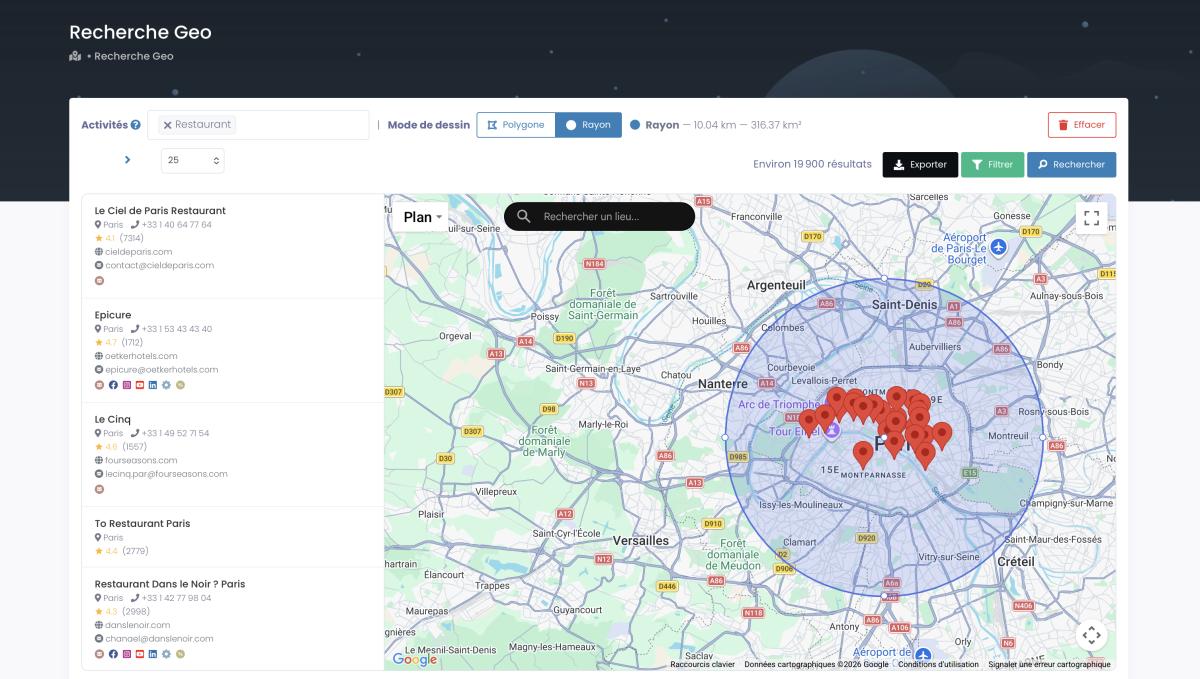
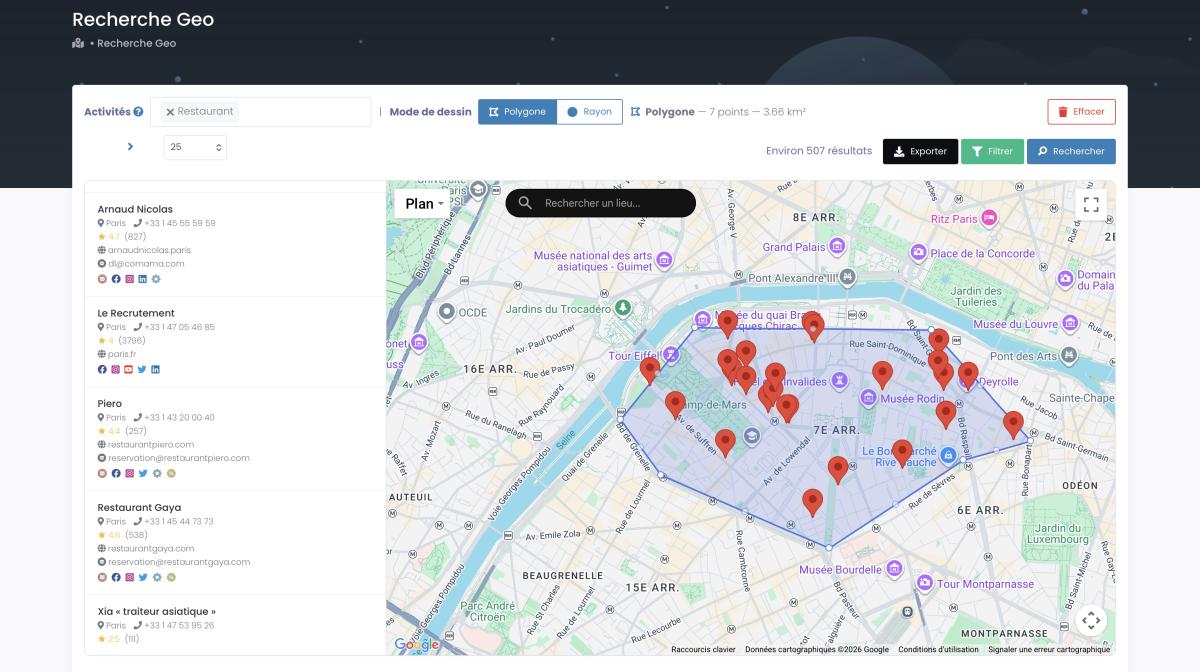
This is the money step. Only want businesses with an email on file? Toggle it. Only mobile numbers for an SMS campaign? Toggle that. Minimum rating, has a website, no website (hello, web agencies), a certain review count — stack the filters. Every one applies before a single credit is spent. You pay only for leads you can actually reach. Need a shape that isn't an administrative area — a trade area around a point, or a hand-drawn zone over a business district? GeoSearch handles it.
Step 3 — Export to CSV or your CRM
Hit export. CSV or Excel, ready to drop into your cold email tool or CRM. Every row carries the name, address, phone (with type), up to five classified emails per business, social links, and website tech. Re-export the same business within 30 days and it costs zero extra credits. That's the whole loop — and it's how you turn a raw list into local business leads you can actually contact. Here's the country-level version running end to end:
Video: How to Scrape Local Leads at the Country Level
Run your first UK export in under 15 minutes. Start your free Scrap.io trial — 7 days, 100 leads included. Filter for the contacts you can reach, export, done.
UK business data at scale: what the map reveals
Numbers time. We pulled fresh Scrap.io counts for the UK on 31 July 2026, and the contrast with the free register is almost funny.
2.06 million UK businesses had a public email address you could extract. The Companies House free file has zero. Not fewer. Zero.
| UK businesses on Google Maps (Scrap.io, July 2026) | Count | Share |
|---|---|---|
| Total businesses indexed | 5,463,734 | 100% |
| With a public email | 2,065,983 | ~37.8% |
| With a phone number | 3,941,871 | ~72.1% |
| Without a website | 2,439,934 | ~44.7% |
Sit with those figures for a second. Nearly 3.94 million UK businesses with a phone you can dial. And 2.44 million with no website at all — which, if you run a web agency, is a prospect list with a built-in pitch ("you're on Google, but you've got nowhere to send people"). None of that lives in the register. Try building a contactable list like that from the free bulk file. Go on — I'll wait. All of it comes from enriching the same companies against the map. If you want a worked example, the London business directory shows the density in a single city, and our breakdown of Google Maps vs LinkedIn for B2B covers when this beats the usual suspects.
And here's a fun one for the "we're a real company" crowd. Scrap.io itself is on the register — GH Consultancy Dev LLP, registered office in London, SE16 6DW. You can look us up on Companies House right now. You just won't find our email there either. Kind of proves the whole point, quoi.
2.06M UK businesses with a public email are one filter away. Join 50,000+ pros using Scrap.io to turn the register into reachable leads. Free for 7 days, 100 leads included.
Is it legal? Using UK company data for prospecting (GDPR)
Short answer: yes, for public business data, done properly. And I know — the company that does this saying it's fine isn't exactly a neutral witness. So let's be specific instead of hand-wavy.
You're using business information — company names, addresses, publicly listed emails and phones that businesses chose to publish on their own websites and listings. Under UK GDPR, processing publicly available business contact data for B2B outreach generally falls under the "legitimate interest" basis, as long as every message includes an easy opt-out. Under PECR, marketing to corporate subscribers (limited companies, LLPs) has more headroom than marketing to sole traders or individuals — so know who's on your list. The register itself carries no usage restriction; it's public by law. And Scrap.io only extracts publicly available business data, stays GDPR and CCPA compliant, and keeps every data point traceable to its source.
None of this is legal advice — if there's real money at stake, talk to an actual lawyer, not a blog post. But the panic around this is mostly recycled fear from people who never read the rules. Bref — stick to public business data, respect opt-outs, and you're on solid ground.
FAQ
Is Companies House data free?
Yes. You can search individual companies on Find and update company information, download the Free Company Data Product (a monthly ZIP of CSV files), or query the Companies House API — all free. What you won't find anywhere in it are emails and phone numbers.
How do I download Companies House data in bulk?
Use the Free Company Data Product at download.companieshouse.gov.uk — a monthly snapshot of every live company, delivered as ZIP files in CSV, updated within five working days of each month-end. For real-time single lookups instead of a bulk snapshot, use the API.
Does Companies House data include email addresses or phone numbers?
No. It holds legal and administrative data — company number, registered address, status, SIC codes, filing dates — but no emails and no phones. Companies House has confirmed it only collects a postal address. To actually contact companies, enrich the records against a live source like Google Maps (for example, with Scrap.io).
What's the difference between the Companies House API and the bulk data download?
The bulk download is a static monthly snapshot of the whole register — perfect for analysis. The API returns real-time data for specific companies on demand — perfect for validation and CRM enrichment. Neither includes contact details.
Can I use Companies House data for marketing and prospecting?
Yes, within the rules — it's public business data, and B2B outreach usually sits under legitimate interest, but you must respect UK GDPR and PECR and offer an opt-out. Tools like Scrap.io are GDPR and CCPA compliant and keep every record traceable to its source. (Not legal advice.)
The bottom line
So, where does that leave you? Download the register for free — bulk file, single lookups, or API, your call. Understand its one fatal gap: it proves companies exist, but hands you no way to reach them. Then enrich those records against Google Maps to get the emails, phones, and social profiles the register was never built to hold. Free first, contactable second, compliant throughout.
The names have been sitting there the whole time. What's missing is the contact info — and that's a filter away, not a fortune away.
Stop downloading dead data. Turn the UK register into reachable leads with Scrap.io — free for 7 days, 100 leads included. Pick a category, pick the UK, filter for what you can actually contact, and export in a couple of clicks.
Generate a list of restaurant with Scrap.io