

A marketing agency called me last month, furious. They'd paid $900 for a "premium" list of home builders. First campaign, 40% of the emails bounced. The rest? Half were general contact forms nobody reads. Two grand's worth of frustration, basically.
Here's the uncomfortable truth about home builders: they're everywhere, and almost impossible to reach with a decent list. There are 452,773 of them in the US. And yet type "list of home builders" into Google and you get consumer rankings, association directories, and PDFs older than some of the houses these people built. Not one of them hands you an email you can actually write to.
So this guide does two things. First, the part everyone Googles — the 2026 top-builder rankings. Then the part almost nobody covers: how to build your own fresh, filterable, exportable home builders list with real contact data. Let's get into it.
Video: Scrap.io — How to Get Started?
- How many home builders are there in the US?
- Who are the top home builders in the US? (2026)
- Why a public list isn't enough
- What a usable home builder list contains
- How to build your own list (step-by-step)
- Filter before you export
- Going national: every home builder in the US
- Who needs a home builder list? (use cases)
- Custom home builders: the high-value segment
- Staying compliant (CAN-SPAM & GDPR)
- FAQ
How many home builders are there in the US?
There are 452,773 home builders in the US in 2026, up about 1.7% from last year (IBISWorld). So why is it so hard to get a clean list of them? Because that headline number counts every registered builder — including the sole trader who does two custom homes a year and has no website at all.
The reachable slice is smaller and much more useful. On Google Maps, the "home builder" category returns 71,186 active listings in the US (Scrap.io, July 2026). Of those, 54,175 (76%) have a website and 37,131 (52%) have a public email address. That last number is the one that matters. Fifty-two percent. That's your real addressable list — roughly 37,000 builders you can actually email.
Who dominates the volume side? The National Association of Home Builders counts 140,000+ members responsible for about 80% of new US homes, and its Builder 20 peer networks are where a lot of these operators actually compare notes. But the giants are the exception. The median NAHB member started just six homes in 2024 — small operators run this industry, not the household names. Keep that in mind, because it shapes everything about who you should be targeting.
Context for the market itself: new-home construction has stayed strong, with monthly housing starts tracked by the U.S. Census Bureau holding near multi-year highs. Translation for a B2B seller — the pool of active, buying new home builders isn't shrinking. It's steady, and it turns over constantly.
Who are the top home builders in the US? (2026)
Everyone Googles "top 10 home builders." Here's the 2026 answer — and why it's only 0.002% of the market.
Ranked by homes closed, the top of the 2026 Builder 100 looks like this:
- D.R. Horton
- Lennar
- PulteGroup
- NVR
- Meritage Homes
- KB Home
- Taylor Morrison
- Clayton Properties Group
- Century Communities
- LGI Homes
Positions shift a little year to year, especially past the top five. But the shape holds: a handful of public companies at the top, then a very long tail. Together the top 200 builders delivered more than 500,000 homes in 2025 (Builder Magazine). Impressive. Also basically irrelevant if you're trying to sell into the industry.
Why? Do the math. The top 200 is 0.04% of 452,773 builders. Everyone selling to home builders is fighting over those same 200 logos — the ones with procurement teams, existing vendors, and a "no" ready before you finish your sentence. The other 99.96%? Barely prospected.
Home builder rankings by quality vs. rankings by volume
A quick word on home builder rankings by quality, because people conflate two different things. Volume rankings (Builder 100, "top 50 home builders in usa" lists) sort by homes closed. Quality rankings sort by customer satisfaction and construction standards — those come from J.D. Power studies and regional review data, and they rarely match the volume list one-for-one. A builder can be #3 by volume and mediocre by owner reviews. For a prospecting list, quality signals like Google rating and review count matter far more than a national closings rank. More on that in a minute.
| 2026 rank (by closings) | Builder | Primary segment |
|---|---|---|
| 1 | D.R. Horton | Production, entry-level |
| 2 | Lennar | Production, move-up |
| 3 | PulteGroup | Production, multi-brand |
| 4 | NVR | Production (Ryan Homes) |
| 5 | Meritage Homes | Production, energy-efficient |
Why a public list isn't enough
That PDF directory you bookmarked? Half its phone numbers are already dead.
Here's the problem with every public list of home builders you'll find on page one of Google. The Builder 100 gives you rankings and zero contact info. NewHomeSource is built for home buyers, not for you — no export, no emails. Association directories (Texas Association of Builders and the like) are regional, members-only, and locked behind a login. None of them were designed for B2B prospecting. They were designed for consumers picking a builder.
And even when a directory does list contact details, it rots. Construction has one of the highest business-turnover rates in the economy. A project manager at a firm in January is running his own outfit by June. Companies merge, rebrand, close after a rough winter. A static list loses roughly a quarter of its accuracy every single year. So the "verified 2024" file someone sold you is already missing thousands of real contacts.
Builders on Reddit's r/Construction and salespeople over on r/sales keep having the same argument from both sides: contractors drowning in irrelevant pitches, reps burning budget on contacts who left the industry months ago. Both are right. Both problems trace back to the same thing — stale, generic data.
The paid databases don't fully solve it either. Providers like Prospeo and Apollo advertise huge counts — 440,000 to 800,000-plus contacts — and headline accuracy figures like "98%." Sounds great on the pricing page. But a number verified whenever they last refreshed the file isn't the same as a number verified today. That's the whole game with a construction audience that churns this fast: a static snapshot decays no matter how big it started.
The fix isn't a better directory. It's building the list yourself, fresh, the day you need it.
What a usable home builder list contains
A name and a city aren't a lead.
If you're going to run outreach that actually converts, each row needs to earn its place. Here's what separates a real home builder contact list from a spreadsheet that torches your sender reputation:
- A verified email that exists today — not one "verified" 14 months ago.
- The right email, classified — is this the owner's individual address, or a generic contact@ nobody checks?
- A phone number — so you can follow up on another channel.
- Website and social profiles — context and personalization ammo.
- Quality signals — Google rating, review count, whether they've claimed their listing.
That second point is where most lists fall apart. Hitting [email protected] is worlds away from reaching the owner directly. Scrap.io crawls each builder's website and sorts every email it finds into buckets: an individual email with the first and last name parsed out, plus separate contact, sales, marketing, and admin addresses. You know who you're writing to before you hit send. Try getting that from a $200 static file. Spoiler: you won't.
Want the full field list before you commit to anything? Our guide on how to build a cold email list breaks down exactly what a high-converting row needs — and why the hook matters more than the row count.
See exactly which fields Scrap.io pulls for every builder — business name, phone, up to five classified emails, website, rating, review count and more, all from public sources. Explore the data on Scrap.io →
How to build your own list (step-by-step)
Meet Dana. She sells roofing supplies and needed every home builder in Ohio by Friday. Buying a broker list would've cost her a week of back-and-forth and a coin-flip on freshness. Instead she built the list herself in an afternoon. Here's the exact flow she used.
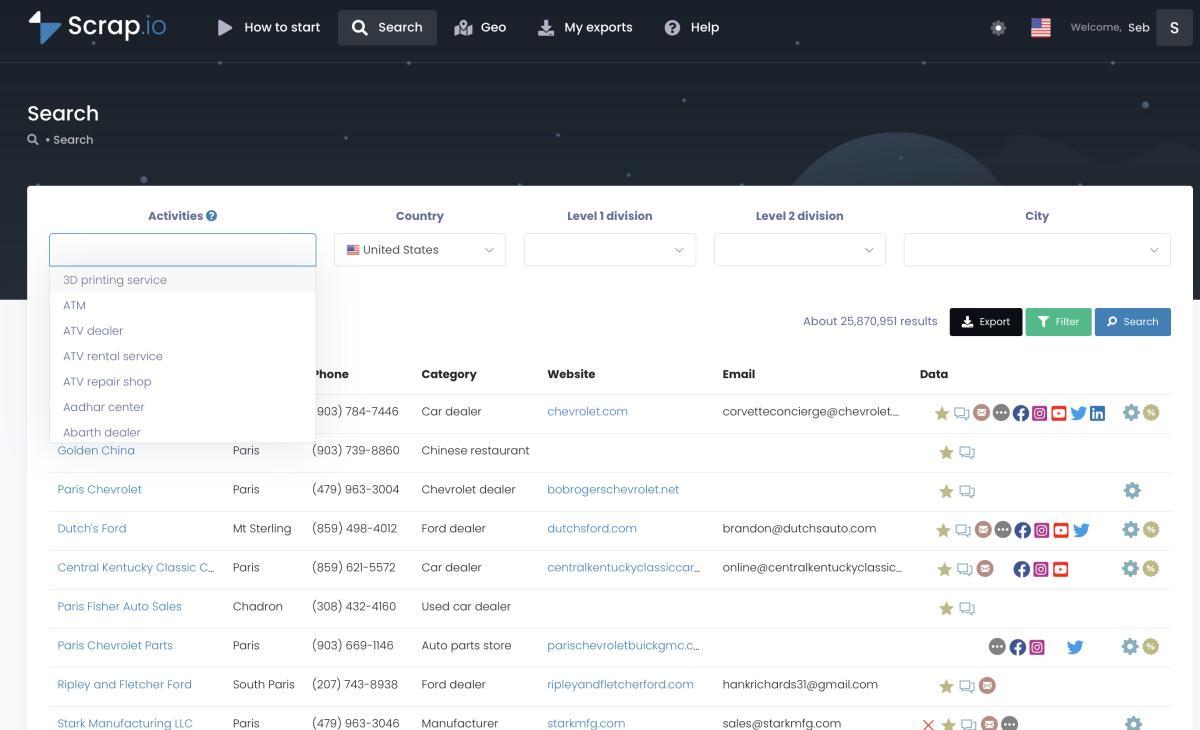
Step 1 — Search. Pick the "home builder" category (Scrap.io covers 4,000+ of them) and choose a location — a city, a county, a state, or the entire US. Dana picked "home builder" + Ohio. The platform tells you how many results match before you spend anything. And counting is free, always — in the interface, via the API, via the MCP connector. Zero credits.
Step 2 — Filter. This is the part that saves your budget. Only want builders with a public email? Toggle it. Only ones with a website? Done. Minimum rating, minimum review count, claimed listings only — apply it all here. (We'll go deeper on filters in the next section, because this is where most people leave money on the table.)
Step 3 — Export. Hit export. CSV or Excel, ready to drop into your sending tool or CRM the same afternoon. Every column is available on every plan. That's it. No code, no scraper to maintain, no Google frontend breaking at 3 AM.
If you want the deeper mechanics of pulling contact data this way, our guide to finding emails on Google Maps and the full Google Maps scraping guide both walk through it end to end. But honestly? The three steps above are the whole game.
One thing worth saying plainly, since we build tools for this: nobody on our team is out there copying builder emails into a spreadsheet by hand. That era is over. We've watched customers who used to hand-build a "list of home builders near me" for three straight days replace it with a two-click export. The manual approach isn't diligent. It's just slow.
Build your first home builder list free. Start a 7-day trial on Scrap.io — 100 leads included — and pull a fresh, filtered, email-present list from any state you want. 225 million businesses indexed across 195 countries, data validated at the moment you export. (A card is required to activate the trial.) Start your free trial →
Filter before you export
The smartest move is to throw away most builders before you export a single one.
Counterintuitive, I know. But think about it. You don't want 71,186 builders. You want the 37,131 with an email, minus the ones outside your service area, minus the ones that don't fit your product. Filtering isn't about narrowing for its own sake — it's about not paying for contacts you can never use.
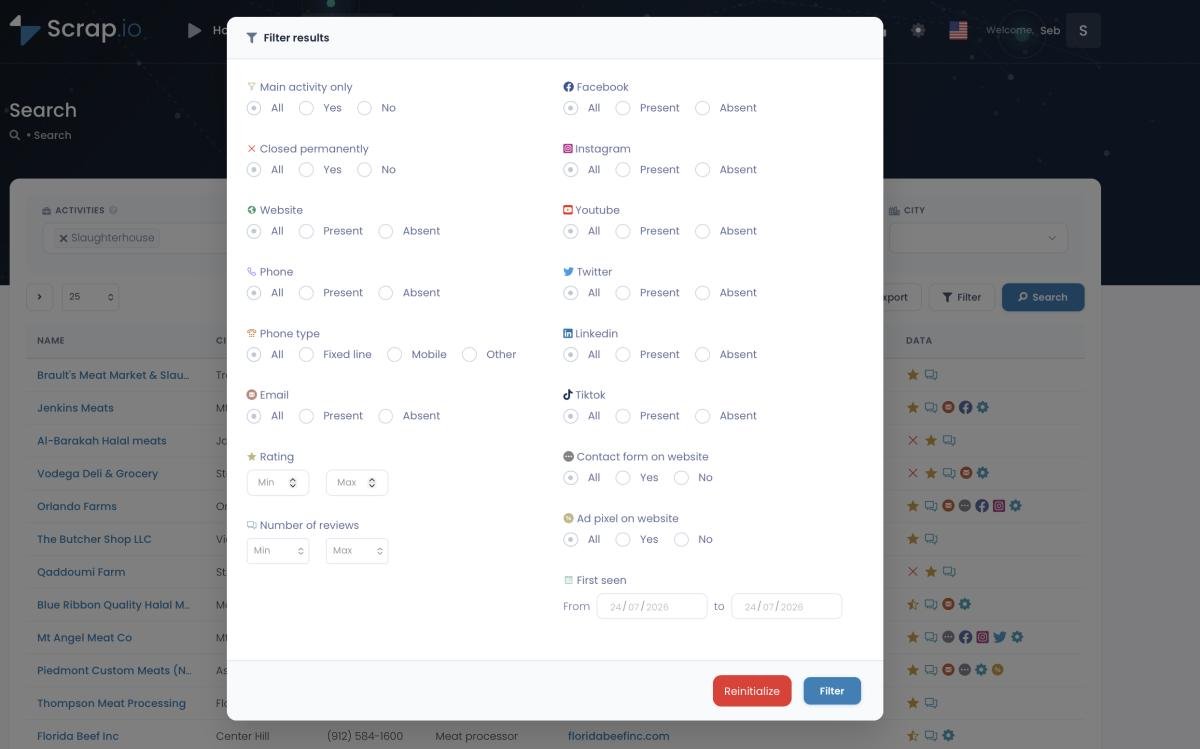
And here's the bit that actually matters for your wallet: on Scrap.io, filters apply before credits are consumed. Static list providers make you buy the whole database and filter afterward — you pay for the dead weight. Scrap.io flips it. Filter first, pay only for the rows that match. Selling energy-efficient materials? Filter for builders with a website but a low review count — often the smaller, hungrier outfits. Selling reputation management? Filter for builders sitting under 3.5 stars. That's not just a list of home builders anymore. It's a targeted campaign.
One honest caveat, because we'd rather tell you than have you find out mid-export: the mobile-vs-landline phone filter is available in most of the world but not in the US or Canada. So for a US builder list, filter on email presence, website, rating and location — not phone type. The phone numbers are still in your export. You just can't pre-sort them by type here.
Video: Finding Clients Through Google Maps Filters
Going national: every home builder in the US
71,186 home builders. One country. Two clicks.
Most tools cap you at a city, or choke past a few hundred results. Google Maps itself only shows about 120 results per search — try to pull "home builders in Texas" natively and you're seeing a sliver of what exists. Scrap.io doesn't have that ceiling, because it queries its own index of 225 million-plus businesses rather than scraping Google's search page live. You can request an entire state, or the whole US, in a single go.
The same approach handles every geo variant people search for. Want a list of home builders in Texas, or just the ones in Houston? Pick the state, then narrow to the city. Florida, Arizona, Ohio — same three clicks. You can pull the "best home builders" in a metro by sorting your export on rating and review count, or assemble a "top 20" and "top 100" regional shortlist without ever touching a consumer directory. It's your data, your cut.
For pinpoint targeting there's GeoSearch. Two modes. Radius draws a circle up to 500 km around any point — perfect for "every builder within an hour of this new development." Polygon lets you draw an irregular shape by hand, up to a million square kilometers, for when your territory doesn't match a tidy administrative boundary.
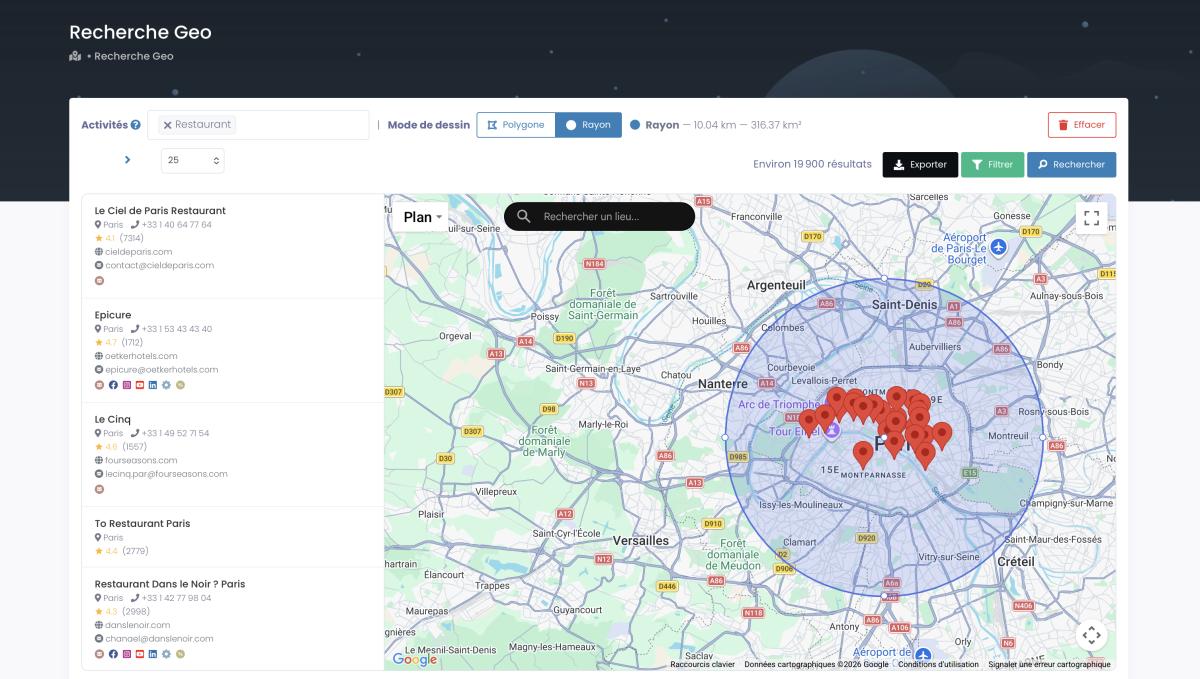
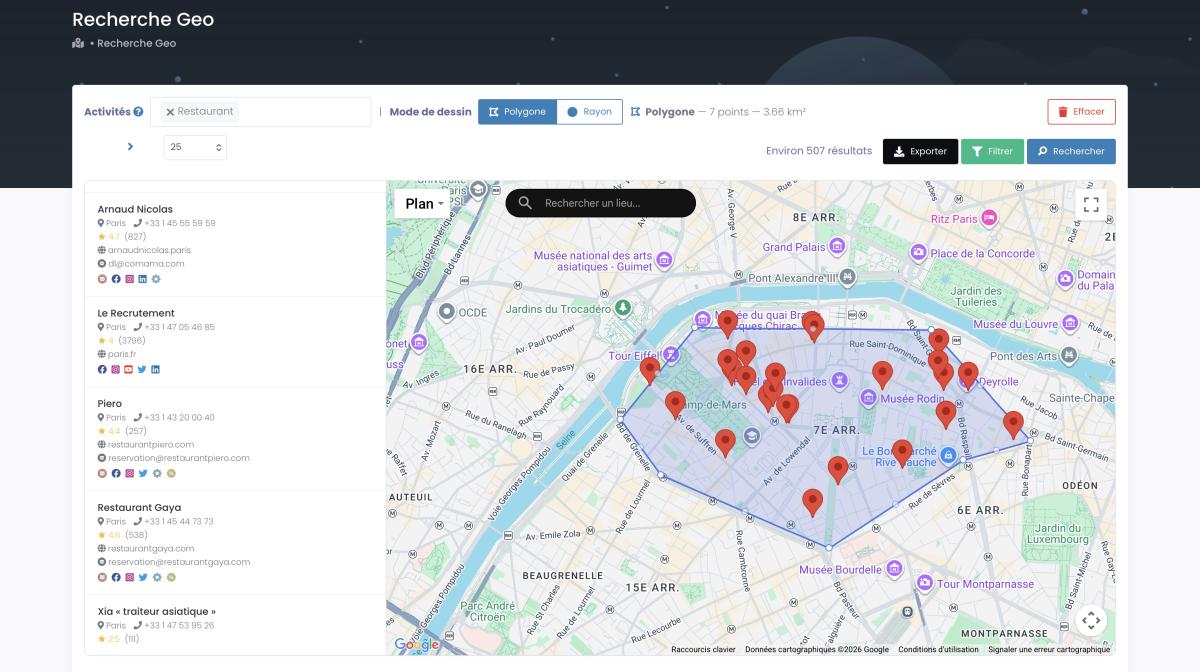
Does this scale actually work in practice? Yes. One customer pulled 11,734 businesses in 45 minutes — deduplicated, exported, done. Now picture that across all 50 states for home builders specifically. That's a national home builders list most agencies would quote you a month and four figures to assemble.
Video: How to Scrape Local Leads at the Country Level
11,734 businesses exported in 45 minutes — do the same across all 50 states. Country-level extraction, real-time data, zero duplicates. See it on Scrap.io →
Who needs a home builder list? (use cases)
Who actually buys a list of home builders? More people than you'd think.
Materials and equipment suppliers are the obvious one — lumber, roofing, windows, tools. Every builder is a repeat buyer, which makes a fresh list a renewable revenue line. Then there's construction software. The sector is booming: Tracxn counts 435 construction-SaaS companies pulling roughly $2.8 billion in revenue as of mid-2026, and every one of them lives on cold outreach. Companies like Buildertrend (project management built specifically for residential builders), CompanyCam (jobsite photo documentation), and Procore (construction management at enterprise scale) all grew by reaching builders directly — not by waiting for them to fill out a form.
Beyond those, the list works for web and marketing agencies (filter for builders with no website — instant client pipeline), insurance and finance reps, recruiters staffing the trades, and anyone doing market research on a local construction scene. If your customer builds houses, this is your prospecting universe.
Home builders also sit inside a wider construction cluster, and the same approach powers the neighboring lists. If your targeting spills over into trades and general construction, we've got dedicated guides for a construction company email list, a contractor email list, and a roofing contractor list — siblings to this one, same method, different category. For the bigger picture on turning any of these into a pipeline, our local business lead generation guide ties it all together.
The home builders email list angle
If email is your whole play, the number to anchor on is that 52% coverage — 37,131 builders with a public address out of 71,186 listings. A purpose-built home builders email list isn't the full category; it's that emailable slice, classified by address type so your individual-email rows get the personalized treatment and your generic contact@ rows get a value-first pitch. Segment by email type at export and a 500-contact list will out-convert a 10,000-row blast every time.
Custom home builders: the high-value segment
27,464 custom home builders. Smaller list, fatter deals.
Quick distinction, because people mix these up. Production builders (the D.R. Hortons of the world) put up many homes from a set of standard plans. Custom home builders build one-off homes to a client's spec — bespoke, higher-ticket, fewer per year. On Google Maps, Scrap.io indexes 27,464 custom home builders in the US as its own category.
For a lot of sellers, that's the better list. Fewer prospects, but each one runs higher project values, makes decisions faster (often it's the owner, no procurement committee), and cares more about premium tools and finishes than about shaving pennies. If you sell high-end materials, design software, or specialized services, target this segment directly instead of the whole production-heavy category.
One note to avoid a wrong turn: custom home builders are not the same as real estate developers. Developers buy land and finance projects; builders construct the homes. Different audience, different pitch. If it's the capital side you're after, that's covered in our real estate developer list guide — think of it as the complement to this article, not a substitute.
Staying compliant (CAN-SPAM & GDPR)
Okay, the slightly less fun but essential part: staying legal.
Good news first — B2B cold email to home builders is legal in the US. The CAN-SPAM Act doesn't ban unsolicited commercial email; it regulates it. Three non-negotiables: accurate sender info and honest subject lines, a real physical mailing address in every message, and a working unsubscribe link you honor promptly. Break those and penalties climb fast — into tens of thousands of dollars per email. So don't be sloppy.
Targeting builders in Europe, or holding data on EU residents? Then GDPR applies, and B2B outreach leans on "legitimate interest" as your legal basis — your email has to be genuinely relevant to the recipient's business. Document why you're reaching out. Keep the opt-out obvious.
Where does Scrap.io land on all this? On solid ground. Every data point comes from publicly available business sources — information companies chose to publish on Google Maps and their own websites — and each record is traceable to its origin. The platform is GDPR and CCPA compliant by design. That doesn't exempt you from honoring opt-outs at send time. But it means your list itself starts clean.
FAQ
How many home builders are there in the US?
About 452,773 registered home builders in 2026, per IBISWorld. On Google Maps, Scrap.io indexes 71,186 active "home builder" listings, of which 52% have a public email address — roughly 37,000 you can actually reach with contact data.
Who are the top home builders in the US in 2026?
By homes closed: D.R. Horton, Lennar, PulteGroup, NVR and Meritage Homes lead the 2026 Builder 100, followed by names like KB Home, Taylor Morrison and Century Communities. The top 200 builders together delivered more than 500,000 homes in 2025.
How can I get a list of home builders with emails?
Search the "home builder" category for your area on Scrap.io, apply the "has email" filter before exporting, then download a CSV or Excel with names, phone numbers, websites and classified emails. Filtering before extraction means you only pay for builders that actually have an address.
Is it legal to build a list of home builders for outreach?
Yes — using publicly available business data and following CAN-SPAM in the US or GDPR in the EU. Scrap.io only collects public business information and is CCPA and GDPR compliant. Always include a working unsubscribe option and honor opt-outs.
What's the difference between a home builder and a custom home builder?
Production builders construct many homes from set plans; custom home builders (27,464 of them on Google Maps) build one-off homes to a client's specification. Custom builders are a smaller, higher-value segment — fewer prospects, bigger deals.
Stop renting stale lists. Start with a fresh one today. A public directory hands you rankings and dead phone numbers. Scrap.io hands you 71,186 US home builders — filtered by location, email presence and quality, validated the moment you export, exportable to CSV in minutes. Free for 7 days, 100 leads included (a card is required to activate). Build your home builder list now →
Generate a list of home builder with Scrap.io