

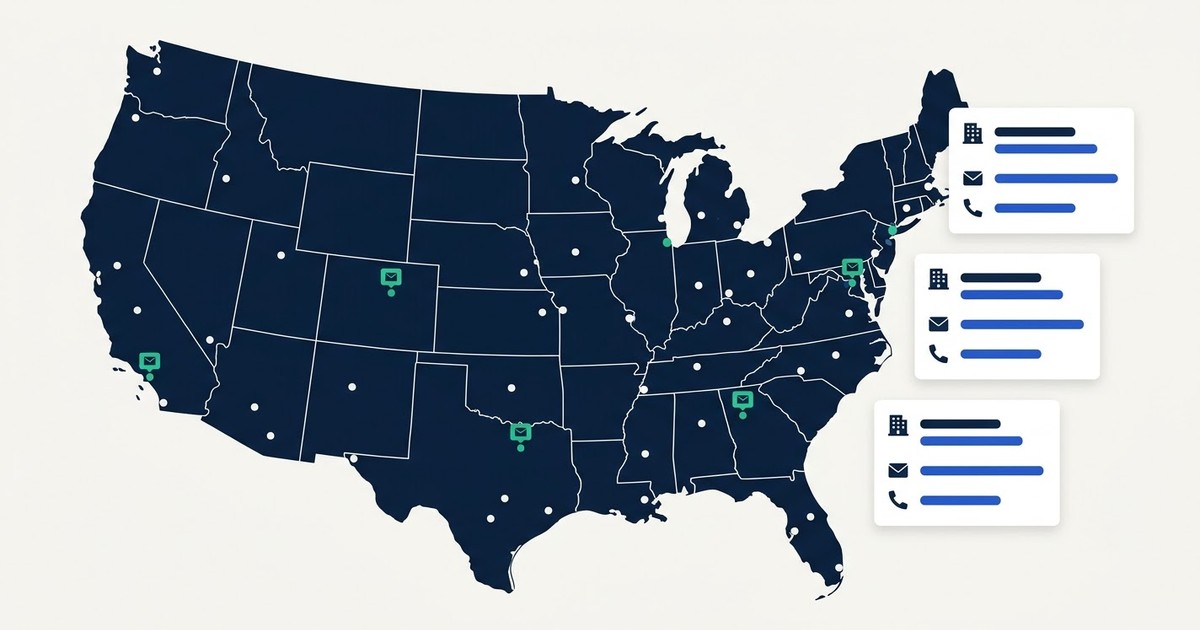
Here is a confession that will save you a week of work: the list of private equity firms you are about to Google is almost useless. Not wrong. Useless. Wikipedia will hand you a few hundred names, Praxis Rock will rank the top 100 by assets, and the PEI 300 will sell you a PDF. Then what? You have a spreadsheet of names and zero way to actually reach any of them.
That is the gap nobody talks about.
And before we go further, one distinction that trips up half the people searching this term. A private equity firm is not a financial advisor. If you are looking for the people who manage individual clients' retirement money, you want our financial advisor email list (or the financial planner email list) instead. This article is about the funds: the PE and venture capital firms that buy companies, back startups, and write the big checks. Founders chasing capital, M&A advisors, and vendors who sell into these funds, this one is for you.
So here is the plan. We will give you the actual list (the giants by AUM, plus the thousands of mid-market and VC firms that nobody ranks), then show you how to turn any list of names into a list you can email. With real contact data. Pulled live. Let's go.
Table of Contents
- What is a private equity firm (and why you need a list)
- The 10 biggest PE firms in 2026 (by AUM)
- Beyond the giants: mid-market, boutique and VC
- PE databases: PitchBook, Private Equity List, Grata
- Why a list of names isn't a list you can act on
- How to build your own contactable list
- How to reach out to PE & VC firms (that gets replies)
- Staying compliant: CAN-SPAM & GDPR
- FAQ
What is a private equity firm (and why you need a list)
Quick version, because you probably know most of this. A private equity firm pools money from institutional investors and wealthy individuals, then buys stakes in private companies (or takes public ones private), improves them, and sells them for a profit years later. Venture capital is the early-stage cousin: same structure, smaller checks, riskier bets on startups instead of mature businesses.
Why does the sector matter so much? Because it is enormous. Private equity directly employs 13.3 million workers in the US, and 85% of PE-backed companies are small businesses, according to the American Investment Council. The same source counts $1.6 trillion poured into US healthcare since 2008 and over $625 billion in active private credit deals across more than 3,700 companies. This is not a niche corner of finance. It is a huge chunk of the real economy.
Which is exactly why so many people need a list of these firms. Founders raising a round. Investment bankers shopping a deal. SaaS companies, law firms, recruiters, and fund administrators who sell services to PE. Every one of them needs to know who the players are, and how to get in the door.
The 10 biggest PE firms in 2026 (by AUM)
Blackstone alone manages roughly $1.35 trillion. That is more than the annual GDP of most countries on Earth. Let that sink in before you send your next polite little email.
Here are the top 10 private equity firms ranked by assets under management, using the most recent figures from AlphaSense (June 2026). Note that "AUM" here means total assets across all strategies, not just buyout funds, which is why diversified managers like Brookfield rank so high.
| Rank | Firm | HQ | Total AUM (2026) |
|---|---|---|---|
| 1 | Blackstone | New York | ~$1.35 trillion |
| 2 | Brookfield | Toronto / New York | ~$1.27 trillion |
| 3 | Apollo Global | New York | ~$1.05 trillion |
| 4 | KKR | New York | ~$796 billion |
| 5 | Ares Management | Los Angeles | ~$671 billion |
| 6 | Carlyle Group | Washington, D.C. | ~$486 billion |
| 7 | EQT | Stockholm | ~$389 billion |
| 8 | TPG | Fort Worth | ~$327 billion |
| 9 | Blue Owl Capital | New York | ~$319 billion |
| 10 | CVC Capital | Luxembourg | ~$225 billion |
Source: AlphaSense, total AUM as of June 2026.
Top PE firms by AUM: ranking beyond the top 10
Want the longer top 100 private equity firms by aum? There are two authoritative rankings worth bookmarking, and they measure different things, so do not confuse them. Looking instead for a top 20 private equity firms shortlist, a top 50, or a ranking of private equity firms by size across the world? Same two sources scale up and down, and both cover the biggest firms worldwide, so a quick filter gets you any list of private equity firms in the world you need. The PEI 300 ranks firms by five-year fundraising totals (the top 300 pulled in $3.55 trillion over five years, with the top 10 alone taking $854.6 billion). The SWFI fund manager rankings sort by managed AUM. Fundraising momentum and total assets tell you two very different stories about a firm, so pick the lens that matches your question.
And here is the thing about these rankings. They are great for a pub quiz about the most prestigious private equity firms. They are close to worthless for actually contacting anyone. More on that in a minute.
How many PE firms are there in the US?
There are roughly 10,373 private equity funds in the United States, according to Tracxn (2026). Ten thousand. The ten giants everyone ranks are a rounding error against that number, and when you add venture capital and smaller investment firms, the real list of private equity firms in usa runs into the tens of thousands. That matters more than you think, and we will get to why.
Tired of names you can't act on? Build your own fresh list of investment firms, with website, phone and email, straight from Google Maps. Start free on Scrap.io: 7-day trial, 100 leads included. Filter for the firms that actually have a public email before you spend a single credit.
Beyond the giants: mid-market, boutique and VC
The firms most likely to reply to you are not in the top 10. They are the ten thousand others.
Think about it for a second. Blackstone is not reading your cold email. It has a wall of gatekeepers, a full deal pipeline, and zero reason to open a message from someone it does not know. But a mid-market buyout shop in Denver? A boutique growth-equity fund in Austin? Those firms are hungry, lean, and often run by partners who still read their own inbox. If you want a list of middle market private equity firms or a list of small private equity firms, that is where the actual opportunity lives.
Quick aside for two other searchers who land here. If your list of private equity firms to invest in is actually a career hunt (you want the best private equity firms to work for), the big names above are the usual starting point, though the leaner mid-market shops often treat their people better. Different goal, same roster to start from.
Axial alone catalogs 799 lower middle market PE funds on its M&A platform, focused on companies with $3M to $19M in revenue. These are the firms doing the deals that never make headlines, and they are far more reachable than the names in the AUM table above.
Notable venture capital firms
If your target is startups and early-stage capital, you want a list of venture capital firms, not a buyout ranking. The marquee names (Sequoia, Andreessen Horowitz, Founders Fund, Accel, Benchmark) get all the press. But the useful insight is that VCs, even famous ones, read cold emails far more than founders assume.
Andrew Reed of Sequoia put it bluntly: "Easiest business arbitrage: the risk/reward of a well-written cold email is so wildly favorable, and yet so few people will actually send one." (Quoted via Visible.vc.) Some investors report reviewing 10 to 20 cold emails a day. They are reading. Most founders just never send the thing.
Companies owned by PE firms
One more angle, because search demand for a list of companies owned by private equity firms is climbing fast. If you sell to portfolio companies rather than to the funds themselves, the ownership map is your prospecting list. A PE firm that just bought a chain of dental clinics has suddenly created a buyer for whatever you sell to dental clinics. Follow the money, then follow what the money bought.
PE databases: PitchBook, Private Equity List, Grata
PitchBook will happily sell you access. But do you really need a subscription that runs into five figures a year just to email a few funds?
Right. Here is the honest landscape of the venture capital firms database and private equity firms database market, warts and all.
| Tool | What it is | Coverage | Catch |
|---|---|---|---|
| PitchBook | Deal & investor intelligence | Deep PE/VC data | Enterprise pricing, often $20k+/yr |
| Private Equity List | PE/VC/angel database | ~7,931 investors, 119 countries | Paid tiers; static profiles |
| Grata | Deal sourcing platform | 22M+ private companies | Built for funds, priced for funds |
| SourceScrub | Deal sourcing / data | 17M+ companies | Premium, firm-level contracts |
| Scrap.io | Live Google Maps extraction | 225M+ businesses, 195 countries | Local/public data, not fund LP terms |
Private Equity List is a solid, focused product: around 7,931 PE and VC investors across 119 countries, with team contacts and CSV export. Grata (22M+ companies) and SourceScrub (17M+ companies, used by 35 of the top 40 firms) are genuinely powerful. They are also built and priced for funds with real budgets. If you are a three-person agency trying to pitch services to PE firms, that math does not work. For a wider view of the category, our guide to business database search tools breaks down who each one is actually for.
So which tool for which job? This video lays out the trade-off between a premium database and live extraction, which is exactly the decision you are facing here.
Video: Scrap.io vs Apollo, Which Tool for Which Type of Prospecting
50,000+ professionals build their prospecting files on Scrap.io instead of paying five figures for a frozen database. Real-time Google Maps data, filtered before you pay. Try it free: 7 days, 100 leads offered.
Why a list of names isn't a list you can act on
A list of names is a trivia sheet. A list with emails is a pipeline. Those are not the same thing, and confusing them is the single most expensive mistake in B2B prospecting.
Look. Open the Wikipedia list of private equity firms, go on, I'll wait. You get names. No email. No phone. No website link that works. No indication of who still exists and who got absorbed in a merger last year. It is a museum exhibit, not a contact database. The PEI 300 and the SWFI rankings are the same: beautiful for citations, dead on arrival for outreach.
And the static databases are not much better on freshness. Firms rebrand. Partners leave. A fund that was active in 2024 might be winding down today. Any list compiled months ago and sold to fifty other buyers is already decaying the moment you download it.
So what does an actionable list look like? It has a name, yes. But also a working email (ideally classified, so you know if you are writing to a person or to info@), a phone number, a website, and a timestamp proving the data is current. Everything else is just names on a page.
How to build your own contactable list
Google Maps already indexes thousands of investment firms, with website, phone and email attached. You just have to extract them. And this is where a list of private equity firms stops being a static artifact and becomes a living, filterable file you control.
We pulled fresh numbers from Scrap.io while writing this, so you are looking at live counts, not a stat from someone's old blog post:
| Google Maps category (US) | Total listings | With a public email | With a website |
|---|---|---|---|
| Private equity firm | 1,703 | 1,216 (71%) | 1,461 (86%) |
| Venture capital company | 1,335 | 905 (68%) | 1,094 (82%) |
| Investment company | 13,692 | 7,269 (53%) | n/a |
Source: Scrap.io live Google Maps data, United States, October 2026.
Read those numbers again. Over 1,200 US private equity firms with a public email address. Nearly a thousand VC companies the same. That is a contactable list the AUM rankings will never give you, and the counting is free: Scrap.io never charges a credit just to show you how many results match.
Step-by-step with Scrap.io
Here is the whole flow, start to finish. It takes minutes, not weeks.
- Pick a category. Type "venture capital company" or "private equity firm" or "investment company" into the search, and choose your geography: a city, a state, or the entire US in one shot (country-level search is the thing almost no other tool does in two clicks).
- Filter before you extract. Toggle "email present" so you only ever pay for firms you can actually reach. Add a minimum rating, a review count, a website filter, whatever sharpens your list. The filters run before any credit is spent. Zero waste.
- Export. One click to CSV or Excel. Each row carries the firm name, address, phone (with mobile/landline type), website, social profiles, Google rating, and up to several classified emails: individual (with first and last name), contact, sales, marketing, finance.
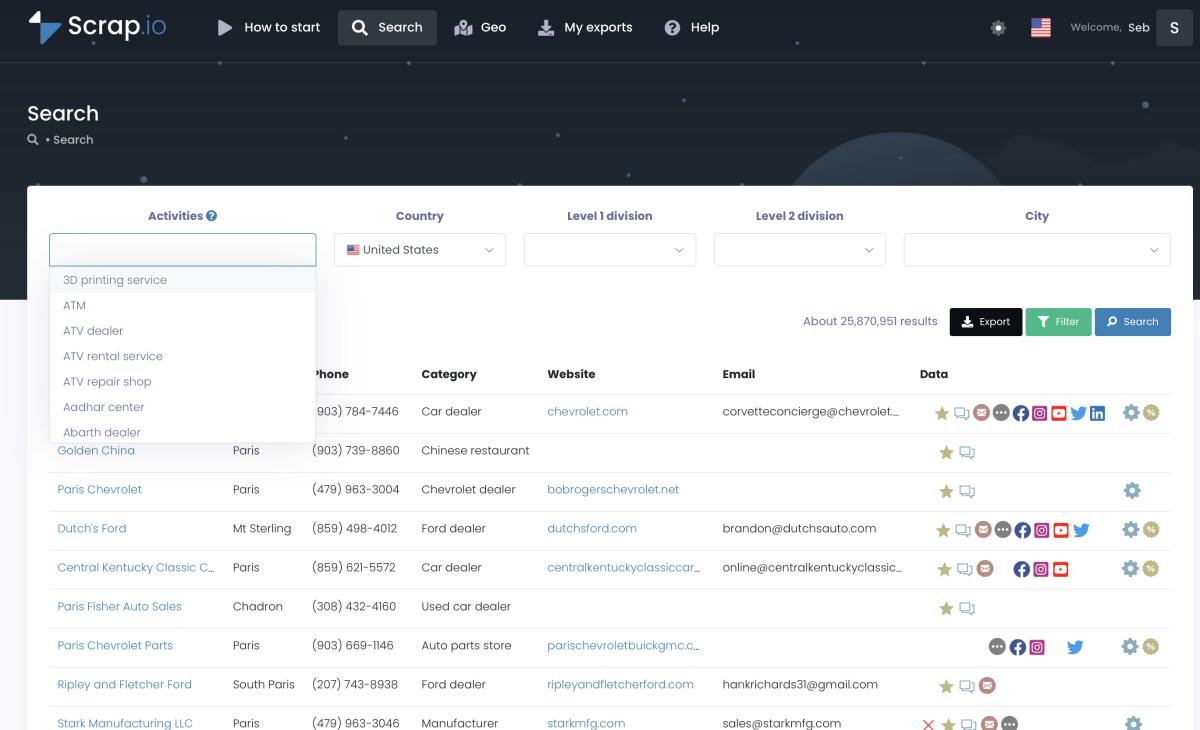
That finance-email classification is quietly a big deal for this exact use case. A generic info@ box at a fund is a black hole. But an individual email with a name attached, or a dedicated finance or investor-relations address? That is a human who might actually read you.
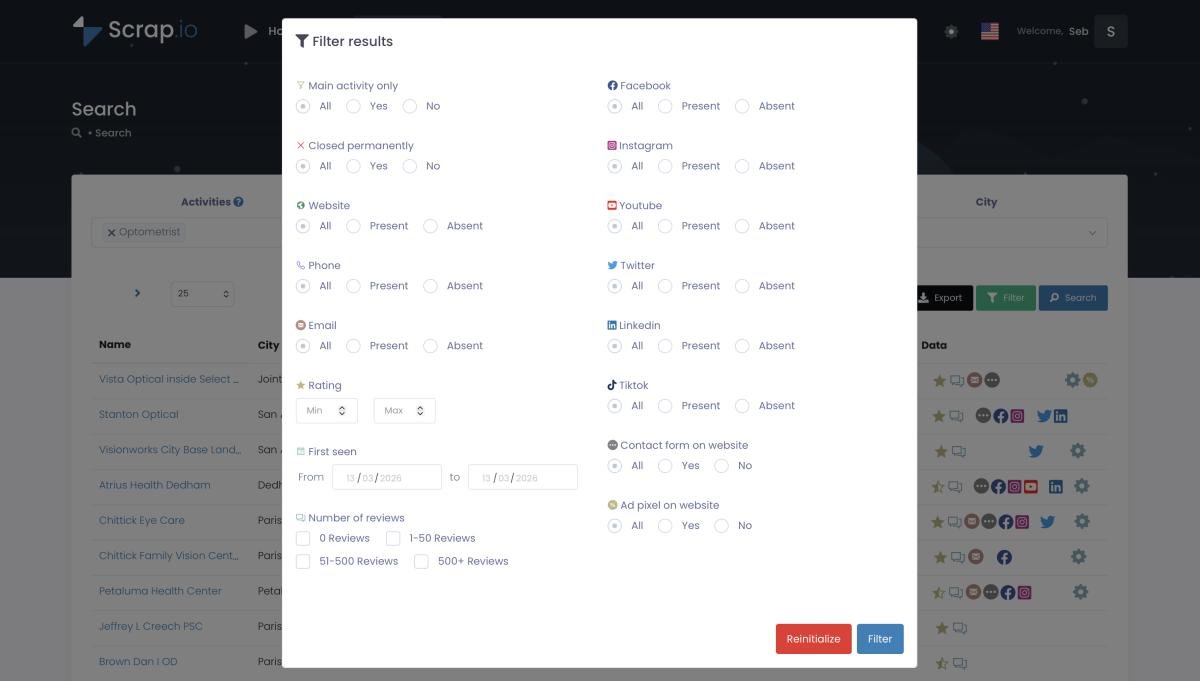
And if you would rather not pick a category at all, here is the trick for mapping an entire territory in one pass: extract every business in an area, no category filter, and sort later. Handy when you want every investment-adjacent firm in a financial district, not just the ones tagged neatly.
Video: How to Extract Every Business in 1 Click (No Category)
Anyway. Does this replace PitchBook for deal diligence or LP terms? No, and I am not going to pretend it does. It is public, map-level business data. But for building a fresh, contactable investors email list of the thousands of mid-market and VC firms you actually want to reach? It beats a $20k subscription and a stale CSV, hands down. Same method works for a whole vertical: see our USA business email database guide for the wider playbook.
How to reach out to PE & VC firms (that gets replies)
Investors get 10 to 20 cold emails a day. Here is how to be the one they answer.
First, the proof that it works at all. Jason Lemkin of SaaStr has said that roughly half of his investments came from cold emails sent by founders, including names like Salesloft (a $2.4B exit), Talkdesk (valued around $10B), and Pipedrive (a $1.5B exit). According to SaaStr, top investors like Keith Rabois (Founders Fund), Aileen Lee (Cowboy Ventures), David Sacks (Craft), and Satya Patel (Homebrew) all read cold pitches. Honestly, the channel is not dead. Lazy use of it is.
So what separates a reply from the trash folder? A few things, and none of them are complicated.
- Target precisely. A $30M growth fund and a $900B asset manager get completely different emails, or more honestly, only one of them gets an email at all. Match the firm's stage and thesis to what you are offering.
- Lead with their world, not yours. Nobody at a fund cares about your origin story. They care about a deal, a return, or a problem you can remove.
- Write to a human. Use the individual email with a name, not the generic inbox. That is the whole reason email classification matters.
- Keep it short. One problem, one proof point, one question. Get in, get out.
Want the full framework? We wrote the deep version in our guide on how to write a cold email, and a swipe file of proven structures in our cold email templates guide. Got your list and your pitch? Pair them and go.
Staying compliant: CAN-SPAM & GDPR
Is it even legal to cold email a private equity firm? Short answer: yes, when you do it right.
In the US, cold B2B email is legal under CAN-SPAM. No prior opt-in required. You need accurate sender information, a real physical mailing address, and a working opt-out that you honor promptly. That is the baseline. In the EU, B2B outreach is allowed under the "legitimate interest" basis of the GDPR, though the rules shift country by country (Germany, for one, is far stricter). Our GDPR cold email B2B guide maps exactly where legitimate interest holds and where it does not.
The part that keeps all of this clean: when you source contacts from publicly available business data, like a firm's own Google Maps listing and website, you are standing on solid ground. These are details the firm chose to make public, and every record is traceable back to its source. That traceability is worth more than most people realize when a regulator asks where your data came from.
FAQ
How many private equity firms are there in the US?
Roughly 10,373 private equity funds operate in the United States, according to Tracxn (2026), ranging from mega-funds like Blackstone down to single-partner boutiques. Add venture capital and broader investment firms and the number climbs into the tens of thousands.
What are the 10 biggest PE firms in 2026?
By total AUM (AlphaSense, June 2026): Blackstone, Brookfield, Apollo Global, KKR, Ares Management, Carlyle Group, EQT, TPG, Blue Owl Capital, and CVC Capital. Blackstone leads at roughly $1.35 trillion in assets.
Where can I find a list of PE firms with contact details?
The public rankings (Wikipedia, PEI 300, SWFI) give you names only. For emails and phone numbers you have two options: pay for a database like PitchBook or Private Equity List, or build a live list yourself from Google Maps with a tool like Scrap.io, which pulls 1,703 US private equity firms (1,216 with a public email) that you can filter and export directly.
Is it legal to email PE firms cold?
Yes. In the US, cold B2B email is legal under CAN-SPAM as long as you use honest sender details, include a physical address, and offer a working opt-out. In the EU it is permitted under GDPR's legitimate interest basis, with stricter rules in some countries. Sourcing from public business data keeps you traceable and compliant.
What is the difference between a PE firm and a VC firm?
Venture capital funds back early-stage startups with smaller, higher-risk checks. Private equity firms typically buy mature companies outright, often through leveraged buyouts, and work to grow them before selling. Both are listable and contactable the same way: they show up on Google Maps with public contact details.
Stop collecting names you can't use. Build a fresh, contactable list of private equity and VC firms, straight from Google Maps, filtered for a public email before you spend a credit. Start free on Scrap.io: 7 days, 100 export credits, no commitment.
Generate a list of private equity firm with Scrap.io