

Right now, as you read this, there are 53,268 nutritionists sitting on Google Maps in the United States. Not a guess. Not a two-year-old industry estimate someone rounded up for a slide deck. A live count, pulled this month (Scrap.io, July 2026).
And almost nobody selling to them knows how to actually reach them.
Here's the weird part. Search "list of nutritionists" and you get a wall of directories built for patients — find a nutritionist near you, book an appointment, filter by insurance. Useful if you've got a cholesterol problem. Useless if you're a founder, an agency, or a health-tech company trying to build a list of these professionals and sell them something. That B2B angle? Barely anyone covers it. So we will. This guide walks through where a real list of nutritionists comes from in 2026, how to build a fresh nutritionist email list yourself, and how to stay on the right side of CAN-SPAM while you do it. If you've done this for other verticals — say a personal trainer email list or the broader healthcare email list — some of this will feel familiar. Some of it won't.
- Why build a list of nutritionists?
- Nutritionist vs. dietitian: who's on your list?
- How big is the US nutritionist market?
- The 4 ways to get a list of nutritionists
- Build your own list from Google Maps — step by step
- Filtering: only pay for contacts you can use
- Is it legal? CAN-SPAM & HIPAA
- Real companies marketing to nutritionists
- FAQ
Why build a list of nutritionists?
Meet Dana. She spent eight months building a slick meal-planning app for nutrition professionals — clean UI, smart macros, the works. Launch day came. She had exactly zero users. The product was fine. The problem was she had no way to reach the people who'd pay for it. She knew there were tens of thousands of nutritionists out there. She just couldn't get a list of them into a spreadsheet.
That's the whole game, really.
Nutritionists and dietitians are a genuinely good B2B audience. They buy practice-management software, scheduling tools, supplement lines, lab-testing services, insurance products, continuing-education courses, marketing help. Most run their own practice, which means the owner is the buyer — no procurement committee, no six-month approval cycle. You email the right person, they decide by Friday. And here's the kicker: they're weirdly hard to reach through the usual channels. LinkedIn barely covers solo practitioners. Cold-calling a clinic gets you a receptionist. But a good nutritionist mailing list catches them in the 20 minutes they spend on admin before their first client walks in.
So the question isn't whether a nutritionist database is worth having. It's how you build one that doesn't bounce half the time. Building a proper cold email list starts with the row, not the row count — and we'll get to that. First, some housekeeping on who actually goes on the list. For the adjacent audience, the same logic drives a wellness center email list too.
Nutritionist vs. dietitian: who's on your list?
People use "nutritionist" and "dietitian" like they're the same word. They're not. And if you're building a list, the difference actually matters — because it changes who you can legally market to and what they respond to.
A Registered Dietitian (RD) or Registered Dietitian Nutritionist (RDN) is a protected, credentialed title. It requires a degree, a supervised internship, a national exam, and — in most states — a license to practice. These are the clinical folks. Think hospitals, medical nutrition therapy, insurance billing.
"Nutritionist," on the other hand, is barely regulated in a lot of states. Anyone from a Certified Nutrition Specialist with a master's degree to a self-taught wellness coach might use the term. That's not a knock — it's just reality. It means your list of nutritionists is broader, more entrepreneurial, and often more open to marketing than a tight industry list of RDs only.
Why should you care? Two reasons. Your dietitian email list skews clinical and cautious — these people breathe compliance all day, so your outreach has to look legitimate from the first line. Your nutritionist segment skews toward independents hunting for clients and tools, which usually means higher reply rates. Different mindset, different pitch. Segment them and you'll thank yourself later. Blast them the same email and you'll lose both. This is also why a broad "nutritionist vs dietician" search pulls in so many curious patients — the terms genuinely confuse people, and that confusion is exactly what keeps the B2B angle wide open.
How do people find a dietitian — and why it matters for your list
Understanding how to find a dietitian from the patient's side tells you a lot about how these professionals get discovered. Most patients start with an insurance directory or a Google search for a "registered dietitian near me," then check reviews. A big chunk specifically want how to find a nutritionist covered by insurance — which is why so many RDs now advertise their insurance networks front and center. For you, the list-builder, that's a signal: a list of registered dietitians who accept insurance behaves very differently from a cash-pay wellness coach, and a clean dietitian contact list should note which is which. If you're figuring out how to get a list of dietitians at scale, the same Google Maps method below works — a list of dietitians and a list of nutritionists come from the exact same export, just a different category toggle.
How big is the US nutritionist market?
Let's put real numbers on this, because the gap between "official" counts and what's actually reachable is bigger than most people expect.
The Bureau of Labor Statistics counts 90,900 dietitians and nutritionists employed in the US in 2024, with the field projected to grow 6% through 2034 — faster than average — and roughly 12% of them self-employed (BLS, May 2024). Median pay sits at $73,850 a year. The Academy of Nutrition and Dietetics — the world's largest body of nutrition professionals — reports 112,000+ credentialed members, about 72% of them RDNs. And the market itself? The Nutritionists & Dietitians industry pulls in around $766.2 million in revenue across 5,172 businesses, up 2.4% in 2025 (IBISWorld).
But those are employment figures. What you can actually put on a list is a different number. Here's the reachability picture, straight from live Google Maps data:
| Source / Segment | Count | Notes |
|---|---|---|
| Nutritionists on Google Maps | 53,268 | Scrap.io, July 2026 |
| — with an email address | 23,259 (43.7%) | Directly contactable |
| — with a website | 32,737 (61.5%) | — |
| — with a phone number | 50,840 (95.4%) | For cold calling / SMS |
| Dietitians on Google Maps | 7,925 | 5,596 with email (70.6%) |
| Combined establishments | ≈ 61,000 | ~28,800 with email |
Read that table again. Of 53,268 nutritionists, only 43.7% have an email you can actually write to. Which means if you buy a "53,000-contact list," you're paying for roughly 30,000 rows that have no email at all. That's the trap. And it's exactly why how you build the list matters more than how big it is.
Geography swings it too. Healthgrades alone lists 6,167 dietetics specialists in California. So when someone asks you "how many nutritionists are near me?" — the honest answer is "depends entirely on your state, and you should count before you commit."
The 4 ways to get a list of nutritionists
You've basically got four options. One of them is dramatically better than the other three, and I'll tell you which — but you should see why, not just take my word for it.
Video: Scrap.io - How to Start?
| Method | Speed | Freshness | Verdict |
|---|---|---|---|
| Public directories (eatright.org, Healthgrades) | Slow, manual | Current but gated | 🔴 No export, no emails |
| Buy a ready-made list (DataCaptive, MedicoReach) | Instant | Stale, shared | 🔴 Most expensive mistake |
| LinkedIn Sales Navigator | Medium | Current | 🟡 Misses solo practices, no emails |
| Extract from Google Maps | Fast, no code | Real-time | 🟢 The winner |
A quick word on option two, because it's the one people default to. Deciding to buy a nutritionist email list — or any ready-made nutritionist email database — feels like a shortcut. Usually it's a shortcut to the spam folder. That "exclusive" file got sold to a dozen of your competitors last quarter, the data's already six months old, and a chunk of the practices have closed or rebranded. You're not buying a list. You're renting a bounce rate.
Directories? Great for finding one professional, hopeless for building a list — there's no export button and the contact info is deliberately gated to protect patients. LinkedIn is decent for clinical dietitians at big institutions but whiffs completely on the independent nutritionist working out of a rented room in a strip mall. And there are a lot of those.
Which leaves extraction. Every nutritionist with a Google Business listing has published their name, address, phone, category, hours, and — often — a website with an email on it. Publicly. Voluntarily. Pull that data and you've got a list of nutritionists that's current as of today, not last year. That's the move. Let me show you exactly how it works.
Build your own list from Google Maps — step by step
Four steps. Honestly, once you know your niche, the whole thing takes about five minutes. If you want the deep-dive version, there's a full guide on how to find emails on Google Maps and a broader one on how to scrape Google Maps. But here's the short version.
Video: How to Scrape Local Leads at the Country Level
Step 1 — Pick your category and zone. Type "Nutritionist" (or "Dietitian," or both — you can stack categories). Then choose your geography: a single city, a county, a whole state, or the entire US. Want all 53,268 nutritionists nationwide? That's one search. Want just Ohio? Also one search. No code, no ZIP-code juggling.
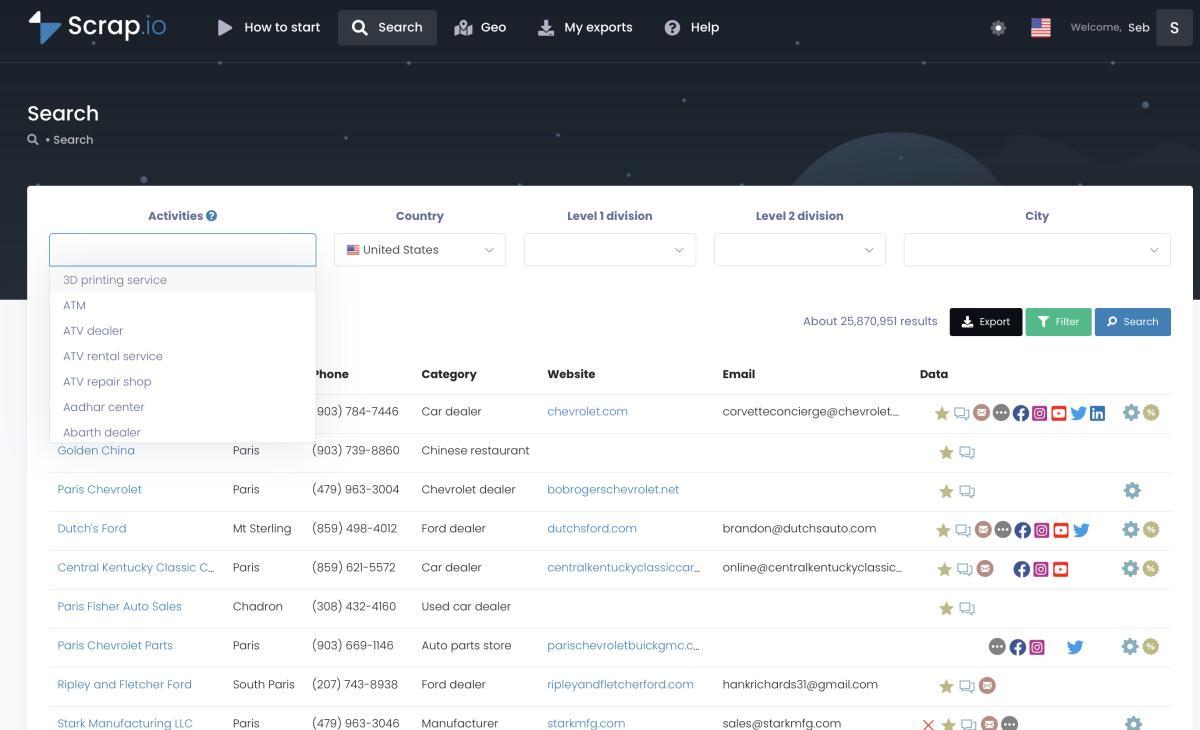
Step 2 — Count for free. Hit the count button. It tells you exactly how many matching nutritionists exist in your zone — across a whole country if you want — and it costs zero credits. This is your reality check before you spend anything.
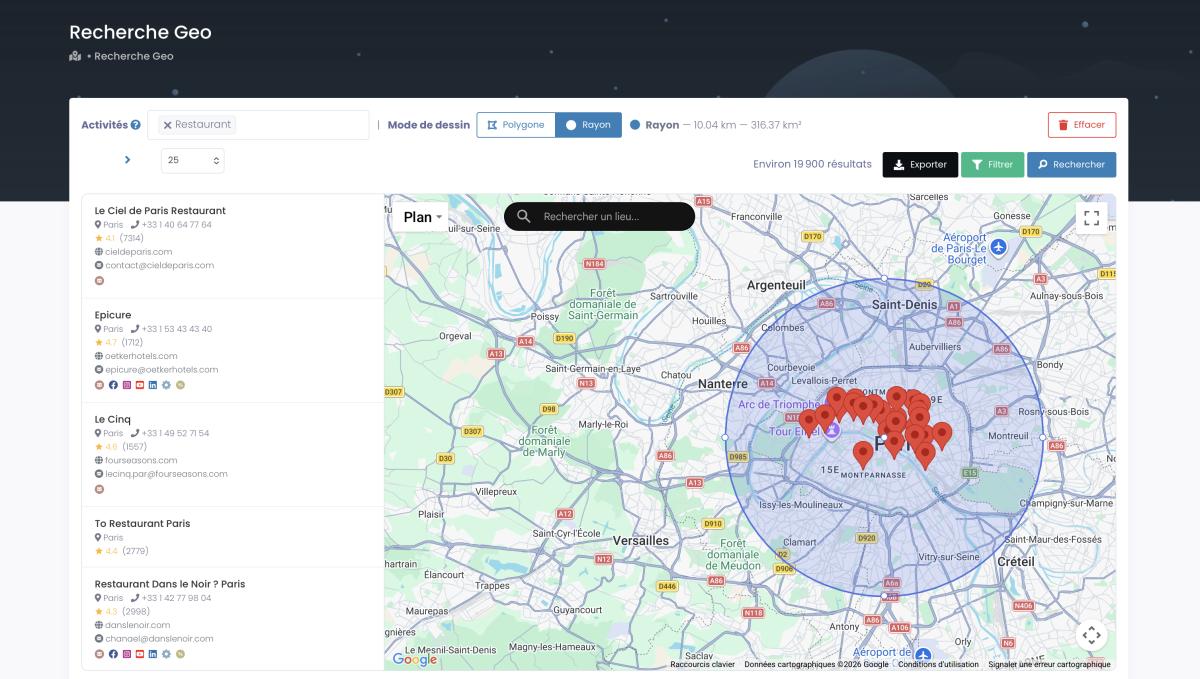
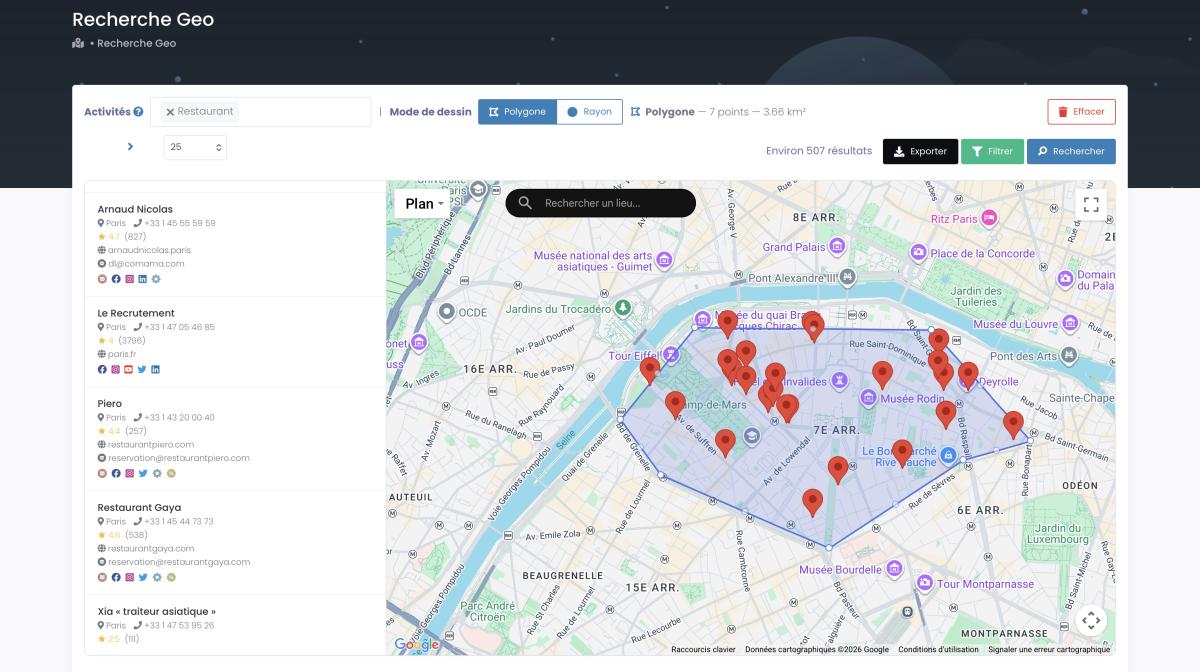
Step 3 — Narrow it down. Use GeoSearch when administrative borders don't match your target. The radius tool draws a circle around any point — say 25 miles around Austin. The polygon tool lets you freehand-draw an odd-shaped territory, down to a single neighborhood. Every filter still applies inside that shape.
Step 4 — Export. One click. You get a CSV or Excel file with business name, address, phone (tagged mobile vs. fixed), website, up to five classified emails per record, social profiles, Google rating, review count, and more. Drop it straight into your CRM or your cold-email tool. Done. That's how you export nutritionists from Google Maps without touching a line of code — the same workflow people use to pull nutritionist leads at scale.
One customer we know needed every hair salon in Texas and pulled 11,734 businesses in 45 minutes. Building a nutritionist email list works exactly the same way. Try doing that by hand. I'll wait.
Filtering: only pay for contacts you can use
Remember that stat? Only 43.7% of nutritionists have an email. So why would you pay to export the other 56%?
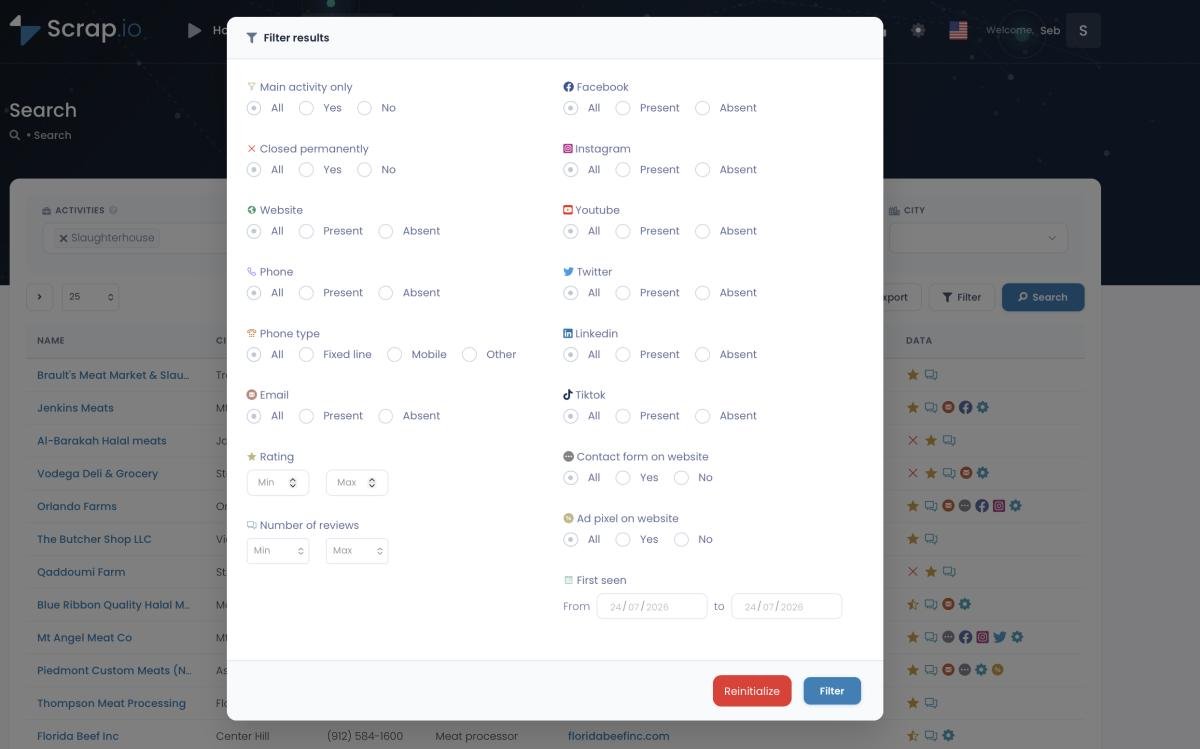
You wouldn't. This is the part that separates smart list-building from lighting money on fire. With Scrap.io, filters run before extraction — before a single credit is spent. Toggle "email present" and your 53,268 nutritionists collapse to the 23,259 you can actually write to. No wasted credits on dead-end listings. Compare that to a bought list, where you pay for every row whether it's reachable or not.
Video: Finding Clients Through Google Maps Filters
And filtering goes way deeper than "has email." You can slice by Google rating, review count, whether they've claimed their listing, whether the website runs a specific tech stack, whether there's a mobile number for SMS. Selling reputation management? Target nutritionists under 3.5 stars. Selling booking software? Find the ones with a website but no online scheduling. The filter is the pitch.
Whatever you build, verify it before you send. Even fresh data deserves a quick pass — a bounce rate over 2% tanks your sender reputation fast. Here's how to verify your email list properly. Don't skip it.
Is it legal? CAN-SPAM & HIPAA
Short version: yes, cold-emailing nutritionists is legal in the US, as long as you follow CAN-SPAM. The longer version is worth 60 seconds of your attention.
You're collecting public business data — a professional's business email, published on their own website, linked from a public Google listing. That's not private patient data. That's a company contact. Which puts you squarely in B2B territory, and B2B cold email is legal under the CAN-SPAM Act. The rules are simple: use an accurate sender name and subject line, include your real physical address, give a working unsubscribe link, and honor opt-outs within 10 business days. That's the whole checklist. Miss it, though, and the FTC can fine you as much as $53,088 per email (adjusted annually). Per email. So don't be sloppy.
Now the question everyone panics about: what about HIPAA? Here's the thing — HIPAA protects patient health information. When you email a nutritionist to pitch your scheduling app, you're not touching a single patient record. You're doing B2B outreach. HIPAA simply doesn't apply to that. It applies to their handling of their clients' data, not to your marketing email landing in their inbox.
But — and this matters — nutrition professionals live and breathe data-privacy anxiety. So even though your email is perfectly legal, the person reading it has their guard up. One line fixes most of that: tell them where you got their info. Something like "I found your practice through your public Google listing." It sounds small. It's the difference between a reply and a spam report. Scrap.io only extracts publicly available business data, is GDPR and CCPA compliant, and every record is traceable to its source — which makes that sentence easy to write honestly.
Real companies marketing to nutritionists
If you think nutritionists aren't a serious B2B market, look at who's already raised piles of money to serve them.
Nourish (nourish.com) built an insurance-covered telenutrition platform, raised somewhere around $215 million, and works with more than 10,000 dietitians. Fay Nutrition (faynutrition.com) runs an RD network across all 50 states and closed a $50 million Series B at a valuation reportedly near $500 million. Berry Street (berrystreet.co) connects RDs to 1,000+ insurance plans and has raised roughly $50 million. Then there's the software layer — Healthie (gethealthie.com), an EHR and practice-management system built exclusively for nutrition pros, and Practice Better (practicebetter.io, which acquired That Clean Life), an all-in-one platform for practitioners.
Every one of these companies needs to reach nutritionists and dietitians at scale. They didn't get there by buying stale broker lists.
And it's not all rosy from the practitioner side, which is useful intel for your outreach. The Dietitian Success Center published a candid roundup of RD perspectives on working for these telehealth startups — the good, the bad, the "I got burned." Voices like Kelly Hogan RD (writing about the brutal reality of "Private Practice: Year One") and Whitney Bateson (whose whole thing is helping dietitians who genuinely hate marketing) keep saying the same thing: client acquisition is the real bottleneck. Which is exactly the pain your product can speak to — if you can reach them. Email marketing still returns around $36 for every $1 spent (Litmus). The bottleneck was never the channel. It was always the list.
FAQ
What's the difference between a nutritionist and a dietitian?
A Registered Dietitian (RD/RDN) holds a protected, licensed title requiring a degree, supervised internship, and a national exam — they're the clinical, insurance-billing side. "Nutritionist" is unregulated in many states and can mean anyone from a Certified Nutrition Specialist to a wellness coach. For list-building, dietitians skew clinical and cautious; nutritionists skew independent and marketing-friendly.
Where can I get a list of nutritionists in the US?
Four sources: public directories (like eatright.org or Healthgrades, but no export), list vendors (fast but stale and shared), LinkedIn (misses solo practices), and live extraction from Google Maps via a tool like Scrap.io. The last one gives you a fresh, filterable list of nutritionists with emails, phones, and addresses — and it's the only method that's both current and exportable.
How many nutritionists are there in the US?
Google Maps shows 53,268 nutritionists plus 7,925 dietitians — roughly 61,000 establishments, with about 28,800 carrying an email address (Scrap.io, July 2026). The BLS counts 90,900 employed dietitians and nutritionists, since that figure includes professionals working inside hospitals and institutions who don't have their own business listing.
Is it legal to email nutritionists you found online?
Yes, for B2B outreach using publicly available professional contacts, as long as you follow CAN-SPAM: accurate headers, a real physical address, a working unsubscribe link, and opt-outs honored within 10 business days. HIPAA doesn't apply to your marketing email — it governs how nutritionists handle their clients' health data, not how you contact the business.
How do I get only nutritionists who have an email?
Apply an "email present" filter before you export. On Scrap.io, filters run ahead of extraction, so your 53,268 nutritionists narrow to the 23,259 with a real email address — and you only spend credits on those reachable contacts. No paying for empty rows.
Generate a list of nutritionist with Scrap.io