

Video: Scrap.io - How to Start?
- Why OB-GYN Email Lists Are Critical in 2026
- Understanding the Obstetrician-Gynecologist Market
- Traditional Email Lists vs Live Data Extraction
- How to Target OB-GYNs Effectively
- Best Practices for OB-GYN Email Marketing
- Building Your OB-GYN Contact Database
- Success Stories & Use Cases
- FAQ
- Conclusion & Next Steps
103,687 obstetrician-gynecologists. That's the live count on Scrap.io right now, extracted straight from Google Maps across the United States. Not some recycled CSV from 2023 that's been repackaged fourteen times. Real, current, breathing data.
And yet, half the companies trying to reach OB-GYNs are still buying static lists where a third of the contacts have already retired. I wish I was exaggerating.
Here's the uncomfortable truth about the obstetrician gynecologist email list market: the U.S. is staring down a shortage of 8,000 OB-GYNs right now, with projections hitting 22,000 by 2050 according to ACOG. Half of all U.S. counties don't have a single OB-GYN. Not "a few less than they need." Zero. That means the doctors who ARE still practicing are swamped, switching roles faster than ever, and absolutely drowning in vendor emails. Getting through to them requires data that's fresh, not "freshly repackaged."
So. If you're selling medical devices, marketing pharma products, or pitching healthcare software to women's health practices, this guide covers how to actually build an obstetrician gynecologist email list USA database that works in 2026, not 2019.
Why OB-GYN Email Lists Are Critical in 2026
The Growing Shortage Crisis
Let me hit you with numbers that should genuinely concern anyone selling into women's healthcare.
ACOG's latest workforce data paints a grim picture: the U.S. currently faces a shortage of up to 8,000 OB-GYNs, and that gap is projected to balloon to 22,000 by 2050. A study published in NCBI/PMC shows OB/GYN workforce adequacy is expected to drop from 93.4% to just 81.7% by 2037.
And the newest projection is worse than that. A September 2025 study in the Green Journal (Obstetrics & Gynecology), Projected Shortages and Distributional Challenges of Obstetrician-Gynecologists in the US, 2025-2035, found that by 2035 all but six states are projected to have an inadequate supply of OB-GYNs, with the shortfall hitting nonmetropolitan areas hardest. Six states. Out of fifty.
That's not some slow decline. That's a cliff.
And the human impact? Over 10 million women now live in maternity care deserts, counties with zero OB-GYN coverage. According to Healthgrades, 35% of practicing OB-GYNs are 55 or older, with less than 1 in 5 under 40. We're watching an entire specialty age out of the workforce in real time.
What does this mean for you? Every remaining OB-GYN becomes exponentially more valuable as a contact. But it also means your data decays faster: retirements, practice closures, relocations. A six-month-old list is practically fiction at this point.
82% Female Workforce Shift
82% of new OB-GYN graduates are women. That's completely reshaping how practices operate, what they purchase, and how they respond to outreach. If you're still using the same messaging playbook from 2015, you're speaking to a workforce that barely exists anymore.
This demographic shift creates specific opportunities: practice management tools designed for work-life balance, subspecialty equipment for the growing number of fellows, and telehealth solutions for practitioners covering rural territories. A well-segmented female obstetrician gynecologist email list lets you tailor messaging to this new reality. (And honestly, most of your competitors haven't figured this out yet.)
Geographic Disparities in 2026
Not all shortages are created equal. Bref, here's where it gets wild.
The West sits at just 74.4% OB-GYN workforce adequacy. The Northeast? 98.6%. Non-metro areas? A brutal 51.4% compared to 85.1% in metro zones. The disparity is staggering, and it's only widening.
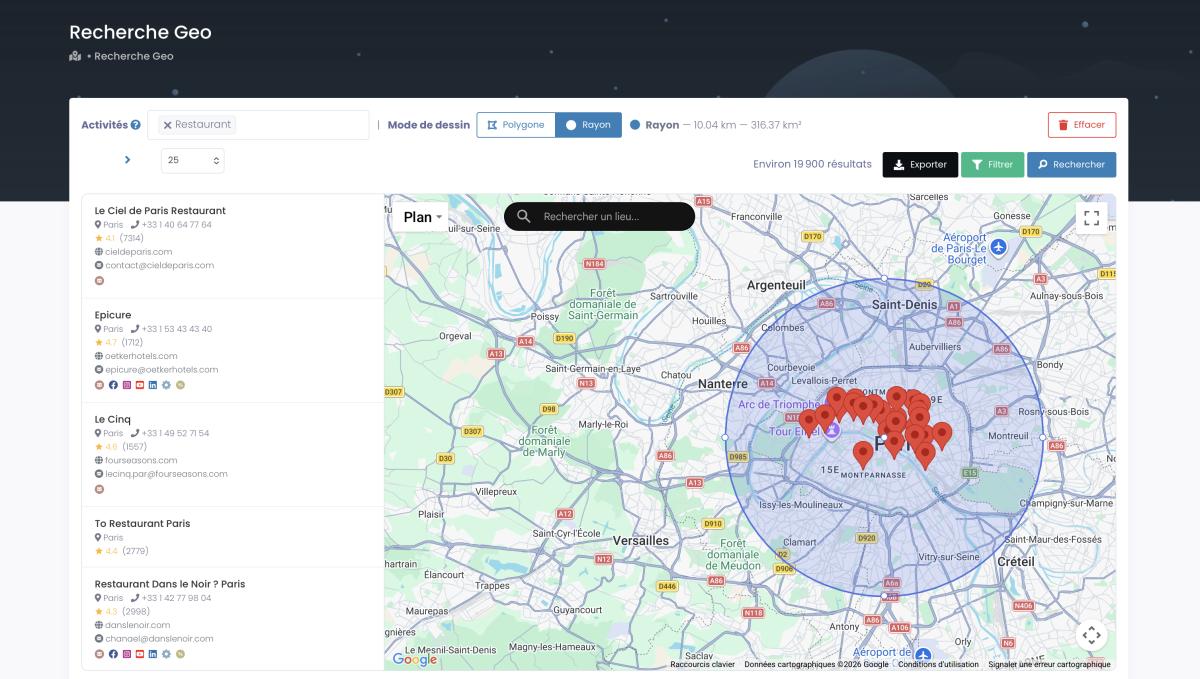
This geographic data isn't just interesting. It's your targeting roadmap. Rural practices in Montana or Wyoming are desperate for solutions that help them serve more patients with fewer resources. Metropolitan practices in Boston or New York have completely different pain points. Your email outreach needs to reflect that, or you're wasting credits on contacts who'll never convert.
Understanding the Obstetrician-Gynecologist Market
103,687 OB-GYNs on Scrap.io
As of August 2026, Scrap.io indexes 103,687 obstetrician-gynecologist listings across the United States, extracted live from Google Maps and enriched with website data. That's your addressable market, updated in real time, not stuck in some quarterly refresh cycle.
Quick reality check: an earlier version of this article quoted a lower figure. Numbers fluctuate because Google Maps reflects reality. Practices close, doctors retire, new ones open. That's actually the point. You want data that moves with the market, not data frozen in amber. For context on how this fits the broader doctor email list landscape, OB-GYNs represent one of the highest-value specialty segments in any medical email list database. The same real-time model powers our medical clinic email lists across the country.
Geographic Distribution
California leads with the highest concentration of OB-GYN practices. Texas, New York, Florida follow. But knowing WHERE the OB-GYNs are only tells half the story. You also need to know where they aren't.
According to Bureau of Labor Statistics occupational data, the distribution of physicians continues to skew heavily toward urban centers. Over 200 rural hospitals have closed their maternity services in the past decade. The remaining practices in those areas are handling exponentially more patients, which makes them prime prospects for efficiency tools, equipment upgrades, and staffing solutions. But only if you can actually reach them with current ob gyn doctor email addresses.
$13.4 Billion Market
IBISWorld pegs the U.S. OB-GYN market at $13.4 billion for 2026. That's up from $12.8 billion the year prior. Growth persists despite the shortage. Or maybe because of it. Fewer practitioners, higher patient volumes, more spending on technology and efficiency.
That's a massive addressable market. And you can't address it with dead email addresses.
Traditional Email Lists vs Live Data Extraction
Why Static Lists Fail
A medical-device sales rep once dropped $2,400 on a "premium" list of 5,000 physicians. Guess how much of it worked.
1,200 emails bounced instantly. Another 800 went to doctors who'd changed practices months earlier. That's 2,000 dead contacts, 40% of the list, gone before a single campaign went out (Prospeo, Healthcare Cold Email Services 2026). Two thousand credits, lit on fire.
And this isn't a one-off horror story. Go read any thread on Quora about where to buy a physician email list and you'll see the same complaint on loop: people buy a "verified" doctor database, and the answers circle back to the same warning. The cheap files are recycled, resold to dozens of buyers, and bounce hard within weeks. Bref, the community already knows.
Here's what happens when you buy ob gyn mailing list data from traditional brokers: they compile contacts quarterly (at best), sell the same database to your competitors, and have no way to account for the constant churn in healthcare. Retirements, relocations, practice mergers. Generic outreach tools average 25-35% bounce rates on healthcare contacts thanks to recycled hospital addresses, catch-alls, and anti-spam filters (Prospeo, 2026). With 35% of OB-GYNs nearing retirement age, static lists become dangerously unreliable, dangerously fast. Your target for a healthy send? Hard bounce under 1%.
InsightsABM's case study with Comprehensive OB/GYN demonstrated how account-based marketing campaigns targeting women's health providers require precise, current data to work. Their ABM approach with board-certified OB-GYN physicians showed that personalization only works when the contact data behind it is accurate. Generic blasts to outdated lists? Garbage results.
Video: Get Emails from Google Maps for Free
| Criteria | Static Email Lists | Scrap.io Live Data |
|---|---|---|
| Data freshness | Updated quarterly (maybe) | Real-time extraction |
| Cost per contact | $0.10–$0.50 | ~$0.0035 |
| Bounce rate | 25–35% | Under 5% |
| Source traceability | Opaque | Full (Google Maps + website) |
| Exclusivity | Shared with competitors | Your extraction, your data |
| Filtering | Basic (specialty, location) | 30+ filters including email type, reviews, social media |
The Scrap.io Advantage
Scrap.io doesn't store a static database. It extracts obstetrician gynecologist email list data in real time from Google Maps and practice websites. When a doctor updates their listing or a new practice opens, you get that data immediately. Not next quarter.
And here's the part that kills traditional list economics: Scrap.io's Basic plan starts at $35/month for 10,000 credits. That's roughly $0.0035 per contact. Compare that to the $0.10–$0.50 per contact traditional brokers charge for data that might be six months stale. The math is embarrassing for static providers.
Oh, and also: you can filter BEFORE you pay. Only want OB-GYN practices that have an email address on their website? Filter for that. Only practices with a mobile number for SMS campaigns? Done. You never waste credits on contacts missing the data points you need. This is the direct answer to those 25-35% broker bounce rates: fresh data, validated at the moment of export.
Compliance & Data Quality
Traditional list brokers often can't tell you where their data came from. That's a compliance headache waiting to happen.
Scrap.io only extracts publicly available business information that practices voluntarily display on Google Maps and their own websites. Full source traceability. GDPR and CCPA compliant. No sketchy data harvesting. Check our guide on buying email lists legally for the full breakdown.
How to Target OB-GYNs Effectively
Segmentation by Specialization
Not all OB-GYNs are the same. About a third of residents now pursue subspecialty training in maternal-fetal medicine, reproductive endocrinology, gynecologic oncology, or female pelvic medicine. Each subspecialty has radically different equipment needs, budget priorities, and pain points.
Selling ultrasound equipment? Target maternal-fetal medicine specialists. Marketing hormone therapies? Reproductive endocrinologists. Pitching surgical devices? Gynecologic oncology. A generic blast to your entire gynecologist contact list for marketing is pure laziness. Segment or suffer. (The same segmentation logic applies whether you're building this list or a pediatrician email list for a related specialty.)
Geographic Targeting
Remember those adequacy stats? The West at 74.4%, non-metro at 51.4%? That's your opportunity map right there.
Rural OB-GYNs in Montana, Wyoming, or the Dakotas are serving counties the size of some European countries. Alone. They need portable equipment, telemedicine solutions, and efficiency tools. They're also dramatically underserved by sales teams who don't bother traveling to their territories. (Seriously. Try being the one vendor who actually shows up.)
Metro practices in New York or LA? Different game entirely. They're competitive, tech-savvy, and drowning in vendor pitches. Your differentiation has to be sharper. With Scrap.io's GeoSearch you can draw a radius around a single hospital or trace a custom polygon over an entire underserved region, then apply every filter inside it.
Timing & Personalization
Physicians receive 70–200+ emails per day according to ResidencyAdvisor. The generic response rate? A miserable 1–5%. But structured, personalized outreach? 20–40%.
That gap is insane. And it comes down to one thing: relevance.
OB-GYNs check email during admin windows, typically 7–9 AM or 4–6 PM. Tuesday through Thursday outperforms. Mondays are catch-up chaos, Fridays are mental checkout. Reference their specific challenges: the shortage in their region, their subspecialty focus, the number of counties they cover. Make it clear you understand their world before asking for anything.
Best Practices for OB-GYN Email Marketing
GDPR & CAN-SPAM
Healthcare professionals are paranoid about data protection. Can you blame them? They handle patient data under HIPAA every day. If your outreach screams "shady data broker," you're toast before they read the subject line.
CAN-SPAM basics: honest subject lines, clear sender ID, working unsubscribe, real business address. For international contacts, GDPR adds consent documentation and data deletion requirements. This isn't optional. It's the price of admission. Our email validator guide covers deliverability requirements in detail, and if you're starting from zero, here's how to build a cold email list the right way.
Email Authentication for 2026
Google and Yahoo tightened authentication requirements for bulk senders. If you're emailing a physicians email list at any scale, you need proper SPF, DKIM, and DMARC setup. Without them? Your emails go straight to spam. Doesn't matter how good your copy is.
This isn't some edge case. It's table stakes in 2026.
Content That Converts
OB-GYNs can smell a generic sales pitch from orbit. These are people who spent a decade in training learning evidence-based decision-making. "Revolutionary solution!" and "game-changing results!" make them close your email faster than you can say "unsubscribe."
What works? Real numbers. Clinical evidence. Peer references. Something like "New protocol reduces cesarean rates by 23%" gets opened. "Transform Your Practice Today!!" gets deleted.
Be direct. Be factual. Don't waste their time.
Building Your OB-GYN Contact Database
Step-by-Step Process
Building a verified obgyn contacts database with Scrap.io takes minutes. Not weeks. Not months. Minutes.
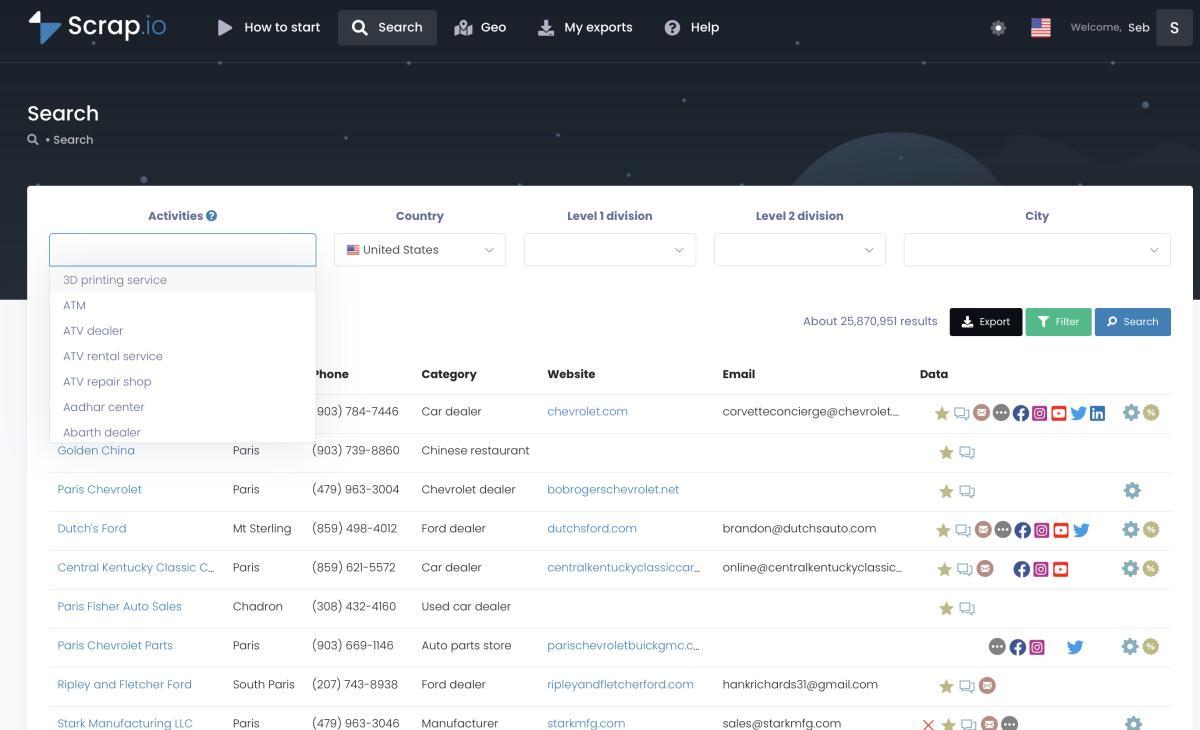
Step 1: Search "Obstetrician-Gynecologist" on Scrap.io. Pick your target area: city, state, or the entire country.
Step 2: Review the free count. See exactly how many results match before spending a single credit.
Step 3: Apply filters: geographic boundaries, email presence, website presence, review scores, whatever matters for your campaign.
Step 4: Export your contacts with full source information: name, address, email, phone, website, social media links, review data.
One Scrap.io user extracted 11,734 verified healthcare contacts in 45 minutes. Try doing that with manual research. I'll wait. (Actually, I won't. That would take you about six months.)
Video: Scrap.io - Product Tour
Advanced Filtering Options
This is where Scrap.io goes from "useful" to "unfair advantage" when building an ob gyn practice email database.
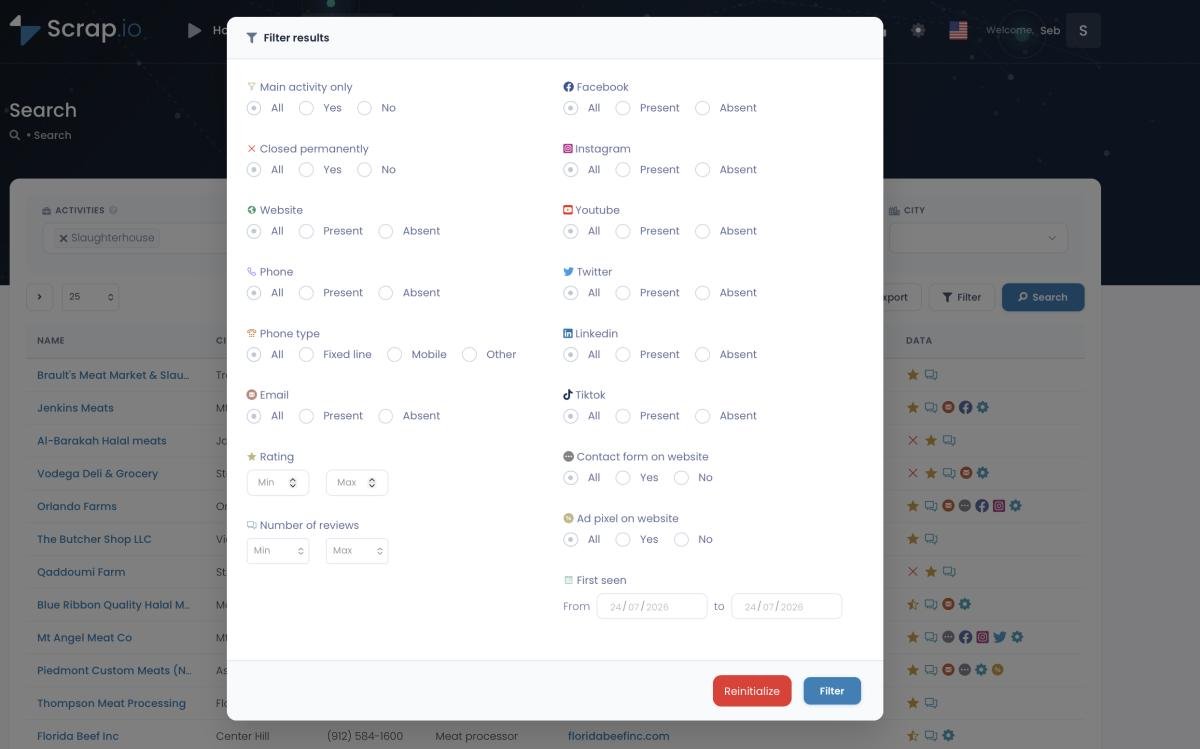
Filter by email type. Scrap.io classifies emails automatically: individual emails (with first and last name extracted), generic contact@ addresses, sales emails, marketing emails. Want to find obgyn email addresses belonging to actual decision-makers, not info@ black holes? Filter for individual emails only.
Filter by digital presence: practices with websites vs. without, social media activity, Google review counts. Need healthcare email lists targeting practices that desperately need marketing help? Filter for low review counts and no social media. Targeting tech-forward early adopters? Look for active social profiles and high review engagement.
And filter by phone type, landline vs. mobile, so you can segment for SMS campaigns or cold calling strategies. (Phone type classification isn't available in the US and Canada, but it's available worldwide elsewhere.)
Data Verification
Because Scrap.io extracts from live Google Maps listings and active websites, the inherent data freshness means dramatically lower bounce rates compared to static databases. Practices maintaining active Google Maps listings are, by definition, active practices. Dead businesses don't update their hours.
Still, for major campaigns: run your extracted list through an email validator like NeverBounce or ZeroBounce before sending. Belt and suspenders. Your sender reputation will thank you.
Success Stories & Use Cases
Medical Device Companies
Companies like GE Healthcare, Hologic, and Philips dominate the OB-GYN equipment space: ultrasound systems, fetal monitors, surgical instrumentation. But here's the thing: the shortage crisis means rural practices need MORE versatile, portable equipment because they're serving larger territories with fewer doctors.
An obstetrician email list for medical device sales targeted at rural OB-GYNs is a fundamentally different campaign than one targeting a Manhattan academic center. The rural practice needs portability, multi-function capability, and telehealth integration. The academic center wants cutting-edge imaging and research capabilities. Same product category, totally different pitch.
Pharmaceutical Manufacturers
AbbVie, Organon, and Mylan are among the pharma players heavily invested in women's health: hormone therapies, contraceptive solutions, prenatal vitamins. The remaining OB-GYNs are seeing higher patient volumes, which makes them more receptive to treatments that improve efficiency and outcomes.
A well-segmented gynecologist mailing list for pharma companies lets you target by subspecialty: reproductive endocrinologists for fertility products, general OB for prenatal supplements, family planning-focused practices for contraceptive solutions. Don't spray and pray. When your buying committee spans MDs, nurse practitioners, and physician assistants, pair this list with a nurse practitioner email list to reach every decision-maker.
Healthcare Software Providers
Athenahealth, eClinicalWorks, and Greenway Health are battling for market share in OB-GYN practice management. The shortage forces practices to do more with less, which means software that improves efficiency, enables telemedicine, and integrates with existing systems has a massive addressable market.
Companies like WebFX and Cardinal Digital Marketing have built entire practice areas around OB-GYN digital marketing, which tells you everything about the demand for reaching these specialists. And PatientGain offers a $999/month digital marketing solution specifically for OB-GYN practices. When agencies are building specialty verticals, you know the market is real.
Marketing Agencies Targeting OB-GYN Practices
Exactly. There's now an entire ecosystem of agencies specializing in women's healthcare marketing. They need fresh doctor email list data to fuel client acquisition, and they need it segmented by practice size, location, digital maturity, and patient volume.
For agencies, the play is clear: extract OB-GYN practices with poor online presence (low Google reviews, no social media, no website) and pitch them marketing services. Scrap.io's filters make this almost embarrassingly easy. Even platforms like Doximity, which tracks physician workload and shortages, confirm that the OB-GYN segment is among the most underserved. Which means more opportunity for agencies who can demonstrate ROI.
FAQ
Where can I buy verified obstetrician-gynecologist email lists?
Scrap.io provides real-time access to 103,687+ OB-GYN contacts extracted live from Google Maps, not stored in a static database. This ensures data freshness and compliance that traditional providers like ReachStream, MedicoReach, or LakeB2B simply can't match with quarterly-updated files. Other physicians email lists sources exist, but none offer real-time extraction at this scale. If you're wondering where to buy ob gyn email list data, start here: real-time, 103,687+ contacts, filtered before you pay.
How much do OB-GYN email lists cost?
Traditional brokers charge $0.10–$0.50 per contact for static data that may be months old. Scrap.io's Basic plan: $35/month for 10,000 credits, working out to approximately $0.0035 per lead. That's roughly 30x cheaper, and the data is actually current. The free 7-day trial includes 100 export credits so you can test before committing.
Are obstetrician email lists GDPR compliant?
Yes, when sourced from public business directories. Scrap.io extracts only publicly available information from Google Maps and business websites, data that practices voluntarily publish. Full source traceability, GDPR and CCPA compliant. For detailed legal considerations, see our guide on buying email lists.
How often should OB-GYN email lists be updated?
With 35% of OB-GYNs nearing retirement and a projected shortage of 22,000 by 2050, the healthcare workforce is churning faster than ever. Static databases updated quarterly are already stale by the time you use them. Real-time extraction (the Scrap.io model) eliminates this problem entirely: every export is fresh. If you're using traditional hospital email lists, plan for monthly re-verification at minimum.
What's the best way to segment an OB-GYN email list?
Segment across four axes:
- Subspecialty (maternal-fetal medicine, reproductive endocrinology, gynecologic oncology)
- Geographic region (state, county, metro vs. rural)
- Practice type (solo vs. group, hospital-affiliated vs. independent)
- Digital presence (website, social media, review activity)
Scrap.io's 30+ filters let you build an obstetrician gynecologist contact database 2026 tailored to exactly these parameters, before you pay a cent.
Conclusion & Next Steps
The OB-GYN market is a $13.4 billion opportunity sitting on top of a workforce crisis. 8,000 fewer doctors than needed today. 22,000 projected by 2050. All but six states short by 2035. Half of U.S. counties with zero OB-GYN coverage. The doctors who remain are busier, harder to reach, and more valuable as contacts than ever.
But none of that matters if your contact data is garbage.
Static lists from traditional brokers are built for a world where healthcare data doesn't change much. Except it does. Constantly. And the cost of emailing outdated contacts isn't just wasted postage. It's destroyed sender reputation, compliance risk, and missed opportunities you'll never get back.
Generate a list of obstetrician-gynecologist with Scrap.io