

Marcus runs a small web agency. He needed 3,000 restaurant leads for a cold email push, saw Outscraper's "$3 per 1,000" price tag, and figured the whole job would run him nine bucks. His actual invoice? Just over $40. Then the enrichment add-ons kicked in on the next batch and it climbed north of $100.
Nobody lied to him. The headline number was real. It just wasn't the number he'd pay.
Here's the thing about outscraper pricing: the sticker price and the checkout price live in two different neighborhoods. The base scrape is genuinely cheap. But a lead you can actually contact (an email, a verified address, a phone number) costs closer to $6 to $14 per 1,000 once the add-ons stack up. This article does the math Outscraper's pricing page won't, shows you exactly where the bill balloons, and puts a flat-rate alternative next to it so you can decide what fits.
- How Outscraper pricing actually works
- The real cost of an Outscraper lead: the $3 that becomes $14
- Outscraper's free tier & free trial: what you really get
- Where the bill surprises people (real reviews & complaints)
- Outscraper API pricing (for technical readers)
- The alternative: flat, predictable pricing with Scrap.io
- Outscraper vs Scrap.io: side-by-side cost & features
- Is it legal? Compliance to check before scraping
- How to choose: which tool fits your use case
- FAQ
How Outscraper pricing actually works
Outscraper doesn't sell plans. It sells credits, and that single design choice is why your final invoice rarely matches your estimate.
The model is pay-as-you-go. There's no monthly subscription, no fixed tier you settle into. You run a task, the platform meters what you consumed, and at the end of a 30-day billing window you get an invoice. Water-meter billing, basically. You pay for what flows through the pipe.
For the core Google Maps scraper, the rate ladder looks like this (straight from Outscraper's pricing page, 2026): your first 500 businesses are free, records 501 through 100,000 cost $3 per 1,000, and anything beyond 100,000 drops to $1 per 1,000. So yes. At massive volume, it gets genuinely cheap. Most people never touch that tier.
But that $3 only buys you the skeleton: business name, address, category, sometimes a phone number. Does Outscraper charge per credit for the extras? In effect, yes. Every enrichment (emails, email verification, phone lookup) is billed as its own separate service on top of the base scrape. This is the part where outscraper pricing per 1000 records stops being a single number and becomes a stack. For the theory behind why metered tools price this way, we broke it down in our guide on per-lead vs execution-time pricing.
And if you're wondering how much scraping Google Maps costs in the first place, the honest answer is: it depends entirely on how many of these add-ons you switch on. Which brings us to the math.
The real cost of an Outscraper lead: the $3 that becomes $14
The headline says $3 per 1,000. A single usable, contactable B2B lead costs closer to $14 per 1,000. Here's exactly how it adds up.
Start with the base scrape at $3. Now you need emails for cold outreach. That's the Emails & Contacts scraper, another $3 per 1,000. Want those emails verified so half your list doesn't bounce and torch your sender reputation? Email verification, +$3 per 1,000. Need phone numbers you can actually dial? The Phone Number Lookup runs $5 per 1,000. Stack the layers you'd realistically need for a working campaign and you land here:
| Data layer | Outscraper cost (per 1,000) |
|---|---|
| Base Google Maps data (name, address, phone field) | $3 |
| + Email enrichment | +$3 |
| + Email verification | +$3 |
| + Phone number lookup | +$5 |
| Real cost of a usable lead | ~$14 |
Independent reviewers land in the same range. gmapsscraper.io pegs the real cost with emails at $9–11 per 1,000, and Lead Scrape's 2026 review puts it plainly: "$3 per 1000 results, plus add-on fees for emails." So the outscraper email cost isn't a rounding error. It's often the biggest line on the bill.
Run the scenario. Need 50,000 fully usable leads for a national campaign? At ~$14 per 1,000, you're looking at roughly $700. For one export. And you won't know the exact figure until the job finishes and the invoice generates. That's the catch with metered billing: the price is a range until it isn't.
Now for scale: the web scraping software market is projected to grow from $1.03 billion in 2025 to around $2 billion by 2030, a 14.2% CAGR (Mordor Intelligence, 2025). More companies are extracting business data than ever, and a lot of them are quietly overpaying because they budgeted for the headline and got billed for the stack.
Curious what those same 1,000 fully-enriched leads would cost on a flat plan? On Scrap.io, one credit gets you a business with emails, phones, and socials already included (no add-ons) for roughly $3.50 per 1,000. See the flat-rate pricing →
Outscraper's free tier & free trial: what you really get
Free for the first 500 records. Great. But what happens on record 501?
Let's be clear about the free tier, because "is Outscraper a free tool?" is one of the most-asked questions and the answer is: partly. Each Outscraper service gives you a free allowance: 500 businesses on the Google Maps scraper, 500 on the emails scraper, and so on. It resets on a rolling 30-day basis. For a one-off test of a hundred leads, you genuinely pay nothing. That's a real perk, and credit where it's due.
The catch on record 501
The moment you cross a free threshold, metered billing kicks in silently. There's no default spending cap on the postpaid model. You connect a card, and usage above the free tier just accrues until the invoice lands at month's end. Nobody taps you on the shoulder at record 501. The counter simply starts running.
That's the difference between "free tool" and "free tier." One is a product. The other is a doorway. And plenty of people find the outscraper free entry point delightful right up until the first real invoice.
Where the bill surprises people (real reviews & complaints)
One user estimated $3 for 1,000 records. She scraped a few thousand leads and got a bill for about $100. This isn't a hypothetical. It's a real thread on Outscraper's own forum.
Here's the verbatim from the Outscraper Community: "According to their pricing plan, the estimated cost for scraping 1000 records is 3$. I have scraped a few thousand leads and been charged about 100$ for it. Can anyone relate to my problem or explain how their pricing technique works?" That single post is the entire outscraper hidden fees story in three sentences.
What's telling is the reply from another user in the same thread. Their fix for avoiding overcharges? Get ruthless with search parameters: "I now create the most restrictive search parameter possible… I ignore the more expensive features 'Company Insight', 'Phone Owner' and 'Validate email'… this is where I mistakingly ran into big costs." Translation: to keep Outscraper cheap, you have to actively fight the enrichments it nudges you toward. That's a real workaround, from a real customer, and it tells you everything about how to avoid extra costs on Outscraper.
To be fair (and this matters), Outscraper's own team answered honestly in that same thread. Their staffer explained that the base scrape has a fixed per-record price, but that "additional costs for those extra services might be added" when you turn on enrichments, and that using them is "completely up to you." No dodging. They're upfront about the mechanism. The problem isn't dishonesty. It's that the mechanism surprises people who only read the headline.
Search "outscraper pricing reddit" or scan the Trustpilot reviews and the pattern repeats: support gets praised, the team gets praised, and then someone mentions a month-end invoice that ran double what they modeled. Is Outscraper worth it? For the right user, absolutely. But "costs that look cheap per task add up quickly" is the recurring refrain, and you should walk in knowing that.
Outscraper API pricing (for technical readers)
The API doesn't change the price. It just makes it easier to spend faster.
If you're a developer, Outscraper's REST API is solid: clean docs, predictable JSON, the whole toolkit. Getting an outscraper api key takes a couple of minutes. And search volume for that exact query has climbed sharply over the past year, so clearly more people are automating against it.
Here's the thing to internalize, though: the outscraper api pricing is identical to the dashboard. Same $3 per 1,000 base, same per-service enrichment fees. The API is a faster faucet, not a cheaper one. Wire it into an automated pipeline that scrapes on a schedule, leave the enrichments toggled on, and you can rack up cost overnight without a human ever eyeballing an estimate. Automation amplifies whatever pricing model sits underneath it. And metered billing amplified by a cron job is how you get a surprise on the first of the month. If you're weighing the API route against the official Google one, our breakdown of when scraping beats the official Google Maps API runs the real numbers.
The alternative: flat, predictable pricing with Scrap.io
What if the number you see before you extract is the number you actually pay?
That's the whole pitch for Scrap.io as an Outscraper alternative for Google Maps scraping. It's a flat-rate tool built specifically for Google Maps lead generation, not a 50-scraper Swiss Army knife. One credit equals one business exported. And that business arrives with all the columns already attached: emails (classified by type), phone numbers with landline/mobile/special detection, social profiles, website tech, ad pixels. No add-on for emails. No separate charge for verification. No phone-lookup surcharge. The price you budgeted is the price you pay.
Run the math and it's stark. The Basic plan is $35/month (annual) for 10,000 credits, and every credit is a fully enriched lead. That's roughly $3.50 per 1,000 fully usable leads, versus Outscraper's $6–14 for the same completeness. Two to four times cheaper, and the amount is known in advance. That predictability is why people searching for a predictable pricing google maps scraper or an outscraper vs flat rate scraping tool keep landing here.
Filter before you pay: zero wasted credits
This is the part metered tools can't match. On Scrap.io, filters apply before extraction, so credits only burn on leads that meet your criteria. Only want businesses that actually have an email listed? Toggle it. Only mobile numbers for an SMS campaign? Done. Minimum 4-star rating with 50+ reviews and a contact form on the site? A few clicks, and you pay for exactly those. If 40% of a target area has no email, you simply don't buy those rows. Try that when you're billed per record after the fact. It's the single biggest lever on your lead generation cost: scraping vs traditional methods. You stop paying for contacts you can't use.
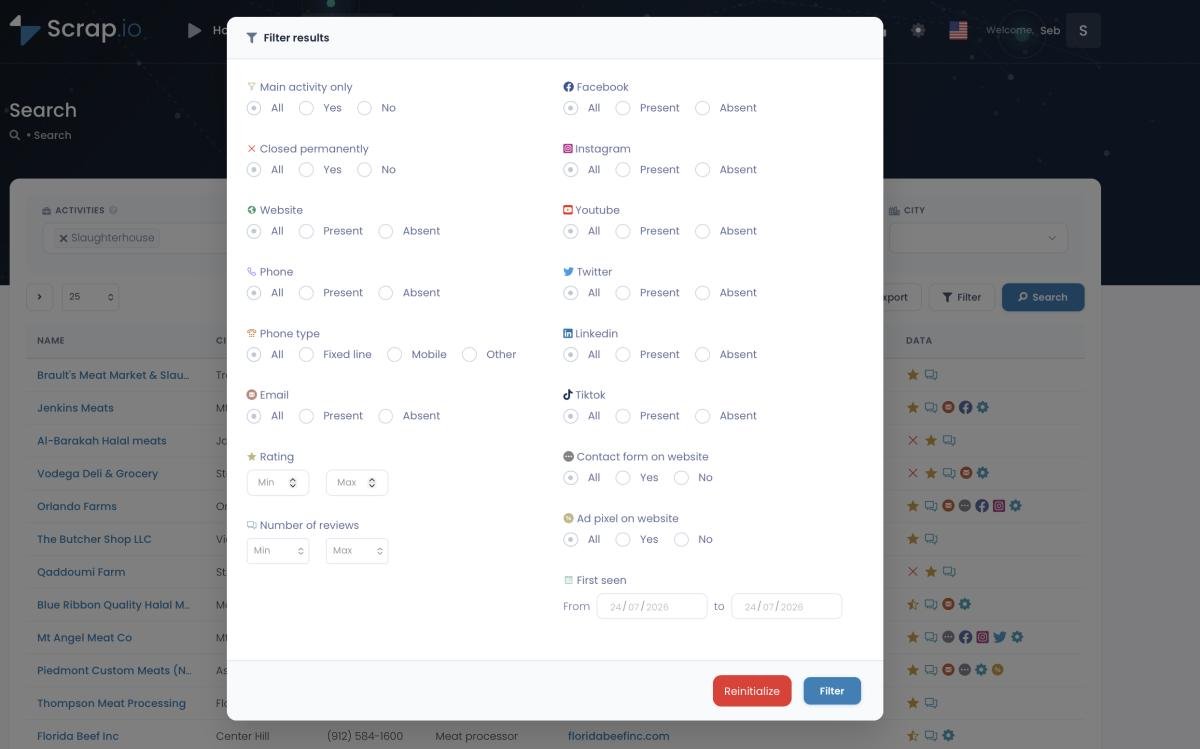
Counting results is free, too: in the interface, via the API, or through the MCP connector. Take US restaurants. Scrap.io indexes 668,211 of them, and only 199,437 (about 30%) have an email on file. With filter-before-you-pay, you spend credits on those 199,437, not the full 668,211. Billed per record after the fact? You'd have paid for all 668,211. That's not a small thing. It removes the guesswork that makes outscraper pricing feel like a gamble.
A whole country in two clicks
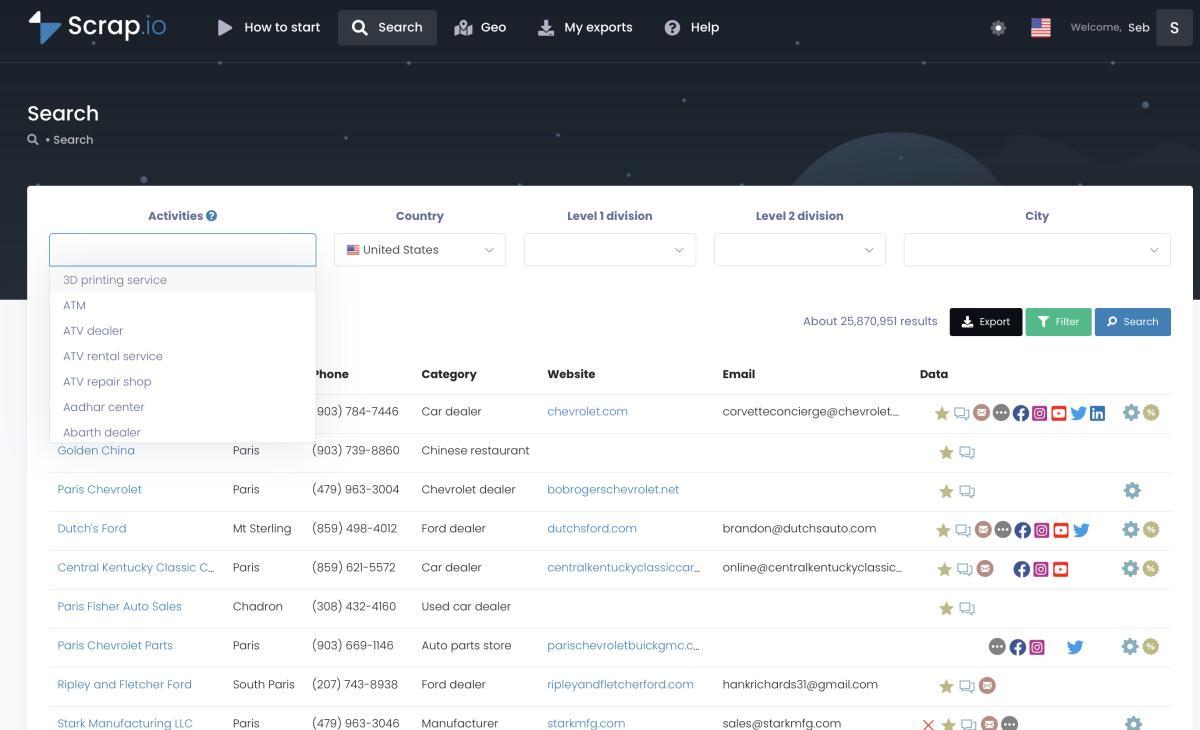
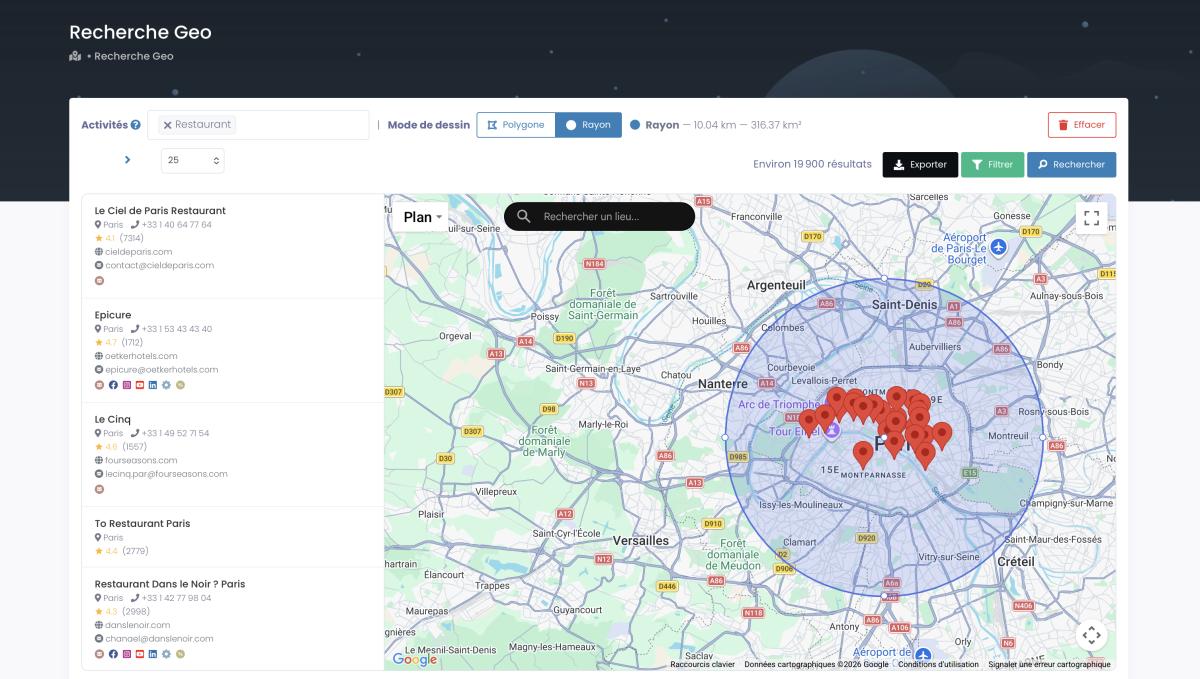
Scrap.io has indexed 225,676,406 establishments across 195 countries and 4,000+ categories, with data refreshed in real time at the moment of export. No stale, frozen database. Pick a category, pick a geography from a single city up to an entire country, and export. One documented client pulled 11,734 businesses in 45 minutes. And the GeoSearch tools let you draw a radius or a custom polygon on the map when administrative borders don't match your target zone.
Video: How to Scrape Local Leads at the Country Level?
Need emails specifically? Scrap.io classifies every address it finds: individual (with first and last name extracted), contact, sales, marketing, finance, admin. So you know if an address belongs to the owner or a generic inbox before you hit send. There's a full walkthrough in our guide on how to find emails on Google Maps.
Try Scrap.io free for 7 days: 50 searches and 100 export credits included. Run a real extraction on your own target market and compare the invoice you'd have gotten. Start your free trial →
Outscraper vs Scrap.io: side-by-side cost & features
Two tools, same Google Maps data. One bills you per action. The other bills you once a month.
| Outscraper | Scrap.io | |
|---|---|---|
| Pricing model | Metered (pay-as-you-go) | Flat monthly |
| Base price | $3 / 1,000 records | ~$3.50 / 1,000 fully enriched |
| Emails | +$3 / 1,000 add-on | ✅ Included & classified |
| Phone enrichment | +$5 / 1,000 add-on | ✅ Included (type detection) |
| Real cost per 1,000 usable leads | 🔴 $6–14 | 🟢 ~$3.50 |
| Filtering before you pay | 🟡 Limited / after export | ✅ 17+ filters before extraction |
| Invoice known in advance | ❌ No | ✅ Yes |
| Country-level extraction | 🟡 Difficult | ✅ Two clicks |
Both tools pull from the same public source. Google Maps holds 200 million+ businesses and serves 2 billion monthly active users (Google / Loopex Digital). The data isn't the differentiator. The billing model is. Outscraper wins if you scrape rarely and lightly. Scrap.io wins the moment you need enrichment, repetition, or a number you can put in a budget without flinching.
One honest caveat, since I'd want it flagged if I were reading: Outscraper scrapes 50+ platforms: Amazon, Yellow Pages, Google News, the lot. Scrap.io does Google Maps. If your job spans multiple sources, the generalist is the right call. If it's Maps leads, the specialist is cheaper and deeper. Weighing the whole field? Our rundown of the best B2B data providers puts the local-business layer next to the big corporate databases.
50,000+ professionals already extract on predictable pricing. Scrap.io is rated 4.8 on Capterra and 4.9 on G2. See why they switched →
Is it legal? Compliance to check before scraping
Is scraping Google Maps even legal? Short answer: public business data, yes. With conditions.
Extracting publicly available business information (names, addresses, listed phone numbers, ratings) is generally legal for commercial prospecting in both the US and the EU. Under GDPR Article 6, B2B contact data typically falls under "legitimate interest," and the CCPA in California carves out publicly available business information from its scope. Reputable tools are GDPR- and CCPA-compliant, extract only public data, and keep every data point traceable to its source.
The line you don't cross: harvesting private personal data, scraping behind login walls, or ignoring opt-out obligations. You stay responsible for how you use what you pull. A compliant tool doesn't make a non-compliant campaign legal. Include an opt-out in every outreach email, honor unsubscribes, and don't be a jerk about it. That's the floor, not the ceiling.
How to choose: which tool fits your use case
There's no universally "best" tool: there's the one that fits how often you extract.
Scrape once a quarter, under 500 records, no emails? Outscraper's free tier is genuinely hard to beat. You might pay nothing. Need multi-platform coverage beyond Maps? Again, Outscraper. But the second your work involves enrichment, repetition, or a budget you have to defend to someone, the metered model works against you. That's when a flat-rate cheapest google maps scraper 2026 pick like Scrap.io (or any outscraper free alternative built on predictable pricing) starts saving real money.
Tempted by the raw-API route instead? Our Scrape.do vs Scrap.io comparison spells out why an API without a developer is a subscription to nothing. Most teams run two tools anyway: one for corporate contacts, one for local.
Already sitting on Outscraper credits? Keep them for the occasional one-off. Then test a flat plan on a real campaign and compare the two invoices side by side. Numbers settle arguments faster than blog posts do. Here's a two-minute look at how the flat-rate workflow starts:
Video: Scrap.io - How to Start?
The bottom line
Outscraper's $3 isn't a lie. It's just the first floor of a building. The real cost of a lead you can email, verify, and call sits between $6 and $14 per 1,000, you won't see the exact figure until the invoice generates, and there's no default cap catching you if a job runs long. For light, occasional, multi-platform work, that's a fair trade. For serious Google Maps lead generation, it's a budgeting headache with a nice-looking sticker price.
Flat-rate flips the script: one price, all data included, filters that stop you paying for junk, and a number you know before you click export. Stop guessing your next invoice.
Start your free 7-day Scrap.io trial: 100 leads included, 225 million+ businesses across 195 countries, every column included. Run one real extraction and see the difference for yourself. Try Scrap.io free →
FAQ
How much does Outscraper cost?
It's pay-as-you-go. Google Maps data runs about $3 per 1,000 records after the first 500 free (dropping to $1 per 1,000 beyond 100,000 records). Emails (+$3/1,000), verification (+$3/1,000) and phone enrichment (+$5/1,000) are billed separately, so a fully usable lead typically costs $6 to $14 per 1,000.
Is Outscraper free?
Partly. The free tier covers your first 500 records per service plus a rolling monthly allowance. Beyond that, usage is billed per record at the end of the 30-day period through your stored card. There's no default spending cap, so anything above the free tier accrues until the invoice arrives.
What is the best alternative to Outscraper?
For predictable budgets, a flat-rate tool like Scrap.io: one credit equals one business exported with all data included (emails, phones, socials), starting at $35/month for 10,000 leads (about $3.50 per 1,000), with no per-service add-ons and filters applied before you pay.
How much does it cost to scrape Google Maps?
It depends on the model:
| Model | Example | Cost per 1,000 usable leads |
|---|---|---|
| Metered / pay-as-you-go | Outscraper | $6–14 |
| Flat-rate | Scrap.io | ~$3.50 |
| Official API | Google Places API | ~$32+ (basic, no emails) |
The Google Maps API pricing calculator is usually the most expensive route at scale.
Is scraping Google Maps legal?
Extracting publicly available business data is generally legal for commercial prospecting, and reputable tools are GDPR- and CCPA-compliant. You remain responsible for how you use the data: include an opt-out in outreach, honor unsubscribes, and check each tool's compliance and your local rules.
How can I scrape Google Maps for free?
Both tools have a free entry point. Outscraper gives you 500 free records per service on a rolling monthly basis. Scrap.io offers a 7-day free trial with 50 searches and 100 export credits. Past those limits, you pay per record with Outscraper or a flat monthly plan with Scrap.io. For a quick test, either one costs nothing.
This article references pricing published by Outscraper and Scrap.io as of 2026. Metered pricing can change; verify current rates on each provider's pricing page before budgeting.
Generate a list of restaurant with Scrap.io