

Video: Scrap.io - How to Start?
Table of Contents
- What is a Singapore business directory (and why most are broken in 2026)?
- Singapore's business landscape in 2026: the numbers
- Where to find a list of companies in Singapore (5 sources compared)
- The smarter way: extract your own directory from Google Maps
- How to build a Singapore company database step by step
- Filtering before you spend
- Real examples: who uses Singapore business data
- Staying compliant: PDPA, GDPR & public business data
- FAQ
Wei Ling runs a small lead-gen agency here in Singapore. Last quarter she paid S$1,200 for a "premium" Singapore company database. Twelve thousand rows. Looked gorgeous in the preview.
Then she hit send.
Nearly 40% bounced. Another slice went to companies that had closed, moved, or rebranded since the file was compiled. And that's the dirty little secret of most static directories — they're photographs of a market that never stops moving. You're prospecting a version of Singapore that stopped existing months ago.
Here's a number that should reframe the whole thing. ACRA, the country's official business registry, lists 614,000+ active entities as of mid-2025 — including 456,000+ companies. New ones appear every single day. So any "singapore business directory pte ltd" spreadsheet you bought half a year ago is already blind to thousands of them. Advertisers clearly know this data is worth something, too: the keyword singapore business directory carries a cost-per-click of nearly US$8. People are paying real money to reach these businesses.
This guide skips the recycled stuff. We'll cover what a Singapore business directory actually is in 2026, where to find a reliable list of companies in Singapore, and why the sharpest teams stopped renting stale lists and started building their own — live, from Google Maps, filtered before they spend a cent.
What is a Singapore business directory (and why most are broken in 2026)?
A Singapore business directory is, at its simplest, a database of local commercial entities — company name, address, phone, sometimes a website, occasionally an email. That's the theory. In practice, the word "directory" hides a huge quality gap.
Most of what gets sold as a directory is a snapshot. Someone compiles the data once, then licenses that same file over and over for a year or two. Makes sense for the seller — build once, sell forever. Terrible for you. A dental clinic in Tanjong Pagar changes its email? The listing still shows the dead address. A startup in one-north raises a round and moves offices? Good luck seeing that update before 2027.
The other broken flavour is the browse-only directory. You can look a company up, one at a time, on a website. Lovely for a single check. Useless when you need a segmented list of 3,000 businesses for a campaign. No filters, no bulk export, no emails. You end up copy-pasting like it's 2011.
So what does a useful directory look like in 2026? Verified contact data, filterable by city and category, exportable in bulk, and — this is the part almost nobody delivers — current on the day you use it. That last requirement is where every static file falls apart. And it's the entire reason a live source like Google Maps has quietly become the default for serious prospecting.
Singapore's business landscape in 2026: the numbers
Let's separate the official picture from the operational one, because they're not the same.
ACRA counts 614,000+ active entities. SingStat, the national statistics office, put the number of enterprises (excluding those in the public sector) at roughly 345,100 in 2023 — and here's the detail people miss: 77% of them post an annual turnover of S$1M or less. Singapore isn't just banks and multinationals. It's overwhelmingly a nation of small operators. That matters, because SMEs are exactly the segment that lives on Google Maps rather than in some corporate database.
Momentum is real, too. According to an Emerhub analysis of ACRA data, Singapore registered 77,579 new companies in 2025 — an 8.5% jump year-on-year. That's 213 new businesses a day. Every one of them is a prospect that no six-month-old list contains.
Now the number that actually matters for prospecting. On Google Maps — the layer where businesses maintain their own listings because that's where customers find them — Scrap.io currently indexes the following for Singapore, pulled in real time:
| Data point (Singapore, Google Maps) | Count | Share |
|---|---|---|
| Total establishments indexed | 395,394 | 100% |
| With a phone number | 294,675 | ~75% |
| With a website | 169,263 | ~43% |
| With an email | 113,580 | ~29% |
Source: Scrap.io, real-time Google Maps extraction, July 2026 (country = Singapore).
Read those numbers side by side and a strategy jumps out. Three in four Singapore businesses list a phone — great for cold calling. Fewer than three in ten expose an email. So if email is your channel, you don't want all 395,394 records. You want the 113,580 that can actually receive a message. Hold that thought; it comes back in the filtering section.
Curious how many businesses match your exact niche in Singapore? The count is free before you export anything — same for the whole country as for a single street. Run a singapore business directory search by category and you'll see the exact number in seconds. It beats guessing. (More on how the count works below.) For a sense of how this scales to bigger markets, our London business directory guide runs the same playbook across 5M+ UK records.
Where to find a list of companies in Singapore (5 sources compared)
So where do you actually get a list of companies in Singapore? There are more options than you'd think, and they are absolutely not equal. Here's the honest rundown.
| Source | Contact emails | Filter before export | Real-time freshness | Bulk CSV export |
|---|---|---|---|---|
| ACRA BizFile | 🔴 | 🔴 | 🟢 | 🟡 |
| SGPBusiness / Yellow Pages SG | 🔴 | 🔴 | 🟡 | 🔴 |
| Free directories (RecordOwl) | 🔴 | 🔴 | 🟡 | 🔴 |
| Paid data providers (InfoLeadsData) | 🟢 | 🟡 | 🔴 | 🟢 |
| Google Maps extraction (Scrap.io) | 🟢 | 🟢 | 🟢 | 🟢 |
Let's walk the list.
ACRA BizFile is the official registry. If you need to confirm a company's legal name, UEN, or incorporation status, this is the source of truth — and the underlying dataset is even published openly on data.gov.sg — an "acra company search list" you can pull as a free CSV (search "download list of Singapore companies" and this dataset is what you'll land on). It's about as close to a singapore company database free download as you'll get. But it gives you zero contact layer. No emails, no mobiles, no filtered export by industry or rating. It tells you a company exists. It won't help you reach it.
SGPBusiness (sgpbusiness.com) is the volume king — 2M+ entities, ranks #1 for a reason. And Yellow Pages Singapore (yellowpages.com.sg) carries 150,000+ listings. Both are browse-only. Great for a one-off lookup, hopeless for building a segmented list. Worth noting: Yellow Pages' base is about 2.6× smaller than what's live on Google Maps. That's a lot of Singapore you'd simply never see. If you've been hunting for a yellow pages singapore alternative, that gap is the whole reason to look elsewhere.
RecordOwl offers 500,000+ free profiles — a genuine "free business directory singapore" option — but contact data is thin and there's no filtering. The Times Business Directory of Singapore rounds out the browse-only crowd with SME and MNC profiles; same story, no filtered bulk export. And the various paid providers like InfoLeadsData will happily sell you a Singapore email list of 587,000+ contacts, filterable by CBD and industry. Sounds perfect until you remember it's a frozen file. It was accurate the day it was compiled. After that? It decays, quietly, while you pay full price.
Which leaves the fifth row. Extracting your own directory from Google Maps hits every column green — emails, filtering, freshness, bulk export. It's the only approach that treats "current" as a feature instead of an afterthought. If you run outreach across borders, the same method powers our India business directory and broader international lead generation guides.
Directories list names. Scrap.io surfaces 113,580 Singapore businesses with a real email. Search any category, apply filters, and see the exact count before you commit a credit — 395,394 establishments, refreshed at extraction. Start your free 7-day trial — 100 leads included.
The smarter way: extract your own directory from Google Maps
Here's the counterintuitive bit. The best Singapore business directory in 2026 isn't a directory you buy. It's one you build — on demand, filtered to your exact target, fresh the moment you pull it.
Why Google Maps specifically? Because it's the one database Singapore businesses actively maintain themselves. They update their hours, their phone, their website, because that's where customers find them. The data stays alive without anyone selling you a "refresh." And the coverage is brutal in the best way: 395,394 establishments versus Yellow Pages' 150,000. That gap is the opportunity.
The catch — and there's always a catch — is that Google Maps caps you at about 120 results per search and shows no emails at all. Try to do it by hand and you'll spend a week collecting a fraction of the market. That's the wall a tool like Scrap.io was built to knock down: it taps the underlying data layer, ignores the 120 cap entirely, and crawls the linked websites to pull emails, social profiles, and tech stack on top of the map data.
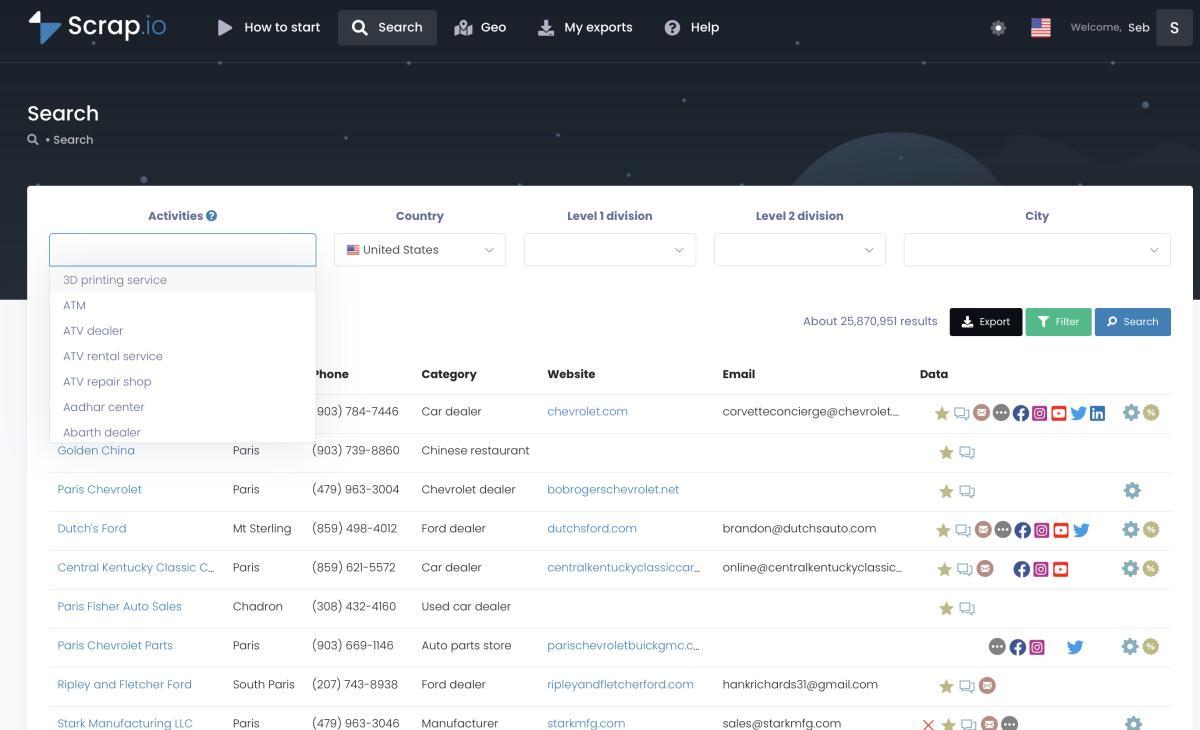
To extract businesses from Google Maps Singapore-wide, the workflow is almost insultingly simple: pick a category (or "all businesses" for a whole-market sweep), pick Singapore, and the platform tells you the count for free. No code. No proxies. No 2 a.m. debugging when Google changes its frontend. If you want the deeper mechanics of finding emails on Google Maps, there's a full breakdown — but honestly, for most people the two-click version is the whole story. And if you'd rather drive it from an AI assistant, the Scrap.io MCP lets you run the same search in plain English.
Video: How to Extract Every Business in 1 Click (No Category)
How to build a Singapore company database step by step
OK, concretely — what do you actually do? Here's how to find a list of companies in Singapore and turn it into a working file, start to finish. Five steps.
- Pick your category and zone. Choose a business type from 4,000+ categories — this is how you build a Singapore business directory by industry — or select "all businesses" to map an entire market. Because Singapore is a city-state, one search set to country = Singapore covers the whole thing — all 395,394 records, no stitching together of separate city runs.
- Filter before you extract. Only want businesses with an email? Toggle it. Only mobile numbers for an SMS campaign? Toggle that. Minimum rating, review count, "no website" — all applied up front (more on why this saves money in the next section).
- Run the count — it's free. The platform shows exactly how many businesses match, across the whole country if you like, at zero credits. Size the market before you spend anything.
- Export to CSV or Excel. One click. You get name, address, phone (with type), up to five classified emails, socials, website tech — the full record, ready to load anywhere.
- Drop it into your sequencer or CRM. Fresh list, in your tool, the same afternoon.
Want more precision than "all of Singapore"? That's where GeoSearch earns its keep. Draw a radius around Raffles Place, or a hand-drawn polygon over the Tanjong Pagar and Marina Bay CBD — or industrial zones like Jurong and Woodlands — and pull only what sits inside. Every filter still applies within the shape.
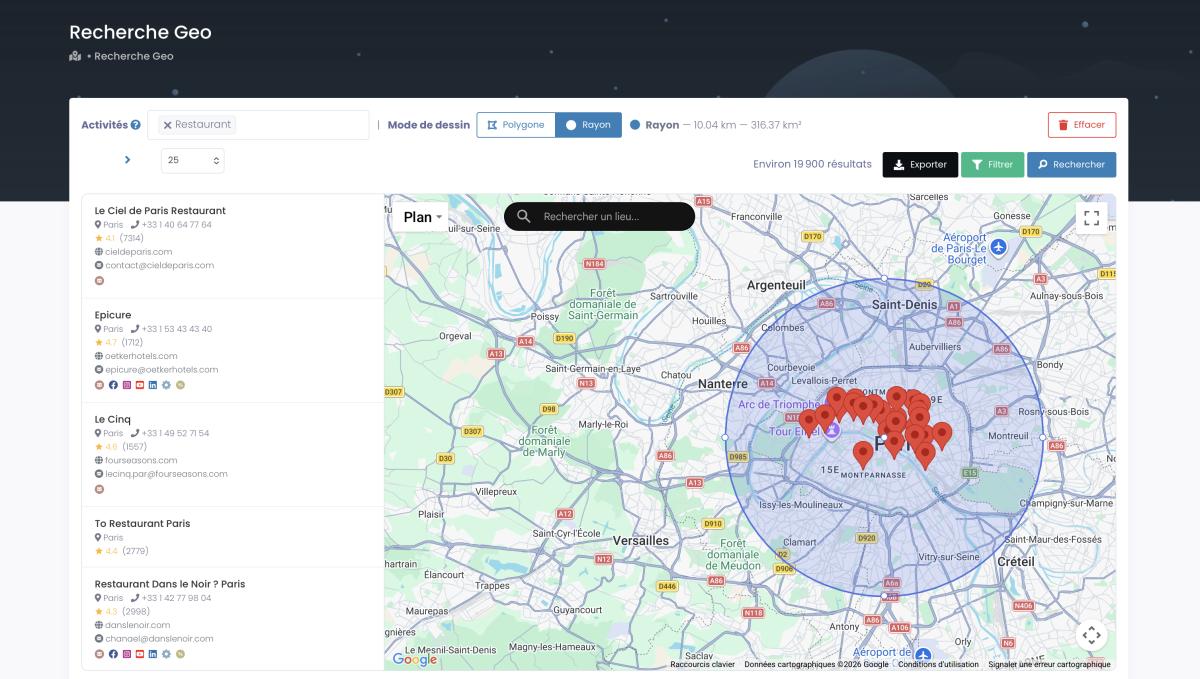
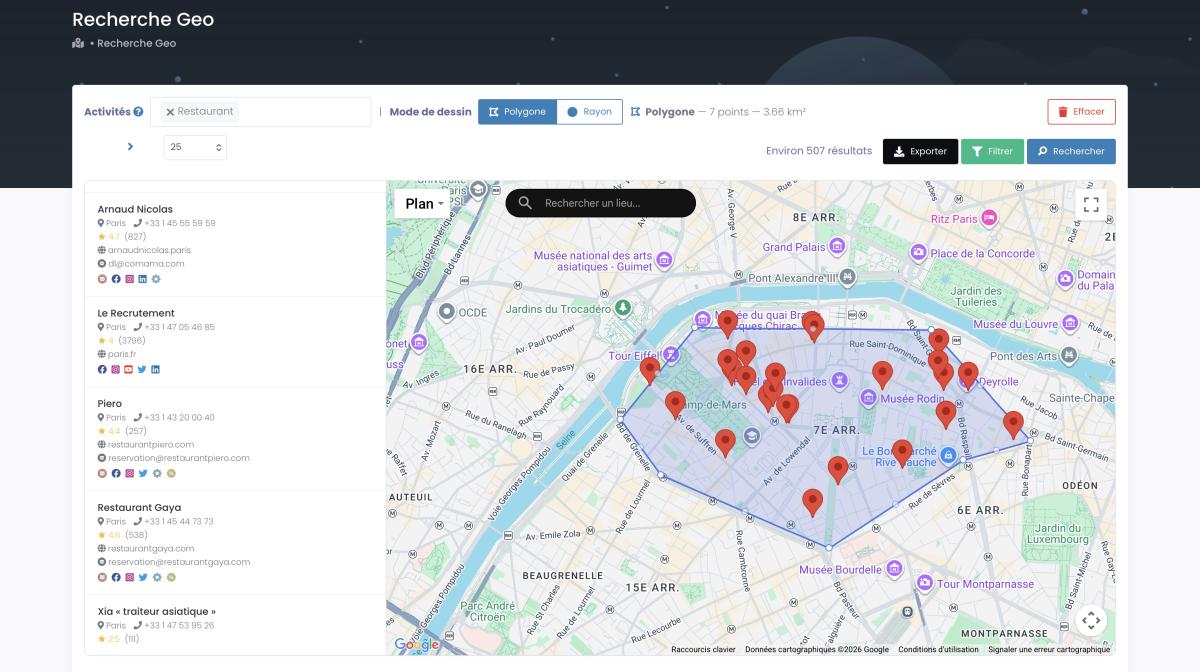
This is genuinely how a modern singapore company database gets built — not downloaded, not bought, but assembled to spec. The same flow underpins building a cold email list anywhere in the world.
Video: How to Scrape Local Leads at the Country Level
Extract your first Singapore list free. 100 export credits, a 7-day trial, and the whole country in two clicks — filter to email-present contacts before you spend a single credit. Build your Singapore directory now.
Filtering before you spend
This is the part that quietly saves the most money, so let me be blunt about it. Buying a frozen list means paying for every row, including the dead ones. Filtering before extraction flips that entirely — you only ever pay for contacts you can actually use.
Go back to the Singapore numbers. Of the 395,394 establishments, only 113,580 carry an email. If you're running a cold email campaign and you extract all 395,394, you just paid for 281,814 records you literally cannot email. That's not a rounding error. That's most of your budget, gone.
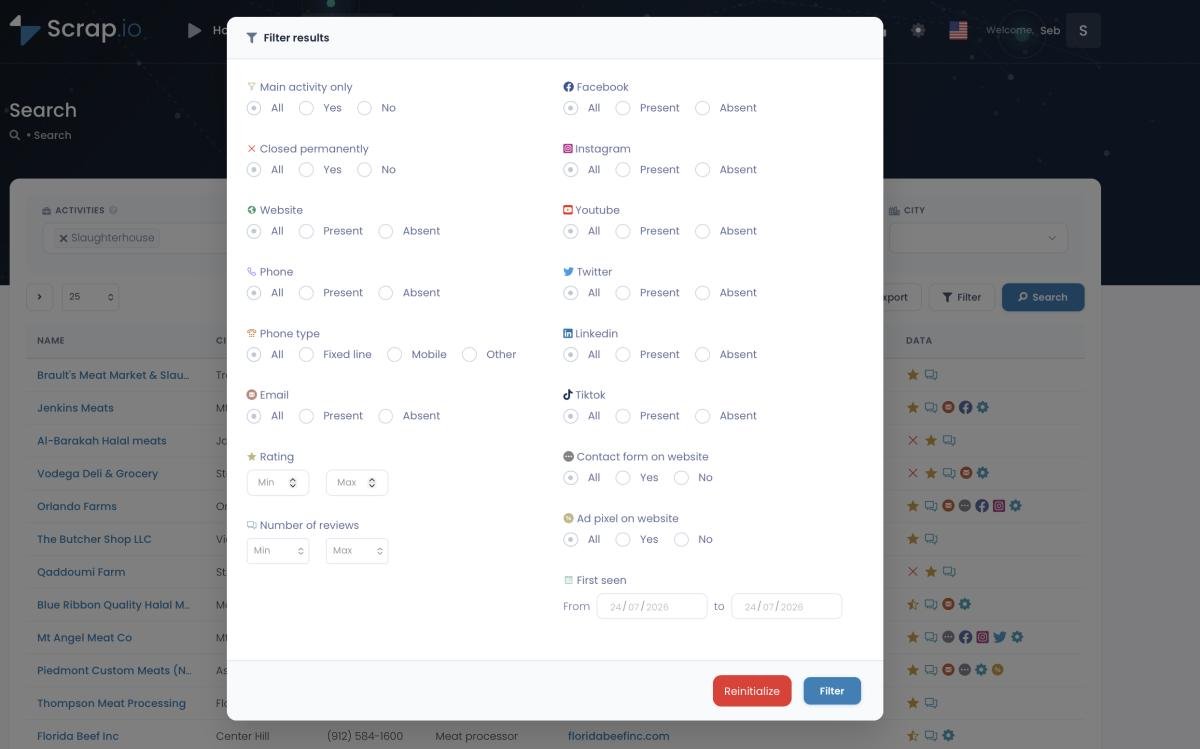
With Scrap.io the filter runs before a credit is consumed. Toggle "email present" and your 395,394 collapses to a clean 113,580 — a proper singapore business directory with email address, ready to contact. Want a singapore b2b contact database of only mobile numbers for SMS? Filter for that. Only businesses without a website, because you sell web design? That's a target list of prospects who literally need what you're selling. This is the same discipline behind extracting emails from Google Maps at scale — narrow first, pay second.
Zero wasted credits. That's the whole design.
Real examples: who uses Singapore business data
Theory's fine. Who actually does this? A few real patterns.
Take a web agency chasing the "no website" angle. Of Singapore's 395,394 establishments, 226,131 have no website at all (that's the flip side of the ~43% that do). Filter for businesses with a Google Maps listing, a decent rating, and no site — and you've got a list of established local companies that visibly need what a web studio sells. One of our users ran exactly this play, pulled a few thousand no-website businesses filtered by the industrial zones, and reached out with a "your competitors are online, you're not" angle. That's not prospecting. That's shooting fish in a barrel.
The pattern generalises. Marketing agencies filter for businesses missing a Facebook or Instagram profile. SMS outreach teams pull only mobile numbers. A "sme business directory singapore" segment — small operators, sub-S$1M turnover, the 77% SingStat flagged — is a goldmine for anyone selling accounting, POS, or bookkeeping tools, and you can carve out a list of SME companies in Singapore by category and review count in seconds.
Why does this beat a bought list every time? Freshness plus intent. As the team at ScrapeBadger put it in a 2026 piece on buying signals, "Reddit posts represent something cold email lists cannot: a person publicly stating they have a problem they are actively trying to solve" (ScrapeBadger, 2026). Live business data works the same way — a listing that was updated last week signals a business that's active, reachable, and paying attention.
And the economics aren't close. Tendem.ai noted in 2026 that "automated extraction produces thousands of contacts at $0.01–0.10 per record — an order of magnitude cheaper than purchased lists." An order of magnitude. On a 10,000-contact campaign, that's the difference between a few hundred dollars and a few thousand — for data that's fresher, not staler. You do the math on that one.
Staying compliant: PDPA, GDPR & public business data
Right, the question everyone eventually asks: is any of this legal in Singapore? Short answer — yes, for publicly available business data, done properly.
Singapore's Personal Data Protection Act (PDPA) governs personal data. But business contact information that a company publishes to be found — a listed office phone, a generic info@ or sales@ address, a business address — sits in a different category from someone's private details. When a business puts that information on Google Maps or its own website, it's making it public precisely so customers can reach it. Using it for B2B prospecting is legitimate. If your outreach also touches EU recipients, GDPR's "legitimate interest" basis typically covers B2B contact from public sources, provided every message carries a clear opt-out.
The guardrails are common sense. Stick to public business data, not scraped personal profiles. Keep the source traceable — every record should point back to where it came from. Include an unsubscribe in every email, and honour opt-outs immediately. Scrap.io only extracts publicly available business information and is GDPR- and CCPA-compliant, with every data point traceable to its source. For the full legal picture — court rulings, the ToS-versus-law distinction, the lot — see our deep dive on whether it's legal to scrape Google Maps.
FAQ
How many companies are there in Singapore in 2026?
ACRA lists 614,000+ active entities, including 456,000+ companies (2025). On Google Maps, Scrap.io indexes 395,394 establishments in Singapore that can be extracted in real time — a more complete picture of the businesses you can actually reach, since it includes the small operators that never show up in a formal database.
Where can I get a list of companies in Singapore with contact details?
ACRA BizFile gives you legal names and registration status but no emails or mobiles. For contact-ready data — name, address, phone, website, email, all filtered before export — extract from Google Maps with Scrap.io. That's the fastest route to a list of companies in Singapore with contact details rather than just names. If you've wondered how to get contact details of Singapore companies in bulk, that's it.
Is there a free Singapore business directory?
Yes — RecordOwl, Yellow Pages SG, and SGPBusiness are free to browse, but contact data is limited and there's no filtering or bulk export. If you want a filtered, email-present file, Scrap.io's free 7-day trial exports up to 100 records, 100 leads included, so you can test the data quality before committing.
Is it legal to extract Singapore business data?
Yes, when you're using publicly available business data only. It's PDPA-friendly in Singapore and GDPR-compliant for EU outreach, with a traceable source, and it's legal for B2B prospecting. Include a clear opt-out in every message and honour unsubscribe requests.
What's the best Singapore business directory for lead generation?
For lead gen, a real-time, filtered extraction beats a browse-only directory every time. The best singapore business directory 2026 approach is to build your own: filter by email, mobile, rating, or "no website," export, and reach out — instead of paging through a frozen list. You can even hit it via the singapore business directory api or the MCP if you want to automate the whole thing.
Stop renting a stale list. Build your live Singapore directory today — 395,394 establishments, 113,580 with an email, filtered before you spend a credit and fresh the moment you export. Free for 7 days, 100 leads included. Build your Singapore business directory now.
Generate a list of restaurant with Scrap.io