

- Why 90% of Startups Fail, And How Market Research Fixes That
- What Is Startup Market Research? (And Why It's Different in 2026)
- The 5-Step Framework to Validate Your Startup Idea with Data
- How to Use Google Maps Data for Startup Market Research
- 3 Real-World Examples of Startup Market Research Done Right
- Startup Market Research vs. Traditional Market Research
- Common Market Research Mistakes That Kill Startups
- Is It Legal? Compliance in 30 Seconds
- FAQ
Why 90% of Startups Fail, And How Market Research Fixes That
Here's a number that should make you uncomfortable: 90% of startups fail. Not "struggle." Not "pivot." Fail. Gone.
And the reason usually isn't running out of cash. Cash is where the story ends, not why it started going wrong. CB Insights just rebuilt its famous post-mortem analysis for 2026, digging through 431 VC-backed companies that shut down since 2023. "Ran out of capital" tops the chart at 70%, sure. But the more honest root cause, the one that dried up the capital in the first place, was poor product-market fit, cited in 43% of cases (CB Insights, March 2026). Translation: they built something nobody wanted.
Let that sink in for a second.
Thousands of founders every year pour their savings, their weekends, their relationships into products that exactly zero people asked for. They had a "feeling" about the market. They asked their friends. Their mom said it was a great idea. (Your mom always says it's a great idea.)
And look, gut instinct isn't worthless. But gut instinct without data? That's just gambling with extra steps. The founders who survive aren't necessarily smarter. They just did their startup market research before writing a single line of code.
Here's the good news. In 2026, you don't need a $50,000 consulting engagement to understand your market. You don't need a 12-week research cycle. You need a laptop, a few hours, and access to data that's already sitting there: publicly available, real-time, and absurdly underused. I'm talking about the 225 million+ businesses indexed on Google Maps across 195 countries, generating signals from 2 billion monthly active users (Google, 2026).
But most founders have no clue how to use any of it. So let's fix that.
What Is Startup Market Research? (And Why It's Different in 2026)
What if you could count every single competitor in your market, before writing a single line of code?
Market research for startups isn't the same thing as corporate market research. Not even close. A Fortune 500 company has dedicated teams, six-figure budgets, and months of runway for surveys and focus groups. You have a laptop and a weekend. Different game, different rules.
At its core, startup market research is the process of validating whether real demand exists for your product or service, before you invest serious time and money. It combines primary research (talking to actual humans) with secondary research (analyzing existing data), as Harvard Business School Online explains well. The goal isn't a 200-page report. The goal is a clear yes-or-no: should I build this thing?
What's changed in 2026 is access. The raw material for business startup market research used to be locked behind expensive databases and quarterly industry reports. Now? Google Maps alone contains 225 million+ business listings across 195 countries and 4,000+ categories, with real-time data on ratings, reviews, contact info, and geographic density. That's not a sample. That's the whole population.
And platforms like location intelligence tools make it trivially easy to query that data: count competitors, analyze saturation, identify gaps, without writing a single API call. The playing field hasn't just leveled. It's flipped.
Bref, how to do market research for a startup in 2026 looks nothing like it did five years ago. Let me show you the framework.
The 5-Step Framework to Validate Your Startup Idea with Data
Meet Alex. She had a great idea for a dog grooming marketplace, an app connecting pet owners with mobile groomers. Before building anything, she spent 2 hours on Google Maps. What she found changed everything.
Here's the exact framework she used. It works for startup idea validation regardless of industry.
Step 1: Define Your Hypothesis and Target Market
Every good startup market analysis starts with a falsifiable hypothesis. Not "I think people want this." Something specific: "There is enough demand for mobile dog grooming in Austin, TX to support a marketplace with 20+ providers."
Define your persona. Choose your geography. Be ruthlessly specific about who you're serving and where. Vague hypotheses produce vague results. If you want to define your Ideal Customer Profile with geographic data, start here.
Step 2: Size Your Market with Real Business Data
This is where most founders go wrong. They Google "pet grooming market size" and cite some top-down TAM number from a Statista report. Cool. Useless.
Instead, use actual data. How many businesses are in your market, right now, in your target area? With tools like Scrap.io, you can count every pet groomer in the United States in about 10 seconds. Alex found 59,360 pet groomers, a real, verifiable number (Scrap.io, 2026). That's how to size a market for a startup with data instead of guesswork.
The best part? Counts are free. You can extract all businesses from a city or country and know exactly what you're working with before spending a dollar.
Video: How to Scrape Google Maps at the Country Level
Step 3: Analyze the Competitive Landscape
Counting competitors is step one. Understanding them is step two. This is where market research and competitive analysis for startup companies gets interesting.
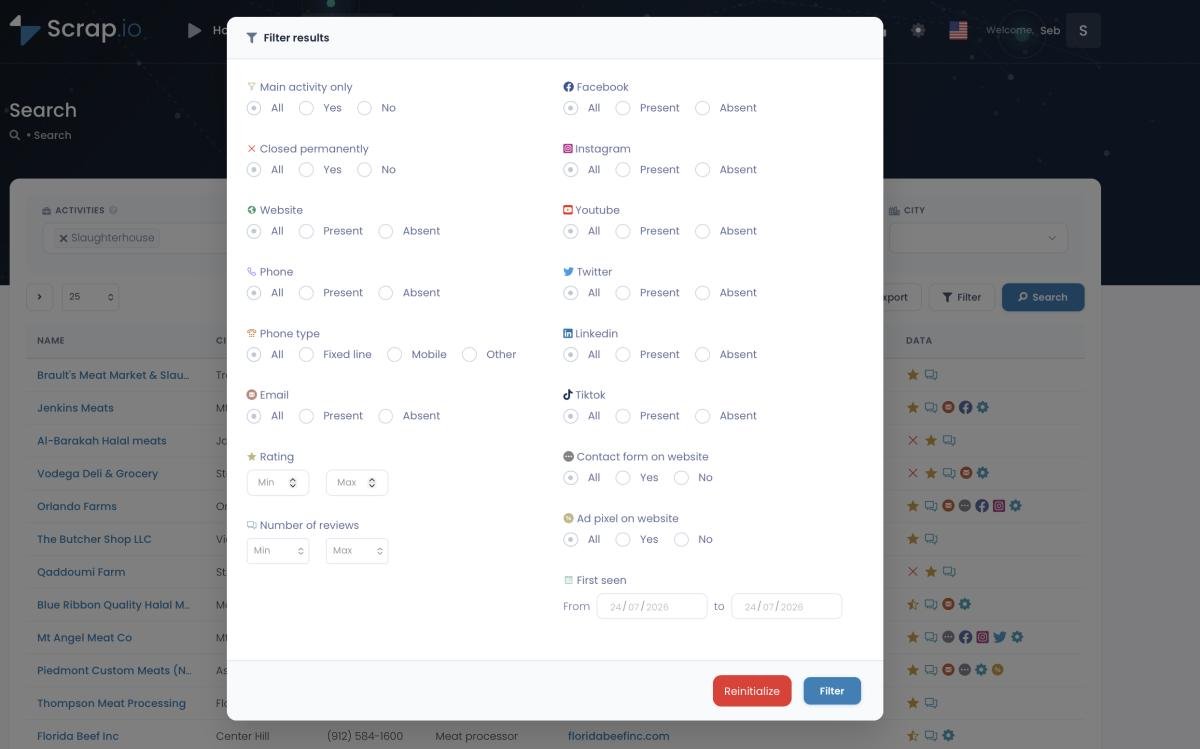
Filter your results. What's the average rating? How many have a website? How many have an email listed? Alex discovered that 38% of dog groomers in Austin had no website at all. Zero online presence beyond their Google Maps listing. That's not just a data point. That's an opportunity screaming at you.
A startup competitive analysis using Google Maps reveals the gaps that spreadsheets can't. Are competitors clustered in one area? Do they have terrible reviews? Are they missing basic digital infrastructure? Each gap is a potential wedge for your product. The pizzeria video below shows exactly this kind of "spy on the block" analysis in action.
Video: How Pizzerias "Spy" on Competitors Using Google Maps
Step 4: Spot Market Gaps and Underserved Areas
Now zoom out geographically. GeoSearch tools let you draw a radius or polygon on a map and see exactly what's inside. Compare business density between neighborhoods, cities, or entire regions.
Alex found that North Austin had 3x more groomers per capita than South Austin. South Austin? Underserved. Massive demand signal. You can do the same kind of analysis using market segmentation with Google Maps criteria, it's the same data, just sliced differently.
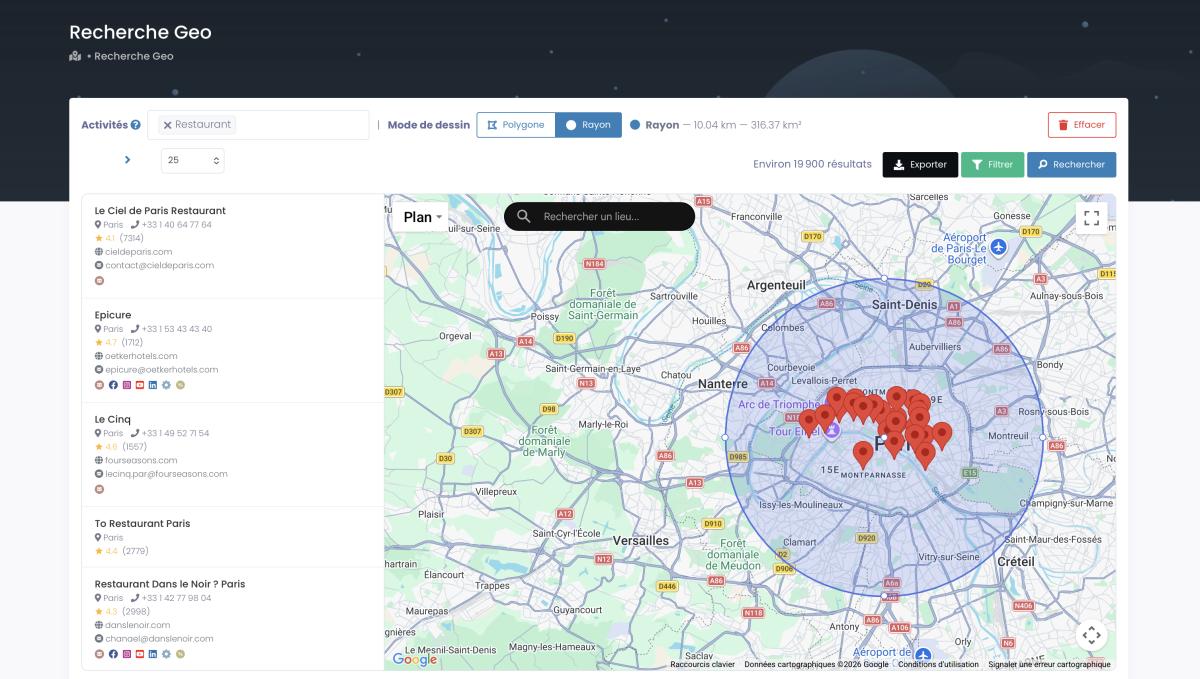
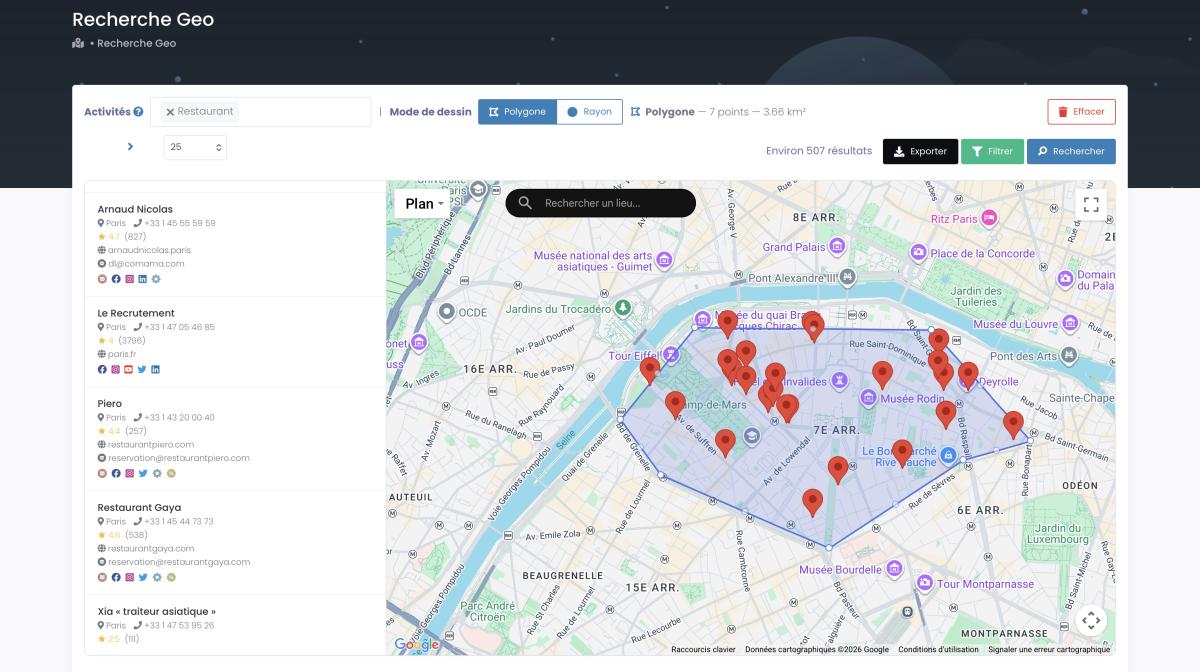
Need a shape that isn't a circle? Draw a custom polygon around one neighborhood and pull every business inside it. The suburbs don't have to come along for the ride.
Step 5: Validate Demand with Customer Signals
Data gets you 80% of the way. The last 20% is qualitative. Cross-reference your Google Maps findings with signals from Reddit, Quora, and review sites. Are customers complaining about the current options?
As one Reddit r/startups user put it: "Go out and ask potential customers about their pains/needs/wants. Keep asking and keep learning until you're getting the same responses over and over."
And here's a validation shortcut that works: if people complained about the same problem in 2020, 2022, and 2024, you've found a fundamental market need (Reddinbox). That's a signal no pivot will erase.
How to Use Google Maps Data for Startup Market Research
Google Maps is sitting on the largest real-time business database on the planet. And most startup founders have no idea how to use it.
Think about what's embedded in each listing: name, category, full address, phone number, email (often), website, review count, average rating, business hours, photos, even social media links. That's not a directory. That's a startup demand analysis with real data waiting to happen.
Why is this superior to traditional market reports? Three reasons. First, it's real-time, not a quarterly snapshot that's already stale by the time you read it. Second, it's granular: street-level precision, not country-level estimates. Third, it's massive: 225M+ establishments across 195 countries with 4,000+ business categories.
Video: Scrap.io - How to Start?
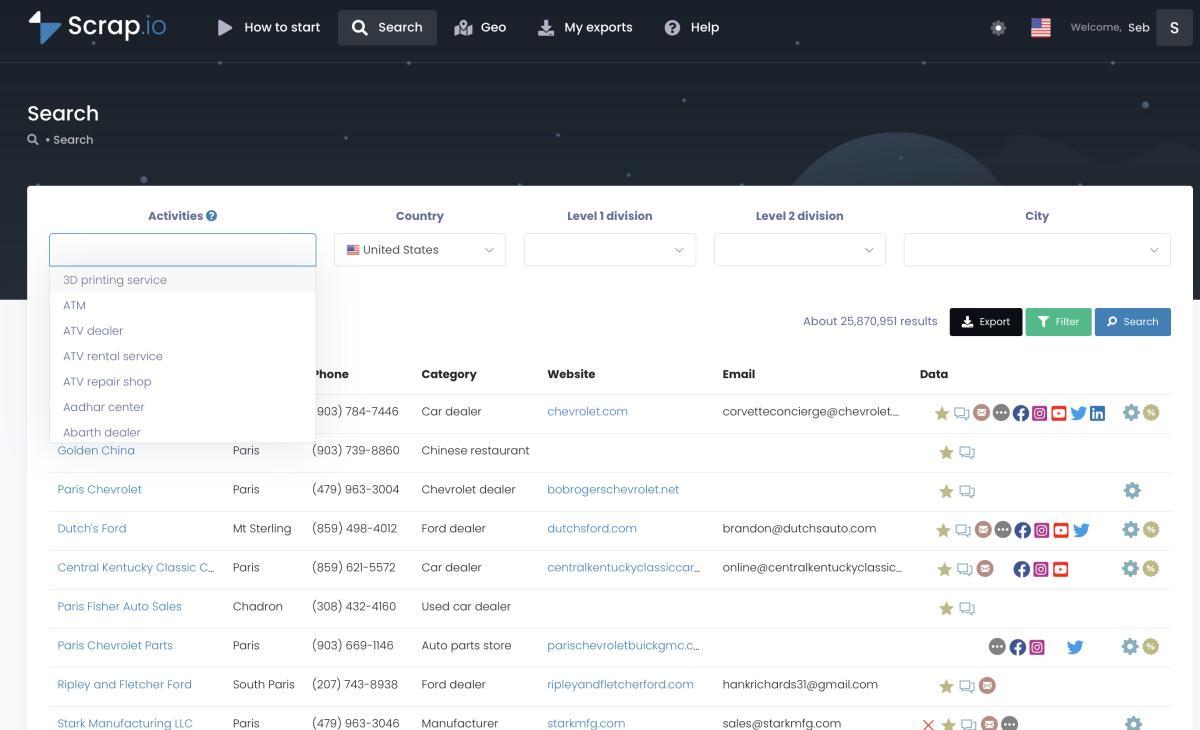
Here's the practical workflow for doing market research for a startup with Google Maps data:
Search → Pick a category and location. Want every yoga studio in California? Every dentist in London? Two dropdowns.
Filter → Narrow down before committing. Only businesses with an email? With a website? With 4+ stars? Filters apply before you use any credits. Zero waste.
Count → See the exact number of matches. Free, always.
Export → CSV or Excel. Full contact info, social links, tech stack, ad pixels. Everything.
Use cases for founders: market sizing (how many competitors exist?), competitive density (where are they clustered?), geographic gap analysis (where aren't they?), customer acquisition cost estimation (how reachable are potential customers?). And 88% of consumers use Google Maps to find local businesses (BrightLocal, 2025), meaning the businesses listed there are the ones customers actually see.
3 Real-World Examples of Startup Market Research Done Right
The best startup ideas aren't born in a garage. They're born in a spreadsheet.
(OK fine, sometimes a garage. But the spreadsheet helps.)
Here are real examples of founders and companies using local business data for market validation, not hypotheticals.
📌 Example 1: Greg Isenberg, AI Agent Validates "Boring Businesses" on Google Maps
Greg Isenberg's viral LinkedIn post made waves in late 2025. He used an AI agent to scrape Google Maps and identify profitable "boring businesses" in local areas, the kind of ventures nobody talks about at startup events but that print money quietly. As he put it: "I just watched a guy scrape Google Maps with an AI agent and show EXACTLY which boring businesses can make you stupid money in your local area." The post generated 119+ engaged comments, proving the approach resonated (LinkedIn).
📌 Example 2: Metrics Watch, B2B Validation in 7 Steps
SaaS startup Metrics Watch documented a systematic 7-step validation process that includes market sizing with public data. Their framework, widely cited in the B2B startup community, emphasizes counting real businesses and cross-referencing with customer signals before building anything. It's how to conduct market research for a startup the methodical way. (Their own honest admission: their first guess about who'd pay was flat wrong. Which is exactly the point.)
📌 Example 3: heliopas.ai, Academic-Grade Validation for a B2B Startup
German B2B startup heliopas.ai used a 4-step framework published in the TIM Review: measurement system → hypothesis → discovery → validation. Their case was peer-reviewed and demonstrated how systematic business experiments, including market sizing with public data sources, can validate even complex B2B models in agricultural technology.
Startup Market Research vs. Traditional Market Research
You don't have $50,000 for a McKinsey report. Here's how to get better data for free.
(OK, not literally free. But $35/month instead of five figures. Close enough.)
Here's the honest comparison, how to do market research for a startup example versus what the consulting firms charge:
| Criteria | Traditional Research | Startup Market Research (2026) |
|---|---|---|
| Cost | $5K–$50K+ | $0–$99/mo |
| Timeline | 4–12 weeks | 2–4 hours |
| Data freshness | Quarterly reports | Real-time |
| Geographic precision | Country/region | Street-level (GeoSearch) |
| Sample size | 500–2,000 respondents | 225M+ business listings |
| Tools | Surveys, focus groups | Google Maps, Scrap.io, Reddit |
The web scraping market crossed $1.03 billion in 2025 and is projected to hit $2 billion by 2030 at a 14.2% CAGR. The B2B lead generation market is expected to reach $3.33 billion in 2026. These aren't niche tools anymore. This is how market research for startup companies gets done now.
And honestly? The "traditional" approach isn't just expensive, it's slow. By the time your McKinsey report lands, the market has already moved. A startup market research template built on real-time data from Google Maps gives you answers while the consultants are still scoping the engagement.
Common Market Research Mistakes That Kill Startups
Are you confusing "people love the idea" with "people will pay for it"?
Because those are two very different things. And mixing them up is the biggest mistake founders make during market research for startups. Here are the others:
Confirmation bias. You Google things that support your thesis and ignore everything else. Try actively looking for reasons your idea will fail. If you can't find any, you're not looking hard enough.
Ignoring the local competition. National market reports don't tell you what's happening on the ground. A city with 300 yoga studios is a very different market than a city with 30. Use free market research tools for startups, like Google Maps, to count what actually exists where you plan to operate.
Confusing interest with demand. "That sounds cool!" is not a purchase order. Ten people saying they'd use your product is not validation. Ten people paying for a waitlist spot? That's validation.
Not verifying market size. "The wellness industry is worth $4 trillion." Great. Your slice of it might be worth $4,000. Validate startup idea with data: real counts of real businesses in your actual target geography. Not aspirational TAM numbers from pitch deck templates.
Premature scaling. You got 50 users in Brooklyn and decided to expand to 10 cities. Without researching whether those cities have the same demand signals. Data eliminates the guessing. Use it.
Is It Legal? Compliance in 30 Seconds
Quick, because someone always asks. The business data on Google Maps is public, B2B information that companies voluntarily publish: name, address, phone, website, category. Using it for market research and prospecting is a normal, legal practice. Scrap.io only touches publicly available business data, is GDPR (EU) and CCPA (California) compliant, and keeps every field traceable back to its source. You're sizing a market, not surveilling individuals. Big difference, and it keeps you on the right side of the line.
FAQ
How do I do market research for a startup with no budget?
Start with what's free: Google Maps for counting competitors and analyzing reviews, Reddit and Quora for customer pain points, Google Trends for demand signals, and government databases (SBA, Census) for demographics. Scrap.io's free trial lets you count businesses in any category and location at no cost, 100 leads included.
What is the best way to validate a startup idea before launch?
Combine quantitative data (market size, competitor count, geographic density) with qualitative signals (customer interviews, Reddit threads, review analysis). Use Google Maps data to size your market objectively, if there are fewer than 100 businesses in your category nationally, the market may be too niche. Or too blue-ocean. Either way, you need to know.
How do you use Google Maps for startup market research?
Google Maps indexes 225M+ businesses worldwide across 195 countries, with data on category, location, reviews, ratings, website, phone, and email. Tools like Scrap.io let you extract and filter this data at scale: count all restaurants in Chicago, find all plumbers without a website in Texas, or analyze average ratings across an entire country. B2B lead generation platforms like Google Maps vs LinkedIn each have their strengths, Maps wins for local market intelligence.
What is TAM SAM SOM for startups?
TAM (Total Addressable Market) is the total revenue opportunity. SAM (Serviceable Addressable Market) is the segment you can actually target. SOM (Serviceable Obtainable Market) is what you can realistically capture year one. Google Maps data helps calculate each layer with real business counts, not top-down guesses from analyst reports.
How long should startup market research take?
With modern tools, meaningful startup market research can be done in 2–4 hours rather than weeks. The key is combining automated data extraction (business counts, competitive density) with targeted qualitative research (10–15 customer interviews, Reddit analysis). Don't let perfect be the enemy of done.
Start Validating, or Stay Guessing
Look, global VC funding hit $425 billion in 2025, a 30% year-over-year surge. Money is flowing into startups. But the bar for what gets funded, and what survives, keeps going up. The founders who win aren't the ones with the flashiest decks. They're the ones who can show investors a spreadsheet full of actual market data and say: "Here's exactly how many businesses we're competing with, where the gaps are, and why our unit economics work."
That's what startup market research does. Not theory. Not vibes. Data.
And if you're still Googling "how to do market research for a startup" instead of actually doing it, well, your competitors aren't waiting.
Generate a list of restaurant with Scrap.io