

By The Scrap.io Team | Last updated: July 2026
Fifteen thousand wineries. Give or take. That's how many the United States has sitting on Google Maps right now — 15,052 the last time I pulled the number, and it'll have moved by the time you read this. Here's the part nobody puts on the sales page: 9,697 of them publish an email address. In public. Free to look at.
So why is the going rate for a "wine industry email list" still $2,400 a year for a file that's stale the day it lands in your inbox?
Good question. I've pulled business data off maps for a living for years, so I'll say the quiet part out loud: most winery databases you can buy are worse than the one you could build yourself this afternoon. Not a little worse. A lot. This guide shows you how to build your own winery database — a real us wineries list with names, emails, and phone numbers — and why that beats renting someone else's frozen spreadsheet.
Video: Scrap.io - How to Start?
- What Is a Winery Database (and Why Yours Beats the Rest)
- How Many Wineries Are in the US? (The 2026 Market)
- Where Winery Databases Come From (5 Sources Compared)
- Build Your Own From Google Maps (Step-by-Step)
- Filter Before You Pay
- Winery Email List (Owners & Winemakers)
- Go National or Hyper-Local (Napa, Sonoma, by State)
- Is Scraping Winery Data Legal? (GDPR/CCPA/CAN-SPAM)
- FAQ
What Is a Winery Database (and Why Yours Beats the Rest)
Type "winery database" into Google and it hands you two completely different things wearing the same name. Only one of them helps you make a sale.
The first kind is a wine catalog — Vivino, Wine Spectator, CellarTracker. Millions of bottles, tasting notes, ratings, vintages. Beautiful stuff if you're a drinker. Useless if you're trying to sell something to the winery itself. There's not a single business email in the whole thing.
The second kind is a winery contact database: a structured list of wineries with the details you actually need to reach them — business name, address, phone, website, and ideally an email that a human reads. That's the one that matters for B2B. A winery contact list is a prospecting asset. A wine catalog is a shopping app. People confuse the two constantly, and then wonder why their "database" produced zero replies.
A list of wineries isn't a mailing list (until you add contacts)
Here's the distinction that trips people up. A plain list of wineries — names on a page — is worth almost nothing. A winery mailing list with verified, current contact info is worth real money. The gap between those two is 90% of the work, and it's exactly where cheap databases cut corners.
So what makes your version better than a bought one? Three things, and I'll defend each: it's fresh (pulled the moment you build it, not compiled in 2024), it's filtered (you keep only the wineries with an email, or a website, or whatever you need), and it's yours alone (nobody else got sold the identical file). Bought lists fail all three. Built lists pass all three. That's the whole argument, and the rest of this guide is just proof.
How Many Wineries Are in the US? (The 2026 Market)
7,000. Or 11,000. Or 15,000. Every source gives a different answer — and honestly, the gap is the story.
Start with the official count. The WineBusiness Analytics Winery Database counted 11,107 US wineries at the start of 2026, down from 11,450 in 2025 — a 3% drop, the third year of decline in a row. Roughly one winery closed its doors every single day of 2025. That's not a rounding error. That's a market in a genuine down cycle, which the 2026 SVB State of the US Wine Industry Report confirms in painful detail (tasting rooms and wine clubs now carry 53% of the average winery's sales — direct-to-consumer is the lifeline).
Then there's the tax number. The federal bonded winery list maintained by the TTB (Alcohol and Tobacco Tax and Trade Bureau) sits around 7,000 permit-holders — every business legally licensed to produce wine.
And then there's Google Maps: 15,052 wineries as of July 2026 (our own count, and it's live — I re-ran it while writing this). Why so much higher than the TTB number? Because Maps captures tasting rooms, second labels, satellite locations, urban wineries, and the guy who bonds under one name but trades under three. The bonded list counts licenses. Google Maps counts storefronts you can actually walk into and sell to. For prospecting, the storefront number wins.
The broader market backdrop: the US winery industry is worth roughly $27.6 billion in 2026 (IBISWorld), producing well over 800 million gallons a year (Statista). Shrinking headcount, big dollars, and thousands of small operators who read their own email. If you sell to wineries, a contracting market is actually good news — the survivors are fighting harder for every edge, and they answer the phone.
Where Winery Databases Come From (5 Sources Compared)
Before you buy anything, one question: when was this data last checked? Ask it out loud to every vendor, because it's the one they hate answering. Here's the honest lay of the land.
| Source | What you actually get | Freshness | Price | Best for |
|---|---|---|---|---|
| WIN Data (WineBusiness) | Insider industry directory | Updated periodically | ~$2,400/yr | Wine-industry insiders |
| WineBusiness Analytics | Winery database + market analytics | Periodic | Enterprise / quote only | Analysts |
| Wine Prospects | ~4,000 wineries + emails | Refreshed periodically | <$300/mo | B2B sellers on a budget |
| Consumer catalogs (Vivino, Wine Spectator, CellarTracker) | Reviews & ratings, zero B2B contacts | Live, but consumer-facing | Free–subscription | Drinkers, not sellers |
| Build your own (Scrap.io, Google Maps) | Names, emails, phones — filtered | Real-time at export | Pay-per-use, from $49/mo | Anyone selling TO wineries |
Quick read on that table. WIN Data is genuinely good — if you're an industry insider who needs the analyst-grade directory and has $2,400 a year to spend. For someone who just wants to email 2,000 California wineries a real pitch, it's massive overkill and the file is frozen the moment you get it. Wine Prospects is cheaper and closer to the mark, but you're still renting someone else's snapshot. And the big consumer catalogs? Vivino has 60M+ users' worth of ratings, CellarTracker tracks 13M+ wines — and neither gives you a single business email. Wrong tool, wrong job.
The gap none of them fill: a self-service, real-time, pay-per-use way to build a winery contact list for whatever slice you want, whenever you want. That's the whole reason this article exists.
Curious how many wineries match your target before you spend a dime? Counting results on Scrap.io is free — zero credits, in the app or via the API. Pick "winery," pick a state, and see the number instantly. 225M+ businesses indexed across 195 countries, all counted for free before you export a single row.
Build Your Own From Google Maps (Step-by-Step)
Let's make this concrete. Take Maria. She sells custom wine labels and needs 2,000 California wineries with a real email address — not a contact form, not info@ nobody reads — by Friday. Apollo gave her almost nothing local. LinkedIn gave her winemakers posting barrel photos and zero contact info. So she built the list from the map instead. Here's the exact flow.
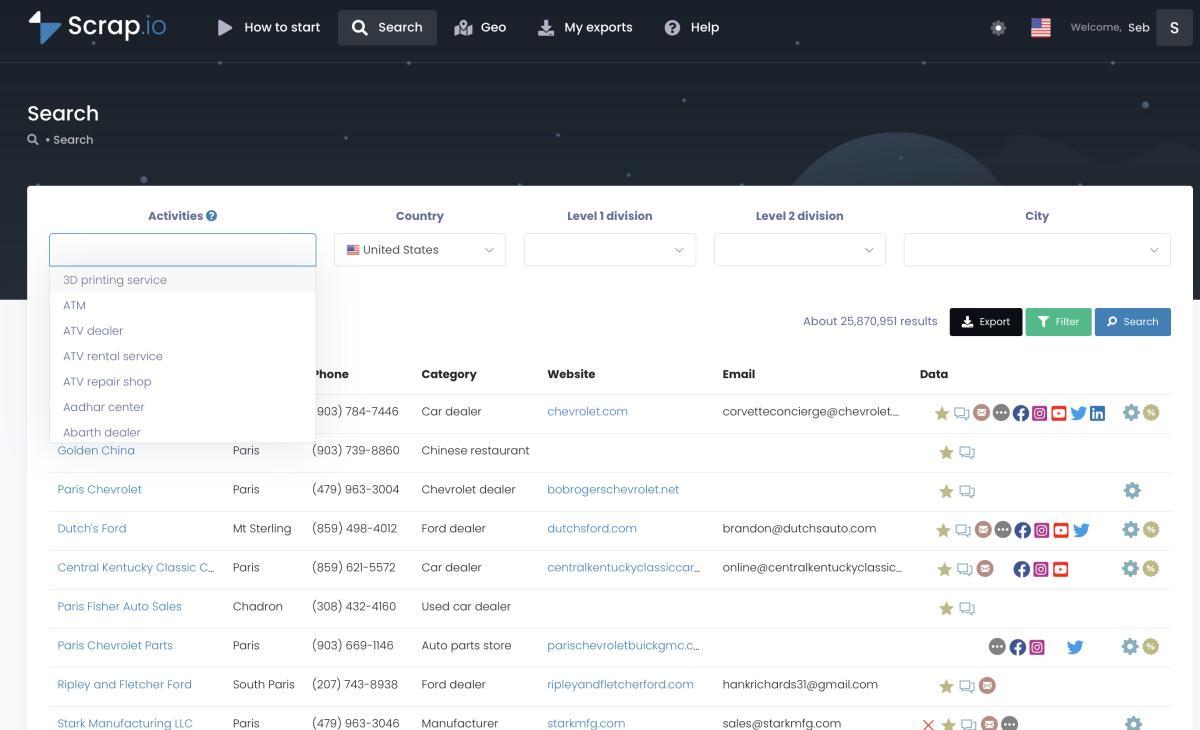
Step 1 — Category plus location. Type "winery." Pick your geography: a single city, a county, a state, or the entire US. Maria picks California. (No app to install, no code, no Python. Just a search box.)
Step 2 — Count for free. Hit the count button. It tells you exactly how many wineries match — across a whole state or the whole country — and it costs nothing. This is how you sanity-check your market before committing a credit.
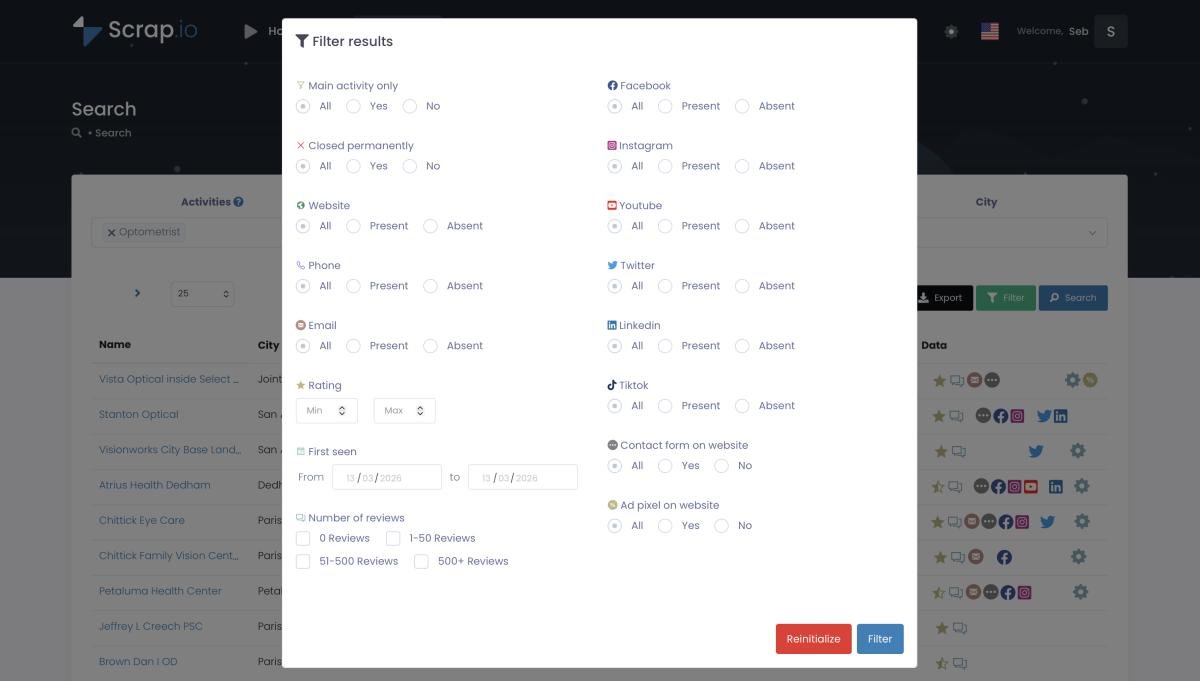
Step 3 — Filter before extracting. Toggle "email present." Now the list only counts wineries with an actual email address on file. Want only the ones with a website? Or a minimum star rating? Or a certain review count? Stack the filters. All of them apply before you pay.
Step 4 — Export. One click. CSV or Excel — so yes, this is your winery database excel file, ready to drop into a sequencer, a CRM, or a spreadsheet. Columns include business name, address, phone, website, up to five classified emails per winery, social profiles, and more. Re-export the same records within 30 days and it's free.
Maria pulled her 2,000 in one sitting. Fresh, filtered, in her outreach tool the same afternoon. That's the difference between building and buying. If you want the full mechanics of the platform, our complete guide to scraping Google Maps walks through every step, and the Google Maps leads playbook covers the outreach side.
Prefer to hand the whole thing to an AI? Scrap.io also runs an official MCP connector for Claude, ChatGPT, and Gemini — you describe the winery list you want in plain English and the agent builds the search, filters, and zones for you.
Video: How to Scrape Local Leads with Claude & Vibe Prospecting
Filter Before You Pay
Here's the thing almost every data vendor gets backwards. They sell you 15,000 rows, and then you delete the 5,000 with no email. You paid for those 5,000. You paid to create your own cleanup job. That's insane, and it's the standard.
Filter first. Look at what "winery" actually looks like once you slice it:
| Filter applied | US wineries remaining |
|---|---|
| All wineries | 15,052 |
| With a website | 11,276 |
| With an email | 9,697 |
| With a phone number | 13,645 |
Source: Scrap.io — real-time, July 2026.
Read that top to bottom. If your campaign is cold email, you care about 9,697 wineries, not 15,052. Paying for the other 5,355 — the ones with no reachable email — is pure waste. Scrap.io applies the email filter before a single credit is spent, so you only ever pay for wineries you can actually contact. Our filtering guide goes deeper on stacking these accurately.
The inverse is a goldmine too. Notice that only 11,276 of 15,052 wineries have a website — which means roughly 3,700 wineries with no website at all. If you're a web agency or a digital-marketing shop, that's your entire prospect list on a plate. Filter for "no website," and you've got a list of established businesses (they have a location, reviews, foot traffic) that visibly need what you sell. Targeting before you export is almost unfair.
Only 9,697 US wineries publish an email — so pay for nothing else. Scrap.io filters to email-present wineries before you spend a credit, and every record is verified at the moment of extraction, not pulled from a file frozen last year. Start your free 7-day trial — 50 searches and 100 export credits included — and build a filtered winery list from any state you want.
Winery Email List (Owners & Winemakers)
9,697 wineries publish an email. But not all emails are equal, and this is where most people fumble a perfectly good list.
This, by the way, is what a real wine industry email list looks like when you build it yourself instead of buying it: segmented by role, current to the day, and scoped to exactly the wineries you chose. A broker's file can't do that.
An email to tastingroom@ is not the same as an email to the owner. So when you're figuring out how to get winery contact information that actually converts, the classification matters as much as the address. Scrap.io doesn't just dump a pile of addresses — it sorts every email it finds into a type: individual (with the person's first and last name pulled from the site), contact (info@, hello@), sales, marketing, finance, and admin. You know who's on the other end before you hit send.
Why does that build a better winery owners email list? Because a message to a named individual gets personalized — reference their region, their rating, the wine club they just launched. A generic info@ gets a value-first pitch that doesn't assume who's reading. Same list, two completely different open rates. Bref, the classification is the difference between "Dear Winery Owner" (deleted) and "Hey, saw your Paso Robles tasting room just hit 300 five-star reviews" (replied to).
This isn't wine-specific wishful thinking, either. Over on r/coldemail, someone documented pulling 10,000+ validated business emails from Google Maps in a single campaign — filtered by review count and rating, no developer involved. The thread blew up because it's exactly this playbook, just in a different vertical. (Full disclosure: I couldn't find a verifiable, winery-specific Reddit or Quora thread to quote here, so I'm citing the closest real one rather than inventing a fake quote. If you've seen a good winery prospecting thread, I'd genuinely like to read it.)
Want the mechanics of turning a raw export into a campaign? Our guides on finding emails on Google Maps and building a cold email list cover verification, warm-up, and segmentation — the boring stuff that keeps your bounce rate under 2% and your domain out of the spam folder.
Go National or Hyper-Local (Napa, Sonoma, by State)
California alone has 4,646 wineries. That's more than the next four states combined.
Here's the 2026 list of wineries by state, top five, straight from the WineBusiness Analytics count via VinePair:
| State | Wineries (2026) |
|---|---|
| California | 4,646 |
| Oregon | 868 |
| Washington | 821 |
| Texas | 521 |
| New York | 450 |
So — national or local? Both, and it's a dropdown either way.
California winery database (and Napa, and Sonoma)
Want the whole state? Search "winery," pick California, export. That's your winery database california, done. Want to go tighter — a napa county winery database, or a sonoma county winery database? Drop to the county level and the platform tags each winery by its administrative zone, so you get Napa without accidentally scooping up half of the Central Valley. Precise, not approximate.
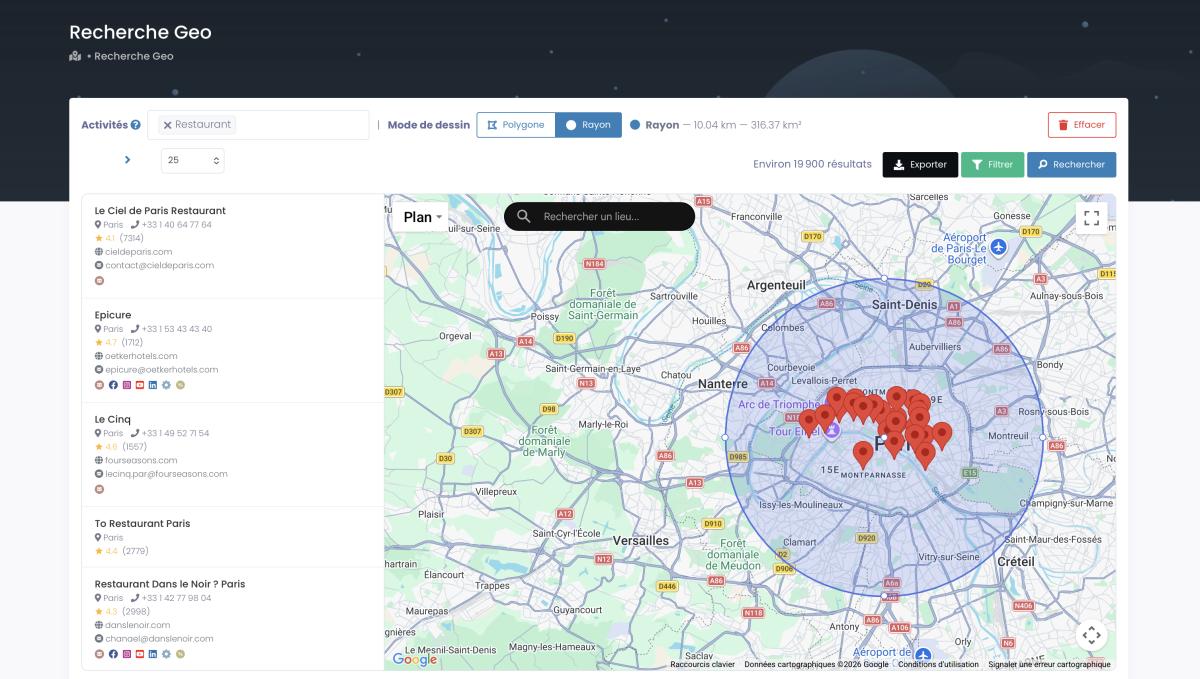
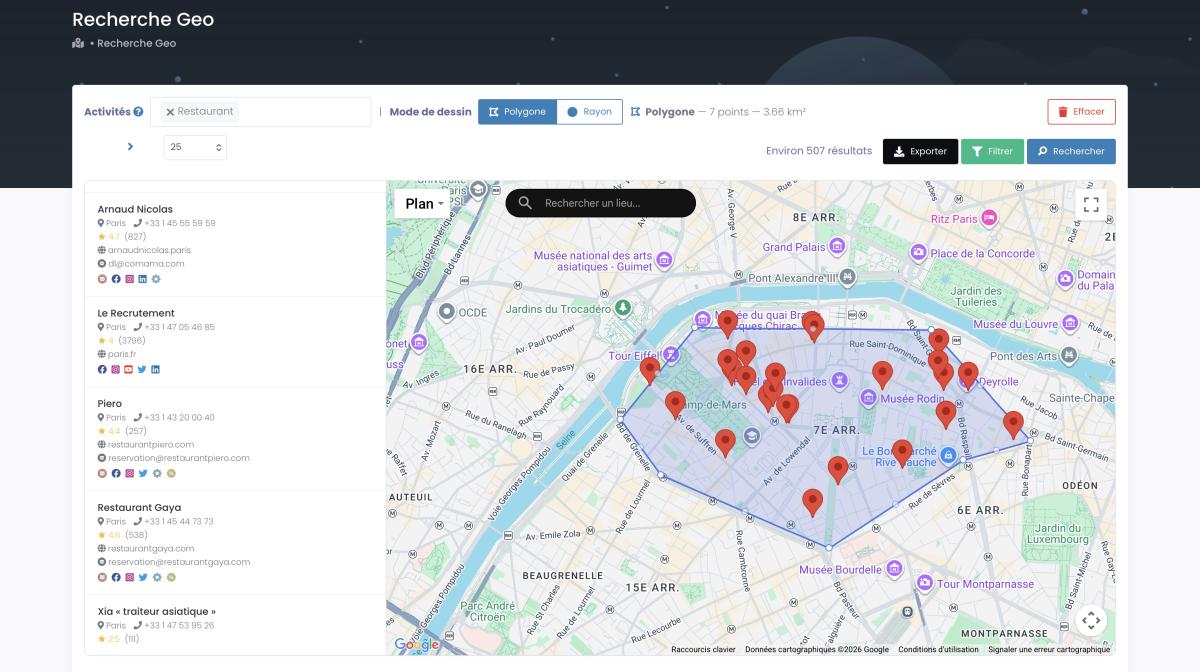
And when your target doesn't fit neat county lines — a specific AVA, a cluster of tasting rooms along one valley road — GeoSearch handles it. Draw a radius around a point (up to 500 km) or sketch a custom polygon on the map by hand. Every filter still applies inside that shape. Try doing that with a bought spreadsheet.
Video: How to Scrape Local Leads at the Country Level
This is also where the "build vs buy" math gets brutal for the vendors. A $2,400/year insider file locks you into one national snapshot. A pay-per-use tool lets you pull Napa this week, all of Oregon next month, and every winery in Texas without a website the week after — each one fresh at the moment you export. For a deeper dive on scaling from one city to a whole country, see our breakdowns on the USA business email database and email lists by industry.
Is Scraping Winery Data Legal? (GDPR/CCPA/CAN-SPAM)
Yes, there are rules. And no, they're not scary — not for public business data used for legitimate B2B outreach.
Start with the foundation. US courts, from hiQ Labs v. LinkedIn onward, have consistently held that scraping publicly available data doesn't violate the Computer Fraud and Abuse Act. A winery's business name, address, phone, and website are public information. Collecting them for prospecting sits on solid legal ground.
On CAN-SPAM (the US rule that actually governs your cold emails): it doesn't ban unsolicited commercial email — it regulates it. Every message needs accurate header info, a real physical address, and a working unsubscribe link, and you honor opt-outs within 10 business days. No opt-in required for B2B. That's the whole checklist.
On GDPR and CCPA: a company's generic business email generally isn't treated as personal data, and B2B prospecting typically leans on the "legitimate interest" basis. California's CCPA carves publicly available business information out of scope entirely. Where it gets stricter is a named individual's private address — so stick to business contacts and you're fine across borders.
Scrap.io only extracts publicly available business data, is GDPR and CCPA compliant, and keeps every data point traceable to its source. That last part matters more than people realize: when you can point to exactly where a record came from, documenting your legitimate-interest basis stops being a headache. One caveat, honestly stated — compliance at the data layer doesn't exempt you from honoring opt-outs at send time. Fresh, traceable data gets you most of the way. The unsubscribe link does the rest.
FAQ
What is a winery database?
A winery database is a structured list of wineries with their business contact details — name, address, phone, website, and email — used for B2B outreach, market research, or CRM enrichment. It's different from a wine catalog (like Vivino or Wine Spectator), which lists bottles and ratings for consumers but contains no business contacts. If you want to sell to wineries, you need the contact database, not the catalog.
How many wineries are in the US?
Around 11,107 registered wineries as of early 2026 (WineBusiness Analytics), down 3% year over year, plus roughly 7,000 federally bonded producers on the TTB list. On Google Maps, 15,052 winery listings appear — the higher number captures tasting rooms, second labels, and satellite locations. California leads with 4,646, followed by Oregon, Washington, Texas, and New York.
Is there a free list of wineries?
Sort of. On Scrap.io, counting wineries is free — pick "winery," pick any state or the whole country, and see the total with zero credits spent. That's as close to a free winery database (and a winery database pdf you can screenshot for planning) as it gets before extraction. To actually export the contact records, the free 7-day trial includes 100 credits, enough to pull a solid starter list.
How do I get winery emails?
Filter for wineries with an email present — 9,697 of the 15,052 on Google Maps publish one — then export. Scrap.io classifies each address (individual, contact, sales, marketing) so you can target the owner instead of a generic inbox. Stay CAN-SPAM and GDPR compliant: include an unsubscribe link and honor opt-outs. That's the entire workflow for building a winery owners email list.
WIN Data or Scrap.io — which should I use?
Depends who you are. WIN Data is built for wine-industry insiders who need analyst-grade directories and can spend ~$2,400 a year on a national file. Scrap.io is built for anyone selling to wineries who wants a fresh, filtered, pay-per-use list — one city or the whole country, updated in real time at export, with no annual lock-in. Different jobs. If your goal is prospecting on a budget, the self-serve tool wins.
Stop renting a frozen winery spreadsheet. Build a fresh one today. Start your free 7-day Scrap.io trial — 50 searches and 100 export credits included — and pull a filtered US winery database from any state: 15,052 wineries indexed, 9,697 with a verified email, filtered before you pay a single credit. Build your winery list now →
Generate a list of winery with Scrap.io