

What's in this guide
- What is an AI sales agent?
- AI sales agent vs AI SDR: the real difference in 2026
- What they each automate, step by step
- The best AI sales agents and AI SDRs in 2026
- Do AI sales agents actually work? An honest answer
- The uncomfortable truth: your agent is only as good as its data
- The local-data blind spot (and how to fix it)
- Staying compliant: GDPR, CCPA and clean sourcing
- How to build your own AI sales stack (data to agent to CRM)
- FAQ
Here's a number that should stop you cold. 87% of sales organizations already run on AI in some form (Salesforce State of Sales, 2026). Basically everyone. Now the part nobody puts on their homepage: a 2026 SaaStr poll found 83% of teams haven't gotten a single real result out of their AI SDR yet (SaaStr). Eighty-three percent. So the whole market bought the tool, and most of them are sitting there staring at an empty pipeline wondering what went wrong.
Honestly? I'll tell you what went wrong. And it's almost never the agent.
Every "what is an AI sales agent + 10 best tools" article out there is written by a vendor who ranks their own product at number one. Convenient. None of them touch the one thing that actually decides whether an ai sales agent books meetings or burns your domain: the data you feed it. That's the gap this guide fills. We'll cover the boring table-stakes stuff (definitions, the AI SDR comparison, a real tools table, the FAQ), and then the part that moves the needle, which is where good prospect data actually comes from.
What is an AI sales agent?
An AI sales agent is autonomous or assistive software that uses AI to run parts of the sales process, prospecting, outreach, qualification, follow-up, and adapts its next move based on how a prospect responds. That's the definition, stripped of the marketing varnish. It's not a chatbot reading from a script. It makes a call about what to do next.
The useful split is between two kinds. An autonomous agent runs the workflow on its own: it finds the leads, writes the emails, sends them, handles the replies, and only taps a human when a deal gets real. An assistive agent sits beside your rep and does the grunt work on command: draft this, research that, summarize the call. Same underlying tech, very different amount of leash.
People use a pile of names for the same thing, by the way. AI SDR, AI BDR, autonomous sales agent, AI sales rep, an ai powered sales agent, agentic selling, a digital sales worker. A sales ai agent and an ai agent for sales point at the same idea. Don't let the vocabulary trip you up. The question that matters is how much the thing does by itself, and what data it does it with.
AI sales agent vs AI SDR: the real difference in 2026
So here's the confusion worth clearing up first, because half the internet uses these two terms interchangeably and they are not the same.
An ai sdr is narrow. It lives at the top of the funnel and does top-of-funnel things: build the list, personalize the first touch, run the sequence, book the meeting, hand off to a human. That's its whole job. A broader AI sales agent reaches further down the deal, qualification, CRM updates, follow-ups across the cycle, even forecasting. Think of it this way: every AI SDR is an AI sales agent, but not every AI sales agent is an SDR. The SDR is a specialist. The agent is the category.
Why does the distinction matter when you're buying? Because you can overpay for a broad platform when all you needed was an SDR, or you can bolt an SDR onto a problem that needed a full agent and wonder why the pipeline stalls after the first meeting. Match the tool to the slice of the funnel that actually leaks.
| AI SDR | Broader AI sales agent | |
|---|---|---|
| Scope | Top of funnel, narrow | Across the deal, wide |
| Core jobs | List building, outreach, sequences, booking | Qualification, CRM updates, follow-up, forecasting |
| Autonomy | High on a single task | Spread across several tasks |
| Human role | Takes over at the meeting | Oversees, closes, handles exceptions |
| Example tools | Artisan, 11x, AiSDR, Qualified | Salesforce Agentforce, HubSpot Breeze |
One framing that stuck with me, from the same reporting that tracks this space: the SDR is a job title, the agent is an org chart. Keep that straight and the rest of this gets easier.
What they each automate, step by step
OK but concretely, what do these things actually do all day? Let's break it down by type, because the outbound machine and the broad platform automate very different work.
What an AI SDR automates (outbound and inbound)
An outbound ai sales agent runs the cold motion end to end. It builds the list against your ICP, enriches each record with emails and firmographics, writes a personalized first line, fires off a multichannel sequence (email, LinkedIn, sometimes a call), reads the replies, and drops a meeting on a rep's calendar when someone bites. Artisan's Ava, 11x's Alice, and AiSDR all live in this lane. There's also a voice flavor now, an ai voice sales agent that handles the dial itself, which is where the ai sales agent call and cold-calling use cases are heading.
Inbound is the mirror image. Instead of hunting, it catches. Qualified's Piper sits on your website and engages visitors in real time, qualifies them, and books the demo before they bounce. HubSpot's Customer Agent handles inbound questions the same way. Same automation instinct, opposite direction of travel. If you want the mechanics of the outreach step itself, our guide on sales prospecting walks through the targeting that makes or breaks all of this.
What a broader AI sales agent automates
The wide agents play a different game. They sit on your CRM data and work the whole cycle: scoring and qualifying leads, auto-updating records so your reps stop playing data-entry clerk, drafting follow-ups mid-deal, summarizing calls, even nudging a forecast. Salesforce Agentforce, HubSpot Breeze, and conversation tools like Gong all operate here. The pitch is less "book me meetings" and more "run the admin layer of my entire sales org so humans can sell."
And the time savings are real on paper. Sellers expect agents to cut prospect-research time by 34% and email drafting by 36% (Salesforce, 2026). That's not nothing. But hold that thought, because "expect" is doing a lot of work in that sentence. Writing the email was never the hard part. Writing it to the right person was. More on that in a minute. First, a quick walk through what you can actually buy, and when a good cold email that gets replies still has to carry its weight.
The best AI sales agents and AI SDRs in 2026
Here's an honest, neutral look at the main players. No rankings, no "we're number one" nonsense, just what each one is for and roughly what it costs. Pricing moves around, so treat these as ballpark, not gospel. This is the short version of the field; for the wider roundup see our breakdown of the best AI sales tools and the deeper AI prospecting tools comparison.
| Tool | Best for | Type | Starting price | Key data source |
|---|---|---|---|---|
| Artisan (Ava) | Autonomous outbound | AI SDR (outbound) | ~$250/mo | 250M+ B2B contacts |
| 11x (Alice / Julian) | Outbound + voice inbound | AI SDR | Custom | Buying signals, B2B data |
| AiSDR | Email + LinkedIn outreach | AI SDR (outbound) | ~$250/mo | 700M+ contacts |
| Qualified (Piper) | Inbound website conversion | AI SDR (inbound) | ~$40K+/yr | Your live site traffic |
| Salesforce Agentforce | CRM-native, full cycle | Broad agent | ~$2/conversation | Your Salesforce CRM |
| HubSpot Breeze | HubSpot-native automation | Broad agent | Outcome-based | Your HubSpot CRM |
| Clay (Claygent) | Data orchestration | Data layer (not an SDR) | $0–446/mo | 100+ providers |
Notice the last column. That's the one nobody else makes you look at, and it's the whole point of this article. Every tool here is only as good as what sits under "key data source." Clay isn't even an agent, it's the plumbing, and I put it on the list on purpose to make that point: good ai sales agent software is a delivery mechanism. The data is the fuel. Hold that thought.
Do AI sales agents actually work? An honest answer
Yes. And also, mostly no. Look, both are true, and anyone who gives you a clean one-word answer is selling something.
The optimistic case is genuinely strong. Beyond the 34% and 36% time savings, Salesforce reported its own agents contacted 130,000 leads and created 3,200 opportunities in four months (Salesforce, 2026). Top performers are 1.7x more likely than laggards to use AI prospecting agents. When these things work, they really work.
Now the cold water. Remember that SaaStr number, 83% no results, just 3% seeing real revenue and 11% seeing early pipeline. And the people in the trenches are blunt about why. On the RevGenius community, one member put it flatly: "Most of the companies we talk to that have tried these full-stack AI SDR solutions churn." Another, Konstantinos P., added that "these systems are way too brittle... much more labor to maintain" and that his favorite setup is "80% AI with 20% human in the loop" (RevGenius). Jason Lemkin of SaaStr was even shorter about it: "I would be cautious today. No one needs to be sending more spam."
So what separates the 3% from the 83%? It's not the model. They're all running similar LLMs under the hood. The winners feed their agent fresh, well-targeted data, and the losers point an autonomous machine at a dead list and let it email ghosts at scale. The AI didn't fail. It amplified. An agent is a megaphone, and a megaphone makes a bad list louder, not better.
The uncomfortable truth: your AI agent is only as good as its data
This is the part the vendors skip. So let's sit in it.
B2B contact data decays at roughly 2.1% per month, which compounds to about 22.5% a year (HubSpot's decay simulation). Firmographic data rots even faster in some sectors, 20 to 30% annually, per Dun & Bradstreet's B2B data reporting (same source). People change jobs. Businesses close. Numbers get reassigned to a pizza place. Meanwhile the average SDR tenure is 1.4 years (The Bridge Group, same source), so the person who built your "golden list" is already gone and nobody's maintaining it.
I mean, do the math on what that means with an autonomous agent attached. A list that's 25% wrong, handed to a human, wastes a few hours. The same list handed to an AI SDR sending thousands of emails a week? That's thousands of bounces, spam-trap hits, and a tanked sender reputation, automatically, at machine speed. You didn't save time. You industrialized the damage.
The teams that win already know this. 79% of top performers prioritize data hygiene, versus just 54% of everyone else (Salesforce, 2026). That's not a coincidence. That's the whole causal chain. Clean data in, real meetings out. Garbage in, polished garbage out, faster than ever.
Teams that win with AI prioritize data hygiene (79% of top performers do). Scrap.io gives your agent fresh, source-traceable business data, re-extracted in real time on every export across 225M+ listings in 195 countries. See what clean local data looks like before you pay a credit. Try Scrap.io free →
The local-data blind spot (and how to fix it)
Here's the gap almost nobody talks about, and it's a big one.
Most AI SDRs pull from LinkedIn-centric databases. Fantastic if you sell software to a VP of Engineering. Useless if your buyer runs a dental clinic, a roofing crew, or a taquería with 900 five-star reviews and no LinkedIn page at all. There are 36.2 million small businesses in the US, and they make up almost 46% of private-sector employment (SBA, 2025). Most real businesses are local. And most of them are invisible to the exact databases your b2b ai sales agent is running on.
Think about who that locks out. The web agency chasing ai sales agent for small business clients. The SMS campaign. The ai sales agent for real estate play that needs every brokerage in a county. The agency doing ai sales agent for lead generation on behalf of local service businesses. For all of them, the addressable market lives on Google Maps, not Sales Navigator. Point a LinkedIn-fed agent at that market and it returns row after empty row.
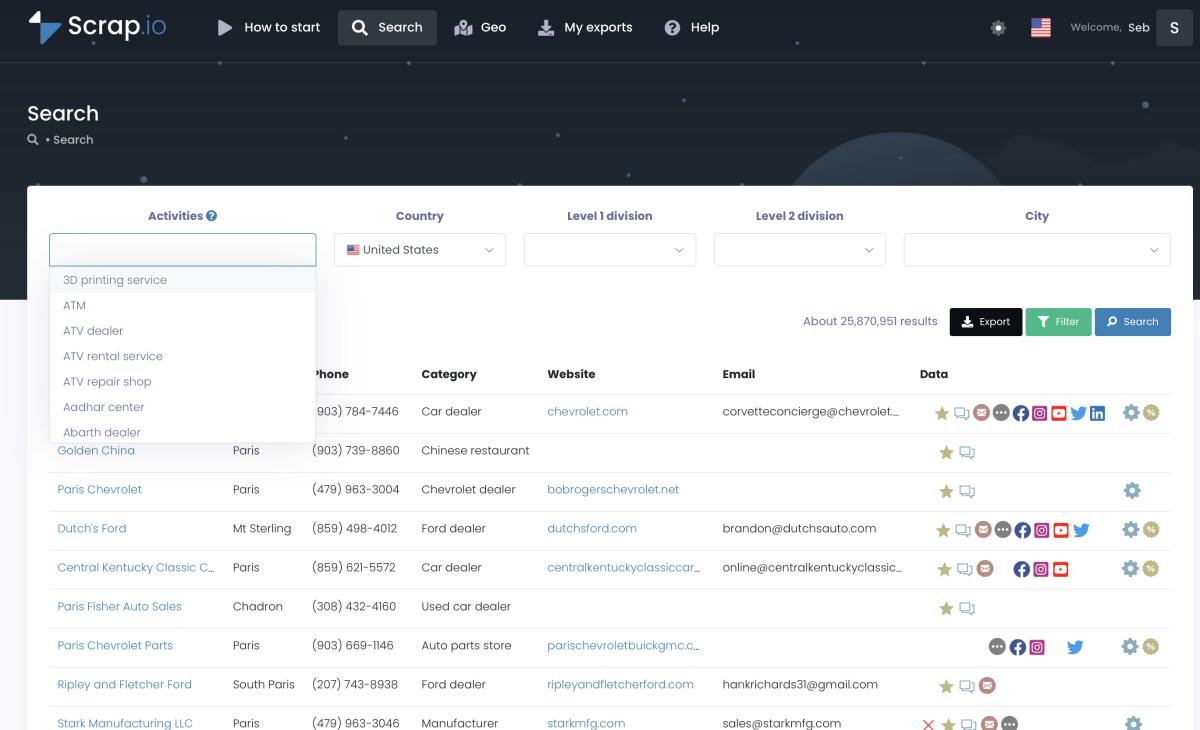
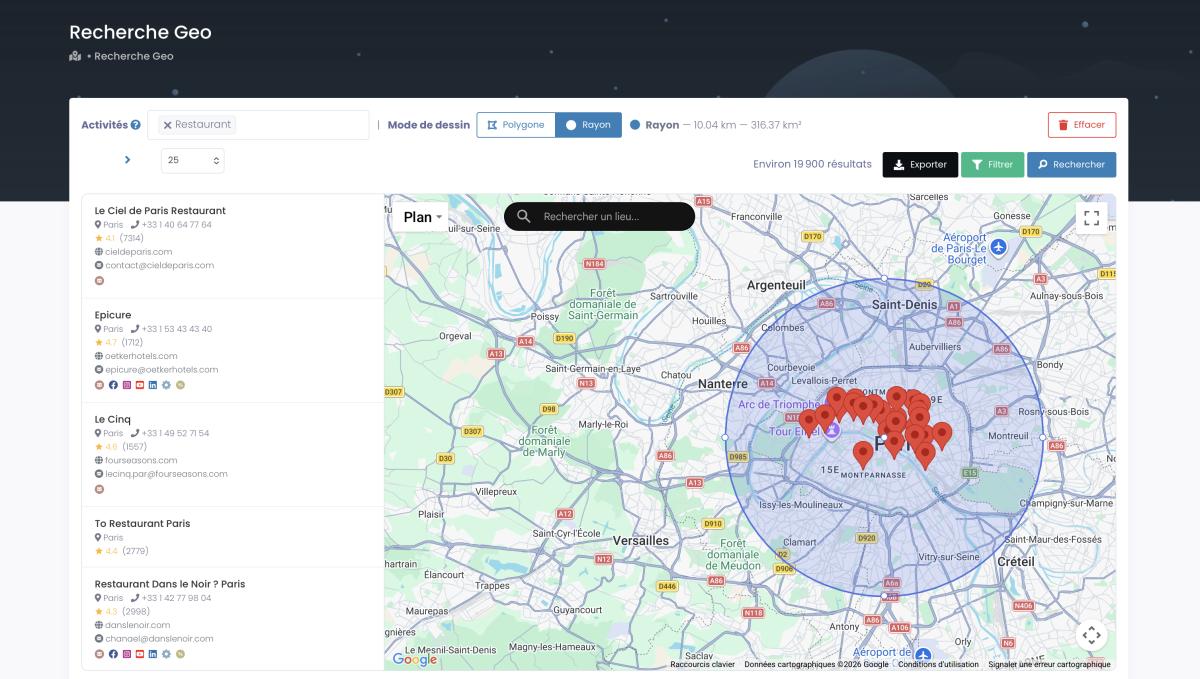
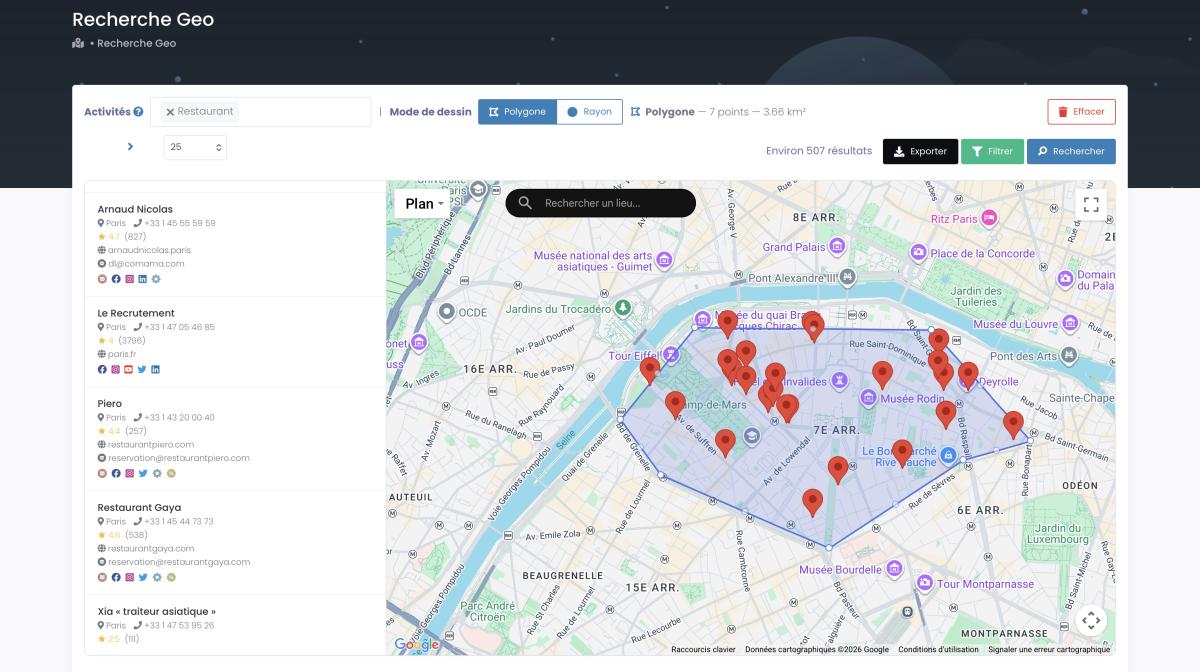
So the fix is to feed your agent a data source built for local. That's exactly what Scrap.io does: it pulls real-time business data straight from Google Maps across 225 million-plus establishments, 195 countries, and 4,000-plus categories. Not a frozen database. The data is re-extracted the moment you export, so a business that opened last week is in there, and a number that changed yesterday is already updated. You can grab an entire country's businesses in a category in two clicks, or draw a custom catchment area on the map when a city boundary doesn't match your territory. If you need the technical side of feeding Google Maps data to AI agents, we wrote the full walkthrough, and the wider local lead generation playbook covers the strategy around it.
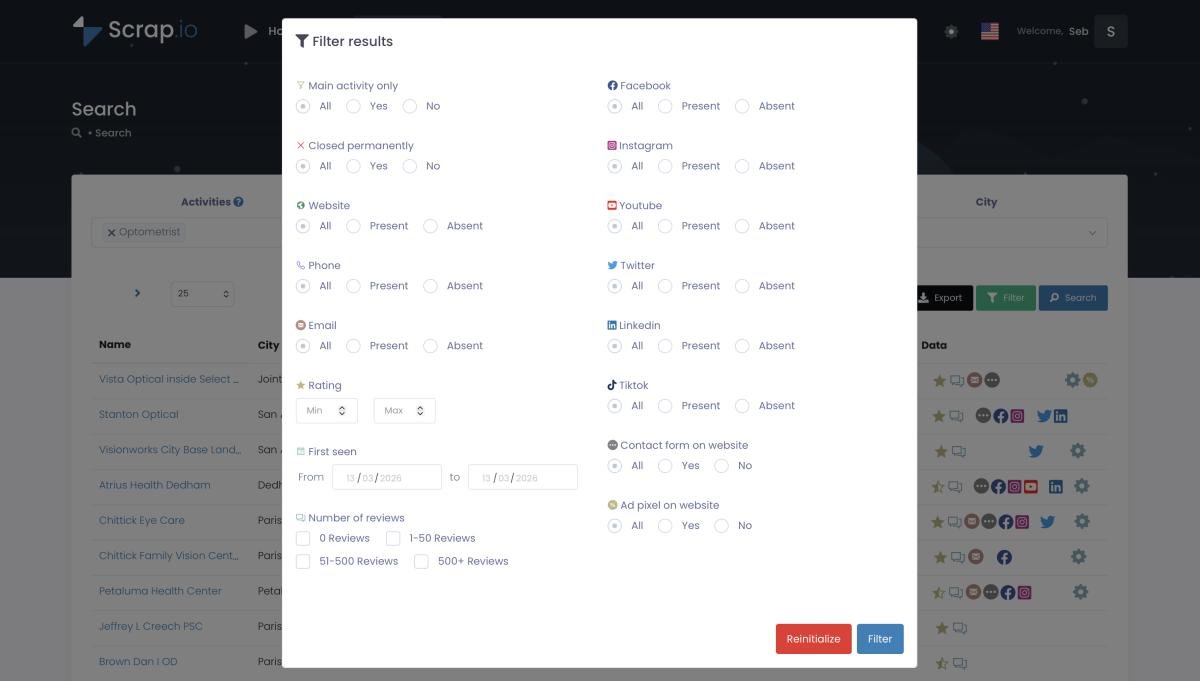
And the filtering is where it stops wasting your money. You filter before extraction, not after. Only want businesses with an email on file? Mobile numbers only, for SMS? Recently opened? Toggle it, and credits only get spent on contacts that match. Counts are always free, so you can size a market before paying anything. For agencies, there's an obvious angle here: find local businesses without a website and you've got a list that practically sells itself.
Want to see it driven end to end from a chat window? This one shows an AI agent pulling Google Maps data live.
Video: I Told an AI Agent to Scrape Google Maps. Then I Gave It Superpowers.
Pull an entire country's businesses in your category, filtered by email, phone, or "just opened," in two clicks. That's the local layer your AI SDR's database can't see: 225M+ businesses, real-time, filtered before you spend a credit. Try Scrap.io free →
Staying compliant: GDPR, CCPA and clean sourcing
Quick but necessary, because "my AI did it" is not a legal defense.
The good news is that B2B prospecting on public business data sits on solid ground. Under GDPR in the EU, a company's published email or listed phone number generally falls under "legitimate interest," as long as every message carries a clear opt-out. Under CCPA in California, publicly available business information is carved out of scope entirely, you're handling commercial data, not consumer profiles. The variable that actually matters is the source. A tool that collects public business listings and keeps every record traceable to where it came from is playing clean. A mystery list of unknown origin is not.
That's the standard Scrap.io is built to: only publicly available business data, GDPR and CCPA compliant, every record traceable to its source. Feed your agent from a clean source, include an unsubscribe in every send, honor opt-outs fast, and you're prospecting like a professional instead of gambling with your domain.
How to build your own AI sales stack (data to agent to CRM)
So let's put it together. If you're figuring out how to build an ai sales agent setup that doesn't collapse the first week, it comes down to three layers, in this order. The order is the whole trick.
Layer 1, the data source. This is the foundation, and it's the layer everyone skips. Start here. A real-time source like Scrap.io gives your agent fresh, filtered, local-inclusive business data instead of a stale list. Get this wrong and the other two layers just amplify the mistake.
Layer 2, the agent. Now you pick your outbound SDR (Artisan, 11x, AiSDR), your inbound agent (Qualified), or a broad CRM-native one (Agentforce, Breeze). This is the layer people obsess over and it's genuinely layer two, not layer one.
Layer 3, the CRM. Everything flows back into Pipedrive, HubSpot, Salesforce, wherever you live. The move that saves hours is to auto-enrich your CRM with Google Maps data so records stay current instead of rotting in place.
The plumbing between the three is easier than it used to be. Scrap.io ships a REST API, a Make.com module, and an official MCP connector (scrap.io/mcp) that works with Claude, ChatGPT, and Gemini, so you can literally type "find every roofer in Texas with an email and no website" and your agent builds the search, the filters, and the geo-targeting itself. Counts stay free. No code. Here's exactly what that looks like end to end.
Video: How to Scrape Local Leads with Claude & Vibe Prospecting
Data first. Agent second. CRM third. Do it in that order and the stack holds. Do it backwards, buy the shiny agent, then scramble for data, and you join the 83%.
FAQ
What is the difference between an AI sales agent and an AI SDR?
An AI SDR is a narrow, top-of-funnel agent that finds contacts, personalizes outreach, runs sequences, and books meetings, then hands off to a human. A broader AI sales agent spans more of the deal: qualification, CRM updates, follow-ups, even forecasting. Every AI SDR is an AI sales agent, but not every AI sales agent is an SDR.
How much does an AI sales agent cost in 2026?
Pricing ranges widely. Inbound agents like Qualified's Piper run roughly $40K to $68K a year, outbound AI SDRs like Artisan or AiSDR start around $250 a month, and CRM-native agents such as Salesforce Agentforce or HubSpot Breeze often price per outcome (around $1 to $2 per conversation). Budget 1.5 to 2x the sticker price for data and ramp-up, because that's the ai sales agent pricing reality nobody quotes you up front.
Do AI sales agents actually work?
They can, but results are uneven. A 2026 SaaStr poll found 83% of teams hadn't yet gotten real results from AI SDRs. The ones that win feed their agents fresh, well-targeted data: top performers are 1.7x more likely to use AI prospecting agents and far more likely to prioritize data hygiene. The agent amplifies your data, so clean data decides the outcome.
Can an AI sales agent find local businesses, not just SaaS contacts?
Only if you feed it local data. Most AI SDRs rely on LinkedIn-centric databases that miss the 36.2 million small US businesses, the restaurants, clinics, and agencies that live on Google Maps, not LinkedIn. To prospect local, pair your agent with a Google Maps data source like Scrap.io.
Will AI sales agents replace human sales reps?
Not in 2026. They automate the repetitive top-of-funnel work, list building, first-touch outreach, qualification, so humans focus on relationships and closing. The common pattern practitioners describe is roughly "80% AI, 20% human in the loop."
What data does an AI sales agent need to work?
Accurate, fresh, well-targeted prospect data: verified company name, contact email and phone, website, and intent or firmographic signals. Because B2B data decays 20 to 30% a year, stale lists are the number one reason agents underperform, which is why real-time sources matter more than the agent you pick.
The bottom line
An AI sales agent runs parts of the sales process on its own, and an AI SDR is the top-of-funnel specialist version of one. That's the vocabulary sorted. But the thing that actually decides whether you land in the winning 3% or the stuck 83% isn't which agent you buy. It's what you feed it. Start with the data, then add the agent, then wire it to your CRM. Backwards is how pipelines die.
Start with the data. Try Scrap.io free for 7 days, 50 searches and 100 export credits, no commitment. Fresh, source-traceable business data from 225M+ listings across 195 countries, filtered before you pay, ready to feed any AI sales agent. Start your free trial →
Generate a list of restaurant with Scrap.io