

Here's a number that should bug you a little: 2,729,648. That's how many businesses are actively trading across Australia right now (ABS, 30 June 2025). Every one of them is a potential customer, supplier, or competitor sitting on a public map.
And getting a clean, exportable list of them? Still weirdly painful in 2026.
You'd assume an Australian business directory would fix that. Type a category, pick a city, download the list, get on with your day. Nope. Most directories were built so a customer can find one plumber — not so you can pull every plumber in Queensland into a spreadsheet. Two completely different jobs. (Spoiler: only one of them makes you money.)
So this guide covers the part nobody else does. Not just where to browse a business directory in Australia, but how to build your own — filtered by state, city, email, phone, or website, and exported in minutes. Real numbers, real limits, and an honest look at when a free directory is enough and when it's a dead end.
Video: Scrap.io — How to Start?
- What is an Australian business directory?
- How many businesses are there in Australia? (2026)
- Free Australian business directories (and their limits)
- Australian business directory by state & city
- How to build your own real-time directory (step by step)
- Filter for the data that actually matters
- 3 real ways businesses use an AU directory
- Is scraping an Australian business directory legal?
- Conclusion
- FAQ
What is an Australian business directory?
Two very different things share this name — and which one you need changes everything.
The first is a directory you browse. Yellow Pages, White Pages, True Local, Pure Local. You search "electrician near me," you get a page of listings, you call one. Great for consumers. Great if you need a single supplier this afternoon.
The second is a directory you export. A structured list of businesses — name, address, city, state, phone, email, website — that you can filter and download as a file. This is what a sales team, a web agency, or a market analyst actually wants. Not one café in Fitzroy. All 8,000 cafés in Victoria, with emails, minus the ones that already have a website.
Same words. Opposite outcomes. Whether you call it an Australian company directory online, a business database, or just a list of companies in Australia, that split — browse versus export — is the thing that trips everyone up. Most of the internet only serves the first kind, which is exactly why "how to find a list of companies in Australia" is such a frustrating search. The ABN Lookup register, for instance, is brilliant for verifying a single ABN — and useless the moment you want every business in a postcode. It checks one entity at a time, by design.
Here's the honest framing before you pick a tool:
| Tool | Best for | Export a full list? | Cost |
|---|---|---|---|
| Yellow Pages AU | Getting found / finding one supplier | No | Free |
| Pure Local | Verified local listings | No | Free |
| ABN Lookup | Verifying an ABN or legal entity | No (one at a time) | Free |
| Scrap.io | Building & exporting a filtered list | Yes (CSV / Excel) | Free trial, then from $35/mo |
If you only ever need the "best Australian business directory" to find a tradie, stop here — Yellow Pages is fine. If you need a list you can actually work, keep reading.
How many businesses are there in Australia? (2026)
Let's put real numbers on the table, because the scale is genuinely wild.
At 30 June 2025 there were 2,729,648 actively trading businesses in Australia (ABS). That's a net increase of 2.5% — 66,650 more businesses in a single year, off the back of 437,150 new entries against 370,500 exits. The market added the population of a small city, in businesses, in twelve months.
Now the part that matters for prospecting. 97.3% of them are small businesses with fewer than 20 employees — 2,656,469 companies (ASBFEO, June 2025). These are owners who read their own inbox and make their own decisions. No procurement committee. No 18-month cycle. That's a good audience, if you can reach it.
One more figure that trips people up: there are also 6,009,760 ABNs registered but not actively remitting GST (ASBFEO). So the ABN register is much bigger than the count of businesses actually trading. Which is a polite way of saying: a raw ABN dump is full of ghosts. You want the ones that are alive.
And here's where a real-time Australian business database earns its keep. As of July 2026, Scrap.io indexes 2,328,574 Australian establishments pulled live from Google Maps. Of those, roughly 59% have a website (about 1,373,767) and 40% list an email (around 939,053). That last number is the whole game — nearly a million Australian businesses you can actually email, updated at the moment you export. (If email is specifically what you're after, the companion guide to building an Australian business email database goes deep on that angle.)
Curious how big your slice is? Punch a category and a state into Scrap.io and it shows you the exact count before you spend anything — counting results is always free, no credit burned, no card charged. Restaurants in NSW, tradies in Perth, dentists in Brisbane. See the number first, decide later. Check the free count on Scrap.io.
Free Australian business directories (and their limits)
Free, yes. Prospectable, no. That's the whole section in five words, but let's be fair about it.
Australia has plenty of solid free directories, and for their intended purpose they work:
- Yellow Pages AU — the classic. Huge, well-organised, great for finding a local service.
- White Pages — names and numbers, more consumer-facing.
- Pure Local — established 2014, manually verified listings, genuine reviews.
- True Local and Nationwide — general listing portals.
- ABN Lookup — the official register, one entity at a time.
So what's the catch? Every one of these was built to get businesses listed, not to hand you the list. There's no "export all" button. You can look up a company, sure. Try to pull all 4,000 accountants in Sydney into a CSV and you'll be copy-pasting until Christmas. Ever tried building a spreadsheet from a directory by hand? I'll wait.
Here's the plain comparison:
| Directory | Free to browse? | Export a filtered list? | Data freshness |
|---|---|---|---|
| Yellow Pages / White Pages | Yes | No | Listing-based |
| Pure Local | Yes | No | Manually reviewed |
| ABN Lookup | Yes | One ABN at a time | Official register |
| Scrap.io | Count free | Yes (CSV / Excel) | Real-time at export |
If you're hunting a Yellow Pages alternative that actually exports, or a proper Australian small business directory you can filter down to a single suburb, that's precisely the gap these free portals leave open.
And whatever you do, please don't fix the "free but not exportable" problem by buying email lists from a random vendor. A frozen file someone else pulled — and resold to your competitors — is the worst of both worlds. Stale and shared. Hard pass.
Australian business directory by state & city
Meet Sarah. She runs a five-person web agency in Melbourne and her pitch is simple: she builds sites for businesses that don't have one. Her ideal list? Every business in Victoria with a Google listing but no website. Try assembling that from Yellow Pages. You can't. The information's there, scattered across thousands of listings — it's just not shaped like a list.
This is where geography does half the selling for you. Australian business activity isn't spread evenly, and knowing the map is an edge.
New South Wales leads the country with roughly 916,603 businesses — the most of any state — anchored by Sydney's finance, tech, and professional-services scene. Victoria is next, driven by Melbourne's creative, hospitality, and education sectors. Then Queensland (Brisbane), Western Australia (Perth, mining-heavy), and South Australia (Adelaide). Every state grew in 2024-25 — here's who added the most:
| State | Net new businesses (2024-25) | Main hub |
|---|---|---|
| New South Wales | +20,040 (largest net increase) | Sydney |
| Victoria | +16,486 | Melbourne |
| Western Australia | +10,877 (+4.3%, biggest % rise) | Perth |
Source: ABS, Counts of Australian Businesses, 2024-25.
A real directory tool lets you slice this any way you need: a single city (Sydney, Melbourne, Brisbane), a division, a whole state, or the entire country in one search. So a business directory for Melbourne is just a Victoria search narrowed to a city — and if you want to extract every business in an area regardless of category, you can do that too. Building a country-level list this way is the exact playbook behind the USA business email database approach, just pointed at Australia.
Video: How to Scrape Local Leads at the Country Level?
How to build your own real-time directory (step by step)
Contrarian take: the best Australian business directory isn't one you browse. It's one you build in two clicks and own outright.
Here's the actual process with Scrap.io, which scrapes businesses from Google Maps in real time. No code, no proxies, no 3 a.m. debugging.
Step 1 — Search. Pick a category from 4,000+ options (they mirror Google Maps), then a location: a city, a division, a state, or all of Australia. The platform tells you exactly how many businesses match before you spend a single credit.
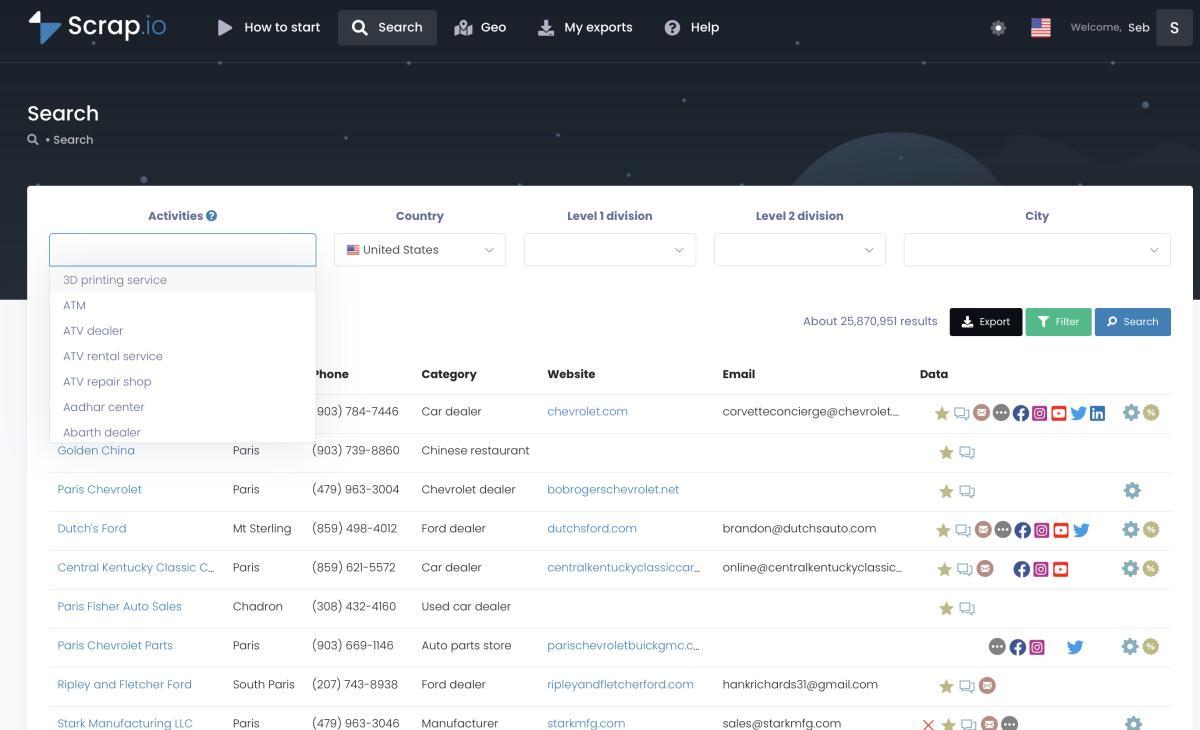
Step 2 — Filter before you pay. This is the bit that saves you money. Only want businesses with an email? Toggle it. No website (hello, Sarah)? Toggle it. Minimum rating, review count, mobile numbers only — all applied before credits are consumed. You never pay for a contact you can't use.
Step 3 — Export. Preview the data, name your file, choose CSV or Excel. Done. Big lists (100,000+ rows) get split into a tidy ZIP automatically. One agency pulled 11,734 businesses in 45 minutes — try that by hand.
That's the whole thing. And because the data is pulled live from the map at the moment you export, there's no list decay. No fossil file. The café that added its email on Tuesday is in your Tuesday-afternoon export.
Video: How to Extract Every Business in 1 Click (No Category)
Build your Australian directory today. Pick a state, add your filters, hit export. The free 7-day trial gives you 50 searches and 100 export credits — enough to pull a real list from your own market and see the data quality before you commit a cent. Start your free trial — 100 leads included.
Filter for the data that actually matters
Two million businesses is noise. Eight thousand Brisbane cafés with an email and no website? That's a pipeline. The filter is where a directory stops being a phone book and starts being a sales tool.
Scrap.io applies every filter before extraction, so your credits only ever go to contacts worth having. The ones that move the needle:
- Digital presence — has a website (or crucially, doesn't), has an email, has a phone, or is on a specific social network.
- Phone type — mobile vs landline. Mobiles for SMS campaigns, landlines for B2B cold calls. (Note: phone-type classification isn't available for the US and Canada, but it works across Australia.)
- Quality signals — minimum rating, review count, claimed listings, price range.
- First-detected date — target businesses that only appeared on the map recently. Freshly opened, under-marketed, and nobody's pitched them yet.
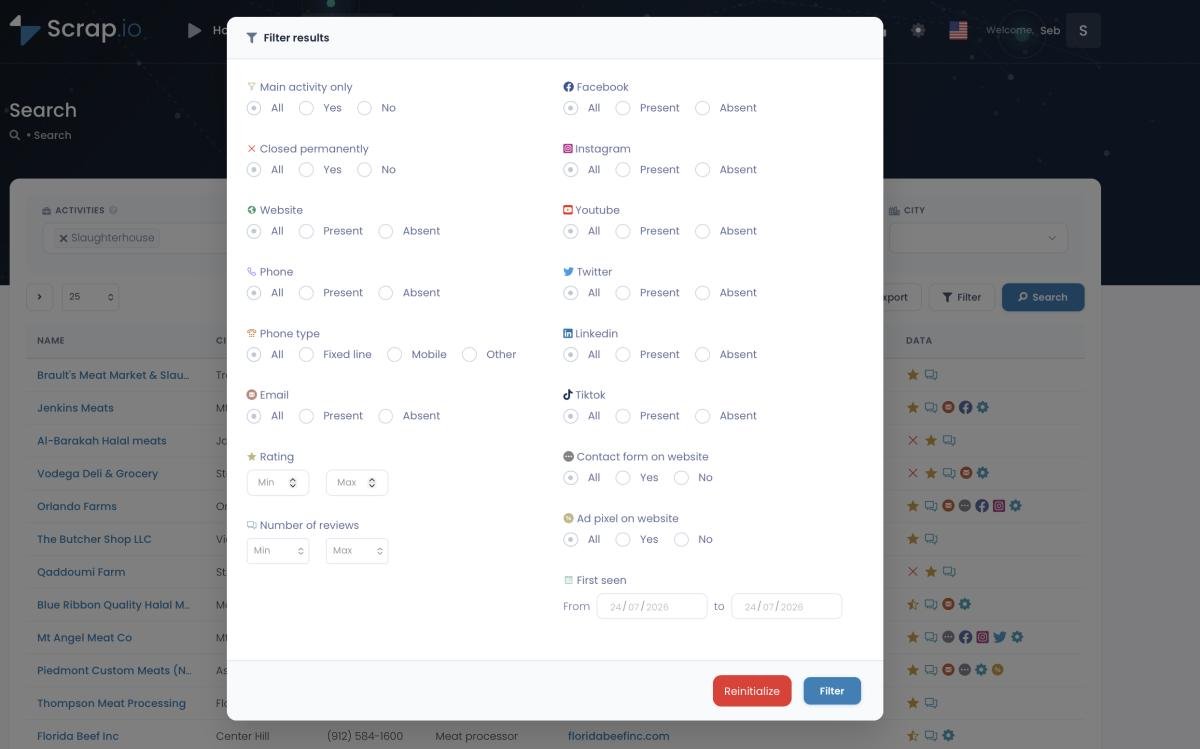
Every one of those fields is a qualifier in disguise. A business with a listed email, 50+ reviews, and a 4.5 rating didn't just appear on your list — the listing pre-qualified it for you. And when you're ready to reach out, the classified emails (individual, contact, sales, marketing) mean you can find business emails and know whether you're writing to the owner or a generic info@ inbox before you hit send.
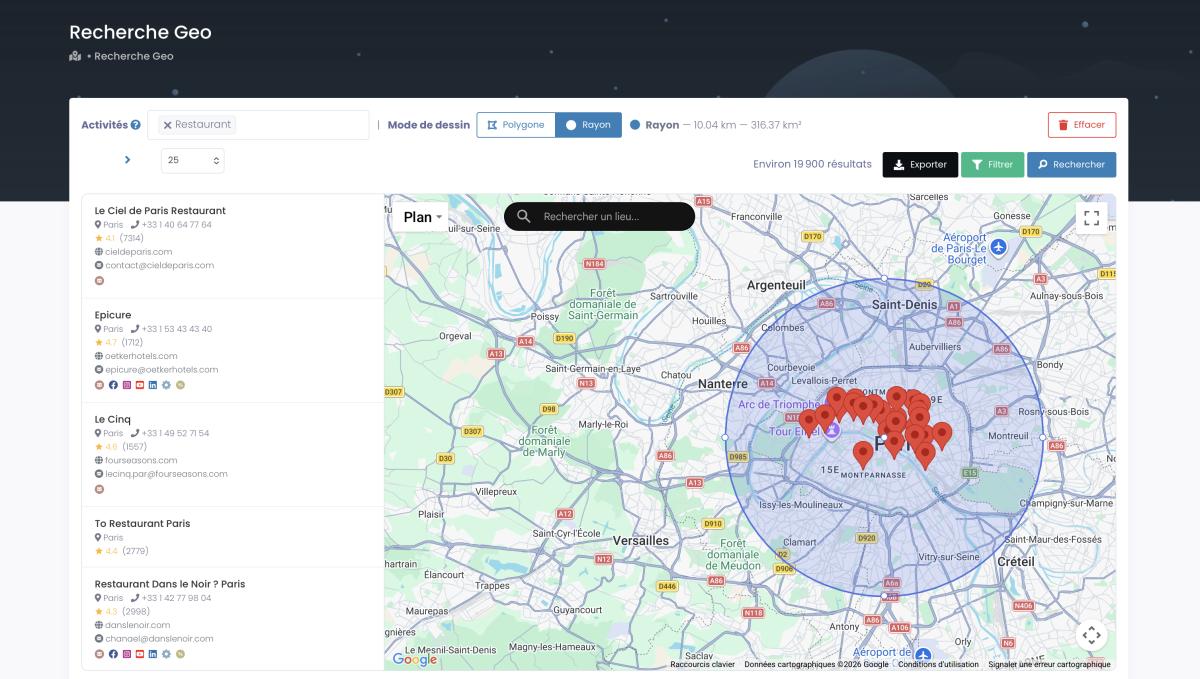
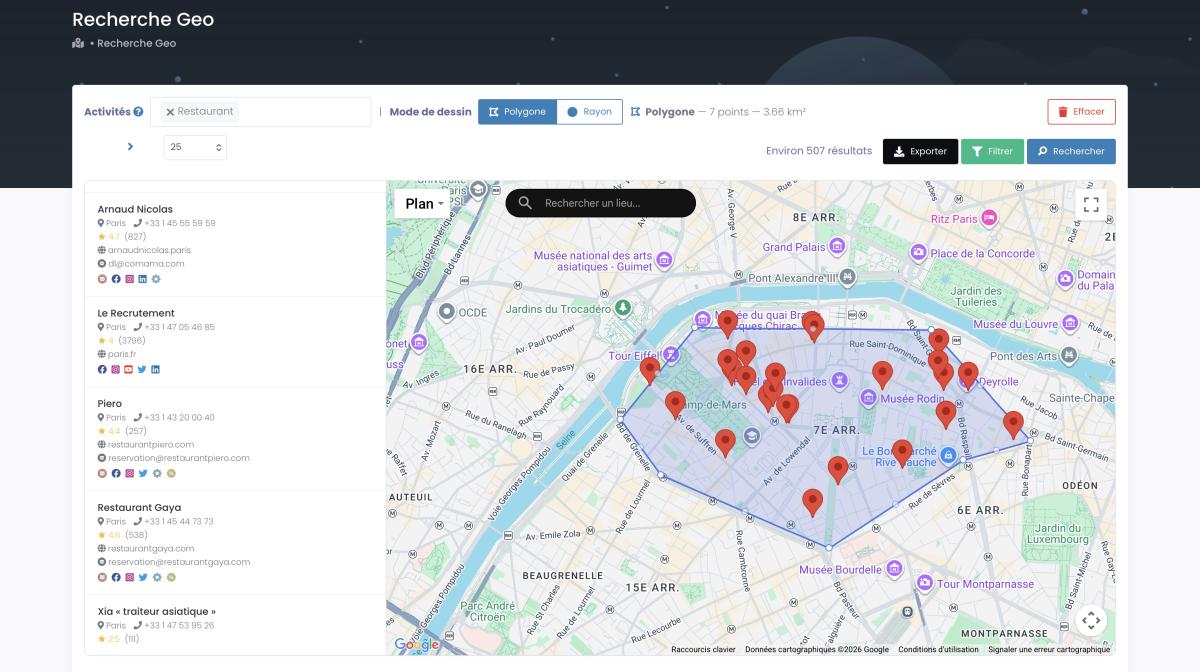
Need a shape that isn't a whole city? Draw one. GeoSearch lets you set a radius around a point or hand-draw a polygon over an exact suburb or catchment — and every filter still applies inside it.
3 real ways businesses use an AU directory
Web agency, SMS marketer, market analyst — same directory, used three completely different ways. Here's what that actually looks like.
1. The web agency (no-website filter). Back to Sarah in Melbourne. She filters Victoria for businesses with a Google listing but no website, exports a few thousand, and pitches web design. It's not cold outreach when you're offering exactly the thing they're missing. This is the classic local business leads play, and it converts because the targeting is surgical.
2. The SMS marketer (mobile filter). A promotions business wants to run SMS campaigns to salons and gyms across Brisbane. They filter for mobile numbers only — no point texting a landline — and export a clean, compliant list. Landlines would've tanked the campaign. The filter did the compliance work upfront.
3. The market analyst (whole-zone extraction). An analyst mapping the WA hospitality sector doesn't want emails at all. They pull every restaurant, café, and bar in Perth to size the market, spot white space, and benchmark competitors. A directory as a research instrument, not a lead list.
And a quick reality check on the "just buy an Australian list" alternative. Community sentiment on Reddit's r/sales has long flagged that big US-built databases are hit-and-miss on local data — especially mobile numbers for smaller businesses. The data backs it up: an independent 2026 benchmark found the major providers quietly degrade SMB record freshness, with mobile coverage swinging wildly between tools. Local-first options like Firmable exist precisely because ANZ coverage from the giants thins out where it counts — ZoomInfo leans enterprise, Cognism leans EMEA, and Australian SMB mobiles fall through the cracks of both. Real-time extraction sidesteps the whole problem — you're not buying a snapshot, you're pulling the current state of the map.
50,000+ professionals build their lists this way. Rated 4.8 on Capterra and 4.9 on G2, Scrap.io covers 225M+ businesses across 195 countries — including 2.3M+ in Australia. Same directory, filtered to your exact play. See how it works on your market.
Is scraping an Australian business directory legal?
Short answer: yes, for publicly available business data — done properly.
When a business publishes its name, address, phone, and email on Google Maps or its own website, that's public commercial information, not private personal data. Collecting it for B2B prospecting is legal in Australia, the same way it is under GDPR in Europe and CCPA in California. Scrap.io only extracts publicly available business data, is RGPD and CCPA compliant, and keeps every data point traceable to its source.
The line that matters is how you use it, not that you collected it. Australia's SPAM Act 2003 governs your outreach: identify yourself clearly, include a working unsubscribe, and honour opt-outs. B2B email to a publicly listed business address generally sits fine within those rules. Just don't be shady, and don't email someone's private Gmail like it's a business inbox.
Bottom line: public business data, used for legitimate prospecting, with an opt-out on every message. That's the clean way to do it.
Conclusion: your directory is two clicks away
Australia has 2.7 million trading businesses and the number climbs every quarter. The old free directories are great for finding one supplier and hopeless for building a list. The register is official and one-entity-at-a-time. Everything in between — the exportable, filterable, current directory — is the gap nobody else fills.
So stop copy-pasting from listing sites like it's 2015. Pick a state, add a filter or two, and pull the exact slice of the market you sell to. If you later want to take the same method global, the international lead generation playbook is the identical process pointed at any of 195 countries.
Your slice of 2.7M Australian businesses is two clicks away. Free for 7 days — 50 searches and 100 export credits, filtered before you pay, no code required. Pull your first list before lunch. Start your free trial — 100 leads offered.
FAQ
What is the best Australian business directory?
It depends on the job. To simply find a business, Yellow Pages, Pure Local, or True Local are all solid free options. To export a filtered list — by state, city, category, email, phone, or website — you want a real-time tool like Scrap.io that turns Google Maps into a downloadable CSV or Excel file.
How many businesses are there in Australia in 2026?
There were 2,729,648 actively trading businesses at 30 June 2025, up 2.5% year on year (ABS). Around 97% are small businesses with fewer than 20 employees. Scrap.io indexes 2.3M+ Australian establishments in real time from Google Maps.
Is there a free Australian business directory?
Yes — Yellow Pages, White Pages, Pure Local, True Local, Nationwide, and the official ABN Lookup are all free. The limit is that they're built for visibility, not for exporting a filterable list. You can look businesses up, but you can't download them in bulk.
How do I get a list of all companies in a specific Australian city?
Use a tool that searches Google Maps by location. In Scrap.io, pick a city (Sydney, Melbourne, Brisbane), add a category, apply filters, check the free count, and export to CSV or Excel. No manual copy-pasting, no 120-result cap.
Is it legal to extract Australian business directory data?
Yes, for publicly available business data used for legitimate prospecting. Scrap.io is RGPD and CCPA compliant, and every record is traceable to its source. When you contact those businesses, follow the SPAM Act 2003: identify yourself, include an unsubscribe, and honour opt-outs.
Generate a list of restaurant with Scrap.io