

Meet Dana. She runs a three-person web agency, and every Monday morning she stares at the same ugly problem: an empty pipeline, a rent check due, and roughly 33 million local businesses out there she has no idea how to reach. She's tried buying lists. She's tried waiting for referrals. Neither pays the bills.
Here's the thing nobody says loudly enough. Finding local business leads in 2026 isn't hard because the leads are hidden. They're hard because everyone's looking in the wrong place — and paying a fortune to do it. The businesses you want are sitting on a public map, updated by their owners, waiting. This guide covers all three ways to get them: free, paid, and the one almost nobody talks about — extracting your own. Let's get into it.
Video: Scrap.io — How to Start?
- What are local business leads (really)?
- The state of local business leads in 2026
- Free ways to get local business leads
- Paid sources: lead-gen companies, LSAs & databases
- The smart way: extract your own leads from Google Maps
- How to qualify leads before you spend a cent
- Turning local business leads into customers
- Staying compliant: GDPR, CCPA & CAN-SPAM
- FAQ
What are local business leads (really)?
A name and a phone number isn't a lead. So what actually is one?
A local business lead is a nearby business that fits your ideal customer profile and shows a real signal that it could buy from you — the right industry, a reachable contact, and a geographic footprint you can serve. Not just data. A reason to reach out.
People blur three words together and it costs them. A suspect is anyone in your category. A prospect matches your profile. A lead is a prospect you can actually contact — email, phone, a real front door. The gap between those three is where most pipelines quietly leak.
And the "local" part changes everything. When someone qualifies as a local lead, proximity does half your selling for you. You know their market. You can name the street their competitor is on. You can show up in person if the deal's big enough. That's an edge national B2B prospecting never gets. Whether you call them local leads for business, nearby prospects, or small business leads, the principle holds: geography plus intent equals a lead worth your time.
The state of local business leads in 2026
There are 33.2 million small businesses in the US — and most of them are three clicks away from being your next customer (Tailor Brands / SearchLogistics, 2026). Sit with that number for a second. Thirty-three million. That's the total addressable market hiding in plain sight.
Here's where it gets interesting. Around 18 million US businesses use Google's free Business Profile tools, and there are somewhere between 39 and 42 million Google Business Profile listings across the country. Yet only about 44% of businesses have actually claimed their listing — even though the average profile pulls in roughly 1,260 Maps views and 59 customer actions every month. Translation: a massive, active database, half of it unclaimed and under-marketed. That's not a problem. For you, that's an opportunity.
Demand backs this up too. Roughly 46% of all Google searches carry local intent — people looking for something near them, right now. Meanwhile the cost of buying your way in keeps climbing.
How much? The average B2B cost per lead now sits at $198 across all industries, climbing to $208 in B2B tech and $285 in finance (DigitalApplied / Martal, 2026). And the whole B2B lead generation services market is worth $3.33 billion in 2026, on track for $8.2 billion by 2035 — an 11.9% CAGR (Business Research Insights, 2026). A lot of companies are paying a lot of money to find customers who are, quite literally, on a map.
Free ways to get local business leads
"Free leads" usually means "you'll pay with your time." But a few methods genuinely work, and if you're starting with more hours than dollars, this is where you begin.
Claim and optimize your Google Business Profile. Boring? Yep. Effective? Also yep. A complete profile with photos, accurate hours, and steady reviews shows up more in Maps and pulls in inbound local leads while you sleep. If you want the deeper inbound playbook, our guide to local business lead generation strategies covers the whole system.
Prospect manually on Google Maps. Search a category plus a city, open each listing, hunt for the website, dig out the email. It works. It's also mind-numbing, and you'll cap out around 50 businesses an hour if you're fast. A free browser extension can speed this up by surfacing emails directly on the map — more on that in a second.
Referrals and partnerships. The oldest trick, still the best conversion rate. A warm intro from a trusted contact beats any cold email sequence. The catch? Referrals don't scale on command.
Communities and forums. This is where you learn what your market actually wants. Search local business leads reddit and you'll hit thread after thread of people trading tactics — because how to find local leads from Google Maps is the burning question of the moment. Honestly, the community sentiment is louder than any vendor's landing page. In one digital-marketing subreddit, someone asked flat out for the best way to find local business leads from Google Maps; over in a small-business community, another owner described stumbling into "the simplest local lead gen method" they'd ever used — and the answer, again and again, was extraction. Chasing local business leads free of charge? Lurk, learn, occasionally contribute. Free intel.
Lead magnets. A local checklist, a free audit, a "best plumbers in [city]" resource — give value, capture contact info in return. Slow to build. Compounds forever.
Prefer to skip the manual copy-paste grind? The free Scrap.io Chrome extension surfaces business emails and social profiles right on the Google Maps interface — no signup, unlimited use. It's the easiest way to test whether extraction is for you before you commit to anything.
Paid sources: lead-gen companies, LSAs & databases
Paying for leads isn't the problem. Paying for shared, stale leads three competitors already bought — that's the problem.
There are three flavors of paid, and lumping them together is how people overpay. First, lead-gen agencies do the work for you: they build the list, run the outreach, book the meetings. Real example — Clicks Geek, a Google Premier Partner focused on local service businesses, prices on your ad spend and pitches "revenue, not vanity metrics." Or Scorpion, an AI marketing platform for home services, legal, and healthcare, starting around $1,500/month. Great if you have budget and no in-house sales muscle. Pricey, and you're renting a pipeline you don't own.
Second, pay-per-lead channels like Google Local Services Ads — the "Google Guaranteed" badge you see at the top of local searches. You pay per lead, roughly $51 to $92 depending on the trade, while referral leads come in cheapest at around $52 (WebFX Home Services Benchmarks, 2026). Clean model. The catch, with some pay-per-lead outfits, is that the same google local service leads get resold to several businesses at once.
Third, B2B databases like UpLead (real-time email verification, a claimed 95% accuracy guarantee, from $99/month) or ZoomInfo. You buy access to data and do the selling yourself. Fresh-ish, but you're one of many customers pulling from the same well.
Here's the honest comparison:
| Source | Typical cost per lead | Exclusivity | Data freshness | Best for |
|---|---|---|---|---|
| Lead-gen agency (Clicks Geek, Scorpion) | $1,500+/mo retainer | 🟢 Usually exclusive | 🟡 Varies | No in-house sales team |
| Google Local Services Ads | $51–$92 / lead | 🟡 Sometimes shared | 🟢 Live | Home & local services |
| B2B databases (UpLead, ZoomInfo) | $99+/mo subscription | 🔴 Shared with all subscribers | 🟡 Periodic updates | National B2B |
| Extract your own (Google Maps) | Fractions of a cent | 🟢 100% yours | 🟢 Real-time at export | Local B2B, agencies, SMBs |
Notice the pattern? The more middlemen, the higher the cost and the lower the exclusivity. If you want the full math, we broke down the real lead generation cost breakdown by channel — and why shared lists are usually the worst deal on the table. There's also a nuance worth understanding before you buy anything: the difference between genuinely qualified leads and buying them in bulk.
The smart way: extract your own local business leads from Google Maps
In theory, every business on Google Maps is a potential lead. In practice, copying them one by one would take you until 2030. Here's the two-click version.
A Google Maps extraction tool like Scrap.io lets you pick a category, pick a location — a city, a state, or an entire country — and pull every matching listing into a clean CSV or Excel file. No code. No proxies. No 3 a.m. debugging when Google changes its HTML. You choose "Restaurants" and "Texas," and the platform tells you exactly how many results exist before you spend a single credit.
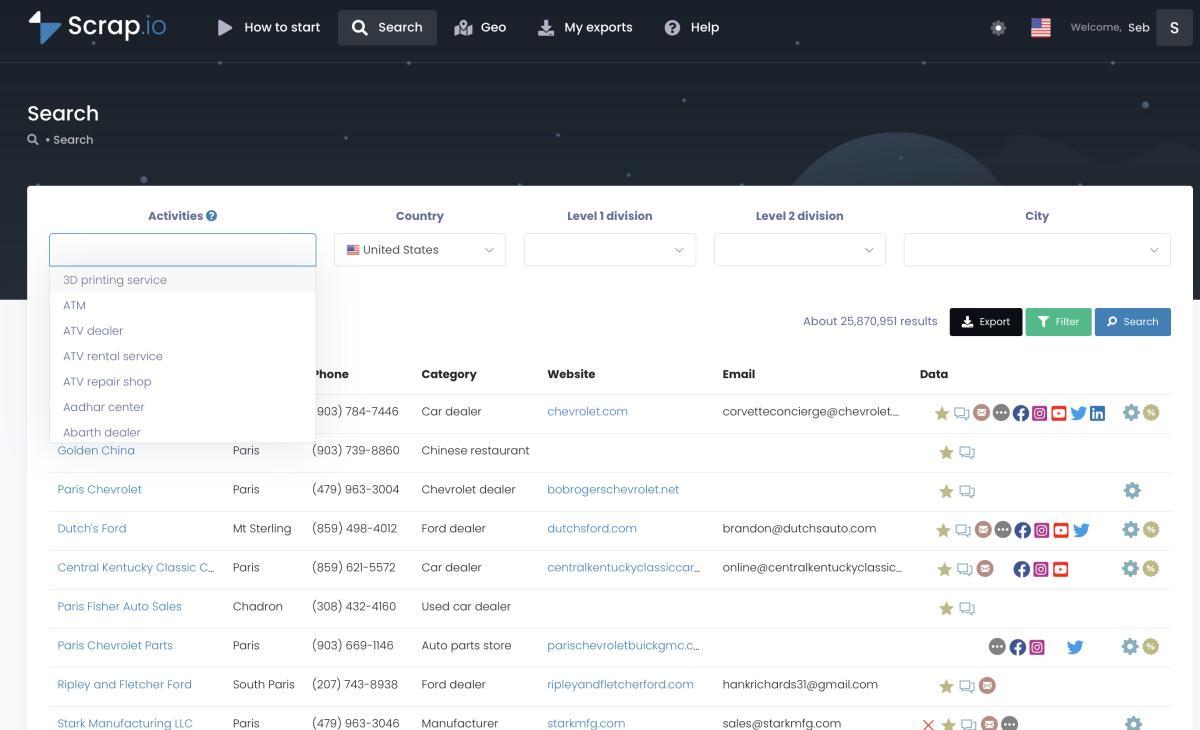
The scale is the part that breaks people's brains. Scrap.io indexes 225,676,406 establishments across 195 countries and 4,000+ categories, updated in real time at the moment you extract — so no list decay, no dead leads, no CSV someone recycled for the fifth time. One real agency case: 11,734 businesses extracted in 45 minutes. Try doing that by hand. I'll wait.
And the data isn't just names. Every export can include phone numbers (tagged mobile or landline), up to five classified emails per business — individual, contact, sales, marketing, finance — plus social profiles, website tech stack, and ad pixels. That's the difference between a contact list and a segmented pipeline. If you want the full method, here's the complete guide to scrape Google Maps for business data, and a focused walkthrough on how to find emails on Google Maps specifically.
Want it hands-off? You can drive the whole thing in plain English through Scrap.io's MCP connector — ask Claude or ChatGPT to "find every dentist in Chicago with an email and a 4+ rating" and it builds the export for you. This is what people mean by vibe prospecting.
Video: How to Scrape Local Leads with Claude & Vibe Prospecting?
The real unlock is scale without a team. Need every plumber in the entire United States, not just one city? That's a country-level extraction — one search, one file. This is the exact thing generic scrapers choke on past a few hundred rows, and it's where a purpose-built tool earns its keep.
Video: How to Scrape Local Leads at the Country Level?
New to it? The getting-started documentation walks through your first search step by step, and there's a sample export file so you can see the actual columns before you sign up. And yes — this is the category people mean when they search for local business leads software. It's not a scraper you babysit. It's a tap you turn on. Look, once the file's in hand you own it outright: a clean, exclusive local business leads list you built yourself, at a fraction of a cent per row. That's about as close to cheap local business leads as this industry gets — and because counting results is always free and the trial is generous, testing it costs you nothing. Call it near-unlimited local business leads, capped only by your plan's monthly credits. You'll see dedicated export products built on this exact idea — localbusinessleadlist.com, for instance, sells pre-packaged Maps exports — but paying for a static file someone else pulled defeats the whole point. Fresh beats frozen.
Extract your first 100 local leads free. Scrap.io's 7-day trial includes 100 export credits and full access to 225M+ businesses across 195 countries — no code, two clicks, trusted by 50,000+ professionals (4.8 on Capterra, 4.9 on G2). Start your free trial and pull a list from your own market.
How to qualify local business leads before you spend a cent
The 5-minute rule says speed wins — respond to a new lead within five minutes and you're up to 9× more likely to qualify it than if you wait 30 (WebFX, 2026). But speed on a bad list is just fast failure. Qualify first.
Here's the move most people miss: filter before you extract, not after. With Scrap.io, every filter runs before a single credit is spent — so you only ever pay for leads worth calling. That's the whole "zero wasted spend" argument, and it's not marketing fluff. It's how the economics work.
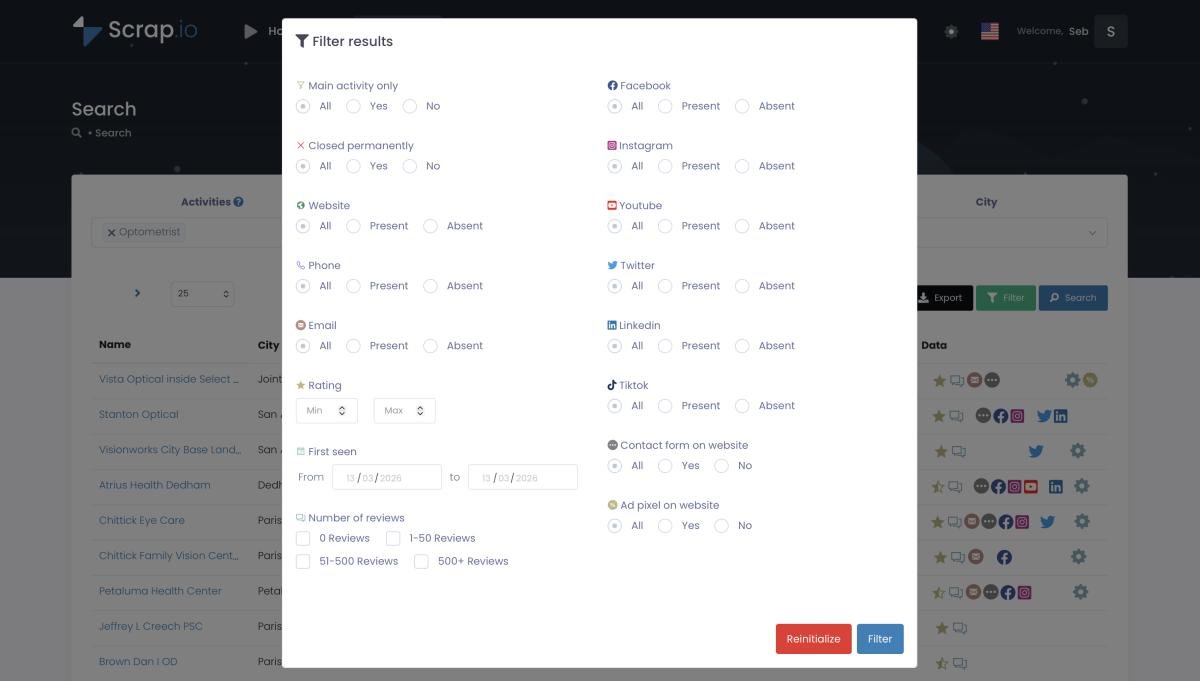
What can you filter on? A lot. Email present (skip anyone you can't contact). Mobile vs. landline (mobiles for SMS, landlines for B2B cold calls). No website at all — which, if you're a web agency, is a literal list of "people who need exactly what I sell and aren't buying it yet." Minimum rating, minimum review count, ad pixel present or absent, and even a "first detected" date so you can target recently opened businesses before your competitors notice them.
Every one of those fields is a qualifier in disguise. A business with a website, a listed email, 50+ reviews, and a 4.5 rating? That's a pre-qualified lead. It exists, it's reachable, it has customers, and people like it. You didn't score that lead — the listing scored it for you.
Need a shape that isn't a whole city? Draw one. GeoSearch lets you set a radius around a point or hand-draw a polygon over an exact neighborhood or catchment area, and every filter still applies inside it.
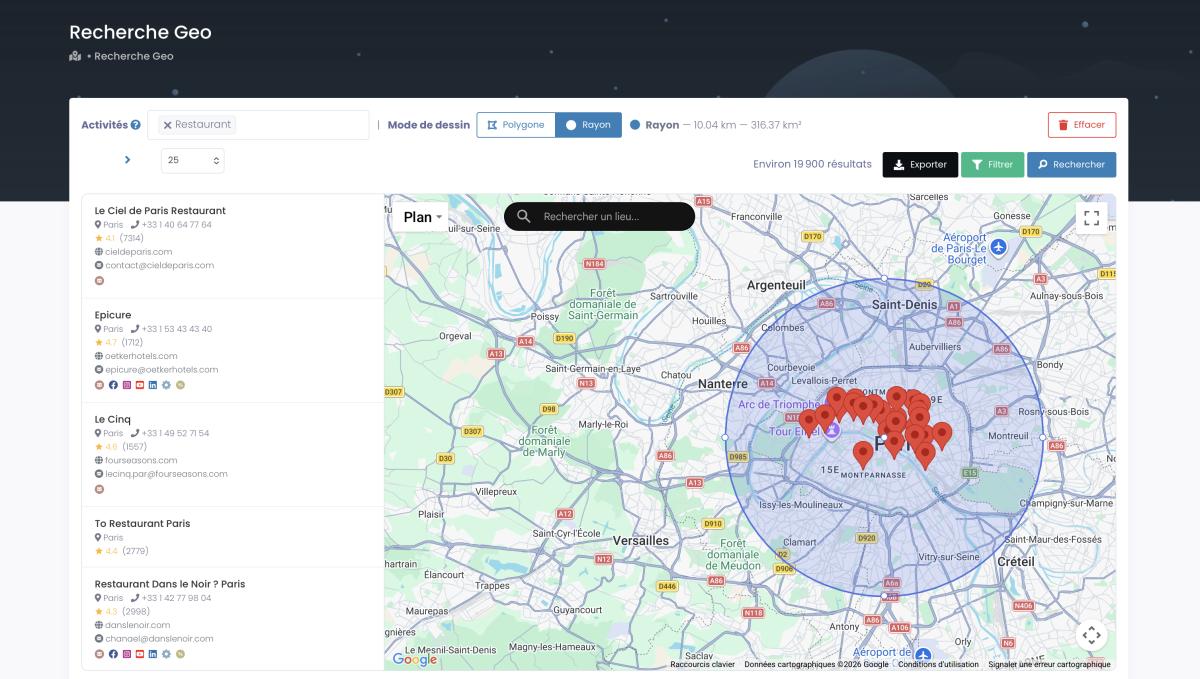
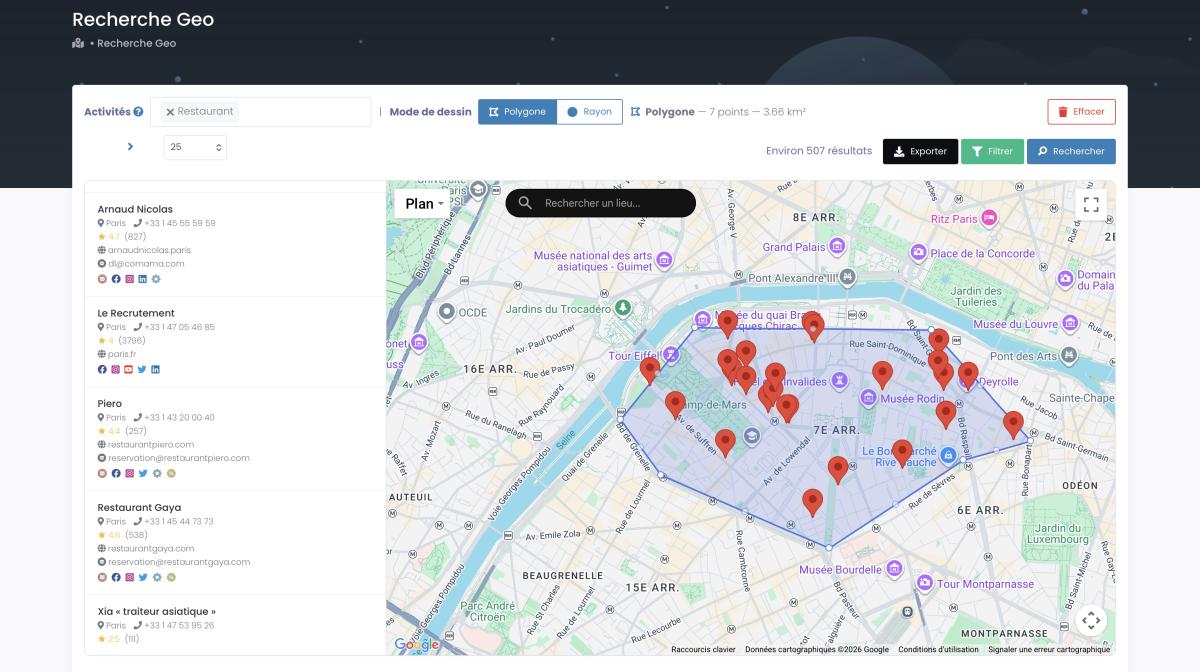
Filter before you extract: email, mobile, no-website, rating, ad pixel — and only spend a credit on leads worth calling. Counting results is always free on Scrap.io, so you can size your market before committing. See how the filters work on your own category and city.
Turning local business leads into customers
You've got 2,000 fresh local leads. Now what?
Now the work starts, because a list is potential energy, not revenue. The good news: because you filtered and classified upfront, you already know how to reach each one. The best local business leads aren't the ones with the most data points — they're the ones you contact first, on the right channel, with the right message. Match the channel to the data.
Cold email for your local business email leads. This is where email classification earns its keep — a message to a named individual should read nothing like one to a generic info@ inbox. Reference their rating, their neighborhood, a specific gap on their listing. Generic outreach is spam; specific outreach is service. Our walkthrough on how to write a cold email that gets replies has real before-and-after examples that push reply rates from 1% into double digits.
Cold calling for the landlines. That phone-type filter matters here — dialing mobiles for a B2B pitch feels intrusive, landlines don't. SMS campaigns for the mobiles, where the mobile-only filter keeps you compliant and relevant. And CRM enrichment to tie it all together, so your extracted data flows straight into your pipeline instead of dying in a spreadsheet.
One honest caveat, because it's worth saying. As one sharp observation making the rounds on LinkedIn put it: most local businesses don't actually need more leads — they need to stop losing the ones already coming in. If your follow-up is broken, more leads just means more waste. Fix the system before you fill the funnel.
Staying compliant: GDPR, CCPA & CAN-SPAM
Okay — the slightly-less-fun-but-absolutely-essential part.
"Is scraping Google Maps even legal?" It's the question everyone whispers, and the honest answer is yes, for public business data, done right. Business contact information — a company name, address, phone number, listed email — is not personal data under most readings of GDPR. It's commercial information a business chose to publish. CCPA in California carves out publicly available business data almost entirely. And in the US, CAN-SPAM permits unsolicited commercial email to business addresses as long as you include honest headers, a real physical address, and a working unsubscribe link.
The line that matters: how you use the data, not that you collected it. Every outreach email needs an opt-out. B2B email in Europe typically leans on the "legitimate interest" basis — a documented, reasonable business reason for reaching out. Get that wrong and the fines are not parking tickets.
This is where sourcing from public listings actually protects you. Scrap.io only extracts publicly available business data, is GDPR and CCPA compliant, and keeps every data point traceable to its source. When a regulator asks "where did this email come from?" — and in 2026 they ask more than they used to — "a public Google Maps listing" is about the cleanest answer in the industry. For the full breakdown, read our guide on whether cold emailing is legal and how to stay on the right side of it.
FAQ
How do I get local business leads for free?
Optimize your Google Business Profile, prospect manually on Google Maps (a free Chrome extension can reveal emails), ask for referrals, and offer a local lead magnet. Free methods cost time, not money — great to start, hard to scale.
Is it worth paying for local business leads?
It depends on exclusivity. Shared leads resold to several competitors convert poorly. Exclusive or self-extracted leads — fresh, filtered, and yours alone — deliver far better ROI, especially for high-ticket local services.
How do I generate 100 local leads in a day?
Manually, you can't. With a Google Maps extraction tool like Scrap.io, you filter by category and location, apply filters (email present, mobile, rating), and export hundreds or thousands of fresh, qualified leads in minutes.
What is the 5-minute rule for leads?
Contacting a new lead within five minutes makes you up to 9× more likely to qualify it than waiting 30 minutes. Speed matters — but only if the underlying list is fresh and accurate.
Where can I buy local business leads?
From lead-gen agencies (Clicks Geek, Scorpion, Hibu), Google Local Services Ads, or B2B databases (UpLead, ZoomInfo). Cheaper alternative: extract your own from Google Maps with Scrap.io and skip the middleman.
Stop buying stale lists. Start extracting fresh local business leads today — free for 7 days, 100 leads included. Scrap.io gives you 225M+ businesses across 195 countries, filtered to your exact criteria before you spend a credit, no code required. Start your free trial now and pull your first list before lunch.
Generate a list of restaurant with Scrap.io