

Two hundred and fourteen dollars. That's what the median B2B team paid for a single lead in Q1 2026, up 11% from a year earlier (Martal / Digital Applied, 2026). Two hundred and fourteen dollars for one name. And here's the ugly part nobody puts on the invoice: about half of those names were never going to buy anything.
Take Maria. She runs a five-person web agency, and last quarter she bought a "premium" list of 2,000 contacts. Dead emails. Wrong industries. Businesses that closed during the pandemic. She paid for volume and got noise.
So let's talk about qualified leads: what they actually are, how to generate them, whether you should ever buy them, and why a humble Google Maps listing might be the most under-rated source of pre-filtered prospects on the internet. No fluff. Just the stuff that moves pipeline.
Table of Contents
- What Is a Qualified Lead?
- The 3 Types of Qualified Leads: MQL vs SQL vs PQL
- How Qualified Leads Are Scored: BANT, CHAMP & MEDDIC
- How to Generate Qualified Leads in 2026
- Buying Qualified Leads: When It Works, When It Burns Cash
- Google Maps: The Underrated Source of Pre-Qualified Leads
- Is It Legal? GDPR, CCPA & CAN-SPAM
- Qualified Leads Checklist (Copy-Paste)
- FAQ
What Is a Qualified Lead?
A qualified lead is a prospect who fits your Ideal Customer Profile (ICP) and shows real signals of being able and willing to buy: the right industry, a real need, reachable contact details, and no obvious dealbreakers. In plain English, someone worth your sales team's time, not just another email address in a spreadsheet.
Simple definition. Shame almost nobody applies it.
Here's a stat that should sting. Back in 2014, 49.7% of companies had a formal, written definition of what a "qualified lead" even meant. By 2017 that number had dropped to 29.5%, and 43% of teams had no definition at all (study cited by Directive). Read that again. Nearly half of B2B teams are chasing "leads" without agreeing on what the word means. That's not a strategy. That's a group hallucination with a CRM attached.
Qualified vs unqualified leads
The difference is intent plus fit. An unqualified lead might have downloaded a whitepaper because they liked the title. A qualified lead matches your ICP and has a reason to act. One is curiosity. The other is a pipeline. (It's the same gap that separates warm vs cold leads: temperature tells you who's ready, fit tells you who's worth the effort.)
And the gap matters more every year, because buyers now do most of their homework alone. Roughly 80% of the B2B buying journey happens without ever speaking to a salesperson, and about 61% of buyers are already deep into their research before they raise a hand (INFUSE, Voice of the Buyer). So by the time a lead reaches you, they're either a genuine fit or a genuine waste of a follow-up. Qualifying is how you tell which.
Want to see what a pre-qualified lead actually looks like? Scrap.io pulls real business listings from Google Maps (name, verified email, rating, review count, website tech) so you can eyeball data quality before spending a cent. Free 7-day trial, 100 leads included.
The 3 Types of Qualified Leads: MQL vs SQL vs PQL
Not all qualified leads are qualified the same way. There are three flavors, and mixing them up is how marketing and sales end up screaming at each other in the Monday standup.
Marketing Qualified Leads (MQL)
Someone who engaged: opened three emails, hit the pricing page, downloaded the guide. Interest, not intent. A marketing qualified lead is a hand half-raised. By the marketing qualified leads definition most teams use, they've signalled curiosity. Nothing more yet.
Sales Qualified Leads (SQL)
Vetted and ready. Budget exists, there's a real need, and you're talking to someone who can actually say yes. A sales qualified lead has cleared the bar. This is where revenue lives, and the sales qualified lead definition hinges on confirmed intent, not just clicks.
Product Qualified Leads (PQL)
The freemium era's gift. They used your product, hit a limit, and now they have a reason to upgrade. PQLs often convert faster than either MQLs or SQLs because the value's already proven.
So what comes first, MQL or SQL? The MQL. Marketing warms them, sales closes them. And the handoff between the two is exactly where most pipelines spring a leak.
| Type | What qualifies them | Owned by | Buying signal |
|---|---|---|---|
| MQL | Engagement (opens, clicks, downloads) | Marketing | Interest |
| SQL | Budget + authority + need + timeline | Sales | Confirmed intent |
| PQL | Hands-on product usage + a hit limit | Product / Sales | Proven value |
Now the number that keeps CMOs up at night. The MQL-to-SQL conversion rate slid from 13% in 2024 to just 9.8% in 2026 (Martal / Digital Applied). Translation: the pipe between marketing and sales is getting narrower. But there's a plot twist. When leads carry real intent signals, that conversion jumps back up to 16.4%. So the fix isn't more leads. It's better-qualified ones. Which is the whole point of this article.
How Qualified Leads Are Scored: BANT, CHAMP & MEDDIC
Okay, but concretely, how do you decide if a lead is a 9 or a 2? Frameworks. Three of them still matter in 2026, and each fits a different sales motion.
BANT (Budget, Authority, Need, Timeline). IBM invented it when fax machines were hot. Still works for fast, transactional deals. Seller-centric, a little blunt, but quick.
CHAMP (Challenges, Authority, Money, Prioritization). Flips BANT around and leads with the prospect's problem instead of their wallet. Better for consultative selling, especially to local businesses that don't yet know what they need.
MEDDIC (Metrics, Economic buyer, Decision criteria, Decision process, Identify pain, Champion). Built for enterprise. Six-month cycles, buying committees, $50K+ deals. Overkill for a plumber. Essential for a platform sale.
| Framework | Best for | Sales motion | Local business fit |
|---|---|---|---|
| BANT | Simple, transactional B2B | Short (1–4 weeks) | ✅ Great |
| CHAMP | Consultative, mid-market | Medium (1–3 months) | ✅ Good |
| MEDDIC | Enterprise, complex deals | Long (3–12 months) | ❌ Overkill |
Here's the shift, though. In 2026, 61% of B2B teams use AI for lead scoring (here's the full AI lead scoring in 2026 breakdown), up from just 23% in 2024 (Martal / Digital Applied). Machines now weigh the signals and rank the list. But AI can only score data you feed it. Garbage in, ranked garbage out. Which is why sourcing clean, structured data (spoiler: like a Google Maps export) beats a fancy scoring model built on a rotten list. Every time. If you want the deep dive on scoring, there's a full lead qualification frameworks guide worth bookmarking, plus a focused playbook on lead scoring for local leads.
How to Generate Qualified Leads in 2026
So how to get qualified leads without torching your budget? Six channels actually produce them right now. Ranked, roughly, by cost-efficiency.
- Referrals. The cheapest quality leads on earth, around $25 per lead (Sopro / HubSpot, 2025). Warm, trusted, high-close. The catch? They don't scale on demand.
- Content & SEO. Slow to start, compounding forever. A ranking article generates qualified leads while you sleep. This one's doing it right now.
- Cold email. Cheap and scalable if your list is good. Personalized outreach still works, see this walkthrough on how to write a cold email that gets replies.
- LinkedIn / paid social. Great for decision-maker targeting. Not cheap. LinkedIn Ads run $110+ per lead (Sopro / HubSpot, 2025).
- Trade shows. High intent, brutal cost. Roughly $840 per lead once you count the booth, the flights, and the branded stress balls. Ouch.
- Local data extraction. Pull pre-filtered business listings straight from Google Maps. The dark horse. We'll spend a whole section on it below.
Notice the spread? $25 to $840 for the "same" thing: a lead. That 33x gap is the game. And it's exactly why qualified lead generation in 2026 is less about finding more prospects and more about finding the right ones cheaply. If you're targeting businesses with a physical footprint, there's a whole playbook on local business lead generation and a specific guide to generating Google Maps leads at scale that go deeper than we can here.
Video: How to Scrape Local Leads with Claude & Vibe Prospecting?
Stop paying trade-show prices for cold leads. Scrap.io indexes 225+ million businesses across 195 countries and lets you filter before you export, so you only pay for prospects that fit. Grab 100 qualified leads free and test it on your own market.
Buying Qualified Leads: When It Works, When It Burns Cash
Can you just buy qualified leads? Sure. Should you? That depends on what you're actually buying.
There are two very different things sold under the same label. One is a shared list: a pre-built CSV of contacts sold to you and four of your competitors simultaneously. The other is self-served extraction, where you pull fresh, exclusive data yourself from a public source. Same word, "buy." Wildly different outcomes.
Shared lists are where money goes to die. You pay $30 for a "qualified plumber in Dallas," and so did four other agencies. Now the poor business owner gets five identical cold calls before lunch and hates all of you by the third. That's not a lead. That's a race nobody wins. The recurring sentiment across r/sales threads on buying B2B lists is blunt and consistent: purchased lists decay fast, and reps burn hours dialing disconnected numbers.
And decay is the real killer. A static list starts rotting the moment it's compiled. Businesses move, close, rebrand, change owners. By the time that "premium" CSV lands in your CRM, a chunk of it is already fiction. If you're weighing this route, the honest breakdown in buying email lists is worth reading before you swipe the card.
So when does buying work? When "buying" means generating on demand from a live source you control: fresh, exclusive, filtered to your ICP. Which brings us to the section this whole article has been building toward.
Google Maps: The Underrated Source of Pre-Qualified Leads
Here's the thing almost every lead-gen guide misses entirely. The biggest database of pre-qualified local businesses on the planet isn't a paid list broker. It's Google Maps. And it's public.
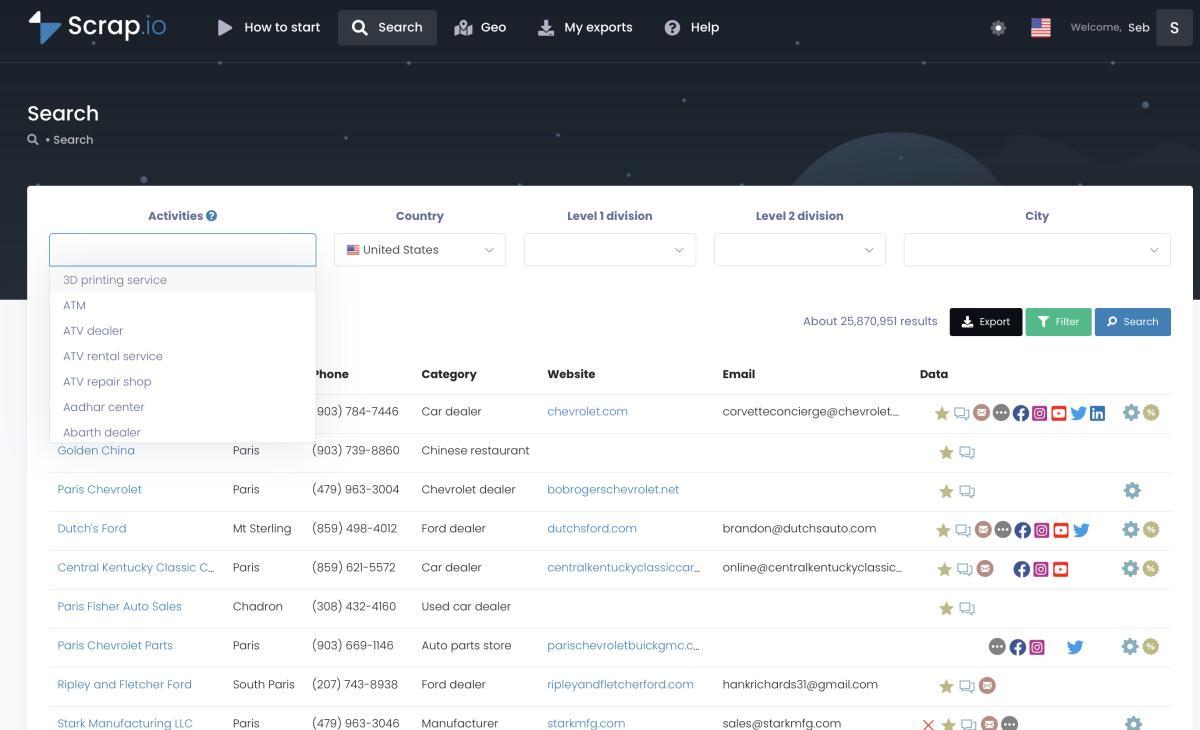
Google Maps indexes hundreds of millions of businesses, and Scrap.io currently mirrors 225,676,406 establishments across 195 countries and 4,000+ categories, updated in real time at the moment of extraction, not pulled from some frozen database that was scraped last spring. No list decay. That single fact solves the biggest problem with bought leads.
Why a Google Maps listing is already a qualifier
Look closely at a single Google Maps listing and you'll notice something: every field is a qualification criterion in disguise.
A website present? They're reachable and digitally aware. A public email? Contactable, no gatekeeper. A 4.6 rating with 120 reviews? Active, trusted, and clearly open for business. "Open now"? A real operation, not a ghost listing. Category says "Restaurant"? That either matches your ICP or it doesn't, an instant filter.
Think about it. A business with a website, a listed email, 50+ reviews, and a 4.5 star average is, by definition, a pre-qualified lead. It exists, it's reachable, it has customers, and people like it. You didn't score that lead. The listing scored it for you.
Video: How to Scrape Local Leads at the Country Level?
Filtering before you pay: only export usable leads
This is the part that quietly changes the economics. Most tools make you export everything, then sort the garbage afterward. After you've already paid for it. Scrap.io flips it. You filter before a single credit is spent.
Only want businesses that actually have an email listed? Toggle it. Only mobile numbers for an SMS campaign? Done. Rating above 4.0, more than 50 reviews, has a website but no Facebook ad pixel (translation: they need marketing help and aren't buying it yet)? That query takes ten seconds, and you only pay for the rows that match.
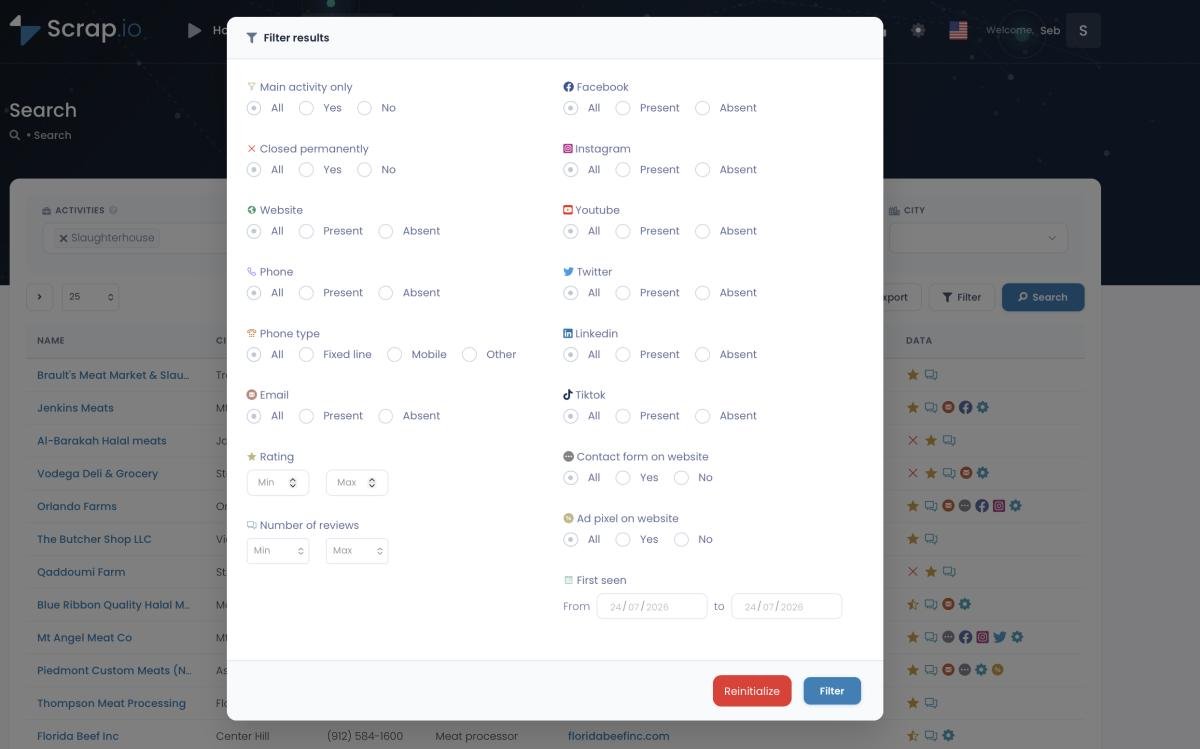
And it scales absurdly. One real agency case: 11,734 businesses extracted in 45 minutes. Try doing that by hand. Go on. I'll wait.
Need a specific catchment area instead of a whole city? GeoSearch does radius or hand-drawn polygon: target a single neighborhood, a delivery zone, whatever shape your market actually is.
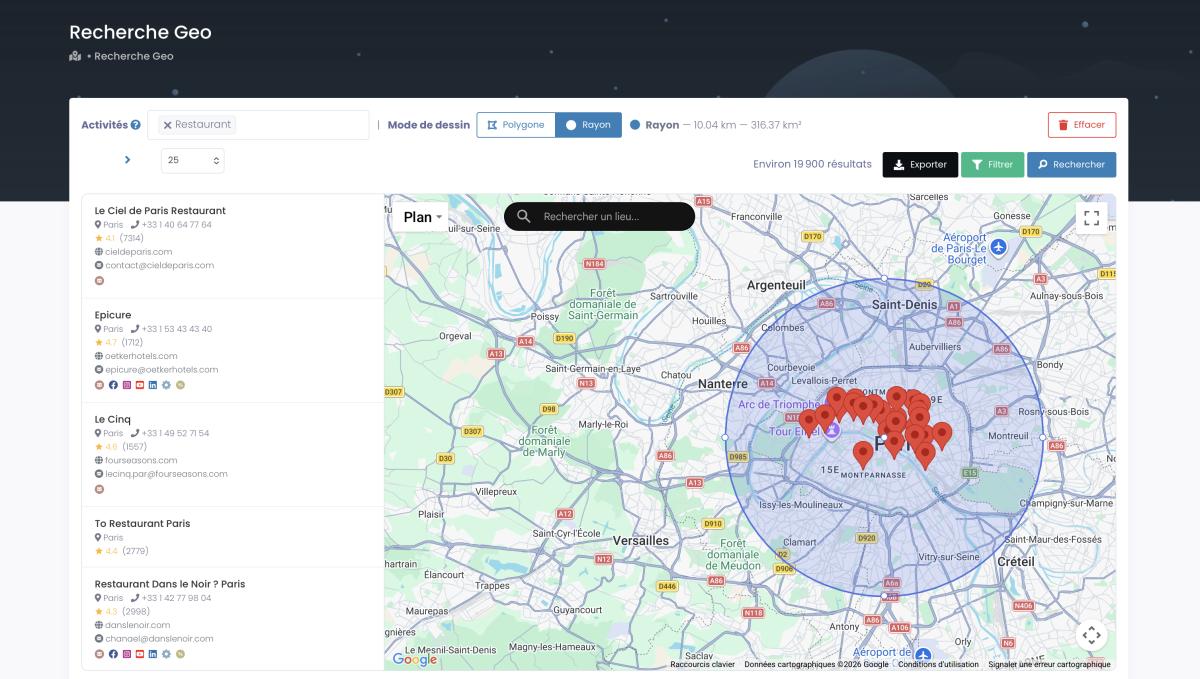
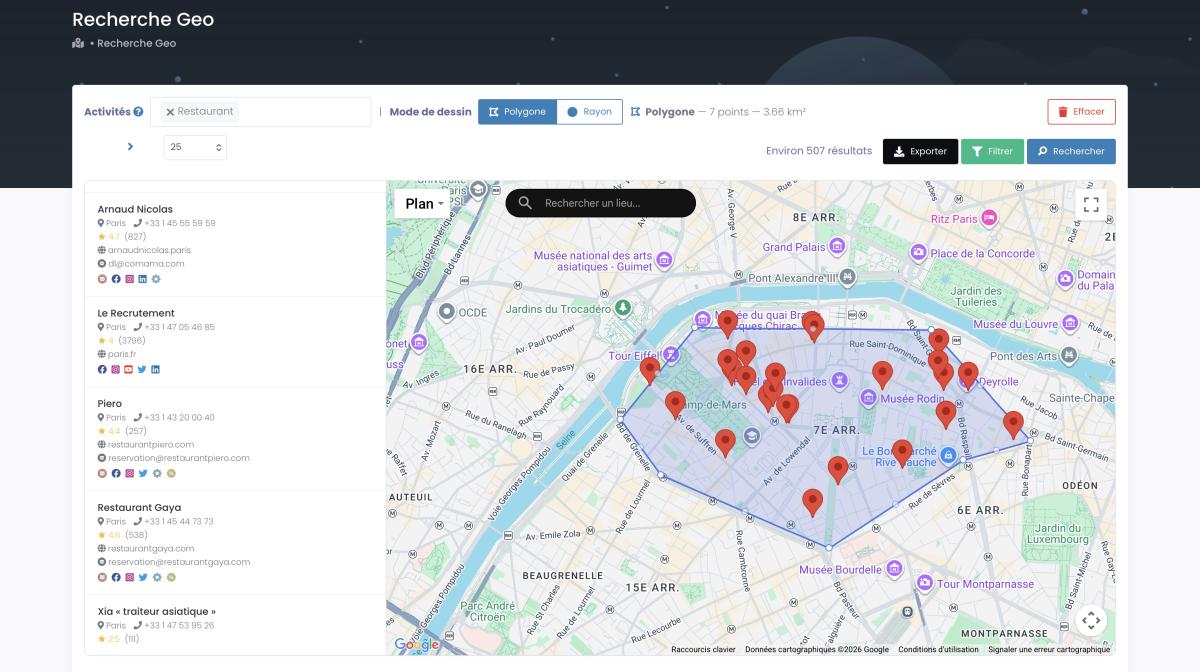
This is the exact play a web agency runs when it filters for local businesses with no website and pitches them a build: the "unqualified for a competitor, perfectly qualified for me" trick. Same data, sharper filter. If defining that target is your bottleneck, here's how to define your ICP with Google Maps data, and a broader look at Google Maps vs LinkedIn for B2B lead gen in 2026. For the full extraction mechanics, the complete Google Maps scraping guide covers every method. And if it's specifically emails you're after, start with finding emails on Google Maps.
Is It Legal? GDPR, CCPA & CAN-SPAM for Acquired Leads
The question everyone whispers. Let's answer it plainly.
Extracting publicly available business data from Google Maps and using it for B2B prospecting is legal in the US and the EU. But (and this matters) how you use that data is where the rules bite. Three frameworks to know:
GDPR (EU). It protects personal data. A company name, business address, and generic info@ email are business information, not personal data in most readings. B2B outreach typically leans on the "legitimate interest" basis. Individual personal emails? Different story. Handle with care. The primary source is worth a skim at gdpr.eu.
CCPA (California). Publicly available business information sits largely outside its scope. You're processing commercial data, not consumer profiles.
CAN-SPAM (US). This one governs what happens after you extract, not the extraction. Every commercial email needs accurate headers, a truthful subject line, your physical postal address, and a working opt-out you honor within 10 business days. And no, there's no B2B exemption. The FTC is explicit that the law covers business-to-business email too, with penalties up to $53,088 per message (FTC CAN-SPAM Compliance Guide). Read it. Seriously.
Scrap.io only extracts publicly available business data, is GDPR and CCPA compliant, and keeps every data point traceable to its source. The floor is legal compliance. The ceiling is not being annoying. Clear both and you're fine. For a competing perspective on the framework itself, Salesforce's lead qualification overview is a solid reference.
Qualified Leads Checklist (Copy-Paste)
Wondering how to identify qualified leads without a 50-field CRM form? Run every prospect through this checklist before you pick up the phone. Two minutes now saves you a thirty-minute dead-end call later.
- ICP fit: right industry, right size, right location? (Non-negotiable.)
- Reachable: verified email or direct phone on file?
- Active: recent reviews, updated hours, a live website?
- Traction: 4+ star rating and a real review count?
- Need signal: a visible gap you can solve (no site, no ad pixel, bad reviews)?
- Decision access: can you reach an owner or manager, not a black-hole inbox?
- Timing: any sign of an active need in the next 1–3 months?
- Compliance: public data, opt-out ready, address in the footer?
Score each yes. Six-plus? Call today. Three or fewer? Park it. That's the whole discipline. It's boring. Boring makes money.
Conclusion: Qualify at the Source
Here's what fifteen sections boil down to. You can keep paying $214 a lead for names that go stale before you dial them, or you can source prospects that are pre-qualified the moment you export them. A Google Maps listing with a website, an email, reviews, and a rating isn't raw data. It's a lead that already passed half your checklist.
Generate, don't rent. Filter before you pay. And let the listing do the qualifying it's already doing for free.
Video: Scrap.io - How to Start?
Stop paying $214 per lead. Scrap.io gives you 225M+ businesses across 195 countries, filtered to your exact ICP before you spend a credit. Trusted by 50,000+ professionals (4.8 on Capterra, 4.9 on G2). Start your free 7-day trial, 100 leads on us.
FAQ
What is a qualified lead?
A qualified lead is a prospect who matches your Ideal Customer Profile and shows real signals of being able and ready to buy: the right industry and size, a genuine need, reachable contact details, and no obvious dealbreakers. It's the difference between a name in a spreadsheet and a real sales opportunity.
What's the difference between a qualified lead and a prospect?
A prospect could fit your market; a qualified lead is a prospect verified against your ICP with real buying signals (reachable, genuine need, no dealbreakers). Every qualified lead is a prospect; not every prospect is qualified.
What's the difference between an MQL and an SQL?
A Marketing Qualified Lead (MQL) has shown interest through engagement: email opens, downloads, pricing-page visits. A Sales Qualified Lead (SQL) has been vetted and confirmed to have budget, authority, and a real timeline. The short version: MQL is interest, SQL is intent. Marketing hands MQLs to sales, and sales confirms which become SQLs.
How much does a qualified lead cost in 2026?
The median B2B cost per lead hit $214 in Q1 2026, up 11% year over year (Martal / Digital Applied). It swings hugely by channel (roughly $25 for referrals versus $840 for trade shows) and by industry, from about $91 (eCommerce) to $982 (Higher Education) per First Page Sage. Extracting your own leads from public sources like Google Maps sits at the low end.
Can you buy qualified leads, and is it legal?
Yes on both, with a caveat. Buying shared lists (sold to multiple competitors) tends to burn cash on decayed, low-intent data. Generating fresh, exclusive leads yourself from public sources is legal for B2B use under GDPR, CCPA, and CAN-SPAM, as long as you follow the usage rules, especially the opt-out and physical-address requirements of CAN-SPAM.
How do you generate qualified leads from Google Maps?
Pick a business category and a location, then apply filters (email present, minimum rating, review count, website status) before exporting. Because a Google Maps listing already carries qualifying signals (website, public email, reviews, category), the export is pre-filtered by design. Tools like Scrap.io let you extract thousands of matching businesses in minutes and only charge for the rows that fit your criteria.
Generate a list of restaurant with Scrap.io