

Four of the five articles ranking right now for "b2b data providers" were written by B2B data providers. Guess who came out on top in each one. Every single time.
So the bar for an honest comparison is on the floor. Good. That's the whole reason this page exists — we don't sell contact databases, we sell a different slice of the market entirely, and we'll get to that later without pretending we're the answer to everything. We're not.
What follows is a real look at 15 B2B data providers: what they cost (including the enterprise numbers they hide behind a "book a demo" button), how fresh their data actually is, whether buying from them is even legal in 2026, and which one fits your use case instead of who has the biggest logo wall. Real prices. Real coverage. Real fines. Let's go.
- What Is a B2B Data Provider (And What It Isn't)
- The 7 Criteria That Actually Separate Business Data Providers
- The 15 Best B2B Database Providers in 2026: Comparison Table
- Provider by Provider: Who's Good at What
- What B2B Data Actually Costs in 2026
- Which B2B Data Provider for Which Use Case?
- The Blind Spot: Local & SMB Business Data
- Is Buying B2B Data Legal in 2026? GDPR, CCPA and the Fines That Landed
- How to Audit a B2B Data Provider Before You Sign (6 Steps)
- Our Recommendation, by Budget
- FAQ
What Is a B2B Data Provider (And What It Isn't)
A B2B data provider is a company that collects, verifies and re-sells information about businesses and the people who work at them — contact details, company attributes, buying signals — so your sales and marketing teams don't build lists by hand. That's the 45-word version. The reality is messier, because the term covers at least five very different things.
The market is real money, by the way. Sales intelligence was worth $4.0 billion in 2025 and is projected to hit $8.7 billion by 2033, a 10.1% CAGR, with North America eating roughly 40% of it (Grand View Research). A lot of that spend is on data that's already wrong by the time you export it. More on that in a second.
The 5 types of B2B data: contact, firmographic, technographic, intent, and location data
When someone says "b2b database," they could mean any of these:
- Contact data — names, emails, phone numbers, job titles. The classic. What a b2b contact database provider sells.
- Firmographic data — company size, revenue, industry, HQ, org structure. D&B's home turf.
- Technographic data — what software a company runs. Great for "sell to everyone using Shopify" plays.
- Intent data — signals that a company is in-market (content consumption, research spikes).
- Location data — the physical business layer: address, category, reviews, opening hours. The one everyone forgets.
Honestly, most providers are strong in one, decent in two, and bluffing on the rest. A single data provider company that claims to nail all five is a red flag, not a feature.
B2B database vs. B2B data provider vs. data broker — the distinction that matters legally
Quick vocabulary, because it matters when the regulator calls. A B2B database is a static file — a snapshot. A B2B data provider is the ongoing service that maintains and re-delivers that file over time. A data broker is a narrower legal category: an entity that sells personal data about people it has no direct relationship with. In California, data brokers now have to register. That last distinction has already cost companies real money in 2025, so hold that thought until section 8.
The 7 Criteria That Actually Separate Business Data Providers
Database size is the most useless number in this entire industry. "500 million contacts!" Cool. How many are in your target market, still employed, and reachable? That's the number nobody prints on the pricing page. Here's what to look at instead — the seven things that actually matter when you compare business data providers.
1. Coverage that matches your ICP (not the biggest number)
A giant global database is worthless if your buyers are dentists in Ohio. What you need is depth where you sell. Before you look at a single vendor, get brutally specific about who you're targeting — here's a practical way to define your ICP first. Then ask each provider for their count inside that exact segment. The gap between the headline number and the ICP number is where the sales pitch lives.
2. Data freshness — and how to actually test it
Data decays. Fast. The most widely cited benchmark — HubSpot's decay simulation, built on MarketingSherpa data — puts it at 2.1% per month, or about 22.5% a year. People change jobs, companies fold, emails bounce. And it compounds with a quality problem that's already ugly: per Validity's 2025 survey of 602 practitioners, 76% of CRM users say fewer than half their records are accurate and complete, and 37% have lost revenue because of it (Validity, State of CRM Data Management 2025). Gartner has long pegged the cost of poor data quality at an average of $12.9 million a year per organization (Gartner).
So how do you test freshness? Ask for the timestamp on each record. When was this email last verified? If the answer is a shrug, or "our data is continuously updated" with no date field in the export, assume it's stale. A quick primer on fresh data vs. old lists will save you a burned domain.
3. Cost per usable contact, not per seat
Look, two providers quote you "$99/month." One gives 170 credits, half of which bounce. The other gives 10,000 usable records. Same sticker, wildly different math. The only honest unit is cost per usable contact — price divided by the records you can actually email. We calculate it properly in section 5.
4. Compliance: GDPR, CCPA, and the data broker registry
Buying data doesn't move liability onto the seller. It stays with you. A provider needs a defensible legal basis, documentation you can actually request, and — if they sell personal data in California — a spot on the CPPA registry. Skip this and you're the one holding the bag. (We have receipts in section 8.)
5. Filtering before extraction vs. after
This one's subtle and it costs you real money. With most tools, you pull a broad list, pay for all of it, then filter down to what you wanted. You paid for the junk. The better model applies filters before a single credit is spent — "only businesses with an email," "only ones without a website," "only 4-star-plus" — so you never pay for records you'd have thrown away.
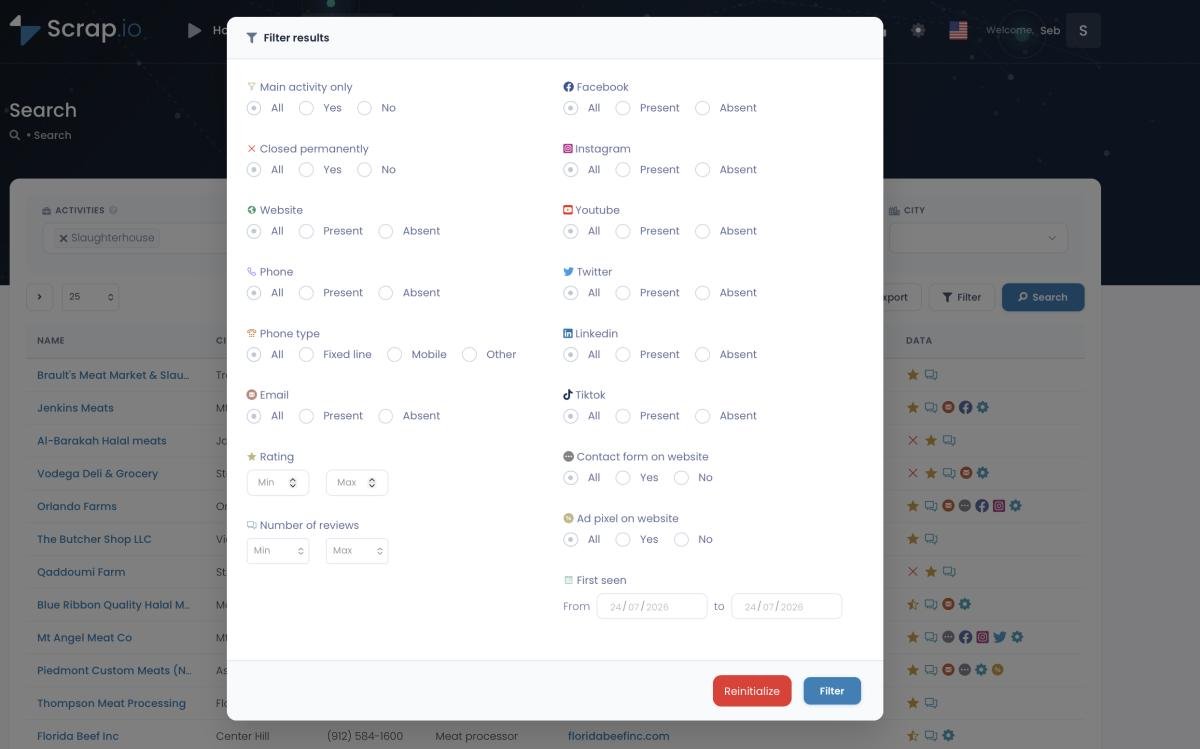
Curious what filtering-before-extraction actually looks like? That's the Scrap.io filter panel above — email present, no website, minimum rating, ad pixel, and more, all applied before any credit is counted. Counts are free. See how it works.
6. Export & API: who owns the data once you leave
Read the exit clause before you sign, not after. Some contracts make the data hostage. Here's a ZoomInfo customer on r/sales, August 2024:
"Yes, ZoomInfo has a contract clause that requires you to delete all your contact data once you've churned. If you inform them of your intent not to renew, they begin threatening legal actions for the data you keep. (…) Literally no other vendor does this." (r/sales)
Whether that clause is enforceable is one question. Whether you want that fight is another. A clean export you own — CSV or Excel, plus an enrichment path — beats a rented list every time.
7. Free trial or sample data
If a provider won't hand you a sample of your own ICP before you pay, ask yourself why. The confident ones let you test. The rest need you to sign first. Simple test, isn't it?
The 15 Best B2B Database Providers in 2026: Comparison Table
$0.0035 to $0.59. That's the per-record price gap between the cheapest and most expensive provider on this list — same data category, wildly different bill. Here are the 15 best B2B data providers in 2026, side by side. Prices are indicative 2026 starting points and change constantly; always request a current quote.
| Provider | Best for | Coverage claim | Starting price | Pricing model | Free tier | GDPR/CCPA | Data type |
|---|---|---|---|---|---|---|---|
| ZoomInfo | US enterprise org charts | Very large (claimed) | Custom (~$33.5k/yr median) | Enterprise contract | Trial only | Yes | Contact + intent |
| Apollo.io | SMB self-serve | 275M+ contacts (claimed) | ~$49/user/mo | Seat + credits | Yes (900 cr/yr) | Yes | Contact + intent |
| Cognism | EMEA mobile numbers | Strong EU/UK (claimed) | Custom | Enterprise contract | Sample only | Yes | Contact + firmographic |
| Lusha | Quick lookups | 100M+ contacts (claimed) | Freemium | Seat + credits | Yes (40 cr/mo) | Yes | Contact |
| D&B Hoovers | Enterprise firmographics | 500M+ businesses (claimed) | Custom | Enterprise contract | No | Yes | Firmographic |
| Data Axle (Salesgenie) | US SMB + consumer | Large US (claimed) | Subscription (quote) | Subscription | Trial | Yes | Contact + firmographic |
| HubSpot Breeze Intelligence (ex-Clearbit) | HubSpot enrichment | Enrichment layer | HubSpot credits | Credits (in HubSpot) | Within HubSpot | Yes | Firmographic |
| UpLead | Verified emails, SMB | 160M+ contacts (claimed) | ~$99/mo (170 cr) | Credits | Trial (5 cr) | Yes | Contact |
| Seamless.AI | High-volume outbound | Large (claimed) | ~$0.59/contact | Credits | Yes (50 lifetime) | Varies | Contact |
| Bright Data | Developers / datasets | Web-scale datasets | Pay-as-you-go | Per record | Yes (5k/mo) | Yes | Datasets |
| RocketReach | Individual lookups | 700M+ profiles (claimed) | ~$39/mo | Credits | Trial | Yes | Contact |
| Lead411 | US intent + triggers | US-focused (claimed) | ~$99/mo | Subscription | Trial | Yes | Contact + intent |
| Dealfront | EU B2B + web visitors | Strong EU (claimed) | Custom | Subscription | Trial | Yes | Firmographic + intent |
| LinkedIn Sales Navigator | Social selling | LinkedIn graph | ~$99/mo | Seat | Trial | N/A (no export) | Insights (no email export) |
| Scrap.io | Local & SMB from Google Maps | 225.7M establishments, 195 countries | $35/mo (10k credits) | Credits ($0.0035/record) | 7-day trial (100 cr) | Yes | Location + emails |
Provider by Provider: Who's Good at What
AVEVA tested Lusha, Apollo, ZoomInfo and Cognism side by side before choosing. A four-way bake-off. Most buyers sign after one demo and a nice lunch — which is exactly how you end up overpaying. Here's the honest, 45-words-each version of each provider. Best for, watch out for, price.
ZoomInfo
Best for: US enterprise org charts and intent. The category king — FY2025 revenue was $1.25 billion, up 3% (ZoomInfo IR), roughly 31% of the whole market alone. Watch out for: price and that exit clause. Price: custom; ~$33.5k/yr median. See ZoomInfo alternatives.
Apollo.io
Best for: SMBs that want data plus sequencing in one seat. Generous free plan, huge claimed contact pool. Watch out for: accuracy dips outside North America; mobile fill rates can disappoint. Price: ~$49/user/month. If it's not sticking, here are Apollo.io alternatives.
Cognism
Best for: EMEA and UK mobile numbers — genuinely the strongest in that lane. Diamond-verified phones, solid compliance posture. Watch out for: no self-serve; you talk to sales, you get a contract. Price: custom, annual.
Lusha
Best for: reps who need a quick number mid-prospecting via a browser extension. Fast, freemium, low friction. Watch out for: depth — it's a lookup tool, not a whole b2b database. Price: free tier (40 credits/mo), paid seats above.
D&B Hoovers
Best for: firmographics and credit/risk data at enterprise scale. The oldest name here — Dun & Bradstreet dates to 1841. Watch out for: vendor risk is real now — Clearlake Capital bought D&B for $7.7 billion (closed August 26, 2025), delisting it from the NYSE. Price: custom.
Data Axle (Salesgenie)
Best for: US small-business and consumer coverage, direct-mail-era depth. Watch out for: UI feels dated; verify freshness on your segment. Price: subscription, quote-based. One of the more accessible database provider companies for US SMB lists.
HubSpot Breeze Intelligence (ex-Clearbit)
Best for: HubSpot users who want native enrichment. Watch out for: Clearbit was on every "best B2B data providers" list in 2023. In 2026 you can't buy it standalone — HubSpot folded it into Breeze and, in June 2025, merged Breeze Credits into HubSpot Credits. That's the risk nobody prices in. Price: HubSpot credits.
UpLead
Best for: verified emails with real-time verification and a clean UX. Watch out for: smaller pool; credits burn fast. Price: ~$99/month for 170 credits. A tidy b2b contact database provider for lower volumes.
Seamless.AI
Best for: high-volume outbound teams that want a real-time search engine for leads. Watch out for: credits get consumed even when a search returns nothing useful, and accuracy reviews are mixed. Price: credit packs, roughly $0.59/contact at entry.
Bright Data
Best for: engineers who want raw web datasets and scraping infrastructure, not a sales UI. Watch out for: it's a data platform, not a prospecting tool — you'll build the workflow yourself. Price: pay-as-you-go, free tier ~5,000 records/month.
RocketReach
Best for: one-off individual lookups across a huge claimed profile base. Watch out for: better for finding a person than building a segmented list. Price: from ~$39/month.
Lead411
Best for: US intent signals and hiring/funding triggers at a fair price. Watch out for: coverage thins outside the US. Price: from ~$99/month.
Dealfront
Best for: European B2B and website-visitor de-anonymization (the old Echobot + Leadfeeder). Watch out for: less relevant if you sell only in the US. Price: custom, subscription.
LinkedIn Sales Navigator
Best for: social selling and warm relationship mapping on the world's biggest professional graph. Watch out for: no bulk email export — it's insight, not a database you can pull. Price: from ~$99/month.
Scrap.io
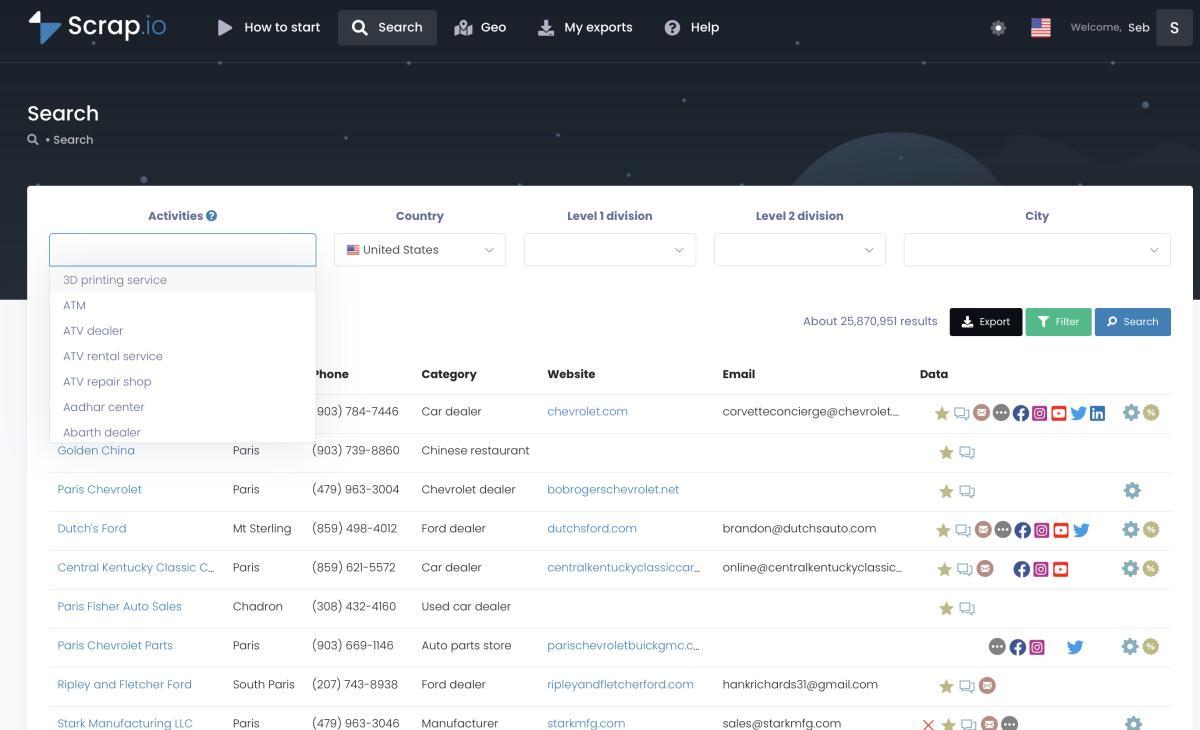
Best for: local and SMB business data pulled in real time from Google Maps — 225,676,406 establishments, 195 countries, 4,000+ categories. Filtering before extraction, whole-country coverage in two clicks. Watch out for: it's not for enterprise org charts. Price: $35/month for 10,000 export credits. Here's the search in action:
Video: Scrap.io - How to Start?
What B2B Data Actually Costs in 2026
"Our current deal is 12 months for $17,500 on the advanced+ package… I know ZoomInfo prices are essentially made up. Am I getting shafted?" — a real r/sales post, April 2025. A former ZoomInfo employee replied: "Yes, you are getting ripped off. I worked at ZI. You can get higher amount of credits for 8k. Wait until the last day of the month…" (r/sales).
That's the whole problem in one thread. Nobody knows what B2B data costs, because the pricing is deliberately fogged. Let's clear it.
The four pricing models (and why they're impossible to compare)
There are basically four ways you'll get billed, and they don't line up:
- Seat + credits — pay per user, then per record (Apollo, Lusha). ~$49/user/month entry.
- Pure credits — buy a bucket of records (UpLead at ~$99 for 170).
- Enterprise contract — annual, negotiated, unpublished (ZoomInfo, Cognism, D&B).
- Pay per record — the most transparent one (Scrap.io at $0.0035, Seamless around $0.59).
Same "data provider" label. A 400× spread on the unit price. How is a buyer supposed to compare that? You can't, unless you normalize it — which nobody selling to you wants you to do.
Cost per usable contact: the calculation nobody publishes
Here's the math the pricing pages skip. Take the annual cost, divide by the records you can actually use (after bounces and out-of-ICP junk). ZoomInfo's median is $33,500/year, ranging $7,200 to $155,280 across 1,569 purchases (Vendr, Feb 2026). If half your pulled records are usable, your real cost per usable contact just doubled. Do that calculation before you sign. Every time.
Video: Stop Paying $20,000 a Year for ZoomInfo — This Does More for $49 a Month
For reference: 10,000 export credits on Scrap.io's Basic plan cost $35/month. That's $0.0035 per business record — against a $33,500 median annual ZoomInfo contract. Counts are free, and filters run before any credit is spent. Compare for yourself.
The hidden costs: wasted credits, bounces, duplicates, and exit clauses
The sticker price is the start, not the total. Credits burned on empty searches. Emails that bounce and torch your sender reputation. Duplicate records you already exported last quarter. And the exit clause that turns churn into a legal headache. Look — a provider that excludes duplicates automatically and lets you filter before paying is quietly saving you more than a discount ever would.
Which B2B Data Provider for Which Use Case?
Selling SaaS to a VP of Sales in Ohio and selling websites to plumbers in Ohio are not the same problem. Most of this industry only solves the first one. AVEVA — the industrial software giant, 6,500+ staff — proved the point: it ran a pilot across Lusha, Apollo and ZoomInfo before landing on Cognism for EMEA, then saw +40% outbound pipeline and +36% target personas in its CRM (Cognism case study). The lesson isn't "pick Cognism." It's that the right provider depends entirely on who and where you sell.
Video: Scrap.io vs Apollo — Which Tool for Which Type of Prospecting
| Use case | Best provider | Why | Budget |
|---|---|---|---|
| US enterprise outbound | ZoomInfo | Depth on org charts + intent | Enterprise |
| EMEA / UK calling | Cognism | Best mobile fill rate in Europe | $500–5k/mo |
| SMB self-serve outbound | Apollo.io | Data + sequencing, low entry price | $100–500/mo |
| Local / SMB & agency leads | Scrap.io | The Google Maps layer nobody else sells | < $100/mo |
| HubSpot enrichment | Breeze Intelligence | Native, no extra tool | In HubSpot |
| Developer datasets | Bright Data | Raw web data at scale | Pay-as-you-go |
The Blind Spot: Local & SMB Business Data
There are 25,780,635 businesses listed on Google Maps in the United States. 10,958,155 of them don't have a website — that's 42.5%. And 8,852,365 have a findable email (34.3%). Those numbers were pulled fresh from Scrap.io on August 9, 2026. Not one traditional B2B data provider on this list will sell you that segment.
Let that land. Eleven million US businesses with no website — every one a live prospect for a web agency — and they're invisible to ZoomInfo, invisible to Apollo, invisible to Cognism. The database of businesses everyone competes over is the corporate one. The local one is wide open.
Why traditional providers skip local businesses
Because their model is built on people, not places. They index LinkedIn profiles, corporate email patterns, funding rounds. A one-person landscaping outfit or a family dental practice has none of that. No LinkedIn org chart, no press releases, no tech stack to fingerprint. So the big providers just… skip it. It's not malice. It's that their pipes don't reach the corner store.
What a location-data provider gives you instead
A location-data provider starts from the map, not the org chart. Scrap.io extracts in real time from Google Maps and the associated website at the moment you export — so freshness isn't a promise, it's a byproduct of the architecture. You can pull an entire country, or draw a radius or polygon around a neighborhood, and apply every filter before spending a credit.
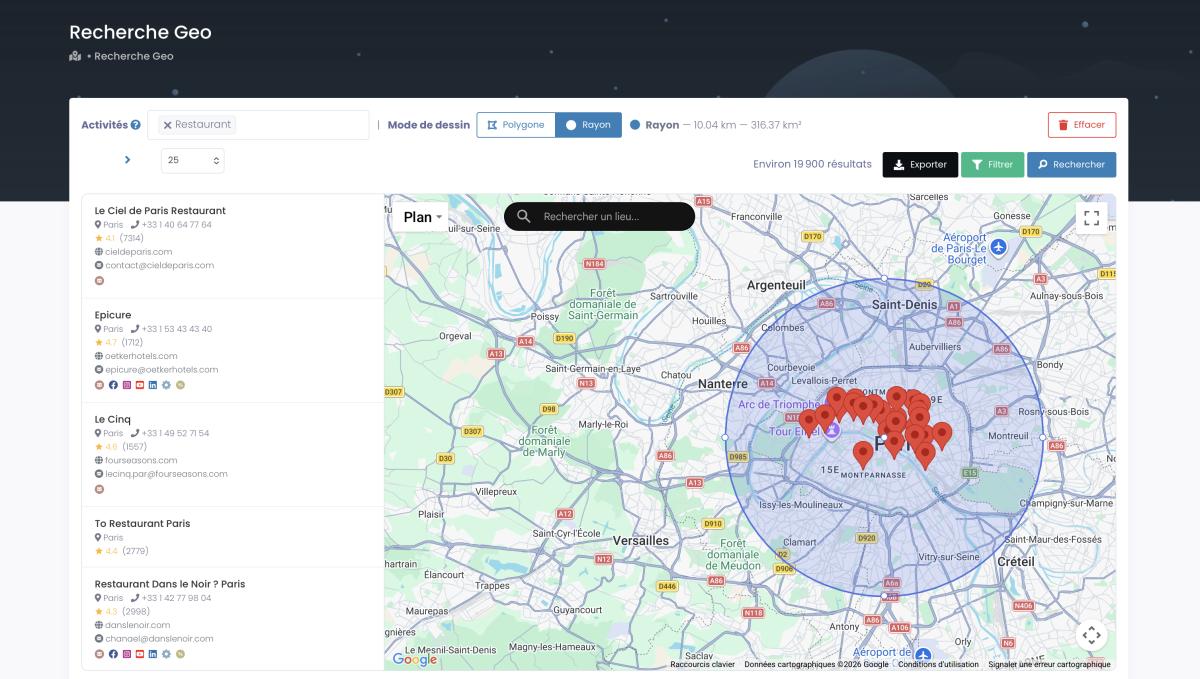
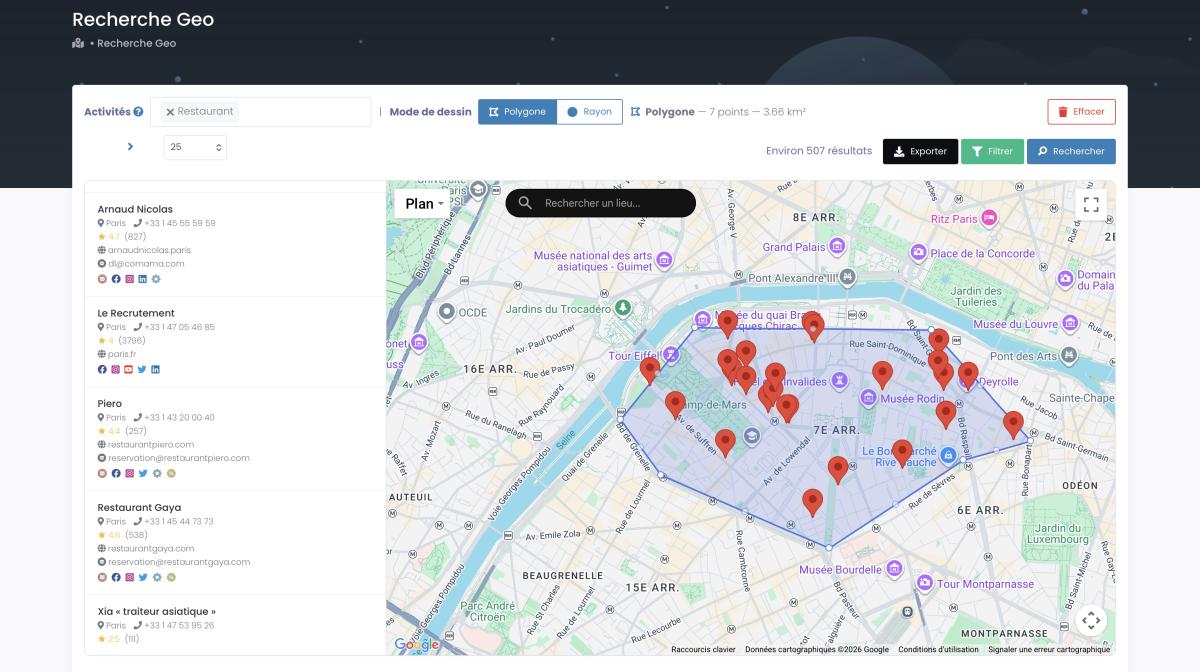
Want the 10,958,155 US businesses with no website? That's one search and two filters. Try it free for 7 days — 50 searches and 100 export credits, cancel anytime. Start your free trial.
Is Buying B2B Data Legal in 2026? GDPR, CCPA and the Fines That Landed
In May 2025, France's data authority fined a company €900,000 — not for selling bad data, but for buying it. That's the part most buyers don't see coming. Is buying b2b data legal? Yes, when it's done right. And expensive when it isn't.
GDPR: legitimate interest, and why the buyer is liable too
Under GDPR you can process B2B personal data on a legitimate-interest basis — but the basis has to be real, documented, and honored (opt-outs, transparency, the lot). The CNIL fined Solocal Marketing Services €900,000, plus a €10,000/day penalty, for prospecting on data bought from brokers with invalid consent (CNIL). The buyer was on the hook. Not just the broker. If you run cold email in Europe, read up on GDPR and cold email before you send.
CCPA & the California data broker registry (DROP is live)
California requires data brokers to register with the CPPA — and it's enforcing. In January 2025 the CPPA announced its fifth action against an unregistered data broker, Key Marketing Advantage, with $200/day penalties and a $55,800 settlement (CPPA). Ask any US provider whether they're registered. If they get cagey, that's your answer.
The compliance checklist before you sign
Short version: confirm the legal basis, request the compliance documentation, check registry status where it applies, and make sure business-only, publicly-available data is exactly that. Public business data — a restaurant's listed email, a category, an address — is a very different animal from personal data bought with a fake consent trail. For the cold-outreach side specifically, here's a rundown on whether cold emailing is illegal.
How to Audit a B2B Data Provider Before You Sign (6 Steps)
"Some providers will say data is 'verified' when it clearly isn't. The best thing to do is look up sample data in your ICP and test the emails and dials by actually sending them." — r/sales, January 2025 (source). You can catch a weak provider in about 30 minutes. Here's how:
- Request a sample of 50 records inside your exact ICP — not their cherry-picked demo list.
- Check the timestamp on each record. No "last verified" date? Assume it's old.
- Cross-reference a handful against LinkedIn and the company website by hand.
- Test deliverability — actually send to the emails and watch the bounce rate.
- Count duplicates against a list you already own. Overlap you pay for twice is a cost.
- Read the exit clause — what happens to your data the day you cancel?
None of the four articles ranking above this one gives you a test protocol. That's not an accident.
Our Recommendation, by Budget
If you take one thing away: match the provider to who you sell to, not to who has the biggest logo. Here's the short list of the best B2B data providers by budget.
| Budget | Recommendation | Why |
|---|---|---|
| < $100/mo | Scrap.io (local/SMB) or Apollo free/starter | Maximum usable records per dollar |
| $100–500/mo | Apollo.io or UpLead | Self-serve depth for growing teams |
| $500–5k/mo | Cognism (EMEA) / Lead411 (US intent) | Regional accuracy where it counts |
| Enterprise | ZoomInfo or D&B Hoovers | Org charts, intent, scale — negotiate hard |
And one more thing worth pricing in: the whole industry is turning "headless." ZoomInfo now exposes its base through an API and an MCP server to ChatGPT, Claude and Copilot. Scrap.io exposes its own MCP at scrap.io/mcp — free, included in every plan — so your AI agent can build the radius, run the count (still free), and pull the export in plain language. That's where this is all heading.
Selling to local and SMB businesses? Start your 7-day free trial of Scrap.io — 50 searches and 100 leads, cancel anytime. 225.7M establishments across 195 countries, filtered before you spend a single credit. Try Scrap.io free.
FAQ
How much does B2B data cost in 2026?
Between $0.0035 and $0.59 per contact, depending on the model. Self-serve tools like Apollo start around $49/user/month; Scrap.io runs $35/month for 10,000 export credits; enterprise contracts like ZoomInfo have a median of $33,500 a year, ranging from $7,200 to $155,280 (Vendr, Feb 2026). Always compute cost per usable contact, not per seat.
Which B2B data provider is the most accurate?
There's no single answer, and any provider claiming one is selling. Accuracy is segment-specific: Cognism performs best on EMEA mobile numbers, ZoomInfo on US enterprise org charts, Scrap.io on local and SMB records. AVEVA ran a four-way pilot before choosing — that's the only reliable method.
Is buying B2B data legal?
Yes, when the data is lawfully collected and you can prove the legal basis. In May 2025 France's CNIL fined Solocal Marketing Services €900,000 — as the buyer of broker data with invalid consent. In California, data brokers must register with the CPPA or face $200/day. Always ask your provider for their compliance documentation and registry status.
What's the difference between a B2B data provider and a B2B database?
A B2B database is a static file of records. A B2B data provider is a service that maintains, verifies and re-delivers those records over time. The distinction matters because data decays around 22.5% per year — a database you bought in January is measurably worse in December.
Are there free B2B data providers?
Several offer free tiers: Apollo (900 credits/year), Lusha (40 credits/month), Seamless.AI (50 lifetime credits), Bright Data (5,000 records/month). Scrap.io offers a 7-day trial with 50 searches and 100 export credits. Free tiers are for testing accuracy on your ICP, not for running campaigns.
Generate a list of restaurant with Scrap.io