

A sales rep once told me his CRM was "a very expensive graveyard." Beautiful dashboards. Custom fields for days. And maybe forty contacts in it, half of them from a trade show in 2023. He'd picked the software everyone recommended. He just never solved the part that actually matters: getting real prospects into the thing.
That's the dirty secret of every "best CRM for sales teams" list you've ever read. They rank the software. They never tell you where the leads come from. So you end up with a Ferrari and no gas.
This article does both. If you're hunting for the best CRM for sales teams in 2026, you're in the right place: we'll compare the 10 leading tools — real pricing, honest limits, who each one is actually for. Then we'll cover the step nobody writes about: how to fill your CRM with fresh, local leads instead of staring at an empty pipeline. Buckle up.
Video: Scrap.io — How to Start?
- Your reps spend 13 hours a week on data entry
- What is a sales CRM in 2026?
- How to choose: 6 criteria that actually matter
- The 10 best CRMs for sales teams in 2026 (compared)
- Best free & small-business sales CRMs
- The step every "best CRM" article skips: filling it
- Before you import: compliance (GDPR & CAN-SPAM)
- FAQ
Your reps spend 13 hours a week on data entry
Thirteen hours. That's how much time the average salesperson loses to manual data entry every week — roughly 28% of their working days, according to Everstage and SuperOffice's 2026 numbers. Read that again. More than a full workday, gone, typing addresses into fields.
And it gets worse. SPOTIO's 2026 data puts 71% of a rep's time on non-selling tasks. So the people you hired to close deals are spending most of their week... not closing deals. Feels like buying a race car and using it to deliver pizza.
The right CRM claws a chunk of that time back. The wrong one — or an empty one — just adds another tab nobody opens. That's the whole game with a best crm for sales teams decision: not the feature list, but whether it saves hours or eats them. Let's figure out which tools do which.
What is a sales CRM in 2026?
Strip away the jargon. A sales CRM is where your team tracks every prospect, deal, and conversation in one place — who you talked to, what you promised, when to follow up. That's the core. Everything else is decoration.
This isn't a niche tool anymore, either. The global CRM market hit roughly $126.17 billion in 2026 (Digitalapplied / Shno, 2026), and 91% of companies with 10+ employees now run one (CRM Stats, 2026). If you're the holdout, you're not being scrappy. You're just late.
But in 2026 the decoration got useful. Modern platforms score your leads with AI, draft follow-up emails, forecast which deals will close, and ping a rep the second a prospect goes quiet. Everstage and Coffee.ai peg AI-assisted CRMs at roughly 40% less manual entry and 8–12 admin hours saved per rep per week. Not nothing.
CRM vs spreadsheet for sales
People still ask this. Honestly? A spreadsheet works right up until it doesn't. One person, twenty leads, no follow-up sequences — sure, a Google Sheet is fine. But add a second rep and suddenly two people are emailing the same prospect with different offers, nobody knows who owns what, and a deal slips because "I thought you called them." The crm vs spreadsheet for sales debate ends the moment your team hits two people. A spreadsheet has no memory. A CRM does.
Sales CRM vs suite vs work-OS
Three flavors, and they're not the same animal. A pure sales CRM (Pipedrive, Close) is laser-focused on the pipeline — deals, stages, calls. A suite (HubSpot, Zoho, Salesforce) bolts marketing, service, and reporting onto that core. A work-OS (monday) is a flexible workspace you shape into a CRM. Pick the wrong category and you'll either drown in features you never use or hit a wall the day you scale. Match the tool to how your team actually sells, quoi.
How to choose: 6 criteria that actually matter
Forget the 200-item feature matrices. After watching plenty of teams pick — and abandon — CRMs, six things decide whether the software sticks. The best CRM for sales teams isn't the one with the longest spec sheet; it's the one that nails these six. Everything else is noise.
1. Time to value. If it takes three weeks and a consultant to get running, your reps will quietly go back to their inbox. The best crm to manage a sales team is the one people actually open on day two. Fast setup beats deep features almost every time.
2. Pipeline visibility. Can a manager see, in five seconds, where every deal sits? That's the whole point. Good best crm pipeline management means a visual board, drag-and-drop stages, and no digging. If you need a report to answer "what's closing this month," the tool is failing you.
3. Automation. Follow-up reminders, sequences, lead assignment — the stuff that runs while you sleep. This is also where the best crm for cold outreach earns its keep, because manual follow-up is where most deals die. For a longer, multi-touch B2B cycle, the best crm for b2b sales is usually the one with the sharpest automation, not the flashiest AI.
4. Mobile. Your outside and field sales reps aren't at a desk. Here's the stat that should end the argument: 65% of reps with a mobile CRM hit their quota, versus just 22% without one (Nutshell / SuperOffice, 2026). Three times the quota attainment. If the phone app is garbage, walk away. This matters double for the best crm for outside/field sales reps.
5. Integrations — and bulk lead import. Everyone checks whether it talks to Gmail. Almost nobody checks whether you can pour in thousands of leads at once. Can it swallow a CSV cleanly? Does the API let you push contacts in at scale? A sales crm with lead import that chokes on a big file is going to hurt you the day you actually have leads to load. This is the criterion the other guides skip — and the one that connects your CRM to the outside world. (More on that later, because it's the whole second half of this article.)
6. Total cost of ownership. Sticker price lies. Add-ons, per-seat jumps, onboarding fees, the "you need the higher tier for that" tax. Work out what you'll really pay at your team size before you sign. The cheapest crm for sales teams on the pricing page is rarely the cheapest once you're live.
One quick reality check on ROI, because the marketing numbers oversell it. Nucleus Research's famous figure is $8.71 back for every $1 spent on CRM. Lovely. But the same research shows average ROI drops about 37% — from roughly $4.90 to $3.10 per dollar — when the data inside is dirty. Translation: the CRM doesn't create the return. The data does. Hold that thought.
The 10 best CRMs for sales teams in 2026 (compared)
Here's the shortlist of the best CRM for sales teams contenders. Real tools, real prices (verified live in 2026 — vendors love a quiet hike), and the honest version of who each one fits. No tool is perfect. I'll say so when it isn't.
1. Pipedrive — best visual pipeline for sales-native teams
If your team lives in the pipeline, Pipedrive is hard to beat. Built by salespeople, for salespeople — the drag-and-drop board just makes sense. Over 100,000 companies use it. Starts at $14/user/month (annual). The catch? Marketing and support features are thin; this is a sales tool, full stop. For pure best crm pipeline management, though, it's the benchmark.
2. HubSpot Sales Hub — best free tier that scales
HubSpot runs a genuinely useful free CRM — unlimited users, deal tracking, email tracking, no time limit. Paid Sales Hub starts at $20/seat/month and climbs to $100 (Professional). The most generous free entry point on this list, and 1,900+ integrations. The downside is predictable: the jump from free to paid is steep, and costs balloon as you add hubs.
3. Zoho CRM — best value all-in-one
Zoho quietly powers 300,000+ businesses and does an absurd amount for the money. Free for 3 users; paid tiers from around $14/user/month. If you want most of what Salesforce does at a tenth of the price, this is it. Best rapport quality-to-price in the category, easily. It can feel busy — the interface tries to do everything — but that's the trade for the value.
4. Salesforce Sales Cloud — best for enterprise muscle
Salesforce is the 800-pound gorilla, and for good reason: nothing customizes deeper or scales higher. Starter is $25/user/month, but real sales orgs land on Pro Suite ($100) or Enterprise (~$165+). Powerful. Also a lot. For a five-person team it's overkill and a budget bonfire; for a 200-rep org it's table stakes. Selling to Salesforce shops, by the way, is its own game — here's how to build a Salesforce users email list if that's your market.
5. monday CRM — best no-code work-OS
monday CRM is the shape-shifter. It's a flexible work-OS you bend into a CRM, and if your team hates rigid software, that freedom is a gift. Roughly $12–15/user/month to start (14-day trial, no free plan). The flip side of infinite flexibility? You have to build it yourself. Some teams love that. Some just want a CRM that works out of the box.
6. Freshsales — best budget pick with AI baked in
Freshsales gives you a free tier for 3 users and paid plans from about $9/user/month — the cheapest paid CRM from a major vendor. AI lead scoring ("Freddy") is built in, not an upsell. For a crm for small sales team watching every dollar, it punches way above its price. The database and integrations aren't as deep as Zoho's, but at this price, who's complaining.
7. Close — best for high-volume inside sales
If your reps make 80 calls a day, Close was built for you. Calling and email live inside the CRM — no tab-juggling, no separate dialer. Around $29/user/month. It's the best crm for cold outreach teams doing serious volume. Not the tool for a relationship-driven, low-volume enterprise sale, but for a call-heavy floor? Chef's kiss.
8. Pipeline CRM — best for simple, unlimited deals
Pipeline CRM (formerly PipelineDeals) keeps it refreshingly simple. Start is $25/user/month; the Grow tier unlocks unlimited active deals and advanced reporting at $49. No free plan, 14-day trial. It won't wow you with AI bells and whistles — and that's kind of the point. Straightforward pipeline software for teams that want to sell, not tinker.
9. Nutshell — best easy setup for small teams
Nutshell nails the "up and running by lunch" promise. Plans run from about $13/user/month (annual) to $67, with genuinely good support. It's a strong best sales crm for small business option when you don't have an ops person to configure things. Reporting is lighter than the enterprise crowd's, but for a lean team that's a feature, not a bug.
10. Copper — best for Google Workspace diehards
Copper lives inside Gmail and Google Workspace like it was always meant to be there. If your whole company runs on Google, the native feel is fantastic — Starter is around $9/user/month. Outside the Google ecosystem, though, its appeal drops fast. Right tool, specific team.
Comparison table: top 10 CRM software at a glance
Here's the whole top 10 crm software lineup side by side — including the column the other top crm platforms roundups never show you: bulk lead import. Because a CRM you can't fill quickly is a CRM you'll fight.
| CRM | Starting price | Best for | Free plan | Bulk lead import (CSV + API) |
|---|---|---|---|---|
| Pipedrive | $14/user/mo | Visual pipeline | No (14-day trial) | ✅ |
| HubSpot Sales Hub | $0 / $20/seat/mo | Free tier + scaling | Yes | ✅ |
| Zoho CRM | $0 / ~$14/user/mo | Best value all-in-one | Yes (3 users) | ✅ |
| Salesforce Sales Cloud | $25–$165/user/mo | Enterprise + deep customization | No (30-day trial) | ✅ |
| monday CRM | ~$12–15/user/mo | No-code work-OS | No (14-day trial) | ✅ |
| Freshsales | $0 / ~$9/user/mo | Budget + built-in AI | Yes (3 users) | ✅ |
| Close | ~$29/user/mo | High-volume inside sales | No (14-day trial) | ✅ |
| Pipeline CRM | $25/user/mo | Simple, unlimited deals | No (14-day trial) | ✅ |
| Nutshell | ~$13–19/user/mo | Easy setup, small teams | No (14-day trial) | ✅ |
| Copper | ~$9/user/mo | Google Workspace-native | No (14-day trial) | ✅ |
Notice the last column. Every single one takes a CSV and has an API. Which means every single one has the exact same problem the moment you sign up: it's empty. The software is solved. The pipeline isn't. If you also want AI layered on top, our roundup of the best AI sales tools covers the stack that plugs into these.
Best free & small-business sales CRMs
Counter-intuitive truth: for a lot of small teams, the best CRM for sales teams is the free one. You don't need a $165 seat to start selling. You need something you'll actually use.
The three real best free crm for sales teams picks, no asterisks: HubSpot (unlimited users, best-in-class free CRM), Zoho CRM (free for 3 users, huge feature set), and Freshsales (free for 3 users, AI scoring included). Those are the ones with real free plans — not a 14-day trial dressed up as "free."
Where free plans bite you? Contact caps, thin automation, limited reporting. Fine for month one. Painful by month twelve as your list grows. That's the natural upgrade trigger — and if you're a slightly bigger shop, the best sales crm for small business paid tier (Zoho or Freshsales, usually) is a cheap jump. For the full breakdown of choosing and outgrowing an SMB tool, we went deep in our guide to the best CRM for small business.
Quick note for solo operators: the best crm for independent sales reps is usually whichever one you'll open every morning without cursing. Simplicity beats power when it's just you.
Reddit says the same thing, loudly. The recurring thread on r/CRM about the best CRM for sales reps keeps circling one point: reps want something affordable that scales with the database, not a feature monster. Over on r/CRMSoftware, the mid-2026 discussion leans the same way — lead management and import came up more than fancy AI. And a long-running Quora thread on free CRM software for managing sales teams lands, predictably, on HubSpot and Zoho. Funny how the crowd and the data agree.
The step every "best CRM" article skips: filling your CRM with fresh leads
OK. Here's the part that actually decides whether any of this matters.
You can pick the perfect CRM. Configure it beautifully. Automate every workflow. And then? Nothing happens. Because a CRM doesn't create leads — it stores them. It's a filing cabinet. A very smart, very expensive filing cabinet with nothing in the drawers.
Remember that Nucleus stat — ROI drops 37% when the data is dirty? This is why. And remember McKinsey's 2026 finding (via SimplyDepo) that over 70% of B2B buyers no longer want in-person meetings? That means the first touch is digital, which means you'd better have a clean phone number and a working email before you ever reach out. An empty or stale CRM isn't a small problem. It's the problem.
So where do fresh leads come from? For local and SMB selling, the richest source on earth is sitting in plain sight: Google Maps. The plumber, the dentist, the family restaurant, the 6-person roofing crew — none of them are on LinkedIn. All of them are on the map. And business owners update their own listings, so the data is alive, not a CSV someone sold five times since 2023.
Here's the workflow. Four steps, no code.
Step 1 — Target on the map. Pick a category (from 4,000+) and a zone — a city, a county, a whole country. Yes, a whole country in two clicks. A web agency in Austin didn't want Austin; they wanted every roofer in Texas without a website. Done before lunch.
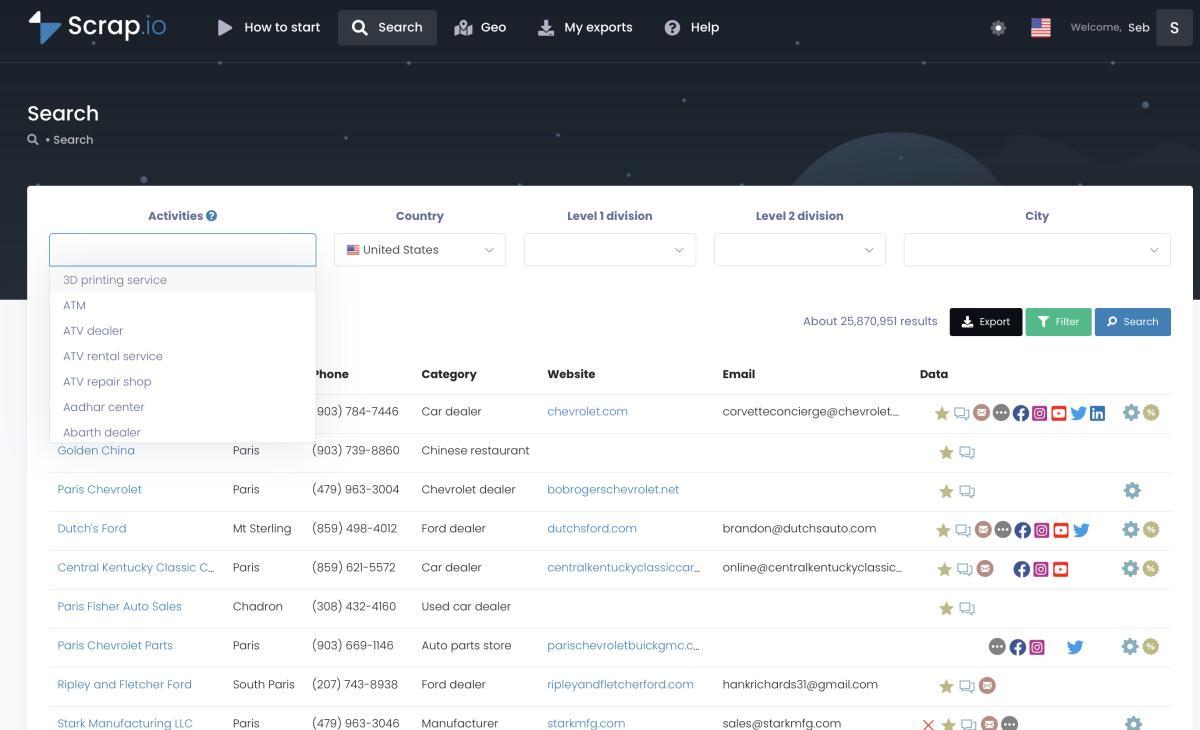
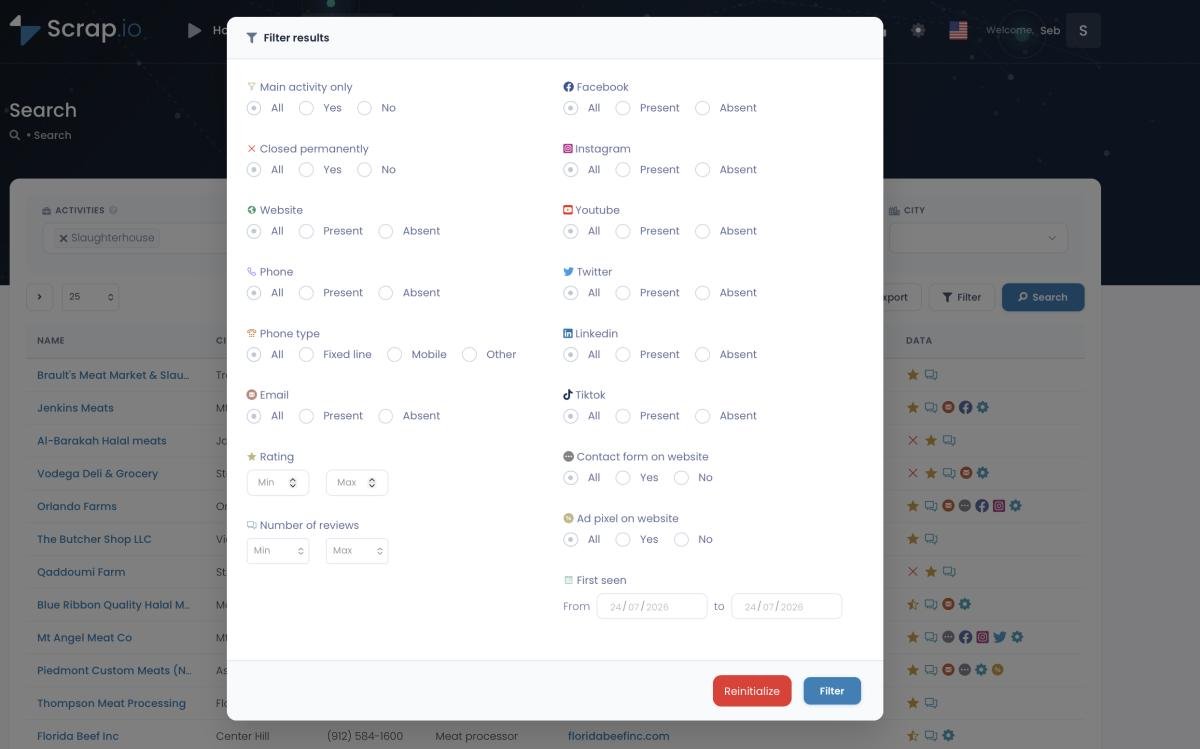
Step 2 — Filter before you extract. This is the bit that saves your money. Narrow to exactly what you need — email present, mobile number only, no website, minimum rating, runs an ad pixel — before a single credit is spent. You never pay for a contact you can't use. Most tools make you extract everything and clean the mess afterward. That's backwards. You end up buying garbage just to bin it.
Step 3 — Export a clean CSV. Out comes a spreadsheet with names, addresses, phone numbers (classified landline vs mobile), categorized emails, social profiles, ratings — the works. One real user pulled 11,734 businesses in 45 minutes. Try that by hand. I'll wait.
Step 4 — Fill your CRM. Import the CSV into any tool on this page, or push it through the API. That's how to fill a crm with leads, minus the three weeks of manual Googling. Want the deeper play? Here's how to build a sales pipeline from Google Maps leads step by step, or automate CRM lead enrichment so new records fill themselves.
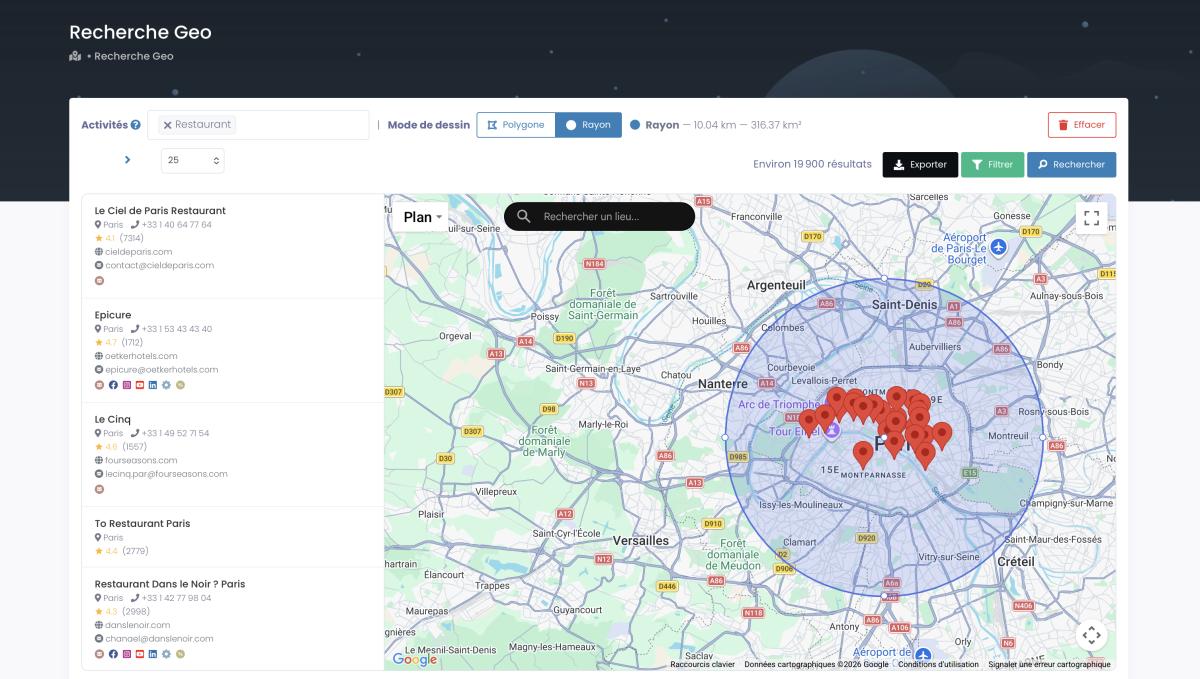
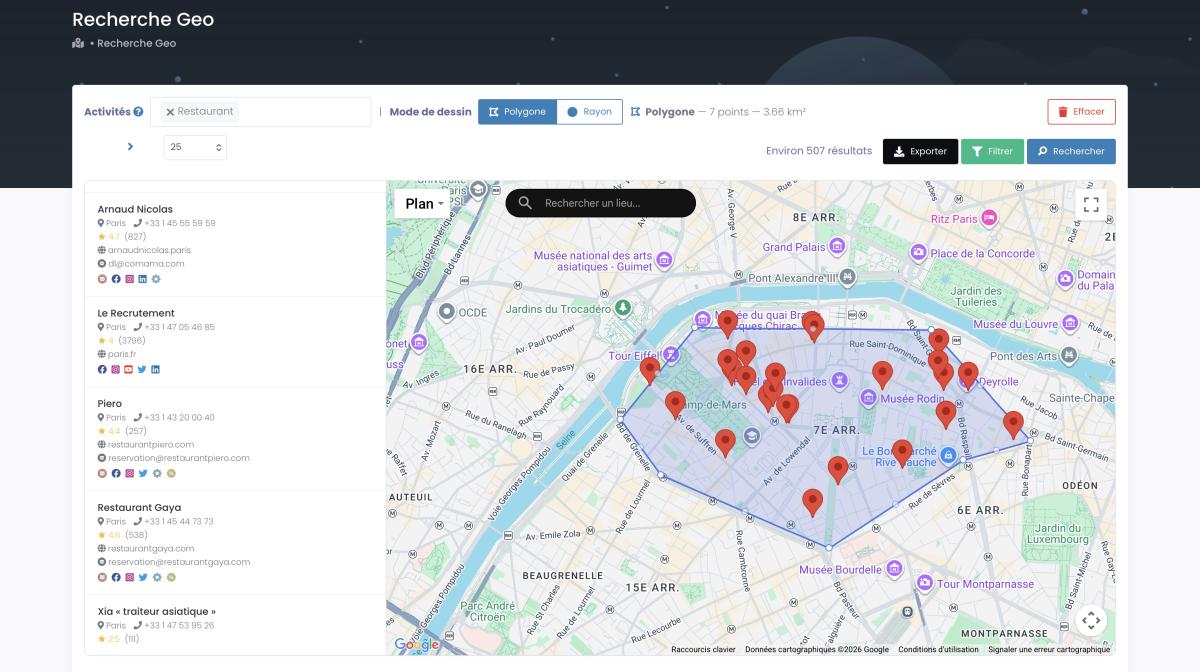
Need to target a specific catchment area instead of a whole city? GeoSearch draws a radius around a point — or a custom polygon on the map — so you can grab a single neighborhood, a commercial strip, a crm for local business sales zone that doesn't match any administrative border.
Video: How to Turn Your CRM Into a War Machine Using Google Maps Data
And "does scraped data go stale?" — fair question, and the honest answer is: only if your source is a frozen database. This isn't. Extraction happens in real time at export, against 225 million+ establishments across 195 countries. Fresh every pull. That's the difference between feeding your CRM and poisoning it. If you want to go big, here's how to generate Google Maps leads at scale.
Video: How to Scrape Local Leads at the Country Level
Before you import: compliance (GDPR & CAN-SPAM)
Not the fun part. Skip it anyway and the fines are very real — CAN-SPAM violations run over $50,000 per email. Per email. So, briefly.
The good news: you're on solid ground when the data is public business information. A company's listed address, its info@ email, its phone number — that's public by definition, and B2B prospecting on that basis is legal in both the US and EU. Under GDPR, business contact data typically leans on "legitimate interest"; under CCPA, publicly available business info is carved out entirely. US courts, from hiQ v. LinkedIn onward, have consistently backed the right to access public data.
The rules you don't get to skip: every outreach email needs a working unsubscribe, accurate sender info, and your real business address — and you honor opt-outs immediately. That's it. Not complicated, just non-negotiable.
This is also why the source matters. Scrap.io extracts only publicly available business data, is GDPR and CCPA compliant, and keeps every record traceable to its origin. No shady databases, no gray areas. And one honest caveat before you blast anything: validate your emails first. Fresh, real-time data means fewer dead addresses to begin with, but a verification pass still protects your sender reputation. Bounce too much and Gmail stops caring about how good your offer is.
Worried your existing CRM already has the enrichment covered? Enrichment fills in a record you already have — it doesn't create the account in the first place. Different job. If you're weighing enrichment options, here are the best data enrichment tools compared.
FAQ
Which CRM software is best for sales teams?
For most teams, Pipedrive (visual pipeline) and HubSpot (best free tier) lead the pack. Zoho CRM offers the best value for money, and Salesforce is the pick for enterprise-scale customization. The right answer depends on team size and how you sell — but whichever you choose, plan for how you'll fill it, because every CRM starts empty.
What is the best free CRM for a sales team?
HubSpot, Zoho CRM, and Freshsales offer the three genuinely free tiers worth using. HubSpot allows unlimited users; Zoho and Freshsales are free for up to 3 users with real sales features, not stripped-down demos. Most teams outgrow free plans within 6–12 months as their contact list grows.
How much does a sales CRM cost in 2026?
Anywhere from $0 (HubSpot, Zoho, Freshsales free tiers) to roughly $550/user/month for top-end Salesforce. Most small and mid-sized teams land between $14 and $60 per user per month. The real cost isn't the subscription, though — it's the hours lost to manual data entry and the revenue lost from an empty pipeline.
How do you fill a new CRM with leads?
Target a business category and zone on Google Maps, filter by email, website, or rating, export a clean CSV, and import it into your CRM. A tool like Scrap.io automates the extraction — pulling verified, real-time business data across 195 countries — so you skip the weeks of manual research and start with a full pipeline instead of an empty one.
Do sales teams still need a CRM in 2026?
Yes — arguably more than ever. The data is blunt: 65% of reps with a mobile CRM hit their quota, versus just 22% without one. With over 70% of B2B buyers avoiding in-person meetings, the CRM is where the whole relationship now lives. The only mistake is buying one and leaving it empty.
Your CRM is only as good as the pipeline you feed it
The CRM market is crowded with great tools. Stick to the ten on this list and you genuinely can't pick a bad one — Pipedrive, HubSpot, Zoho, Salesforce, monday, Freshsales, Close, Pipeline, Nutshell, Copper all work. Match the tool to how your team sells, mind the total cost, and you're set on the software side — that's the real answer to "what's the best CRM for sales teams," and it's different for every team.
But the software was never the hard part. The difference between teams that get ROI and teams that don't comes down to one thing: data. A perfectly configured CRM with an empty pipeline produces exactly nothing. Fill it with fresh, filtered, verified leads and suddenly all those features have something to work on.
Generate a list of restaurant with Scrap.io