

A four-person agency in Manchester bought 12,000 "verified" UK business contacts last spring. £1,400 on the invoice. Fourteen days later, their sending domain was flagged, their reply rate sat at zero, and a chunk of those addresses turned out to be spam traps planted specifically to catch people doing exactly this. That's not a horror story I invented to scare you. It's just Tuesday in the world of bought data.
So let's have the honest conversation nobody selling you a list wants to have.
You're here because you want to buy email lists UK providers are advertising, and you want to know three things: is it legal, what does it actually cost, and does it even work. Maybe you typed "where can I buy email lists UK" or "where to buy B2B data UK" into Google and landed here. Fair. This guide answers all three — the legal side under PECR and UK GDPR, the real price tags (including the ones brokers hide), and a fresher alternative that costs a fraction of a static file. No fluff. Let's go.
Video: Scrap.io - How to Start?
- What "buying an email list" actually means in the UK
- Is it legal to buy email lists in the UK? (PECR + UK GDPR)
- What do UK email lists cost in 2026?
- Where to buy email lists in the UK: providers compared
- Why bought lists disappoint: the deliverability tax
- The alternative: build your own fresh UK list
- How to build a compliant UK email list, step by step
- Buy vs build: which is right for you?
- FAQ
What "buying an email list" actually means in the UK
Here's the thing most people miss before they even open their wallet: "an email list" isn't one product. It's at least three, and in the UK that distinction is the difference between a legal campaign and an ICO complaint. So before you spend a penny, get clear on what you're actually buying.
B2B vs B2C: not the same rulebook
A UK business email list aimed at companies plays by one set of rules. A consumer file — the kind behind every "buy consumer email list UK" or "buy email list B2C" ad — plays by a much stricter one. Under UK law, emailing a limited company is broadly fine; emailing a private individual almost always needs their consent. Mix the two up and you're exposed. We'll get into the why in the next section, but plant the flag now: B2B and B2C are different animals. Treat them the same and you'll get bitten.
Rented vs owned vs built
Three models, wildly different value. A rented list you pay to blast once, usually through the broker's own platform — you never even see the addresses. An owned file you buy outright and import. And a built list you generate yourself from a live source. Renting feels cheap until you realise you're paying per campaign forever. Owning feels permanent until you realise the file starts rotting the day it lands. Building? That's the one nobody sells you, because there's no margin in teaching you to fish.
Where the data actually comes from
Ask any broker "where did this come from?" and watch them squirm. A good email marketing list UK vendor sources from public registers, opt-in forms, and business directories. A bad one bought it from someone who bought it from someone who scraped it in 2021. The provenance matters — legally and practically. If nobody can trace a contact back to its source, you're inheriting a liability, not an asset — and that's true whether you're handed a tidy "list of email addresses in UK" spreadsheet or a raw dump. Anyway. Keep that question in your back pocket. You'll need it.
Is it legal to buy email lists in the UK? (PECR + UK GDPR)
Buying an email list is not illegal in the UK. Sending to it is where the risk lives. Under PECR, you can email corporate subscribers (companies, LLPs) without prior consent, as long as you identify yourself and offer an opt-out. But individual subscribers — sole traders, many partnerships, consumers — need consent or a valid soft opt-in. And UK GDPR still applies whenever an address names a person. The sender carries the risk. Not the broker.
Read that twice, because it's the whole ballgame. Now the detail.
Corporate vs individual subscribers
PECR — the Privacy and Electronic Communications Regulations — splits the world into two buckets. Corporate subscribers are bodies with separate legal status: limited companies, LLPs, Scottish partnerships, and the like. According to the ICO's B2B marketing guidance, the electronic-mail consent rule simply doesn't apply to corporate subscribers. You can email [email protected] without asking first. That's the UK being genuinely more permissive than, say, Germany, where you'd need opt-in for the same message.
Individual subscribers are the other bucket — sole traders, non-limited partnerships, and ordinary people. Them, you can only email with specific consent or a qualifying soft opt-in. Here's the trap: a huge slice of UK "businesses" are actually sole traders. That plumber, that freelance designer, that one-person consultancy? Individual subscriber. Full consumer protections. Most people buying a list of UK email addresses never check, and that's exactly where complaints start.
| Recipient type | Examples | Consent needed to email? |
|---|---|---|
| Corporate subscriber | Ltd company, LLP, Scottish partnership | No — just identify yourself + offer opt-out |
| Individual subscriber | Sole trader, many partnerships, consumers | Yes — consent or valid soft opt-in |
B2B soft opt-in — and its limits
The soft opt-in gets thrown around like a magic password. It isn't. Per the ICO's electronic mail marketing rules, it only works if you collected the address during a sale or negotiation of your own similar product, gave an opt-out at that moment, and repeat the opt-out in every message. That's it. A bought list fails every one of those tests, because you weren't in the room when the data was collected. So no — the soft opt-in does not launder a purchased file. (There's also a newer charitable-purposes soft opt-in for details collected from 5 February 2026 onward, but that's a charity thing, not a get-out for cold B2C blasts.)
Where UK GDPR bites: named individuals
PECR governs whether you can send the message. UK GDPR governs the personal data inside it. The moment an address identifies a person — [email protected] — you're processing personal data, even in a business context, and you need a lawful basis (usually legitimate interest) plus a duty to tell them. A generic sales@ inbox? Probably outside GDPR. A named person? Inside it, every time. This is the part "GDPR compliant email lists UK" sellers gloss over. A website badge saying "GDPR compliant" is their claim about their collection, not a shield for your sending.
What the ICO actually expects
Boiled down: identify yourself, give a working opt-out, honour it fast, keep a suppression list, and be able to answer "how did you get my address?" with a straight face. The regulator has cranked up scrutiny of SMEs, and buying a list from a vendor without checking how they collected it has itself been treated as a violation. So the "is it legal to buy email lists" question has a boring, accurate answer: buying is fine, sending badly is not, and the paperwork is on you. For the full UK framework, our guide on whether cold emailing is legal goes deeper, and the UK GDPR & PECR rules for B2B cold email break down the legitimate-interest test step by step.
What do UK email lists cost in 2026?
Advertisers bid up to £201 per click on the term "b2b data providers uk" (DataForSEO, 2026). Let that sink in. Two hundred quid. For one click. When a keyword costs that much, it tells you exactly how much margin is baked into this market — and who's paying for it. Spoiler: you.
Pricing comes in three shapes, and they're not comparable.
Per-record vs subscription vs one-off
Per-record is the classic list buy. RD Marketing, a real UK broker, publishes a sliding scale: £295 per 1,000 contacts under 2,500 records, dropping to £170 per 1,000 above 50,000 (rdmarketing.co.uk, 2026). So a tidy 10,000-contact UK email database runs you roughly £2,200. Subscription is the enterprise route — Cognism's plans start around $12,750 a year (cognism.com, 2026), which buys you a platform, not just a file. One-off bulk consumer files can drop to pennies per record, and those are almost always the worst quality. You get what you pay for, and sometimes less.
The hidden costs nobody quotes you
Here's where the sticker price lies to you. A bought list bounces. Bounces cost you sender reputation, which costs you deliverability on the good addresses too. Then you pay again to verify what you already bought. Then you pay to replace the dead records — if the vendor even offers replacements. UpLead recommends never buying a list that isn't 95%+ verified and re-checked within 90 days, and there's a reason: stale data is a tax you pay after the invoice clears. And those tempting "free list of CEO email addresses UK" results floating around Google? Recycled, ancient, and sitting on every spam trap going. Look. The real cost of a cheap list isn't the list. It's the domain you have to warm back up afterwards.
Before you pay a broker, see what a live UK export looks like. Scrap.io pulls real-time business data straight from Google Maps — filter by category, area and "email present," then export. No frozen file, no reseller markup. Try Scrap.io free for 7 days — 100 leads included →
Where to buy email lists in the UK: b2b data providers compared
If you're set on the buy email lists UK route, at least buy with your eyes open. Here are the b2b data providers UK marketers actually search for — and what each one is really selling. (Vendor claims below are theirs, not verified facts. Treat them accordingly.)
| Provider | Claimed scale | Pricing | Best for |
|---|---|---|---|
| DataHQ | ~3.7M records, 95% accuracy claim | Quote only (no public price) | Managed, account-led buys |
| UK Marketing Management | 5M business + 18M consumer claim | Quote only | Niche B2B + B2C selections |
| RD Marketing | 1.5M UK businesses | £170–£295 per 1,000 | Transparent per-record buys |
| Cognism | Platform + EU B2B data | From ~$12,750/yr | Mid-market/enterprise teams |
Notice a pattern? Two of the four won't show a price until you've spoken to sales. That's not an accident. And every single one leans on a "GDPR compliant" badge that, as we covered, protects their collection — not your send.
Before you sign anything, run the vendor through this six-point checklist:
- Source transparency. Can they name where each record came from? If not, walk.
- Verification date. When was it last re-checked? Anything over 90 days is aging.
- Subscriber type. Do they separate corporate from sole-trader/individual data?
- Bounce guarantee. Will they replace dead records for free? Get it in writing.
- Usage rights. Rented (send-once) or owned? Read the licence.
- Sample first. Test 100 records through a validator before you buy 10,000.
Zoho's marketing team put it bluntly once: old purchased addresses are often honeypots — accounts kept alive purely to catch spammers. Buy blind and you're mailing landmines. So don't buy blind.
Why bought lists disappoint: the deliverability tax
Back to Sarah in Manchester. Four-person agency, tight budget, real ambition. She bought the list because building one "sounded like a faff." Two weeks later she was on the phone to her email provider begging them to un-flag her domain. What happened to her happens to almost everyone. It's not bad luck. It's physics.
Video: Why Your Google Maps Emails Don't Get Replies?
Bounces and spam traps
A static list starts decaying the second it's compiled. People change jobs, companies fold, mailboxes get retired. Push a bounce rate over 2% and Gmail and Outlook flag you — AWS documents the same threshold logic in its sender reputation guidance, and Campaign Monitor has been warning about bounce and spam-trap damage for years. The nasty part is spam traps: dead addresses that regulators and blocklist operators resurrect specifically to catch people mailing lists they didn't build. One trap hit and your reputation takes a beating. Several, and you're in a blocklist. Ouch. Campaign Monitor has been hammering this point for years, and it still catches people out.
Sender reputation is the whole game
This is the bit people underrate. Your domain has a reputation score with every mailbox provider, and it's brutally slow to rebuild once it drops. A bought list doesn't just waste the money you spent on it — it poisons every legitimate email you send afterward, to real customers, to warm leads, to your own team. That's the deliverability tax. You don't see it on the invoice. You feel it three campaigns later, when even your good emails land in spam. Was the list worth it? Ask Sarah.
The alternative: build your own fresh UK list
So if buying is a trap, what's the move? Build. And no, not by hand — nobody's suggesting you copy-paste addresses off websites for a fortnight. The move is to extract a live list from a source that updates itself: Google Maps.
Here's the number that reframes everything. 2,066,092 UK businesses already have a public email address on their website (Scrap.io, 2026) — out of 5,464,062 UK establishments indexed, roughly 38%. (That UK slice sits inside 225,676,406 listings across 195 countries, for context.) Those emails are already public. Already fresh. Already sitting there. You don't need to buy them from a middleman who scraped them and marked them up. You just need to filter and export the ones that fit.
That's what Scrap.io does, and three things make it different from a broker file. One, the data is pulled in real time at the moment you export — not a frozen snapshot from last quarter. Two, you filter before extraction, so you only spend a credit on records that actually have an email present. Zero waste. Three, you can sweep an entire country in two clicks without writing a line of code. Try building that by hand. I'll wait.
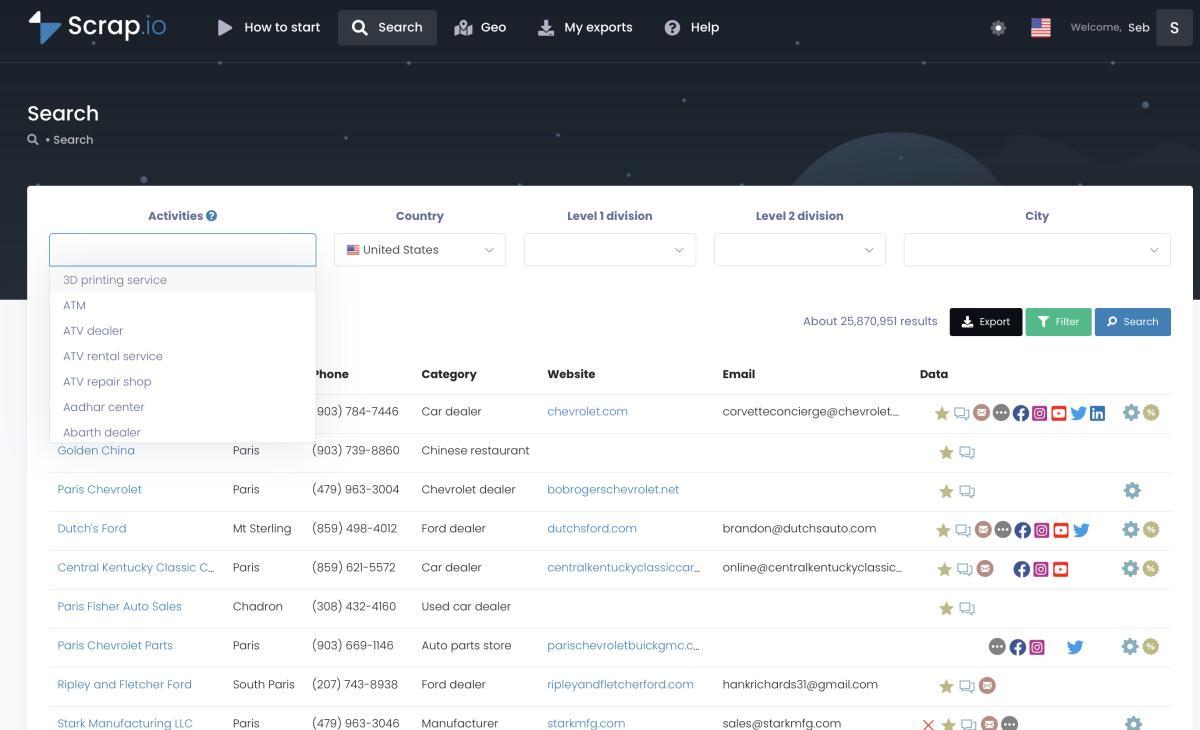
Video: How to Scrape Local Leads at the Country Level
And because every record traces back to a public Google Maps listing, you've got the provenance answer PECR and UK GDPR want you to have. "Where did you get this?" — "Public business listing, extracted on this date, filtered by category and area." Try giving that answer with a bought file. You can't.
2,066,092 UK businesses already have a public email. Filter and export the ones that match your ICP — by category, by region, "email present" only — instead of renting a stale file. Free for 7 days, 100 export credits included →
How to build a compliant UK email list, step by step
Right. Concrete time. Here's the exact flow to go from nothing to a clean, filtered UK list in an afternoon. This is also, incidentally, the closest honest answer to "buy email lists UK free" — the same itch behind every search for a "UK email address list free" or a "UK email database free download." The difference: here the count step costs nothing and you only pay when you export a record worth having.
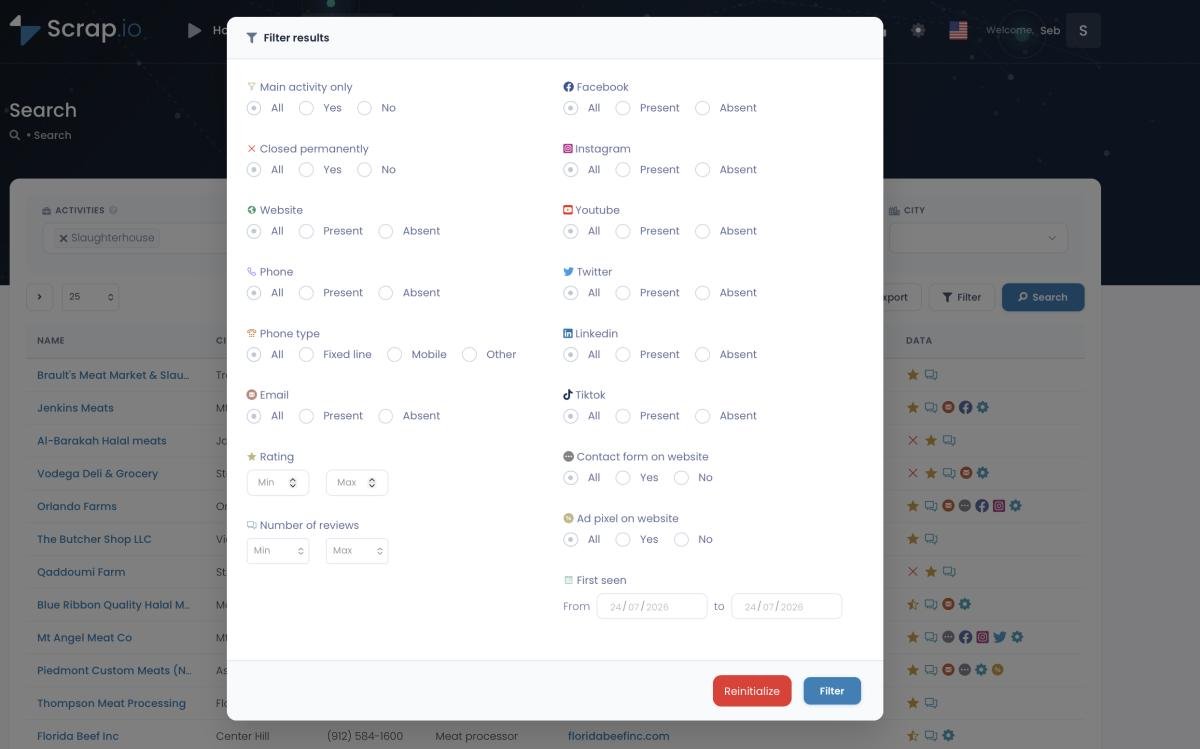
- Pick a category and a UK area. Choose your business type (say, "estate agents") and your zone — a city, a county, or the whole of the UK if your plan allows it.
- Filter to "email present" before extracting. Toggle the email filter so only records with a real address get counted. This is the step that saves your budget — no credits burned on dead-end listings.
- Count for free. Hit count. Scrap.io tells you exactly how many matching businesses exist, across a whole country if you want, and it costs zero credits.
- Narrow with the filters that matter. Minimum reviews, has a website, mobile number present, recently detected listings — tighten until the list is genuinely your ICP.
- Export to CSV or Excel. One click. Emails come classified — individual (with first and last name), contact, sales, marketing — so you know who you're writing to.
- Verify, then send. Even fresh data deserves a validation pass. Run it through a checker, keep bounce under 2%, and warm your domain before you scale.
For sweeping a big region or targeting a precise patch, the GeoSearch modes let you draw a radius or a custom polygon around exactly the area you want — a single borough, a business park, whatever.
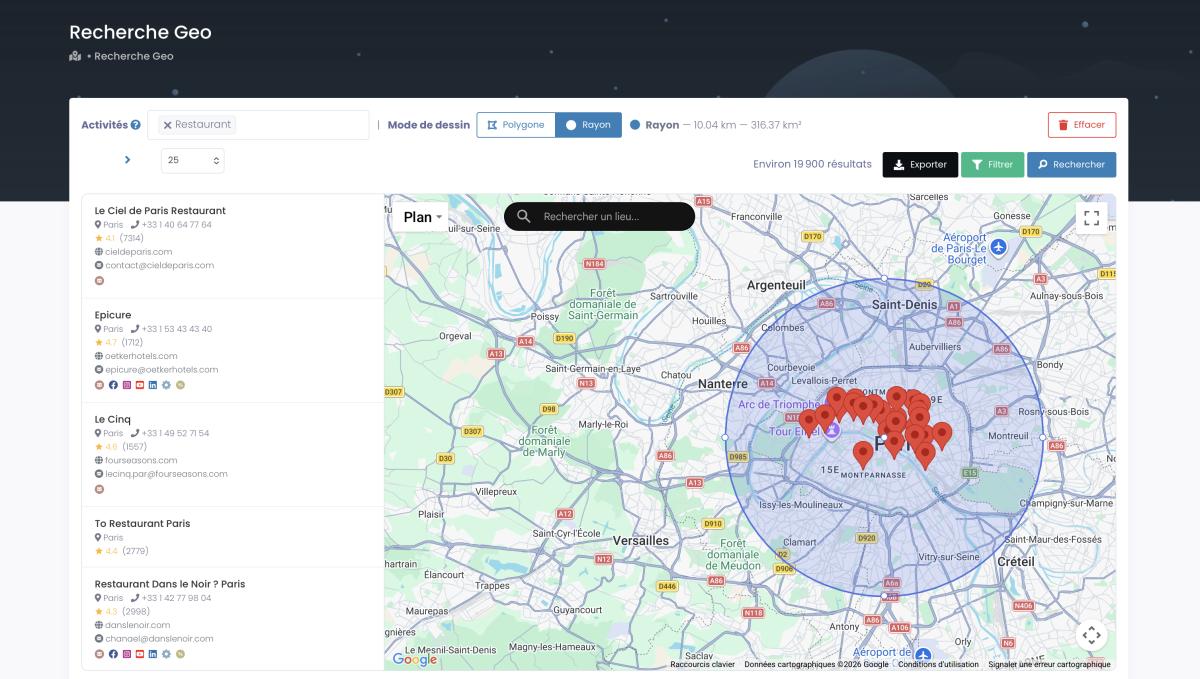
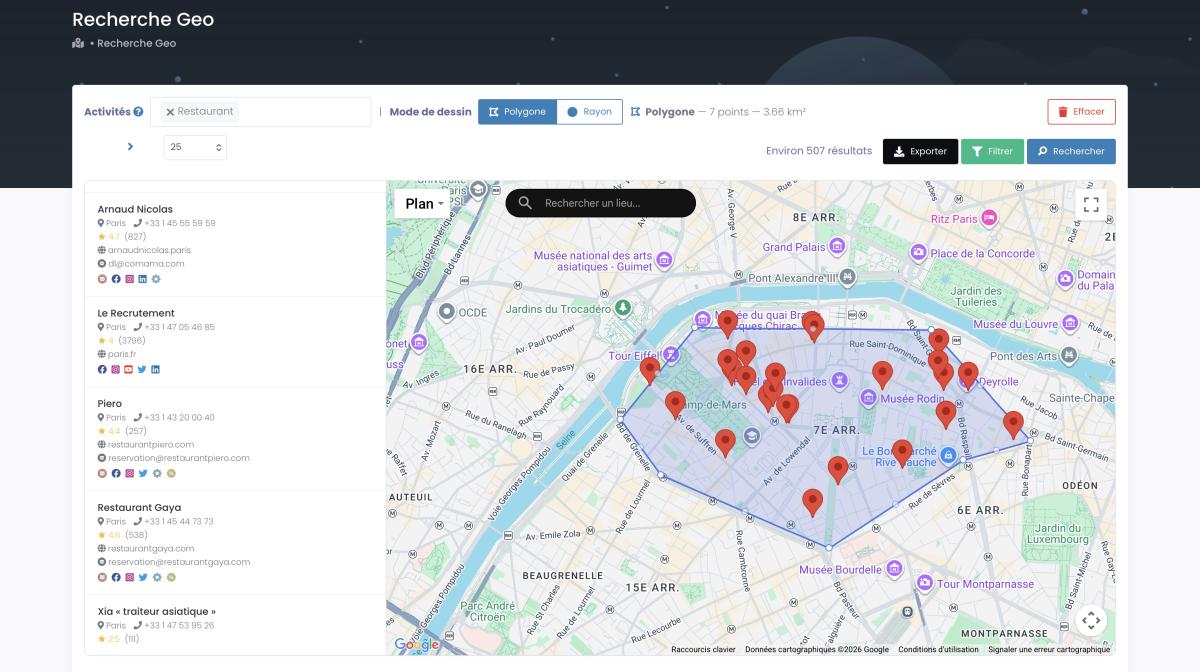
Want the deeper walkthrough? Our guides on building a cold email list from scratch and finding business emails on Google Maps cover the full method, and once you've got the file, verify your list before you send so it lands. Need scale? You can access millions of UK business contacts the same way. And if you're targeting one vertical, here's how to find verified B2B contacts by industry — which beats any generic "buy email list by industry" file.
Buy vs build: which is right for you?
Look, buying isn't never the answer. If you need a hyper-niche B2C consumer segment you genuinely can't source yourself, and you've vetted the vendor to death, a bought file can be a starting seed. But for UK B2B prospecting? Building wins on almost every axis that matters.
| Factor | Buy a list | Build your own |
|---|---|---|
| Cost | £170–£295 per 1,000 + hidden costs | From £35/month, unlimited searches |
| Freshness | Frozen at compile date, decays fast | Real-time at export |
| Compliance risk | Unclear provenance, your liability | Traceable to public source |
| Targeting | Whatever the vendor has | Filter before you pay |
| Setup time | Days (quote, invoice, delivery) | An afternoon |
The honest read: if your target is UK companies with a public footprint, the whole buy email lists UK model means paying more for worse data with more legal exposure. That's not marketing spin — that's the table. For the broader picture, our parent guide to buying email lists covers the global market beyond the UK.
Skip the stale broker file. Build a fresh, targeted UK list today — pick a category, pick an area, filter for "email present," export. 7 days free, 100 leads on us, card required to activate. Start your free trial →
FAQ
Is it legal to buy email lists in the UK?
Buying isn't illegal. Sending is where the rules bite. Under PECR you can email corporate subscribers (Ltd companies, LLPs) without prior consent if you identify yourself and offer an opt-out; individual subscribers — sole traders, many partnerships, consumers — need consent or a valid soft opt-in. UK GDPR applies whenever an address names a person, and the sender carries the risk, not the broker.
How much does a UK email list cost in 2026?
Anywhere from pennies per record for bulk consumer files to premium per-record B2B pricing — UK broker RD Marketing publishes £170–£295 per 1,000, and subscription platforms like Cognism start around $12,750 a year. Watch the hidden costs, though: bounces, replacements and verification often cost more than the file itself.
Are bought email lists GDPR compliant?
A "GDPR compliant" badge on a vendor's site describes their collection, not your send. You still need your own lawful basis and PECR compliance for every message. Building a list from public business data with a documented soft opt-in or legitimate interest is far easier to defend than a purchased file with murky provenance.
Where can I get a fresh UK B2B email list?
Extract a live one instead of buying a frozen one. Tools like Scrap.io pull business data in real time from Google Maps — filter by category, area and "email present," then export. As of 2026, 2,066,092 UK businesses already have a public email on their website, so the data is there to build from without a broker.
Why do bought email lists bounce so much?
Because static lists age fast and are riddled with spam traps. People change jobs, companies close, and old addresses get resurrected as honeypots to catch spammers. Once your bounce rate passes 2%, Gmail and Outlook flag you — and that damage spreads to every legitimate email you send afterward.
Ready to build instead of buy? Try Scrap.io free for 7 days — 50 searches and 100 export credits, no commitment. Extract a fresh, filtered, traceable UK list from any category and area. Get started →
Generate a list of restaurant with Scrap.io