

Google "Canada business directory" and the first thing you get is Canada.ca politely pointing you toward a dozen "directories of Canadian companies." Helpful. What it won't tell you: there are 3,011,109 active business listings on Google Maps in Canada right now. Not a registry estimate. Not a marketing round-up. The actual count, pulled fresh at the end of July 2026.
That gap is the whole story. On one side, the tidy little listing sites everyone still links to. On the other, a live, filterable, exportable business list Canada companies already live inside — Google Maps. One helps you look up a plumber in Halifax. The other lets you email 6,000 of them by Friday.
Big difference.
This guide walks the whole thing: what actually counts as a business directory in Canada, how many companies are really out there, how the big-name directories stack up (with their warts), and how to build your own fresh Canada business database in minutes instead of buying a stale one. Let's get into it.
Video: Scrap.io - How to Start?
- What Is a Canada Business Directory in 2026?
- How Many Businesses Are There in Canada?
- The Best Canada Business Directories, Compared
- Government Registries vs Commercial vs Real-Time
- Canada Business Directory by Province
- Canada Business Directory by Major City
- How to Build Your Own Canada Business Directory
- Filter Before You Extract
- Is It Legal to Extract Canadian Business Data?
- FAQ
What Is a Canada Business Directory in 2026?
So what actually counts as a "business directory" in Canada? Turns out the word covers four very different things, and mixing them up is why so many people waste money.
There's the public listing site you browse — YellowPages.ca, CanadaOne, the online business directory Canada type where you type a name and get an address. There's the legal registry — the official government record proving a company exists on paper. There's the paid B2B database — a subscription product like Scott's that sells you contacts. And there's the real-time list you build yourself — a fresh export straight from Google Maps.
Here's the thing. Only the last two are any use if your goal is outreach, and only the last one is genuinely fresh at the moment you use it.
Put simply: a Canada business directory is a structured list of companies operating in the country — names, addresses, phone numbers, and ideally emails — that you can search, filter, and export. A directory you can only look at is a phone book. A directory you can filter and download is a pipeline. That distinction is your entire prospecting workflow, so hold onto it.
And the raw material for the modern version already exists. Every business with a Google Maps pin is, effectively, a directory entry — geolocated, categorized, usually linked to a website. Nobody sat down and compiled it. The businesses did it themselves, because that's where their customers find them.
How Many Businesses Are There in Canada?
Depends who you ask — and the gap is huge.
Statistics Canada counts 1.38 million employer businesses and 3.59 million non-employer businesses with annual revenues over $30,000 (Statistics Canada, Canadian business counts, June 2025). Those are legal entities on the tax register. And 98.2% of employer businesses are small businesses with fewer than 100 employees (ISED, Key Small Business Statistics).
Now the other lens. On Google Maps — the place with an address, a phone, and often a website — Scrap.io indexes 3,011,109 Canadian establishments as of July 2026. That's the mappable, contactable slice. Not the same thing as the tax register, and that's the point: a registered numbered company holding a rental property won't help you prospect. A dental clinic with a pin, five photos, and an email will.
| Lens | Count | Source |
|---|---|---|
| Employer businesses | 1.38 million | StatCan, June 2025 |
| Non-employer businesses (rev. > $30k) | 3.59 million | StatCan, June 2025 |
| Reachable on Google Maps | 3,011,109 | Scrap.io, July 2026 |
| …with a website | 1,745,014 (≈58%) | Scrap.io, July 2026 |
| …with an email | 1,202,172 (≈40%) | Scrap.io, July 2026 |
| …with a phone number | 2,370,634 (≈79%) | Scrap.io, July 2026 |
So when someone asks for a "list of companies in Canada," the honest answer is: which list? The legal one, or the reachable one? For research, StatCan wins. For revenue, it's the 1.2 million with an email, every time.
The Best Canada Business Directories, Compared
Most "best directory in Canada" articles are just link dumps — a wall of names with no opinion attached. Useless. Here's what each of the big ones is actually good for, and where it falls apart.
| Directory | Type | Best for | The catch |
|---|---|---|---|
| YellowPages.ca | Public listing | Quick lookup by category | No bulk export, no B2B filters ❌ |
| Canada's Business Registries | Government registry | Legal status & incorporation | Zero marketing contacts ❌ |
| CanadaOne | Free directory | Browsing by province | Basic listings, not exportable ❌ |
| Scott's Directories | Paid B2B database | Verified executive contacts | Subscription, quarterly refresh 🟡 |
| Scrap.io | Real-time extraction | Fresh, filtered, exportable list | You build it yourself ✅ |
YellowPages.ca is the canada business directory yellow pages everyone knows. Great for finding one business. Try exporting 5,000 of them, though — you can't. Scott's Directories is the serious paid option: 900,000+ verified companies, 60+ years in the game, executive contacts and LinkedIn links. Solid product. But it's a subscription base verified quarterly, which means the data is frozen between refreshes — and in a country where businesses open and close constantly, "quarterly" ages fast.
The pattern here isn't unique to Canada, by the way. We saw the exact same split writing our India Business Directory and South Africa Business Directory guides — old listing sites you can only browse, versus a live database you can actually download. Different flag, identical frustration.
Curious how a real-time directory compares? Scrap.io indexes over 3 million Canadian businesses across 4,000+ categories — and counting is free, no credits spent. Run "dentists in Calgary" or "law firms in Ontario" and see the size of your market before you commit a cent. See what Scrap.io pulls for Canada.
Government Registries vs Commercial vs Real-Time
The official registry is free and authoritative. It's also almost useless for prospecting.
Canada's Business Registries — run by ISED — lets you confirm a company is incorporated, check its legal status, look up its directors. Genuinely valuable if you're doing due diligence or a canada company search by name. But it hands you legal status and nothing else. No email. No marketing phone. No way to filter for "roofers in Alberta with a website but no Facebook page." You can verify a business exists. You can't reach it.
Commercial databases fix the contact problem but introduce a fresh one: staleness. You pay for a snapshot, and a snapshot starts decaying the moment it's taken. People change jobs. Companies close. The email that tested 95% deliverable in January is bouncing a chunk of your sends by June.
Real-time extraction is the third path. Instead of buying a frozen file, you pull the data live at the moment you need it — the same approach we break down in the USA business email database guide. Business updates its number on Tuesday morning? It's in your export Tuesday afternoon. Not next quarter.
| Government registry | Commercial database | Real-time (Scrap.io) | |
|---|---|---|---|
| Legal status | ✅ | Sometimes | ❌ |
| Emails & phones | ❌ | ✅ | ✅ |
| Freshness | Filing-based | Quarterly-ish | Live at export |
| Bulk export | Limited | ✅ | ✅ |
Canada Business Directory by Province
A national list is great. But you probably sell to Ontario, not Nunavut.
That's the thing nobody mentions when they wave the "3 million businesses" number around. You don't want 3 million. You want the few thousand in your province, your category, with an email. So here's the provincial breakdown straight from Scrap.io (July 2026), and how to slice a list of businesses in Canada by province that actually matches where you sell.
Business Directory Ontario, Canada
Ontario is the giant: 1,103,128 establishments on Google Maps — more than a third of the entire country. If you're building a business directory Ontario Canada prospects will recognize, this is where the density lives. Toronto anchors it, but Ottawa, Hamilton, London, and Mississauga each carry serious volume. Filter to a single category with an email attached and even Ontario shrinks to a workable, contactable list.
Québec and British Columbia
Québec sits at 560,955 establishments, and it comes with a language wrinkle: outreach in Montréal or Québec City lands far better in French. British Columbia adds 437,605, heavily clustered around Vancouver and the lower Fraser. Selling to one province? Then don't download the whole country. Pull the province, apply your filter, done.
Indigenous Business Directory Canada
One niche worth calling out. The searches for an indigenous business directory Canada (and indigenous business directory Ontario specifically) have been climbing fast, and there's an official source: the government's Indigenous Business Directory, run by Indigenous Services Canada. It's the authoritative place to find Indigenous-owned suppliers for procurement. Worth knowing it exists — it's a legal/procurement register, not a marketing list, so treat it the way you'd treat any government registry.
Is There a Free Business Directory in Canada?
Yes — a few. CanadaOne and YellowPages.ca are free to browse, and the government registries are free to search. So is a free business directory listing Canada owners can claim for their own company. The catch is always the same: free directories let you look, not export. No bulk download, no email filtering, no small business directory Canada file you can drop into a CRM. For that, you need extraction — which is exactly what the rest of this guide is about. The same country-level method powers our international lead generation playbook, whatever market you're chasing next.
Canada Business Directory by Major City
How many businesses can you actually reach in Toronto? Real number, not a vibe: 113,795 on Google Maps. Montréal follows with 90,896, and Vancouver with 73,621. That's a lot of doors — and you almost never want all of them at once.
| City | Businesses on Google Maps |
|---|---|
| Toronto | 113,795 |
| Montréal | 90,896 |
| Vancouver | 73,621 |
Only prospecting downtown Toronto? Then why download the whole city? You don't have to. Beyond the standard city / province / country levels, Scrap.io's GeoSearch lets you draw the exact zone you care about — a radius around a point, or a polygon you trace by hand on the map.
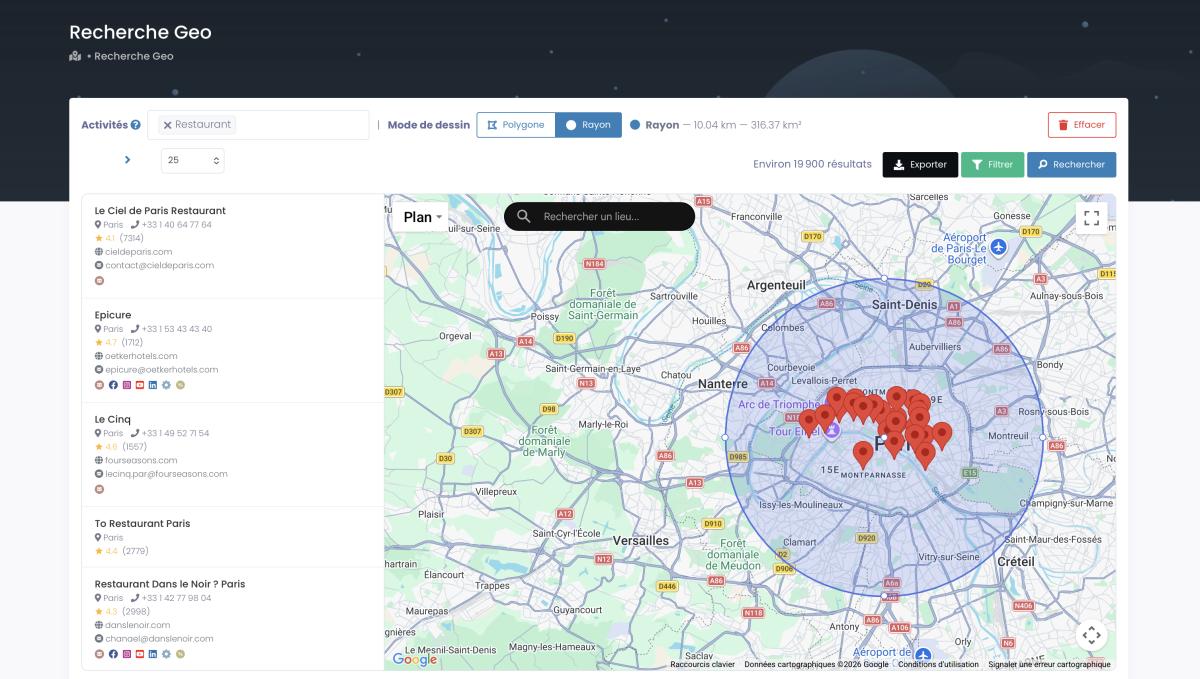
Radius: a circle of whatever size around a point — say, every business within 20 km of downtown Vancouver. Polygon: a shape you draw yourself, tracing a neighbourhood, an industrial corridor, a coastline, whatever doesn't fit a neat administrative box. All the filters and multi-category search still work inside it.
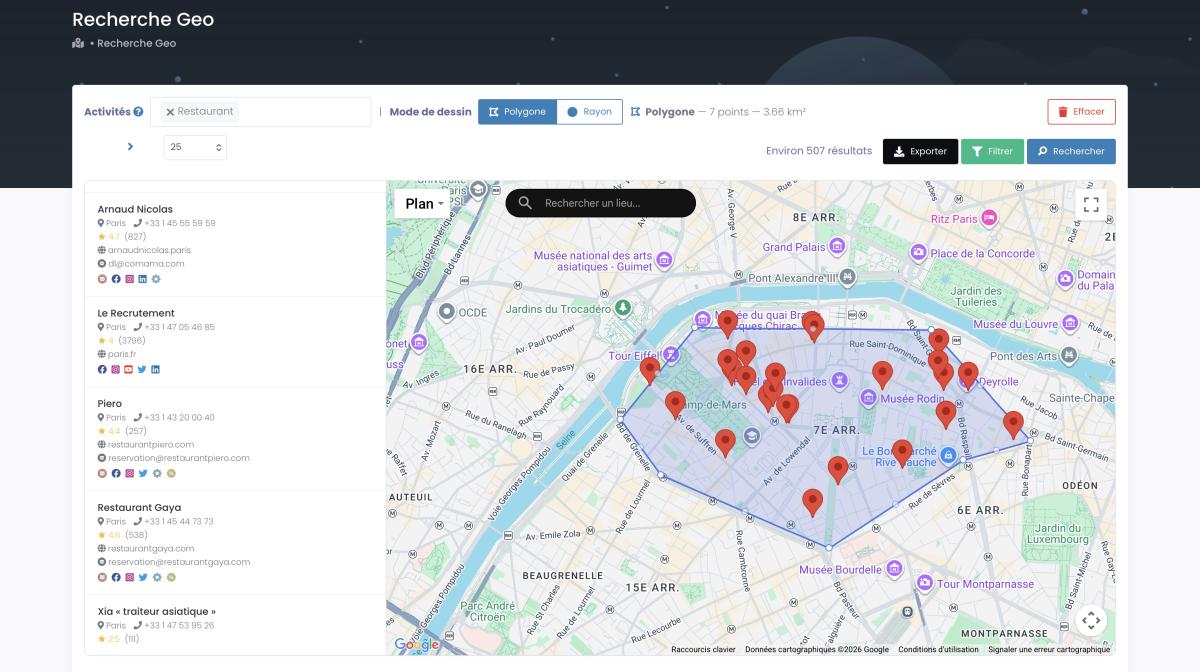
So "law firms with an email, within 15 km of the Montréal city centre" is a completely normal request. Try drawing that on YellowPages. This is how local agencies and regional sales teams stop wasting spend on leads three provinces away — the exact playbook in our local business lead generation guide. Here's the one-click version in action:
Video: How to Extract Every Business in 1 Click (No Category)
How to Build Your Own Canada Business Directory
Take Marc, a SaaS founder in Montréal who needed every dental clinic in Canada for a product launch. Old way? Weeks of manual searching, copy-pasting names into a spreadsheet, hating his life. His way? He had a clean CSV by lunch. Here's the exact process — no code, four steps.
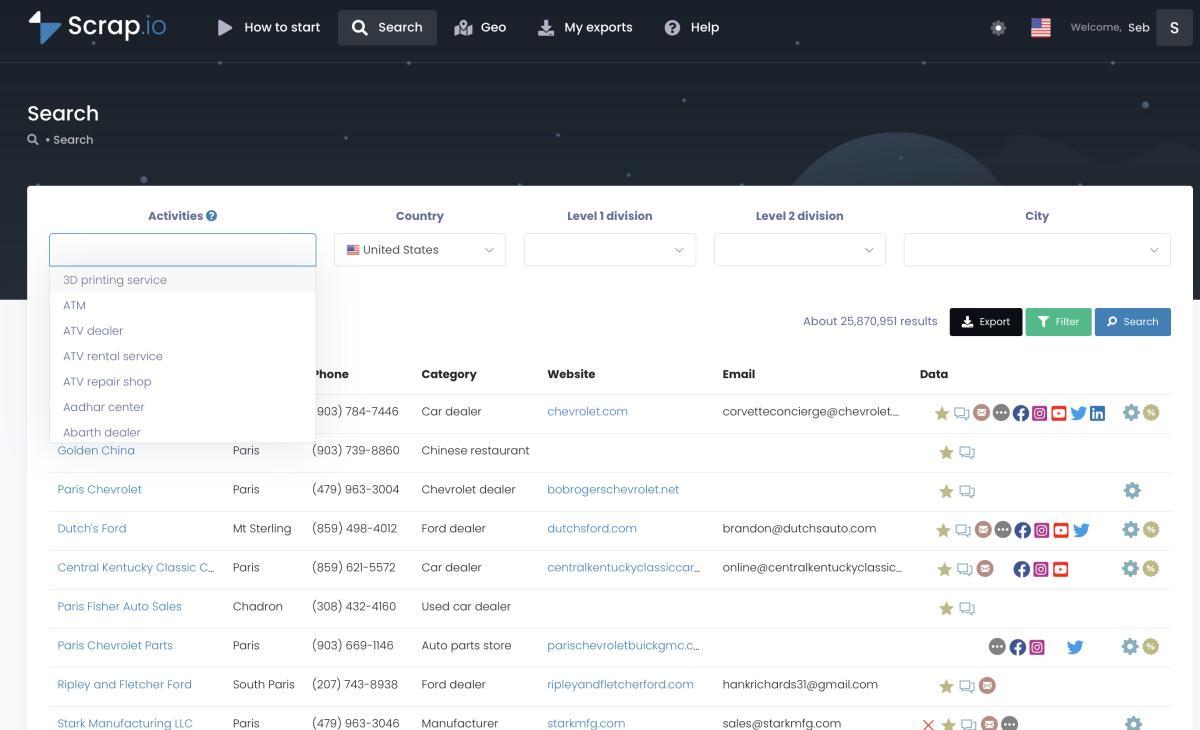
Step 1 — Search. Open Scrap.io. Two dropdowns: business category (4,000+, mirroring Google Maps) and location. Location can be a city, a census division, a province, or all of Canada. Pick "All businesses" if you want everything in a zone regardless of category — that's the canadian business database with emails move nobody else offers.
Step 2 — Filter before you pay. More on this in the next section, but the short version: toggle "has an email," "has a website," minimum rating, whatever matters. You only spend credits on contacts you'll actually use.
Step 3 — Count, then preview. Scrap.io shows the exact number of matching results before you commit — and counting is always free. Marc saw his dental-clinic total in seconds, no card charged for the number itself.
Step 4 — Export. CSV or Excel. Name the file, hit export. Big datasets over 100,000 rows get split into a tidy ZIP automatically. That's it — that's how you extract every business from Google Maps at country scale.
The deep mechanics live in our guide on how to extract every business from Google Maps, and the full five-method breakdown (DIY scripts, extensions, APIs, no-code) is in the complete how to scrape Google Maps walkthrough. Country-level extraction is the part that surprises people, so here's a video on exactly that:
Video: How to Scrape Local Leads at the Country Level
Build your first Canadian list now. Try Scrap.io free for 7 days — 100 export credits included. Pick a category, pick a province, and pull a fresh b2b directory Canada file before your coffee goes cold. Start your free trial.
Filter Before You Extract
Buying a list of 3 million companies is a rookie move. You want the 1.2 million with a real email — and honestly, you want way fewer than that, sharply targeted.
Here's the math that matters. Of those 3,011,109 Canadian listings, 1,745,014 have a website, and only 1,202,172 have an email you can actually contact. Extract everything blindly and you've paid for 1.8 million rows you can't email. That's money on fire.
| Filter stage | Canadian listings |
|---|---|
| All establishments | 3,011,109 |
| With a website | 1,745,014 |
| With an email | 1,202,172 |
So flip the order. Scrap.io applies every filter before credits are consumed — which means you only ever pay for contacts that match what you need. Want only businesses with an email? Toggle it. Minimum rating, minimum review count, has a contact form, recently opened, runs an ad pixel — all upfront, before a single credit is spent.
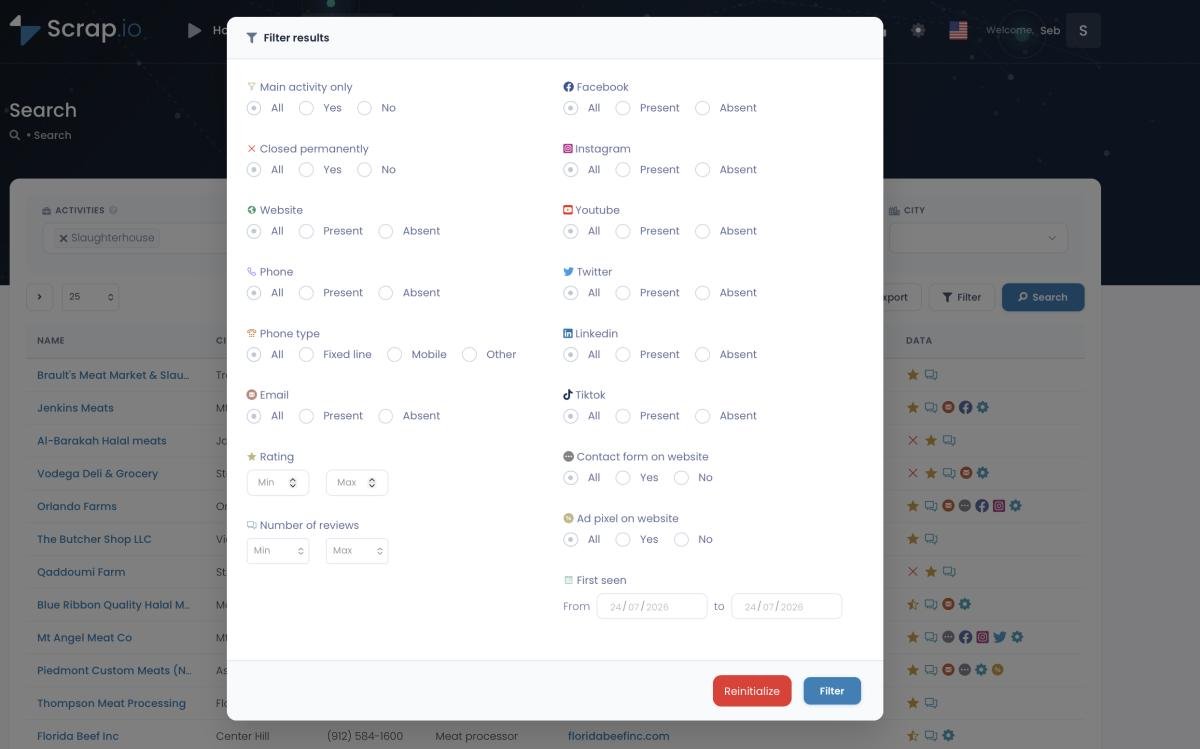
And the emails don't come as a blob. Scrap.io classifies them — individual (with first and last name parsed out), contact@, sales@, marketing@, admin@. So before you write a word, you know whether you're emailing the owner or a generic inbox. The full walkthrough of pulling verified addresses lives in our guide on how to find emails on Google Maps. That's the difference between a template and a message that lands.
Only 1.2M of those 3M listings have an email. Filter for them — and by province, category, and rating — before you spend a single credit. That's the whole trick: shape the list first, pay for it second. Filter your Canadian list on Scrap.io.
Is It Legal to Extract Canadian Business Data?
Short answer: yes, for publicly available business data — with a couple of Canadian rules to respect. Let me be specific, because vague hand-waving helps nobody.
The data we're talking about is public business information. A company's phone number, its business address, the email it published on its own website — that's information a business deliberately made public so customers could find it. Collecting publicly available business data is broadly legal, and Scrap.io only ever touches that kind of data, with every point traceable back to its source. The platform is GDPR and CCPA compliant by design.
Two Canadian wrinkles. First, PIPEDA is the federal privacy law governing personal information — but business contact details a company publishes to be reached are treated far more leniently than an individual's private data. Second, and this is the one people forget: CASL, Canada's Anti-Spam Legislation, governs what you do after you collect the emails. When you send commercial email, you need to identify yourself clearly, include your physical address, and honour unsubscribe requests fast. Notably, a business email a company published publicly can qualify as "implied consent" under CASL when your message is relevant to that recipient's role — but the anti-spam rules still apply. The official rundown lives on the CRTC's CASL page.
Bottom line? Extracting public business data is fine. Emailing it responsibly is on you. When real money's on the line, talk to a lawyer — but for public business data used within the rules, you're on solid ground.
Stop browsing static directories. The best Canada business directory in 2026 isn't a website you scroll — it's a fresh, filtered list you build in minutes. Start your free 7-day trial (100 export credits included), pick a province, and export a live Canadian list today. Then turn it into replies with our guide on how to write a cold email. Start your free trial on Scrap.io.
FAQ
How many businesses are there in Canada?
As of 2026, there are over 3 million active business listings on Google Maps in Canada — 3,011,109 to be exact (Scrap.io, July 2026). Statistics Canada counts about 1.38 million employer businesses and 3.59 million non-employer businesses (June 2025). The first number is the reachable, mappable slice; the second is the legal tax register.
What is the best Canada business directory?
It depends on your goal: YellowPages.ca for a quick lookup, Canada's Business Registries for legal status, Scott's Directories for a paid verified database, and Scrap.io for a fresh, filtered list you export in minutes. For prospecting, the real-time exportable option wins — you filter by city, category, and email instead of clicking through one entry at a time.
Is there a free business directory in Canada?
Yes — CanadaOne and YellowPages.ca are free to browse, and government registries are free to search. But free directories don't allow bulk export or email/website filtering. Scrap.io offers a 7-day free trial with 100 export credits so you can test a real segment before paying anything.
Can I download a list of all companies in Canada?
Yes. With Scrap.io you can export up to the entire country (3M+ listings) to CSV or Excel, filtered by email, website, rating, or category — no code required. Big files over 100,000 rows are split into a ZIP automatically.
Is it legal to extract business data in Canada?
Extracting publicly available business data is legal, and Scrap.io is GDPR/CCPA compliant with every data point traceable to its source. For email outreach, comply with Canada's CASL anti-spam law: identify yourself, include a physical address, and honour opt-outs.
Generate a list of restaurant with Scrap.io