

$300. Fifty thousand "verified" Canadian contacts. That was the deal a guy in a sales forum bragged about last spring — until his sending account got suspended and 41% of the emails bounced on the first blast. Dead inboxes, closed shops, people who left their jobs two years ago. He didn't buy a Canadian business email database. He bought a spreadsheet-shaped liability.
Here's the uncomfortable part. There are more than three million businesses on the Canadian map right now, and most of the files sold as "the Canada business database" were compiled long before you ever paid for them.
So this guide does the opposite of the usual sales pitch. Instead of telling you which stale list to buy, it shows you how to build a fresh one yourself — pulled live, filtered before you spend a cent, and clean enough to survive CASL, which (spoiler) is a lot stricter than the American rules you might be used to.
Video: Scrap.io — How to Start?
Table of Contents
- What is a Canadian business email database?
- How many businesses are there in Canada?
- Buy vs. build: the real cost of a static list
- How to build your own Canadian business email database
- Directory vs. database vs. leads
- Is it legal? CASL & Canadian cold email compliance
- Best data fields to enrich your Canadian list
- FAQ
What is a Canadian business email database?
A Canadian business email database is a structured, filterable collection of business contact records for companies operating in Canada — company name, address, phone, website, and one or more email addresses — organized so you can segment it by industry, province, or city and load it straight into a CRM or cold email tool. A canadian business email list is the same thing, minus the fancy word. People use both.
But the label matters less than what's underneath it. Two databases can carry the identical 50,000 rows and perform five times apart, and the gap is almost never the size. It's the freshness.
Static files are photographs. Somebody indexed a pile of Canadian companies on a Tuesday — which Tuesday, they usually won't say — and they've been reselling that photo ever since. A real-time canada business database is different: the record gets pulled at the moment you export it, straight off the business's own public listing. Owner updated their email last week? You get last week's email. Not a ghost from 2023.
And that's the whole premise of this article. You don't need to find the perfect frozen file. You need a way to generate a fresh one on demand.
How many businesses are there in Canada?
Canada has roughly 1.37 million employer businesses and about 3.67 million non-employer businesses, according to Statistics Canada's Canadian Business Counts (December 2025). That's the official baseline for any list of Canadian companies — and it's why "there aren't enough prospects in Canada" is a myth people repeat without checking.
Now the part you can actually extract. On the map — the live, publicly listed businesses you can reach today — Scrap.io indexes 3,011,298 Canadian businesses as of August 2026. Of those:
| Signal | Canadian businesses | Share |
|---|---|---|
| Total indexed (Google Maps) | 3,011,298 | 100% |
| With a detected email | 1,203,307 | ~40% |
| With a website | 1,745,261 | ~58% |
| With a phone number | 2,370,756 | ~79% |
Source: Scrap.io, live counts, August 2026.
Read that email row again. Over 1.2 million Canadian companies with a real, detectable email address — a canada company email address you can actually write to, not a contact form you'll fill out and never hear back from. That's the pool. That's your canadian business contact database waiting to be filtered.
Most of these are small. A four-person landscaping outfit in Kelowna doesn't run a procurement committee — the owner reads the inbox and decides. Which, for outreach, is exactly what you want.
Curious how many are in your niche? Scrap.io counts them for free — no credits burned, whether you check one city or the entire country. Type your category, pick Canada, read the number. See your niche count →
Buy vs. build: the real cost of a static list
Buying feels like the shortcut.
Usually it's a shortcut to the spam folder.
Let's do the honest math. A pre-compiled file looks cheap on the invoice and expensive everywhere else. Industry benchmarks put bought lists at 10–30% stale on arrival, and cold campaigns run on that data bounce around 7–8% — versus 0.5–1.5% on fresh, verified records (2026 deliverability benchmarks). A bounce rate north of a few percent doesn't just waste sends. It tanks your sender reputation, and then even your good emails start landing in spam. One bad file, months of cleanup.
Here's the side-by-side.
| Factor | Buy a static list | Build it live (Scrap.io) |
|---|---|---|
| Freshness | Compiled months ago; 10–30% stale | Pulled at the moment of export |
| Bounce rate (typical) | 7–8% | 0.5–1.5% |
| Who else has it | Every other buyer | You generated it |
| Filtering | Sort it yourself, after paying | Filter before a credit is spent |
| CASL paper trail | Opaque — good luck documenting the source | Every record traceable to a public listing |
Look at the vendors themselves and the pattern holds. BookYourData sells a Canada file of around 2.26 million contacts at roughly $0.40 per contact — pre-compiled, freshness not guaranteed. Scott's Directories markets a static canadian companies database of about 900,000 businesses and 3.6 million emails, NAICS-coded, subscription-based, no real-time refresh. Salesgenie and Data Axle push Canadian mailing lists with freshness you basically can't audit. None of them are scams. They're just photographs — and the older the photo, the more of your money it wastes.
The community verdict is blunter than mine. Scroll any thread on r/coldemail and you'll find the same refrain: bad data — bounced emails, dead numbers, stale records — kills campaigns before the copy ever gets a chance. It's not the subject line. It's the list.
Video: Stop Paying $20,000/Year for ZoomInfo — This Does More for $49/Month
50,000+ professionals build fresh lists instead of renting stale ones. Scrap.io covers all of Canada — 3M+ businesses, filtered before export — so you email real inboxes, not ghosts. Build fresh, not bought →
How to build your own Canadian business email database
OK, but concretely — what do you actually do? You extract a fresher list yourself, and it takes about two clicks. No code, no CSV broker, no waiting on a sales rep to "prepare your file."
Take Maya. Runs a small web-design studio in Ottawa, needed 2,000 restaurant owners across Ontario with an actual email — not info@, not a contact form. The bought lists she tried gave her dead addresses. So she built the list from the map instead. Here's the exact flow she used to scrape Canadian business emails without touching a line of code.
- Pick a category — or don't. Choose your business type (restaurants, dentists, contractors), or skip the category entirely to pull every business in a zone. Scrap.io covers 4,000+ categories across 195 countries, Canada included.
- Set the location. A single city, a province (Ontario, Quebec, B.C., Alberta), or the whole country. Country-level extraction runs on the Company plan — that's the one built for a full-nation canada business database.
- Filter to "has email" BEFORE you export. This is the money step. Toggle the email filter so only records with a real address are counted. You never spend a credit on a dead-end listing. Want verified Canadian business emails only? That's one switch.
- Count for free. Hit the count button. It tells you exactly how many matching businesses exist — even across all of Canada — and it costs zero credits.
- Export to CSV or Excel. One click. Drop it into your sequencer the same afternoon.
Maya pulled her 2,000 in one sitting. That's how to build a cold email list that's actually fresh — and because the count is free, it's as close as it gets to a canadian business email database free preview before you commit a single credit. (No, the count isn't a trial trick. It's genuinely free, in the app, the API, and the MCP.)
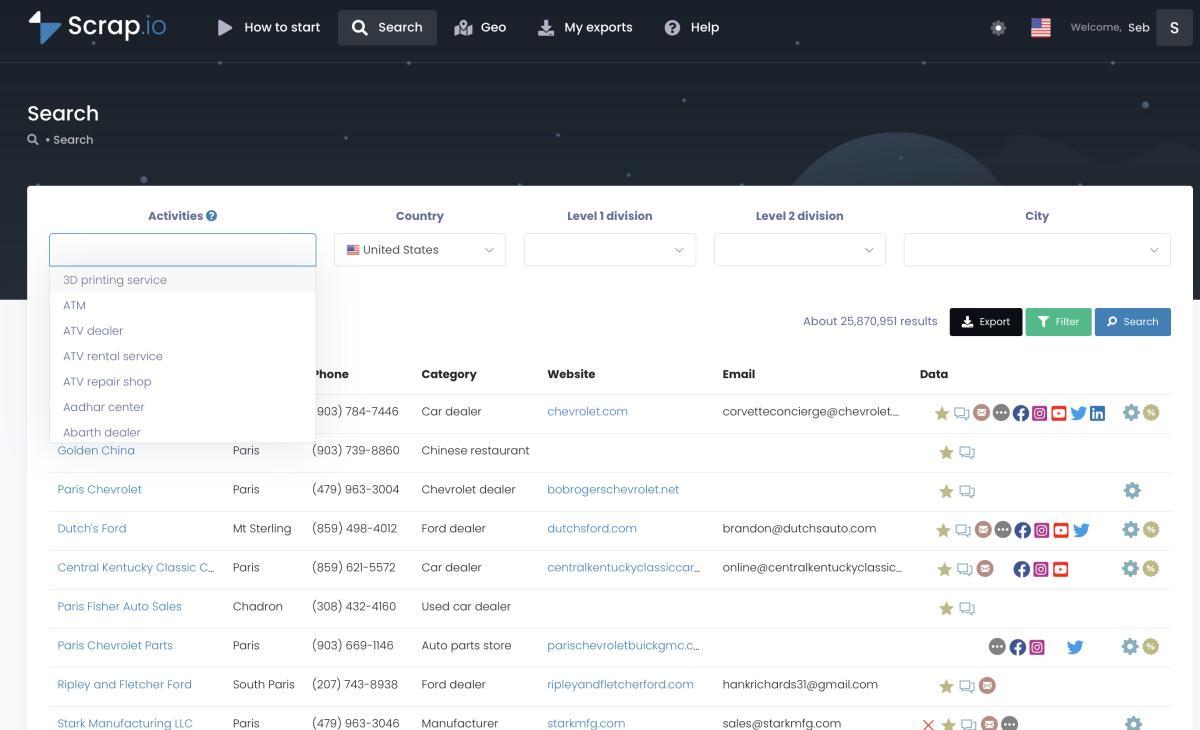
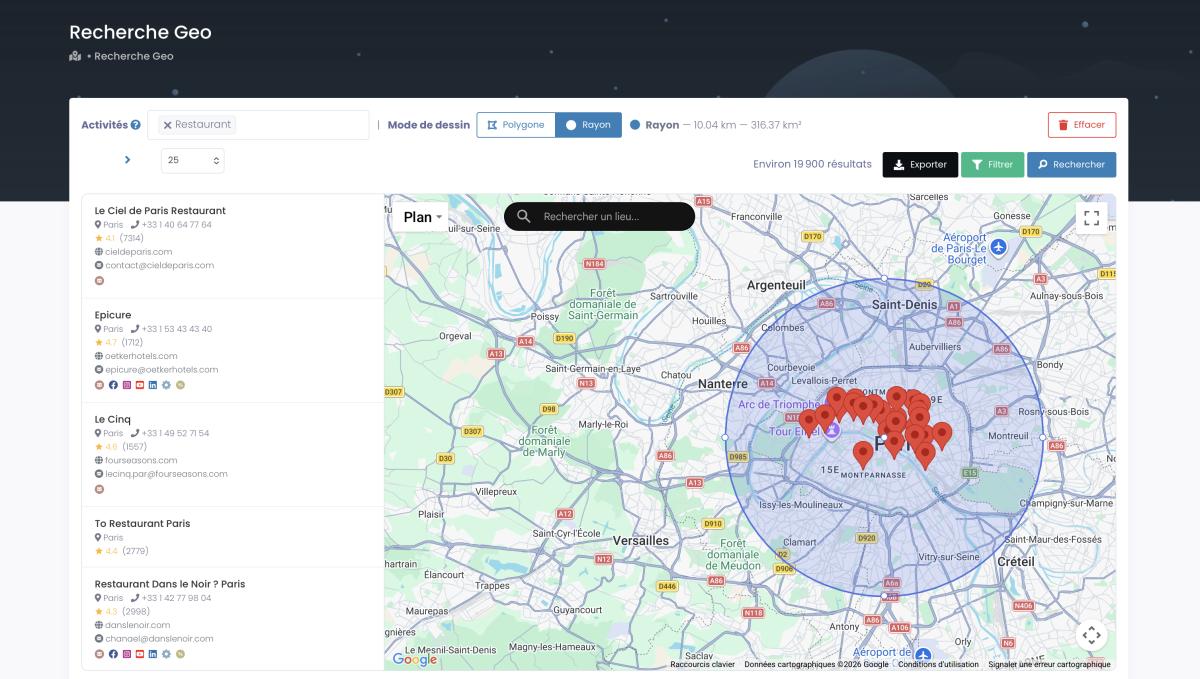
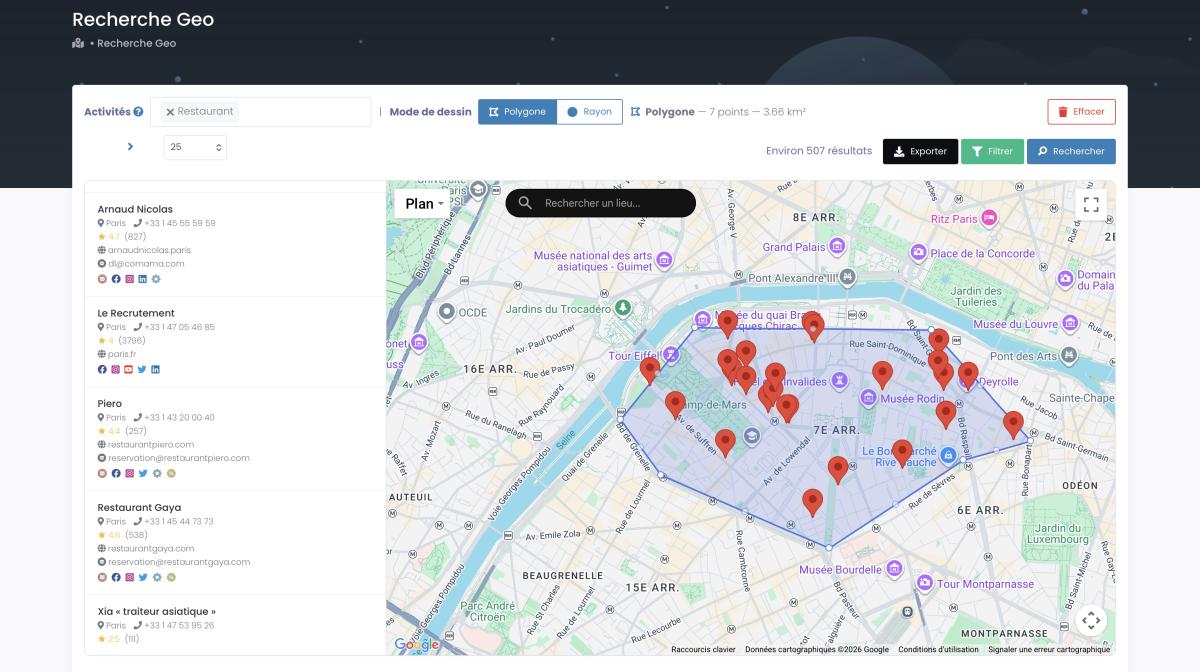
The targeting goes deeper than "restaurants in Toronto," too. Two GeoSearch modes let you draw the exact zone: a radius around a point, or a hand-drawn polygon for a neighbourhood, a corridor, a specific suburb — anything that doesn't line up with a tidy administrative boundary.
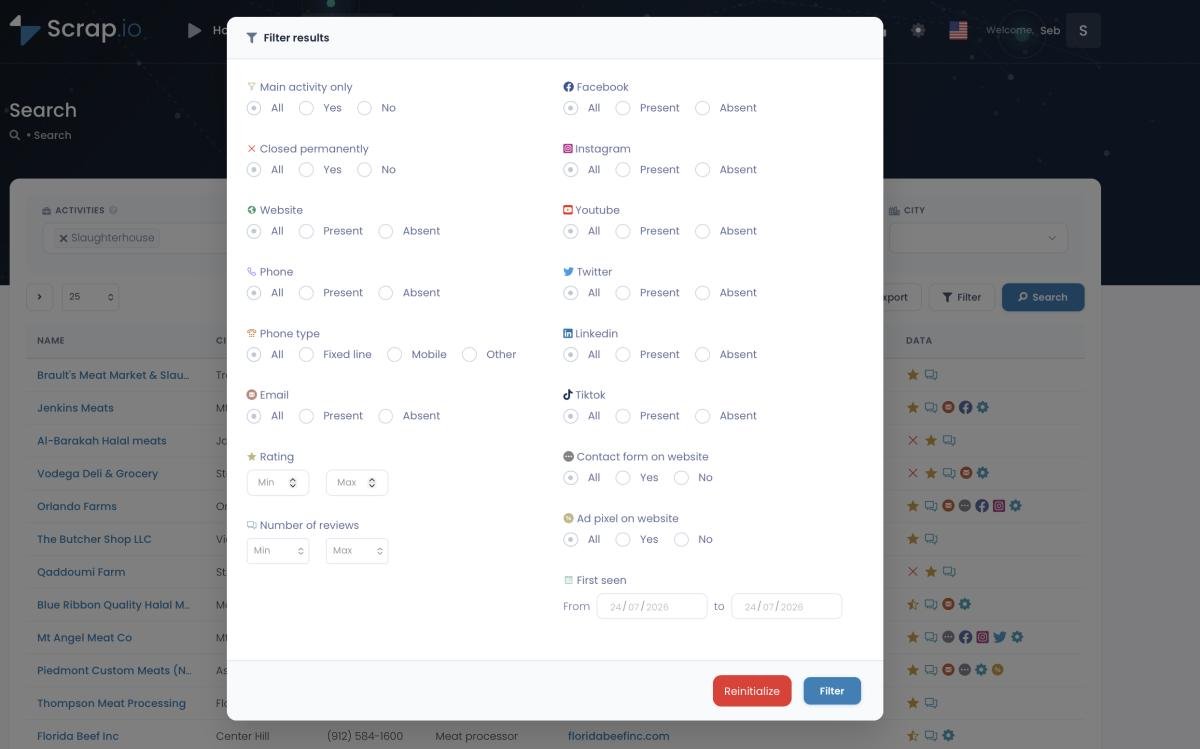
And here's where filtering earns its keep. You apply it before extraction, so you only pay for contacts you'll actually use. Only businesses with an email? Done. Recently opened listings? There's a first-seen date filter for that. The data is verified at the moment of extraction, which is exactly why fresh beats frozen on deliverability.
Want the country-level version step by step? This one walks through extracting an entire nation's worth of local leads at once.
Video: How to Scrape Local Leads at the Country Level
Prefer to do it from an AI assistant? The Scrap.io MCP lets you run searches and exports in plain language — "pull dentists in Calgary with an email" — and it builds the query for you. If you'd rather work close to the source, there's also a full Google Maps scraping guide covering the API and the DIY routes. Honestly, though? The no-code path wins for most people.
Try Scrap.io free for 7 days — 50 searches and 100 export credits included (card required to activate). Build a fresh, filtered, email-present b2b email list Canada from any category and zone you want. Start your free trial →
Directory vs. database vs. leads
People throw these three words around like they mean the same thing. They don't, and the difference decides which tool you actually need.
| Term | What it is | Best for |
|---|---|---|
| Directory | A reference listing of businesses (a phone-book descendant) | Looking a company up |
| Database | Structured, filterable fields you can query | Segmenting and building lists |
| Lead list | A database slice, segmented for outreach | Actually running a campaign |
A Canadian business directory answers "does this company exist and where." Great for a one-off lookup, useless for a campaign — you can't slice a phone book by "has email, 4+ stars, opened this year." That's what a database does. And canada business leads are what you get when you take the database and cut it down to the exact segment you're pitching.
The trap with "canada business directory free" searches? Most of what surfaces is either a thin lookup tool or a stale export dressed up as a directory. The move isn't to hunt for a magic free directory. It's to treat the live map as your database and generate the lead list yourself — directory depth, database structure, outreach-ready output, all in one export.
Is it legal? CASL & Canadian cold email compliance
Canada doesn't do CAN-SPAM.
It does CASL — and it's one of the strictest anti-spam laws on the planet.
Quick reality check on scale: between April 1 and September 30, 2025, Canada's Spam Reporting Centre logged 152,603 complaints — about 5,869 a week — per the CRTC's own CASL enforcement snapshot. Canadians report spam. A lot. So the "nobody's watching up there" assumption is just wrong.
The core difference from the US: CAN-SPAM runs on opt-out (email first, let people leave). CASL runs on consent — you generally need it before you send. Consent comes in two flavours, and this is where the build-your-own approach actually helps you.
- Express consent — the recipient explicitly opted in.
- Implied consent — you've got an existing business relationship, or a recent enquiry, or the person conspicuously published their business email without a "no unsolicited mail" note attached. That last one matters: a business email publicly listed alongside its relevant role can support implied consent for a message relevant to that role.
Then, whatever your basis, every message needs three things: clear identification of who you are, valid contact info, and a working unsubscribe that you honour within 10 business days. Miss those and the penalties are not symbolic — up to $10 million CAD per violation for a company and $1 million for an individual, and "violation" means per instance, not per campaign (CRTC). Fines actually issued in 2025 skewed smaller — think notices of violation in the tens of thousands — but the ceiling is there for a reason.
This is the part vendors of static files quietly skip. When a regulator asks "where did this email come from?", "we bought a list" is the worst possible answer. Because Scrap.io pulls only publicly available business data and keeps every record traceable to its source, documenting your implied-consent reasoning gets a whole lot easier. It doesn't exempt you from honouring opt-outs — nothing does — but it puts you on solid ground. For the full breakdown across borders, here's the deeper guide to cold email compliance, and the CRTC's own CASL FAQ is worth ten minutes before your first send.
Best data fields to enrich your Canadian list
A row with just an email is barely a lead. The fields around it are what let you personalize — and personalization is the difference between a 0.2% average cold-email conversion and the 10–12% reply rates the top B2B senders hit (Martal Group and 2026 benchmarks; martal.ca).
Here's what's actually worth pulling into a canadian business mailing list, and why:
- Classified emails. Scrap.io doesn't dump one address — it labels them: a main email, an individual email (with the person's first and last name pulled out), plus contact@, sales@, marketing@, finance@, and admin@ variants. Writing to a named human beats blasting
info@every single time. - Phone number. Multi-channel lifts reply rates hard. Note one Canada-specific limit, though: the fixed/mobile phone-type filter isn't available in Canada (or the US), so you can't pre-segment SMS-only here. Don't let a tool tell you otherwise.
- Firmographics. Category and sub-categories, full address, city, province, postal code, GPS — the raw material for a canada email list by province or a tight local zone.
- Ratings & reviews. Review count and average rating make great personalization hooks and great filters (established businesses, or struggling ones you can help).
- Website intelligence. CMS/generator, detected technologies, ad pixels, contact pages, social profiles — gold for agencies pitching web or ad services.
Micro-story to make it concrete. One agency we know filtered Canadian businesses that had a Google listing but no website, then wrote to the owner by name using the individual-email field. Established companies, obvious need, personal opener. That list converted because the data did the heavy lifting — not the copy. The point stands: enrich first, then write. For a full sense of which fields exist and how they're structured, the USA business email database guide walks through the identical field set on the American side.
Bottom line — a fresh, well-enriched Canadian file isn't just more ethical under CASL. It's the thing that makes the outreach actually work.
FAQ
How many businesses are there in Canada?
Statistics Canada's Business Counts (December 2025) puts it at about 1.37 million employer businesses plus 3.67 million non-employer businesses. On the live map, Scrap.io indexes 3,011,298 Canadian businesses as of August 2026, of which roughly 1.2 million have a detectable email address.
Is it legal to use a Canadian business email database for cold email?
Yes — under CASL, provided you have express or implied consent, identify yourself clearly, and include a working unsubscribe you honour within 10 business days. Unlike the US CAN-SPAM opt-out model, CASL is built on consent, so the source and documentation of your data matter. A publicly listed business email relevant to the recipient's role can support implied consent.
Where can I get a free Canadian business email database?
The "free" PDFs floating around Scribd and similar sites are small, unverified, and usually years out of date — high bounce, low value. A better free move: use a live tool's free counting feature to size your target, then extract a fresh, filtered list on a free trial. Truth is, the best Canadian business email database isn't a file you download — it's one you build fresh, on demand, from current data instead of a recycled file.
What's the difference between a directory, a database, and a lead list?
A directory is a reference listing you look companies up in. A database has structured, filterable fields you can query and segment. A lead list is a database slice, segmented and ready for outreach. For campaigns you want the database and the lead list — a directory alone can't be filtered by email, rating, or opening date.
How do I build my own Canadian business email database?
Pick a category (or none), set your location to Canada, a province, or a city, toggle the "has email" filter before exporting, check the free count, then export to CSV or Excel. It's no-code, real-time, and you only pay for the contacts you actually keep.
Stop paying for yesterday's data. Extract a live Canadian business email database today — 3M+ companies, 1.2M with verified emails, filtered before you spend a credit. Free 7-day trial, 100 export credits included (card required to activate). Extract your Canadian database →
Generate a list of restaurant with Scrap.io