

A recruiter I know spent an entire Friday building a prospect list of local employers by hand. Company name, address, whether they looked like they were hiring, one browser tab at a time. Four hours. She ended up with 60 names, half of them already in her CRM.
Meanwhile, roughly 70% of the workforce isn't even looking for a job. So why is every recruiter still fishing in the same LinkedIn pond?
That's the whole problem with modern candidate sourcing. Everyone crowds into the same two or three channels, pays more each year for worse response rates, and calls it a strategy. This guide takes a different angle: using public Google Maps data to map the companies that are actually hiring and the local talent that never shows up on LinkedIn. It's an underused channel, it's cheap, and almost nobody in recruiting is doing it yet.
- What Is Candidate Sourcing? (And How It's Different From Recruiting)
- Why Traditional Candidate Sourcing Is Getting Harder in 2026
- The Overlooked Channel: Sourcing Through Google Maps Data
- 6 Candidate Sourcing Strategies That Work in 2026
- How to Source Local Candidates & Hiring Companies with Scrap.io
- Candidate Sourcing Tools Compared (2026)
- Is Sourcing From Public Business Data Legal?
- Build Your Local Talent Map Before Your Competitors Do
- FAQ
What Is Candidate Sourcing? (And How It's Different From Recruiting)
Candidate sourcing is the proactive process of finding, identifying, and engaging potential hires, both active and passive, before they ever apply for a role. It sits at the very top of the recruiting funnel. Sourcing fills the pipeline; recruiting moves people through it. That's the whole distinction in one sentence.
People blur the two constantly. They shouldn't. When you're sourcing candidates, your job is discovery and first contact: building a list of humans who could be a fit and getting a conversation started. Recruiting is everything after: screening, interviewing, negotiating, closing. Different muscle. Different metrics.
Here's the mistake I see over and over. Teams treat sourcing as an afterthought, something you do only when a req opens and panic sets in. Then they wonder why time-to-hire is brutal. Good talent sourcing is continuous. You're always mapping the market, always adding names, always warming people up. So when the req lands, you're not starting from zero.
Active vs. Passive Candidates (and why passive candidate sourcing wins)
Two kinds of people exist in any talent pool. Active candidates are job hunting right now: updating resumes, refreshing job boards, firing off applications. Passive candidates are heads-down doing their jobs, not looking, not scrolling listings. And they're the majority. By a lot.
Around 70–75% of the workforce is passive at any given moment (HootRecruit / WeCreateProblems, 2026). The people you actually want, the ones who are good enough that nobody's letting them go easily, are almost never in the active pile.
Read that again.
Which is exactly why passive candidate sourcing is where the real leverage is. Teams with mature sourcing operations pull 50–70% of their hires from passive sources (WeCreateProblems, 2026). The catch? Passive people don't respond to job posts. You have to go find them, and you have to reach them where the competition isn't already shouting.
Why Traditional Candidate Sourcing Is Getting Harder in 2026
The LinkedIn arms race is over.
And everyone lost.
Not because LinkedIn is bad. It's a phenomenal database. The problem is saturation. Every recruiter, every agency, every in-house team is sending InMails to the same profiles. The average sourcing outreach response rate now sits around 19.6%, and only about 37.7% of those responses signal real interest (Ashby Talent Trends, 2026). So you message ten people, two reply, and maybe one actually cares. Fun.
Then there's the cost of all this. Time-to-hire in the US averages 36–42 days, stretching to 44 for tech and healthcare roles (MSH / Recruiterflow, 2026). Average cost per hire? $4,425 (Pin, 2026). Every extra day a seat stays empty is money bleeding out. And the harder sourcing gets, the more those numbers climb.
The uncomfortable truth: relying only on the crowded channels is a slow, expensive form of self-sabotage. When 200 recruiters compete for the same passive engineer, the winner isn't the best pitch. It's whoever got there first, or paid the most. That's not a game you win consistently.
Some teams try to brute-force it with more tooling: LinkedIn scraping tools, automated connection requests, sequence-everything platforms. It helps at the margins. But it's still the same pond, just with a bigger net. Sound familiar?
Recruiters feel this daily. As one internal recruiter put it on r/recruiting: "I've been an internal recruiter for 4+ years and live and swear by LinkedIn for its sheer volume of candidates…", the exact dependency that makes the channel so crowded in the first place. Everyone knows it. Few do anything different. And that gap is your opportunity.
The Overlooked Channel: Sourcing Through Google Maps Data
Okay. Here's the part nobody in recruiting talks about.
Google Maps is, quietly, one of the largest business databases on earth. Scrap.io alone indexes 225 million+ establishments across 195 countries, spanning 4,000+ business categories. Names, addresses, phone numbers, websites, emails: public, verified by the businesses themselves, and updated in real time. And here's what makes it interesting for sourcing specifically: it works in two directions.
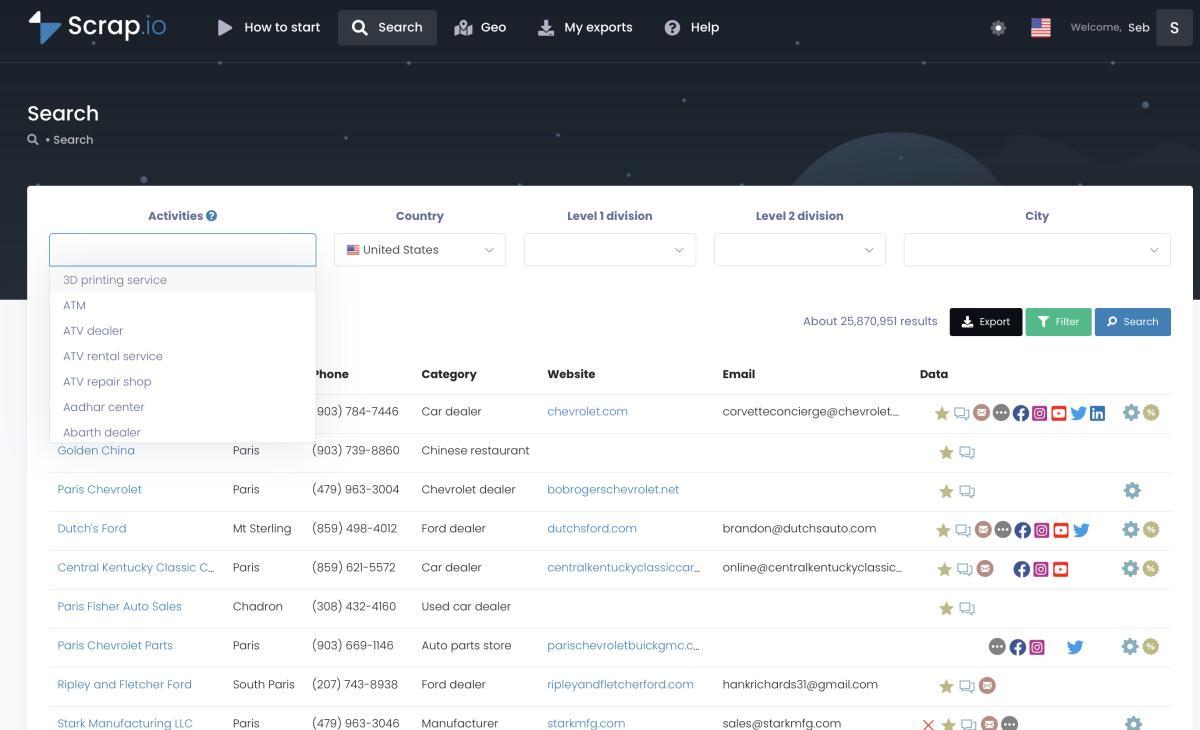
Direction one: map the companies that are hiring. If you run a staffing agency or an RPO, your prospects aren't candidates. They're employers. And employers who are growing tend to be findable: they've got a Maps listing, a website, a phone number that rings. You can pull every dental clinic, every logistics firm, every engineering shop in a territory and build a business-development list in minutes. These are the companies that need people, which means they need you.
Direction two: reach local talent that LinkedIn never shows you. Think about who isn't well-represented on LinkedIn. Tradespeople. Restaurant managers. Clinic staff. Small local employers whose whole team is invisible to a Boolean search. When you're hiring for local, hands-on, non-desk roles, mapping the businesses in an area gets you closer to that talent than any professional network. The people you want are working at those addresses right now.
The mechanism is dead simple: pick a category, pick a location, extract. No code. This is the same Google Maps scraping method that lead-gen teams have used for years. Recruiting just hasn't caught up yet. If you already run local lead generation strategies for sales, you already know the playbook. Those same Maps updates double as hiring & growth signals you can act on: a new location, a review spike, an owner who just claimed the listing. Sourcing is the same motion, aimed at a different target.
6 Candidate Sourcing Strategies That Work in 2026
No single channel carries a sourcing operation. The best recruiters stack a few. Here are six candidate sourcing strategies worth your time this year, including the one nobody's using.
1. Passive sourcing & X-ray search. The classic. Use advanced Boolean and X-ray searches to surface passive profiles across LinkedIn, GitHub, and niche sites. Powerful, but crowded: you're competing with everyone else running the same strings. Treat it as a baseline, not your whole strategy.
2. Employee referrals. Still the highest-quality source, hands down. Referred candidates convert faster and stick around longer. The downside: it doesn't scale. Your team only knows so many people. Great for filling gaps, useless for volume.
3. Niche communities. Slack groups, Discord servers, subreddits, industry forums. The talent here is engaged and specific. It's slow, relationship-first work: you can't spam it, but for hard-to-fill technical roles, it's gold. Recruiters swap tactics on threads like this r/recruiting discussion on AI sourcing tools constantly.
4. Resume databases. Indeed, Monster, CareerBuilder, and the rest. Big pools, but mostly active candidates, and you're paying per contact. Fine for high-volume roles. Weak for the passive talent that matters most.
5. Local employer mapping (the underused one). This is our angle, and it's wide open. Extract every relevant business in a territory from Google Maps, across 4,000+ categories, to find both hiring companies and pockets of local talent. Nobody in recruiting is doing this at scale. Which is precisely why it works. First-mover advantage in a channel your competitors haven't noticed. Pair it with a sharp ideal employer profile (ICP) and you target the right sectors instead of scraping everything.
6. AI-assisted sourcing. The newest lever. AI candidate sourcing tools, the better ai sourcing tools for recruiting, rank matches, draft outreach, and score fit automatically. Automation can reclaim up to 15 hours a week (Pin, 2026): real time, back in your pocket. Just don't outsource judgment to it. AI finds and drafts; you decide. Platforms like Indeed Smart Sourcing lean hard into this, but they still search the same profile pool everyone else does.
Video: How to Scrape Local Leads with Claude & Vibe Prospecting
How to Source Local Candidates & Hiring Companies with Scrap.io (Step by Step)
Enough theory. Here's the actual candidate sourcing process for sourcing candidates and employer targets from Google Maps data. Start here if you've never touched the platform:
Video: Scrap.io - How to Start?
Step 1: Pick your category. Choose the business type that maps to your goal. Hunting for hiring employers in a sector? Pick that sector: "logistics," "dental clinic," "software company." Sourcing agencies to partner with or benchmark? Pick "employment agency." You can even skip the category entirely and pull every business in an area at once.
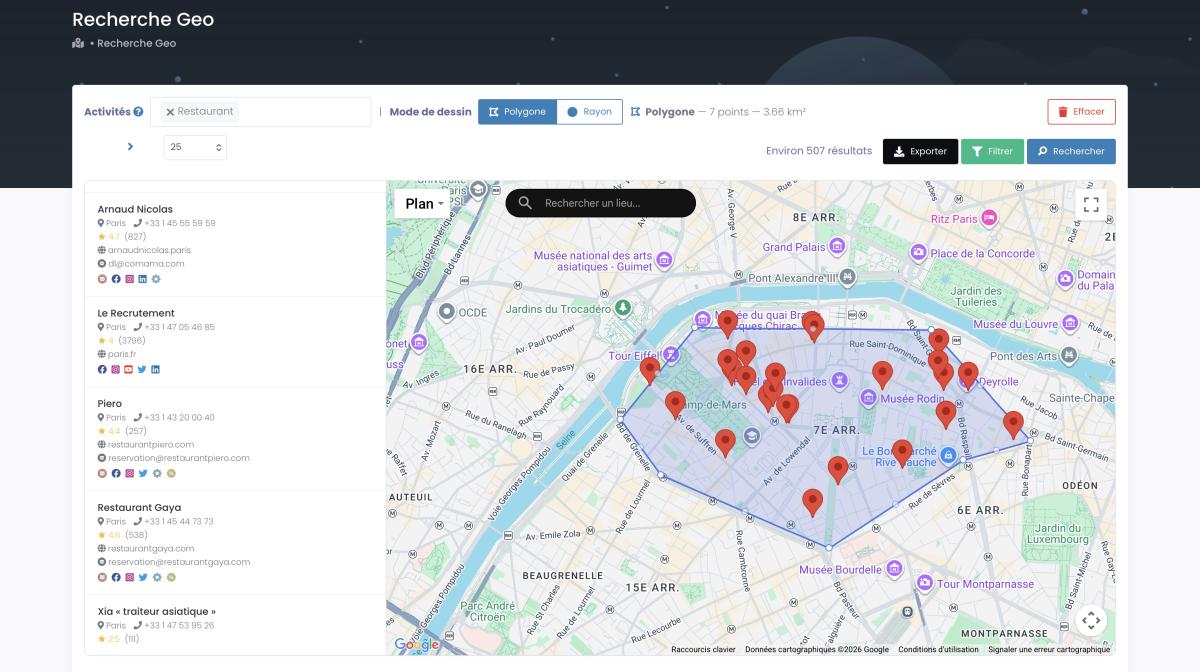
Step 2: Set your zone. City, county, state, or an entire country: Scrap.io handles all four levels. You can also draw a custom radius or polygon on the map to target one metro, one district, one commuting zone. Sourcing local? This is where it clicks. Need to source leads at country level instead? Same interface, bigger scope.
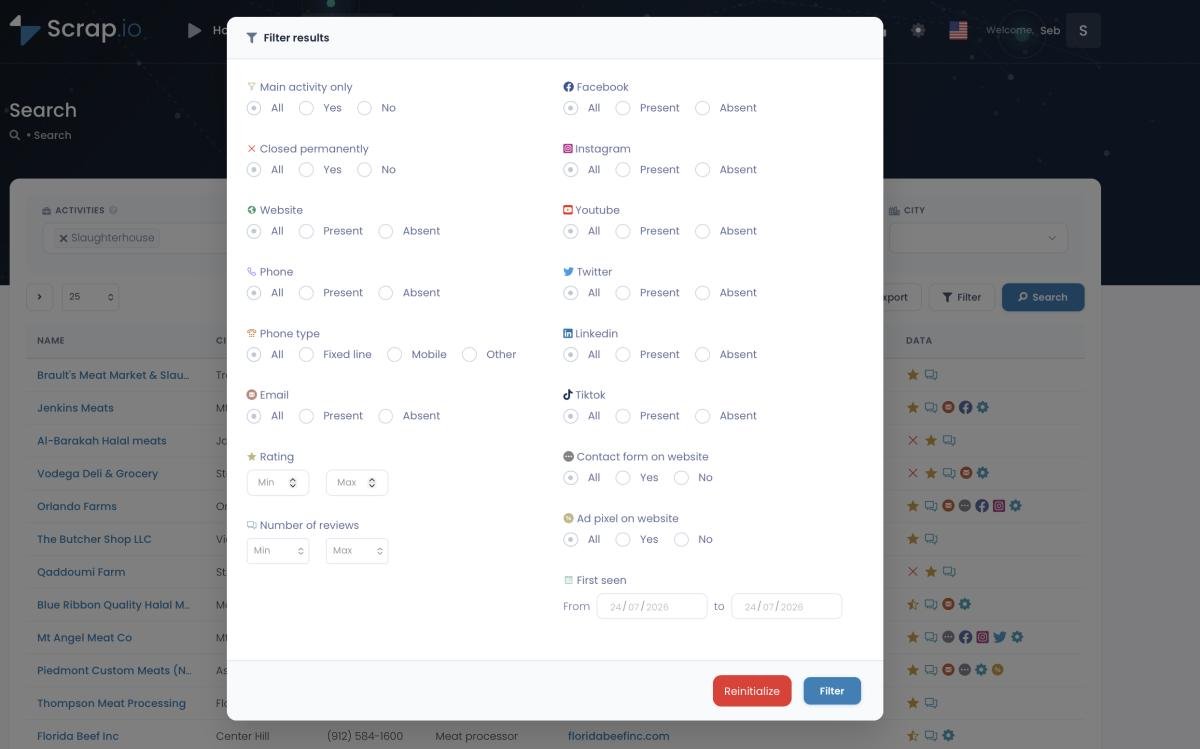
Step 3: Filter before you extract. This is the part that saves you money. Scrap.io applies filters before credits are spent, so you only pay for records you can actually use. Want only businesses with an email on file? Toggle it. Only listings with a website? Done. You're not buying a pile of dead rows and sorting through them later. You filter, then you pay. In that order.
Step 4: Export. CSV or Excel, ready to drop into your ATS or CRM. Each row carries the business name, address, phone, website, up to five classified emails, social profiles, ratings, the works. Need the contact details specifically? Here's how to find emails on Google Maps and scrape phone numbers at scale.
How fast is this, really? One user pulled 11,734 businesses in 45 minutes in a single export. Try building that list by hand. I'll wait.
Now for the numbers that make this concrete. We ran the "employment agency" category across the US on Scrap.io (data pulled fresh, September 2026):
| US employment agencies (Google Maps) | Count | Share |
|---|---|---|
| Total indexed | 60,205 | 100% |
| With a website | 36,570 | ~61% |
| With a usable email | 28,007 | ~47% |
So in two clicks you can pull 28,007 US employment agencies reachable by email, filtered before extraction, zero credits wasted on unreachable listings. Or narrow it to one state, one city, one niche. And the exact same mechanic works for any sector that hires: healthcare, construction, hospitality, whatever your desk covers. 4,000+ categories, remember.
Video: How to Scrape Local Leads at the Country Level
One more thing before you fire off outreach: whatever you extract, personalize the message. A generic blast to 27,000 agencies is spam, and it'll get treated like spam. Here's how to write a cold email that actually earns a reply, problem first, pitch second. Want proven copy to start from? Our recruiting email templates give you a running start.
Candidate Sourcing Tools Compared (2026)
There's no shortage of candidate sourcing tools and candidate sourcing platforms out there. Most solve the same slice of the problem, profiles on professional networks, and ignore everything else. Here's an honest breakdown of where each type fits:
| Tool / Type | Best for | Data source | Local business data | Starting price |
|---|---|---|---|---|
| LinkedIn Recruiter | Desk-based & professional roles | LinkedIn profiles | ❌ | $$$ |
| SeekOut / hireEZ / Juicebox | AI profile search & ranking | Aggregated web profiles | ❌ | $$$ |
| ATS (Loxo, Bullhorn…) | Managing the pipeline | Your database + add-ons | ❌ | $$–$$$ |
| Scrap.io | Local employer & business mapping | Google Maps (real-time) | ✅ | $35/mo |
The honest read? These aren't really competitors. They're complements. Loxo is a strong sourcing-plus-ATS platform. Fetcher and Juicebox lean hard into AI profile search. SeekOut and hireEZ do the same. All of them live on the same professional-profile data, which is exactly the crowded pond we started with. Scrap.io covers the one thing they all miss: the local business and employer data that isn't on any of those platforms. Use LinkedIn and an AI tool for named profiles; use Scrap.io for the local employers and hidden talent the others literally can't show you.
Worth noting how much the market itself values this problem. The US staffing and recruiting market runs somewhere between $180.2 billion (Staffing Industry Analysts) and $237.1 billion (IBISWorld), 2026, served by 43,756 employment and temp agencies across the country (IBISWorld, 2026). Prefer to skip the extraction and start from a ready-made list of 66,000+ US staffing agencies? We built one. That's a lot of businesses that all need the same thing: people. And back in 2021, Bullhorn already found 54% of staffing firms ranked candidate sourcing as a top priority (Bullhorn). It hasn't gotten less important since. For deeper tactics, the LinkedIn Talent Blog and the American Staffing Association are both solid.
Is Sourcing From Public Business Data Legal? (GDPR & CCPA)
Short version: yes. Let me be specific about why.
Scrap.io only extracts publicly available business data: the same information a company chose to publish on its own Google Maps listing and website. A business name, address, phone number, and generic contact email are business information, not private personal data. That distinction is the whole ballgame.
Under GDPR (EU), publicly available business contact data can generally be processed for legitimate B2B purposes, provided you offer a clear opt-out on any outreach. Under the CCPA (California), publicly available business information is carved out of scope. Scrap.io is GDPR- and CCPA-compliant, and every data point is traceable back to its source. No shady databases, no scraped personal profiles.
The common objection, "Google Maps lists businesses, not candidates," misses the point entirely. That's the strength, not the weakness. You're identifying the employers who are hiring (your business-development targets) and the local companies whose staff you'd never find on a professional network. Legitimate, public, traceable. Just remember: compliance is the floor, not the ceiling. Respect people's inboxes and your results improve anyway.
Build Your Local Talent Map Before Your Competitors Do
The recruiters who win in 2026 won't be the ones sending the most InMails. They'll be the ones sourcing where nobody else is looking.
Candidate sourcing is getting harder, more expensive, and more crowded on every traditional channel, and that trend isn't reversing. The teams that treat candidate sourcing as a data problem, not a messaging problem, are the ones pulling ahead. Google Maps data is the rare exception: a massive, fresh, public dataset that recruiting has barely touched. Map the hiring companies. Reach the local talent LinkedIn hides. Treat talent sourcing as a continuous map you keep building, not a fire drill you run when a req opens.
Do it before it becomes obvious to everyone else.
FAQ
What is candidate sourcing?
Candidate sourcing is the proactive process of finding, identifying, and engaging potential hires, both active and passive candidates, before they apply for a role. It's the top of the recruiting funnel: sourcing builds the pipeline, recruiting moves people through it.
What's the difference between sourcing and recruiting?
Sourcing fills the pipeline: finding and engaging potential candidates. Recruiting moves those people through it: screening, interviewing, and hiring. Sourcing is discovery and first contact; recruiting is everything that happens after a candidate is in your pipeline.
Can you source candidates with Google Maps?
Yes. You can map hiring companies by industry and location, and reach local businesses (and their teams) that don't show up on LinkedIn. Tools like Scrap.io extract Google Maps listings with emails and phone numbers in a few clicks, filtered before extraction so you only pay for usable contacts.
Is sourcing from public business data legal?
Yes, when you use publicly available business data and respect GDPR and CCPA. Scrap.io only collects public business information, is GDPR- and CCPA-compliant, and keeps every data point traceable to its source. Any outreach should always include a clear opt-out.
What is the 70/30 rule in hiring?
The 70/30 rule describes the split between passive and active talent: roughly 70% of the workforce isn't actively job hunting, while only about 30% is. For recruiters, it means most of your strongest candidates sit in that passive 70%, so sourcing has to reach people who never see a job post.
What are the best candidate sourcing tools in 2026?
For named professional profiles, LinkedIn Recruiter plus an AI platform like SeekOut, hireEZ, or Juicebox. For local employer and business data those tools miss, Scrap.io: real-time Google Maps data across 195 countries and 4,000+ categories, starting at $35/month with a free 7-day trial (100 leads included).
Generate a list of employment agency with Scrap.io