

📋 What's in This Guide
- Why Most Cold Outreach Dies Before It Reaches the Close
- Cold Outreach Benchmarks You Need to Know in 2026
- The 7-Stage Cold Outreach Pipeline: From Send to Signature
- 5 Proven Sales Closing Techniques That Work for Cold Outreach
- Real-World Case Studies: Cold Outreach Campaigns That Closed
- Cold Email Compliance in 2026: CAN-SPAM, GDPR & Best Practices
- FAQ — Closing Cold Outreach Deals
95% of cold emails get zero engagement. No reply. No click. Nothing happens. And honestly? That number doesn't surprise me one bit.
But the 5% who actually close deals from cold outreach? They're not doing anything magical. They just have a system. A real pipeline that goes from first email all the way to a signed contract. Most people don't.
I know this sales guy — let's call him Dave. Dave sends about 200 outbound emails a week. Not a huge number. But he closes around $40K in new business every month. Just from cold outreach. His buddy Mark? Blasts 2,000 emails weekly. Books maybe one call. Maybe.
Difference isn't volume. It's process. That's it.
Most people treat cold email like a slot machine. Send enough and eventually something hits. Nope. Doesn't work that way. This guide breaks down the full journey from that very first prospecting email to getting the contract signed. Real numbers. Real case studies. No fluff.
Because the problem was never email as a channel. Email works fine. The problem is almost nobody builds an actual closing pipeline around it.
Why Most Cold Outreach Dies Before It Reaches the Close
Okay so let's talk about what's really going on. Average cold email reply rate dropped to 5.1% — that's from Smartlead's 2025 State of Cold Email report. Was 7% back in 2023. Pretty big drop. And people are sending more emails than ever. So what's happening?
Three things. Three things kill campaigns before they get anywhere near a deal.
First one. Spray-and-pray targeting. People grab random lists, throw them into a sequence tool, hit send. No research on who they're actually emailing. No filtering. Zero thought about whether the person on the other end even needs what they sell. Darts. Blindfolded. That's what it is.
Second thing. No follow-up system. And this is a big one. 80% of sales need five or more touchpoints before closing. That's from RAIN Group and Brevet Group research. Five touchpoints. Most salespeople send one email and stop. Maybe two on a good day. That's not a cold email outreach strategy. That's hope.
Third. Wrong audience. Completely wrong audience. You could write the greatest outreach email ever written. Perfect subject line. Amazing personalization. Killer offer. Send it to someone who doesn't have the budget, the authority, or the problem you solve? Dead. On arrival.
The channel isn't broken. The pipeline is missing. People polish subject lines when they should be building a system that moves a stranger from "who are you" to "where do I sign."
Cold Outreach Benchmarks You Need to Know in 2026
Before building anything you need to know what good looks like. Here are the numbers that actually matter right now. All from 2025 benchmark data.
Open rates — averaging 27.7% across cold outreach. That's Smartlead and Woodpecker 2025 benchmarks. Honestly not bad. Emails are landing in inboxes. The problem kicks in after the open.
Reply rates — 5.1% average like we said. But. Campaigns with real personalization — not just {first_name} tokens but actually researched stuff — jump to roughly 2x improvement. From about 9% to 18% reply rate. That's Woodpecker's 2025 study. Doubling your pipeline just by doing homework on each prospect.
Meeting booking rates — somewhere between 0.5% and 2.2% depending on industry. Sounds tiny right? At scale though. Send 1,000 targeted emails. Book 5-22 meetings. Close a quarter of those. Real money.
Email length — keep it around 150 words. Four or five sentences. Smartlead's 2025 data. Shorter wins for first touch. Nobody reads a novel from a stranger.
Hook types that work — Digital Bloom studied 16.5 million emails in 2025. Timeline hooks pulled a 7.21% reply rate. The ones referencing specific timeframes or deadlines. Way above average.
Timing — Tuesday through Thursday. 8-11 AM or 2-4 PM in recipient's timezone. July shows highest response at 6.3%. December lowest at 4.67%. Makes sense if you think about it.
Multi-contact outreach — reaching multiple people at the same company — boosts response rates by 93%. That's Woodpecker 2025. If you're only emailing one person per account you're leaving almost double on the table.
One more thing. The 3-7-7 cadence captures about 93% of total replies within 10 days. Smartlead's data. That's your window. If they're gonna respond, it'll happen fast.
All these numbers say the same thing. Cold outreach works. But only when you're sending the right emails to the right people with an actual system behind it. And every system starts with data quality.
Platforms like Scrap.io let you build verified prospect lists straight from Google Maps — filter by industry, location, reviews, digital presence. Start with 100 free leads on a 7-day trial and watch what happens to your reply rates when you use fresh targeted data.
The 7-Stage Cold Outreach Pipeline: From Send to Signature
Here's what most guides get wrong about this. They treat cold email like it's one thing. Write email. Send email. Cross fingers. That's not a pipeline. That's a wish.
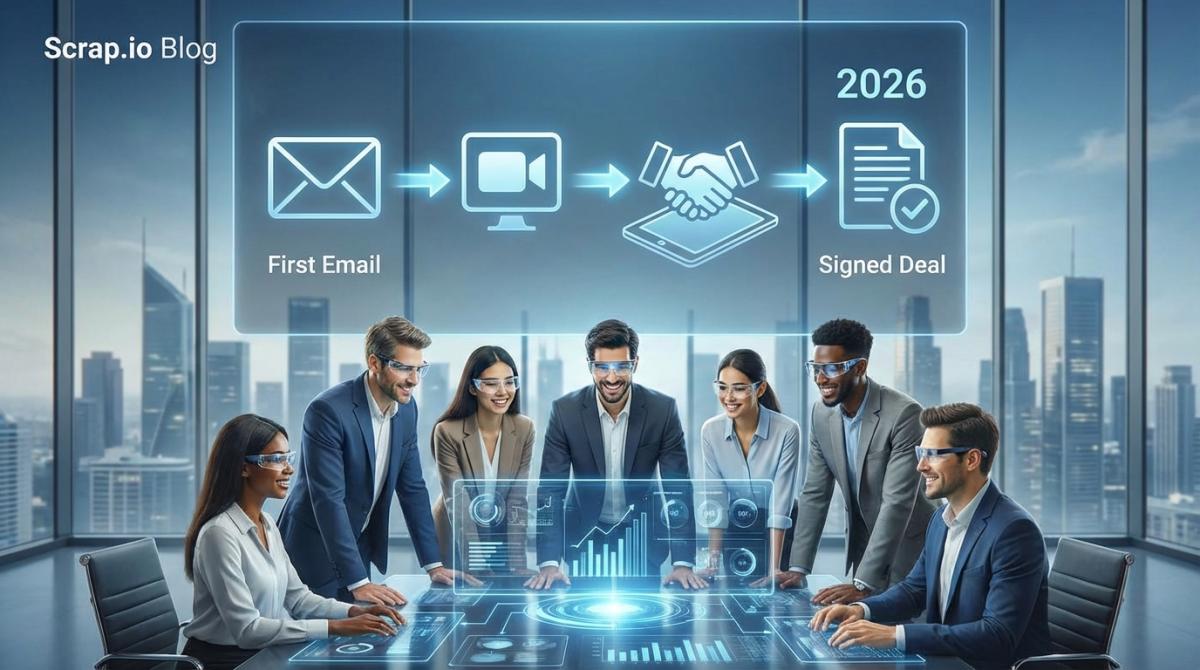
The real cold email to signed contract process has seven stages. Skip one and the whole thing breaks.
Stage 1 — Targeting & List Quality (ICP + Data)
This part? This is where campaigns actually get won or lost. Before you write anything.
Your Ideal Customer Profile needs to be stupidly specific. Not "B2B companies." Not "SaaS startups." Think: Series A SaaS companies in the US, 20-100 employees, selling to HR departments, with a VP of Sales who's been in role less than a year. THAT specific. THAT targetable.
Then you need data that's current. Like actually current. The number one killer of cold outreach isn't bad copy. It's emailing the wrong people. Stale databases. Wrong job titles. People who left six months ago. You're basically performing for an empty room.
This is why live data extraction from Google Maps has become the go-to for local and regional prospecting. Business updates their listing with a new email or phone number? You get it right away. Not six months later.
Stage 2 — The First Email (Hook + Value Prop + Soft CTA)
First email has one job. Start a conversation. That's literally it. You're not closing anything here. You're not pitching your whole product. You're cracking a door open.
What works: hook in the first line referencing something real about them. One sentence on the problem you solve. One sentence on how. A single easy question as your call to action. Done.
~150 words. Use those timeline hooks from Digital Bloom's study — 7.21% reply rate remember? Something like: "Noticed your team grew 40% this quarter. Usually that's when [specific problem] starts creeping in."
These cold email templates that generated $20M in pipeline follow this exact same pattern. Short. Specific. One ask.
Let me give you the actual structure top performers use. First sentence — something real about their business. Second — name the problem. Third — your solution in one line. Fourth — ask a question. Four sentences. That's the whole email.
If you want to really nail this part there's a great breakdown on how to write cold emails that actually convert.
Stage 3 — The Follow-Up Sequence (3-7-7 Cadence)
This is where money actually gets made. Also where most people quit too early. Way too early.
The 3-7-7 cadence is the most validated cold email follow up strategy out there based on 2025 data. Here's the breakdown:
Day 1: Initial email goes out.
Day 3: First follow-up. This one's huge — adds 49% more replies by itself.
Day 7: Second follow-up. New angle. Extra proof point.
Day 14: Third. Different value prop entirely.
Day 21: Fourth touch. Social proof or a case study.
Day 28-30: Breakup email. Creates urgency through loss aversion.
That first follow-up? Almost half your total responses come from follow-ups. Not from the original email. The email you nearly didn't bother sending is where your pipeline actually lives. Wild right?
How many follow ups for cold email? The 3-7-7 cadence captures 93% of total replies within about 10 days. After that diminishing returns hit hard. You don't need to chase people for months. But you absolutely need a multi-touch sequence.
Every follow up email after no response should bring something new. Not "just bumping this up." Everyone hates that. New angle. Different case study. Industry trend. Give them a fresh reason to care every single time.
Stage 4 — Engagement & Qualification (Reply Handling)
Okay someone replied. Now what?
This is where a lot of salespeople mess things up. They get a positive reply and immediately unload everything. Pricing. Features. Calendar links. Demo offers. The entire kitchen sink in one message. Take a breath.
Goal here is qualification. Does this person actually have the problem? Budget? Authority to buy? Timeline to act?
Ask questions. Understand their situation first. A lead magnet like a relevant case study or ROI calculator works great at this stage. Gives them something valuable while you figure out if the deal is real.
How to move cold leads to warm leads? Be genuinely helpful before you pitch. Seriously. That's the whole trick. Value first, sell second.
Stage 5 — Objection Handling (Price, Timing, Need)
Objections aren't rejection. They're engagement. Think about it. Someone who pushes back is someone who's actually thinking about it. Way better than radio silence.
Three objections come up constantly in cold outreach:
"Bad timing." Don't fight it. Say: "Totally get it. When would make more sense? I'll set a reminder." Then actually follow up when they said. This single thing puts you ahead of 90% of salespeople. Because most just vanish.
"Costs too much." Never defend price directly. Reframe around the cost of NOT fixing the problem. "What's [problem they mentioned] costing you right now? Most clients see ROI within [timeframe]."
"Already have something." Fine. "Makes sense. A lot of our current clients used [competitor] before. Main thing they noticed was [differentiator]. Would a 15-minute comparison be worth it?"
How to handle objections in cold email — stay conversational. Don't get defensive. Don't send a wall of text. Acknowledge the concern. Redirect. Short and direct.
Stage 6 — The Close (Assumptive, Timeline, Urgency, Breakup)
We'll get deep into specific closing techniques in the next section. But the main idea here: the close isn't some dramatic moment. It's the natural result of a well-run pipeline.
Target the right person. Right message. Follow up with discipline. Qualify properly. Handle objections with empathy. And the close just... happens. It feels like the obvious next step. Not a pressure tactic.
Best closing lines for cold emails aren't tricks. They're clear. Direct. And they make the next step incredibly easy.
Stage 7 — Contract & Onboarding (Stakeholder Management)
Deal isn't done when someone says yes. It's done when the contract's signed and first payment clears. That gap between verbal yes and actual signature? That's where deals go to die.
Send the contract within hours. Not days. Hours. Figure out who else needs to sign off — that VP who said yes might need CFO approval. Make onboarding crystal clear before the signature. Remove every single reason to hesitate.
This is where a multichannel cold outreach strategy pays off too. If you've been reaching them through email AND LinkedIn you have multiple ways to keep momentum going during the contract phase.
5 Proven Sales Closing Techniques That Work for Cold Outreach
Alright let's get into the actual techniques. These aren't the same tactics you'd use face-to-face with a warm referral. Closing deals that started from cold outreach requires its own playbook.
The Assumptive Close
Powerful one. Instead of asking "would you like to move forward?" you just act like the next step is already decided. Remove the yes-or-no question entirely. Replace it with logistics.
Assumptive close cold email example: "I'll block 30 minutes next Tuesday at 2 PM to walk through setup. Does that work or is Thursday better?"
No "would you like to schedule a call?" No opening for "let me think about it." Just two versions of yes. Works best after Stage 4 when you've confirmed real interest and fit.
The Timeline Close
Anchor the decision to a real deadline. Something that matters to THEM. Not fake urgency — real business timelines.
Example: "You mentioned Q3 planning kicks off in June. If we start implementation by May 15 your team's fully onboarded before budget reviews. Want me to send the proposal this week?"
Remember those timeline hooks from Digital Bloom's study? 7.21% reply rate across 16.5 million emails. People respond to specific relevant timeframes. "Limited time offer" is trash. "Before your Q3 planning cycle" is real.
The Social Proof Close
When you've got results with similar companies use them. Works especially well during the warm outreach transition when cold leads start heating up.
Example: "We just helped [similar company] cut their [relevant metric] by 40% in 8 weeks. Setup was nearly identical to what you described. Want to see exactly how they did it?"
Specificity is everything here. Not "hundreds of companies trust us." That means nothing. Name the company. Name the metric. Name the timeframe. That's what moves people.
The Value Summary Close
Before asking for commitment stack everything you've talked about. Remind them why they were interested in the first place. People forget. They had 47 things happen since your demo last week.
Example: "Based on our conversations — you're losing about 15 hours a week on [manual process], your team flagged [pain point], and you want this solved before Q4 hiring. Our setup covers all three. ROI should hit within 60 days based on your team size. Ready for me to send the agreement?"
Brings everything back into focus. Simple but really effective.
The Breakup Email Close
Last touch. The "I'm going away" email. And here's the weird part — it's often the highest-converting email in the entire cold email sequence that converts.
Breakup email cold outreach template: "Hey [Name] — I've reached out a few times about [problem/solution]. Don't want to keep bugging you if it's not relevant right now. If [specific outcome] isn't a priority this quarter no worries at all. I'll close your file. But if timing was just off let me know and I'll circle back later."
Why does this work? Loss aversion. People hate having doors close on them. Even doors they weren't planning to walk through. The breakup creates gentle urgency without being pushy.
Want to test these closing techniques with fresh contacts? Start with 100 free leads on Scrap.io and see how they perform with real verified data.
Real-World Case Studies: Cold Outreach Campaigns That Closed
Theory's great. But what actually happens in the real world? Here are verified closing the sale examples from companies that went from cold outreach to signed deals.
SaaS Startup — 61 Demos From 400 Cold Emails
This one blew my mind. A SaaS startup targeting funded tech companies — documented by Smartlead. They sent 400 cold emails over 8 weeks. Not 40,000. Four hundred. Carefully researched. Deeply personalized.
Outcome? 61 demos booked. That's a 15% email-to-demo conversion. Multiple closed deals from those demos. Volume wasn't the play. Precision targeting was. Every single email referenced something specific about the prospect's tech stack or recent funding round.
App Labs — 78 Monthly Replies, 10 Clients in 5 Months
App Labs is an AI applications agency. They used a six-source lead verification process targeting technical decision-makers at funded startups. Smartlead published this case study.
Their emails didn't say "AI can help your business." That's worthless. They included specific deployment success stories tailored to each prospect's industry. Real implementations. Measurable outcomes.
The numbers: 78 monthly replies. 10 paying clients in 5 months. Closed through specificity and multi-step qualification. Every email in the sequence added a new relevant data point. Not the same pitch reworded five times.
Marco Massaro — $15K Project From Cold Email
This one's for the freelancers and solo consultants. Marco Massaro is a web consultant. Closed a $15,000 project entirely through cold email. Documented on lemlist's blog.
His approach was surgical. Built a tiny targeted list from Crunchbase — early-stage tech companies needing web consulting. His first email didn't even introduce himself. No "Hi my name is Marco and I run a consultancy." Just straight into an insight showing he understood their specific situation.
Automated follow-ups but each one felt personal. From first cold email to signed contract. No referral. No warm intro. No prior relationship. Cold to closed.
Ambition — 73 Leads Through A/B Testing Personalization
Ambition makes performance management software. They ran an A/B test that HubSpot published. Personalized cold emails versus generic ones. Head to head.
Personalized version: 73 leads. 12.6% total response rate. Generic version? Significantly lower across everything. But the really interesting part — follow-ups drove the majority of conversions. First email opened the door. The follow-up sequence closed it.
That's the cold email conversion rate benchmark you should target. Not 1-2%. With proper personalization and follow-up you can hit 10%+ response rates. The data proves it.
Shane Snow — 15% Response Rate From C-Level Execs
Writer and entrepreneur Shane Snow ran a published experiment. Cold emailed top executives at major companies. C-suite people. The supposedly unreachable ones.
What he did differently: highly personalized emails that referenced their recent published work. Plus humor. Actual humor. Showed he'd read their stuff and had something real to say about it.
Result: 15% response rate from C-level executives. Triple the average reply rate. From the busiest most gatekept people in business. Personalization plus closing psychology works. Even at the top.
Common thread across all five? List quality and personalization beat volume. Every. Single. Time. A multichannel cold outreach strategy built on verified current data crushes bulk blasting.
Cold Email Compliance in 2026: CAN-SPAM, GDPR & Best Practices
Is cold emailing still legal? Yes. But ignore the rules and it'll cost you.
CAN-SPAM (US)
Basics haven't changed. Enforcement got stricter though. What you need: honest subject lines that match your actual content. Clear sender identification — they need to know who you are. Working unsubscribe in every email. Your real business address somewhere in there. Honor opt-outs within 10 business days. Not complicated. Just do it.
GDPR (EU/UK)
Emailing international contacts? GDPR probably applies to some of your campaigns. Key concept for B2B cold outreach: "legitimate business interest." You can email business contacts when you reasonably believe your product is relevant to their professional role.
Still need a clear opt-out option though. And transparency about how you got their info.
Cold Outreach Best Practices for Staying Clean
Smartest approach? Use data sources that are compliant by design. Scrap.io has an edge here — only extracts information businesses already made public on Google Maps and their own websites. No shady databases. No questionable data trades. Just public info.
Other cold outreach automation compliance basics: clean lists regularly. Remove bounces immediately. Watch complaint rates. Document your legitimate interest basis for each campaign.
For the full breakdown on whether cold email is legal and how to stay out of trouble there's a detailed guide here.
FAQ — Closing Cold Outreach Deals
What is the 30/30/50 rule for cold emails?
It's a framework. 30% of your success comes from list quality. 30% from your offer. 50% from copy and follow-up execution. Main takeaway? Even incredible writing fails if you're targeting the wrong people or your offer isn't compelling. Targeting and offer matter as much as — maybe more than — your actual words.
How should I end a cold sales email to maximize replies?
One question. Low friction. That's it. Not a calendar link. Not "let me know your thoughts." Something specific: "Would it make sense to explore this?" or "Is this a priority for your team right now?" No double CTAs. No vague closings. The best closing lines for cold emails are the ones where responding feels effortless.
What's a good cold email conversion rate in 2026?
Benchmarks sit at 1-5% from reply to customer. Top performers with advanced personalization and multi-touch cadences hit 8-15% reply rates and 3-5% close rates. The cold email conversion rate benchmarks for 2026 show personalized campaigns beating generic ones by 2x or more. Biggest variables: list quality and follow-up discipline.
How many follow-up emails should I send before giving up?
Three to five follow-ups grab 93% of total replies. The 3-7-7 cadence — Day 1, Day 3, Day 7, Day 14 — is the most validated sequence. First follow-up alone adds 49% more replies. When to stop following up on cold email? After 4-5 touches. Diminishing returns hit hard after that. But quitting after one or two? You're leaving almost half your potential responses behind.
Is cold emailing still legal in 2026?
Yes. Cold B2B email is legal under CAN-SPAM in the US and GDPR in the EU. You need accurate sender info. A clear unsubscribe option. And you have to honor opt-outs within 10 days. GDPR requires legitimate business interest for B2B outreach. Using publicly available data — like what businesses post on Google Maps — keeps you on solid ground. Key is transparency and easy opt-out.
From First Email to Signed Deal: The Pipeline Is Your Closing Technique
Let me wrap this up simply.
Closing a cold outreach deal has nothing to do with some perfect phrase in the last email. Never did. It's about a pipeline where every touchpoint pushes the deal forward. Or tells you to move on.
Numbers back this up. 80% of deals need 5+ touchpoints. Personalization doubles reply rates. First follow-up adds 49% more replies. And 93% of responses land within 10 days of a structured cadence.
All that to say — the pipeline IS the closing technique. Stage 1 through 7. Each one building on the last. Skip a stage and you're back to spray-and-pray.
And it starts with who you're reaching out to. Best copy in the world can't fix a bad list. Fresh verified targeted data isn't optional. It's the foundation everything else sits on.
Try Scrap.io free for 7 days — grab 100 verified B2B leads and start building your sales pipeline from the ground up. Deals won't close themselves. And every day you wait your competitors are building their pipeline ahead of you.
Stop reading. Start sending. You've got contracts to close.