

Here's a number that should bother you. Buyers of medical email lists report bounce rates north of 60% on files that looked spotless the day they paid for them. Sixty percent. That's not a rounding error, that's half your budget gone before the first reply lands.
So this guide does the thing nobody selling an endocrinologist email list wants to do: it shows you how to build one yourself, fresh, from live data, and tells you honestly when buying one might still make sense. No static file. No "contact us for a quote." Just a repeatable way to pull a current endocrinologists email list and reach the right people without torching your domain.
- What is an endocrinologist email list?
- How many endocrinologists are there in the US?
- Why most endocrinologist email lists let you down
- Who markets to endocrinologists (and why)
- Buy vs. build: the honest comparison
- How to build your own list (5 steps)
- Segment your list by subspecialty and filters
- Is it legal to email endocrinologists?
- How to email them so they actually reply
- FAQ
What is an endocrinologist email list?
An endocrinologist email list is a database of contact details for endocrinologists and endocrinology practices: name, practice, address, phone, website, and email. B2B teams in pharma, medical devices, software, and recruiting use it to reach the doctors who actually sign off on what their practice buys.
Sounds obvious. It isn't.
Because the label hides a huge quality gap. A weak endocrinologist mailing list is a flat dump of addresses, half of them generic info@ boxes nobody reads. A good one tells you who you're writing to, where they practice, and whether the contact was alive this week or compiled eighteen months ago and resold to a dozen competitors.
What data a good endocrinologist database actually contains
The fields that matter: a verified email (ideally classified, so you know if it's a personal address or a shared inbox), a direct phone, the practice name and full address, the specialty, and a source you can click through and check. That last part is the whole game. If you can't trace where a contact came from, you're trusting a vendor's word, and the vendor's word, as we'll see, tends to inflate. For the broader picture beyond one specialty, our doctor email list guide and healthcare email lists guide cover the same build-your-own logic across every medical category.
How many endocrinologists are there in the US?
Try to get a straight answer from the vendors and you'll go cross-eyed. One site advertises 2,190 contacts. MedicoReach claims 5,289. Another vendor, LogiChannel, lists 15,596. Same specialty, same country, and the numbers are off by a factor of seven. (And yes, every one of them calls the data "verified.")
So here's a fresh count, pulled live the day this was written. Scrap.io indexes 20,049 endocrinologist listings across the US on Google Maps, of which 15,945 have a website (79.5%), 19,638 have a phone (98%), and 4,781 carry a public email on their site (23.8%) (Scrap.io, live Google Maps data, October 2026).
Now, the clinical headcount is smaller. There are roughly 8,000 to 9,000 practicing endocrinologists in the US against more than 200,000 primary care physicians (MedTech Dive, 2023). The gap between that figure and the 20,049 listings is simply reality: clinics, multi-location groups, and practice listings all show up on the map. The point isn't which number is "the" number. The point is that a static vendor file freezes one snapshot and starts rotting immediately, while a live list of endocrinologists reflects what exists today.
And the audience is only getting more valuable. The AAMC projects a US physician shortage of up to 86,000 by 2036. Fewer specialists, more demand on each one. If you sell to endocrinologists, the people you're trying to reach are busier and harder to catch every year, which makes reaching the right ones the first time matter even more.
Why most endocrinologist email lists let you down
A bought list starts dying the day it's compiled. That's not cynicism, it's arithmetic. Doctors change practices, retire, merge groups, swap email providers. Every month that a static file sits in a warehouse, more of it goes bad, and you're the one who finds out, one bounce at a time.
Dead on arrival, basically.
List decay, bounces, and "verified" that isn't
Listen to the people who actually bought these things. One long-time buyer put it plainly on a review of a medical list vendor: "I've purchased lists over the past 15 years and really gave up on them because some bounce rates have been over 60%" (Trustpilot, August 2024). Fifteen years of disappointment in one sentence.
Then there's the duplicate problem. Another buyer: "within the list I had bought, names were repeated numerous times, and that went against their advertising" (Trustpilot, October 2024). You pay for 8,000 "unique" contacts and get the same doctor four times. And even when a vendor tries to fix it, the fix is telling: "got some bounce emails, the good part is they took back those bounced contacts and replaced with new ones" (same source, March 2025). Read that again. The replacement step only exists because bounces were expected.
So the "verified" badge on a vendor page means less than you'd hope. Verified when? By whom? Against what? Usually the honest answer is "verified at some point, maybe." (And "maybe" is doing a lot of work in that sentence.) A real-time pull from a public source sidesteps the whole mess, because the contact you export is the contact that exists right now. That's the whole trick with any bought endocrinologist mailing list: the file ages, your data doesn't have to. If you want the deeper method behind building clean lists instead of inheriting dirty ones, our build a cold email list guide walks through it.
Who markets to endocrinologists (and why)
Dexcom is a good place to start, because the company more or less built its go-to-market on endocrinologists. Its CEO, Kevin Sayer, said the thinking out loud: the company felt that if the endocrinologist told diabetes patients what to do, "we would get access to them" (MedTech Dive, 2023). That bet paid off. Dexcom crossed 800,000+ users after its 2021 Super Bowl push. The prescriber was the lever.
Diabetes tech and CGM, GLP-1 pharma, software and data vendors
The continuous glucose monitoring market tells you why the fight is this intense. It sat around $4 billion in 2023 and analysts expected it to reach roughly $10 billion by 2025 (MedTech Dive). Abbott, with its FreeStyle Libre, plays the same game as Dexcom: devices prescribed through endocrinologists and primary care. And the demand underneath all of it is brutal and growing. The CDC counts 40.1 million Americans with diabetes (12.0% of the population), 29.1 million of them diagnosed, plus 115.2 million adults with prediabetes (CDC, 2023 data). That's the market every diabetes brand is chasing, and endocrinologists are the gatekeepers.
Pharma piles in too. The GLP-1 makers, Eli Lilly and Novo Nordisk, market diabetes and metabolic drugs straight at the prescribers who write them, and the competition between them has spilled into lawsuits over promotional claims. Then come the software vendors: companies like Meditab and PrognoCIS sell EHR systems built specifically for endocrinology practices. And the data brokers, Apollo.io and the rest, sell the physician databases that everyone above uses to find their targets. Different products, one audience. No wonder a clean endocrinologist contact list by state is worth real money to all of them.
Buy vs. build: the honest comparison
Let's be fair to the "buy" side for a second, because it's not pure evil. A pre-built file is fast, and for a tiny one-off test it can be fine. The trade-offs are just rarely what the sales page implies. Here's the honest version.
| Factor | Buy a static list | Build it live (Scrap.io) |
|---|---|---|
| Data freshness | 🔴 Frozen the day it was compiled | 🟢 Pulled live at export |
| Typical bounce rate | 🔴 Reported over 60% on aging files | 🟢 Fresh contacts, far lower |
| Duplicates | 🔴 Common, and resold to rivals | 🟢 Dedup built in, exclusive to you |
| Pricing | 🟡 Often "on quote", opaque | 🟢 Flat plan, filter before you pay |
| Source traceability | 🔴 "Various partners" | 🟢 Google Maps, clickable source |
| Re-use / refresh | 🔴 Buy again next quarter | 🟢 Re-extract anytime, stays current |
My honest take? Buying a static file is renting a problem. You hand over the money, and a quarter later you're back where you started with a staler version of the same list. Building it yourself flips that: the data is yours, it's filtered to what you actually need, and when it ages you just pull it again. That's not a marginal edge. That's the difference between a channel that compounds and one that leaks.
How to build your own list (5 steps)
Here's the part none of the nine vendors ranking for this keyword will teach you, because it cuts them out of the deal. You can build a current endocrinologist email list yourself, no code, before your coffee goes cold.
And building your own endocrinologists email list is genuinely this simple. Here's the exact flow.
Video: Scrap.io - How to Start? A two-minute walkthrough of the search, filter, and export flow.
- Choose the category. Type "endocrinologist" into Scrap.io. Done. It maps straight to the Google Maps category.
- Set your zone. A single city, a county, a whole state, or all 50 at once. Need a precise catchment, like a hospital corridor or a metro that ignores county lines? Draw a radius or a custom polygon on the map, and every filter still applies inside it.
- Apply filters before extracting. This is the money step. Toggle "email present" so you only count the 4,781 listings that actually carry an email. Add "has website," a minimum rating, whatever fits. Filters run before any credit is spent, so you never pay for a dead-end record.
- Check the free count. Hit the count button. It tells you exactly how many businesses match, across a whole country if you want, and it costs zero credits. Know the size of your pool before you commit.
- Export to CSV or Excel. One export. Up to five classified emails per listing (individual, contact, sales, marketing), phone with type, social profiles, website data. Load it straight into your CRM or sending tool.
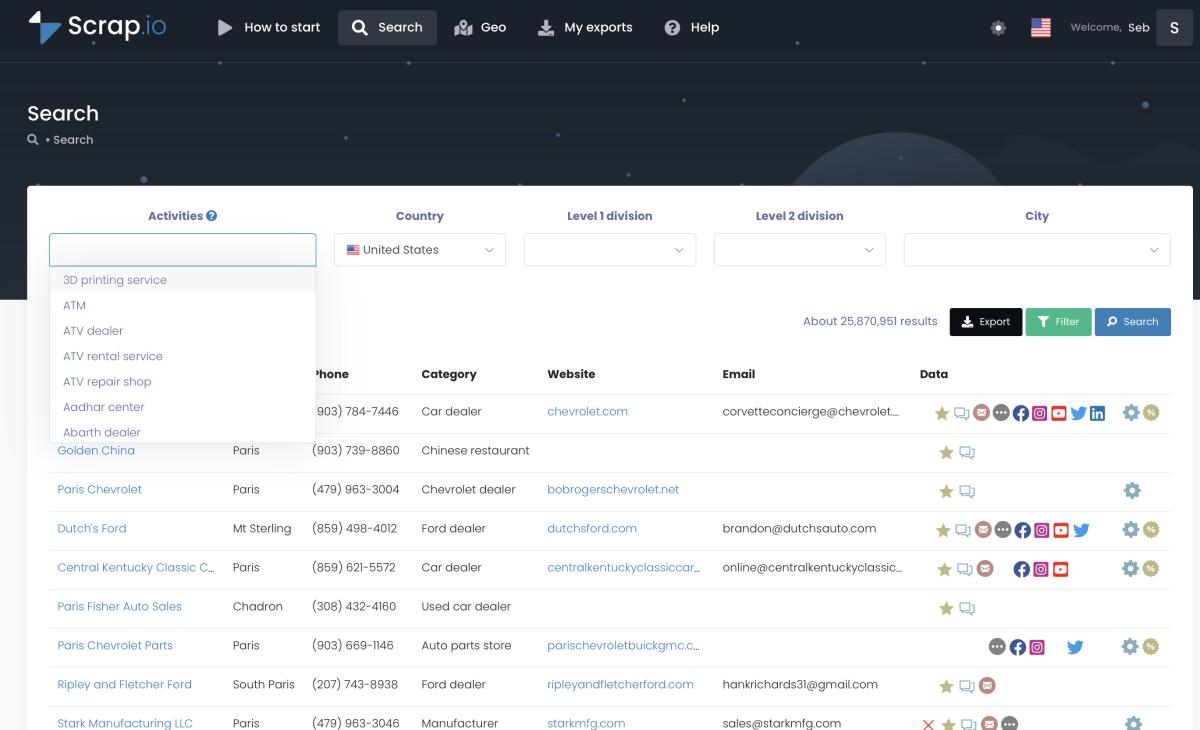
Search for "endocrinologist", pick your location, and the match count shows up instantly, for free.
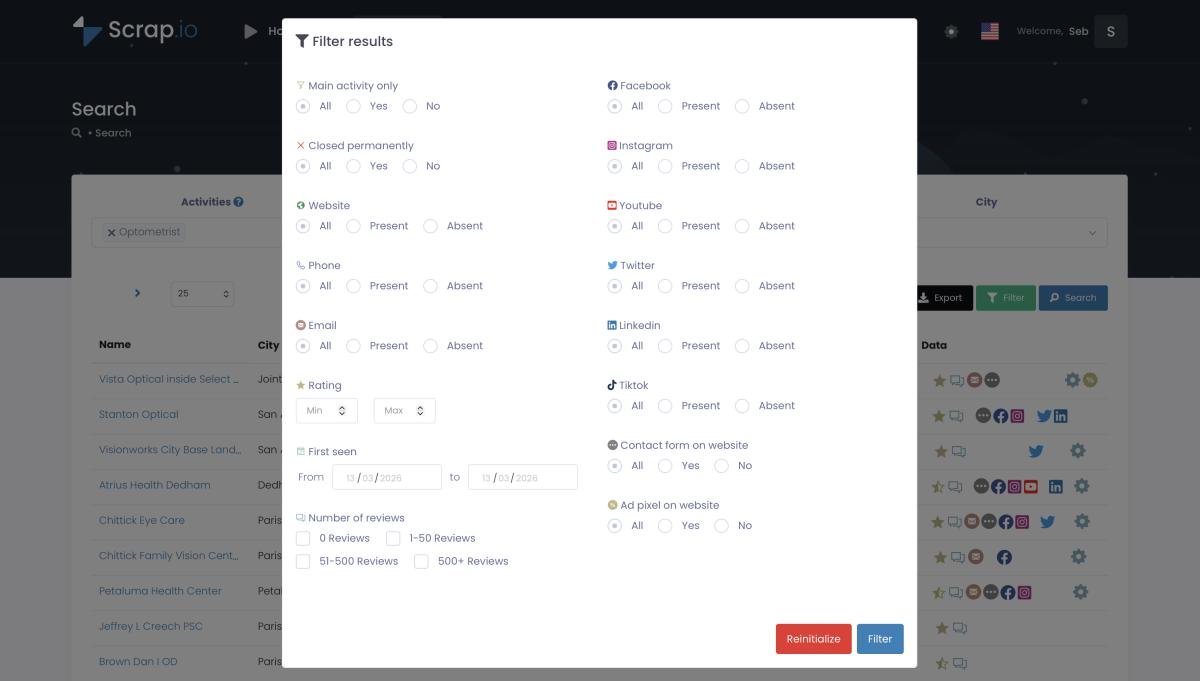
Filters apply before extraction, so you only consume credits on contacts that match your exact criteria.
That's it. No eight-month data project, no $2,000 invoice from a broker who won't say where the records came from. One client once pulled 11,734 businesses in 45 minutes this way. For the deeper mechanics of pulling addresses off the map, see our guides on how to find emails on Google Maps and the full Google Maps email extractor walkthrough.
Segment your list by subspecialty and filters
One generic email to all 20,000 listings? That's how you get ignored by all 20,000. "Endocrinologist" isn't one audience, it's a cluster of them, and a pediatric endocrinologist has almost nothing in common with someone running an endocrine oncology practice.
Subspecialties to target, and filtering before you extract
Think in segments before you export. Pediatric endocrinology. Reproductive endocrinology. Diabetes and metabolism. Neuroendocrinology. Endocrine oncology. Each one reads a different pitch. A CGM company cares about the diabetes and metabolism crowd; a fertility-device brand wants the reproductive side; nobody should be sending the same message to both. These are the diabetes, thyroid, and hormone specialists your offer actually fits, and segmenting them is the difference between a 2% reply rate and something you'd be proud of.
The filtering is where it gets efficient. Because you can narrow before you pay, you build tight micro-lists instead of one bloated file: endocrinologists in Texas with a website and an email, say, or practices rated above 4 stars in a single metro. Pull restaurants-level precision but for clinics. (OK, not restaurants, you get the idea.) The same filter panel that builds the list segments it, in one pass, before a credit leaves your account.
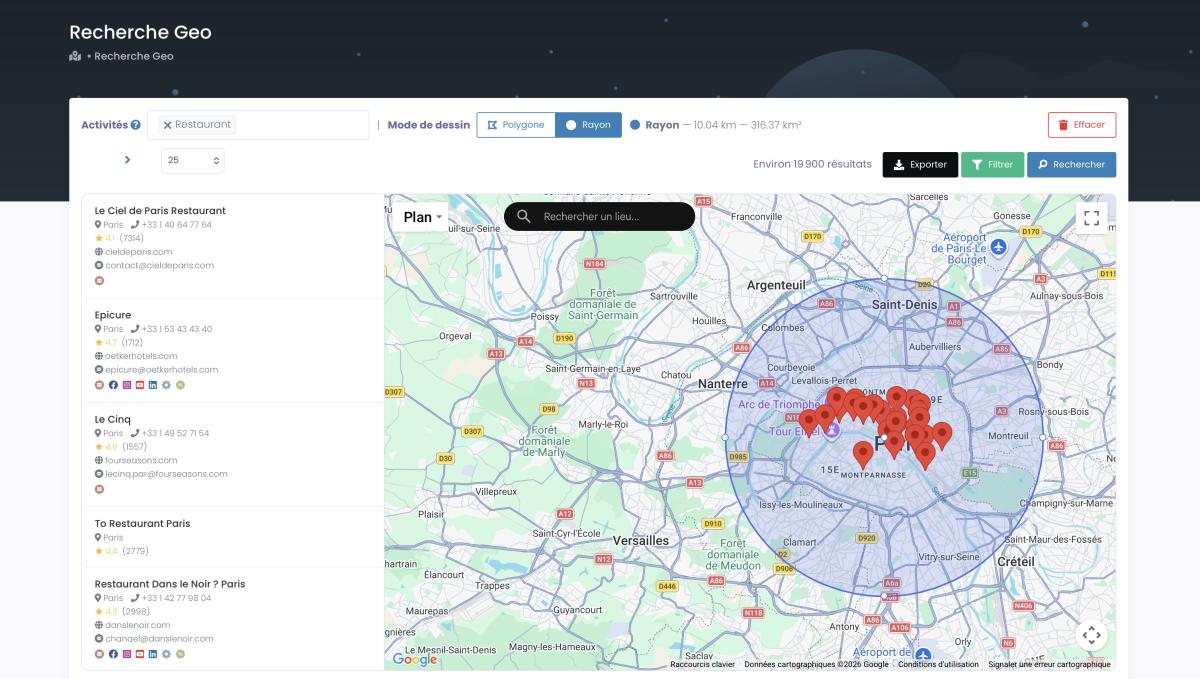
GeoSearch radius: target every endocrinologist within a set distance of any point on the map.
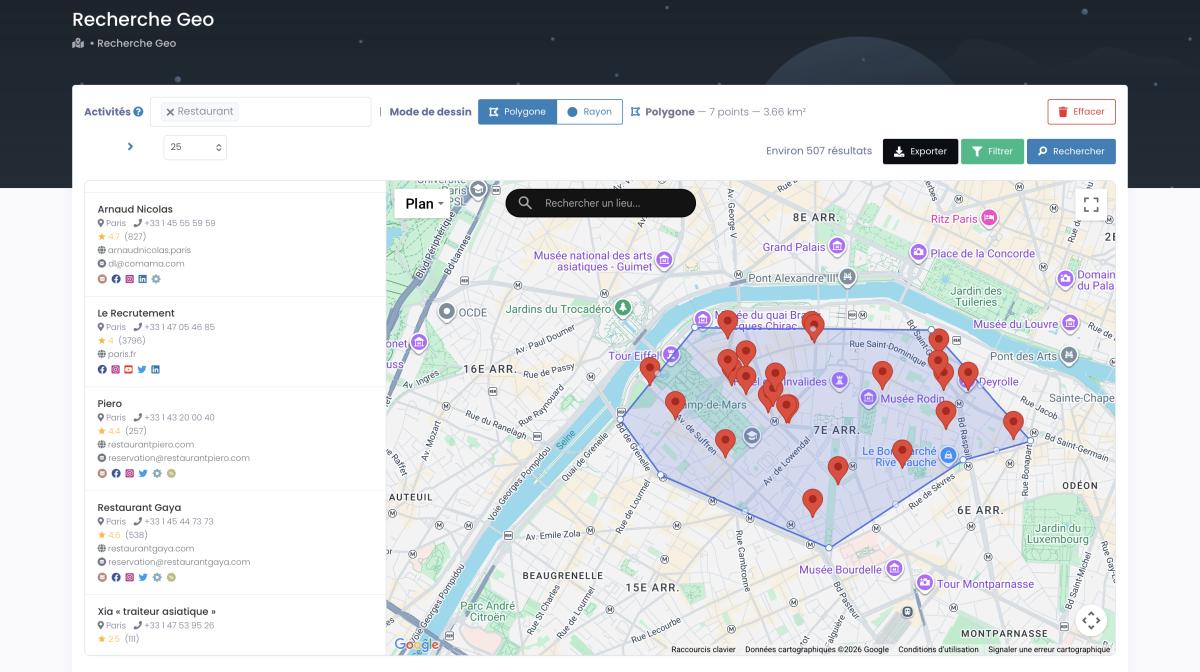
Or draw a polygon by hand for a custom area that doesn't fit any county or state border.
Selling to related specialties too? The same approach builds a physicians email list across 50+ categories, or a focused neurologist email list when your product crosses over. One platform, every specialty, same filter-before-you-pay logic.
Is it legal to email endocrinologists?
Short version: yes, if you follow the rules. The data you're working with here is public business information, the stuff a practice chose to publish on Google Maps and its own website. That matters legally, and it's a much stronger footing than a list from a broker who can't tell you where each record came from.
Public business data vs personal, plus CAN-SPAM and GDPR
In the US, B2B cold email is legal under CAN-SPAM. The rules are not complicated: no deceptive headers, identify yourself, include a real physical address, and give a working opt-out that you honor. No prior opt-in required. (The FTC can fine up to $53,088 per email that breaks the rules, so "not complicated" doesn't mean "optional.")
In the EU, GDPR applies, and B2B outreach can rest on the legitimate-interest basis, provided you document your reasoning and offer an easy opt-out. The catch is that ePrivacy rules vary by country, and Germany in particular is strict. If any of your targets sit in Europe, read our dedicated GDPR cold email B2B guide before you send, because the paperwork is what keeps you out of trouble. The one thing that makes all of this easier: every contact Scrap.io surfaces is traceable to its public source, which is exactly the documentation a regulator asks for.
How to email them so they actually reply
A great list emailed badly is a burned domain. So before you send a single message, understand that the list is half the job and the sending is the other half. Get both right or neither matters.
Video: How to Find the Best Email to Contact? Picking the right address so your message reaches a human.
Subject lines, personalization, and picking the right contact email
Pick the right inbox first. This is why email classification earns its keep. A message to a sales@ box reads completely differently from one to a named individual. Send the personal pitch to the individual address; send the value-first version to the generic one, and never assume the two are interchangeable. Guessing wastes your best line on an inbox nobody checks.
Then keep it short and specific. Fifty to a hundred and twenty-five words. One problem, one proof point, one question. A subject line that references something real ("question about your diabetes-tech workflow") beats a clever pun every time, and a first line that mentions the practice by name beats "Dear Doctor" by a mile. Want to email doctors without getting flagged as spam? Set up SPF, DKIM, and DMARC, warm up the domain, and keep your bounce rate low by starting from fresh data. The full craft is in our how to write a cold email guide.
Oh, and one more thing. Don't send once and quit. Most replies to good outreach come from the follow-ups, not the first touch, so plan a short, polite sequence before you hit send on message one.
FAQ
What is an endocrinologist email list?
It's a curated database of contact details for endocrinologists and endocrinology practices: name, practice, address, phone, website, and email. Pharma, medical-device, software, and recruiting companies use it for B2B outreach. The best versions are built from live, verifiable sources rather than bought as static files that go stale.
How many endocrinologists are there in the US?
Around 8,000 to 9,000 are in active clinical practice (MedTech Dive), but live Google Maps data surfaces 20,049 endocrinologist listings (Scrap.io, October 2026) once clinics and multi-location practices are counted. Vendor files range from 2,190 to 15,596, which is exactly why freshness and a traceable source matter more than any single headline number.
Is it legal to email endocrinologists you found online?
In the US, yes, under CAN-SPAM: no deceptive headers, identify yourself, include a physical address, and offer a working opt-out. In the EU, GDPR applies and B2B outreach can rely on legitimate interest with proper documentation. Scrap.io only surfaces publicly available business data, every record traceable to its source.
How accurate are bought endocrinologist email lists?
It varies, and often badly. Buyers report bounce rates over 60% on aging files, plus duplicates and recycled records resold to competitors. A static list decays from the day it's compiled. Building your own from real-time data avoids paying for contacts that are already dead.
How do I build my own endocrinologist email list?
Pick the category ("endocrinologist"), choose your zone (city, state, or the whole US), apply filters before extracting (email present, website, rating), check the free count, then export to CSV or Excel. Minutes with Scrap.io, with the data pulled live at the moment you export.
The bottom line
Every endocrinologist email list you can buy is a photograph of a moment that has already passed. The nine vendors ranking for this keyword sell you that photograph and hope you don't notice it fading. You can do better in an afternoon: pick the category, filter to the contacts that actually have an email, check the count for free, and export a list that's current today, not last spring.
Stop paying for contacts that bounce. Build the list yourself, keep it fresh, and email it like you mean it.
Generate a list of endocrinologist with Scrap.io