

A neurologist email list is a database of verified contact information — emails, phone numbers, practice addresses, and specialties — for neurologists across the United States, used by B2B companies for targeted healthcare outreach.
Last month, a medical device rep I've known for years sent me a screenshot of his email bounce report. He'd just paid $700 for a "premium neurologist email database." Out of 10,000 contacts, over 3,200 bounced. Dead addresses. Wrong clinics. One email went to a dermatologist's office in Tucson. (Neurologist. Dermatologist. Close enough, I guess?)
He's not alone. This happens all the time in healthcare B2B, and it's maddening because the opportunity is genuinely enormous. The WHO reported in 2024 that neurological conditions now affect 3.4 billion people globally — 43% of the world's population. The US has 47,420 practicing neurologists right now, and every single one of them is a potential buyer for someone reading this page.
Problem is, most neurologist email list companies are selling recycled spreadsheets from six months ago. And charging you $700 for the privilege.
I've been watching B2B healthcare marketing for years, and the gap between what list companies promise and what they deliver is wider than ever. The lists keep getting more expensive. The data keeps getting worse. And the buyers — device reps, pharma teams, SaaS companies — keep getting burned because they don't know there's a better option.
This guide is the antidote to that. I'll show you what actually works in 2026 for building a neurologist contact list that doesn't suck — where to get fresh data, what it should cost (spoiler: way less than $700), and how to not waste your marketing budget emailing retired doctors in Arizona.
Video: How to Extract Every Business in 1 Click with Scrap.io
📋 Table of Contents
- Why Traditional Neurologist Email Lists Fall Short in 2026
- The $7.57 Billion Neurology Market
- Who's Actually Buying Neurologist Email Lists?
- Scrap.io vs Traditional Providers: Live Data vs Stale Databases
- ROI Analysis: What to Realistically Expect
- Step-by-Step: Building Your Neurologist Database
- Legal & Compliance
- Beyond Email: Multi-Channel Outreach
- Neurologist Email List Providers Compared (2026)
- Frequently Asked Questions
Why Traditional Neurologist Email Lists Fall Short in 2026
Every legacy neurologist mailing list company has the same pitch. "10,000 verified contacts, updated quarterly, $700." Sounds fine on paper.
In practice? Disaster.
These companies collect data once, maybe twice a year. They shove it into a spreadsheet. Then they sell that exact same spreadsheet to 50, 100, sometimes 200 different buyers over the next six months. By the time you download the file and load it into your CRM, a third of the emails are dead. Neurologists retired, changed hospitals, moved states, started private practices, or — in one memorable case I heard about — passed away two years prior.
Quick math. You pay $700 for 10,000 contacts. Let's say 35% are garbage (industry average for lists older than 90 days). That means 6,500 usable contacts. You just paid roughly eleven cents each for data you're sharing with all your competitors. Oh, and those 3,500 bad emails? They're wrecking your sender reputation with every bounce.
Brain Doctors Don't Stay Put
Here's why neurologist data goes stale so fast. These people move. Constantly.
Back in 2012, research from PMC showed only 16,366 active neurologists treating a patient base that needed about 18,180 specialists. Already short-staffed then. Now the gap's even wider. The American Academy of Neurology has been ringing alarm bells about workforce shortages for years — and the shortage means aggressive recruiting, new practices popping up, hospital systems poaching specialists from each other.
Every job change. Every new practice. Every relocation. That's your contact data dying in real time.
"Updated Quarterly" Means Three Months of Wasted Emails
A neurologist switches hospitals in January. The list company's next refresh happens in April. For three solid months, you're emailing an address that goes nowhere. Your bounce rate climbs. Gmail notices. Outlook notices. Your domain reputation takes a hit that affects every email you send — even the ones going to valid addresses.
One bad campaign on stale data can tank your deliverability for weeks. I've seen it happen to companies that should've known better. (Our email validation guide gets into the technical details of what bounce rates actually do to your domain.)
And here's the part that really stings: while you were sending emails to nobody, 15 of your competitors already reached that neurologist at their new address. You didn't just waste money. You lost the race.
The $7.57 Billion Neurology Market: Why This Matters
Precedence Research puts the neurology market at $7.57 billion by 2034, growing at 7.72% per year.
That's drugs only.
The device side is even bigger. EEG machines, neurostimulation systems, brain monitoring equipment — Mordor Intelligence estimates the neurology devices market at $15.33 billion in 2026, heading toward $19.14B by 2030. The global neuroscience market overall? Around $41.21 billion this year. North America grabs 38-42% of that revenue.
Those aren't numbers you ignore.
An Aging Population with Aging Brains
By 2050, the US will have 90 million people over 65. Census Bureau's projection, not mine. Older brains break down more — that's just biology. The Parkinson's Foundation projects 1.2 million Americans with Parkinson's by 2030. Add Alzheimer's, stroke rehab, epilepsy, MS, and the WHO's updated 2024 figure showing neurological conditions as the world's leading cause of disability. Demand for neurology services isn't slowing. It's accelerating.
Too Few Neurologists for Too Many Patients
The World Federation of Neurology published some brutal numbers in 2024: low-income countries have up to 82 times fewer neurologists per 100,000 people than wealthy nations. Even the US can't fill the gap.
For B2B companies, this shortage is actually an opportunity. Overworked neurologists desperately need tools that save time — better diagnostic equipment, faster EHR systems, billing that doesn't take three hours, telehealth solutions. They'll respond to your email. But only if it reaches them, and only if it's relevant to the specific pain they're dealing with today. Not a generic blast. Not a pitch about dermatology software. (Yes, that happened. Don't be that company.)
Who's Actually Buying Neurologist Email Lists?
Medical Device Companies
Far and away the biggest category. Medtronic, Boston Scientific, Abbott — the major players in the $15.33B neurology devices space all depend on verified neurologist contacts to move product.
A guy I know sells portable EEG systems. He told me once: "Give me 500 neurologists who actually run sleep studies over 10,000 random neuro emails. I don't need volume. I need the right inboxes." He's correct, obviously. When you're selling equipment that costs more than most people's cars, the person reading your email needs to be the one who signs purchase orders. Not the office manager. Not the receptionist. Not the billing coder.
Device companies also use neurologist mailing lists for demo scheduling, training event invitations, and firmware update notices for equipment already deployed. The relationship doesn't end at the first sale — it compounds. If you're approaching device marketing across multiple specialties, the strategy overlaps with hospital email lists and medical clinic contact databases.
Pharma Companies (and Their Clinical Trial Recruiters)
Pharma targeting neurologists isn't new. What's new is how competitive it's gotten. Brain monitoring alone — $3.78B in 2025, projected $5.57B by 2031 (ResearchAndMarkets). New neurological drugs flood the pipeline constantly. Hundreds in clinical trials right now.
And clinical trials are the part most people forget about. If you're developing a new epilepsy treatment, you don't just need neurologists — you need neurologists whose patient populations match your trial criteria. You need current contact info. And you need to reach them before the rival trial three blocks away grabs every eligible patient. A neurologist database for pharma isn't some nice-to-have marketing accessory. It's infrastructure that touches drug launches, trial recruitment, key opinion leader identification, and post-market surveillance. Every part of the commercial and medical affairs operation depends on reaching the right specialists at the right addresses. Stale data doesn't just waste money here — it can delay a clinical trial by months.
Healthcare Tech and SaaS
Neurologists juggle some of the most complex diagnostic workflows in medicine. EEG readings. MRI interpretations. Drug interaction management across four or five chronic conditions per patient. Clinical trial documentation. The administrative burden is crushing, and neurologists know they need better tech.
They're also deeply skeptical. They've been pitched "practice-changing" software about 500 times. If your cold email sounds like every other vendor's cold email, it dies in the inbox. Understanding the specific frustrations neurologists face — not the ones you imagine they face — is what separates a 4% response rate from a 0.3% response rate. Same principles apply when building healthcare email lists for any specialty. And if you're starting from zero, our guide on how to build a cold email list walks through the whole sourcing-to-send process.
Education, Research, and Everyone Else
CME providers buying contact lists in bulk. CROs hunting for principal investigators. Conference organizers filling seats. Insurance companies marketing malpractice coverage. EHR trainers offering certification programs. The list of buyers is longer than most people expect.
The overlap with general physicians email lists and doctor email databases is substantial — but neurology's subspecialty depth adds real complexity. A movement disorders specialist and a headache clinic neurologist have almost nothing in common from a purchasing perspective. Comparing approaches across oncologist databases, psychologist email lists, and family practice physician contacts can help calibrate what realistic targeting looks like.
Scrap.io vs Traditional Providers: Live Data vs Stale Databases
OK so here's where it gets interesting. While legacy companies resell the same tired spreadsheet to your entire industry, there's a completely different way to build a neurologist email list.
47,420 US Neurologists. Extracted Live.
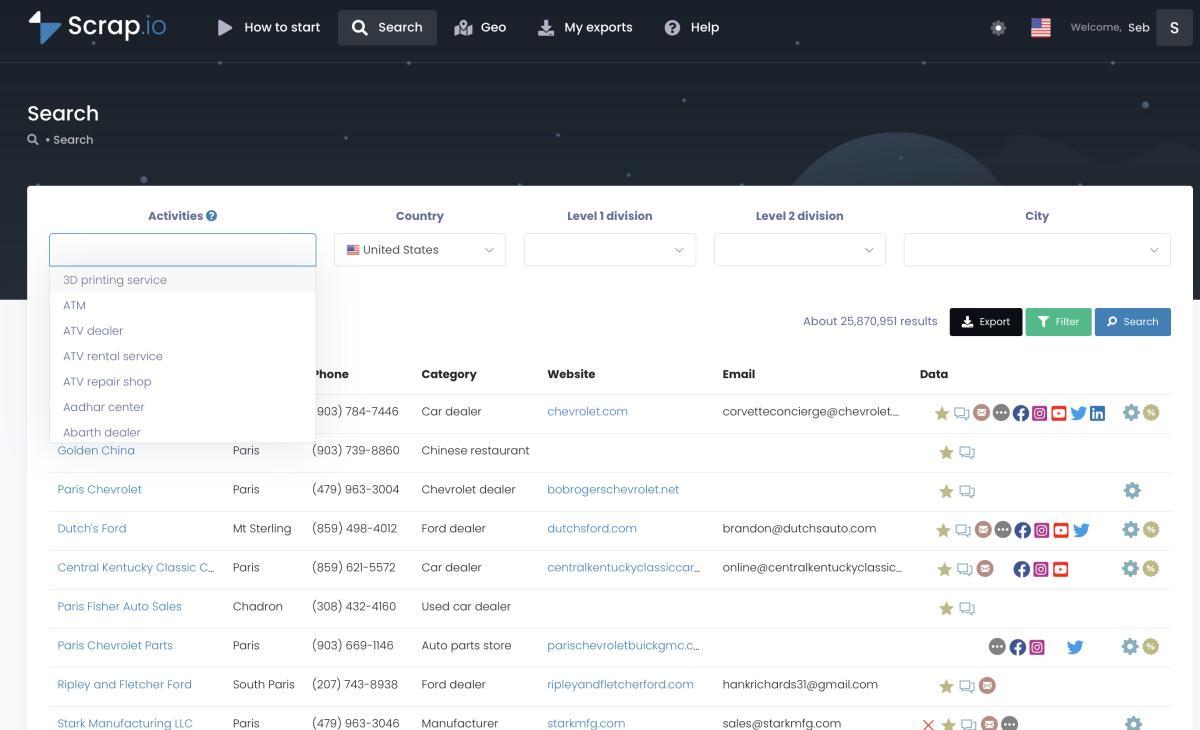
Scrap.io doesn't sell you a file compiled three months ago. It pulls contact info directly from Google Maps listings and practice websites — in real time. Right now there are 47,420 neurologists listed across the US, with 34,578 doing neurology as their primary thing.
That's a roughly 73% primary activity rate, which is better than most medical specialties. You're reaching actual practicing neurologists. Not retired doctors. Not administrators. Not someone who pivoted to radiology in 2023.
And because Scrap.io filters before you spend a credit, the raw counts get useful fast: of those 47,420 listings, 10,301 have a public email, 33,814 have a website (about 71%), and 46,441 have a phone number (roughly 98%). Toggle "email present" and you export 10,301 contactable neurologists — zero credits wasted on the ones you couldn't email anyway. Try getting that math out of a static database.
The practical difference is obvious when you run a campaign. With traditional lists, you might send 10,000 emails and get 300 bounces, 1,500 "no longer at this address" auto-replies, and a pile of spam complaints from people who never signed up for anything. With live data, your bounce rate stays under 5-8%, which is where it needs to be to keep Gmail and Outlook happy with your domain.
It's the same methodology we cover in our Google Maps scraping guide. When a neurologist updates their Google listing — new phone, new email, new location — you get that change immediately. Not whenever the list company gets around to their quarterly database refresh.
Live vs Stale, Side by Side
The whole "quarterly database" model is exactly what makes bought lists rot. Here's the contrast, visualized: recycled files on the left, real-time extraction on the right.
The Numbers Side by Side
| Traditional Providers | Scrap.io | |
|---|---|---|
| 10,000 neurologist contacts | $700+ (TargetNXT, InfoCleanse, LakeB2B) | ~$50 |
| Data freshness | Updated quarterly (at best) | Real-time from Google Maps |
| Accuracy after 6 months | 60-70% | 90%+ |
| GDPR compliance | Often unclear sourcing | Public data, fully traceable |
| Filtering | Basic (location, specialty) | Advanced (reviews, website, social, hours) |
A 1400% cost difference. For better data. That's not a marginal improvement — it's a different universe.
Want to see how the whole country gets pulled in one pass instead of city by city? This one's short:
Video: How to Scrape Local Leads at the Country Level
Scrap.io gives you access to 47,000+ verified neurologist contacts in real-time — pulled live from Google Maps across all 50 states, filterable before you spend a credit. Start your free 7-day trial — 100 leads included — and see for yourself.
ROI Analysis: What to Realistically Expect from Neurologist Email Campaigns
I'm going to be straight with you. The previous version of this guide had "case studies" claiming 29,000% and 399,000% ROI. Those numbers were... let's call them aspirational. Nobody verified them. They were the kind of made-up examples that make Google's E-E-A-T reviewers reach for the "thin content" stamp.
So here's what real healthcare email marketing performance looks like, based on Mailchimp's 2024 benchmark data:
- Open rates: 21% average for healthcare/pharma
- Click-through rates: 2.5-3.1%
- Response rates (cold outreach): 1-4% first touch
- Conversion to sales conversation: 0.5-2% of total sends
Neurologists tend to engage slightly above these averages. Why? They get fewer B2B emails than primary care docs. When something's genuinely relevant to their subspecialty — a new EEG system, a clinical trial for refractory epilepsy — they pay attention. Performance patterns are similar to what we see with dermatologist campaigns and cardiologist outreach.
Honest ROI Math (No Fairy Tales)
Here are the assumptions. All of them. Stated upfront:
- Data cost: $50 via Scrap.io (10,000 contacts)
- Email campaign cost: $200 (tool + design)
- Total investment: $250
- Open rate: 21% → 2,100 opens
- CTR: 3.1% of opens → ~65 clicks
- Conversion to qualified lead: 5-10% of clickers → 3 to 7 qualified leads
If you sell $15,000 medical equipment, one closed deal from those 3-7 leads = $15,000 on a $250 investment. That's 5,900% ROI. Still extremely good. And actually defensible.
SaaS company selling $200/month subscriptions? Three new annual customers = $7,200 from $250 in spend. Not life-changing money, but a fantastic return on a test campaign. Scale from there.
For context on what's achievable in healthcare B2B email, Marathon Health — a real company, not a hypothetical — reported generating $4.5M in pipeline from 22,000 emails with a 38% open rate using conversational email approaches (per an Impact case study). That's not neurology-specific. But it demonstrates what happens when you combine accurate contact data with messaging that doesn't read like it was written by a committee.
Five Things That Actually Move Response Rates
- Subspecialty filtering beats volume every time. An epileptologist doesn't care about your Parkinson's drug. Filter BEFORE you send. Not after.
- Specific subject lines. "Portable EEG for sleep disorder practices" destroys "Innovative medical device solution for your practice." Neurologists give subject lines about two seconds. Be specific or be deleted.
- Follow-up persistence. Healthcare sales cycles run long. Most deals happen after 4-7 touches. Give up after one email and you've abandoned 80% of potential responses. (If you want the science on follow-up sequencing, our cold email writing guide covers it.)
- Timing. Don't email during AAN Annual Meeting week — half your list is at the conference. Mondays are brutal for clinical schedules. Mid-week, late morning works best.
- Data quality is the prerequisite. None of the above matters when 30% of your emails bounce. Start with accurate contacts. Everything else is optimization on top.
Want to test these numbers? Start with 100 free neurologist leads on Scrap.io — a 7-day free trial — and run your own test campaign.
Step-by-Step: Building Your Neurologist Database with Scrap.io
Enough talking about why data matters. Here's the how. And if you're the type who'd rather watch than read, this walkthrough covers the setup end to end:
Video: Scrap.io — How to Start?
Step 1: Get Specific About Who You Want
Blasting 47,000 neurologists with the same email is lazy and it doesn't work. Even if every address is valid, a generic blast converts terribly. Specificity is the whole game.
Before you extract a single contact, decide:
- Geography — All US? Just California's ~7,200? The Houston medical center corridor? 50-mile radius around your sales team?
- Practice type — Hospital-based neurologists have completely different buying processes than solo private practices. A department head at Mass General lives in a different reality than a two-person neurology clinic in rural Montana.
- Subspecialty — Movement disorders. Epilepsy. Pediatric neuro. Sleep medicine. Headache/migraine. The more you narrow, the more relevant your pitch becomes.
- What contact info you need — Emails only? Phone numbers for follow-up? Social profiles for LinkedIn layering?
Step 2: Location Targeting
The whole point of extracting data from Google Maps is precision. National. State-level. City-level. Down to a specific hospital complex. You decide.
I've seen companies waste months debating whether to go broad or narrow. My recommendation? Start narrow. Pick one state or one metro area. Run a test campaign on 500-1,000 contacts. See what converts. Then expand to the next geography with the messaging that worked. This is so much smarter than blasting all 47,000 contacts on day one and hoping for the best.
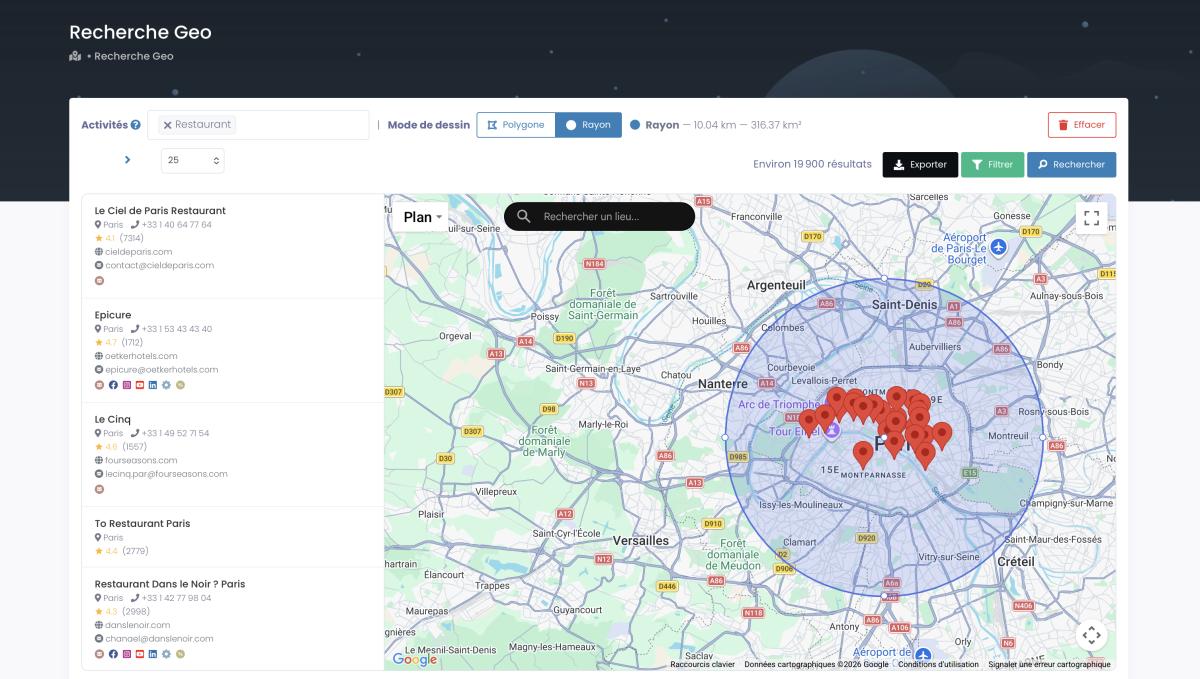
Some of the best-performing neurologist campaigns I've seen targeted a single city. A medical device company focused exclusively on neurologists in the Houston Medical Center area — maybe 200 contacts total — and booked 11 product demos in a month. They could've gone national and gotten lost in the noise. Instead, they owned one market first. GeoSearch makes this trivial: drop a radius around the medical center, or draw a polygon around the exact corridor you care about.
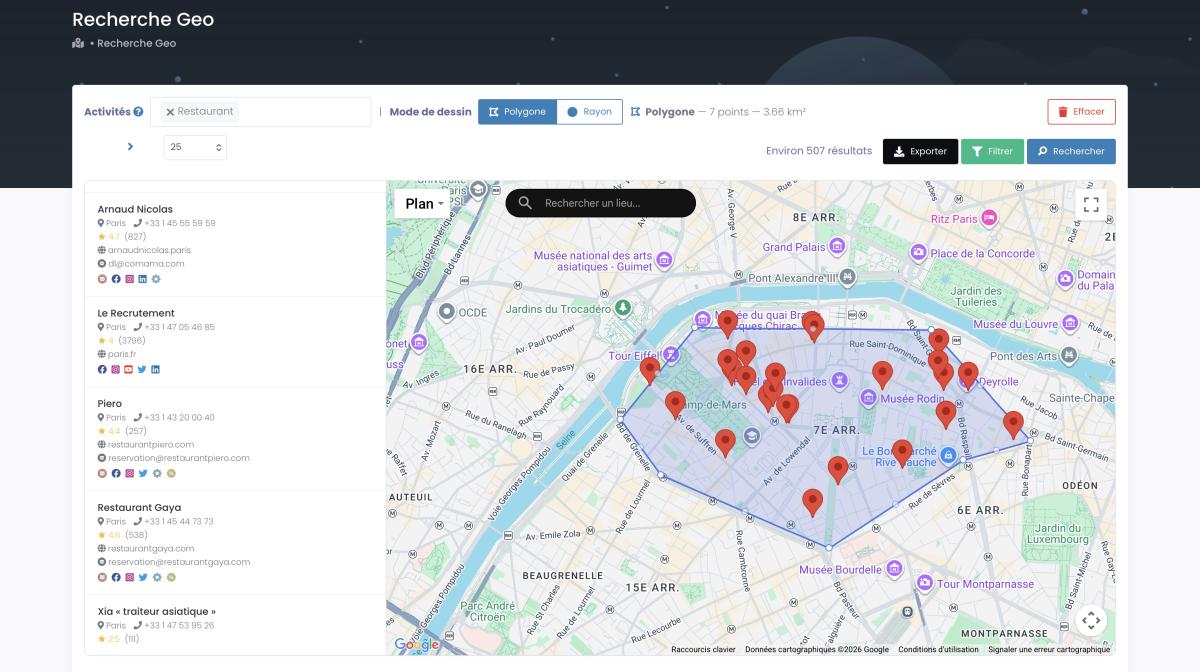
Step 3: Use the Filters (This Is Where It Gets Good)
Most people skip the filtering step. Don't. This is where you turn a giant list into a targeted weapon.
Digital presence filters — Does the neurologist have a listed email? An active website? Social media? Online booking? A practice with a complete, active Google Maps profile operates differently than one with three reviews and no website. That distinction tells you something about how tech-savvy they are, how established the practice is, and whether your SaaS pitch has any chance of landing. Remember those live counts — 10,301 with email, 33,814 with a website — that's exactly what the filters isolate before you pay.
Practice quality signals — High Google review ratings correlate with busier, better-funded practices. Lots of uploaded photos usually mean an active, marketing-aware office. Claimed listings indicate the practice pays attention to their online presence.
Where the Neurologists Actually Are
Geographic data from Scrap.io's real-time Google Maps extraction, March 2026:
| State | Approx. Neurologists | Notes |
|---|---|---|
| California | ~7,200 | Highest concentration |
| New York | ~4,800 | NYC metro dominates |
| Texas | ~3,900 | Houston + Dallas medical hubs |
| Florida | ~3,200 | Aging population = demand |
| Pennsylvania | ~2,100 | Philly medical corridor |
Growing markets worth watching: North Carolina (Research Triangle expansion), Washington state (Seattle's medtech cluster), Colorado (Denver healthcare boom).
Underserved = underexploited. Rural Midwest states are chronically short on neurologists. If you sell telehealth or remote diagnostics, that's where demand is hottest and competition for attention is lowest. Everyone else fights over California and New York inboxes. Those Midwest states? Wide open.
Legal & Compliance: GDPR-Compliant Neurologist Prospecting
Healthcare email marketing has extra rules stacked on top of the normal rules. Skip this section and you might learn about TCPA fines the hard way. (Spoiler: they're not small.)
GDPR and Public Data
When a neurologist puts their email on their Google Maps listing or practice website, they've intentionally made that information public for business contact. That's fundamentally different from buying a list where nobody can explain how the data was collected.
With Scrap.io, every contact has a clear paper trail: source (Google Maps listing), extraction date (real-time), data type (publicly posted business info). That's what GDPR compliance auditors actually want to see — not a vague "our data is GDPR compliant" badge on a website.
CAN-SPAM for Healthcare
Non-negotiable basics:
- Clear sender ID — your name, your company, no tricks
- Honest subject lines — "New EEG system" is fine; "URGENT: Your medical license" is fraud
- One-click unsubscribe — processed within 10 days
- Physical business address — in every single email
Our cold email compliance guide covers the specifics across GDPR, CAN-SPAM, and CASL. The FTC's CAN-SPAM reference page is the US primary source.
HIPAA (It's Not What You Think)
You're contacting business professionals at work addresses. You're not touching patient data. HIPAA doesn't directly apply to your B2B outreach. But — and this matters — neurologists deal with HIPAA all day every day. Their radar for anything that feels privacy-violating is maxed out. If your email even hints at sloppy data handling, it gets deleted immediately. Professionalism isn't optional with this audience.
TCPA — Read This If You Plan to Call
Your neurologist contact list includes phone numbers? Great. Planning to use auto-dialers or pre-recorded messages? Stop. Read this first. The Telephone Consumer Protection Act requires prior express consent for auto-dialed calls and pre-recorded voicemails to cell phones. Violations cost $500-$1,500 per call — per individual call, not per campaign. I've seen companies get hit with six-figure fines for ignoring this because they assumed B2B exemptions covered them. (They didn't. The TCPA doesn't care that you're selling medical equipment. It cares about the consent.)
Manual dialing to business lines is generally fine for B2B. But the second you introduce automation or pre-recorded audio, you're in TCPA territory. Get legal advice before scaling phone outreach. Not after the first lawsuit.
Beyond Email: Multi-Channel Neurologist Outreach
Email alone won't close a $50,000 equipment deal. It opens doors. Other channels build the relationship.
Most neurologists have profiles. Don't lead with a pitch — that's amateur hour and they can smell it from a mile away. Comment on their posts about new research. Share an interesting study you found relevant to their subspecialty. Build familiarity over a few weeks. Then, after they've seen your name three or four times in their feed, send a connection request with a personalized note referencing a specific post of theirs.
The conversion path is longer than cold email. Might take two to three weeks before you even send a connection request. But when the conversation finally starts, it starts at a completely different level of trust. You're "that person who always shares interesting neuro studies," not "random vendor #47 who wants 15 minutes of my time." Big difference. For a neurologist who gets cold-pitched by 10 vendors a week, that familiarity is worth its weight in gold.
Medical Conferences
The AAN Annual Meeting (spring, every year), ANA Conference, Movement Disorder Society International Congress — these are where deals actually close in neurology. Not over email. Not on LinkedIn. In person, over coffee, after a poster session.
Use your contact list to schedule meetings 6-8 weeks before the event. Not the week of. By then, everyone's calendar is packed tighter than a Manhattan subway car at rush hour. Pre-conference outreach — a short, specific email saying "I'll be at AAN, booth 412, would love 15 minutes to show you our new portable EEG system" — works shockingly well when it hits the right inbox at the right time. But it only works if the email address is current. Sending conference invites to addresses that bounced three months ago is just depressing.
Direct Mail + Email Combo
Old school? Sure. Effective? Absolutely — especially for big-ticket equipment sales. A well-designed case study brochure mailed to a neurologist's verified practice address, followed by a targeted email three days later, gets roughly double the response rate of email alone. The physical piece creates recognition. The email converts it.
Phone
Some neurologists just don't do email for vendor conversations. Period. They'll read your message, think "interesting," and then forget about it within 30 seconds because a patient walked in. But a quick phone call? If you catch them at the right moment — usually between patients, late morning or early afternoon — they'll give you three minutes. And phone coverage is the one field that almost never has gaps: of the 47,420 US neurologists in Scrap.io, 46,441 have a listed phone number — about 98%. So even when the email's missing, you've usually got a way in.
Use phone data from your list for lead qualification, demo scheduling, and most importantly, following up on emails that got opened but never clicked. An email open without a click often means "I was interested but got distracted." A phone call two days later converts that interest into an actual conversation way more reliably than a follow-up email does. Our cold email tools guide covers platforms that integrate phone and email sequences, and the cold emailing strategy guide breaks down response rate expectations across channels.
Neurologist Email List Providers Compared (2026)
If you're shopping for where to buy a neurologist email list, here's the honest breakdown. Every option has tradeoffs. I tried to be fair. (And if you want the wider view on why bought lists disappoint, we went deep on whether you should buy email lists at all.)
| Provider | Price (10K) | Freshness | GDPR | US Contacts | Filtering |
|---|---|---|---|---|---|
| Scrap.io | ~$50 | Real-time | Full (public data) | 47,420 | Advanced |
| MedicoReach | $600-800 | Quarterly | Claimed | Not disclosed | Basic |
| BookYourData | $500-700 | Semi-annual | Claimed | ~30,000 | Moderate |
| ReachStream | $400-600 | Quarterly | Claimed | Not disclosed | Basic |
| TargetNXT | $700+ | Quarterly | Claimed | Varies | Basic |
| InfoCleanse | $600+ | Semi-annual | Claimed | Varies | Moderate |
What Jumps Out
None of the traditional providers can tell you exactly when a specific contact's data was last verified. "Quarterly" means the whole database gets a pass. If Dr. Chen moved in February and the refresh happens in April, Dr. Chen's entry is wrong for two months. Minimum. You just don't know which contacts are current and which are ghosts.
Then there's the sharing problem. You buy from MedicoReach? So did 80 other companies this quarter. Your carefully crafted email lands next to 10 competing pitches from companies who purchased the identical data set. Real-time extraction gives you data that hasn't been resold to your entire competitive landscape.
And sourcing transparency. Ask a traditional provider exactly where they got Dr. Sarah Kim's email. Most can't answer. They aggregated, ran some verification, packaged it up, moved on. The chain of custody is opaque. Public data from Google Maps? You know exactly where it came from and when.
The "You Get What You Pay For" Objection
I hear this one a lot. "$50 for 10,000 contacts? Must be junk."
Fair instinct. Usually correct in other contexts — cheap usually means bad. But the economics here are genuinely different. Traditional providers carry massive overhead: sales teams fielding calls, account managers sending follow-up emails, data entry staff manually updating records, proprietary database infrastructure that costs a fortune to maintain. All that cost gets passed to you in the form of $700 invoices.
Automated extraction from public sources doesn't have that overhead. There's no sales team. No account manager. No person sitting in an office manually checking each neurologist's email against a hospital directory. The data isn't cheaper because it's worse. It's cheaper because the delivery mechanism is fundamentally more efficient to operate. The quality is actually better because it's live instead of months old.
For a broader perspective on evaluating data quality, our email validation guide covers what to look for regardless of which provider you use.
Frequently Asked Questions About Neurologist Email Lists
How much does a neurologist email list cost?
Traditional providers: $500-800 for 10,000 contacts. Scrap.io: about $50 for the same volume, extracted in real-time from Google Maps, on a 7-day free trial to start. You're paying 14x less for data that's actually current. The math doesn't require explanation.
Are neurologist email lists GDPR compliant?
Depends on where the data came from. Scrap.io extracts publicly available info from Google Maps — information neurologists chose to publish themselves. Full traceability on every contact. Lots of traditional providers can't offer that level of sourcing clarity, which should worry you.
How accurate are neurologist email databases?
Traditional lists lose 30-40% accuracy within six months. Job changes, retirements, practice closures — healthcare moves fast. Real-time extraction from current Google Maps listings gets you 90%+ accuracy because you're pulling live data, not a snapshot from last quarter.
Can I target pediatric neurologists specifically?
Yes, but the audience is tiny — roughly 1,500 pediatric neurologists in the entire US. Scrap.io's filters let you isolate practices mentioning pediatric care, childhood epilepsy, or developmental neurology. The targeting logic is similar to building niche chiropractor email lists or physical therapist databases.
What's the best way to reach neurologists for B2B?
Multi-channel. Email first (verified data, targeted list). LinkedIn second (relationship building). Conferences third (face-to-face for high-value deals). No single channel closes healthcare deals alone, but email is where most pipelines start.
How often should I refresh my neurologist contact list?
With traditional vendors, quarterly minimum — and you're paying each time. With real-time extraction, re-pull whenever you want. Your data is as current as your last export.
What data fields come with a neurologist email database?
Good ones include: emails, practice names, phone numbers, addresses, listed specialties, Google Maps data (ratings, review counts, photos), website URLs, social profiles, and business hours. Scrap.io pulls everything publicly available from Google Maps and practice websites.
Is it legal to email neurologists for B2B purposes?
Yes. Under CAN-SPAM: identify yourself clearly, use honest subject lines, include easy unsubscribe, list your physical address. Publicly available contact data from sources like Google Maps is legally solid ground for B2B outreach.
Can I get a neurologist email list for free?
Technically? Sure. Search Google Maps manually, browse AAN directories, check individual practice websites, peek at hospital staff pages. It works for 50-100 contacts. Beyond that, your time costs more than the data does. At roughly 2-3 minutes per contact (find the listing, locate the email, verify it looks legit, paste into a spreadsheet), building a list of 5,000 neurologists eats 150-250 hours. That's over a month of full-time work. The complete database costs $50, and the free 7-day trial gives you 100 leads to start. Pick whichever math makes more sense for your situation.
How do I find neurologist email addresses?
Three ways: manual research (free but slow), traditional list providers (expensive and stale), or real-time extraction from Google Maps via Scrap.io (fast, cheap, current). Our Google Maps email extraction guide covers the technical details.
How many neurologists are there in the US?
Scrap.io's July 2026 data shows 47,420 neurologists listed nationally, with 34,578 practicing neurology as their primary specialty. That covers hospital-based and private-practice specialists across all 50 states — the most comprehensive list of neurologists in the USA available through any public data source.
Are neurologist email list PDFs worth buying?
No. Hard no. PDFs can't import into a CRM. They can't be filtered, sorted, or updated. They're stale the moment they're exported. If a vendor is selling you contact data as a PDF file, run. You want CSV or Excel, ideally pulled in real time.
Enough Reading. Time to Act.
The neurology market is massive — $7.57 billion by 2034 in drugs, $15+ billion in devices, $41+ billion in neuroscience overall. 47,420 neurologists across the US need equipment, software, medications, and training. That market isn't getting smaller. If anything, the neurologist shortage means each individual specialist is making more purchasing decisions than ever because they're handling more patients with fewer colleagues.
But the window for reaching these neurologists with relevant offers narrows every month. Your competitors are already building fresh contact lists. They're segmenting by subspecialty, filtering by practice quality, sending targeted emails to neurologists whose info was verified yesterday — not last October. If you're still buying annual databases from legacy vendors, you're starting every race a lap behind.
Traditional list providers charge 14x more for data that's already decaying. They sell the same file to your entire competitive set. And they market "updated quarterly" like that's supposed to impress you. It shouldn't.
Here's what I'd do. Pull 100 neurologist contacts from Scrap.io with the free trial. Spend 20 minutes crafting a targeted email for one specific subspecialty in one specific geography. Send it. Measure opens, clicks, replies. If the data works — and based on everything I've seen, it will — scale from there. Total risk: an hour of your time. Potential upside: a direct pipeline to 47,000+ brain specialists who need what you sell.
Try Scrap.io free — 100 verified neurologist leads, 7-day trial. Start now and pull your first list from live Google Maps data across all 50 states.
While you're weighing options, those neurologists are updating their Google Maps listings, hiring new staff, expanding services, and making purchasing decisions. Someone's going to reach them with the right offer at the right time. Might as well be you.
Generate a list of neurologist with Scrap.io