

Half the engineering email lists ranking on Google right now aren't even engineering firms. They're bundles of individual engineers scraped off LinkedIn, a student directory, or a PDF someone dumped on Scribd back in 2021. Not the same thing. Not even close.
And that confusion costs people real money. You go looking for an engineering email list to pitch your software or your services to engineering companies, and you end up with 14,000 student profiles or a "role-based" file of job titles that bounces the second you hit send. Been there? A lot of people have.
So here's the plan. This guide draws a hard line between engineers (the people) and engineering firms (the businesses you can actually sell to), shows you how big the US market really is, and walks through building your own fresh engineering email list from Google Maps instead of renting a stale one. Real numbers, real sources, no fluff. Let's go.
Video: How to Scrape Local Leads at the Country Level?
Table of Contents
- What is an engineering email list (and what it isn't in 2026)
- How big is the US engineering market?
- Buy vs build: why static lists fail in 2026
- How to build your own list from Google Maps (step by step)
- Engineering email list by segment (civil, mechanical, structural, MEP)
- What data you actually get
- Is it legal to email engineering firms? (CAN-SPAM & GDPR)
- From list to replies: cold email benchmarks
- Engineering email list providers compared (2026)
- FAQ
- Conclusion
What is an engineering email list (and what it isn't in 2026)
An engineering email list is a file of business contacts for engineering companies: the firm name, a verified email, usually a phone number, a website, a location. You use it to prospect. Cold email, cold calls, CRM enrichment, the usual B2B playbook. That's the clean definition.
The messy reality is that the term gets slapped on three completely different products. Some sellers mean a list of engineering firms or an engineering companies list (businesses). Some mean an engineers email list (individual people). And some mean a recycled CSV of job titles with no company attached at all. If you've ever typed "list of engineering companies in usa" into Google and gotten a mess back, that's exactly why. Knowing which one you're buying is the whole game, and almost nobody tells you upfront.
Engineering firms vs individual engineers
This distinction matters more than anything else in this article, so let me be blunt about it.
Engineers email list vs engineering firms email list. An "engineers email list" (or "engineers email" file) targets individual people: a structural engineer's personal address, a student's inbox, a LinkedIn profile scraped into a spreadsheet. An "engineering firms email list" targets the business itself: the office of a civil engineering consultancy, a mechanical design shop, an MEP contractor. If you sell B2B, you want the firm. Firms have budgets, buying committees, and a published business address you can legally reach. A random engineer's Gmail has none of that, and emailing it is a privacy headache you don't need.
Here's why the confusion is so expensive. The keyword "engineers email list" pulls decent search volume, so sellers chase it, then fill it with whatever they can scrape: students, retired PEs, people who changed jobs two roles ago. Influencers.club, for instance, openly sells an engineering students email list of about 14,600 profiles, starting at 189 euros a month, built by scanning social bios with zero B2B compliance. Fine for whatever that is. Useless if you're trying to sell CAD software to a 40-person civil firm. Same story with those random "engineering email list pdf" files floating around forums and Scribd: a frozen dump, no method, no freshness.
Scrap.io covers the firms, not the individuals. Engineering consultants, civil firms, structural outfits, mechanical shops: the establishments that live on Google Maps with a real address and a real inbox. That's the half of the market this whole guide is about.
How big is the US engineering market?
Bigger than most people guess. There are 130,226 engineering services businesses in the US, a figure that's been nudging up year over year (about +0.8%) according to IBISWorld, 2025. That's a lot of buyers for anyone selling software, equipment, insurance, recruiting, or professional services into the sector.
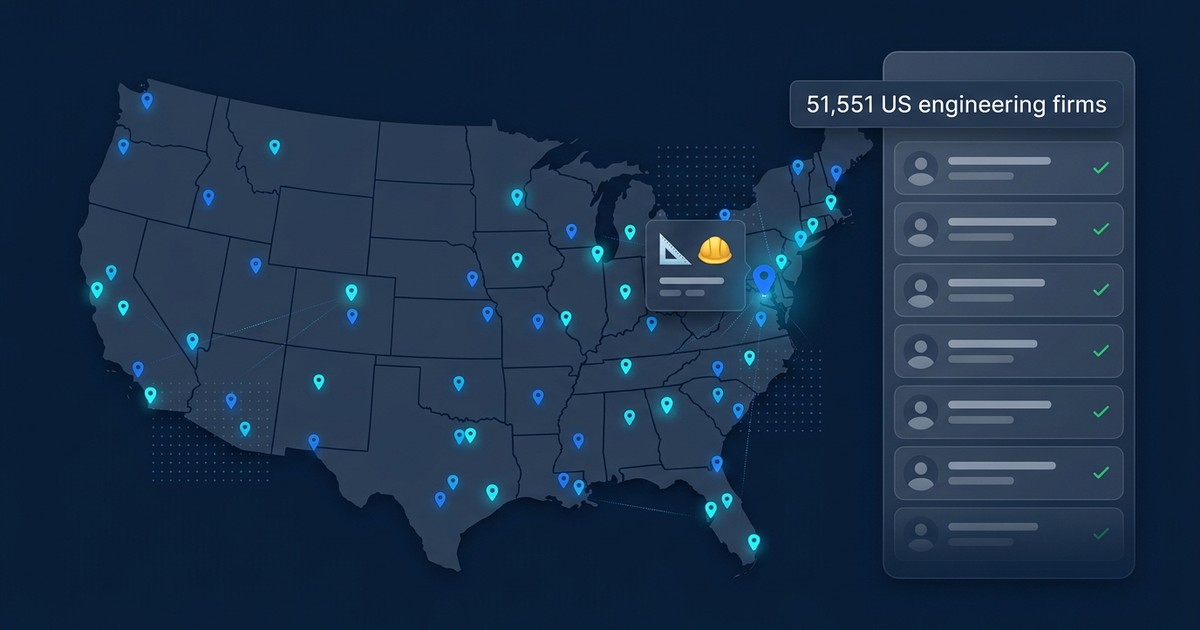
But the number that actually matters for prospecting isn't the total. It's how many of those firms you can reach with a real, contactable email. And that's where live data beats a market report. Pulled from Scrap.io on October 1, 2026, Google Maps lists 51,551 engineering firms in the US (consultants plus civil, structural and mechanical), and of those, 34,650 publish an email (about 67%) and 49,778 list a phone number (about 97%).
Read that again. Two firms in three already hand you an email address, in public, for free. You don't need to buy a broker's file to reach them. You need a way to pull the fresh data they're publishing themselves.
| US engineering firms (Google Maps) | Count | With email |
|---|---|---|
| All engineering firms (consultants + civil + structural + mechanical) | 51,551 | 34,650 (~67%) |
| Engineering consultants | 38,807 | 26,763 |
| Civil engineering companies | 6,847 | 5,091 (6,325 with a website) |
Source: Scrap.io, live data, October 1, 2026. These counts move daily as firms open, close, and update their listings. For industry context, the sector's standards body is the American Council of Engineering Companies (ACEC).
And because those counts shift in real time, a list you "buy" today is a photograph of a market that's already moved by the time you send. Which brings us to the fight at the heart of this whole topic.
Buy vs build: why static lists fail in 2026
A purchased engineering list is already dying the moment it lands in your inbox. Harsh? Maybe. True? Completely.
Here's the mechanic. A bought engineering companies database is a static snapshot. The second it's compiled, it starts rotting: people change firms, companies merge, offices close, domains lapse. B2B data decays fast, and engineering isn't exempt. You're also rarely the only buyer. That "exclusive" file got sold to a dozen other senders who already hammered those same inboxes, so some of the addresses are burned before you even show up. Spam traps, blacklists, bounces. A real cocktail.
Stale data is the single most expensive mistake in B2B outreach.
Don't take my word for it. On the Adobe Community forums, someone trying to talk their boss out of a purchased list got this from a community expert: "there's no guarantee that all or even a portion of mail will reach its destination on account of bounce backs, blacklists and spam filters." Same thread, same person, on the ROI: "Cold mail services usually have a reputation for sending large quantities of unsolicited mail. The return on investment (ROI) could be disappointing." People who've lived it keep saying the same thing.
The hidden cost of purchased lists (bounces, spam traps, blacklists)
The sticker price of a bought list is never the real price. The real price shows up three weeks later, when your domain reputation is in the gutter.
Walk through the math. You buy 10,000 "verified" engineering contacts. Say 25% have gone stale since the file was built (a conservative decay rate for a year-old list). That's 2,500 hard bounces waiting to happen. Push a bounce rate past 2% and mailbox providers stop trusting you, which means even your good emails start landing in spam. Hit a recycled spam trap, an address ISPs repurposed specifically to catch lazy senders, and you're not bouncing anymore. You're blacklisted. Now the whole campaign is dead, not just the bad rows.
That's the trap. You paid for the list, and the list paid you back by torching the one asset you can't easily replace: your ability to reach an inbox at all. If you want the full breakdown of sourcing fresh contacts the right way, our guide on how to build a cold email list covers it end to end. The short version? Build fresh. Fresh beats cheap, every time.
Curious how big your slice is? See how many engineering firms sit in your target state before you spend anything. Counting is free on Scrap.io, no credits used, so you can size the market (a single city, a county, or the whole US) and only then decide. Check your count free →
How to build your own list from Google Maps (step by step)
What if you could pull every engineering firm in Texas, with verified emails, in the time it takes to make coffee? That's not a pitch. That's just what the process looks like once you stop buying files and start extracting live data. Here's how to build an engineering email list from scratch, four steps, no code.
Step 1: Pick the right engineering categories
Google Maps classifies businesses into thousands of categories, and engineering isn't one monolithic bucket. Start by choosing the ones that match what you sell: "engineering consultant," "civil engineering company," "structural engineer," "mechanical engineer," and so on. Scrap.io lets you combine several categories in a single search, so you can pull civil plus structural plus MEP in one go instead of running three separate extractions. Pick precisely. A roofing-materials vendor and a CAD-software seller want very different slices of the same market.
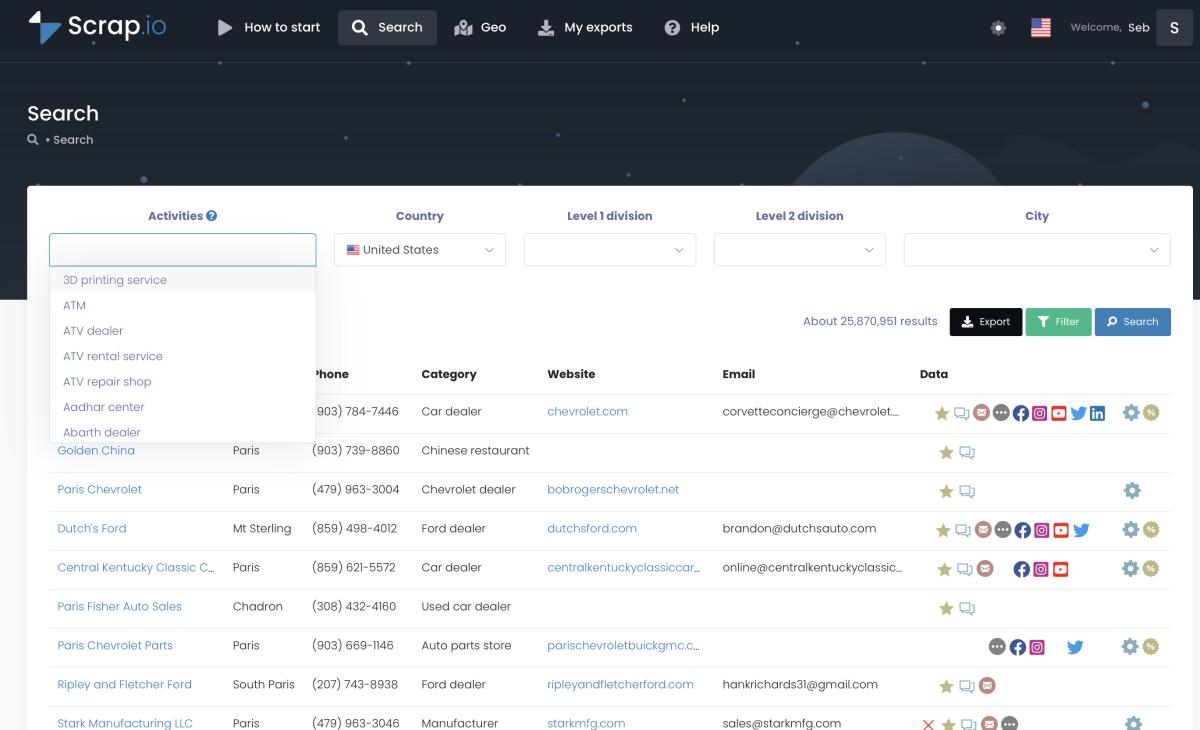
Step 2: Choose your zone (city to entire US)
Now pick where. One city, a county, a whole state, or the entire country in a single pass (country-level search is on the Company plan). This is where Scrap.io is genuinely different from a browser scraper: it can pull every matching firm across the US without you babysitting 50 separate searches.
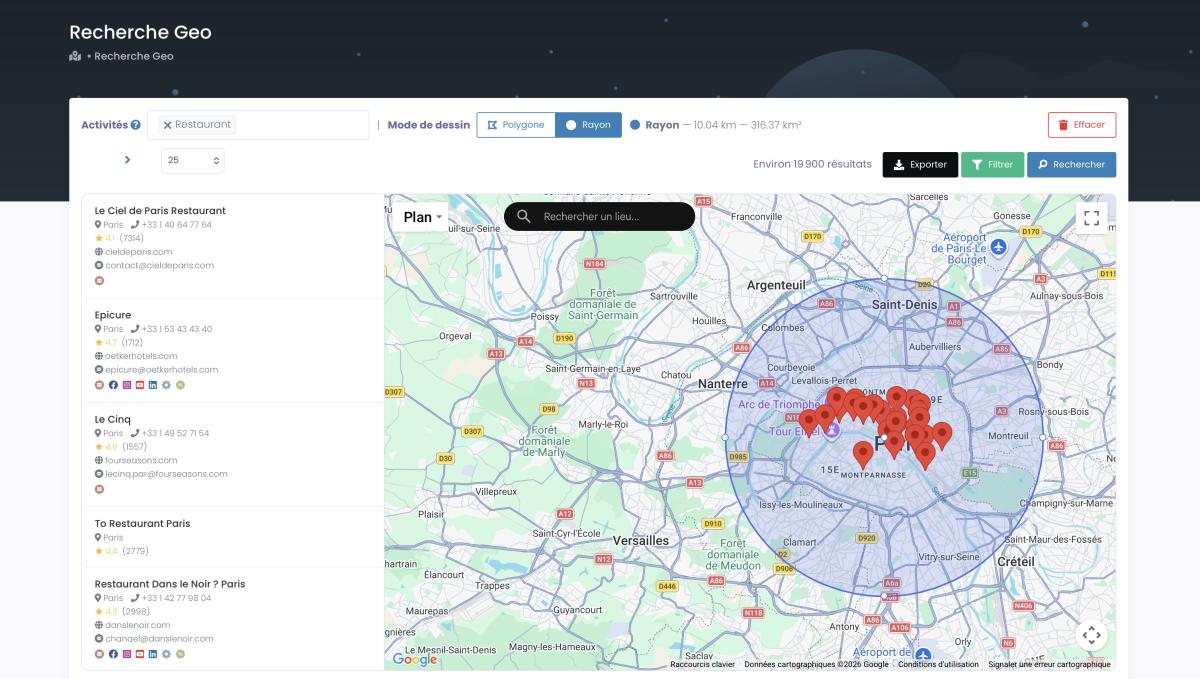
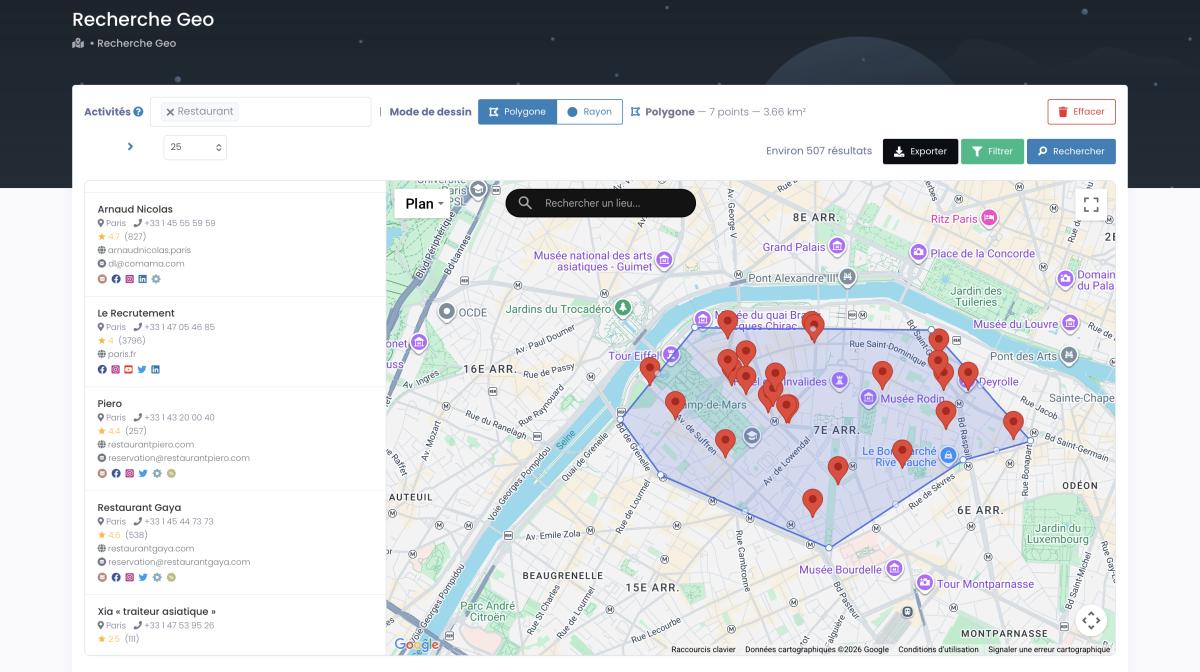
Need a shape that doesn't match an administrative border? GeoSearch gives you two tools. Draw a radius around a point (a metro, a construction corridor) or hand-draw a polygon around the exact zone you care about. Every filter still applies inside it.
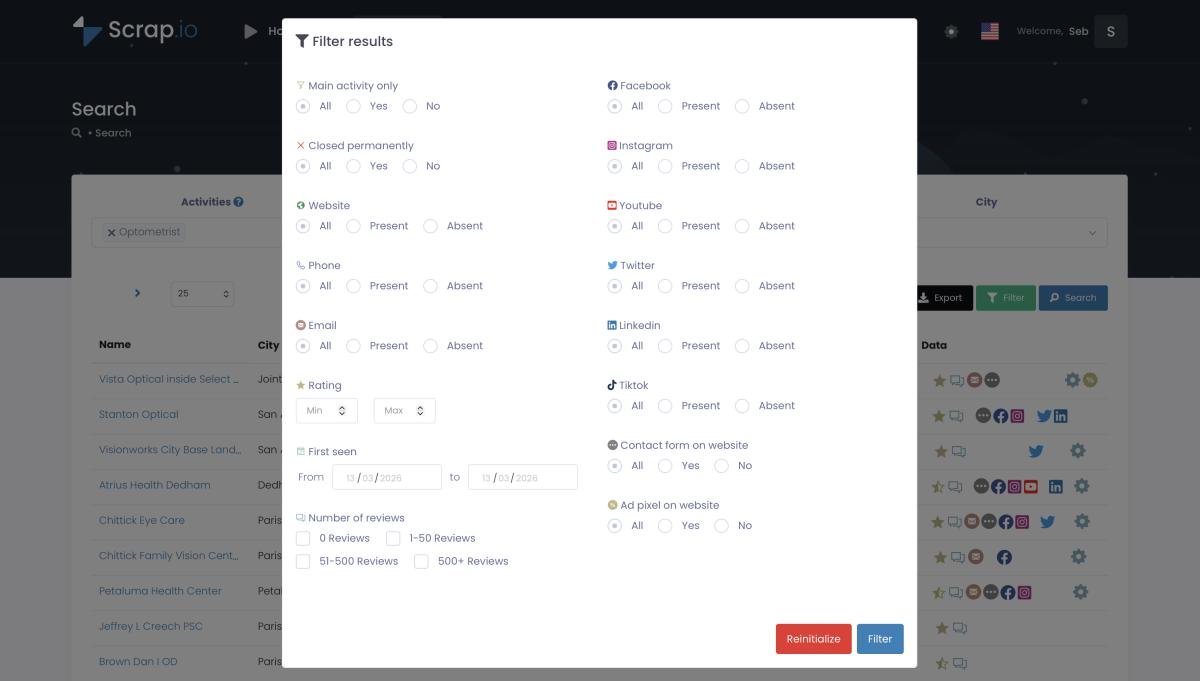
Step 3: Filter before extracting (email, phone, website)
This is the step that saves your budget, so pay attention here. Before you export anything, toggle the filters: "email present," "has a website," "mobile phone," minimum rating, whatever fits your campaign. The filters run before a single credit is spent, so you only pay for firms you can actually contact. No exporting 51,000 rows just to delete the 17,000 with no email.
Remember the market numbers? About 67% of US engineering firms publish an email. Filtering to "email present" means you extract those 34,650 contactable firms and skip the dead weight. That's the difference between a tool that charges you for junk and one that doesn't.
Video: Finding Clients Through Google Maps Filters
Scrap.io crawls each firm's website to pull and classify the email, which is how you get real addresses instead of guesses. If you want the deeper method, here's the full walkthrough on how to find business emails on Google Maps, and the complete Google Maps scraping guide if you like to understand what's happening under the hood.
Step 4: Export fresh, verified data
Last step. Hit export. CSV or Excel, ready to drop into your sequencer or CRM. Every row is current as of the moment you pulled it, because Scrap.io extracts in real time rather than serving a cached database. One client extracted 11,734 businesses in 45 minutes, so volume isn't the bottleneck. Freshness is the point.
Bon. That's the whole loop: pick categories, pick a zone, filter before you pay, export. Do it again next quarter and you get this quarter's data, not a file aging in a warehouse. If you'd rather see the raw extraction mechanics, the Google Maps email extractor page breaks down exactly what comes out.
Build your first engineering list now. Scrap.io gives you a 7-day free trial with 100 leads included, across 225,676,406 businesses in 195 countries and 4,000+ categories. Pick your engineering categories, filter to email-present firms before you spend a credit, and export a fresh list today. Start your free trial →
Engineering email list by segment (civil, mechanical, structural, MEP)
Engineering isn't one market. Civil, mechanical, structural and MEP buy very differently, sell to different clients, and respond to different pitches. Lumping them into one blast is how you get ignored by all four. So segment. Whether you're after an engineering consultant email list or just raw b2b engineering leads, the method stays the same: slice first, extract second.
Civil, mechanical, structural and MEP firms list
A quick tour of the verticals, with the lens of someone building a list for each.
A civil engineering email list targets the firms behind roads, water systems, site development and public infrastructure. On Google Maps that's 6,847 US civil engineering companies, 6,325 with a website and 5,091 with an email (Scrap.io, October 2026). Project-driven buyers, long sales cycles, so your messaging leans on credibility and track record.
A mechanical engineering email list covers HVAC design, product development, manufacturing support, thermal and systems work. These firms buy CAD and simulation tools, components, and outsourced design. Technical audience, so vague "digital solutions" copy dies instantly here.
A structural engineering firms list and a MEP engineering firms list sit close to the construction world. Structural does the load-bearing math; MEP handles mechanical, electrical and plumbing design for buildings. Both overlap heavily with contractors and architects, which is why they pair well with sibling lists. If you work the built environment, a construction company email list and a manufacturer email list are natural companions to your engineering file, not competitors to it.
One more segment people conflate: a construction engineering email list usually means firms that bridge design and build. Same extraction method, just different category toggles. And if you want to work a whole vertical at once instead of one trade, you can build a broader email list by industry across 4,000+ Google Maps categories using the exact same four steps.
What data you actually get
An email on its own is a weak lead. What turns a list of engineering companies into a campaign is everything that rides alongside the address. Here's what comes out of a Scrap.io export per firm.
The firm identity: name, full address, city, ZIP, GPS, primary and secondary categories, website, opening hours, claim status. The engagement signals: Google rating, review count, review breakdown, photo count. These double as lead-scoring fuel, because a 2-star firm with a handful of reviews needs very different outreach than a 4.8-star outfit with 300.
Then the contact data, which is where it gets useful. A primary email, plus classified emails: individual (with first and last name parsed out), contact (info@, hello@), sales, marketing, finance, administration. You know whether you're writing to a named person or a generic inbox before you send a word. There's also the phone number with its type (fixed, mobile, special), social profiles, and website intel like the CMS, detected tech stack, and ad pixels. That last bit is gold for agencies prospecting firms by what they're already running.
Why does the classification matter so much? Because an engineer email address that belongs to a named individual converts very differently from a shared contact@ box nobody checks. Sorting that out automatically, at export, saves hours of manual guessing.
Video: How to Find the Best Email to Contact?
Is it legal to email engineering firms? (CAN-SPAM & GDPR)
Now the less fun but essential part: can you legally email these firms? Short answer, yes, for B2B, if you follow the rules. Longer answer below.
In the US, cold email to businesses is governed by CAN-SPAM, and it does not require prior opt-in. What it does require: honest headers and subject lines, a clear statement that the message is a solicitation where relevant, a valid physical mailing address, and a working opt-out that you honor within 10 business days. Miss those and the penalty runs up to $53,088 per email, so this isn't a corner to cut. Meet them and you're fine.
If you're reaching into Europe, GDPR applies, and B2B cold email there typically rides on "legitimate interest" rather than consent, as long as the message is relevant to the recipient's professional role and the opt-out is easy. It's more paperwork than CAN-SPAM, and a few countries (Germany, mainly) are stricter. We mapped the whole thing in the GDPR cold email guide for B2B if you sell across the Atlantic.
Here's where your data source quietly helps you. Scrap.io pulls only publicly available business data, is GDPR and CCPA compliant, and every record is traceable to its source. When a regulator or a prospect asks "where did you get this?", "this firm publishes its email on its public Google listing and we targeted it by industry and location" is a solid answer. "We bought a list" is not. Compliance starts with where the data came from.
From list to replies: cold email benchmarks
A fresh list is step one. Replies are the point. So what should you actually expect once the engineering firms are in your sequencer?
The average B2B cold email reply rate in 2026 is 3.43%, with open rates around 27.7%, which works out to roughly one or two meetings per 100 emails (Cleverly / Instantly, 2026). Those are averages, though, and averages hide the real lever: targeting. Campaigns sent to fewer than 50 recipients average a 5.8% reply rate, versus 2.1% for big blasts. Smaller and sharper wins. Every time.
Targeting is the whole ballgame.
Reply rates also swing hard by sector. Rough 2026 benchmarks: Legal 8-10%, Real Estate 5-7%, IT and MSP 3-4%, SaaS 2-4% (Cleverly, 2026). Engineering sits in that under-emailed middle, which is good news for you: these firms aren't drowning in outreach the way a SaaS VP is, so a relevant, well-targeted message actually gets read.
A few mechanics worth banking. Keep the email under 80 words. Expect about 58% of replies on the first email and the rest from follow-ups, so plan a sequence of 4 to 7 touches, not a one-and-done. And keep your bounce rate under 2%, which loops right back to data freshness. The best way to hit that number is to start clean and verify your email list before every send. For the copy itself, our breakdown of how to write a cold email that gets replies has the full framework.
Precision beats volume. That's not a slogan, it's a case study. GC Solutions, an AI and geospatial engineering firm, ran targeted outbound into engineering and construction decision-makers and booked 50+ qualified inquiries and 25+ meetings in three months (Leadee case study). Their own takeaway, quoted on the case page: "Precision beats volume. Reaching the right 50 decision-makers with relevant messaging delivers more value than chasing hundreds of unqualified leads." A clean, tightly segmented list of the right engineering firms will out-earn a bloated one, quoi.
Engineering email list providers compared (2026)
So where do people actually get these lists today? Mostly from static sellers, and the quality ranges from "fine" to "please don't." Here's an honest rundown of the landscape, based on what each provider publicly offers as of 2026.
| Provider | Type | Data freshness | Targets firms or people? | Watch-out |
|---|---|---|---|---|
| Scrap.io | Real-time extraction (Google Maps) | Live, every export | Firms (local / SMB) | Not for enterprise-only ICPs |
| BusinessDataProspects | Static purchased file | Periodic, UK-skewed | Firms | Shared, aging, promo-heavy |
| BizKonnect | Static purchased file | Unclear | Firms (niche) | No proof figures, no FAQ |
| Influencers.club | Social-scraped file | Periodic | People (students) | Off-target, from 189 euros/mo |
A couple of things jump out. BusinessDataProspects lists 54,109 engineering companies for the UK and 377,100+ worldwide (US 143,754, Europe 88,156, Asia 59,301, Rest of World 31,871), which sounds impressive until you remember it's a shared, static file skewed to the UK and wrapped in a permanent 60%-off banner. BizKonnect sells niche aviation-engineering contacts but publishes no proof of freshness or deliverability. And Influencers.club isn't even selling firms; it's selling scraped student profiles, which is the exact "engineers vs firms" confusion that opened this article.
The honest read: static sellers hand you a file that was accurate at some unknown point in the past. Scrap.io hands you one that's accurate right now, filtered to your exact criteria, exclusive to your search. For local and SMB engineering outreach, that's not a close call. For a purely enterprise ICP with named global accounts, a big aggregator might still have a role. Horses for courses.
Join 50,000+ professionals building fresh lists with Scrap.io. Rated 4.8 on Capterra and 4.9 on G2, it pulls live engineering firm data from Google Maps across 195 countries, with filtering that only charges you for contacts you can actually use. See why they switched →
FAQ
How many engineering firms are in the US?
There are 130,226 engineering services businesses in the US (IBISWorld, 2025). Of those, 51,551 appear as engineering firms on Google Maps, and about 34,650 publish a usable email address (Scrap.io, October 2026). The gap exists because not every registered business maintains an active, contactable public listing.
Where can I get an engineering companies email list?
Two routes. You can buy a static file from a data broker, which is fast but decays quickly and is usually shared with other buyers. Or you can build a fresh one yourself by extracting engineering firms from Google Maps with a tool like Scrap.io, filtering to "email present" so you only export contactable firms. The second route gives you current, exclusive data and costs far less per usable contact.
Is it legal to email engineering firms in the US?
Yes, under CAN-SPAM. You don't need prior consent to email a business, but you must use honest headers and subject lines, include a valid physical address, and provide a working opt-out that you honor within 10 business days. Scrap.io sources only publicly available business data and is GDPR and CCPA compliant, which keeps your sourcing on solid ground.
Should I buy or build an engineering email list in 2026?
Build. Purchased lists go stale at roughly 25-30% a year, bounce hard, and can drag your domain onto blacklists, because they're shared and over-mailed. A list you extract fresh from Google Maps is current the day you send, exclusive to your search, and filtered before you pay. Freshness and deliverability both favor building.
What's the difference between an "engineers email list" and an "engineering firms email list"?
An engineers email list targets individual people: personal inboxes, student profiles, scraped LinkedIn addresses. An engineering firms email list targets the businesses themselves: consultancies, civil and mechanical shops, MEP outfits with a public address and a company inbox. For B2B selling, you want the firms. Scrap.io covers firms, not individuals, which is exactly the half of the market worth prospecting.
Conclusion
The engineering market is big, under-emailed, and mostly reachable with data the firms publish themselves. The catch has never been finding engineering companies. It's reaching them before the data goes stale and your domain pays for it.
So skip the broker's dusty file. Pick your categories, choose your zone, filter to email-present firms, and export a list that's accurate today. Segment by vertical, keep the emails short, follow up, and respect the opt-out. That's the whole playbook, and it beats a purchased list on freshness, cost, and compliance all at once.
Stop renting stale data. Extract your own engineering email list free for 7 days (100 leads included) with Scrap.io: live Google Maps data across 51,000+ US engineering firms, filtered to email-present contacts before you spend a credit. Build your list now →
Generate a list of engineering consultant with Scrap.io