

42,708. That's how many food and beverage manufacturing businesses the US Census counted across the country in 2022 (US Census County Business Patterns, 2022). Add the distributors, the wholesalers, the beverage companies and the foodservice suppliers, and the number climbs fast. Now go try to find a current food and beverage industry email list for even a slice of them.
I'll wait.
Here's what actually happens. You search "food and beverage industry email list," and the first page of Google is a wall of vendors selling you a pre-packaged file: Data Axle, DataCaptive, Point To Business, a handful of others. Buy now, download, blast. Nobody, and I mean nobody, tells you how to just build a fresh one yourself. So that's the gap this guide fills. How to find food and beverage company emails that are actually alive, filtered to the exact slice you sell to, without paying for a spreadsheet that started rotting the day it was compiled.
- What Is a Food and Beverage Industry Email List?
- The Food and Beverage Industry in 2026
- Buy vs Build: Why Most Lists Fail You
- List of Food and Beverage Companies to Know
- How to Build Your Own, Step by Step
- Segment Your List: Manufacturers, Distributors, Foodservice and Retail
- Keep It Clean and Compliant: Deliverability and CAN-SPAM
- FAQ
- The Bottom Line
What Is a Food and Beverage Industry Email List?
A food and beverage industry email list is a file of business contact details, mostly email addresses, for companies that make, move, or sell food and drink. Manufacturers. Beverage brands. Distributors and wholesalers. Foodservice suppliers. The useful ones also carry a name, a phone number, a website and a location, so you can actually personalize your outreach instead of shouting into a generic inbox.
That's the plain definition. The catch is in the word "industry."
Because "food and beverage" isn't one audience. A craft brewery, a frozen-food plant, a regional seafood distributor and a national snack brand all live under that umbrella, and they buy completely different things. A good food and beverage industry contact database lets you slice by exactly which of those you want. A bad one hands you 50,000 rows of "food companies" and wishes you luck. That distinction, broad business email list versus targeted food company email database, is the whole ballgame, and it's why dumping everything into one bucket almost never converts.
The Food and Beverage Industry in 2026
Let me give you the lay of the land before we talk tactics, because the size of this market is the reason the outreach is worth doing at all.
Food and beverage manufacturing is one of the biggest slices of US industry, full stop. It employed 1.7 million people in 2021 and accounted for 16.8% of all US manufacturing sales that year (USDA Economic Research Service). Not a niche. Nearly a sixth of everything American factories ship.
And here's the part that matters for prospecting, the one food and beverage industry trends reports keep underselling: this sector is overwhelmingly small. More than 75% of food manufacturers have fewer than 100 employees (NIST). Think family-run bakeries, regional sauce makers, single-plant beverage bottlers. These are real companies with real budgets, and most of them are invisible on LinkedIn. They don't have a VP of Marketing posting thought-leadership. They have an owner who checks a shared inbox between production runs.
Zoom out and global food production is projected to reach roughly $4.5 trillion by 2026 (NIST). Enormous. But for a quick food and beverage industry overview that's useful to a seller, the takeaway isn't the trillions. It's the fragmentation. Thousands of small, reachable operators who will never show up in a premium B2B database built for enterprise sales. That's your edge, if you can find them.
Spoiler: Google Maps already has them.
Buy vs Build: Why Most Lists Fail You
So you bought the list. 10,000 food and beverage contacts, "95% verified," a few hundred bucks. First send goes out. And a chunk of it bounces straight back before you've finished your coffee.
This isn't bad luck. It's math.
B2B contact data decays roughly 22 to 30% per year as people change jobs, companies rebrand, and domains get retired (Tomba, 2026; HubSpot pegs the figure near 22.5%). Put a number on it: a list of 10,000 loses about 4,400 usable contacts within 24 months, leaving you roughly 5,600 that still work (Tomba, 2026). Up to 70% of role-based addresses change within a year. So that "fresh" file you bought in the spring? By autumn, a quarter of it is already pointing at people who left.
And the vendors know. Read the fine print and you'll see "refreshed every 45 days" dressed up as a feature (DataCaptive markets 758K+ global food and beverage contacts on exactly that cadence). Forty-five days. That's a month and a half of decay baked in between every update. Quarterly refresh is just marketing-speak for "stale on arrival." We ran the full math on why buying email lists rarely pays off, and it's grim reading.
Zoho says it bluntly: purchased mailing lists "will damage the reputation of your sender domain and IP address" (Zoho). The folks doing cold email for a living agree, loudly. A running theme across the r/sales and r/coldemail threads is the same trio of complaints about bought lists: contacts who already quit, generic info@ inboxes nobody reads, and leads so over-mailed they've muted every sender alive (Reddit, via Tomba). As that write-up puts it, "no template rescues a list of guessed, unverified addresses."
Building is the opposite motion. Instead of inheriting someone else's rot, you pull the data fresh, right now, from public Google Maps listings and the websites behind them. When a beverage distributor updates their site or a new food processing company opens, that's in the data you extract today. Not last quarter's. Today's.
Which list bounces less? You already know.
| Factor | Bought list | Built with Scrap.io |
|---|---|---|
| Data freshness | Decays 22–30% per year | Fresh at the moment of export |
| Targeting | Generic, broad categories | Filter before you pay |
| Small food makers (<100 staff) | Mostly missing | 7,690+ US food manufacturers indexed |
| Cost model | Pay for every row, bounces included | Only spend a credit on listings with an email |
| Source transparency | "Various partners" | Every contact traceable to a public listing |
Curious how big your slice actually is? Counting is free on Scrap.io. Pick "food manufacturers" in your state and see the live number before you spend a thing. A bought list can't tell you how many of its contacts are still real. This one re-counts every time you look.
List of Food and Beverage Companies to Know
When people ask for a list of food and beverage companies, they usually picture the giants. Nestlé. PepsiCo. Kraft Heinz. Coca-Cola. And sure, those names float around in recycled LinkedIn posts promising "food industry email IDs" for the household brands (one such post did exactly that). Problem is, those are generic corporate addresses that route to a switchboard inbox. They don't convert. You're not getting a reply from PepsiCo's press@ line.
Same story one rung down the chain. Everyone can name the big three foodservice distributors, Sysco, US Foods, and Performance Food Group. Great. Now what? Three accounts isn't a pipeline. The regional and independent operators underneath them are where deals actually close, and they're the ones no celebrity-brand list bothers to include.
Here's the contrarian bit: the most valuable list of food companies, or broader list of food and beverage companies in USA, is the one full of names you've never heard of. The 7,000 small manufacturers. The regional beverage distributors. The single-plant processors. They're reachable, they make fast decisions, and your competitors aren't drowning them in pitches yet.
And you can count them yourself, live. As of late September 2026, Scrap.io indexed these US figures straight from Google Maps:
| Segment (US) | Listings | With a website | With a public email |
|---|---|---|---|
| Food manufacturers | 7,690 | 5,740 (75%) | 4,419 (57%) |
| Beverage distributors | 7,236 | n/a | n/a |
| F&B overall (food + frozen + seasoning makers + beverage distributors) | 16,032 | n/a | 8,600 (54%) |
Source: Scrap.io, live Google Maps counts, 2026-09-27.
A static vendor can't show you a table like that, because their number froze the day they built the file. Counting is free here, so the figure you see is the figure that exists this morning. That's the difference between a snapshot and a photograph of a snapshot.
How to Build Your Own, Step by Step
Meet Sarah. She sells inventory software to small food makers, and last month she needed a list of food manufacturers in California she could actually email. The old way, she'd have Googled, opened tabs, copy-pasted, and quit around lunchtime with maybe 40 contacts. Instead she built roughly 4,000 in about 45 minutes. Here's exactly how, so you can copy it. This is how to build a food and beverage industry email list without touching a line of code.
Step 1: Pick your categories
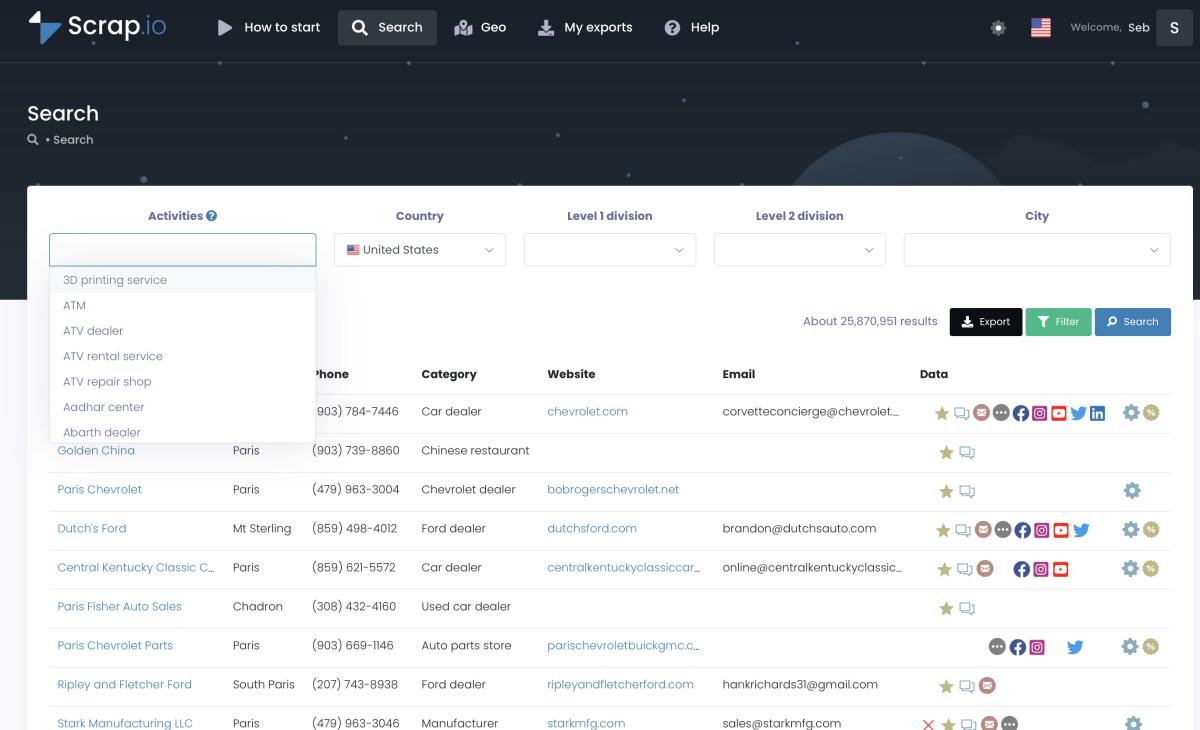
Log into Scrap.io and choose your activity from 4,000+ categories. "Food manufacturer." "Beverage distributor." "Frozen food." Cross several in one search if your audience spans them. This is where you pick your lane: a food manufacturers email list, a beverage companies email list, or the whole F&B umbrella in one pull. Be specific. Narrow targeting is the single biggest lever on reply rate.
Step 2: Choose your territory
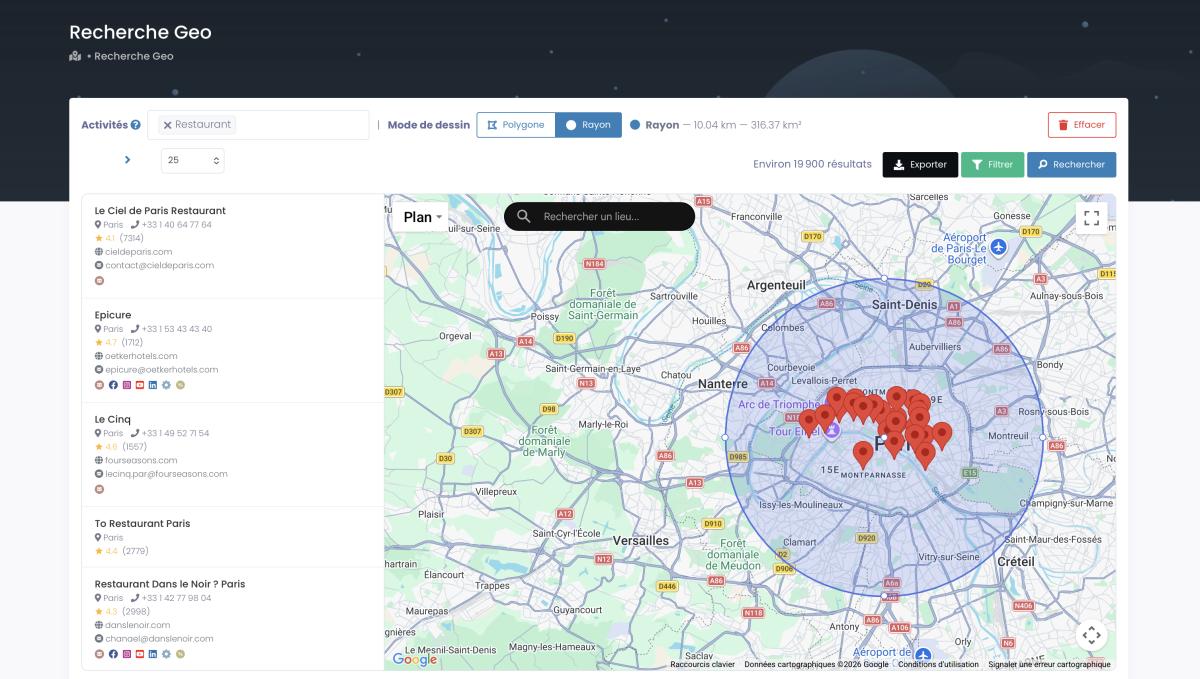
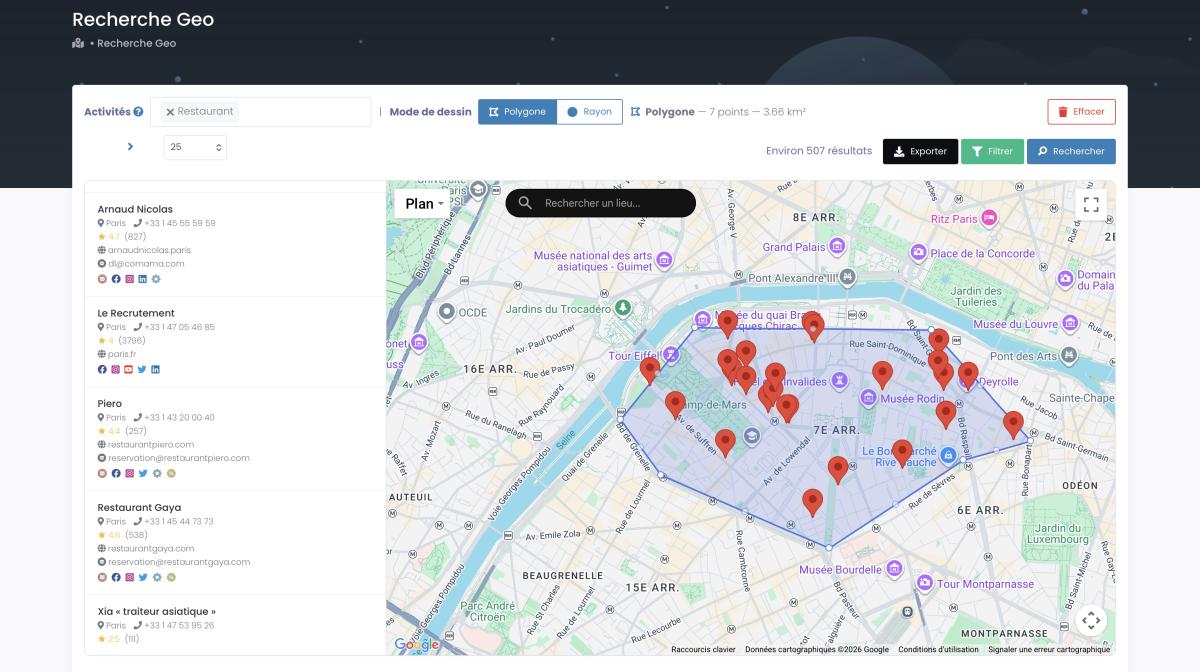
Now the geography. City, county, state, or an entire country if your plan allows it. Sarah picked California because it leads the country in food plants, followed by Texas, New York and Illinois. Need something that isn't a neat administrative shape? Use GeoSearch to draw a radius around a distribution hub, or sketch a custom polygon over a specific industrial corridor. Every filter still applies inside it. That's how you get food and beverage industry contacts by state, or by trading area, instead of a blurry national dump.
Step 3: Filter before you pay
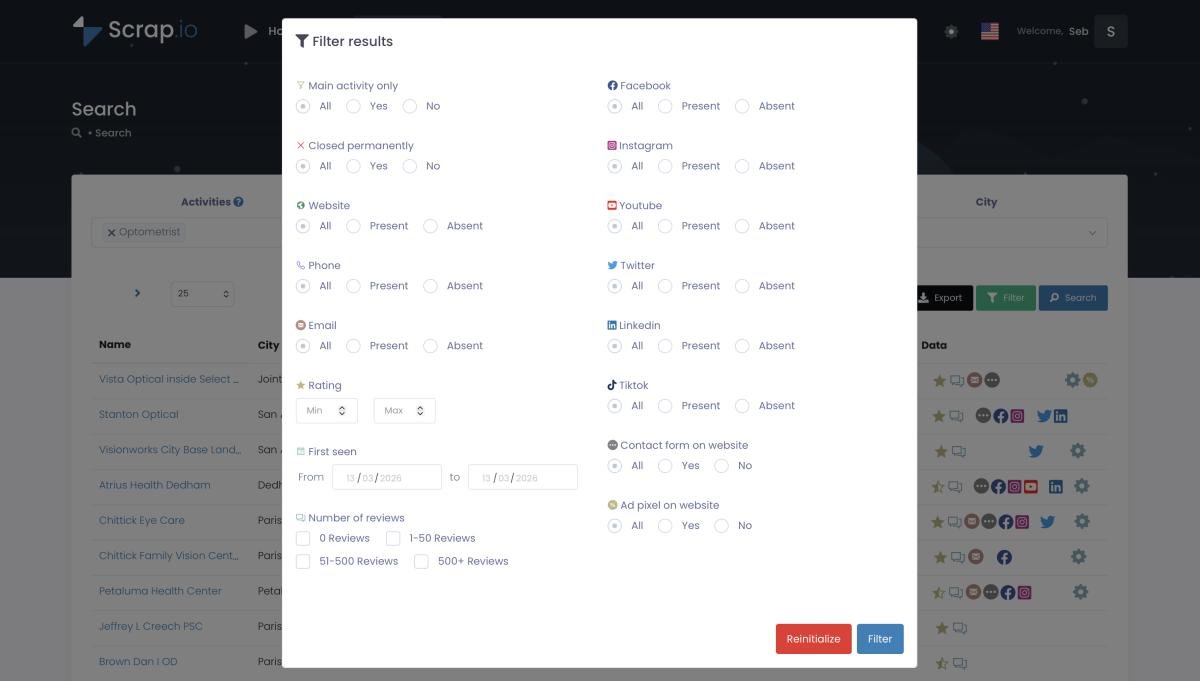
This is the step that makes the whole thing cheaper than buying. Toggle "Email: present" and you only ever spend a credit on a listing that actually has an address. Want just the ones with a website? Rating above 4.0? Recently opened? Set it, all before extraction. We've watched people buy 10,000 rows to keep 3,000 usable ones. That's lighting money on fire. Here, you filter first, pay second.
Video: Get Emails from Google Maps for Free
Step 4: Export and drop it into your CRM
Hit export. CSV or Excel, 30+ columns per business: emails classified by type (the owner's individual email, the generic contact@, the sales@ inbox), phone with mobile-or-landline tag, socials, website metadata. Import straight into HubSpot, Salesforce, Pipedrive, whatever you run. Those rows are your food and beverage sales leads now. Clean, deduplicated, ready. That classification is gold, by the way, because sending your pitch to the sales address instead of the info@ black hole can double your reply rate. Honestly, that one detail is worth more than the list size.
Four steps. No scraper to maintain, no proxies, no broken selectors at 3 AM. Just a verified food and beverage industry contact database you built in the time it takes to drink a coffee. If you need the same thing for an adjacent vertical, the broader email list by industry playbook runs identically, and the full Google Maps email extractor walkthrough covers every filter in depth.
Start building now. Try Scrap.io free for 7 days: 50 searches and 100 export credits, no code, fresh data from Google Maps across 195 countries and 4,000+ categories. Pull your first food and beverage list in about 30 seconds. Free trial, 100 leads offered.
Segment Your List: Manufacturers, Distributors, Foodservice and Retail
One food and beverage industry mailing list is really four audiences wearing the same coat. Lump them together and your message fits none of them. Look, here's how the value chain breaks down, and who you'll find where.
Manufacturers. The makers: food plants, beverage bottlers, frozen and seasoning producers. This is the core of any food manufacturers email list USA or food processing companies email list, and it's where Scrap.io counts those 7,690 US food makers. They buy equipment, software, packaging, logistics. For the deep dive on this slice specifically, our manufacturer email list guide goes further.
Distributors and wholesalers. The movers. A food distributors email list and a beverage distributors list live here, and they care about one thing above all: logistics and margin. If you sell inventory, routing, or compliance tooling, this is your segment. The wholesaler and distributor email list guide maps the whole distribution layer.
Foodservice. The kitchens and the operators who supply them. Restaurants sit at the end of this chain, and there's an entire restaurant email list guide for that world, with its own quirks (owners who read email at 6 AM, not 2 PM).
Retail and grocery. The shelves. Grocers, specialty food shops, convenience stores. Different buying cycle, different gatekeepers, different pitch entirely.
The point of segmenting isn't tidiness. It's relevance. A food and beverage decision makers email list only works when the message matches the segment, which is exactly why you want to filter at build time, not sort through a generic blob afterward.
Keep It Clean and Compliant: Deliverability and CAN-SPAM
You built a great list. Don't torch it on the first send.
Deliverability comes down to one metric most people ignore until it's too late: bounce rate. Keep it under 2% and you're healthy; drift above 5% and mailbox providers start throttling or blocking you (Tomba, 2026). A clean batch of verified food industry email addresses should sit comfortably in the "over 95% valid" range. The reason building beats buying here is simple: fresh data from active Google Maps listings starts clean, so there's far less dead weight to scrub. Still, verify before you send, every time. Even fresh data can shift between extraction and send day, and our email verification guide walks through it.
Then the legal side. In the US, cold-emailing businesses you found online is legal under CAN-SPAM, as long as you follow the rules: an honest subject line, your real physical address in every message, clear sender identity, and an unsubscribe link you actually honor within 10 business days. That's it. Scrap.io only ever surfaces publicly available business data, every record traceable to its source and both GDPR and CCPA compliant, so you always have an honest answer to "where did you get this?" For the full breakdown by country, see the cold email compliance guide.
One honest caveat. "Legal" and "welcome" aren't the same thing. Follow the rules, keep your list tight and relevant, and you stay on the right side of both the law and the people you're emailing.
GDPR and CCPA compliant, every contact traceable. Build your food and beverage list on Scrap.io from public Google Maps data you can stand behind. Free 7-day trial, 100 leads offered.
FAQ
What is a food and beverage industry email list?
It's a file of business email addresses for companies that make, distribute, or sell food and drink: manufacturers, beverage brands, wholesalers, foodservice suppliers and retailers. The good ones also include a contact name, phone, website and location so you can personalize outreach. You can buy one pre-built, or build a fresh one yourself from public Google Maps listings.
How do I build a food and beverage email list for free?
Start a free Scrap.io trial, pick your categories (say, "food manufacturer"), choose a territory, toggle "email present" so you only pull contactable listings, then export to CSV. The trial includes 50 searches and 100 export credits, enough to build a real free food and beverage email list and test the data quality before paying anything.
How many food and beverage companies are there in the U.S.?
The US Census counted 42,708 food and beverage manufacturing establishments in 2022 (County Business Patterns). Add distributors, wholesalers and foodservice suppliers and the reachable universe is far larger. More than 75% of those manufacturers have fewer than 100 employees, which is why so many never appear in enterprise databases.
Is it legal to email food and beverage businesses I found online?
In the US, yes, under CAN-SPAM. You need a truthful subject line, your physical mailing address, clear sender identification, and a working unsubscribe you honor within 10 business days. Using publicly available business data from Google Maps keeps your sourcing clean and traceable. For EU contacts, GDPR is stricter and usually relies on legitimate interest.
Why not just buy a food and beverage email list?
Because bought lists decay 22 to 30% a year, so a file loses roughly 4,400 of every 10,000 contacts within 24 months. You pay for bounces, your competitors bought the same rows, and your sender reputation takes the hit. Building fresh from Google Maps gives you current data, filtered before you pay, exclusive to you.
The Bottom Line
The food and beverage market is huge, fragmented, and mostly made of small operators who never show up on LinkedIn. That's not a problem. That's the opportunity. The vendors on page one want to sell you a frozen snapshot of it. Skip the stale list.
Build a fresh one instead. Pick your categories, draw your territory, filter to the contacts that actually have an email, and export. Fresh beats bought, every single time.
Skip the stale list. Build a fresh one today. Start your free 7-day Scrap.io trial: 50 searches, 100 export credits, real-time food and beverage data from Google Maps. Free trial, 100 leads offered. Your first list takes about 30 seconds.
Generate a list of food producer with Scrap.io