

You typed "free email lists for marketing" into Google. And Google handed you a stack of email software — MailerLite, Brevo, Sender — plus two vendors dangling "free" contacts and an AI Overview that basically shrugs and says you can't download a legit pre-made list anywhere. That mismatch? It's the whole story.
Here's the uncomfortable part nobody says loudly enough: in B2B, "free" is the most expensive word on the page. Not because the download costs money — because the cleanup, the reputation damage, and the compliance risk do. A "$0" list can quietly bill you $2,000 to $5,000 before you've closed a single deal. So let's do the math the vendors won't, and then look at the one approach that actually works.
What's inside
- What "free email lists for marketing" actually means
- The hidden bill: what free and cheap lists really cost
- Cost #1 — Deliverability
- Cost #2 — Data decay
- Cost #3 — The legal landmine (GDPR & CAN-SPAM)
- The 5 real ways to get "free" email lists
- The smarter alternative: fresh data from Google Maps
- How to build your own list, step by step
- Buying email lists: is there ever a right way?
- FAQ
What "free email lists for marketing" actually means (and why the search is a trap)
Let's clear something up. When people search for free email lists for marketing, they don't want a newsletter tool. They want contacts. Names, inboxes, a spreadsheet they can load into a sequencer and start emailing this afternoon. Fair enough.
But that list doesn't exist. Not legitimately, anyway.
What the search actually surfaces splits into three buckets, and none of them give you what you came for. First, the listicles — "best free email marketing tools" — which review sending software, not contacts. A free email list service in that context means a platform that mails your list, not one that hands you one. Second, the freebie vendors: BizProspex offers a "free email list" as bait, and PostcardMania dangles 1,000 free records to reel you toward paid data. Third, Google's own AI Overview, which flatly tells you there's no safe pre-made list to download.
Three answers. Zero of them are the list you wanted. That gap — between what you searched and what exists — is the entire reason this article needs to exist.
So if you've been hunting for free email marketing lists, a free email lists for marketing template, a "free email lists for marketing download," or that mythical "10,000 email list free pdf" floating around the "free email lists for marketing reddit" threads, sit tight. The honest answer to how to get free email lists for marketing costs a little more effort than a download button. It's also the only one that won't wreck your campaigns.
The hidden bill: what free (and cheap) email lists really cost you
A $500 list feels like a bargain next to a $982-per-lead legal-services campaign. Until the invoice for the damage shows up.
Because the sticker price is never the real price. Once you add data cleaning, the bounces that torch your sender reputation, and the hours your team burns nursing a dead file back to life, a list bought for $500 effectively runs $2,000 to $5,000 or more, according to Instantly.ai's 2026 pricing breakdown. And the same research found something brutal: buyers who optimize for the cheapest data end up paying 3 to 8 times more per booked meeting than buyers who optimize for quality. Cheap data isn't cheap. It's a loan with vicious interest.
This is the exact trap ZoomInfo shoppers walk into, paying $15,000–$40,000 a year for a database that starts aging the second it's compiled. (There's a reason "Stop Paying $20,000/Year for ZoomInfo" is a video people actually click.)
Video: Stop Paying $20,000/Year for ZoomInfo
Want the full accounting? We broke down what lead generation really costs channel by channel — and the gap between a cheap list and a fresh one is wider than most teams ever suspect.
The rest of this piece is really about three hidden line items on that invoice: deliverability, decay, and the law. Let's take them one at a time.
Curious what fresh, filtered data actually looks like? You can build a real list from live Google Maps data instead of buying a stale one — Scrap.io indexes 225,676,406 businesses across 195 countries, updated in real time at every export. Peek at a real export, free for 7 days (100 leads included) →
Cost #1 — Deliverability: how one bad list torches your sender reputation
One spam trap. That's all it takes to cut your inbox placement roughly in half — overnight.
Look — here's the mechanism, because it matters. Old and purchased lists are riddled with spam traps: addresses that were either never real or have been recycled by mailbox providers specifically to catch senders with lazy list hygiene. Hit one and you've told Gmail, Yahoo, and Microsoft that you don't know who you're emailing. Higher Logic documents exactly how a single trap hit can gut your deliverability and land you on a blocklist — and warns, in plain terms, that purchased lists are where traps hide.
Then there's the bounce problem. Purchased lists run 5–8% bounce rates, per Prospeo's 2026 analysis, while campaigns that actually land stay under 2%. Cross that 2% line and ISPs start throttling you. Cross 5% and you're flirting with a blacklist. Campaign Monitor has been shouting this for years — their whole argument for why you shouldn't buy lists comes down to this single reputation math.
And reputation doesn't reset on Monday. Once your domain is flagged, even your good emails — to clients, to warm leads, to your mom — start sliding into spam. That's the part that stings. You bought a list to reach more people and ended up reaching fewer.
If you're fuzzy on why some bounces are survivable and others are permanent, our guide on soft vs hard bounces is worth ten minutes. Short version: hard bounces are the reputation killers, and dead lists are stuffed with them.
Video: Why Your Google Maps Emails Don't Get Replies?
Cost #2 — Data decay: your "free" list is already rotting
That 10,000-contact list you "got for free" in January? Roughly 2,500 of those addresses are already dead. And nobody sent you a notice.
B2B data decays at about 2.1% per month — 22.5% a year, according to Instantly.ai's 2026 decay study. Do the compounding and a fresh 10,000-record list loses 2,250 to 3,000 valid addresses in twelve months, even if you never hit send. People change jobs. Companies fold. Domains lapse after an acquisition. The data doesn't get "a little old" — it quietly turns radioactive.
ZeroBounce puts the number even higher: 23% of email addresses go invalid every year (via Cleanlist, 2026). Either way, you're looking at nearly a quarter of any static list rotting annually.
The visual to picture: a stack of 10,000 contacts shrinking ~2.1% a month down to about 7,500 by December — roughly 2,500 dead addresses in a year (Data: HubSpot/MarketingSherpa, ZeroBounce 2026).
Here's the punchline the freebie vendors never mention. A "free" list is worth less than a fresh paid one, because it's usually older, shared with a dozen other buyers, and already halfway to the graveyard. Free doesn't mean new. It usually means "leftovers nobody wanted."
The only real defense is freshness — data verified at the moment you use it, not the moment someone compiled a spreadsheet in 2024. We go deep on that difference in our guide to fresh data vs old lists. But the principle fits on a sticky note: validate at extraction, or pay in bounces later.
Cost #3 — The legal landmine: GDPR & CAN-SPAM in 2026
In 2026, a single non-compliant email can be fined up to $53,088. Now multiply that by your list size and feel your stomach drop.
That's not a scare stat pulled from thin air. Under CAN-SPAM, the FTC counts violations per message, not per campaign, and the inflation-adjusted ceiling has climbed north of $50,000 per email — Tomba's 2026 breakdown walks through the exact math (and confirms the FTC re-adjusts it every January). Blast a non-compliant offer to 5,000 inboxes and, on paper, that's 5,000 separate violations. You'll rarely eat the maximum. But the ceiling is what gives regulators leverage — and settlements still run into six and seven figures.
And here's the aggravating factor that should make free-list hunters sweat: address harvesting — scraping the open web for random emails or buying harvested lists — is specifically called out in the statute as the kind of conduct that invites the harshest treatment. Where your data comes from is a legal question, not just an operational one.
Now cross the Atlantic. Under GDPR, you need a lawful basis (legitimate interest, documented) before you email an EU contact — and a purchased list with zero traceability is a compliance officer's nightmare. Can't prove where a contact came from? That's the exact thing DPAs go hunting for. We mapped the whole minefield in our guide to GDPR cold email rules, country by country.
The through-line across both regimes is the same: publicly available business data, properly sourced and traceable, is the safe path. Random free lists are the opposite of that. They're anonymous, un-sourced, and impossible to defend.
The 5 real ways to get "free" email lists (ranked worst to best)
So where do "free" lists actually come from — and which of them won't get you blocklisted? Let's rank them, worst to best. Because there is a version of "free" that works. It's just at the bottom of the list, not the top.
- Random "free download" lists (BizProspex, forum PDFs, "10,000 email list free" links). Avoid. These are harvested, stale, and shared with everyone. This is the fast lane to spam traps and a torched domain. The "free" here is bait for a paid upsell, nothing more.
- Freebie samples from data vendors (PostcardMania's "1,000 free records"). Marginally better because there's a company behind it — but it's a teaser designed to sell you the paid database. Treat any best free email lists for marketing roundup that points here with suspicion.
- Scraping the web yourself with a DIY script. Technically free if you don't count your time (you should). Also the exact "harvesting" CAN-SPAM frowns on, plus you own every proxy ban and CAPTCHA at 3am. Character-building. Not recommended.
- Building organically — opt-ins, lead magnets, a signup form. The gold standard for warm lists, and about as close to email lists for marketing free as it gets. A decent free email list builder workflow (form + incentive) grows a list that actually wants to hear from you — it's the cleanest answer to how to get free email addresses for marketing. The catch? It's slow. You won't have 5,000 contacts by Friday.
- Extracting fresh public business data and filtering it before you use it. The winner. Not a list you download — one you build, the day you need it, from data that's public and current. This is the closest thing to "free email lists for marketing" that survives contact with reality. More on this in a second.
Don't just take my ranking, though. The community has been saying the same thing for years, in blunter language:
- On Quora's "Where can I find free email lists online?", the consensus is unanimous: there's no real free list — build it organically instead.
- Over on r/Emailmarketing, every "best free email tools" thread quietly confirms the trap: "free" means software, never a list of contacts.
- And in this Adobe Community thread, a marketer is literally begging for help explaining to their boss why buying a list is a bad idea. We've all had that boss.
The smarter alternative: build a fresh, targeted list from Google Maps data
The best "free-ish" list isn't a list you download. It's one you build yourself, fresh, the day you need it.
Think about it. Every restaurant, clinic, contractor, gym, and law firm you'd ever want to reach is already sitting on a map — with a website, and usually an email buried in that website's footer or contact page. That data is public. It's maintained by the businesses themselves (Google rewards them for keeping it current). And it's a category of B2B that the big shared databases barely touch, because these companies don't have tidy LinkedIn pages.
That's the gap Scrap.io fills. Instead of buying a frozen file, you pull email lists for marketing straight from live Google Maps data — extracted and validated at the moment of export, never recycled. Here's how that stacks up against the alternatives:
| Criterion | Free list | Purchased list | Real-time Google Maps data (Scrap.io) |
|---|---|---|---|
| Freshness | ❌ Stale, recycled | 🟡 Ages fast (22.5%/yr) | ✅ Verified at extraction |
| Deliverability | ❌ Spam-trap minefield | 🟡 5–8% bounce | ✅ Fresh = low bounce |
| Compliance (GDPR/CAN-SPAM) | ❌ Un-sourced, risky | 🟡 Hard to trace | ✅ Public + traceable |
| Targeting precision | ❌ Generic | 🟡 Broad segments | ✅ Category + zone + filters |
| True cost | ❌ $2,000–$5,000 in damage | 🟡 3–8× per meeting | ✅ Pay only for useful records |
The two things that flip the equation: freshness and filtering before you pay. You can target a single city or an entire country, then narrow by category, minimum rating, "has a website," or — the big one — "has an email present," so you never burn a credit on a business you can't actually contact. Try doing that with a bought list. I'll wait.
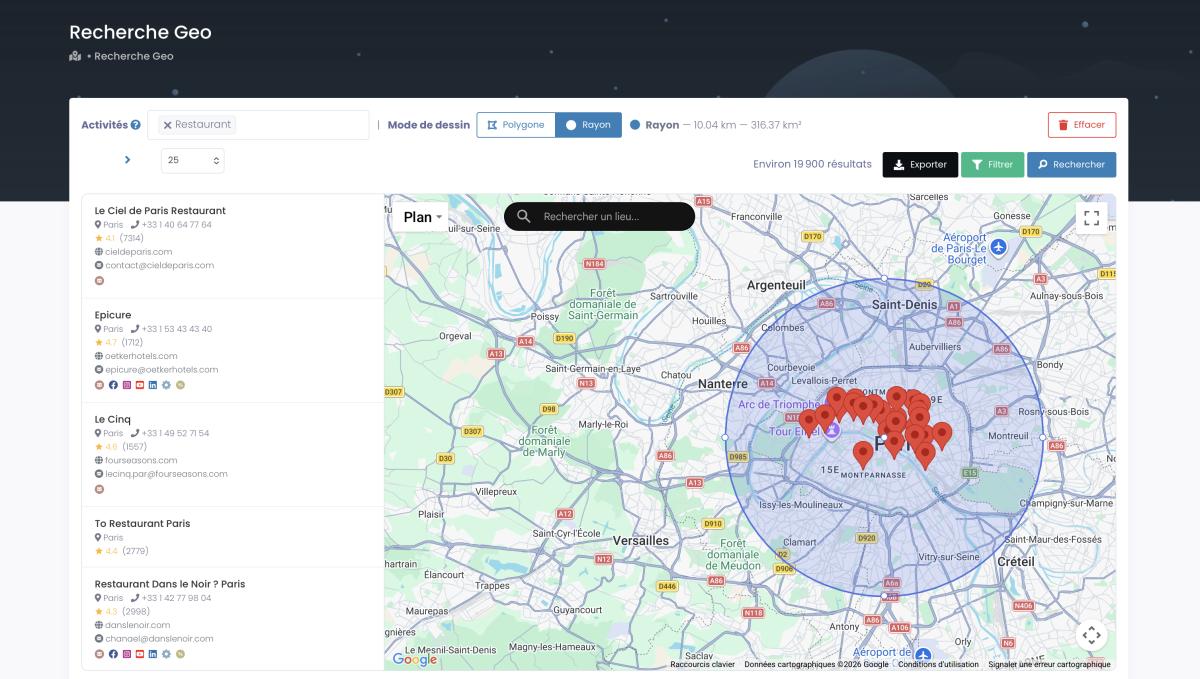
GeoSearch Radius — draw a circle around any point on the map.
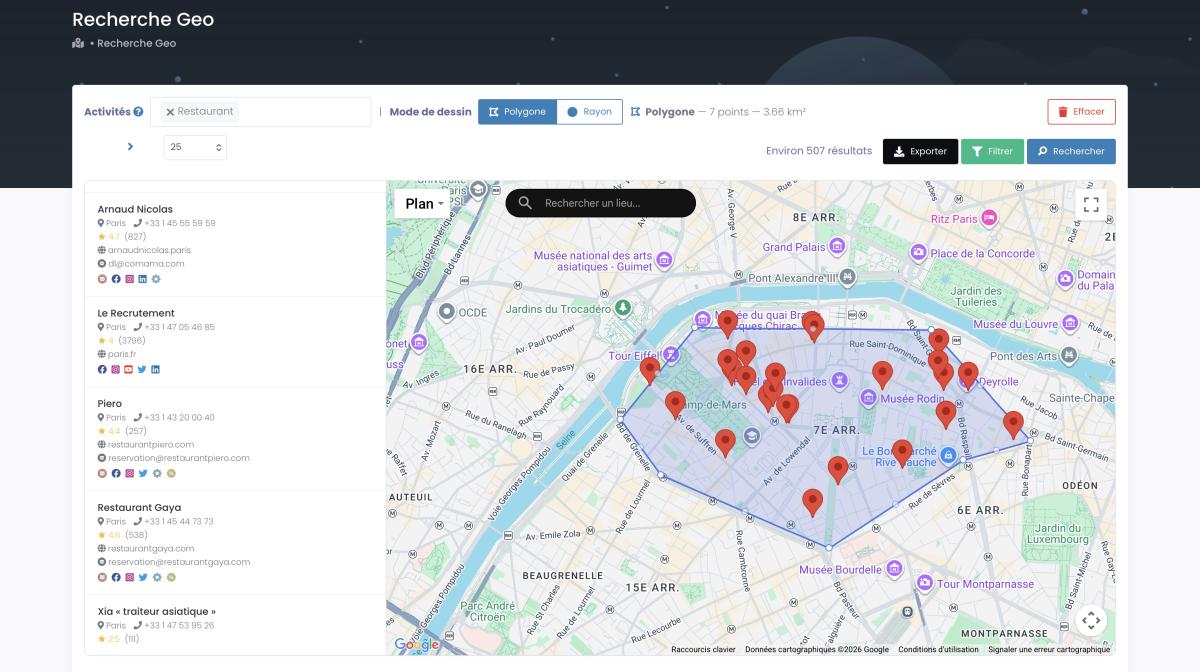
GeoSearch Polygon — hand-draw an irregular zone that no administrative border matches.
Need to target a shape that isn't a city or a county? GeoSearch lets you draw a radius around a point or hand-trace a polygon over a precise neighborhood, and every filter still applies inside it. That's targeting a generic list simply can't do. If you want the deep dive, here's exactly how to find emails on Google Maps.
You're not the first to figure this out. 50,000+ professionals already build their own lists from Google Maps with Scrap.io — GDPR & CCPA compliant, every record traceable to its source. See how it works, free for 7 days →
How to build your own list in practice (step by step)
What if you only had to pay for the records that actually have a valid email? That's exactly what we're about to do. No dead rows, no cleanup bill.
Take an agency owner who needs every hair salon in Texas with a real email — not a contact form, an actual address. Buying a list gives them stale data mixed with dead domains. Building it looks like this instead:
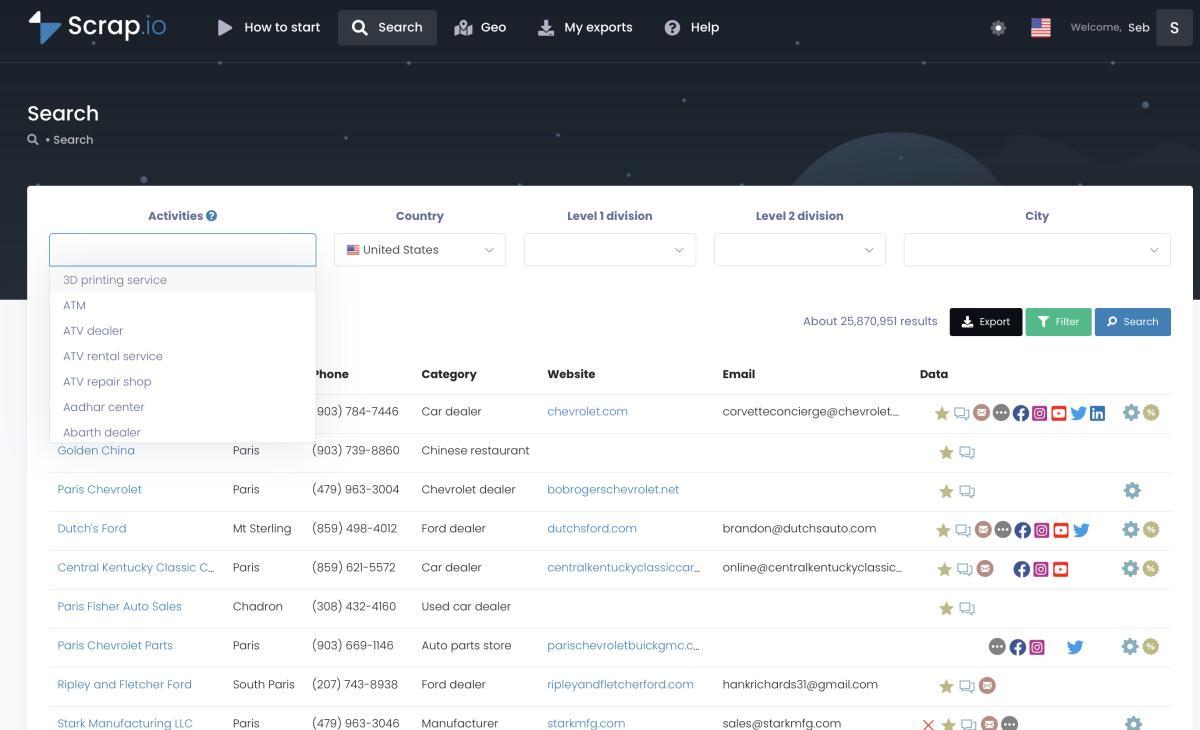
Pick a category and a zone — anything from one city to a whole country.
- Pick your category + zone. Choose the business type (hair salons) and the area — a city, a county, a state, or all of the US. Scrap.io covers 4,000+ categories, so you're not stuck with vague buckets.
- Filter to "email present" BEFORE extracting. This is the whole game. Toggle the email filter so only records with a real address are counted — filters apply before credits are spent. Zero waste.
- Count for free. Hit count. It tells you exactly how many matching businesses exist — across an entire state if you want — and it costs nothing.
- Export to CSV or Excel. One click. The file includes names, addresses, phone numbers, up to five classified emails per business (individual, contact, sales, marketing, admin), social profiles, and more.
- Load it into your sequencer. Done. Fresh list, ready to email the same afternoon.
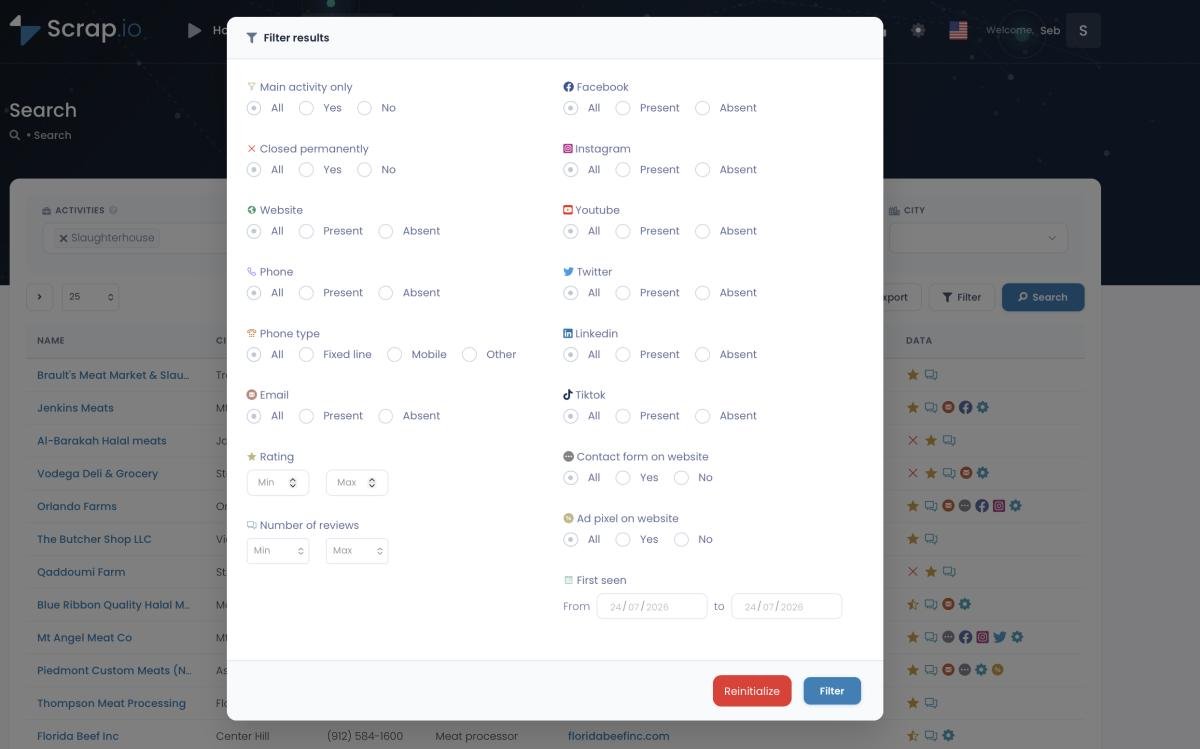
Filter for "has email" before you spend a single credit.
That email classification is the sneaky-good part. Knowing if you're writing to an info@ address or a named individual (with first and last name pulled automatically) changes how you write the email — and whether it lands a reply. This is also, roughly, how to build a cold email list that doesn't fall apart on the first send.
Video: Scrap.io — How to Start?
One client ran this exact playbook and pulled 11,734 businesses in 45 minutes. Try assembling that by hand. (Actually, don't. That's how you lose a weekend.)
Filter for "has email" before you spend a single credit. Start free for 7 days — 50 searches + 100 export credits, 100 leads on the house. Fresh, filtered, email-present data from any category and zone you want. Start your free trial →
Buying email lists: is there ever a right way?
Buying a list is always a bad idea. In theory. In practice, there's one narrow case where it's defensible — and it's worth being honest about it.
If you're staring down a hyper-specific niche, and a reputable vendor offers a recently verified, tightly scoped list as a seed for enrichment — not your whole strategy — it can work. Platforms like UpLead lean hard on verification (they claim 95%), and that's genuinely better than a random free download. Enterprise tools like ZoomInfo have real data — you just pay $15k–$40k a year and still inherit the decay problem the moment the file is compiled.
But as a strategy? Buying is renting a problem. The list is static from second one, it's sold to a dozen other senders hammering the same inboxes, and you can't document where the data came from when a regulator asks. We laid out when it makes sense and when it doesn't in our full guide to buying email lists. Spoiler: "fresh and self-built" beats "bought and frozen" on cost, deliverability, and compliance.
Bottom line — if you can build it fresh, build it fresh. Buying is the fallback, not the plan.
FAQ
Where can I get free email lists for marketing?
Honestly? There's no legitimate, ready-made "free email list" you can safely download — Google's own AI Overview says as much. So-called free lists are usually scraped, outdated, or bait for a paid upsell, and mailing them can wreck your deliverability. The real free-ish path is to build a targeted list yourself: capture opt-ins organically, or extract fresh public business data (from Google Maps, for example) and filter it before you use it.
How much is a 1,000-email list worth?
B2B email lists typically run $0.02–$3.00 per contact (about $300–$1,000+ per thousand). But the sticker price is misleading: once you add data cleaning, bounces, and reputation damage, a $500 list can effectively cost $2,000–$5,000 or more. Freshness and verification are worth far more than raw count.
Is it legal to use a purchased or free email list?
It depends on how it was collected and where you send it. In the US, CAN-SPAM allows cold B2B email, but a non-compliant message can be fined up to $53,088 per email. In the EU, GDPR requires a documented lawful basis. Publicly available business data, properly sourced and traceable, is the safest route — anonymous free lists are the riskiest.
What is the best free email marketing platform?
For sending (not for lists), MailerLite, Brevo, and Sender all offer generous free tiers. Just remember: a free sending tool won't save a bad list. Deliverability still comes down to data quality, so pair any free platform with a clean, fresh list — not a random download.
What's the 3-email rule?
It's the common cold-outreach guideline of capping a sequence at roughly three touches (an initial email plus two follow-ups) before moving on, so you don't annoy prospects or trigger spam complaints. It only works on a clean, well-targeted list — on a dead one, three emails just means three times the bounces.
The takeaway
"Free email lists for marketing" is a search that punishes the people who take it literally. The download you wanted doesn't exist; the ones that pretend to will cost you in bounces, decay, and fines. That's the whole trap in one sentence.
So flip it. Stop paying for dead data — with money or with your sender reputation. Build a fresh, targeted list from public business data, filter it before you spend a cent, and email people you can actually reach. Done right, the channel still pays: cold email returns about $42 for every $1 spent when the infrastructure and the data are clean, not cheap (Prospeo, 2026). Fresh beats free. Every time.
Stop paying for dead data. Build a fresh, targeted list today. Scrap.io pulls verified business contacts from Google Maps across 195 countries — filtered to email-present before you spend a credit, GDPR & CCPA compliant. Free for 7 days, 100 leads on the house. Build your list now →
Generate a list of restaurant with Scrap.io