

- What Is a Google Place ID (And Why Would You Reverse Lookup One)?
- 3 Methods to Convert a Place ID to a Full Address in 2026
- Step-by-Step: Place ID Reverse Lookup with the Geocoding API
- Bulk Place ID to Address Conversion
- Place ID vs CID vs Google ID
- Do Google Place IDs Expire?
- Real-World Use Cases
- Is Reverse-Looking Up Place IDs Legal?
- Google Maps API Pricing 2026
- FAQ
Here's a fun scenario. You're staring at a spreadsheet full of strings like ChIJgUbEo8cfqokR5lP9WhDaM. Hundreds of them. Maybe thousands. And somewhere behind each of those cryptic IDs is a real business, with a real address, that you actually need by Friday.
Welcome to the wonderful world of google place id reverse lookup.
Google Maps indexes over 200 million businesses (and roughly 250 million places total) in 2026, with over 2 billion monthly active users and a 67-80% share of the map-app market (On The Map, 2026). Around 1.5 million new listings show up every month. That's great for Google's internal plumbing. Less great for you when a client dumps a CSV of Place IDs on your desk and walks away.
So let's get into it. No fluff, no filler. Just the methods that work, the ones that don't (spoiler: there are a few), and the shortcut nobody talks about.
What Is a Google Place ID (And Why Would You Reverse Lookup One)?
A Google Place ID is a unique text identifier that Google assigns to every location in its database. Restaurants, parks, landmarks, that weird dentist office on the corner. They all get one. The format looks like this: ChIJN1t_tDeuEmsRUsoyG83frY4. Totally human-readable, right?
The thing is, Place IDs are everywhere. Migration projects spit them out. CRM exports dump them by the thousand. Google My Business feeds are full of them. And if you've ever done any kind of Google Maps scraping, you've got piles of these sitting around.
But a Place ID alone tells you nothing. You need the address, the phone number, the business name. The stuff that's actually useful. That's where a google place id reverse lookup comes in. You feed it the ID, it gives you back structured location data.
Quick note before you go further: reverse lookup (ID to address) is the opposite of finding an ID in the first place. If your goal is the other direction (business name to ID), that's a different job. We cover it in our Google Place ID Finder guide (5 free methods). Different intent, different tool.
Simple concept. Execution? That's where things get interesting.
3 Methods to Convert a Place ID to a Full Address in 2026
You've got a Place ID like ChIJgUbEo8cfqokR5lP9WhDaM. Now what?
There are basically three paths here, and they range from "full developer mode" to "I just need this done in 10 minutes." Let's break them down.
Method 1: Google Geocoding API
The classic approach. Google's Geocoding API accepts a Place ID as input and returns the formatted address, lat/long coordinates, and address components. It's reliable, well-documented, and the go-to method for most developers doing a place id to address conversion.
You pass place_id=ChIJ... as a parameter to the reverse geocoding endpoint, and you get structured JSON back. Done.
The catch? You need an API key. And if you're converting more than a handful of IDs, you have to think about rate limits and costs. (More on that in the pricing section.)
Method 2: Place Details API (New)
Google killed the legacy Places API. Gone. The Place Details (New) is now the only version, and honestly, it's better for a full google place id reverse lookup. Why? Because it returns way more than just the address.
Business name, hours, reviews, photos, website URL. The whole package. If you need to convert place id to address AND grab additional business data in the same call, this is your best bet. You can use field masks to request only what you need, which keeps costs down. This also handles the google place id to address case where you want structured components, not just a single formatted string.
Bref, if you just need an address, use Geocoding. If you need everything, use Place Details.
Method 3: No-Code Tools & Chrome Extensions
Not everyone wants to write code. And honestly? For small batches, you shouldn't have to.
Tools like Stevesie Data offer a no-code converter where you paste your IDs and get results in a spreadsheet. Some Chrome extensions work as a quick google place id lookup right from your browser: click a map listing, grab the ID, look up its data. This is also where people search for a google place id reverse lookup chrome workflow or a google place id reverse lookup free option.
These are fine for 10-50 lookups. Past that, you're going to hit walls. Rate limits, manual copy-paste fatigue, or just your sanity. For anything at scale, you need one of the API methods above, or a tool built specifically for bulk extraction.
Video: Using the Google Maps API and Google Reviews
Step-by-Step: Place ID Reverse Lookup with the Geocoding API
Thierry had 5,000 Place IDs from a client migration. No addresses, no business names, nothing. Just a giant column of ChIJ... strings and a deadline. Sound familiar?
Here's exactly how to get from Place ID to full address with the Geocoding API. No hand-waving.
API Request Structure & Parameters
The endpoint for reverse geocoding place id is straightforward. You hit https://maps.googleapis.com/maps/api/geocode/json with two parameters:
place_id: your Place ID stringkey: your Google Maps API key
That's it. The response includes formatted_address, geometry.location (lat/lng), and address_components broken down into street, city, state, country, zip. You can also pass result_type and location_type filters if you want to narrow things down, but for a standard conversion, the defaults work fine.
Python Code Example
Here's what a place id to address lookup looks like in Python:
import requests

def place_id_to_address(place_id, api_key):
    url = "https://maps.googleapis.com/maps/api/geocode/json"
    params = {"place_id": place_id, "key": api_key}
    response = requests.get(url, params=params)
    data = response.json()

    if data["status"] == "OK":
        result = data["results"][0]
        return {
            "address": result["formatted_address"],
            "lat": result["geometry"]["location"]["lat"],
            "lng": result["geometry"]["location"]["lng"]
        }
    return {"error": data["status"]}

# Example usage
result = place_id_to_address("ChIJgUbEo8cfqokR5lP9WhDaM", "YOUR_API_KEY")
print(result)
Twelve lines. That's it. You can pull an address from a Place ID with barely any code at all. And yeah, the same call gives you lat/long too, because the geometry object has everything. If you want the JavaScript version instead of Python, our guide to extracting Google Maps data with the JavaScript API walks through the geocoder.geocode() approach line by line.
Handling Errors: INVALID_REQUEST & NOT_FOUND
Two errors will haunt you here. INVALID_REQUEST means your Place ID format is wrong (typo, truncated, or just garbage data). NOT_FOUND means the ID was valid at some point but Google can't resolve it anymore.
That second one is sneaky. Place IDs aren't permanent. Businesses close, locations merge, Google reshuffles its database. If you're working with old IDs, say a 2023 export, expect a chunk of them to come back empty.
Pro tip: always log your errors. Don't just skip them in a loop and wonder later why your output has gaps. Trust me on this.
Video: Scrap.io, How to Start
Bulk Place ID to Address Conversion
Calling the API 10,000 times costs $50 or more and takes hours. If you're doing a one-off migration, maybe that's fine. But if this is a regular workflow? Yikes.
Let's talk about bulk place id to address conversion, because doing it one by one is pain nobody should endure.
DIY Batch Scripts
The brute-force approach: loop through your IDs, call the API, respect rate limits (50 QPS for Geocoding), and dump results into a CSV. You can parallelize with async Python or split the job across multiple keys.
It works. But it's slow, it's fragile (one network hiccup and your script dies at row 3,847), and the costs add up fast. $5 per 1,000 Place Details calls. Do the math on 50,000 IDs. Exactly.
Oh, and if you're hunting for a place id to address without api key solution? Forget it. Google locked that down years ago. Every method needs authentication now.
Using Scrap.io for Bulk Extraction
Here's the thing most people don't realize: if you're looking up Place IDs, you probably extracted them from Google Maps in the first place. Which means you could have grabbed the full data (address, phone, email, reviews) at extraction time. The address was already sitting there. You just didn't keep it.
Scrap.io exports everything in one shot. No post-processing reverse lookups, no extra API costs. You search, you filter, you export, and the addresses are already in the file. And this isn't a stale, cached database: Scrap.io indexes 225,676,406 businesses across 195 countries and 4,000+ categories, refreshed in real time at each extraction (Scrap.io, September 2026). So while roughly 5-10% of stored Place IDs quietly rot every year, the data you pull here is validated at the moment you export it.
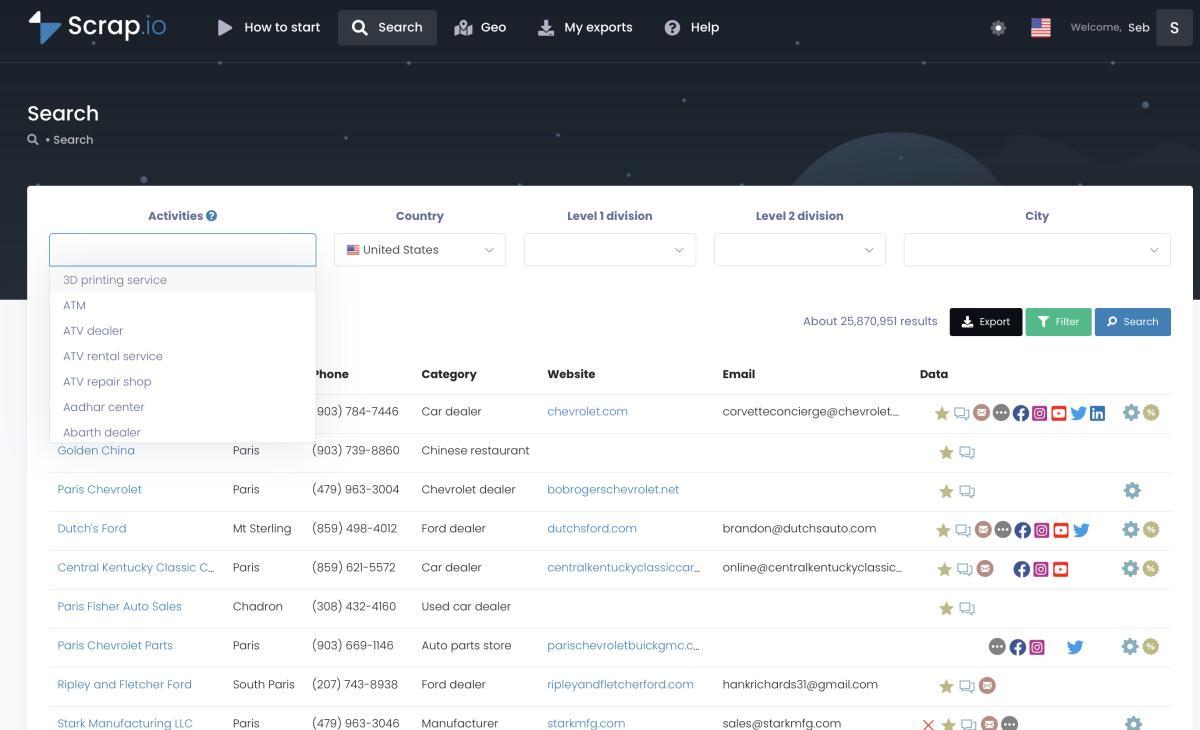
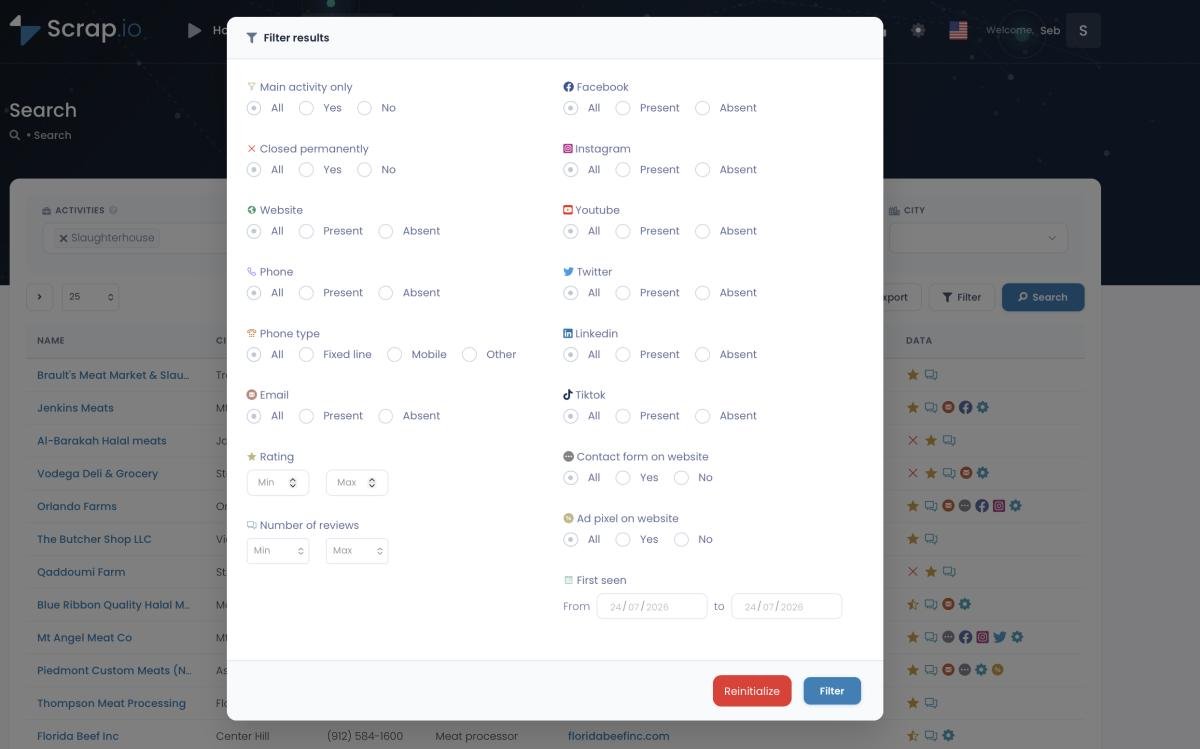
For teams doing regular bulk conversion, this saves both time and money compared to round-tripping through the Geocoding API. Pull an entire country in two clicks. Filter before you spend a single credit, so you never pay for a listing with no address or no email. That last part matters more than it sounds.
Video: How to Scrape Local Leads at the Country Level
Place ID vs CID vs Google ID
This trips everyone up. Google has three different identifiers for locations, and they are not interchangeable. Let me save you the confusion.
| Identifier | Format | Example | Where It's Used | Stable? |
|---|---|---|---|---|
| Place ID | Alphanumeric string starting with "ChIJ" | ChIJN1t_tDeuEmsR... |
Places API, Geocoding, Maps URLs | Mostly (can expire) |
| CID (Ludocid) | Large numeric value | 12345678901234567890 |
Google Business Profile, review URLs | Very stable |
| Google ID (Feature ID) | Hex string | 0x89c259af... |
Internal Google systems, Maps source | Stable but not API-accessible |
The difference matters because you can't use a CID in the Geocoding API, and you can't use a Place ID to directly open a Google Business Profile review page. They serve different purposes. Tools like Outscraper let you convert between these formats via their API. And if you want the deep dive on all three, check out our complete guide to Place ID, Google ID, and CID.
Bottom line: for a google place id reverse lookup, you specifically need the Place ID format. CID won't work. Feature ID won't work. Make sure you've got the right one before you start.
Do Google Place IDs Expire?
Short answer: yes. Kind of.
Google says Place IDs "may change over time" when a business closes, moves, or gets merged with another listing. In practice, 5-10% of Place IDs go stale annually. That's not a lot, until you're working with a dataset of 100,000 IDs and suddenly 7,000 of them return nothing.
The fix? Google itself recommends refreshing any Place ID that's more than 12 months old, and you can do it at no charge by making a Place Details request that asks only for the ID field (Google Maps Platform docs). Sometimes you'll get the same ID back. Sometimes you'll get an updated one. Sometimes you'll get nothing, because the place genuinely doesn't exist anymore.
So if you're wondering about place id expired how to refresh? That's literally the process. Re-query with the old ID, check the response, update your records. There's no magic "refresh" button. It's just another API call.
One recurring complaint on the Google Business Profile community: "How do I find my google Place ID?" keeps getting asked, over and over, which tells you how many business owners are stuck on this. Another good one you'll see on Google Maps forums: different Place IDs returning the same address, which happens when Google merges duplicate listings behind the scenes. Don't assume every Place ID resolves forever. And don't assume two different IDs won't point to the same place.
Real-World Use Cases
OK, but who actually does this? More people than you'd think.
ReviewSense.ai, a Google Business Profile analytics SaaS, documents a Place ID lookup workflow to match reviews to specific locations in their own Place ID tutorial. Same source, incidentally, pegs Place ID churn at 5-10% per year in high-turnover sectors. Real estate and PropTech players lean on it too: Datatoleads works reverse address lookups against property data, and companies like BatchData.io use reverse-geocoding-by-place-id patterns to enrich their datasets. (I'm describing publicly stated positioning here, not private metrics, so take the specifics with the usual grain of salt.)
Then there are the scraping-adjacent use cases. SEO agencies pulling competitor data. Local marketing firms building prospect lists. Sales teams enriching CRM records. The common thread? Everyone has Place IDs. Not everyone has the addresses behind them. And with 5 million+ apps integrating Google Maps Platform and 8 billion+ local searches happening every day, that gap isn't shrinking.
Is Reverse-Looking Up Place IDs Legal?
Fair question. Nobody wants a legal headache over a spreadsheet.
The short version: resolving a Place ID to an address means working with publicly available business data, which is generally fine. What matters is what you do next. In the EU, the GDPR governs how you contact the people behind that data. In California, it's the CCPA. Both apply to the outreach, not the lookup itself. Scrap.io, for its part, works only with public business listings, stays GDPR and CCPA compliant, and keeps every data point traceable back to its source. Use the data for legitimate prospecting, keep a clean unsubscribe path, and you're on solid ground.
Google Maps API Pricing 2026
Let's talk money. Because this is where a lot of projects die.
Google restructured its Maps Platform pricing, and in 2026 here's what you're looking at for a Place ID reverse lookup workflow:
| API | Cost per 1,000 Calls | Free Monthly Credit | Best For |
|---|---|---|---|
| Geocoding API | $5.00 | $200 | Address-only lookups |
| Place Details (New) | $5.00 - $7.00 | $200 | Full business data |
| Places API (Legacy) | Deprecated | N/A | Don't use this |
The $200 monthly credit covers about 40,000 Geocoding calls. Sounds generous, until you factor in the scale of the industry Google is pricing against. The digital mapping market hit roughly $32.79 billion in 2026 and is growing at a 13.3% CAGR toward an estimated $61 billion by 2031 (Market.us). Google knows exactly what its data is worth. Past your free tier, costs scale linearly. No volume discounts unless you're enterprise-level.
For pricing details beyond what I've covered, check the official Google Maps Platform pricing page. For a deeper comparison of geocoding costs across providers, we have a full geocoding API guide, plus a roundup of the best free geocoding APIs in 2026 if budget is your main constraint.
Honest take? If you're doing fewer than 40K lookups a month, the free tier works. Past that, ask yourself whether you really need the API, or whether a tool like Scrap.io (which bundles extraction and data in one price) makes more financial sense.
FAQ
How do I convert a Place ID to an address?
Use Google's Geocoding API with the place_id parameter, or the Place Details (New) API. Both accept a Place ID and return the formatted address, coordinates, and location components. You need a valid Google Maps API key for either method. For bulk jobs, a tool like Scrap.io returns the address already attached to each business, no per-lookup call needed.
Is there a free tool to reverse lookup a Place ID?
Google's $200 monthly credit gives you about 40,000 free Geocoding lookups. For smaller batches, no-code tools like Stevesie Data offer limited free usage, and Chrome extensions can handle one-off lookups. There's no genuinely unlimited free option at scale, though. Every method eventually meters you.
Do Google Place IDs expire?
They can. Google estimates 5-10% of Place IDs go stale each year due to closures, merges, or database restructuring, and recommends refreshing any ID older than 12 months. You can re-query the Geocoding or Place Details API to refresh them (the ID-only refresh is free), but some will simply stop resolving.
What's the difference between Place ID, CID, and Google ID?
Place ID is the main identifier used in Google's APIs (starts with "ChIJ"). CID (Ludocid) is a numeric identifier tied to Google Business Profile listings and review URLs. Google ID (Feature ID) is a hex-based internal identifier. Only Place ID works for reverse geocoding lookups. See our full comparison guide for the details.
How much does a Place ID reverse lookup cost?
$5 per 1,000 calls via the Geocoding API, or $5 to $7 per 1,000 via Place Details (New) depending on the fields you request. Google gives you a $200 monthly credit, roughly 40,000 lookups. For high-volume needs, tools like Scrap.io include address data in bulk exports without per-lookup pricing.
How can I find the Google Place ID for my Google reviews?
For review links, you actually want the ID behind your Google Business Profile so you can build a writereview?placeid=XXXX URL. The quickest routes are Google's official Place ID Finder or a Chrome extension. We walk through five free methods in our Google Place ID Finder guide. Note this is the reverse of what this article covers: here you're going from business to ID, not ID to address.
Generate a list of restaurant with Scrap.io