

On March 1, 2025, Google quietly killed the $200 free monthly credit that had cushioned every Maps project for years. No fanfare. Just a docs update and a new billing model nobody asked for. If you build anything that calculates directions or travel times, your real Google Routes API pricing changed overnight, and most teams still haven't done the math.
So let's do it. Below: the full SKU and tier grid for 2026, the free-tier change that actually matters, three costed scenarios, the fees nobody warns you about, and a brutally honest look at when something cheaper does the job better.
What the Routes API Actually Is
Quick history, because it explains the pricing. The Routes API is Google's replacement for two older products you may still have in your codebase: the Directions API and the Distance Matrix API. Both are now classified as Legacy. Google wants everyone on Routes instead, and new projects increasingly can't even touch the old endpoints.
It does two jobs, and they're billed differently. Compute Routes returns a route between an origin and a destination, and it's billed per request. Compute Route Matrix returns travel times and distances for a grid of origins and destinations, and it's billed per element. That second one bites people. More on it in a minute.
Curious how the routing itself actually works under the hood? That's a separate rabbit hole, and we fell down it in our piece on how Google Maps route planning works. For this article, we care about one thing: what it costs.
Here's the part that catches developers off guard: the tier you pay isn't something you pick on a pricing page. It's triggered by the X-Goog-FieldMask header you send. Ask for a couple of advanced fields and you quietly bump the whole request into a pricier bracket. The features determine the SKU, per Google's Routes usage and billing docs. You don't opt in. You trip the wire.
Directions API vs Routes API Pricing
If you're searching google directions api pricing, you're looking at a product on its way out. The legacy Directions API and Distance Matrix API still bill under the old Maps structure, but Google's whole migration push is aimed at moving you to Routes, where the three-tier SKU model lives. On google routes api vs directions api pricing, the headline rates aren't wildly different; the real gap is support. Legacy endpoints get no new features and could vanish on a quarter's notice. Want the Routes API billing explained in one line? You pay per SKU tier, and the tier is set by the fields you request. Planning a new build? Start on Routes. Setting up a key from scratch is covered in our guide to getting a Google Maps API key, pricing notes included.
Full SKU Pricing Breakdown (2026)
This is the table everyone wants and almost nobody publishes in full. No google routes api pricing calculator needed, just read the grid. These are the current per-1,000 rates straight from Google's core services pricing list (last updated October 2026). Both Compute Routes and Compute Route Matrix bill at these same tier rates, and yes, people search this exact thing as both google maps routes api pricing and plain google maps api pricing.
| SKU tier | Free cap / mo | Up to 100K | 100K–500K | 500K–1M | 1M–5M | 5M+ |
|---|---|---|---|---|---|---|
| Essentials | 10,000 | $5.00 | $4.00 | $3.00 | $1.50 | $0.38 |
| Pro | 5,000 | $10.00 | $8.00 | $6.00 | $3.00 | $0.75 |
| Enterprise | 1,000 | $15.00 | $12.00 | $9.00 | $4.50 | $1.14 |
Compute Routes vs Compute Route Matrix
Same rates, very different math. Compute Routes charges once per request. Compute Route Matrix charges per element, and an element is one origin paired with one destination. So a 100×100 matrix isn't 200 billable things. It's 10,000. The compute route matrix cost per element grows with the product of your inputs, not the sum, which is exactly how a "quick lookup" turns into a four-figure line item. (We'll hammer this in the hidden-costs section, because it deserves it.)
The Three Tiers, Decoded
What actually separates the tiers? Features. Essentials covers basic routing with up to 10 intermediate waypoints. Pro adds the good stuff: traffic-aware routing, two-wheeled vehicle modes, toll calculation. Enterprise is for heavy use cases, large-vehicle and truck routing, eco-friendly route optimization, high-definition polylines. Afi Labs, a routing-software shop, publishes the same three-step ladder as $5, $10 and $15 CPM in their developer's guide to the Routes API. The ladder is real, and the FieldMask decides which rung you land on.
Volume Discounts
The rates slide down as you scale, and they slide hard. Essentials drops from $5 per 1,000 all the way to $0.38 above 5 million. Great news if you're Uber. If you're a 10-person startup doing 30K routes a month? You pay full freight, because those discounts only kick in at volumes you won't see for years. The curve rewards giants and shrugs at everyone else.
The 2025 Free-Tier Change
Here's the thing nobody says loudly enough: the old deal was better for small projects. Before March 1, 2025, every Google Cloud project got a flat $200 monthly credit, pooled across all Maps products. One number. You could spend it however your app happened to spend it.
Dead. Now each SKU gets its own free monthly cap, and you can't shuffle allowance between them. Roughly 10,000 free Essentials calls, 5,000 Pro, 1,000 Enterprise. Add it all up across products and Google says it's "up to $3,250" of free usage spread around, a figure that lit up r/googlecloud when the change dropped. One commenter summed it up: "The current $200 fixed free credit per month will be replaced by up to $3,250 worth of free usage." Sounds generous. In practice, it's three stingy buckets that drain in parallel, and the pricey one empties first.
New accounts still get a one-time $300 trial credit, confirmed on the Google Maps Platform pricing page. Nice for a weekend of testing. Gone by your second real week.
Tired of per-SKU caps you can't predict? If what you actually need is business data and not live routing, Scrap.io runs on flat pricing from $35/month for 10,000 export credits, no metered surprises. Free trial, 100 leads included.
Three Real Cost Scenarios
Abstract rates mean nothing until you see your own use case reflected back. So here are three, from indie to logistics. One caveat up front: these are list prices. They ignore the volume discounts above, which almost nobody at this scale qualifies for anyway.
Scenario 1: Indie App, 10K Routes/Month
You're a solo founder with a small delivery-tracking app. 10,000 Compute Routes calls a month, basic features only. That's Essentials, and the free cap is... exactly 10,000. You pay nothing. For now. The second you add traffic-aware routing (Pro) or cross that cap, the meter starts, and the honeymoon ends fast.
Scenario 2: Growth Stage, 150K Routes/Month
| Requests | Tier | Billable after cap | Est. cost |
|---|---|---|---|
| 150,000 Compute Routes | Pro ($10/1K) | 145,000 | ~$1,410 |
A growth-stage app using traffic-aware routing (Pro tier) runs 150K calls. Subtract the 5,000 free Pro calls, bill the first 95K at $10 and the next 50K at the $8 bracket. You're looking at roughly $1,360–$1,410 a month on routing alone. Before geocoding. Before map loads. Just routes.
Scenario 3: Logistics, 1M Route Matrix Elements
Now the quadratic one. A logistics operation optimizing delivery runs needs a Route Matrix, and it's pairing 1,000 stops against 1,000 stops across the month: 1,000,000 elements. At the Essentials rate, past the 10K free cap, that's roughly $5,000 in a single month. Flip on two-wheeler or large-vehicle features and you're on Enterprise rates at $15 per 1,000, which turns the same workload into five figures. The element math is what makes logistics the scariest line on the invoice.
Hidden Costs That Inflate Your Bill
The published rates are the honest part. The surprises live elsewhere.
Field-mask tier creep. This is the sneaky one. You add a field to your request for a nice-to-have feature, and the whole call jumps from Essentials to Pro, or Pro to Enterprise. Your per-call cost doubles or triples, and nothing in your code looks different. You find out on the invoice. Every time.
Route Matrix element explosion. Said it already, saying it again, because it's the single biggest budget-killer. Origins times destinations. A 50×50 matrix is 2,500 elements, not 100. Scale your stop list and the cost scales by the square. Try estimating that in your head before you ship. I'll wait.
No native spend cap. This one genuinely worries me. Google Maps Platform has no built-in hard ceiling on spending. A runaway loop, a retry storm, a traffic spike, and your monthly bill can quadruple overnight with nothing to stop it. You have to build the guardrails yourself, which is exactly the kind of thing teams skip until the four-figure invoice teaches them.
Cheaper Alternatives to the Routes API
The Routes API is excellent. It's also not the only way to turn coordinates into directions, and for a lot of workloads it's overkill. Let's be honest about the field.
Video: Google Maps API versus Scraping: What's the best approach?
Open-Source Routing Engines
Free, as in actually free, if you can self-host. OSRM is blisteringly fast for driving routes. OpenRouteService adds isochrones, cycling and walking profiles, plus a generous hosted free tier. Valhalla handles multimodal routing and dynamic costing, and GraphHopper rounds out the pack. All of them run on OpenStreetMap data. The catch? You maintain the server, the updates, the scaling. It's free like a puppy is free.
Commercial APIs
| Provider | Angle | Free tier |
|---|---|---|
| Mapbox | Dev-friendly, cheaper geocoding | Yes |
| HERE | Truck-aware, logistics | Yes |
| NextBillion.ai | Last-mile fleet optimization | Trial |
| Woosmap | EU, GDPR-first | Yes |
| Radar | Geofencing, mobile | Generous |
These undercut Google in different ways. NextBillion.ai targets logistics and last-mile; Woosmap claims 41–44% savings versus Google on comparable store-locator workloads and leans hard on EU data compliance; Radar pegs Google Maps Platform at roughly $2 to $30 per 1,000 depending on the SKU, and pitches itself as the cheaper geofencing-first option. All three are competitors talking their own book, so read their numbers with that in mind. Still, the gap is real.
When You Don't Need Routing at All
And here's the question most of these comparisons skip. Do you need a route, or do you need to know what's at the destinations? Those are different problems. If you're pulling business listings and paying the Routes API or Places API to get names, addresses and phone numbers, you're using a routing budget to solve a data problem. That rarely ends well, because google places api pricing climbs just as fast as routing does, and plain google maps pricing buries the data costs across half a dozen SKUs. The genuinely cheaper alternative to google routes api billing, for that specific job, isn't another routing engine at all (we get to it next). If address-to-coordinate lookups are also eating your budget, our Geocoding API pricing comparison lines up the cheaper players, and our Google Maps API cost vs scraping breakdown runs the break-even past 1,000 records.
Do You Actually Need Routing, or the Data?
Let me be straight, because this is a Scrap.io article and you deserve honesty over a pitch. Scrap.io does not do routing. If you need turn-by-turn directions, ETAs, or a distance matrix, stay on the Routes API or spin up an open-source engine. We're not the tool for that, full stop.
But a lot of people reach for the Maps APIs for a different reason entirely: they want the business data behind the pins. Names. Addresses. GPS. Phone numbers. Emails. Websites. Social profiles. And the Places API makes that expensive and complicated, caps results at 120 per query, and never hands over an email address, no matter how much "google maps api free" allowance you still have left. That's where the pin problem becomes a data problem, and a data problem is one we actually solve. It's the whole reason Scrap.io exists as a Google Maps API alternative, and why there's even a Google Maps scraper API for the developers who want it programmatically.
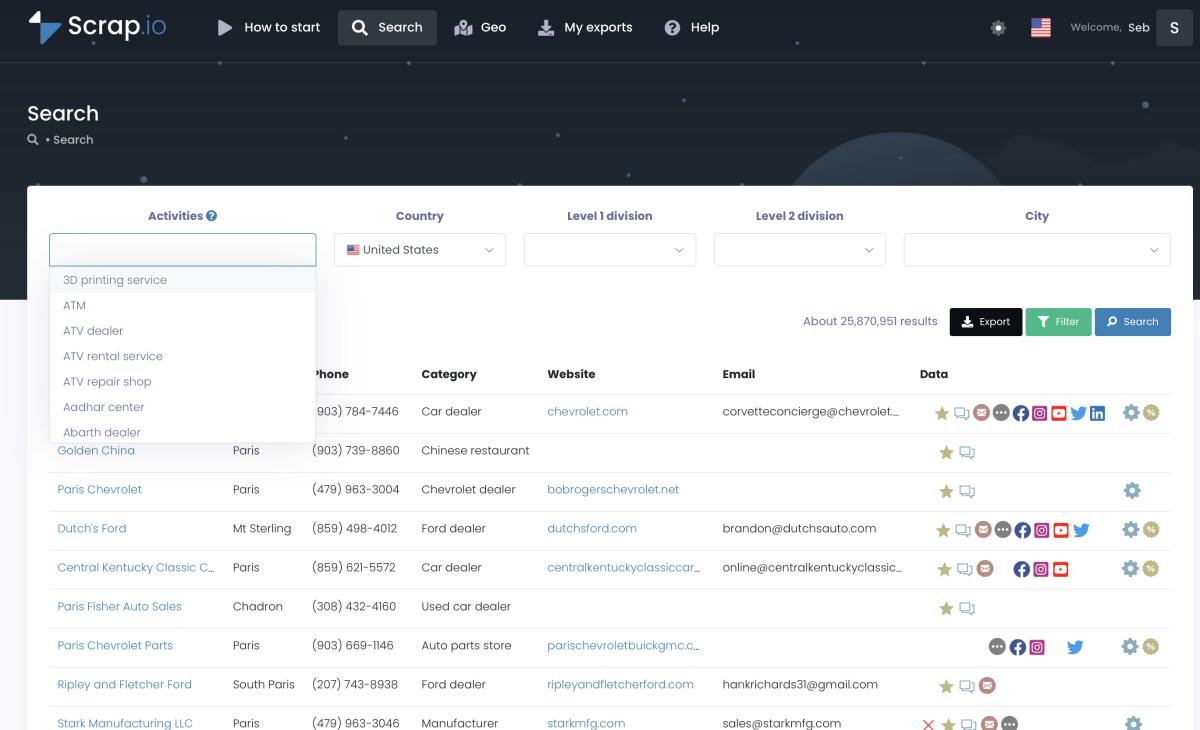
Pick a category and a location. Scrap.io counts the matches for free before you spend a credit.
Scrap.io indexes 225 million+ establishments across 195 countries and 4,000+ categories, and pulls the data no-code, at a flat price. A whole country in two clicks. The killer part is the filtering: it runs before extraction, so you only spend credits on records you'd actually contact.
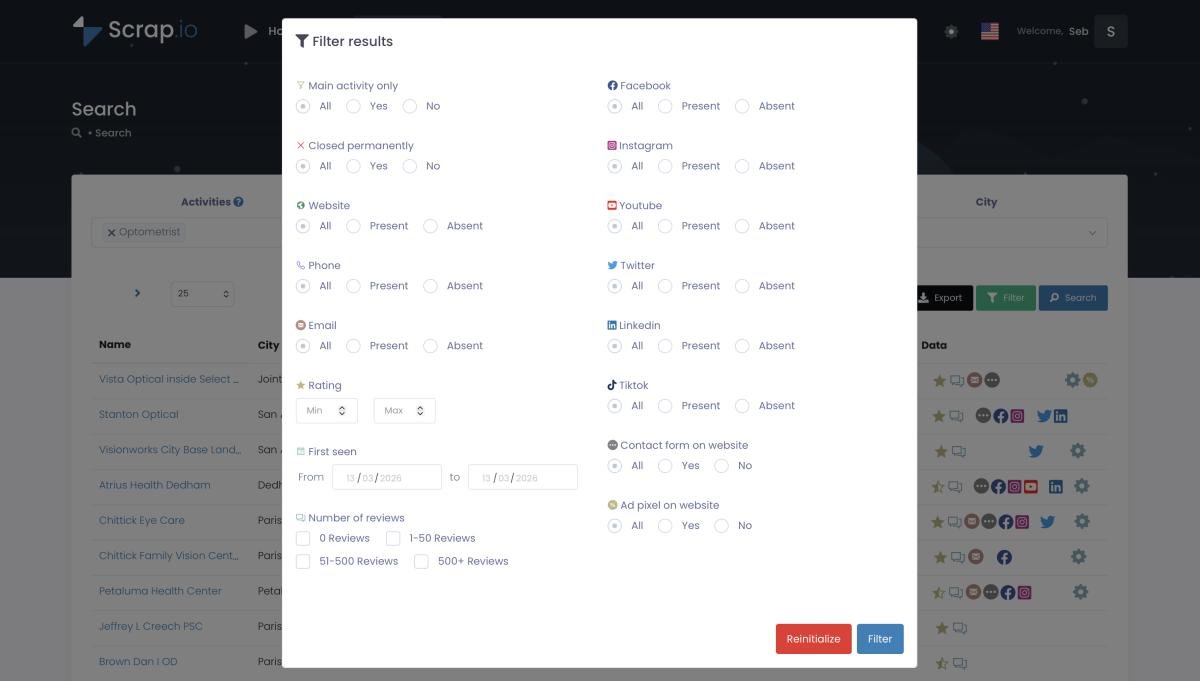
Filters run before extraction: email present, phone type, rating, website tech. No wasted credits on junk.
Want only businesses with a mobile number for an SMS campaign? Only the ones with an email? Apply it first, pay for useful contacts only. And because every extraction is live, the data is fresh at the moment you pull it, not scraped from some cache built six months ago. Columns the API simply doesn't return (phone type, classified emails, detected website tech, social links) come standard.
Video: Google Maps API: What Data can be Collected?
50,000+ professionals already stopped paying per request for data. If your real goal is leads, not routes, Scrap.io hands you 225M+ businesses with emails, phone types and social profiles the Places API never returns, GDPR and CCPA compliant. Start free: 7 days, 100 leads included.
Cut Your Google Maps Platform Costs Today
Staying on the Routes API? Fair. Then at least stop overpaying for it. A few moves that work right now:
- Send the minimal field mask. Every field you don't request keeps you in a cheaper tier. Audit your requests and strip the ones you never read.
- Cache aggressively. Routes between fixed points don't change every second. Store them within Google's terms and stop re-billing identical calls.
- Set budgets and alerts in the Cloud Console. There's no native spend cap, so build your own tripwire before a runaway script builds it for you.
- Batch your Route Matrix calls and prune the grid. Do you really need every origin against every destination, or just the plausible pairs?
- Monitor per-SKU usage monthly. The tier creep that drains your budget is invisible unless you look.
For the broader Maps bill beyond routing, our Google Maps API pricing calculator models your volume against alternatives, and the complete Google Maps API guide maps every SKU in the ecosystem.
FAQ
Is the Google Routes API free?
Not really. Since March 2025, there's no pooled credit, just a per-SKU google routes api free tier: roughly 10,000 Essentials calls, 5,000 Pro, 1,000 Enterprise per month. Past those caps, you're billed per 1,000. Small projects can live inside the caps; anything real blows through them.
How much does the Google Routes API cost per 1,000 requests?
So how much does the Google Routes API cost? In 2026 the routes api cost per 1000 requests is Essentials $5, Pro $10, Enterprise $15, dropping to $0.38 / $0.75 / $1.14 at very high volume. Compute Route Matrix is billed per element (origins times destinations), not per request, so its real cost depends on grid size.
Compute Routes vs Compute Route Matrix pricing?
Compute Routes bills once per request. Compute Route Matrix bills per element, where an element is one origin paired with one destination. A 50×50 matrix is 2,500 elements, not 100. Same tier rates, very different totals.
What's a free alternative to the Routes API?
For routing itself: self-host OSRM, OpenRouteService or Valhalla, all free and built on OpenStreetMap. If your real need is business data rather than routing, Scrap.io exports it at a flat price with emails and phone types included.
What happened to the $200 credit?
Google removed the flat $200 monthly credit on March 1, 2025, and replaced it with per-product free caps (up to roughly $3,250 of usage spread across SKUs, per Google and widely discussed on r/googlecloud). New accounts still get a one-time $300 trial credit.
The Bottom Line
Three takeaways. The Routes API bills by SKU and tier, and your FieldMask, not a pricing page, decides what you pay. The 2025 change traded one simple credit for three stingy buckets, so model your real usage before you commit. And if you were only reaching for Maps to get business data in the first place, there's a cheaper, flatter way to get it.
Stop budgeting for a meter you can't predict. Scrap.io gives you business data from 225M+ Google Maps listings across 195 countries, flat pricing from $35/month, emails and phone types the API won't return at any price. Try it free for 7 days, 100 leads on us.
Generate a list of restaurant with Scrap.io