

Here's a number that should annoy you: B2B companies with a clearly defined ICP see up to a 68% higher win rate. Sixty-eight. And yet most ideal customer profiles get built in a conference room on a Tuesday, pasted into a slide, and never opened again.
Dead on arrival.
I've watched founders spend a whole offsite arguing about their "ideal customer" and walk out with a paragraph so vague it describes half the planet. (Croyez-moi... sorry, wrong language... trust me, we've all done a version of this.) So this isn't another think-piece about why ICPs matter. You already know they matter. This is a fill-in-the-blanks ideal customer profile template: seven sections, a scoring rubric, real filled-out examples, plus the part nobody talks about, how to turn that document into an actual list of companies you can email tomorrow.
Table of Contents
- What Is an Ideal Customer Profile (ICP)?
- ICP vs Buyer Persona: Stop Confusing Them
- Why a Documented ICP Wins in 2026 (The Data)
- The Free ICP Template (7 Sections)
- How to Fill It Out: A 6-Step Process
- ICP Scoring Rubric: Turn the Template Into a Prioritized List
- Real Ideal Customer Profile Examples (B2B)
- From Template to Pipeline: Find the Companies That Match Your ICP
- 5 Mistakes That Kill Your ICP
- FAQ
What Is an Ideal Customer Profile (ICP)?
Your ICP is not your customer. It's the company you wish all your customers looked like.
An ideal customer profile is a description of the type of company that gets the most value from your product and gives the most value back, mapped by firmographics, technographics, and buying signals, not by one person's job title. It answers exactly one question: which companies should we actually be selling to?
So when someone asks what is an ICP in business, that's the honest answer: not a persona, not a wishlist, a company archetype. Notice the word company. That's the whole game. An ICP operates at the account level: industry, headcount, revenue band, tech stack, trigger events. Your Total Addressable Market is everyone who could theoretically buy. Your ICP is the sharpest slice of that: the accounts where your product solves a problem so real the deal half-closes itself.
And here's the thing. In 2020 an ICP was a checklist: "SaaS, 50-200 employees, $5M-$50M, done." That's not an ICP anymore. That's a Sales Navigator filter with delusions of grandeur. A real customer profile template in 2026 layers firmographics with technographics and intent data, all validated against deals you actually won. If you want the full definitional deep-dive, we've written a separate guide on what an ICP really is. This article is about building the thing and using it.
ICP vs Buyer Persona: Stop Confusing Them
Even experienced sales leaders mix these up. So let's kill the confusion for good. As HubSpot puts it: "Personas tell you who you're speaking to. ICPs tell you which companies are worth speaking to in the first place."
The ICP is the company. The persona is the human inside it. Get the company wrong and no amount of persona polish saves you. You'll write a beautiful cold email to the wrong building.
Quick answer, straight for the snippet: the ideal customer profile vs buyer persona difference is scope. The ICP defines the company worth selling to (industry, size, tech, signals). The buyer persona defines the person inside it you need to convince (role, goals, fears). Build the ICP first, the persona second.
| Ideal Customer Profile (ICP) | Buyer Persona |
|---|---|
| The company (the account) | The individual (the human) |
| Industry, size, tech stack, signals | Role, goals, fears, motivations |
| "Which companies do we target?" | "How do we talk to the people inside?" |
| 1-2 per market segment | 3-5 per ICP |
| Comes first | Comes second |
You need both. But sequence matters. ICP first, always. This is also the difference between an ideal customer profile template b2b and a consumer one: B2C leans on demographics, B2B leans on firmographics and triggers. Blur that line and you've built the wrong document entirely.
Why a Documented ICP Wins in 2026 (The Data)
Numbers first. Argue later.
When sales and marketing align around one ICP, companies report 38% higher win rates, 36% higher retention, and 208% growth in marketing-generated revenue (Cognism, 2025). That last figure isn't a typo. Two hundred and eight percent.
Meanwhile the median B2B conversion rate sits at just 2.9%, with most industries landing between 2.0% and 5.0% (Martal, 2026). Thin margins. Which is exactly why targeting precision decides who eats. Martal's data shows top performers hit 30-50% higher conversion largely by fixing who they aim at, not by writing cleverer subject lines.
Then there's the committee problem. The average B2B deal now involves 6 to 10 decision-makers (Forrester/Demandbase, 2026). Six to ten people, each with their own fears and veto power. A vague ICP means you're guessing at all of them. A documented one means you know which roles to map before you ever dial.
So is the conference-room ICP worth anything? No. It's theater. A documented, data-backed one is infrastructure.
The Free ICP Template (7 Sections)
Stop collecting templates. Seriously, you probably already have three saved somewhere, half-filled, gathering digital dust. The problem was never the template. It's that nobody fills it with real data.
So here's the whole thing. Seven sections. And no, you don't need some fancy ideal customer profile generator to do it. A spreadsheet and your own closed-won data beat any AI gimmick. If an attribute shows up in 60%+ of your best accounts, it earns a spot. Anything less, cut it.
| Section | What goes in it |
|---|---|
| 1. Firmographics | Industry (use NAICS codes), employee range, revenue band, HQ / regions, ownership type, growth signals |
| 2. Technographics | CRM, marketing automation, cloud stack, complementary or competing tools |
| 3. Buying Committee | Champion, decision-maker, influencer, blocker |
| 4. Pain Points & Triggers | The specific pains you solve + trigger events (funding, hiring surge, leadership change) |
| 5. Psychographic Layer | The champion's biggest fear, biggest ambition, core beliefs |
| 6. Qualification Gates | Financial readiness, urgency, readiness to change, stakeholder support |
| 7. Disqualification Criteria | Too small, wrong tech, no budget authority, regulatory mismatch |
What should an ICP template include? Those seven blocks, plus a scoring rubric (coming in section 6). Save the scoring in Google Sheets so the formulas do the math; keep the narrative profile in a doc, Word, PDF, or a Notion page, whatever your team will actually open. The format matters way less than the discipline of filling it in. A gorgeous slide template with empty fields is worthless. A scrappy spreadsheet with real closed-won data is gold.
Where can you build or store your ICP template? Any of these formats works:
- Google Sheets: best for the scoring rubric, since the formulas do the math for you.
- Word or Google Docs: best for the narrative profile your reps actually read.
- PDF: best for a locked, shareable version to circulate internally.
- Notion: best for a living document the team updates as the market shifts.
Section 5 is where most worksheets go blank, by the way. People love firmographics and freeze at psychographics. Don't skip it. The champion's fears are what make a cold email sound human instead of like a mail merge.
💡 See what ICP-matching data actually looks like. Before you fill a single cell, it helps to see the raw material: a real Scrap.io export pulls firmographics, website tech, ratings, reviews and verified emails for every business on Google Maps: 225,676,406 establishments across 195 countries and 4,000+ categories. Grab a sample export on Scrap.io and reverse-engineer your template from live data instead of guesses.
How to Fill It Out: A 6-Step Process
The best ICP isn't invented. It's reverse-engineered from your last 50 closed-won deals. You already have the answer. It's sitting in your CRM.
Here's the process, in order:
- Pull your last 50-100 closed-won deals. Not by logo size. Rank by a blend of revenue, retention, expansion, and how little they haggled.
- Find the shared traits. In practice, 70-80% of your best accounts share just 3-5 common traits (Prospeo, 2026). Those traits are your draft ICP. Circle them.
- Document firmographics + technographics + triggers. Write down what was true about the company and what was happening the moment they bought. Those trigger events are the backbone of signal-based selling, so capture them precisely.
- Add disqualification criteria. Who churned in 90 days, every single time? Write it down. Knowing who to avoid saves as much money as knowing who to chase.
- Validate with sales and CS. The people on the phones will tell you which "ideal" accounts are actually a nightmare. Listen to them.
- Layer in geography and segmentation. "US-based" isn't granular enough. Cluster your winners by region and refine with market segmentation criteria. Sometimes the real qualifier is "within 15 miles of a metro," not the vertical.
Do this and you'll learn how to create an ideal customer profile that reflects reality, not the whiteboard. It's also, bluntly, the only reliable way to learn how to find ideal customer profile patterns you'd otherwise never spot. Your gut says enterprise; the data might say mid-market stays 3x longer. Trust the data. Swallow the ego.
ICP Scoring Rubric: Turn the Template Into a Prioritized List
A worksheet without scoring is just a list. And a list doesn't tell your reps who to call first on Monday morning.
So score it. Here's a clean 100-point model.
| Category | Points | Breakdown |
|---|---|---|
| Firmographics | 40 | Industry 15 · Size 15 · Geo 10 |
| Technographics | 30 | CRM fit 15 · Tools 10 · Competitor 5 |
| Intent signals | 30 | Pricing page 10 · Content 8 · Research 7 · Funding 5 |
Then tier every account:
- 🟢 Tier A (80-100): white-glove treatment. Personalized sequences, custom demos, exec intros. These are the accounts that earn full account-based prospecting.
- 🟡 Tier B (50-79): structured cadences. Solid, efficient, not precious.
- 🔴 Tier C (0-49): automate or ignore. No guilt.
Is it worth building? Tier A accounts should close at 1.5-2x the rate of Tier B, with cycles 15-20% shorter. If they don't, your weights are wrong. Fix the rubric, not the reps. One honest caveat: if your average deal is under $10K, a 100-point model is overkill. A three-question checklist (right industry, right size, right tech) will beat an over-engineered rubric nobody maintains. Match the tool to the deal. For heavier segmentation work, the same market segmentation criteria feed straight into these weights.
Real Ideal Customer Profile Examples (B2B)
$2M to $18M ARR. The only thing that changed first? Their ICP got narrower.
That's the pattern across every case worth studying. Let's look at real ones, not made-up "Sarah, 34, likes hiking and SaaS" nonsense.
📌 The narrowing play. A SaaS company documented via SaaS Academy / Pylon went from $2M to $18M ARR with net revenue retention above 200% over 13 months. The trigger wasn't a new product or a funding round. They just made their ICP sharper and stopped selling to everyone.
📌 The qualification play. UnboundB2B ran a 12-week BANT-qualified campaign built on a tightened ICP and generated 227% ROI. Same channels, better targeting.
📌 The definition play. Only-B2B took a client from $10M to $40M ARR after formally defining an ICP, and their own analysis backs the 68% win-rate lift a documented profile delivers.
And here's a full ideal customer profile example you can copy, a mid-market SaaS workflow tool, straight from the Prospeo worksheet:
| Field | Example value |
|---|---|
| Industry | B2B SaaS / FinTech |
| Employees | 100-1,000 |
| Revenue | $10M-$150M |
| Tech stack | Salesforce + 5 disconnected tools |
| Champion | Director of Ops / RevOps |
| Key trigger | 10+ hours/week lost to manual entry |
| Disqualifier | Under 50 employees / no Salesforce |
See the specificity? "5+ disconnected tools, 10+ hours lost weekly" is what separates a useful profile from a generic one. There's even a case (digitalapplied, 2026) where copy rewritten around a tight ICP drove 3.1x engagement. Precision compounds. Once you have this level of detail, nurturing those matched accounts into revenue is its own discipline. Here's our lead nurturing playbook for that stage.
📌 50,000+ teams use Scrap.io to turn an ICP into a real prospect list, including names like L'Oréal, AXA and Decathlon. Rated 4.8 on Capterra and 4.9 on G2. When you're done comparing profiles and ready to find the companies that match yours, start on Scrap.io.
From Template to Pipeline: Find the Companies That Match Your ICP
A perfect ICP that points to zero prospects is a poem, not a strategy.
This is where most articles quietly end, right when it gets useful. You've got a beautiful document. Now what? Here's the gap nobody names: LinkedIn and ZoomInfo cover the corporate world well, but they're thin on local and SMB businesses: the dental clinics, agencies, contractors, franchises, and manufacturers sitting on Google Maps. If your ICP includes any of those, the "obvious" databases leave you empty-handed.
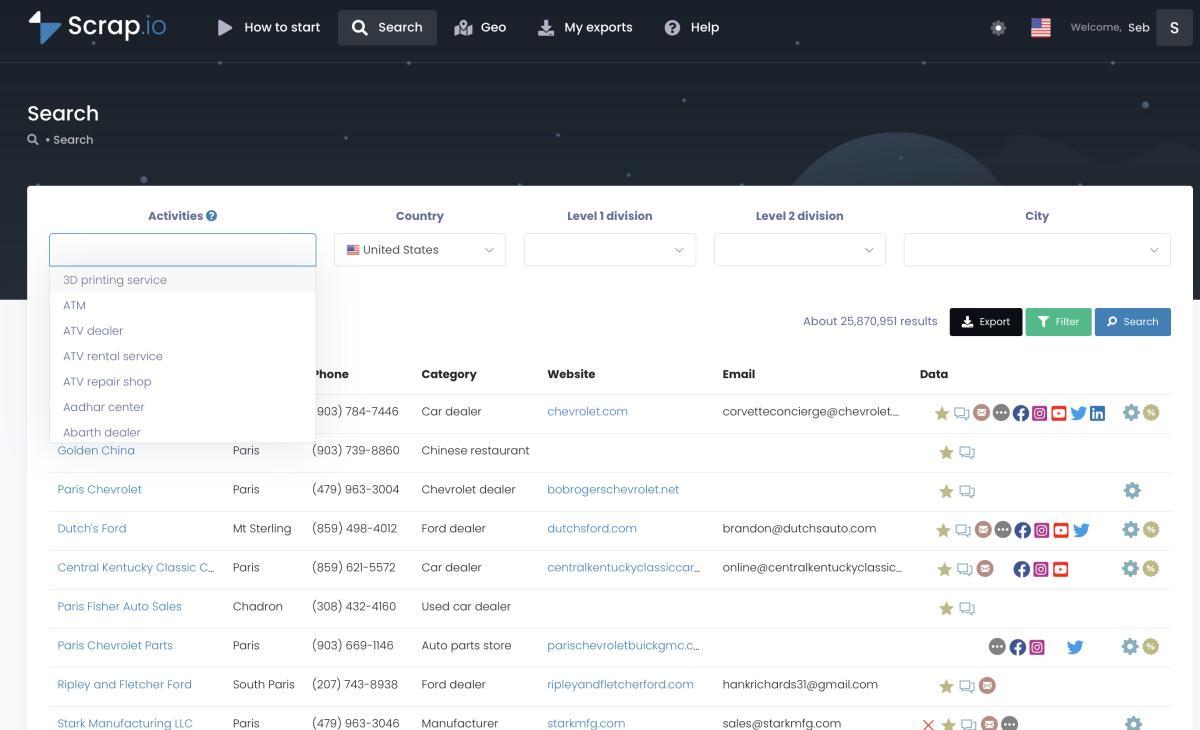
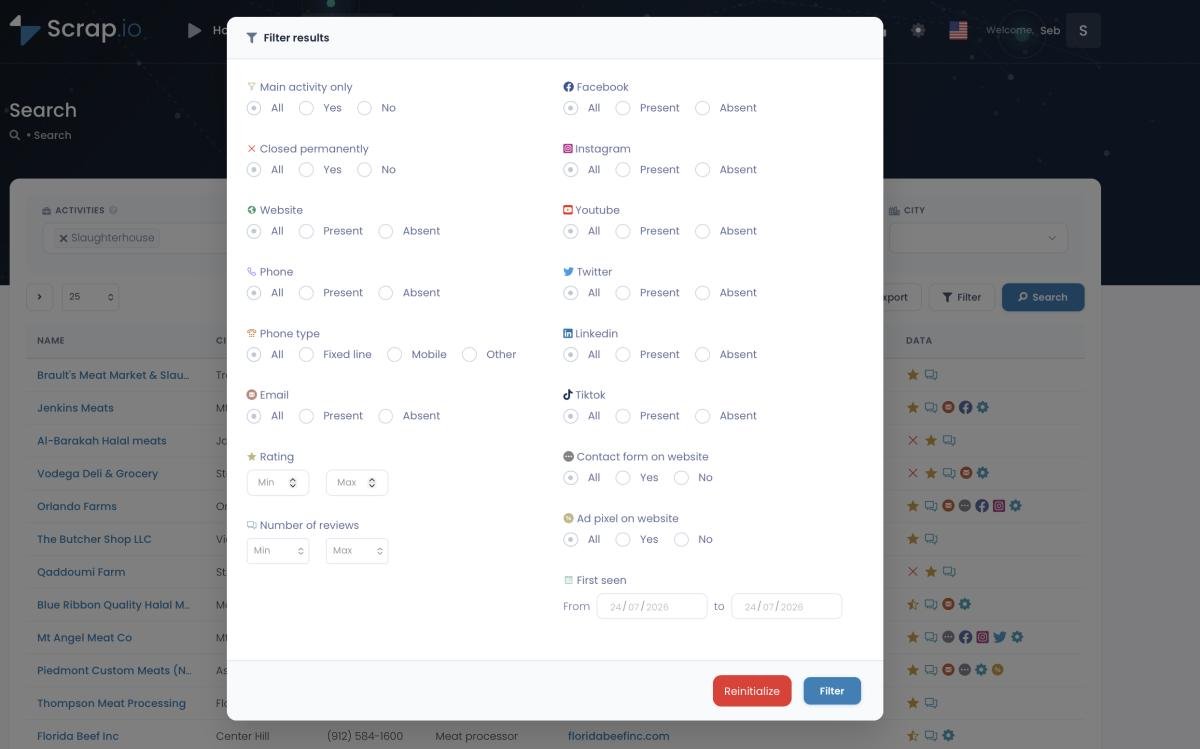
That's the exact problem Scrap.io solves. It translates your ICP into filters before you spend a single credit. Think about your seven sections as a query: has a website? has an email? rating ≥ 4? review count above a threshold? listing claimed? first detected recently (a "newly opened" trigger)? Each of those is a filter you apply upfront, so you only pay for businesses that actually match. Zero waste on junk records.
Concretely, the flow is: define your ICP → set your filters → extract the list. Pick from 4,000+ Google Maps categories, choose a zone from a single city all the way up to an entire country, layer your filters, and export a clean CSV or Excel with verified emails, phones, ratings, and website tech. Two clicks, no code. It's the missing bridge between an ICP document and a pipeline, and it pairs naturally with your cold emailing strategy and sales prospecting techniques once the list is built.
New to the tool? This two-minute walkthrough shows the whole thing click together, from category to exported list:
Video: Scrap.io - How to Start?
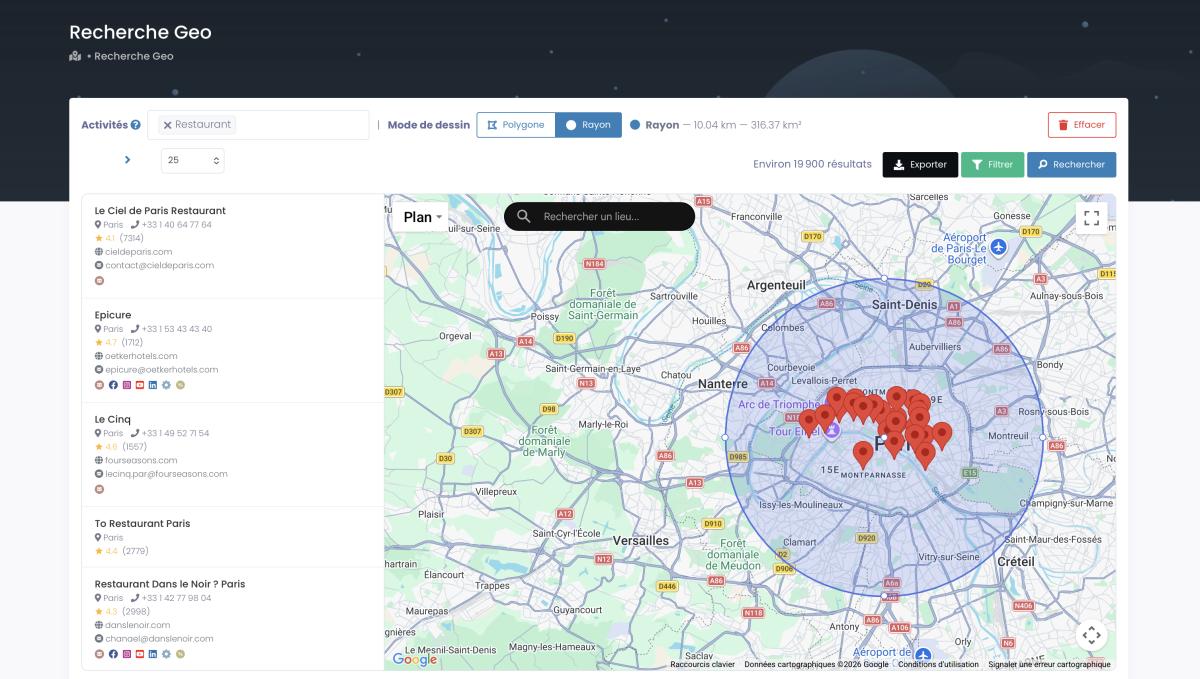
Need to carve out an irregular area, a specific metro, a business district, a catchment zone? GeoSearch lets you draw a radius or a custom polygon on the map and pull every matching business inside it.
"But my ICP targets big accounts, not local shops." Fair. Except 4,000 categories cover clinics, agencies, cabinets, franchises and manufacturers, plus every agency selling to the local market. It's genuinely the only source at that scale. And on the local/SMB angle specifically, you can go deeper on how to define your ICP with geographic data, or read our full breakdown of Google Maps vs LinkedIn for B2B leads. On compliance: Scrap.io works only with publicly available business data, each field traceable to its source, and it's GDPR and CCPA compliant. Legal, for legitimate outreach.
Video: How to Scrape Local Leads at the Country Level?
🎯 Translate your ICP into filters and pull every matching business. Category, zone, website, email, rating, reviews, claimed listing: set your criteria, extract a real prospect list in minutes, and export it straight to your CRM. Try Scrap.io free for 7 days (100 leads included).
5 Mistakes That Kill Your ICP
Most bad ICPs die the same five deaths. Here they are, so yours doesn't.
- Building it like a B2C profile. As the crowd on r/b2bmarketing bluntly puts it: "B2B ICPs fail when they're built like B2C profiles, stuffed with demographics instead of firmographics and purchase triggers." If your ICP reads like a dating profile, you've already lost.
- Building it in a conference room. No customer interviews, no closed-won analysis, just vibes. That's a fairytale, not a profile.
- Stopping at firmographics. Skip technographics, triggers and the psychographic layer and you're scoring on half the picture. (That psychographic layer? A recurring point on r/SaaS is that capturing the champion's fears and ambitions is exactly what makes a cold email sound authentic instead of automated.)
- Never updating it. Quarterly in fast-moving markets like SaaS, annually in stable ones. An ICP from 18 months ago is a historical document.
- Never operationalizing it. A profile that never becomes a filter, a score, or a prospect list is a document, not a strategy. This is the one that kills the most deals.
Notice how many of these come back to the same root: fewer than 10% of your TAM should actually match a real ICP. The disqualification list eliminates roughly 90%. If your profile describes half your TAM, it isn't ideal. It's just a market.
FAQ
What is an ideal customer profile example?
A mid-market SaaS workflow tool's ICP: B2B SaaS or FinTech, 100-1,000 employees, $10M-$150M revenue, running Salesforce plus 5+ disconnected tools, where a Director of Ops loses 10+ hours a week to manual entry. Disqualifier: under 50 employees or no CRM.
ICP vs buyer persona: what's the difference?
The ICP is the company that's the best fit (industry, size, tech, signals). The persona is the individual inside it (role, goals, fears). ICP comes first: pick the right company, then figure out who to talk to.
How do I create an ICP?
Analyze your last 50-100 closed-won deals, find the 3-5 traits 70-80% of them share, document firmographics + technographics + triggers, add disqualification criteria, and validate with sales and CS. Reverse-engineer it from reality, don't invent it.
What should an ICP template include?
Seven sections: firmographics, technographics, buying committee, pain points & triggers, psychographic layer, qualification gates, and disqualification, plus a 100-point scoring rubric with tiers A (80-100), B (50-79), and C (0-49).
How often should I update my ICP?
Quarterly in fast-moving industries like SaaS, annually in stable verticals. Review your win/loss data each cycle and adjust the technographic and intent criteria based on which Tier A accounts actually closed.
Your ICP Is Done. Now Go Use It.
Look, a template alone changes nothing. The teams that win are the ones who fill it with closed-won data, score it, and then translate it into a list of real companies they can reach this week. Document, score, extract. That's the loop.
So finish the seven sections tonight, and let your ICP earn its keep tomorrow.
Video: How to Scrape Local Leads with Claude & Vibe Prospecting?
🚀 Your ICP is done. Extract your first 100 ICP-matching leads free today. Turn your seven sections into filters and pull every matching business across 195 countries and 4,000+ categories. Start free on Scrap.io: 7 days, 100 leads offered.
Generate a list of restaurant with Scrap.io