

Right now, as you read this, there are 80,754 jewelry stores sitting on Google Maps in the US. Rings, watches, engagement stuff, mall kiosks, third-generation family shops. All of them public. All of them reachable.
The jewelry store email list you bought last month? A chunk of it is already dead.
That's not a guess. We watch this happen every week. Someone pays a vendor for "119,580 verified contacts," loads the CSV into their sending tool, hits go, and gets slapped with a bounce rate that torches their domain by lunchtime. Then they email us asking why. So instead of selling you the same frozen spreadsheet everyone else is renting, this guide shows you the other way: how to build a jewelry store email list yourself, fresh, filtered before you spend a cent. It takes about ten minutes. Really.
What's in this guide
- What a jewelry store email list actually means
- The US jewelry market in 2026 (with real numbers)
- Buy vs build: the honest comparison
- How to build your own list of jewelry stores, step by step
- Filtering before you export
- Is buying (or building) a list legal?
- Cold email that actually works
- Where to buy a list (if you must)
- FAQ
What a Jewelry Store Email List Actually Means
Let's clear something up first, because the search results for this keyword are a mess.
Two totally different people type "jewelry store email list" into Google. The first is a B2B seller — a web agency, a POS company, a diamond wholesaler, a packaging supplier — who wants to reach jewelry stores and sell them something. The second is a jeweler who wants to email their own customers about a Valentine's promo. Same words. Opposite jobs.
This guide is for the first group. If you're selling to jewelers and you need a jewelers email list — a clean jewelry store contact list you can actually run a campaign against — you're in the right place. (If you're a jewelry store owner looking to email shoppers, honestly, GemFind's guide for jewelers covers that side better than we could.)
So what's inside a good list? Business name, address, website, phone, and — the part everyone actually pays for — a working email. The best versions also tell you the Google rating, the review count, whether the shop even has a website, and which type of email you're looking at (a generic contact@ address versus a named person). That last bit matters more than people think. More on it later.
One more thing worth saying out loud: jewelry retail is overwhelmingly a small business email list market. Most of these shops are owner-run. No procurement department, no gatekeeper filtering the inbox. Which is great news for outreach — and terrible news if your data is stale, because there's exactly one person to annoy.
The US Jewelry Market in 2026 (With Real Numbers)
Numbers first. Sourced ones, not the "many businesses" kind.
The US jewelry stores industry is worth $60.3 billion in 2026, down about 2.2% on the year, sitting on roughly 73,980 registered businesses (IBISWorld, 2026). It's a mature market. Slightly shrinking, actually. Gold's expensive, tastes shift, some of the old mall players are closing.
But here's where it gets interesting. IBISWorld counts registered businesses. Google Maps counts everything that's actually open and trading — and that number is bigger. Pulled live from Scrap.io the day this went out:
| US jewelry stores on Google Maps | With a public email | With a website | With a phone number |
|---|---|---|---|
| 80,754 | 33,554 (~41.5%) | 57,188 (~70.8%) | 72,917 (~90.3%) |
Source: Scrap.io real-time data, July 2026.
Read that email column again. Only about four in ten jewelry stores publish an email you can actually scrape. So the real reachable universe isn't 80,000 — it's closer to 33,554. That gap is the whole ballgame, and we'll come back to why it saves you money.
The biggest jewelry stores in the USA (and why you probably shouldn't chase them)
When people search "biggest jewelry stores in usa" or "top 10 jewelry stores in usa," they're usually picturing Signet Jewelers — the parent of Kay, Zales, and Jared — plus Tiffany & Co., Blue Nile, and the mall giants. Fine to know. Useless for prospecting.
Those chains have corporate procurement and a wall of "no." The money in a B2B list of jewelry stores in USA is the independents: the 3-person shop in Tulsa, the estate jeweler in Savannah, the watch repair counter that's been in the same strip mall since 1994. They decide fast. They answer their own email. That's your market.
Want to see how far this scales? You can pull every jewelry store in one ZIP, one state, or the entire country in a couple of clicks — the same way you'd build a restaurant email list or a real estate agent email list. Here's the country-level workflow in action:
Video: How to Scrape Local Leads at the Country Level
Curious how many are near you? Count jewelry stores in your state, city, or ZIP for free on Scrap.io — counting never costs a credit. See the real number before you decide anything.
Buy vs Build: The Honest Comparison
Okay. The big decision. And the one every "jewelry store email list" article dodges because most of them are the list vendors.
When you buy an email list by industry, you're buying a photograph. A snapshot of a database from whenever the vendor last bothered to refresh it. Could be last week. Could be Q1. And you're sharing that exact same photo with every other buyer — so the jeweler in your shiny new file already got the same pitch from three competitors on Tuesday. You're number four.
Building is different. You pull the data yourself, live, the moment you need it. Fresh. Nobody else's copy.
Here's the side-by-side:
| 🔴 Buy a pre-built list | 🟢 Build it yourself | |
|---|---|---|
| Freshness | Weeks to months old | Verified at the moment of export |
| Exclusivity | Resold to everyone | Yours alone |
| Bounce risk | High — dead inboxes, spam traps | Low — live listings only |
| Targeting | Preset segments | Filter by rating, website, ZIP, more |
| Cost per 1,000 | ~$15 (BookYourData US pack: $599 / 38,838) | ~$5 |
Notice the cost line, because "how much is a 1,000 email list worth" is a question people actually search. BookYourData's US jewelry package runs $599 for 38,838 records — that's roughly $15 per thousand for static data you share with the world. Building the same volume from live Google Maps data lands around $5 per thousand. Cheaper and fresher. That combination shouldn't exist. Usually you pay more for better. Not here.
And it's not just us saying build beats buy. Mailchimp — who make money when you send email, so they'd love to sell you more contacts — flatly tells people: "it's never a good idea to buy a list of emails… it's best to build your own mailing list over time." When the email platform tells you not to buy lists, listen (Mailchimp).
Want proof it's real? A live export of every US jewelry store with a verified email — all 33,554 of them — takes about a minute to filter and pull. You can build any industry email database the same way.
How to Build Your Own List of Jewelry Stores, Step by Step
Here's how to extract jewelry store emails from Google Maps without touching code, a scraping script, or a 200-hour VA project. Four steps.
Step 1 — Pick the category. Type "jewelry store" into Scrap.io. It maps to Google's own business category, so you're not guessing at keywords. Done.
Step 2 — Pick the zone. A city. A county. A whole state. The entire US if your plan allows it. Beats Googling "list of jewelry stores near me" one town at a time. This is the part that used to be impossible — grabbing every jewelry store in a country without babysitting a scraper for hours.
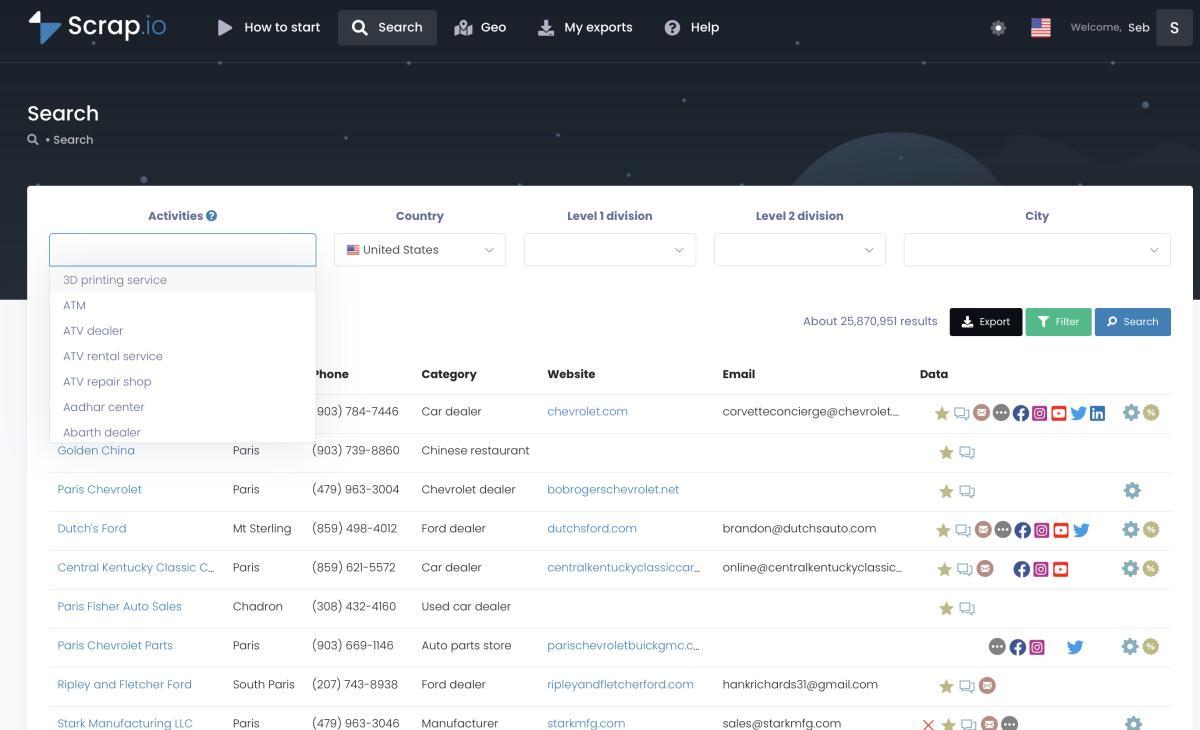
Scrap.io search — pick a category and a zone, see the live count.
Need something tighter than a city but looser than a ZIP? GeoSearch draws a radius around a point, or lets you sketch a custom polygon on the map — a single neighborhood, a shopping district, a stretch of coastline. Whatever shape your territory actually is.
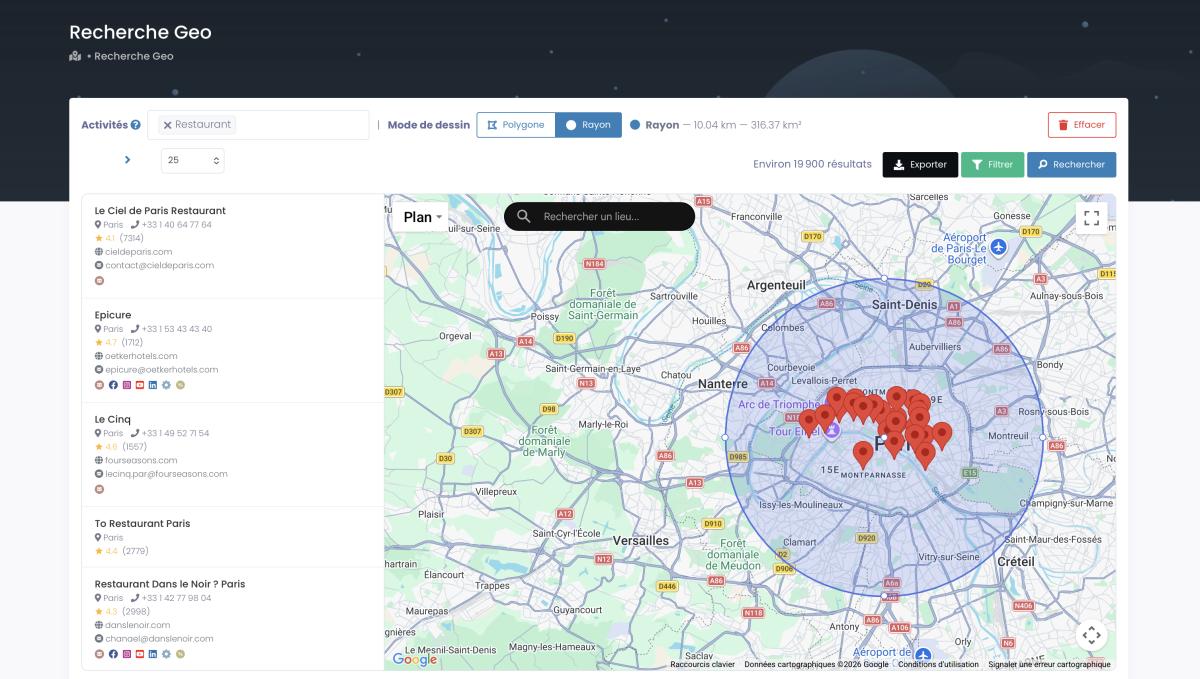
GeoSearch radius — target jewelry stores within X km of any point.
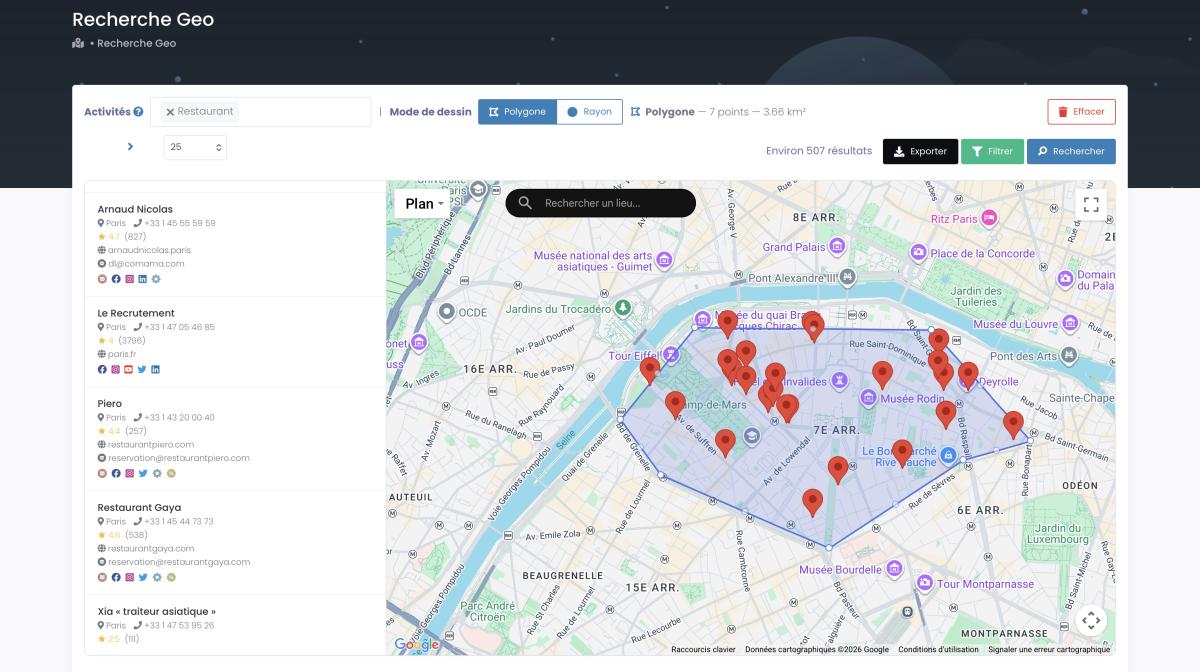
Polygon mode — draw any custom area by hand.
Step 3 — Apply the filters BEFORE you export. This is the step that saves you money, and we'll give it its own section below. Short version: switch on "has email" so you only ever pay for stores you can actually contact.
Step 4 — Export. CSV or Excel, ready to drop into your CRM or sending tool. Names, emails, phones, websites, socials, ratings. Fresh as of the second you hit the button.
That's it. Want to watch someone do the whole thing from zero?
Video: Scrap.io - How to Start?
Rather run it all from inside your browser while you're already on Google Maps? The free Chrome extension shows emails and socials right on the map. And if you want the full walkthrough with every option, the getting-started docs lay it out.
Build your first list now. Start a free 7-day Scrap.io trial — 100 export credits included — and pull a fresh jewelry store email list before your coffee's cold. 225M+ businesses across 195 countries are already indexed.
Filtering Before You Export
Here's the thing nobody tells you about buying lists: you pay for the garbage too.
Buy 40,000 "jewelry contacts" and a huge slice will have no working email — you paid for them anyway. Building flips that. Because the filters run before extraction, a credit only gets spent on a store that passes. No email on file? It never enters your export. You literally cannot pay for a blank.
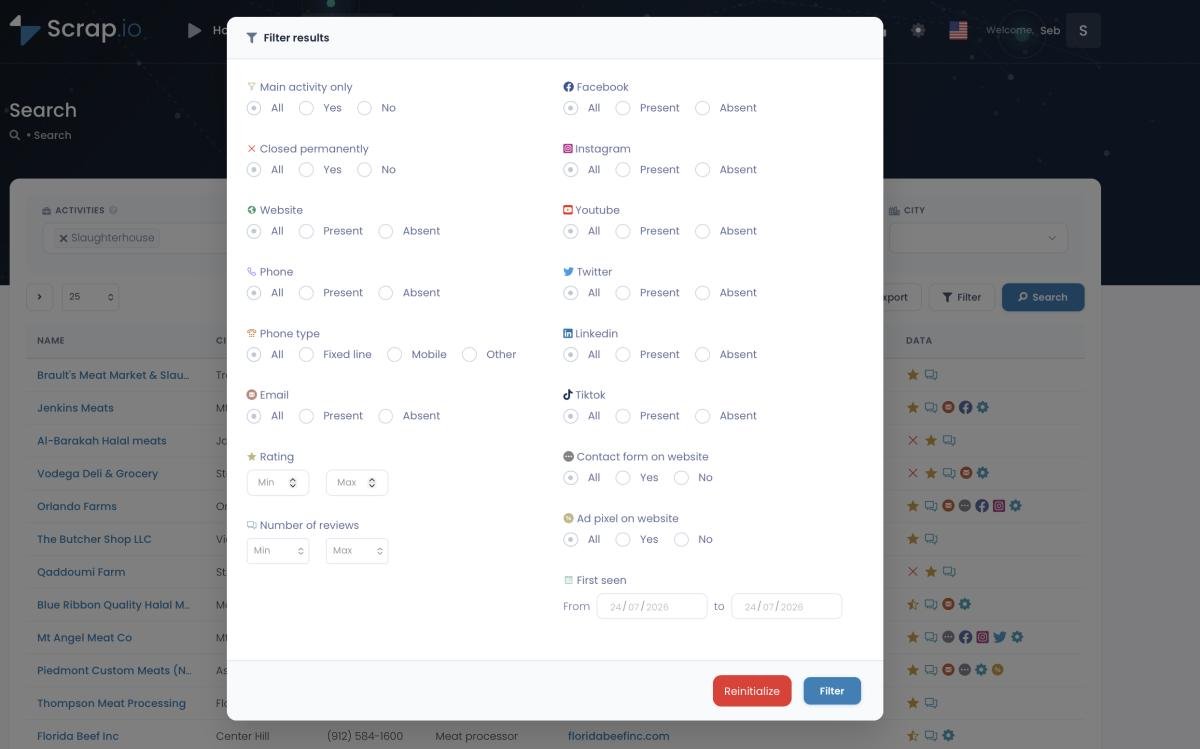
Filter for stores that already have an email — before spending a single credit.
What you can filter on:
- Email present — the big one. Turns 80,754 into a payable 33,554.
- Website / no website — no website is a screaming buy signal if you sell web design.
- Google rating and review count — a 3.1-star shop needs reputation help; a 4.9 with 800 reviews needs something else entirely.
- Date first detected — this one's sneaky-good. It flags stores that just appeared on the map, i.e. jewelers who just opened and are buying everything.
That last filter deserves a demo, because "new business" is the warmest lead in any B2B jewelry stores email database USA:
Video: Find Businesses That JUST Opened (Before Your Competitors Do)
And the emails aren't just dumped in one column. They're classified — the main store email, a contact@ or sales@ address, or a named individual with a first and last name attached. That means you can write "Hi Sarah" instead of "Dear Business Owner," which is roughly the difference between a reply and the trash. Before you send at scale, run the file through a checker anyway — even fresh data drifts, so it's worth learning to verify your emails first.
Is Buying (or Building) a List Legal?
Short answer: yes, for B2B, in the US, if you follow the rules.
"Is it legal to buy an email list?" is one of the most-searched questions on this whole topic, so let's be precise. In the US, the CAN-SPAM Act governs commercial email, and it does not require prior opt-in for B2B. What it requires: don't lie in your subject line, identify yourself honestly, include a real physical mailing address, and give people a working way to unsubscribe — then honor it within 10 business days. That's the whole deal. Break it and fines run north of $50,000 per email, so, you know, don't.
The source of your data matters as much as the sending. Scrap.io only pulls publicly available business information — the stuff jewelers published themselves on Google Maps and their own websites. Voluntarily public. Traceable to the source. GDPR and CCPA compliant. That's very different from a mystery list some vendor "sourced from partners" (translation: bought from someone who bought it from someone who scraped something sketchy in 2019).
Cognism makes the same point from the data side: business emails live on public About, Contact, and Team pages, which is exactly where legitimate extraction pulls them (Cognism). Public data, used for B2B, with an opt-out. Solid legal ground.
Cold Email That Actually Works
You've got a clean jewelry store contact list. Knowing how to email jewelry stores well is the other half of the job — so don't waste it.
The single biggest mistake? Loading 10,000 stores into your sending tool and blasting the identical email to all of them. That's how you hit a 4% open rate and wonder where you went wrong. A targeted list of 500 jewelers you actually researched will out-earn a generic dump of 10,000 every single time. We've seen it over and over.
Segment first. Split by rating. Split by website-or-not. Split by state. A 4.8-star boutique in Beverly Hills and a struggling 3.2-star shop outside Cleveland need completely different emails — different hook, different offer, different everything.
Then personalize past the first name. Mention their city. Reference their rating. Notice they sell watches but have no online booking. Thirty seconds of homework per prospect, and your reply rate jumps. These are small business owners drowning in vendor pitches — generic dies on contact.
And send sequences, not one-offs. One cold email is a coin flip. A 3-to-5 email sequence, spaced roughly ten days apart, is a strategy. The warm outreach course walks through the icebreakers and templates if you want a framework instead of guessing. Selling to agencies too? The same playbook powers a marketing agency email list.
Email still pays, by the way. Retail email marketing returns somewhere around $36–$42 for every $1 spent (DMA / Litmus), and roughly 20% of retail email subscribers actually open and engage (SmartInsights) — versus organic social reach that's cratered to about 2.27% on Facebook and under 1% on Instagram. So yeah. The inbox still beats the feed. It's not even close.
Where to Buy a List (If You Must)
Look, sometimes you need contacts in the next thirty seconds and you'll pay for the convenience. No judgment. Here's an honest map of who sells a jewelry wholesale email list or retail jewelry stores mailing list — basically a business directory with emails attached — and what you're actually getting.
| Provider | Claimed pool | Model | Catch |
|---|---|---|---|
| BookYourData | 119,580 (38,838 US) | $599 US pack / from $99 for 250 | Static, resold, monthly refresh |
| IInfotanks | 50,000+ (US/UK/CA/EU) | Custom quote | Opaque sourcing, quote-gated |
| DataCaptive / ExactData / Blue Mail Media | Varies | SIC/revenue segments | Not real-time, thin on method |
| Scrap.io (build) | 33,554 US with email (live) | Free trial, then ~$5/1,000 | You run the export (1 min) |
If you're hunting a "free jewelry store email list" or the "best jewelry store email list provider," here's the blunt truth: nothing genuinely free exists — a truly free list is either bait or already dead. The closest thing is building one cheaply yourself on a free trial, which beats $599 for a shared file. (Prefer an authority signal over a vendor? Jewelers of America is the industry's professional association — great for research, not a contact source.)
The pattern here is the same across every local vertical, which is why a good hair salon email list gets built exactly the way a jewelry one does: fresh data beats frozen data, and you can't afford to learn that lesson via a burned domain.
Stop renting stale data. Start your free 7-day Scrap.io trial — 100 export credits included — and pull a fresh, filtered, verified jewelry store email list today. Yours alone, not resold to your competitors.
FAQ
How many jewelry stores are there in the US?
About 80,754 are live on Google Maps as of July 2026 (Scrap.io real-time data), while IBISWorld counts roughly 73,980 registered jewelry-store businesses. Around 42% publish a public email — so the realistically reachable universe for outreach is about 33,554 stores.
Is it legal to buy or build an email list of jewelry stores?
Yes, for B2B in the US. The CAN-SPAM Act allows unsolicited commercial email as long as you identify yourself honestly, include a physical address, and offer a working opt-out. Scrap.io uses only publicly available business data and is GDPR/CCPA compliant. How you send is what keeps you legal.
Where can I get a free jewelry store email list?
Nothing truly free is worth having — free lists are usually stale or bait. The cheapest legitimate route is building your own on Scrap.io's free 7-day trial (100 export credits included), which gets you fresh, verified contacts instead of a $599 shared file.
Why are purchased email lists a bad idea?
They're static, resold to everyone, and decay fast — which means bounces, spam-trap hits, and long-term damage to your sending domain. Even Mailchimp advises building your own list over time. Real-time data avoids the whole problem.
How do I find jewelry store owners' emails?
Extract them at scale from each store's Google Maps listing and website. Scrap.io classifies what it finds — the main email, contact@ / sales@ addresses, or a named individual with first and last name — so you can personalize instead of blasting "Dear Owner." You can also verify each address before sending.
Generate a list of jewelry store with Scrap.io