

Around 1,300 housing associations in England manage 2.9 million homes. Last year alone they spent £10 billion on repairs and maintenance. If you sell anything to that sector, one question should be nagging at you right now: where's your list?
Because here's the catch. Most people who go looking for a list of housing associations UK end up with one of two things. A free government register full of legal names and zero contact details. Or a frozen directory that was already wrong the day it was published. Neither one gets you an email you can actually write to.
So this guide does the thing nobody else bothered with. First, the lay of the land: how many housing associations there really are, which ones are the giants, and why the sector is a bigger B2B market than people assume. Then the part that matters, how to build your own fresh, filtered, contact-ready list of UK social landlords. Let's get into it.
- How many housing associations are there in the UK?
- The largest housing associations in the UK (2026)
- Where to find a list (and why most lists fail)
- How to build your own fresh list
- Who needs a list of housing associations, and why
- Turning the list into results: outreach that works
- Is scraping housing association data legal? (UK GDPR)
- FAQ
How many housing associations are there in the UK?
So how many are there, actually? It depends what you're counting: the register, the map, or the parent groups. Those are three different numbers, and people mix them up constantly.
Count the organisations and the National Housing Federation puts it at around 1,300 housing associations operating in England, housing roughly 6 million people, about one in ten of the population. They build a quarter of England's new homes, and almost all of the new social and affordable ones. That's the headline figure most "how many housing associations are there in the uk" searches are chasing.
Then there's the register. The Regulator of Social Housing keeps a statutory list of every registered provider of social housing, which runs to roughly 1,400 private registered providers once you add the for-profit entrants. And then there's the map, which is where it gets interesting for anyone selling into the sector. More on that in a second.
The UK social housing sector in numbers (2026)
The numbers are bigger than most people outside the sector realise. This isn't a charity backwater. It's a multi-billion-pound procurement engine.
The Regulator's 2025 Global Accounts (the year ending 31 March 2025) put it in black and white. Spending on repairs and maintenance climbed 13% to £10 billion. Development investment hit £14.2 billion, delivering 54,000 new social homes. The sector's underlying surplus rose to £1.9 billion, up from £1.6 billion the year before.
Read that repairs figure again. Ten billion pounds, in one year, spent with suppliers.
That's the point most "housing associations uk" explainers miss entirely. Behind every association sits a buying budget: maintenance contractors, PropTech platforms, insurance, energy, consultancy, cleaning, compliance software. The sector doesn't fill in your web form. But it spends like a FTSE 100.
Quick answer: around 1,300 housing associations operate in England, managing 2.9 million homes, with roughly 1,400 private registered providers in total. On Google Maps, about 5,100 housing-association offices are listed with contact details (Scrap.io, 2026).
Registered providers vs housing associations vs councils
So what is a registered provider, exactly? Quick vocabulary check, because the labels trip everyone up and getting them wrong makes you look like an outsider in your first cold email.
A registered provider (RP) is any organisation on the RSH register. That bucket holds three kinds of landlord: local authorities (councils), not-for-profit housing associations, and for-profit private registered providers of social housing. So every housing association is a registered provider. Not every registered provider is a housing association. You'll also hear "registered social landlord" (RSL), "social landlord," "housing trust," "ALMO," and "list of social housing providers" used more or less interchangeably. Same sector, different dialects.
Why does it matter for a list? Because a council procures nothing like a 2,000-home charitable association does, and a for-profit PRP behaves differently again. Know which sub-group you're selling to before you build your social housing providers uk file, or you'll pitch the wrong buyer entirely.
The largest housing associations in the UK (2026)
Everyone in social housing knows Clarion, L&Q and Peabody. Almost nobody can name the other 1,290. That gap is the whole story of this market.
The biggest housing association of the lot is Clarion Housing Group. Per Clarion's own figures, it owns 125,000+ homes, houses 360,000 residents, works across more than 170 local authorities, and turned over £1.045 billion in 2025-26. One association, the GDP of a small town. Down in London and the South-East, the G15 group of 11 large associations manages somewhere in the region of 600,000 homes between them.
Top 10 UK housing associations by homes owned
Here's a rough ranking of the biggest players by homes owned or managed. One honest caveat first: these figures are approximate and move constantly, because the sector merges like it's going out of fashion. Treat it as indicative, not gospel.
| # | Housing association | Approx. homes (owned/managed) | Main footprint |
|---|---|---|---|
| 1 | Clarion Housing Group | 125,000+ | National |
| 2 | Places for People | ~230,000 | National |
| 3 | Sanctuary | ~125,000 | National |
| 4 | L&Q | ~105,000 | London & South-East |
| 5 | Peabody | ~104,000 | London & South-East |
| 6 | Sovereign Network Group (SNG) | ~84,000 | South & London |
| 7 | Riverside | ~77,000 | National |
| 8 | Notting Hill Genesis | ~68,000 | London |
| 9 | Metropolitan Thames Valley (MTVH) | ~57,000 | London & Midlands |
| 10 | Platform Housing Group | ~50,000 | Midlands |
Useful to know.
Also, if you're prospecting, mostly a trap.
…and the 1,300 others the "top" lists ignore
Here's the uncomfortable maths. The Regulator's analysis covers the 200 largest providers, and those 200 account for over 96% of the sector's stock. Which sounds like the big names are the whole game. They're not, not for a seller.
Because the giants have procurement teams, preferred-supplier frameworks, and a polite "no" ready before you finish your sentence. The money for most vendors sits in the long tail: roughly 1,100 small and mid-sized associations that the "top 10" and "list of uk housing associations by size" posts completely ignore. These are the ones that buy in direct, make faster decisions, and still read their own inbox. That's your market. Not the ten logos everyone else is fighting over.
Where to find a list (and why most lists fail)
The official register of housing associations is free, public, and almost useless for outreach. I'll explain why, because it's the whole reason this article exists.
The RSH register of registered providers is the gold standard for one thing: confirming who legally exists. You get names, registration numbers, legal designations, a monthly spreadsheet. What you don't get? An email. A phone number. A named decision-maker. A hint of who to actually call. It tells you who exists, never how to reach them.
Then there are the alternatives, and they're worse. Local directories (192.com by county, say) are frozen, bitty, and region-by-region. The NHF publishes partial PDF lists of signatories, not a contactable database. And Companies House holds the legal shell of each organisation but, as we covered in our guide to enriching Companies House data, it carries no emails or phones either, by design. A page is not a file. A register of housing associations is not a prospect list.
Here's the gap, laid out side by side.
| What you need | RSH register | Directories | NHF / PDF lists | Scrap.io |
|---|---|---|---|---|
| Emails & phones | 🔴 | 🔴 | 🔴 | 🟢 |
| Real-time / fresh | 🟡 | 🔴 | 🔴 | 🟢 |
| Whole UK in one export | 🟡 | 🔴 | 🔴 | 🟢 |
| Filter before export | 🔴 | 🔴 | 🔴 | 🟢 |
| Decision-maker contacts | 🔴 | 🔴 | 🔴 | 🟡 |
There's even a direct competitor worth naming, because it proves the point. Axxco's UK Social Housing Providers Database mirrors the RSH register, synced daily, searchable, genuinely useful for due diligence. But it's registry data only: no emails, no contacts, no decision-makers. It tells investors who the players are. It doesn't tell a supplier how to reach them. Exactly the gap we're about to close.
Curious how many housing associations sit on the map in your target region? See the count for a city, a county, or the whole UK on Scrap.io. Counting is free, no credits spent. Check your market on Scrap.io →
How to build your own fresh list
Meet Priya. She sells a repairs-management platform to social landlords. Last quarter she spent two full days copy-pasting names off the RSH register, then another day hunting for emails that half the time didn't exist. Three days, one mediocre spreadsheet. Here's what she should have done instead, in about ten minutes.
The idea is simple. Every housing association that wants to be found puts itself on Google Maps, with an office address, a phone, usually a website. And that website nearly always has an email on it somewhere. So instead of scraping a legal register by hand, you pull the live map listings and let the tool read the contact data off each site. That's the whole trick. If you want the deeper mechanics, our guide to extracting every business on Google Maps walks through it end to end.
Here's the country-level version running start to finish:
Video: How to Scrape Local Leads at the Country Level
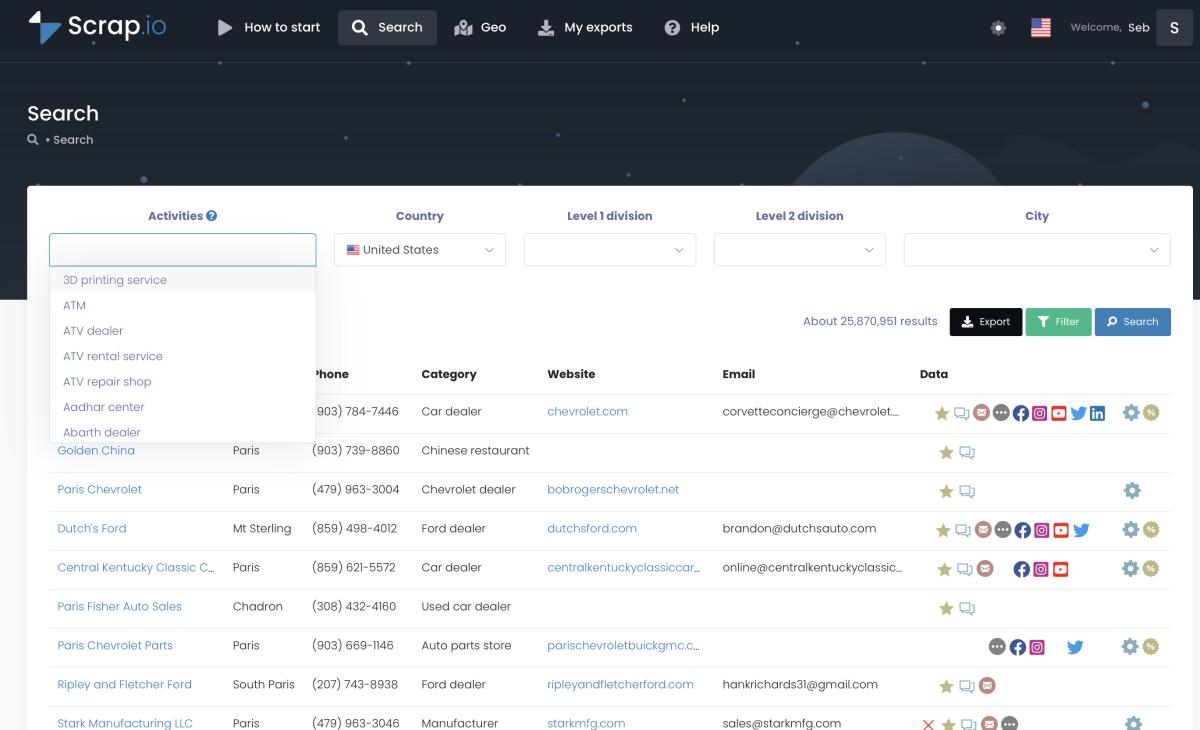
Step 1: Search "Housing association" across the UK
Open Scrap.io, pick the "Housing association" category, and set your geography: a single city, a county, a region, or the entire United Kingdom. That last option matters, because whole-country search lives on the Company plan. On the lower tiers you work city by city instead. Either way, the count shows instantly, and counting costs nothing.
Don't even want to pick a category? You can pull every business in a zone, which is handy for mapping a whole local market. And if you need the same thing in another country, the method carries straight over to our guide on how to find B2B leads by country.
Video: How to Extract Every Business in 1 Click with Scrap.io
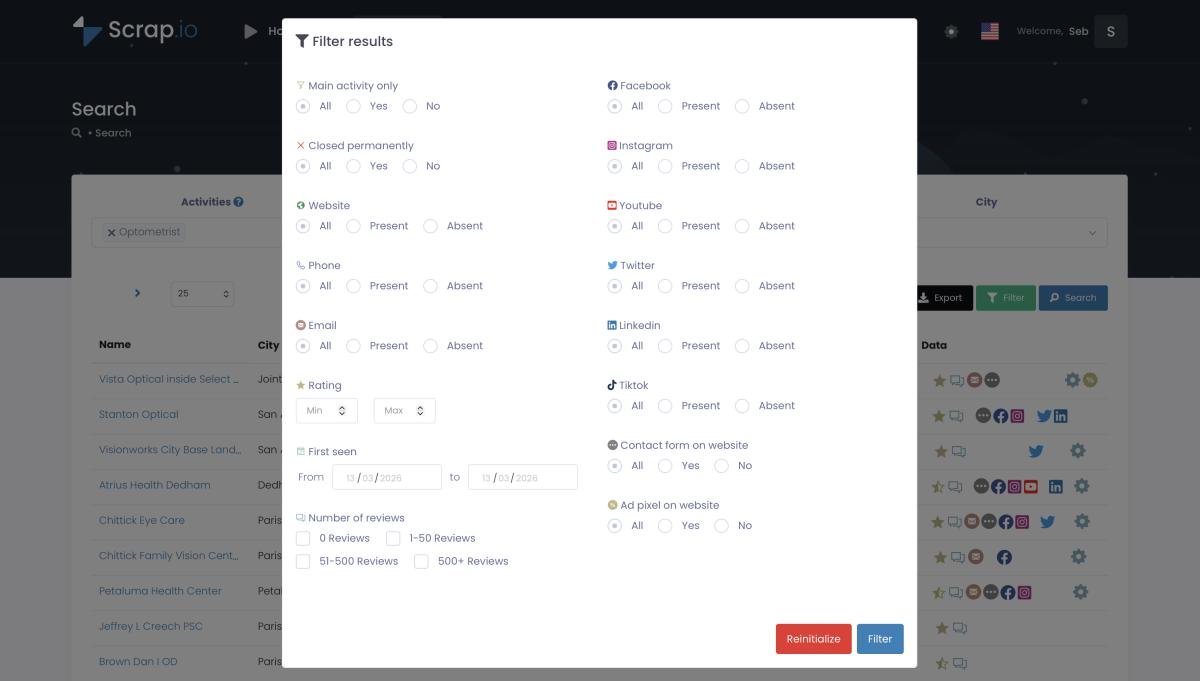
Step 2: Filter before you extract (email, phone, website)
This is the step that saves your budget. On Scrap.io the filters run before any credit is spent, so you never pay for a record you can't use.
Look at the real numbers for this category. As of 30 September 2026, Scrap.io lists 5,105 housing associations in the UK on Google Maps. Filter down and the picture sharpens fast.
| UK housing associations on Google Maps (Scrap.io, Sept 2026) | Count | Share |
|---|---|---|
| Total listings | 5,105 | 100% |
| With a website | 4,043 | ~79% |
| With a phone number | 4,769 | ~93% |
| With an email | 2,186 | ~43% |
So of the 5,105, roughly 2,186 have an email you can write to and 4,769 have a phone you can dial. Toggle "email present" for a cold-mailing list, or "phone present" for a calling campaign, and you only spend credits on the records that qualify. Zero wasted on dead ends. The full mechanics of the email side are in our walkthrough on how to find emails on Google Maps.
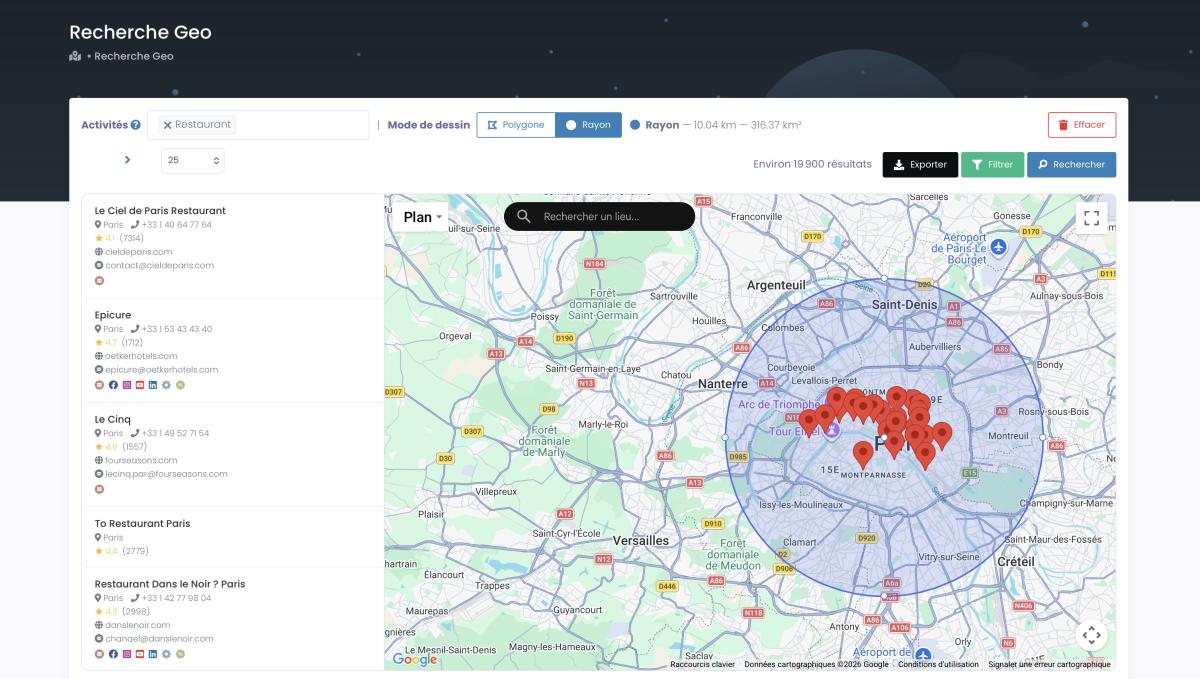
Need a shape that isn't a council boundary? GeoSearch lets you drop a radius around a point, or draw a polygon by hand over a specific patch, say every association within an hour of a new development. All the filters still apply inside it.
Step 3: Export a clean CSV/Excel (real-time)
Hit export. Out comes a CSV or Excel file, deduplicated, ready to drop into your CRM or cold-email tool. Your housing association list, built in minutes instead of days. Each row carries the map basics (name, address, postcode, website, phone with its type, rating) plus the enriched layer pulled from the website: up to several classified emails per association, split into individual, contact, sales, marketing and admin addresses.
That classification is the quiet superpower.
An email to a named individual reads nothing like a blast to info@. You know which is which before you hit send. And because every export is scraped in real time, the data is fresh the day you pull it, which matters a lot in a sector that merges constantly. Last year's static list is this year's bounce rate.
Build your UK housing-association list now. Start a 7-day free trial on Scrap.io (100 leads included), pull the "Housing association" category for the UK, filter for the 2,186 with an email, and export to CSV. No code, no register to copy by hand, cancel anytime. Start free on Scrap.io →
Who needs a list of housing associations, and why
Housing associations don't fill in your web form. But they spend £10 billion a year on suppliers, and they're all on the map. So who's actually buying this list?
Start with the obvious: repairs and maintenance platforms. The clearest proof is Plentific's work with Peabody, one of the sector's giants. In its pilot, Peabody ran 650 repairs in a single week through the platform, hit a 93% first-time-fix rate, logged 90% positive resident feedback, and mobilised in an average of 6 days. That's a vendor selling into social landlords, with numbers to show for it. Every one of those associations was a prospect once.
Then the rest of the supply chain. Maintenance and refurbishment contractors (firms like Bell Group and Axis Europe run dedicated social-housing arms). Compliance and asset-management software. Insurers and energy suppliers. Consultancies and recruiters. There's even a central-purchasing layer, Procurement for Housing, that runs frameworks for thousands of suppliers into the sector. If your customer owns social homes, this is your prospecting universe.
Geography shapes the play too. Associations cluster hard around London and the South-East (that G15 block of ~600,000 homes), with dense pockets in Birmingham, Manchester, Leeds and Nottingham. So you can slice a list of housing associations in London, Birmingham, or anywhere else by filtering city, county or region before you export. If your net spreads wider than social housing, the same method powers a list of estate agents in the UK or a full UK business directory, same two clicks, different category.
Turning the list into results: outreach that works
Social-housing procurement cycles run 30 to 90 days and rarely close on a first touch. So your list has to be clean enough to survive the whole journey. A list is not a campaign.
Segment before you send. Split by the email classification you already have: named individuals get a personalised opener referencing their association, generic inboxes get a value-first pitch that doesn't assume who's reading. Split by size, because a 2,000-home association has nothing like the pain of a 100,000-home group. And target the long tail, the ~1,100 small and mid-sized associations that buy in direct, rather than wasting cycles on the framework-locked giants.
Then go multi-channel. Email first, a follow-up call to the 4,769 numbers, a LinkedIn touch on the named contacts. Warm up your sending domain and drip, don't dump. If you want the full playbook on sourcing and structuring the file, our guide on how to build a cold email list covers it, and for adjacent property verticals the property management company list guide runs the identical mechanics.
The same fresh, real-time data that powers prospecting for 50,000+ Scrap.io users, filtered down to housing associations with an email on file. Pull it, segment it, send. See the data on a free trial → (100 leads included.)
Is scraping housing association data legal? (UK GDPR)
Is any of this actually legal? Short version: yes, if you stick to public business data and UK GDPR.
What you're collecting is publicly available business information: organisation names, office addresses, business phone numbers, and emails the associations themselves published on their own websites. Under UK GDPR, B2B outreach to that kind of data generally rests on "legitimate interest," provided every message carries a clear opt-out and you only hold what you need. The one thing to watch is a named individual's email, which counts as personal data, so keep your targeting relevant and your unsubscribe instant. Scrap.io only extracts public business data, stays GDPR and CCPA compliant, and keeps every record traceable to its source, which turns a nervous "where did you get my data?" into a five-second answer. For the full breakdown, see our guide to GDPR-compliant B2B cold email. (Not legal advice, obviously. If real money's at stake, ask an actual lawyer.)
FAQ
How many housing associations are there in the UK?
Around 1,300 housing associations operate in England, managing about 2.9 million homes, and the sector has close to 1,400 private registered providers in total. On Google Maps, about 5,100 housing-association offices are listed with contact details (Scrap.io, 2026).
What are the largest housing associations in the UK?
Clarion (125,000+ homes), Places for People, Sanctuary, L&Q (~105,000) and Peabody (~104,000) lead the field, followed by names like Sovereign Network Group, Riverside and Notting Hill Genesis. But the top players are a small slice of roughly 1,300 associations.
What is the difference between a housing association and a registered provider?
A registered provider (RP) is any organisation on the RSH register: local authorities, not-for-profit housing associations, and for-profit private registered providers. Every housing association is a registered provider. Not every registered provider is a housing association.
Where can I get a list of UK housing associations?
Download the RSH register or browse directories for names without contacts, or static and incomplete lists. For a fresh, contactable list, extract the "Housing association" category across the UK with Scrap.io and export it to CSV or Excel.
How do I find housing associations with an email or phone number?
Filter before you extract. Of the ~5,105 UK housing associations on the map, about 2,186 have an email and about 4,769 have a phone. Apply the "has email" or "has phone" filter so you only export, and only pay for, the records you can actually contact.
Stop scraping a PDF register by hand. Pull a live list of UK housing associations in minutes: 5,105 on the map, 2,186 with an email, filtered exactly the way you need them. Try Scrap.io free for 7 days, 100 leads included. Start your free trial →
Generate a list of housing association with Scrap.io