

Here's a bet I'll happily make. You searched for a list of pharmaceutical companies, landed on Wikipedia, got a wall of names, and realized you still had no way to actually contact any of them. Been there. Everyone selling to this industry has been there.
The US pharmaceutical market will hit $553.55 billion in 2026 (Towards Healthcare, 2026). Behind that number sit thousands of companies most "top 10" rankings never mention. The names are the easy part. Google them, copy a few, done. The hard part, the part nobody hands you for free, is a list you can actually email, call, and sell to.
So this guide does both. First, the real list: the biggest players, the free directories, the US picture by state. Then the move almost nobody makes, turning that list into a fresh, contactable file of drug companies you can prospect this afternoon. No fluff. Real numbers. One honest method at the end.
What's in this guide
- The pharmaceutical industry in 2026: market size and key numbers
- Top 100 pharmaceutical companies: the biggest players
- Where to find a full list of pharmaceutical companies (free directories)
- Pharmaceutical companies in the USA: by state and by revenue
- Beyond pharma: biotech and medical device companies
- Who actually prospects pharmaceutical companies? (real examples)
- How to build your own fresh list of pharmaceutical companies
- Free vs. bought lists vs. real-time extraction
- Staying compliant: GDPR, CCPA and B2B outreach to pharma
- FAQ
The Pharmaceutical Industry in 2026: Market Size & Key Numbers
Half a trillion dollars.
That's the number that reframes everything else on this page.
The US pharmaceutical market grew from $520.40 billion in 2025 to a projected $553.55 billion in 2026, and it's on track to reach $965 billion by 2035 at a 6.37% CAGR (Towards Healthcare, 2026). That's not a mature industry coasting. That's a market adding tens of billions a year, which means thousands of companies buying equipment, software, lab services, logistics, and talent they can't produce in-house.
A few more numbers worth keeping in your head, because they explain who you're really selling to. Pharma plows 15 to 20% of revenue straight back into R&D, one of the heaviest research spends of any sector. Branded drugs hold about 70% of the US market, generics the other 30%. Prescription products make up roughly 75% of the whole thing. And oncology alone is the single biggest segment at around 30% (all figures: Towards Healthcare, 2026).
| US pharma, key numbers (2026) | Figure | Source |
|---|---|---|
| Market size 2025 | $520.40 billion | Towards Healthcare |
| Market size 2026 (projected) | $553.55 billion | Towards Healthcare |
| Market size 2035 (forecast) | $965 billion | Towards Healthcare |
| CAGR 2025–2035 | 6.37% | Towards Healthcare |
| R&D as share of revenue | 15–20% | Towards Healthcare |
| Oncology share of market | ~30% | Towards Healthcare |
Why does the context matter before the list? Because a budget that big and a research habit that deep tell you these companies are active buyers, not just names in a directory. Keep that in mind. It changes what a good list is even for.
Top 100 Pharmaceutical Companies: The Biggest Players (2026)
Everyone wants the top of the pyramid first. Fair enough.
Let's get it out of the way, then talk about why it barely matters for prospecting.
By 2024 revenue, Merck & Co. led the world with $64.17 billion, edging out Pfizer at $63.63 billion (Drug Discovery Trends, Pharma 50, 2025). Johnson & Johnson, AbbVie, and AstraZeneca round out the next tier, all clustered between $54 and $57 billion. Here are the biggest pharmaceutical companies by revenue:
| Rank | Company | HQ | 2024 revenue |
|---|---|---|---|
| 1 | Merck & Co. | USA (Rahway, NJ) | $64.17 billion |
| 2 | Pfizer | USA (New York, NY) | $63.63 billion |
| 3 | Johnson & Johnson | USA (New Brunswick, NJ) | $57.07 billion |
| 4 | AbbVie | USA (North Chicago, IL) | $56.33 billion |
| 5 | AstraZeneca | UK (Cambridge) | $54.07 billion |
Top 10 Pharmaceutical Companies in the USA
Widen the lens to the usual top 10 and you'll see names like Eli Lilly, Johnson & Johnson, AbbVie, Roche, AstraZeneca, Merck & Co., Novartis, Novo Nordisk, Pfizer, and Amgen trading places depending on whether you rank by revenue or by market cap. The exact order shifts every quarter. Honestly, chasing the precise ranking of the top 20 pharmaceutical companies in USA is a hobby, not a sales strategy.
And here's the uncomfortable truth about every top 100 pharmaceutical companies list, whether it's the top 50 pharmaceutical companies or the top 10 pharmaceutical companies in world. These giants already have a procurement team, three incumbent vendors, and a two-year sales cycle. If you're a CRO, a lab supplier, or a SaaS founder, your real pipeline isn't Pfizer. It's the other 7,800-odd US drug companies nobody ranks. More on that in a minute.
Where to Find a Full List of Pharmaceutical Companies (Free Directories)
So where do you actually get a full list of pharmaceutical companies without paying for it? Good news and bad news.
The good news: free directories exist, and some are solid. Wikipedia's list of pharmaceutical companies is the obvious starting point, an alphabetical roll call of notable active and defunct firms. Drugs.com keeps a directory of roughly 650 to 700 companies marketing products in the US, each with a profile page. Add the Pharmaceutical Technology A-Z index, PMLiVE, and market-cap trackers like companiesmarketcap, and you can assemble a decent pharmaceutical manufacturers list or a drug companies list by country in an afternoon.
Now the bad news, and it's the whole point. These directories give you names. Just names. No email. No phone. No export button. No filter. You can't download a list of pharmaceutical companies in usa pdf that comes with verified contacts, because these sources were never built for prospecting. They were built for reference. Half the time the data is a year or two stale, too.
The list is easy. The contactable list is the hard part. That gap, between "here are some company names" and "here are 4,000 drug firms with a verified email," is exactly where the free directories stop and where the money starts. If you want a sense of how real-time business data compares to a frozen reference list, our rundown of business database search tools and similar company finders lays out the difference.
Curious what a contactable pharma list actually looks like? See it on Scrap.io. Counting is always free, so you can size the market, every pharmaceutical company in a state or across the whole US, before you spend a thing.
Pharmaceutical Companies in the USA: By State & By Revenue
Quick gut check. Where's America's pharma capital? Most people say California. Most people are wrong.
It's New Jersey. The Garden State has been the industry's center of gravity for decades, home to Merck, J&J, and a dense cluster of suppliers up and down the turnpike. After that, the real map of pharmaceutical companies in usa by state runs through Massachusetts (Boston and Cambridge for biotech), California (the Bay Area and San Diego), Pennsylvania, and the North Carolina Research Triangle. That's where the list of pharmaceutical companies in usa actually concentrates.
Why does this matter to you? Because geography is a targeting tool, and almost nobody uses it. A supplier working the NJ-PA-NY corridor has completely different logistics than one chasing a list of pharmaceutical companies near California or a list of pharmaceutical companies near Texas. Segment by state and your outreach stops sounding generic. You can carve the whole country into territories, or zoom into a single metro, the same way you'd build any targeted USA business email database.
Pharmaceutical Companies in the USA by State
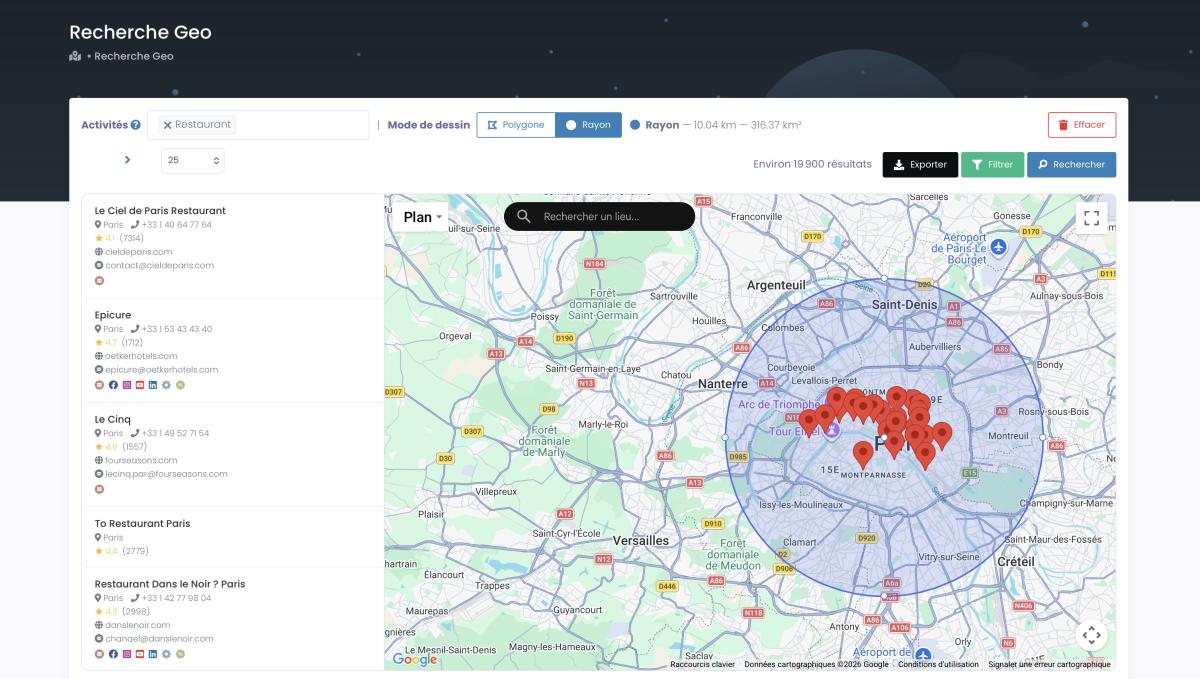
The clean way to do this isn't a static ranking. It's drawing the exact zone you sell into and pulling every drug company inside it. A radius around a point works when your territory is "everything within 60 miles of my warehouse."
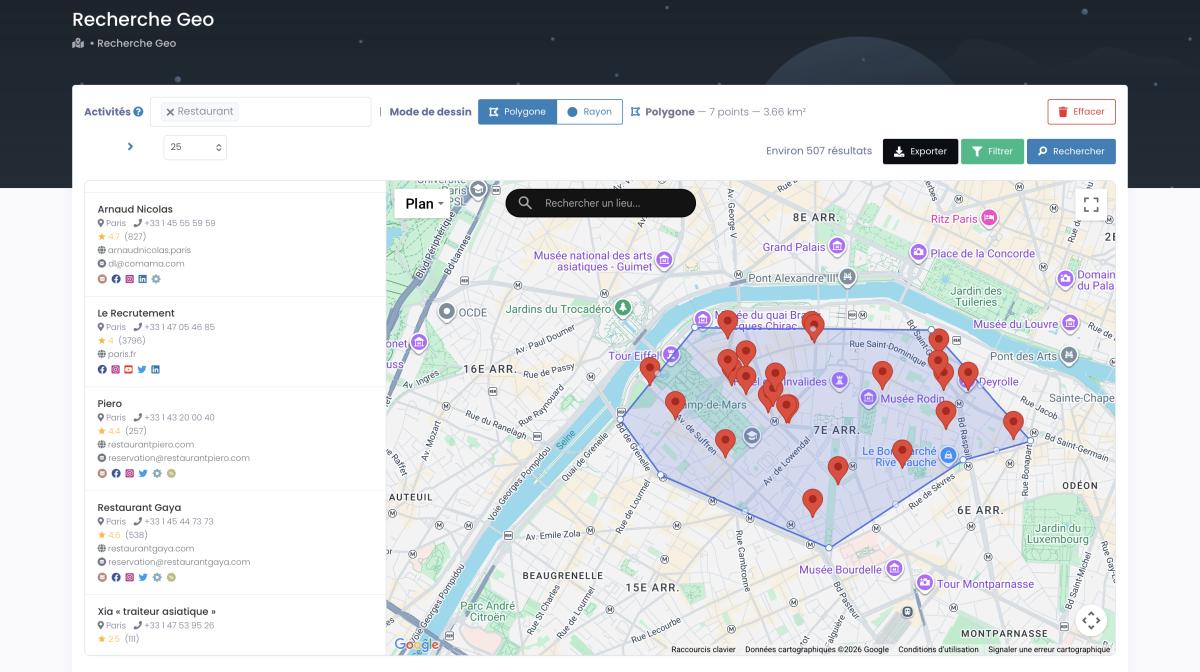
And when your market is a weird shape, a multi-state corridor, say, or a metro that spills across county lines, you draw a polygon by hand and pull only the companies inside it. Administrative borders don't get a vote.
By revenue, the pattern holds: the big public names cluster in those same states, but the long tail of mid-size manufacturers and contract outfits is spread everywhere. That long tail is your pipeline, not the five companies on the evening news.
Beyond Pharma: Biotech & Medical Device Companies
Pharma doesn't live in a vacuum. The second you start prospecting it, you bump into two adjacent markets worth the same effort: biotech and medical devices. Same buyers, often the same buildings.
A biotech companies list overlaps heavily with pharma, especially around Boston, San Diego, and the Bay Area. If your product fits a research-stage drug developer, don't stop at Big Pharma. Pull a list of biotech companies alongside your pharma file and you've roughly doubled your addressable market. The categories sit right next to each other on the map.
Medical Device Manufacturers Email List
Then there's hardware. A medical device manufacturers email list reaches a different buyer (regulatory, quality, procurement) but the sourcing method is identical: find the category, filter to contactable, export. The same goes for a broader list of medical device companies covering everything from diagnostics to surgical tools. If you already build a manufacturer email list, pharma and medtech are just verticalized versions of that playbook, and the same logic extends to a wholesaler and distributor email list for the supply side. Treat them as one connected ecosystem and your pipeline gets a lot deeper.
Who Actually Prospects Pharmaceutical Companies? (Real Examples)
Let me guess what you're thinking. "Who even needs a list of pharmaceutical companies?" More people than you'd expect, and they're already paying for it.
Start with the data vendors, because they prove the market exists. LakeB2B sells a "Pharmaceutical Manufacturing Industry" email list running into the hundreds of thousands of records. MedicoLeads advertises 220,000-plus US pharma contacts. People pay real money for these files, which is exactly why the keyword "pharmaceutical industry email list" carries an $18.59 CPC. Where there's a CPC that high, there's a buyer.
Then the suppliers who sell into pharma. Excedr leases lab equipment to CROs and research labs. Pharmaceutical Technology runs a buyers guide matching equipment suppliers to drug makers. And analytical CROs, the kind ranked in King's Research top 10 testing outsourcing firms, sell contracted testing straight to manufacturers. Every one of them needs a current list of pharmaceutical companies to sell anything.
Here's the honest read. These buyers do well because the audience is reachable by email. B2B email still returns $36 to $42 for every $1 spent, with median open rates between 36.7% and 42.35% (Verified.email, 2025). Reaching decision-makers at drug companies is one of the better plays in B2B, as long as your data is fresh. If your ICP is broader than pharma, the same approach powers a full healthcare email list across clinics, providers, and suppliers.
How to Build Your Own Fresh List of Pharmaceutical Companies (Step by Step)
What if you could pull every US pharmaceutical company with a verified email in about two clicks, filtered before you spend a cent? You can. This is the part the free directories and the data brokers both hope you never figure out.
The source is Google Maps. Every real pharmaceutical company, biotech, and device maker with a physical presence is on it: name, address, phone, website, often an email on the site behind the listing. Scrap.io reads both layers, the map listing and the website, and turns the whole category into an exportable file. That's how you go from a reference list to a true pharmaceutical industry email list you can actually send to.
Here are the real US numbers, pulled from the "Pharmaceutical company" category in September 2026:
| US pharmaceutical companies (Scrap.io, Sept 2026) | Count | Share |
|---|---|---|
| Total pharmaceutical companies | 7,869 | 100% |
| With a website | 5,387 | 68% |
| With an email | 3,997 | 51% |
| With a phone | 7,050 | 90% |
Look at the email row. Only about half of US drug companies publish a findable email, which is exactly why you filter before you export, not after. The workflow is genuinely three moves:
- Search by category and zone. Pick "Pharmaceutical company" and set your area: the whole US, a single state, or a radius around a city.
- Pick your location. National for reach, state-by-state for territory, a custom polygon when your market is an odd shape. All of it, no code.
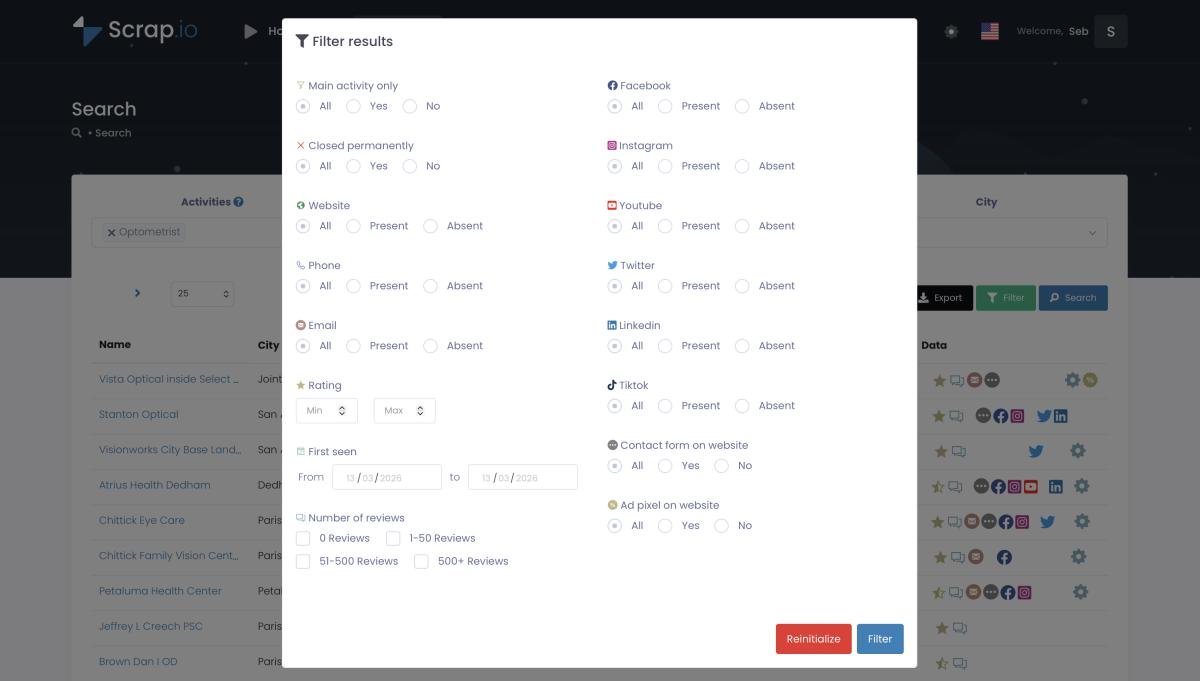
- Filter, then extract. Toggle "has email" (and "has phone," if you run SMS or calls) so only contactable companies count. Preview the number for free, then export to CSV or Excel.
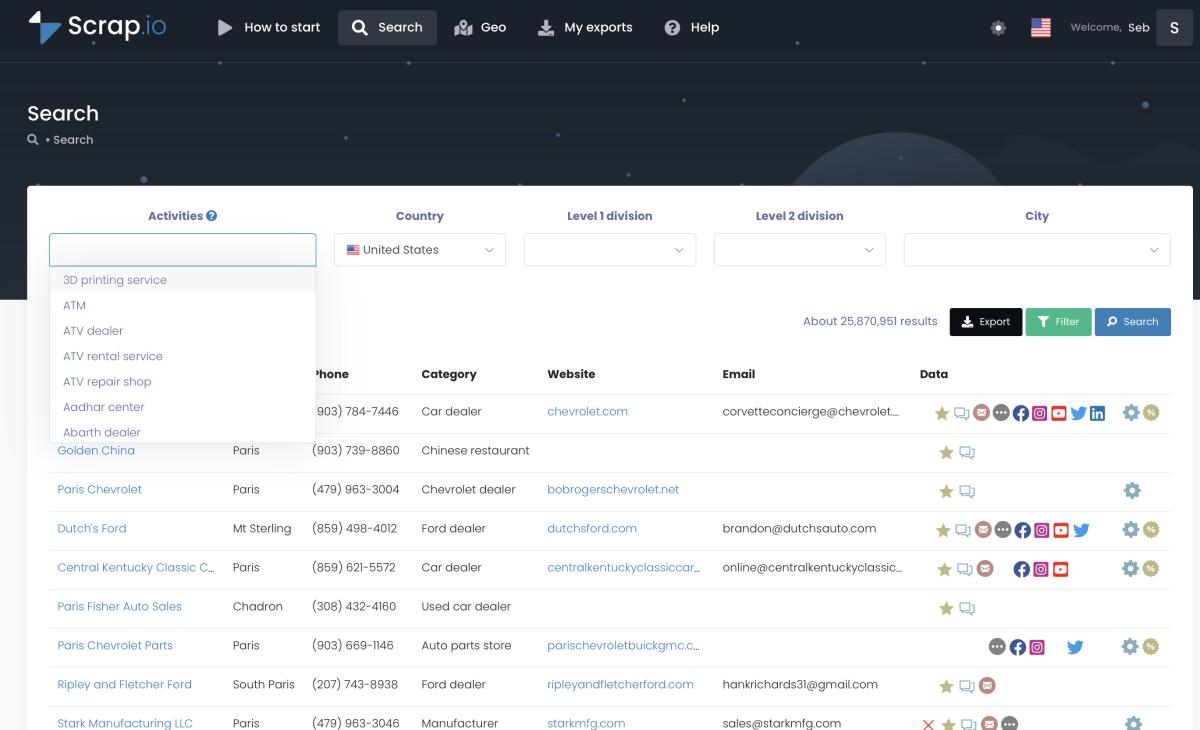
That filtering step is where the money is saved. Instead of paying to export all 7,869 companies, you flip "has email" to yes and export the 3,997 you can actually reach. You skip paying for 3,872 records you could never have emailed anyway. Try doing that with a bought file. You can't, because the dead rows are already baked in.
Here's the two-minute version from a cold start, if you'd rather watch than read:
Video: Scrap.io - How to Start?
Once the file is in hand, the list is only half the job. The other half is the send. Our guide on how to build a cold email list covers sourcing and verification end to end, and how to write a cold email that gets replies handles the message itself. Pharma buyers are busy. Short, specific, and relevant beats long and generic every time.
Pull your first US pharma list free, 100 export credits included. Start your 7-day Scrap.io trial and extract a fresh, email-present list of pharmaceutical companies from any state or the whole country. Real-time data across 225M+ businesses in 195 countries, filtered before you spend a single credit.
Free vs. Bought Lists vs. Real-Time Extraction: What's Best in 2026?
In theory, all three options get you a list. In practice, they're not even close. Let's put them side by side, because this is the decision that actually costs or saves you money.
| Factor | Free directory | Bought list | Real-time extraction |
|---|---|---|---|
| Freshness | 🔴 Often dated | 🟡 Stale the day you buy | 🟢 Pulled live at export |
| Contact data | 🔴 Names only | 🟡 Email, often unverified | 🟢 Email, phone, website |
| Cost model | 🟢 Free, but useless to send | 🔴 Pay for dead rows too | 🟢 Only email-present rows |
| Duplicates | 🟡 Manual cleanup | 🔴 Shared with competitors | 🟢 Excludes past exports |
| Compliance | 🟡 Unclear sourcing | 🔴 Opaque origin | 🟢 Public data, traceable |
The freshness tax is the one people underestimate. A bought pharmaceutical industry email list is a snapshot the moment it's compiled, and contact data decays fast. That's why cold outreach reply rates slid from 6.8% in 2023 to 5.8% in 2025 (Verified.email, 2025), inbox saturation plus aging lists. A file that's six months old in a market where companies merge, rebrand, and close is a file that's actively working against you.
This "how old is your data?" problem is the whole argument for pulling fresh instead of buying stale. Here it is in practice:
Video: D7 Lead Finder vs Scrap.io in 2026: How Old Is Your Data?
50,000+ professionals build fresh lists with Scrap.io. Rated 4.8 on Capterra and 4.9 on G2. Try it free for 7 days, 100 leads included, and pull a pharma list that's current the day you send, not six months into its decay.
Staying Compliant: GDPR, CCPA & B2B Outreach to Pharma
Is any of this legal?
Yes, and it's not complicated, but you do need to get a few things right.
Cold B2B outreach to pharmaceutical companies is legal under both GDPR (in the EU, on a legitimate-interest basis) and CCPA (in California), provided you're using publicly available business data, you keep every record traceable to its source, and you honor opt-outs. Drug companies are businesses, their listings and addresses are public, and emailing them a relevant offer with a clear unsubscribe is squarely within the rules.
Where sourcing matters legally, not just operationally, is that last part: traceability. A bought list from a broker who won't say where the data came from is hard to defend. A list pulled from public Google Maps listings is easy, because every field traces back to a source you can point to. Scrap.io pulls only publicly available business data and is GDPR and CCPA compliant, which puts you on solid ground instead of guessing. For the full country-by-country breakdown, especially if any targets sit in Europe, read our GDPR cold email guide for B2B. And if your prospecting also touches retail pharmacies, that's a separate segment with its own rules, covered in our pharmacy email list guide.
FAQ
How many pharmaceutical companies are there in the US?
As of September 2026, Scrap.io indexes 7,869 pharmaceutical companies in the United States on Google Maps, including 5,387 with a website and 3,997 with a verified email. Beyond the well-known top 20, thousands of small manufacturers, biotech firms, and suppliers make up the real total.
Who are the top 10 pharmaceutical companies?
Ranked among the largest by revenue and market cap, the top 10 pharmaceutical companies typically include Eli Lilly, Johnson & Johnson, AbbVie, Roche, AstraZeneca, Merck & Co., Novartis, Novo Nordisk, Pfizer, and Amgen. The exact order shifts quarter to quarter.
What is the biggest pharmaceutical company in the world?
By 2024 revenue, Merck & Co. led with $64.17 billion, followed by Pfizer ($63.63 billion) and Johnson & Johnson ($57.07 billion), according to Drug Discovery Trends' Pharma 50.
Where can I find a list of pharmaceutical companies in the USA?
For names only, free directories like Wikipedia and Drugs.com work fine. For a contactable, exportable, state-by-state list with emails and phone numbers, extract it live from Google Maps with Scrap.io, filtered to email-present companies before you spend a credit.
Is it legal to email pharmaceutical companies for B2B outreach?
Yes. B2B outreach using publicly available business data is legal under GDPR (legitimate interest) and CCPA, provided you honor opt-outs and keep every record traceable to its source. Using public listings instead of a bought file puts you on far stronger legal footing.
Here's the bottom line. The list of names is easy, it's sitting on Wikipedia right now, for free. What's hard, and what actually drives a pipeline, is a fresh list of pharmaceutical companies you can contact: 7,869 US drug firms, filtered to the 3,997 with a real email, pulled live instead of bought stale. Stop collecting names. Start building a list you can send to.
Start free for 7 days, 100 leads on us. Build your list of pharmaceutical companies on Scrap.io: every US drug firm, biotech, and device maker on Google Maps, filtered to email-present before you spend a credit, exported to CSV in minutes. Counting is always free, so size your market first, then grab a ready-to-use cold email template and start the conversation.
Generate a list of pharmaceutical company with Scrap.io