

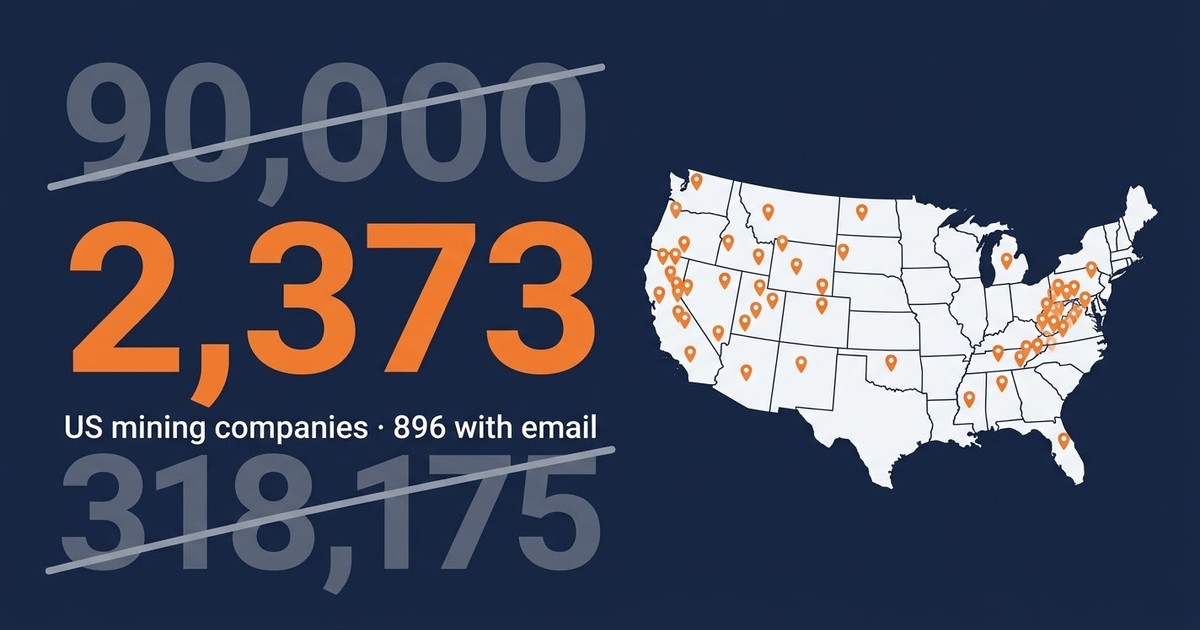
Every vendor selling a mining industry email list quotes you the same kind of number. "90,000 US mining contacts." "246,000 globally." One even puts it at 318,175. Impressive, right?
Here's the number none of them will show you. Google Maps lists 2,379 mining companies in the entire United States. That's it. The whole country. (Pulled fresh on October 3, 2026, and you can re-count it yourself for free in about ten seconds.)
So where do the other 87,000 "contacts" come from? Duplicates. Dead addresses. People who changed jobs three roles ago. Companies that folded in the last commodity slump. A bought mining email list is a photograph of a market that never stopped moving.
This guide does the opposite of what those vendors do. Real numbers, real sources, and a repeatable way to build a fresh, filtered, exportable mining list in two clicks instead of renting someone else's stale file. Same playbook we use across our whole email list by industry hub, applied to mining.
Video: How to Scrape Google Maps at the Country Level
Table of Contents
What is a mining industry email list (and what's really inside)?
A mining industry email list is a file of business contacts for companies in the mining sector: coal operators, metal ore and gold producers, quarrying and aggregate firms, plus the suppliers and service companies around them. Names, emails, phones, addresses, maybe a website. You've seen the pitch. Buy the file, load it into your sequencer, start sending.
Simple, right? In theory, yes. In practice, this is where it gets interesting.
Because "email list" means three very different things depending on who's selling it. Sometimes it's a genuinely compiled database with real addresses. Sometimes it's a mining companies email list scraped years ago and re-sold to everyone with a credit card. And sometimes it's a mining industry mailing list (the "mining industry mailing list USA" files you see advertised) padded with generic info@ inboxes nobody reads. Same label, wildly different quality.
The part that actually matters isn't the row count. It's what's in each row, and when it was last true. A list of 2,000 verified mining contacts you pulled this morning beats a "90,000-contact" file from last year every single time. Freshness is the whole game, and it's exactly where bought files fall apart. More on that below.
How big is the US mining industry, really?
Let's settle the size question, because the "email list" counts you see online have nothing to do with it.
The US mining sector (excluding oil and gas, NAICS 212) employed roughly 189,600 people as of August 2026 and ran across 7,416 private establishments in Q1 2026, per the Bureau of Labor Statistics. Widen the lens to the full mining, quarrying, and extraction sector (NAICS 21) and employment climbs past 560,000. Mining contributes about 1.4% of US GDP (FRED, Q1 2026), and the National Mining Association counts roughly 488,000 direct mining jobs nationwide. Real industry. Real money.
Now the number that counts for outreach. On Google Maps, there are 2,379 mining companies across the US right now (Scrap.io, October 3, 2026). Why the gap between 7,416 BLS establishments and 2,379 Maps listings? Because BLS counts every registered establishment, including remote sites, holding entities, and back-office units with no storefront. Google Maps captures the companies with an actual local presence: a pin, a phone, often an email. Those are the ones you can actually contact.
And here's how that 2,379 breaks down, which is the honest version of "how many contacts can I get":
| US mining companies on Google Maps | Count | Share | Best for |
|---|---|---|---|
| Total listed | 2,379 | 100% | Full market map |
| With a phone number | 2,071 | ~87% | Cold calling |
| With a website | 1,243 | ~52% | Enrichment, signals |
| With a public email | 901 | ~38% | Cold mailing |
So the real, mailable universe is about 901 US mining companies with a public email, not 90,000. That's your actual list of mining companies in the USA worth contacting: a mining companies contact list where the mining company email addresses were published by the businesses themselves. Smaller? Obviously. But every one of those 901 is a live business that published its own address. Nine hundred emails that land beat ninety thousand that bounce. That's not a slogan, it's deliverability math. If you want the same exercise across the whole country at scale, our USA business email database guide runs the identical method sector by sector.
The problem with buying a mining email list
Meet Dana. She runs sales for a mining-equipment supplier and needed decision-makers at US mining companies. So she did the obvious thing: bought a "verified mining industry email list." Ten thousand contacts. One campaign later, a 24% bounce rate and a sender reputation in the gutter. Sound familiar?
The issue isn't her copy.
It's the file. A bought mining email list is static the second it's compiled, and mining is a high-churn, high-consolidation industry. Sites close. Operators get acquired. Contacts move. Honestly, B2B data decays somewhere around 25 to 30% a year, so a file that sat in a warehouse for twelve months has already lost a quarter of its value before the invoice clears.
What providers claim vs what's verifiable
Look at what the category actually sells. DataCaptive advertises 246,000 mining contacts globally and 90,000 in the US, refreshed "every 45 days." InfoClutch lists 318,175 contacts across 111,361 companies, then elsewhere on the same site references "over 3 million" mining contacts. Which one is it? Both can't be true. Thomson Data skips counts entirely and just promises a "90% delivery guarantee."
None of these numbers is checkable. You can't audit them, you can't re-run them, and you certainly can't see them before you pay. Meanwhile the organic search results for this exact term are a mess: a single Namibian company profile on ZoomInfo, an eight-year-old thread, a couple of "join our newsletter" pages. The recurring Quora question on whether industry mailing lists actually help gets asked for a reason: nobody's getting a straight answer.
| Provider | Count claimed | Freshness | Price shown? | Verifiable? |
|---|---|---|---|---|
| DataCaptive | 90K US / 246K global | Every 45 days | No (quote) | No |
| InfoClutch | 318,175 (vs "3M") | Unstated | No (quote) | No |
| Thomson Data | None given | Unstated | No (quote) | No |
| Scrap.io (live) | 2,379 US (901 w/ email) | Real-time | Yes, public | Yes, free count |
This is the same static-vs-live split we broke down for contractors in our construction industry email list: live data vs traditional providers piece. The pattern holds in every vertical. And whatever list you end up with, run it through verification before you send, because even a good file needs a pass. Here's how to verify an email list properly so your bounce rate stays under 2%.
Curious how many US mining companies actually have a public email? Count it yourself on Scrap.io. The count is free, it costs zero credits, and you'll see the real number (currently 901) before you spend a thing. Compare that to whatever figure your current provider is promising.
How to build a fresh mining email list in 2 clicks
In theory, contacting every US mining company means visiting 2,379 websites by hand. In practice, it's two clicks and no code. Here's the exact flow.
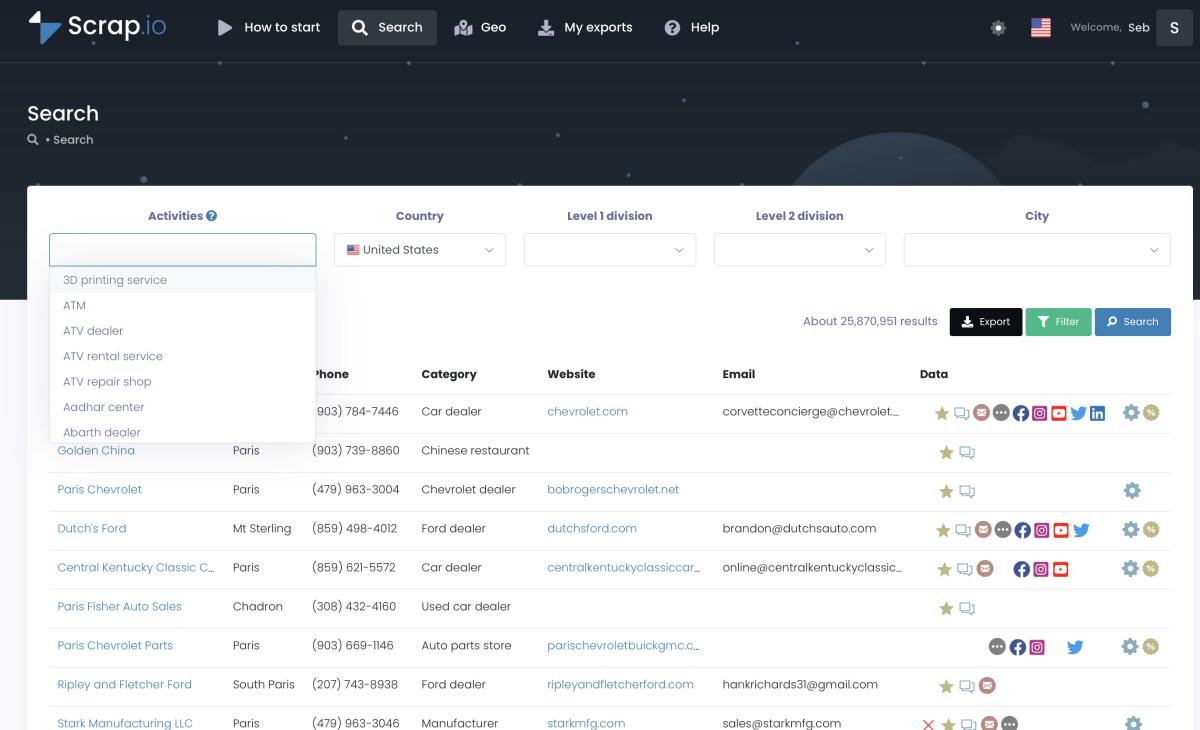
Step 1: Search. Open Scrap.io, type "mining company" in the category field, and pick your zone: a city, a county, a state, or the whole United States. Scrap.io indexes 225+ million businesses across 195 countries and 4,000+ categories, so the entire country is fair game, not just one metro at a time.
Step 2: Count for free. Hit the count button. It tells you exactly how many mining companies match, across the whole US if you want, and it costs zero credits. This is how you get the honest 2,379 (or 901 with the email filter on) before committing anything.
Step 3: Export. One export to CSV or Excel. One credit per business. Re-export the same contacts within 30 days and it's free.
Filter before you extract: email, phone, website, reviews
This is the part that saves your budget, and it's the opposite of how bought lists work. On Scrap.io, filters apply before extraction, so you only spend a credit on a record that already matches what you need.
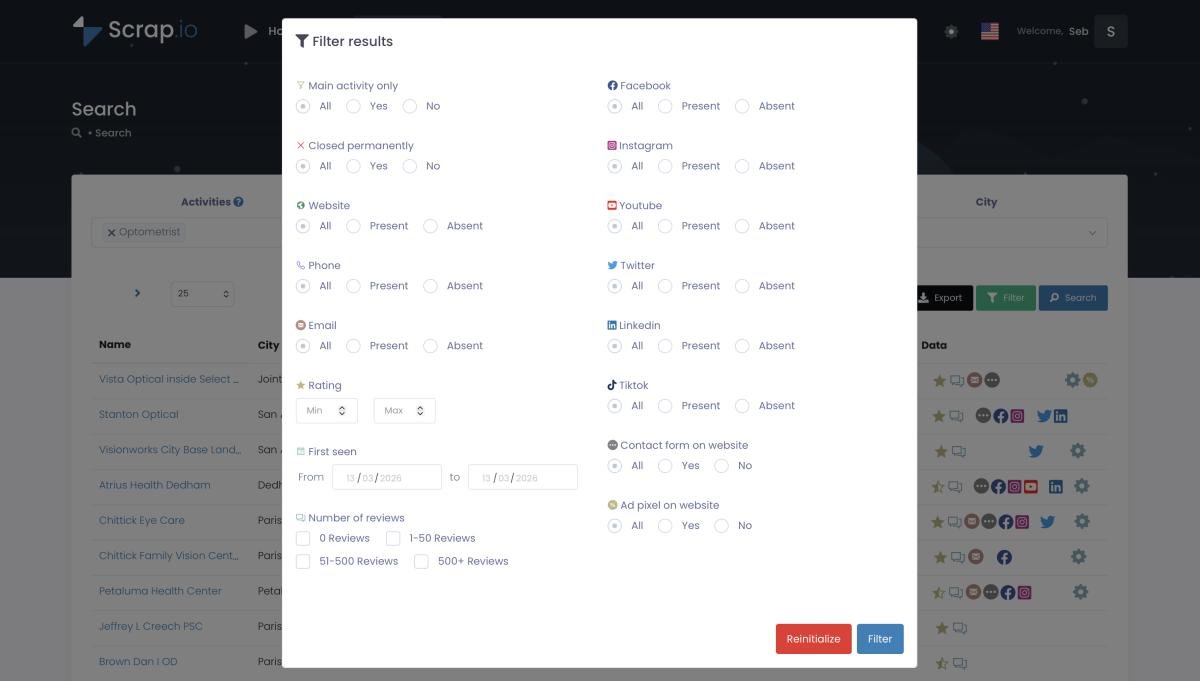
Want only the 901 mining companies with a public email? Toggle "email present." Only the ones with a website too? Narrow further. Minimum review count, claimed listing, specific state, recently detected business: set it, and the count updates live before you pay. No wasted credits on dead-end rows. That's how to find mining companies email addresses at scale, without visiting a single site by hand. Here's the two-minute walkthrough of filtering on the map:
Video: Finding Clients Through Google Maps Filters
The whole thing is the same method we document for building any cold email list from scratch: pick your target, filter to email-present, count free, export.
Mining just happens to be a vertical almost nobody's doing right.
Segments: coal, metal ore, gold, quarrying, suppliers
"Mining" isn't one market. A coal operator in West Virginia and a gold exploration firm in Nevada don't share a single pain point, so your targeting shouldn't lump them together. Scrap.io lets you slice the sector by category and build narrower lists:
- Coal mining companies email list: operators and processors, concentrated in Appalachia and the Powder River Basin.
- Metal ore and gold: a dedicated metal mining industry email list, plus a gold mining companies list for USA exploration and production firms (Scrap.io even has a separate "gold mining company" category).
- Quarrying and aggregates: sand, gravel, crushed stone, the local-heavy segment with the most Google Maps presence.
- Mining suppliers email list: equipment, drilling, safety, and services companies selling into the operators above.
Need a mining executives email list specifically? Scrap.io classifies emails by type (contact, sales, administration, and named individual addresses with first and last name), so you can push past generic inboxes toward real people. The same segment-by-category logic powers our manufacturer email list (190K+ US listings) and wholesaler email lists (62K+) guides. Mining is smaller, but the mechanics are identical.
Build your mining list today. Try Scrap.io free for 7 days with 100 leads included. Search "mining company," filter to email-present, and export every verified US contact in two clicks. Real-time data from Google Maps, filtered before you spend a credit. Start your free trial.
What data you get
So what actually lands in your export? Every mining company record pulls two layers of data: the cartographic layer from the Google Maps listing, and the enriched layer scraped from the company's own website. Here's the field map.
| Layer | Fields you export | Use it for |
|---|---|---|
| Map data | Name, address, city, state, phone, category, rating, review count, hours, claimed status | Cold calling, segmentation, geo targeting |
| Website data | Public email (classified: contact, sales, admin, individual + first/last name), website, social profiles, technologies, contact pages | Cold mailing, personalization, enrichment |
All of it exports to CSV or Excel, with map fields and website fields color-coded so you can see at a glance what came from where. Every column is available on every plan. And because the file is your own live extract, no competitor pulled the identical rows with the identical filters at the identical moment. The list is yours, not a shared file that's been mailed to death.
Is it legal? CAN-SPAM and GDPR for mining outreach
Short answer: yes, with rules. Longer answer worth thirty seconds of your time.
In the US, CAN-SPAM lets you cold email businesses without prior consent. The must-dos: a real physical address, honest subject lines, a working unsubscribe, and opt-outs honored within 10 business days. Extracting publicly available business data is legal too. When a mining company publishes its email on Google Maps and its own website, it's making that information public for business inquiries.
If any of your targets sit in Europe, GDPR applies and the bar rises. B2B cold email is generally fine under "legitimate interest," but you need relevance, an easy opt-out, and documentation of where the data came from. That last part is where a traceable source matters: Scrap.io only surfaces public business data, every record traceable back to its Google Maps listing, which makes your legitimate-interest paperwork far easier to defend. Selling into the EU? Our GDPR cold email guide for B2B walks the legitimate-interest assessment line by line.
Bottom line: a random "free mining email list PDF," a "best mining email list" download, or any mining industry email list PDF floating around a forum is legally sketchy, because you have no idea how those addresses were collected. A list you built yourself from public Google Maps data is clean, traceable, and defensible.
FAQ
How many mining companies are in the US?
Google Maps lists 2,379 mining companies across the United States (Scrap.io, October 2026), of which 901 have a public email, 2,071 have a phone, and 1,243 have a website. The BLS counts 7,416 private establishments in Mining except Oil and Gas (NAICS 212, Q1 2026); the broader figure includes sites and entities without a local listing.
Where can I get a mining industry email list?
Two routes. You can buy a mining industry email list outright from a broker, or build a fresh one yourself from Google Maps with Scrap.io, filtered to the companies that actually have a public email (901 US mining companies do right now). The self-built route is cheaper, exclusive to you, and gives you verified mining company contacts that are yours alone, not a file sold to ten competitors.
Are bought mining email lists worth it?
Usually not. They're static snapshots, often refreshed only every 45 days, with inflated counts and high bounce rates. Mining churns hard, so a file ages fast. A live-extracted list converts better and protects your sender reputation, because you're mailing addresses that exist today.
What data is included?
Company name, public email (about 38% of US mining companies have one), phone (roughly 87% do), website, full address, category, rating and review count, social profiles, and detected technologies. Everything exports to CSV or Excel.
Is scraping mining company emails legal?
Yes, when you use publicly available business data and follow the rules: CAN-SPAM in the US, GDPR in the EU. Scrap.io extracts only public data, and every contact is traceable back to its source listing, which keeps your outreach compliant and auditable.
The bottom line
The vendors want you to believe bigger is better. Ninety thousand contacts. Three million. Pick a number. But a mining industry email list isn't won on volume, it's won on freshness, and the honest count is 2,379 US mining companies with 901 reachable by email. Mail those 901 well and you'll beat anyone blasting a bloated file at the whole imaginary 90,000.
Stop renting a stale file. Build your own fresh mining list instead, filtered before you pay, verified the moment you export, and exclusive to you.
The honest number wins.
Build your mining email list the honest way. Start your free 7-day Scrap.io trial with 100 leads included, search "mining company," filter to email-present, and pull a verified US list in two clicks. No stale file, no inflated counts. Try Scrap.io free.
Generate a list of mining company with Scrap.io