

You just paid $45 for a moving lead. So did four other companies down the road. Right now you're all racing to call the same stressed-out family before lunch, and three of you will lose. That's not a market. That's a coin flip you paid to enter.
Here's the thing nobody selling you leads wants to admit: most "moving leads" you can buy aren't really yours. You're renting a contact that's already been sold to a handful of your competitors. And when the whole industry is bidding on the same recycled data, the only winner is the marketplace collecting the fee.
So this guide takes a different angle. We'll cover where movers actually buy leads today, what those leads really cost once you do the math, and then the part almost nobody talks about: how to build your own moving company leads list from fresh Google Maps data — a list you own, reuse, and never share with the shop across town.
What's inside
- What "moving company leads" actually mean (and the trap most fall into)
- The US moving market in 2026: how big is the opportunity?
- Where moving companies buy leads today (and what it really costs)
- The overlooked alternative: build your own moving company list
- How to build a moving company leads list from Google Maps (step by step)
- Turn your list into booked jobs: outreach that works
- Is it legal? Compliance for moving lead generation (US)
- FAQ
What "moving company leads" actually mean (and the trap most fall into)
Quick gut check before you spend a dollar. When people search for moving company leads, they usually want one of two very different things — and mixing them up is how budgets get torched.
Consumer leads vs B2B leads
The first group is the mover who wants customer leads: a family in Dallas that needs three trucks and two guys next Saturday. That's a consumer lead. It's what marketplaces like Angi and Moving.com sell, and it's what most of page one of Google is chasing.
The second group wants a list of moving companies — the businesses themselves. Marketing agencies selling services to movers. SaaS founders pitching dispatch software. Insurance brokers, fuel-card companies, packing-supply vendors. Or a smart mover building a partner network (real estate agents, HR relocation managers, self-storage operators) and sizing up the competition. That second group is what a data tool actually serves.
Why does this matter? Because if you're in group one, no scraper on earth can hand you a family that's moving next week. Anyone who claims otherwise is selling you smoke. But if you're in group two — or you sell to movers — building a clean database of relocation companies is the single highest-leverage thing you can do.
Shared vs exclusive leads
Now the trap. Purchased consumer leads come in two flavors: shared and exclusive. Shared leads get sold to several movers at once. You compete on who dials fastest and quotes cheapest. Exclusive leads are sold to you alone — better conversion, higher price. And "exclusive" isn't always as exclusive as the invoice implies. More on that in a minute.
The US moving market in 2026: how big is the opportunity?
Let's put real numbers on the table. There are over 20,000 active moving company listings on Google Maps in the US — 20,180 to be exact, as of July 2026. That's the addressable universe if you're building a B2B list of movers, van lines, and relocation contractors.
Dig into those listings and it gets interesting. 13,673 (about 68%) have a website. 6,507 (roughly 32%) don't. Read that second number again if you run a web agency — a third of the entire industry has no site. That's a prospect list handed to you on a plate. And 7,622 (~38%) have an extractable email address, which is your direct-outreach pool.
A note on honesty, because it matters: that 20,180 figure counts active Google Maps listings, which is higher than the ~16,800 "establishments" you'll see from industry analysts. Maps captures independents, agents, and tiny outfits that formal registries miss. So think of it as fiches on the map, not IRS filings.
Zoom out to the whole sector. The US moving services market was worth roughly $21.3 billion in 2023, growing at a modest ~2.1% CAGR from 2021 to 2026 (IBISWorld). It employs about 108,494 people across roughly 6.2 employees per company on average, per ConsumerAffairs' 2026 industry data. Translation: this is a fragmented world of small businesses. Thousands of them. Exactly the kind of long tail that never shows up on LinkedIn but sits right there on the map.
That fragmentation is the opportunity. A market of a few hundred giants is hard to crack. A market of 20,000 small operators, most of them reachable by email? That's a database problem — and database problems have clean solutions.
And movers don't exist in a vacuum. The exact same build-your-own approach powers every adjacent B2B vertical — from a contractor email list to a trucking company email list — because it's all public Google Maps data underneath.
Curious how many movers are in your state? Count them for free in Scrap.io — no credit spent, no export required. Just search "moving company," pick your territory, and read the number. It's the fastest way to size a market before you commit to anything.
Where moving companies buy leads today (and what it really costs)
Is it worth paying for moving leads? Fair question. Let's do the math instead of hand-waving.
The marketplaces
The usual suspects for buying moving leads: Angi (formerly HomeAdvisor), Thumbtack, Moving.com, 99 Calls, and aggregators like Network Leads. Moving.com matches a consumer with up to four movers. 99 Calls sells exclusive moving leads — around $24.99 each in Florida as of mid-2026. Angi runs a shared-lead model, and their own guide is worth reading.
Search "best moving leads providers" (or "best moving leads providers in the USA") and "top 10 moving leads provider" and you'll drown in listicles — Supermove's "7 sites to find moving leads," Network Leads' provider roundups, the whole genre. They all funnel you toward the same handful of marketplaces to buy moving leads online. And a newer 2026 wrinkle: "moving leads ai" tools that auto-score and route inbound calls. Slick demos. Same rented pipe underneath — you're still paying for moving company sales leads that someone down the street also gets.
According to LeadTruffle's 2026 breakdown of Angi, shared leads there run $15 to $120+ each, get sold to 3 to 8 competing contractors at once (roofing leads have hit 16), and carry an annual membership around $300. Shared-lead conversion averages 13–20%. Exclusive leads convert at 27–30% — nearly double — but you pay for the privilege. Broadly, exclusive moving leads land in the $15–80 range and live-transfer calls run $25–85.
Here's the tidy version:
| Lead type | Typical price (2026) | Shared with? |
|---|---|---|
| Shared lead | $5–60+ | 3–8 competitors |
| Exclusive lead | $15–80 | You only |
| Live-transfer call | $25–85 | You only |
The true cost per customer
Now the part that hurts. Take a shared lead at $40. Say you close 4% of them — realistic when four other movers are calling the same person. Do the arithmetic: 1 ÷ 0.04 = 25 leads per booked job. 25 × $40 = ~$1,000 per acquired customer. Before you've moved a single box.
That's not a typo. A thousand dollars to win one job you're then discounting to beat the other four bidders. LeadTruffle's own analysis pegs the fully-loaded cost per booked customer through Angi at $1,400–2,500 once you factor in memberships and chasing dead leads. Either way — brutal.
And the community knows it. Over on Reddit's r/sweatystartup, a long thread titled "Moving Company Lead Generation Help" is full of owners trading tactics, and the recurring theme is dependency: "buy inbound lead calls from a pay-per-call network…" and then hope the math works. Rent, rent, rent. Nobody in that thread owns anything at the end of the month.
Long distance and exclusive leads
Long distance moving leads are the premium tier — bigger jobs, fatter margins, so providers charge more, and "long distance moving leads for sale" is a competitive keyword for a reason. Exclusive versions cost the most. But paying more for an exclusive lead doesn't change the underlying problem: when you stop paying, the pipeline stops. You've bought a job, not an asset.
The overlooked alternative: build your own moving company list
The smartest movers and B2B sellers stopped buying lists in 2026.
They started building them.
The idea is dead simple. Instead of renting contacts from a marketplace, you extract the businesses you care about straight from Google Maps — fresh, filtered, and yours to keep. No monthly lead fee. No sharing with competitors. No recycled data that's been sold eight times before it reaches you.
Who actually needs a list of movers
Plenty of people, it turns out. If you sell software, insurance, packing supplies, or marketing services to moving companies, a list of movers is your customer list. If you run a web agency, those 6,507 movers with no website are your dream prospects. And if you're a mover yourself, a list of local businesses is how you build referral partnerships — real estate agents, storage facilities, corporate HR — plus a clean map of every competitor in your zip code for benchmarking. For the bigger picture on sector-specific databases, our guide to building an email list by industry is the pillar to read.
Why Google Maps
Because it's the largest, freshest business directory on the planet, and business owners update it themselves. When a mover changes their number or adds an email, Google gets the update — which means your extraction reflects today, not last year's snapshot. It's also public data, no login wall. The full mechanics live in our complete Google Maps scraping guide, but the short version: the data is there, it's current, and you can pull it in minutes.
50,000+ professionals already build their lists this way instead of renting them — pulling fresh business data from 225 million+ Google Maps listings across 195 countries. If you're comparing "buy shared leads" against "own your data," the crowd already moved. See why they switched →
Buy vs build, side by side
| Buy shared leads | Build your own list |
|---|---|
| ❌ Shared with 3–8 competitors | ✅ Exclusive to you |
| ❌ Recurring monthly cost | ✅ One tool, reuse forever |
| ❌ Recycled, resold data | ✅ Fresh, real-time data |
| ❌ Pay before you filter | ✅ Filter before you extract |
| ❌ You rent it | ✅ You own it |
How to build a moving company leads list from Google Maps (step by step)
Give me 45 minutes and a coffee and I'll show you how to walk away with thousands of filtered movers — emails classified, duplicates gone, ready for outreach. No code. Here's the whole workflow. Forget googling "how to get 100 leads a day" from a marketplace — the best leads for moving companies are the ones you pull once and own for good.
Video: Scrap.io — How to Start?
Step 1 — Pick your category and territory
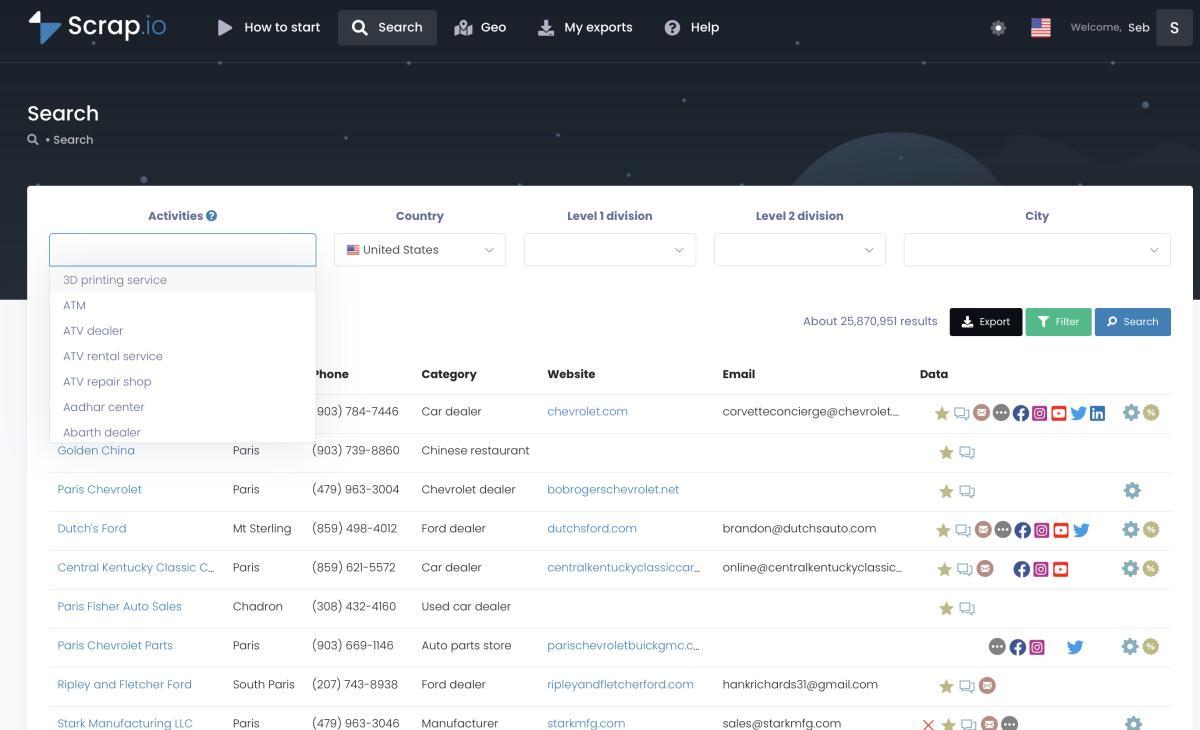
Search "moving company" (and related categories like "mover" or "relocation service" — you can stack several) and choose how wide you want to go. This is the fun part: your geography scales from a single city, up to a county, up to a state, all the way to the entire country. Want every mover in Texas? One dropdown. Want all 20,180 in the US? Also one dropdown, on the right plan. For the deep dive on going wide, see how to extract all businesses from Google Maps.
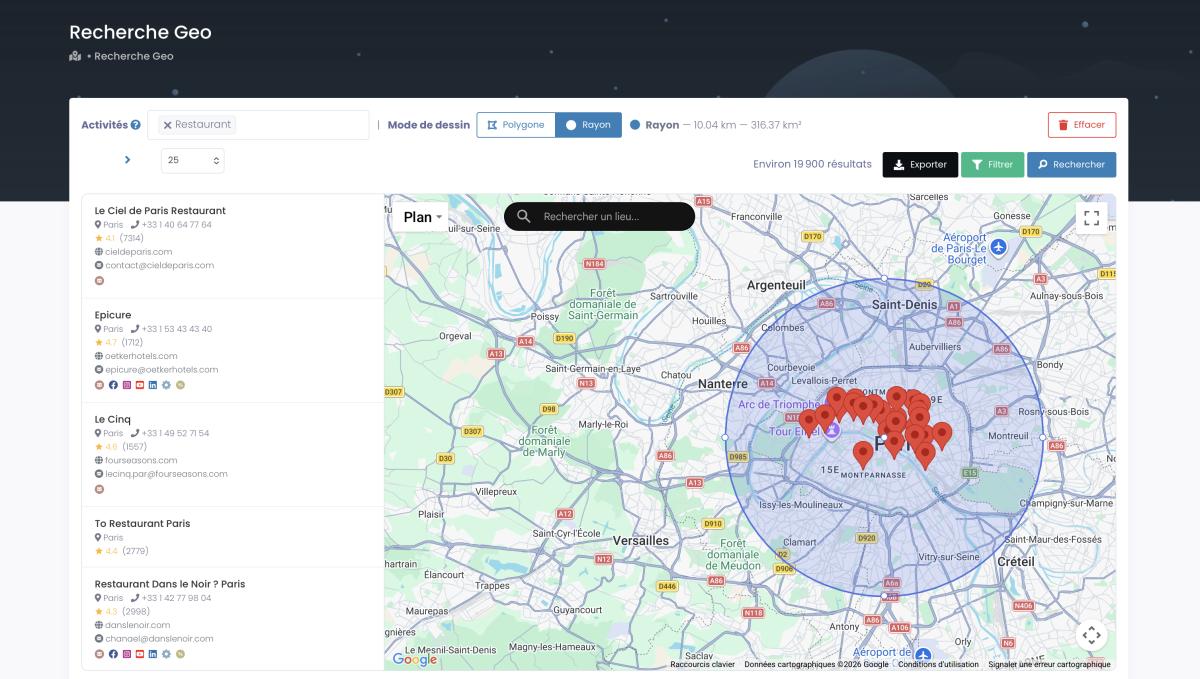
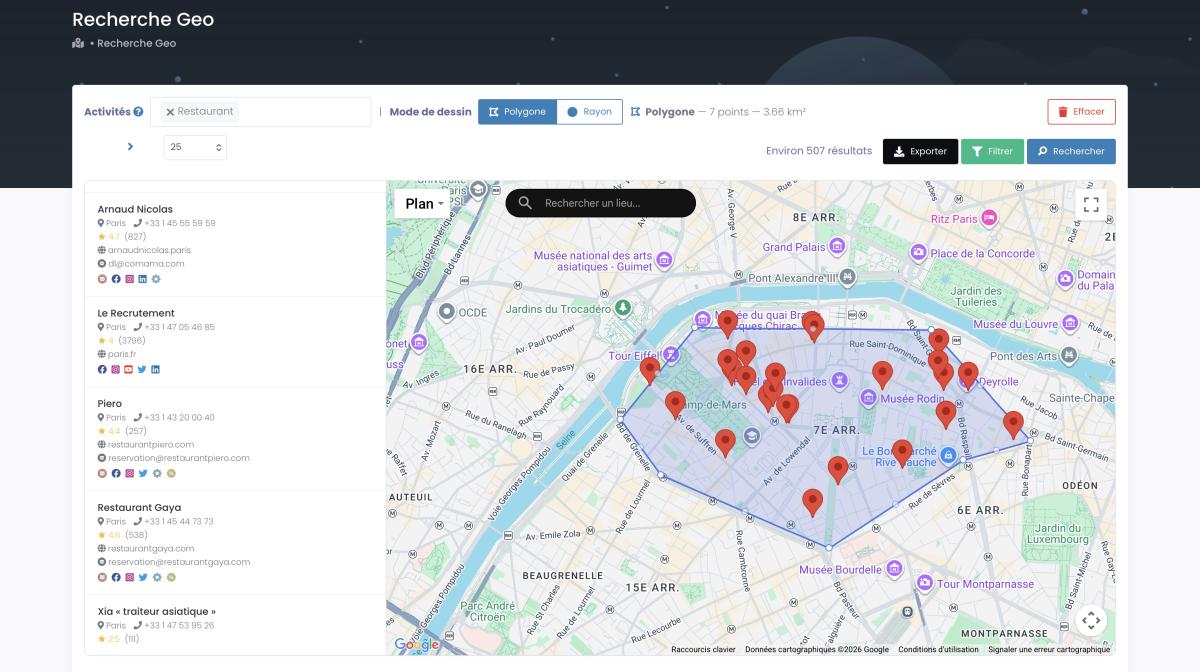
And if administrative zones don't fit your area, GeoSearch lets you draw a radius around a point or a custom polygon on the map — perfect for a metro that spills across county lines.
Video: How to Scrape Local Leads at the Country Level
Step 2 — Filter BEFORE you extract
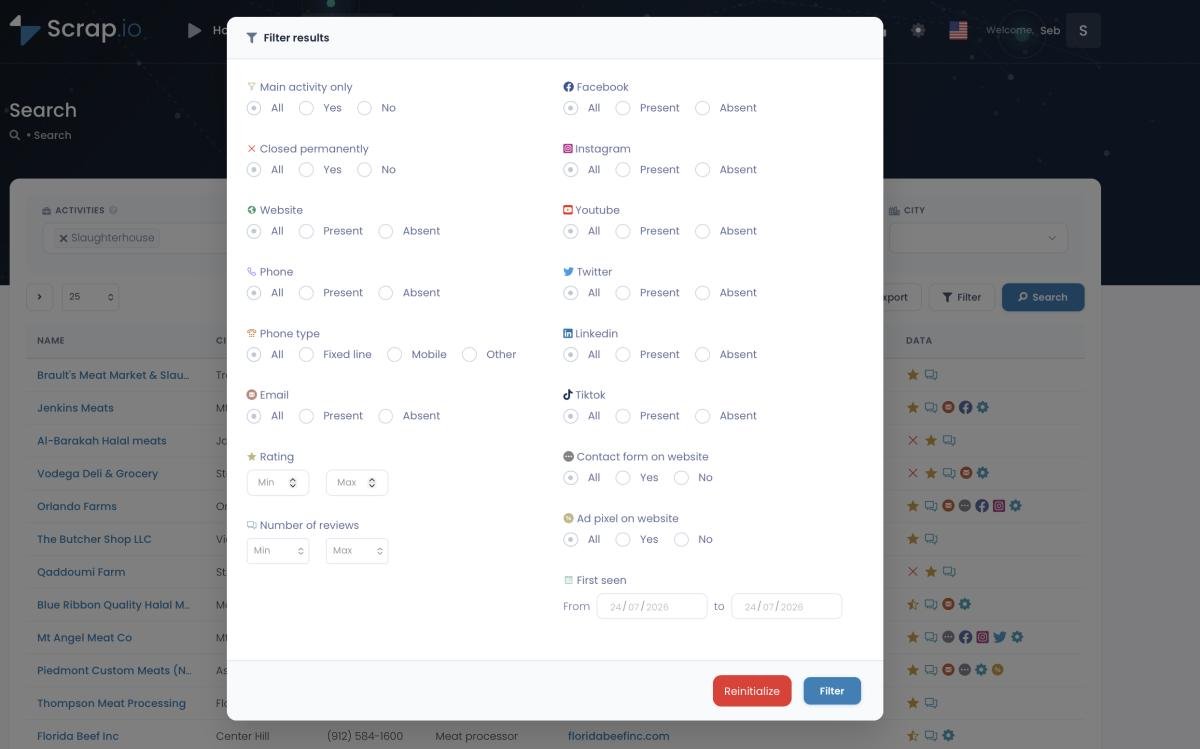
This is where you stop wasting money. Filters get applied before any credit is spent, so you only pay for contacts you can actually use. Selling web design? Filter for movers without a website — there go your 6,507 prospects. Running a cold email campaign? Filter for movers with an email — that's your ~7,622. You can also narrow by rating, review count, claimed listing, social profiles, and more.
Think about the alternative for a second. Try filtering a bought list of 10,000 contacts by hand in Excel, deleting the half with no email. I'll wait. Filtering at the source turns a garbage-in problem into a clean pipeline before it starts.
Video: Finding Clients Through Google Maps Filters
Step 3 — Export clean data
Hit export. You get a CSV or Excel file with the business name, address, phone, website, up to five classified emails per company (individual with first and last name, contact, sales, marketing, admin), social profiles, and website tech. Duplicates already excluded. For the full playbook on the email side, our guide on how to find emails on Google Maps covers every method ranked by speed. Prefer to grab a handful of movers while browsing the map directly? The free Chrome extension shows emails and socials right on Google Maps.
Try Scrap.io free for 7 days — 100 export credits included — and pull your first moving company list today. Filter before you extract, own the data forever, and skip the shared-lead treadmill entirely. Start your free trial →
Turn your list into booked jobs: outreach that works
A clean list is worthless if your first email lands in spam.
So let's talk about what happens after the export.
Cold email deliverability
Your moving company leads are only as good as your deliverability. Movers and the people who serve them are busy and skeptical. Your subject line has about two seconds. What works: specifics and numbers ("47 movers in your metro already do this"). What dies on arrival: "Revolutionary solution for your business." Before you send anything, set up SPF, DKIM, and DMARC on your sending domain — Gmail and Microsoft now reject unauthenticated bulk mail outright — and warm the domain up slowly. Fifty emails a day, building over two weeks. Rush it and you'll burn the domain you just built the list for.
Segment by the email type Scrap.io hands you, too. A note to an individual owner reads nothing like one to a generic info@ address. Personalize the first, pitch value to the second. For a full framework on moving prospects through the funnel, our guide on B2B lead nurturing with Google Maps data is the one to bookmark.
Partnerships beat cold leads
Here's my actual advice, if you run trucks. Cold-emailing consumers isn't your game — you can't build that list anyway. But cold-emailing referral partners? That's gold. Real estate agents send movers a steady drip of clients. So do HR relocation managers and self-storage operators. Build a list of those local businesses, reach out with a genuine partnership pitch, and you get warm referrals for years instead of a $40 coin flip. Wire that into a repeatable process with our 7-step sales pipeline for Google Maps leads. Partnerships compound. Bought leads evaporate.
Is it legal? Compliance for moving lead generation (US)
Short answer: yes — sourcing moving company leads this way is legal when you stick to public business data and follow the rules. Longer answer worth reading.
Extracting publicly listed business information — names, addresses, phones, business emails — for B2B prospecting is legal in the US. The CCPA specifically carves out publicly available business information, and it's a whole different thing from harvesting consumers' personal profiles. Scrap.io only collects public business data, and every data point stays traceable to its source.
Email outreach is governed by CAN-SPAM, and the bar is honestly not high. Per the FTC's CAN-SPAM compliance guide: don't use deceptive headers or subject lines, identify the message as an ad, include your real physical address, give a working opt-out, and honor unsubscribes within 10 business days. The law makes no exception for B2B, so those rules apply to every commercial email you send a mover. Follow them and you're clear. Ignore them and each violation runs up to $53,088 — so don't.
FAQ
How do I get leads for my moving company?
Two paths: buy or build. Buying (Angi, HomeAdvisor, Moving.com) is fast, but leads are often shared with 3–8 competitors at $15–120+ each. Building your own list — extracting moving companies and local referral partners from Google Maps with Scrap.io — gives you exclusive, reusable data you own outright.
How much do moving leads cost in 2026?
Shared leads run $5–60+, exclusive leads $15–80, and live-transfer calls $25–85. At a ~4% close rate, a single $40 shared lead can cost around $1,000 per acquired customer once you account for everyone else calling the same prospect.
Can I get moving company leads for free?
Not quality consumer leads, no. But you can build a business list at near-zero cost: counting movers on Google Maps in Scrap.io is free, and a 7-day trial includes 100 export credits — enough to pull a real, filtered list of moving companies and test it before you pay anything.
Is it legal to scrape moving companies from Google Maps?
Yes — with only public business data and CAN-SPAM/CCPA compliance (accurate identification, a working opt-out, no deception). Scrap.io keeps every data point traceable to its source, and public business information sits outside CCPA's consumer-data scope.
What's the difference between shared and exclusive moving leads?
Shared leads are sold to several movers at once, so you compete on speed and price and conversion sits around 13–20%. Exclusive leads are yours alone and convert closer to 27–30%, but cost more. Building your own list is effectively 100% exclusive — and you're not renting it month after month.
Stop paying for leads five other movers already have. Build a list that's yours — 20,000+ US moving companies, filtered by email or website before you spend a credit, pulled from fresh Google Maps data. Start free for 7 days with 100 leads included. Build your list now →
Generate a list of moving company with Scrap.io