

Two ex-Pinterest engineers raised $2.75 million, went through Y Combinator, and slapped a bold label on their product: "the AI alternative to ZoomInfo." That's Openmart. And the pitch is genuinely clever — scrape public data on local businesses, enrich it with AI, hand sales teams a list of owners to call. Neat.
But here's the thing nobody selling you a review wants to say out loud. A tool being well-funded and YC-backed tells you nothing about whether it's the right fit for your prospecting. Different question entirely.
So this is the honest version. Real features, the actual pricing (including the surcharges Openmart's own homepage buries), what users say, where it falls short — and where a different tool called Scrap.io quietly wins for anyone extracting local leads at scale. Let's get into it.
Video: I tried "Openmart" to scrape Google Maps — Scrap.io vs Openmart
Table of Contents
- What Is Openmart? (Company, Product & the YC Story)
- How Openmart Works (Google Maps Data + AI Enrichment)
- Openmart Key Features in 2026
- Openmart Pricing in 2026 (The Real Numbers)
- Openmart Pros & Cons: What Real Users Say
- Who Should Use Openmart (and Who Shouldn't)
- Openmart's Limitations (The Honest Part)
- The Best Openmart Alternatives in 2026
- Openmart vs Scrap.io: Head-to-Head
- How to Choose + Final Verdict
- FAQ
What Is Openmart? (Company, Product & the YC Story)
Quick bit of context first, because it explains why a tool like this even exists. The sales intelligence market sits around $5.0–5.4 billion in 2026 and is projected to push past $9–12 billion in the early 2030s, roughly 11–13% CAGR (Fortune Business Insights / The Business Research Company, 2026). About 68% of B2B organizations have already adopted data-driven prospecting tools, and lead management alone is 37.63% of that market (Global Growth Insights, 2026). Translation: everyone's buying prospect data, and a lot of startups are racing to sell it. Openmart is one of them.
So — Openmart is a local business data intelligence platform. In plain English: it builds and sells contact lists of small businesses so enterprise sales teams can go pitch them.
The origin story is actually a good one. Back in 2020, Kathryn Wu was working as a product engineer at Pinterest and started a milk tea company on the side. She needed to get her tea into local grocery stores and gift shops — and discovered that finding those shops, plus the right person to email at each one, was a nightmare. The tea company died. The pain point stuck. She co-founded Openmart in late 2023 with Richard He, a former Cruise engineer she'd met during their Pinterest days (TechCrunch, August 2024).
Then things moved fast. The company joined Y Combinator's Winter 2024 batch, and in August 2024 it raised a $2.75 million seed round from YC, Rebel Fund, Afore Capital, and a handful of other firms (Y Combinator; Crunchbase). The tagline they went with? "AI alternative to ZoomInfo." Bold, given ZoomInfo is a multi-billion-dollar public company. But that's the openmart yc positioning in a nutshell — go after the giants with a leaner, AI-first product. (The openmart vs zoominfo framing is theirs, not mine — worth remembering when you read their marketing.)
At launch, the team talked about a database of 20 million+ local businesses. By 2026, the marketing had grown to "200M+ verified contacts" (Openmart; ColdIQ, 2026). Take the bigger number with a pinch of salt — marketing math is marketing math. Either way, the raw idea holds up: there's a real gap between "here's a business" and "here's the owner's cell," and Openmart wants to own that gap. If the broader category interests you, we broke it down in our guide to business database and similar-company finder tools.
How Openmart Works (Google Maps Data + AI Enrichment)
Ever tried to build a targeted list of local businesses by hand? It's soul-crushing. Openmart's whole reason to exist is to make that not your problem.
Here's how does openmart work, step by step:
- You prompt it. Tell Openmart the kind of business you want to reach — "dental clinics in Texas," "independent coffee shops," whatever your ICP is.
- It pulls from its database. The AI has scraped public filings, maps, customer reviews, websites, even call data, and stitched it into a living database of local businesses.
- It enriches. For the businesses you pick, it digs up owner names and contact details — the part that normally eats hours of manual research.
- You export or sync. Push the list to a CSV or straight into your CRM.
Under the hood there's an AI agent doing the discovery and enrichment work. It's the openmart ai angle they lean on hardest — instead of you clicking through 200 listings, the agent does the piecing-together. And to be fair, when it works, it's a nice experience. Type a request, get openmart local business data back. For a lot of teams, "openmart scrape google maps" is basically the job they hire it for — pull public map and website data without ever touching a scraper themselves.
The catch is the data model. Openmart aggregates from a bunch of sources into a database, then charges you to enrich the records you want. That's a fundamentally different approach from pulling data live from a single source like Google Maps at the moment you export. (More on why that matters later — it's the whole ballgame.) If you want the deep version of the live-extraction method, here's our complete Google Maps scraping guide.
Want local business data without per-contact fees? Scrap.io pulls names, emails, and phone numbers live from Google Maps across 195 countries — and you filter before you spend a credit, so you never pay for junk. Try Scrap.io free for 7 days — 100 leads included.
Openmart Key Features in 2026
Credit where it's due — the team ships a solid feature set for a young company. Here's what you actually get.
Maps-based business search. Search local businesses by type and location, powered by that aggregated database. This is the core loop.
AI enrichment for owner contacts. The headline feature. The agent surfaces owner names, emails, and phone numbers — the decision-maker data that generic directories don't give you.
Email and phone extraction. Pull contact details for outreach. Note: emails and direct phone numbers are metered separately (we'll hit the pricing in a second, and it stings).
CRM export and integrations. HubSpot, Salesforce, and a direct integration with Clay for teams that live in enrichment waterfalls. The clay openmart combo shows up a lot in GTM circles — plug Openmart data into Clay, layer more enrichment on top.
Advanced discovery. Filters for things like newly opened or trending businesses. Genuinely useful if you want to catch a prospect early, before your competitors do.
Slack-based support, an API, and a Chrome extension. The connective tissue. Nothing revolutionary, but it's there.
One honest note. A few of these features still feel early — beta energy, rough edges. That's not a knock on the team so much as a reality of a six-person startup moving fast. If your core need is simply pulling emails at volume, by the way, the mechanics are worth understanding — here's how to find emails on Google Maps without an AI agent in the loop.
Openmart Pricing in 2026 (The Real Numbers)
OK. This is the section that actually matters, and it's the one Openmart's homepage is coyest about.
There's an openmart free trial to start — the Free tier gives you 200 credits, no plan required. After that, the base plans look reasonable. It's the per-contact surcharges that flip the math. On top of your subscription, the tool charges $6 per 100 owner emails and $24 per 100 direct phone numbers (G2 lists it among alternatives; pricing detail via SyncGTM, June 2026). Read that again. The contact data — the entire reason you're buying the tool — costs extra, on top of the plan.
Here's the openmart pricing plans breakdown for 2026:
| Plan | Price (annual) | Included | Contact surcharges |
|---|---|---|---|
| Free | $0 | 200 credits | Applies |
| Starter | $105/mo | Higher limits | $6/100 emails · $24/100 phones |
| Pro | $209/mo | More discovery + enrichment | $6/100 emails · $24/100 phones |
| Scale | $750/mo | Team + volume | $6/100 emails · $24/100 phones |
| Enterprise | Custom | Custom | Negotiated |
So what's the real openmart credits cost? It depends entirely on how many contacts you pull. And that's the trap. A "cheap" $105 plan can balloon the moment you actually extract phone numbers at scale. Pull direct dials for 5,000 businesses and that's $1,200 in surcharges alone — on top of the subscription. The advertised price and the invoice are two very different animals.
Openmart Pros & Cons: What Real Users Say
Enough of my opinions. What do actual openmart reviews say?
The positive ones are warm. One user on Product Hunt wrote: "Such a good tool to help us find potential client leads quickly, and it's affordable." That "quickly" comes up a lot — people like that leads show up in minutes, not days. ColdIQ's synthesis of customer results points to teams "cutting 80% BPO costs and hitting 12x ROI in two months" by replacing manual research and outsourced lead qualification with the AI agent. When it clicks, it clicks.
But it's not all glowing. There's a negative review on Trustpilot flagging a billing dispute — the kind of thing worth knowing before you hand over a card. One data point, not a pattern. Still, combined with the per-contact surcharges, it points at the same theme: keep an eye on what you're actually being charged.
| ✅ Pros | ❌ Cons |
|---|---|
| Leads in minutes, not hours of research | US / local-first — thin coverage abroad |
| Reported 12x ROI, up to 80% lower BPO costs | Per-contact surcharges ($6/100 emails, $24/100 phones) |
| AI enrichment surfaces owner contacts | Some features still feel beta |
| Clay, HubSpot, Salesforce integrations | Unpredictable final cost; a billing complaint on record |
Who Should Use Openmart (and Who Shouldn't)
Not every tool fits every team. This one has a clear shape.
Openmart is a good fit if you're an enterprise or agency selling into US local businesses, you value AI-surfaced owner contacts, and your deal sizes are big enough that a $24-per-100 phone surcharge doesn't make you flinch. Franchise sales, SMB-focused SaaS, US-only prospecting — that's the sweet spot.
Openmart is the wrong tool if you're prospecting internationally, you need whole-country coverage, or you're on a tight cost-per-contact budget. And openmart for agencies reselling leads? That's a trickier calculation — the surcharges quietly eat your margin. For that crowd, we've mapped out cheaper, more predictable plays in our guide to local business lead generation strategies.
Here's the blunt version. If your customers have a physical address but live outside the US, Openmart's coverage is going to frustrate you. That's not a dig — it's just where the product is today.
Openmart's Limitations (The Honest Part)
Every tool has limits. Pretending otherwise helps nobody. Here are Openmart's, laid out plainly.
It's US-centric. The database is deepest in the US and thinnest everywhere else. There's a nascent European push (you'll see it teased on their socials), but "nascent" is doing heavy lifting. Sell to businesses in France, Brazil, or Japan and you'll feel the gaps immediately. And openmart data accuracy tracks that same curve — sharp in dense US metros, patchier the further you get from home turf.
Cost per contact is unpredictable. The surcharge model means your bill scales with your success. The more phone numbers you pull, the more you pay — with no ceiling you set in advance. Budgeting becomes guesswork.
Some features are young. Beta rough edges. Fine for early adopters, less fine if you need rock-solid reliability on day one.
No filtering before extraction. This is the big one, and it leads straight into the alternatives section. With Openmart's model, you enrich first and pay for what you get. There's no way to say "only charge me for businesses that actually have a mobile number" before the meter runs. So you pay for records you can't even use. And that? That's just money on fire.
The Best Openmart Alternatives in 2026
If Openmart isn't your fit — international coverage, budget, whatever — you've got options. The best openmart alternative 2026 depends on what you're actually trying to do. Looking for a pure openmart alternative for google maps extraction? That points one way. Comparing openmart vs apollo for broad B2B contact data? That points another. Here's the honest rundown of the openmart competitors worth knowing.
- Scrap.io — #1 for global Google Maps extraction, real-time data, and transparent flat-credit pricing. The one we detail below.
- Apollo.io — from $49/user/mo; strong all-in-one B2B database with built-in sequencing. Great for LinkedIn-style contact data, weaker on local.
- ZoomInfo — the enterprise gorilla Openmart benchmarks against. Deepest B2B data, ~$15K/year, overkill for most SMB-focused teams.
- Cognism — the pick if you sell into EU/UK and need phone-verified, GDPR-first data.
- UpLead — mid-market contact database with verification, decent for US B2B.
- Clay — not a database exactly, but an enrichment layer many teams pair with a source (including Openmart itself).
| Tool | Best for | Starting price | Coverage |
|---|---|---|---|
| Scrap.io | Global Google Maps lead gen | $35/mo | 195 countries |
| Openmart | US local, AI enrichment | $105/mo + surcharges | US-first |
| Apollo.io | All-in-one B2B outbound | $49/user/mo | Global B2B |
| ZoomInfo | Enterprise B2B intelligence | ~$15K/yr | Global B2B |
| Cognism | EU/UK GDPR data | Custom | EU/UK focus |
Want the wider field? We tested and ranked the whole category in the 10 best Google Maps scrapers of 2026, and there's a broader roundup of the best lead generation software if you're building a full stack.
Proof it scales: one Scrap.io user pulled 11,734 businesses in 45 minutes — with emails, phone types, and social profiles, filtered before a single credit was spent. That's the whole-country play in one search. Run yours free — 100 leads included.
Openmart vs Scrap.io: Head-to-Head
This is where it gets interesting — because Scrap.io and Openmart both start from the same raw material (public local-business data) and then go in completely opposite directions. We even filmed the comparison, demos and all:
Video: Scrap.io vs Openmart — a direct, hands-on comparison
Scrap.io has four weapons that matter here. Let me walk them.
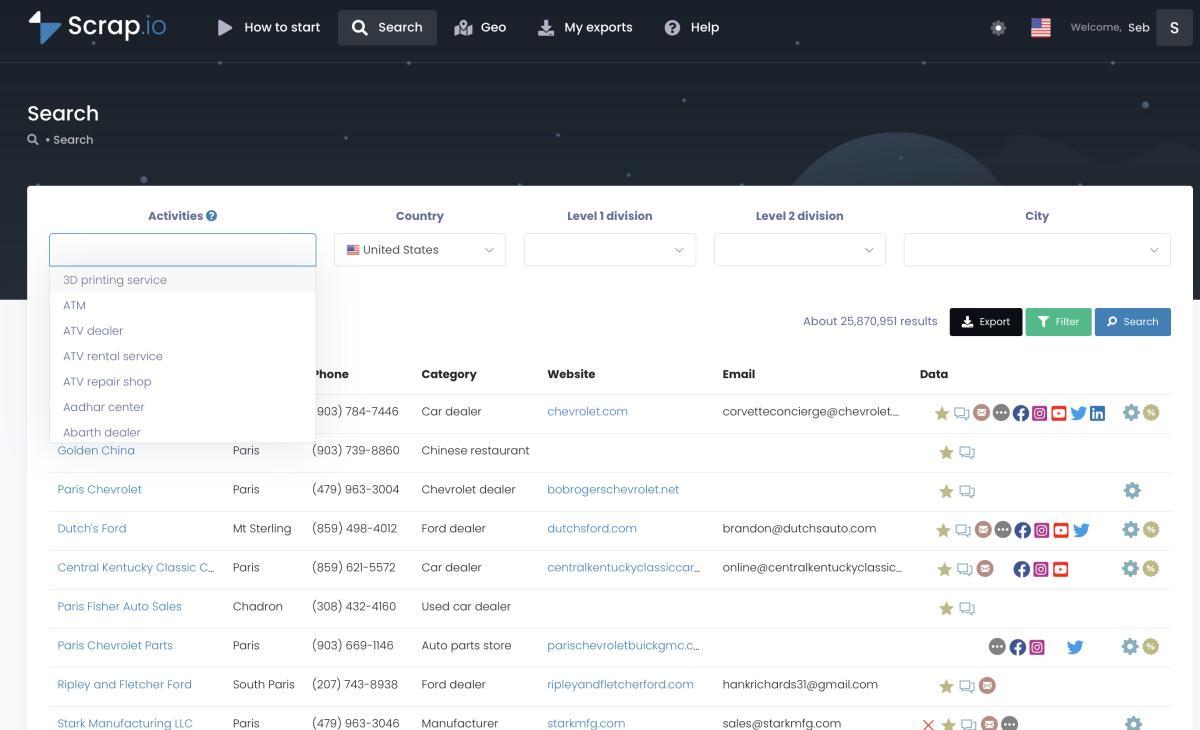
1. Whole-country extraction, two clicks, 195 countries. Openmart is US-first. Scrap.io indexes 225,676,406 businesses across 195 countries and 4,000+ categories, and you can pull an entire country's businesses in two clicks — no code (Scrap.io, 2026). Every business on Google Maps, anywhere. Here's the search interface:
2. Real-time data at every export. Openmart serves from a database. Scrap.io pulls live from Google Maps the moment you export — no frozen file, no records that went stale three months ago. Fresh data, every single time.
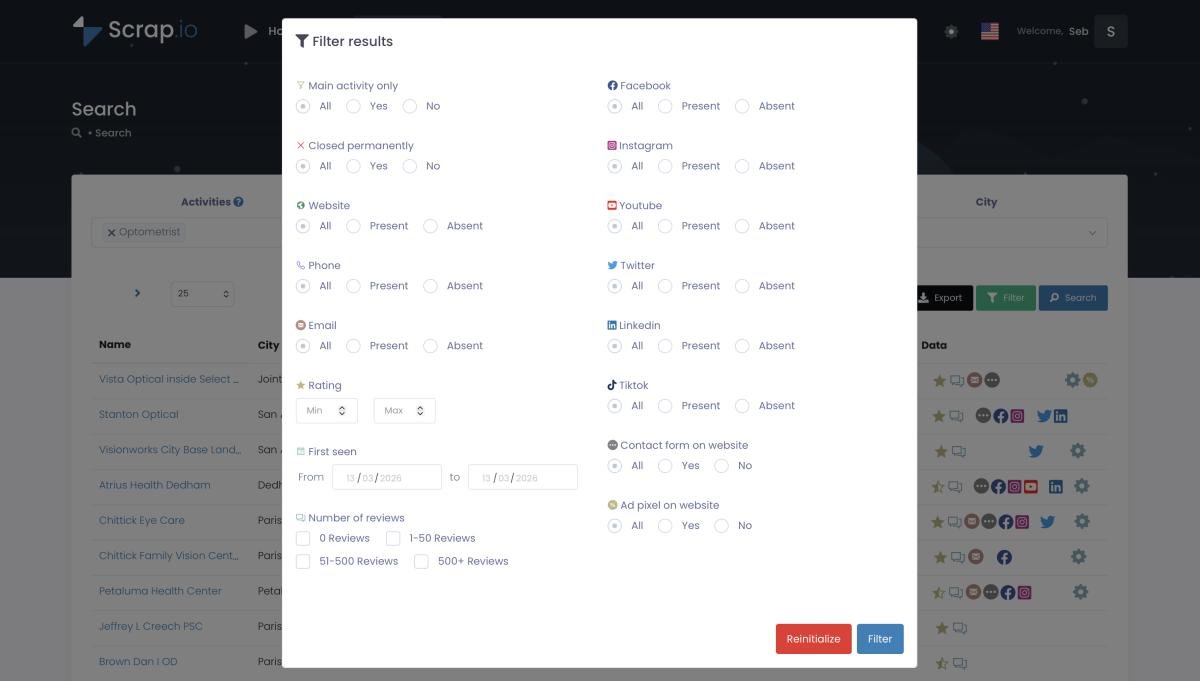
3. Filter BEFORE extraction — zero wasted credits. Remember Openmart's biggest limitation? Scrap.io flips it. You apply every filter — has email, mobile numbers only, minimum rating, no website, whatever — before a credit is consumed. You only pay for contacts you can actually use. No $6-per-100 surprise. No paying for dead records. Look at the filter panel:
4. Catchment-area targeting + GeoSearch. Need a precise zone instead of an admin region? Scrap.io does a radius up to 500 km, or a hand-drawn polygon up to 1,000,000 km² on the Company plan. Draw the exact neighborhood you want and pull every business inside it.
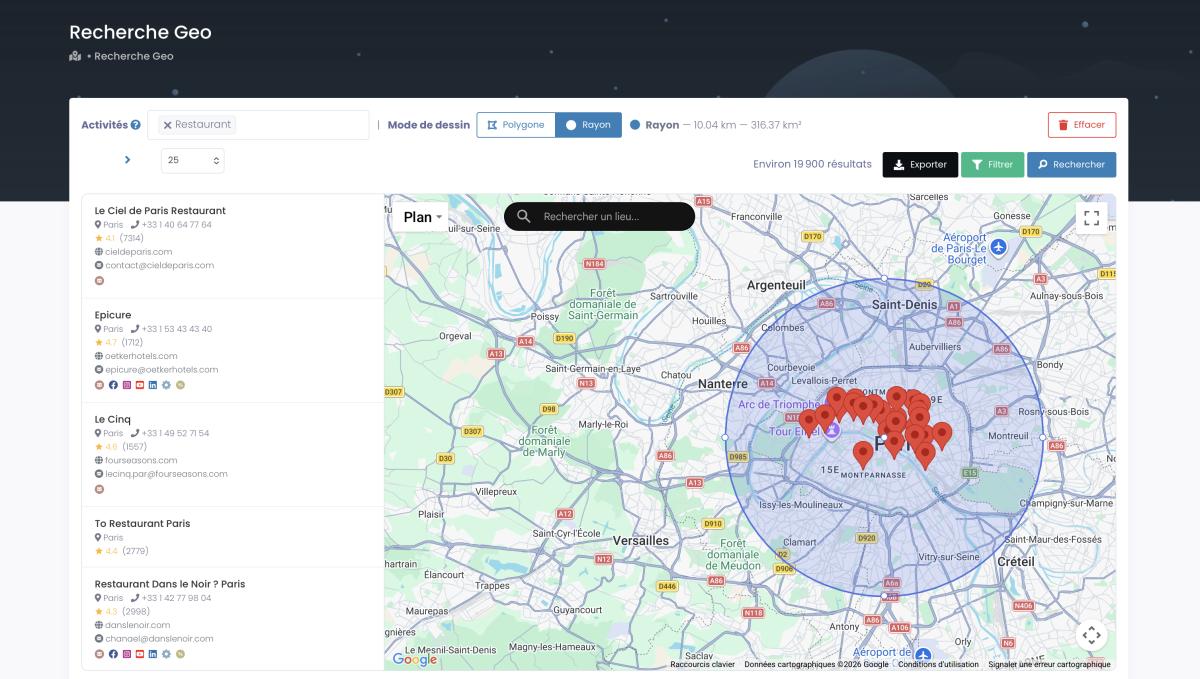
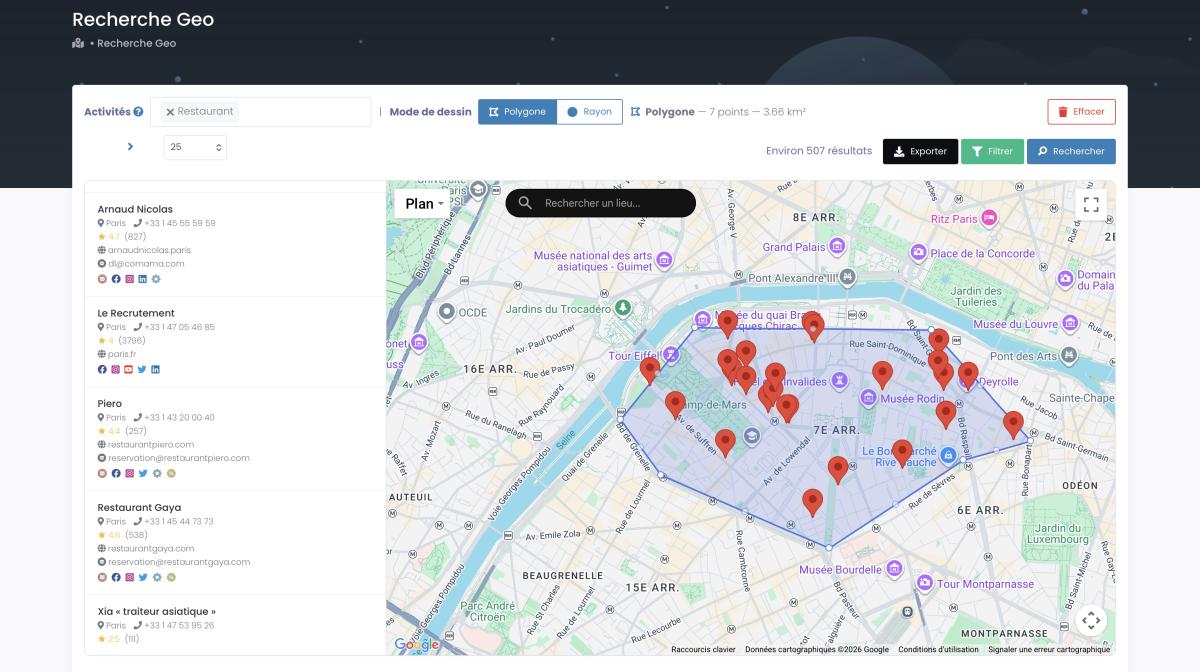
And the pricing philosophy couldn't be more different. On Scrap.io, 1 credit = 1 business, and each business is counted only once per 30-day window — re-export it and you don't pay again. Counting is free. All filters and all export columns are included on every plan, from $35/month. No email surcharge. No phone surcharge. What you see is what you pay.
| Criteria | Openmart | Scrap.io |
|---|---|---|
| Coverage | US / local-first | 195 countries, whole-country |
| Data freshness | Database | Real-time at every export |
| Filtering | Enrich, then pay | Filter before extraction |
| Pricing model | Credits + $6/100 emails, $24/100 phones | 1 credit = 1 business, no surcharge |
| Entry price | $105/mo + surcharges | $35/mo |
New to the platform? This quick start shows the whole flow:
Video: Scrap.io — How to Start?
And the whole-country move that Openmart can't match:
Video: How to Scrape Local Leads at the Country Level
Worth knowing too: Scrap.io ships an official MCP connector, so you can drive searches straight from Claude, ChatGPT, or Gemini in natural language — the AI angle Openmart talks up, without the per-contact meter. If you're weighing data sources more broadly, our take on Google Maps vs LinkedIn for B2B is a useful companion read.
Run the same search yourself. Pick a category, pick a country, filter for businesses that actually have the contact info you need — then export. Scrap.io gives you a free 7-day trial with 100 leads included. See the data quality on your own market before you spend a cent.
How to Choose + Final Verdict
So, is openmart worth it? Here's the decision tree, stripped down.
Choose Openmart if: your market is US local businesses, you want AI-surfaced owner contacts, and your unit economics can absorb per-contact surcharges. For that specific profile, it's a legitimately clever tool.
Choose Scrap.io if: you need international or whole-country coverage, you want real-time Google Maps data, and you want a predictable bill where you filter before you pay. Which — let's be real — describes most people doing local lead gen at any kind of scale.
The honest verdict? Openmart is a well-built, well-funded product with a real use case and a real ceiling. It's US-first, and its pricing rewards the tool more than the buyer. Scrap.io covers the world, keeps the data fresh, and never charges you for a contact you can't use. Different tools, genuinely different jobs — but for most readers landing on a page about "openmart alternatives," the answer is the one that doesn't nickel-and-dime you per phone number.
Once your list is built, the next problem is what you say. We wrote the playbook on that too — cold email templates that generated $20M in sales.
Ready to try the alternative? Scrap.io indexes 225M+ businesses across 195 countries, updated in real time, with every filter and column included — from $35/month. Start your free 7-day trial — 100 leads included. Test it on your target market and decide for yourself.
FAQ
What is Openmart used for?
Openmart is a local business intelligence platform. Sales and marketing teams use it to find small businesses by type and location, then enrich those records with owner names, emails, and phone numbers for outbound prospecting — mostly aimed at US SMBs. It scrapes public sources (maps, filings, reviews, websites) and layers AI enrichment on top.
How much does Openmart cost in 2026?
Openmart offers a Free tier (200 credits), then Starter at $105/mo, Pro at $209/mo, and Scale at $750/mo (annual), plus custom Enterprise. Crucially, contact data carries surcharges: about $6 per 100 owner emails and $24 per 100 direct phone numbers, on top of the subscription. Your real cost depends on how many contacts you pull.
Is Openmart worth it?
It depends on your market. For US-focused teams that value AI-surfaced owner contacts and can absorb per-contact fees, yes — it's a capable tool. For international prospecting, whole-country coverage, or a predictable cost per contact, an alternative like Scrap.io is the better call.
What is the best Openmart alternative?
Scrap.io is the strongest alternative for global, real-time Google Maps lead generation — 195 countries, whole-country extraction, filtering before extraction, and flat pricing (1 credit = 1 business, no surcharges) from $35/month. For general B2B databases, Apollo and ZoomInfo compete; for EU/UK GDPR-first data, Cognism is worth a look.
Does Openmart cover businesses outside the US?
Openmart is US and local-first, with a nascent European expansion. Coverage outside the US is thin compared to its home market. If you need reliable international data, Scrap.io — which covers 195 countries with real-time Google Maps extraction — is the more dependable choice.
Generate a list of restaurant with Scrap.io