

Here's the thing nobody tells you before you start researching outscraper vs apify: the two pages ranking at the top of Google were written by Outscraper and Apify themselves. Each one crowns itself the winner. Shocking, I know.
So you're stuck reading marketing copy dressed up as a comparison. Not helpful.
And plenty of people are stuck there. "Outscraper" alone pulls 6,600 US searches a month — up roughly 50% year on year — and "google maps scraper" adds another 1,600 at a KD of 27 (DataForSEO, 2026). Translation: a lot of buyers are trying to make this exact call right now, and most of them are getting fed spin.
We build a Google Maps scraper for a living, so yes, we're biased too — and we'll flag exactly where. But honestly, we have zero reason to inflate either of these tools, which means you'll get the version nobody else publishes: real pricing, real limits, real Reddit receipts. Plus a third option most "vs" articles pretend doesn't exist. If you want the wider background first, here's the complete Google Maps scraping guide. Otherwise, let's get into it.
Video: I Tested Apify's Google Maps Scraper (Apify vs Scrap.io)
The 30-second verdict
Both companies wrote glowing comparisons of themselves. Neither will tell you the honest answer. So we will.
Outscraper is the no-code, pay-as-you-go option — great for a quick one-off list, painful once you add every data layer you actually need. Apify is the developer's playground — enormous flexibility, a marketplace of pre-built actors, and a billing model (compute units) that surprises people at the worst possible moment. Here's the quick read before we dig in.
| Criteria | Outscraper | Apify |
|---|---|---|
| Best for | No-code, quick lead lists | Developers, custom pipelines |
| Pricing model | Pay-as-you-go (per result + add-ons) | Subscription + compute units + actor fees |
| Learning curve | 🟢 Low | 🔴 Steep (JSON, actors, config) |
| Cost at scale (with emails) | 🟡 ~$9–14 / 1,000 | 🟡 ~$9–14 / 1,000 |
| Pre-extraction filtering | ❌ Limited | ❌ No |
| Country-level extraction | 🟡 Possible, tedious | 🟡 Requires chaining actors |
Notice both share the same two weaknesses in that last chunk. Hold that thought — it's the whole reason this article has a section eight.
What is Outscraper? (2026)
Outscraper is the tool most marketers reach for first — and the one they outgrow fastest.
It's a self-serve platform. You type a keyword and a location, run the job, download a file. No code. The Outscraper Google Maps scraper is one of 50+ scrapers they offer, alongside Amazon, Yellow Pages, Google Reviews, and a pile of others. That breadth is the pitch: one account, many sources. BillionVerify's independent write-up put it plainly — "Outscraper is easier to use without writing code. Apify gives more control over the extraction pipeline." (BillionVerify, 2026).
And for a fast, no-strings scrape? It genuinely delivers. That's not nothing.
The catch shows up when you need complete lead data — the kind you'd actually run a cold email campaign on. Which brings us to the number everyone gets wrong.
Outscraper pricing: what you actually pay
Outscraper advertises roughly $3 per 1,000 basic Google Maps records, with 500 free to start. Sounds cheap. It's a base rate, though — not the real one.
Because names and addresses aren't a campaign. You need emails. That's an add-on. Want those emails validated so half your list doesn't bounce? Another add-on. Reviews, photos — more layers, more per-thousand charges. Stack what a lead-gen team genuinely uses and the number lands closer to $9–11 per 1,000 for enriched leads (gmapsscraper.io, 2026). Lobstr.io ran the full stack — base + emails + validation + reviews + photos — and got to ~$14 per 1,000 (lobstr.io, 2026).
So how much does Outscraper cost? Depends entirely on how many layers you bolt on. We ran the full teardown separately if you want it: the real Outscraper pricing and cost per usable lead. And there's a nastier detail. Per lobstr.io, the API "has no default spending limit… it keeps consuming credits past zero into negative balance and then charges you for the overage." Users on Reddit report surprise invoices of "$200 to $300+" from jobs they assumed were small. That's not a pricing model. That's a slot machine.
What is Apify? (2026)
What happens when a scraping tool is built by developers, for developers? You get power. And a bill you didn't see coming.
Apify is an automation platform, not a Google Maps product. You pick an "actor" (their word for a pre-built scraper), configure it with JSON inputs, schedule runs, and pipe the output into other systems. Their Google Maps Scraper actor is the most popular one in the store: 4.7★ across 1,306 reviews, used by 400,000+ people (Apify Store, 2026). Massive install base. Real capability. If you're chaining multiple data sources into a custom pipeline, few tools match it.
But — and this is a big but — that power assumes you can code. Or at least stomach JSON schemas, actor rental, and proxy config. For a marketer who just wants a clean list of dentists in Ohio, it's a lot.
Apify compute units: the cost nobody explains
On paper, Apify's Google Maps scraping starts around $1.50 per 1,000 places. In practice, teams routinely pay several times that. Here's why.
Apify's apify google maps scraper pricing isn't one number — it's a stack. You pay a platform subscription (plans start around $39/month, ranging up to the high hundreds), plus compute units for the processing your actors consume, plus per-actor usage fees, plus proxy costs. The apify compute units cost is the sneaky part: it scales with how hard the job works, not with how many good leads you get back. A run that stalls, retries, and crawls slow websites for emails burns units the whole time. Add it all up for enriched Google Maps leads and independent reviews land it at roughly $9–14 per 1,000 at scale (gmapsscraper.io / Bright Data, 2026).
One G2 reviewer summed up the trap: "The pricing can get expensive quickly if you're running large-scale scraping jobs. The free tier is very limited and it's easy to burn through credits without realizing it."
Curious what a no-code option without the compute-unit roulette looks like? Keep reading — we get there in section eight.
Tired of guessing what a scrape will cost? Scrap.io shows you the exact result count and the exact price before you export a single row — across 225M+ businesses in 195 countries. Try it free for 7 days (100 leads included) and see the count before you pay.
Outscraper vs Apify: head-to-head
Both tools scrape Google Maps. Both pull emails from the linked websites (neither has a magic contact database — that's worth knowing). The differences are in who they're for and what it costs you to get usable data. So here's the side-by-side for anyone doing an outscraper vs apify for google maps leads evaluation — and if all you care about is the outscraper vs apify pricing gap, jump to the next section.
| Feature | Outscraper | Apify |
|---|---|---|
| Interface | No-code, self-serve | Console + JSON, dev-oriented |
| Skill required | None | Technical familiarity |
| Pricing | Pay-as-you-go + add-ons | Subscription + compute units + actor fees |
| Email extraction | Paid add-on | Actor-dependent |
| Data freshness | Pre-indexed cache + live | Live scraping |
| Platform coverage | 50+ scrapers (multi-source) | 8,000+ actors (huge marketplace) |
| Cost surprises | 🔴 Negative-balance overages | 🔴 Compute-unit blowouts |
Read that bottom row again. Different mechanism, same outcome: you find out the price after the money's gone. On the outscraper vs apify reddit threads, that's the single most common complaint — from both camps.
The real cost at scale
Meet Dana. She budgeted $50 to scrape every restaurant in Texas. She spent it in 20 minutes and had a third of the list.
Dana isn't real, but her Tuesday is. This is where the vendor pages go quiet, because the outscraper vs apify cost conversation only gets interesting past a few thousand records. Below that, everyone looks cheap. Above it, the billing model decides whether you keep your margin or hand it to your scraper.
Here's the honest math for ~10,000 fully enriched Google Maps leads (with emails), pulled from public pricing pages and third-party reviews:
| Tool | Pricing model | Cost / 1,000 (with email) | Predictable? |
|---|---|---|---|
| Outscraper | Per result + add-ons | ~$9–14 | ❌ |
| Apify | Subscription + compute units | ~$9–14 | ❌ |
| Scrap.io | Flat subscription (1 credit = 1 business) | ≈$3.50 (Basic, all data included) | ✅ |
The pattern is brutal and consistent: the more you scrape, the worse the per-result models get, because every layer and every compute minute compounds. A flat subscription flips that — the marginal lead trends toward free. If you want the full breakdown of why runtime-based and per-result billing punish scale, we did the math in our guide on execution-time vs lead-based pricing. And if you're weighing the official route, the Google Maps API cost is its own horror story — roughly $32 per 1,000 requests, no emails included.
The limit both share
Outscraper and Apify are both generalists. And generalists are exactly wrong for one very specific job: building a clean local lead list.
Think about it. Outscraper scrapes 50 platforms. Apify scrapes 8,000. That breadth is a genuine strength if you need Amazon reviews on Monday and TikTok data on Tuesday. But it means neither was designed around the one workflow a lead-gen team lives in — pull every business in a territory, keep only the ones worth contacting, pay only for those.
Two consequences fall out of that, and they're the same two from the verdict table.
First, you filter after you pay, not before. If 40% of the businesses in your target city have no email, both tools happily charge you for all of them, then you delete the dead weight in Excel. Second, country-level extraction is a chore — Google Maps caps results at ~120 per search, so covering a whole country means hundreds of stitched-together queries and manual deduplication.
The people who feel this most are the ones running local outreach. One user on Reddit's r/automation put it bluntly, arguing that a purpose-built tool beats Apify "because it actually finds owner names, email addresses, phone type, and website context rather than just raw listings." That's the generalist tax in one sentence.
Neither tool is bad at what it does. They just weren't built for this. Which is a decent segue.
The third option: Scrap.io
225 million businesses. 195 countries. Two clicks. No code. Let's pressure-test it.
Full disclosure, again: this is our tool. So don't take our word — take the numbers. Scrap.io has indexed 225,676,406 establishments across 195 countries and 4,000+ categories, and it's used by 50,000+ professionals (Scrap.io, 2026). Where Outscraper and Apify scrape everything, Scrap.io does one thing — it's a google maps scraper for lead generation, and it shapes every feature around that job. It's a fully no-code google maps scraper: if you've been hunting for the best alternative to Outscraper and Apify — an apify alternative or outscraper alternative that isn't just another generalist — this is the different-category answer. Bottom line: same market, opposite design philosophy.
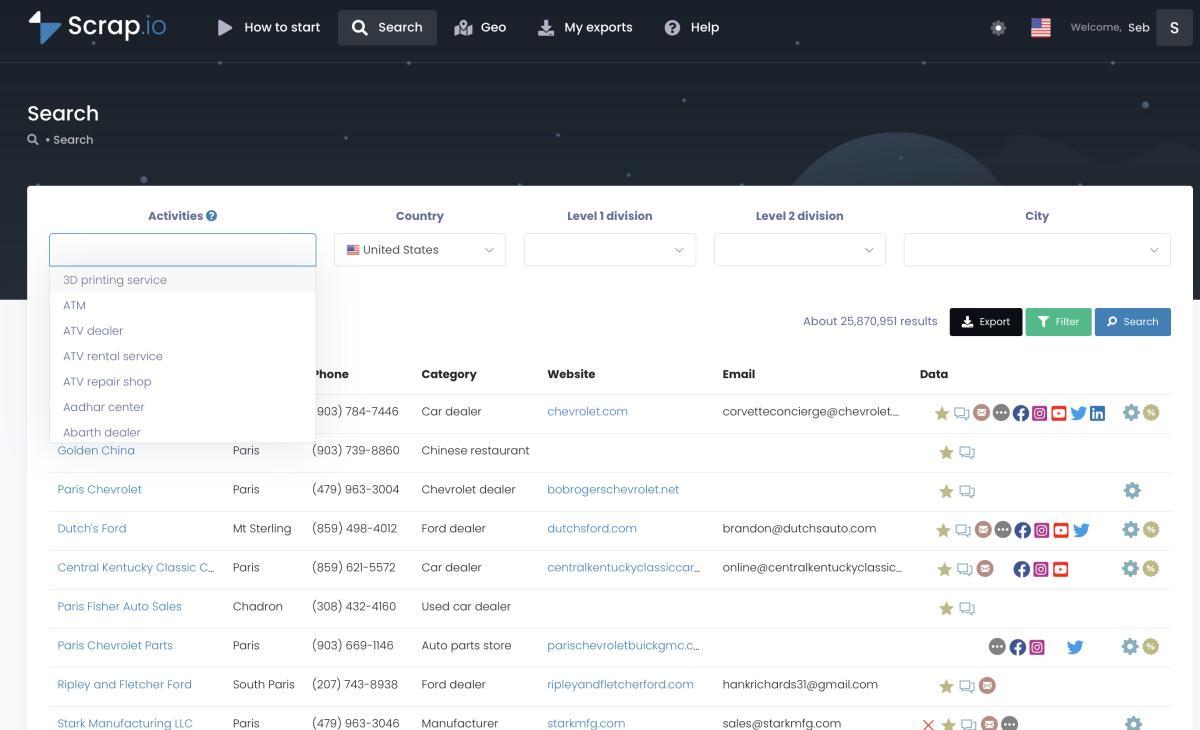
The workflow is embarrassingly short. Pick a category, pick a location — a city, a county, a state, or an entire country on the Company plan. The counter tells you how many results match before you spend a credit (counting is free, always). Then you get to the part that actually saves money.
Filter before you spend a single credit
This is the bit both competitors can't do. Scrap.io applies filters before extraction, so you only pay for contacts that match. Want businesses that have a website but no email? Toggle it. Only mobile numbers for an SMS campaign? Done. Minimum 4 stars with 50+ reviews, a contact form, an ad pixel, a specific social network — all set before a credit moves.
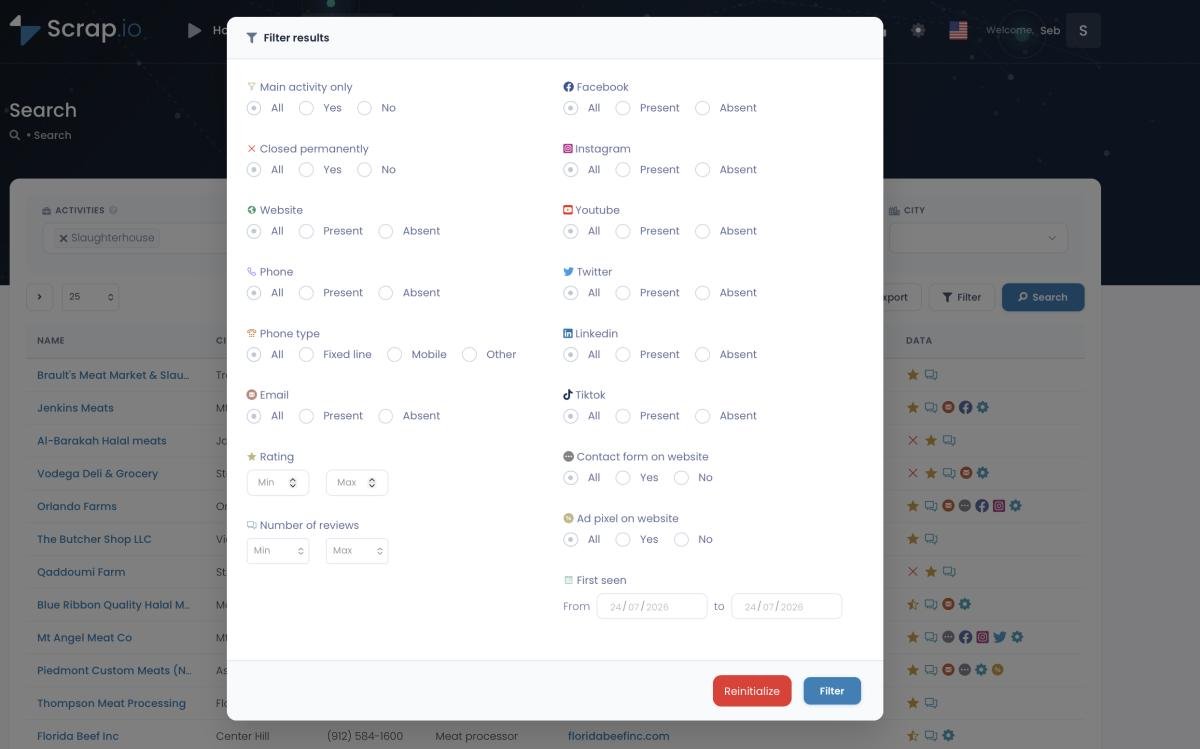
On Outscraper or Apify, you buy the rows first and sort the garbage later. Here you never buy the garbage. If you want the deep version, here's our full guide to filtering business data before extraction. And because it's a genuinely no-code tool from start to finish, you get a google maps scraper without code — no Python, no proxies, no CAPTCHA babysitting.
Video: How to Scrape Local Leads at the Country Level?
Country-level in two clicks — and GeoSearch when borders don't fit
Remember the 120-result cap that turns country coverage into hundreds of queries on the other tools? Scrap.io built its own index, so that cap doesn't apply. Select "Plumber" and "United States," check the count, export. You can even extract all businesses in an area with no category at all — a full economic map of a territory. A documented client result: 11,734 businesses extracted in 45 minutes.
And when administrative borders don't match your service area, GeoSearch lets you draw a radius (up to 500 km) or a custom polygon (up to 1,000,000 km² on Company) straight on the map.
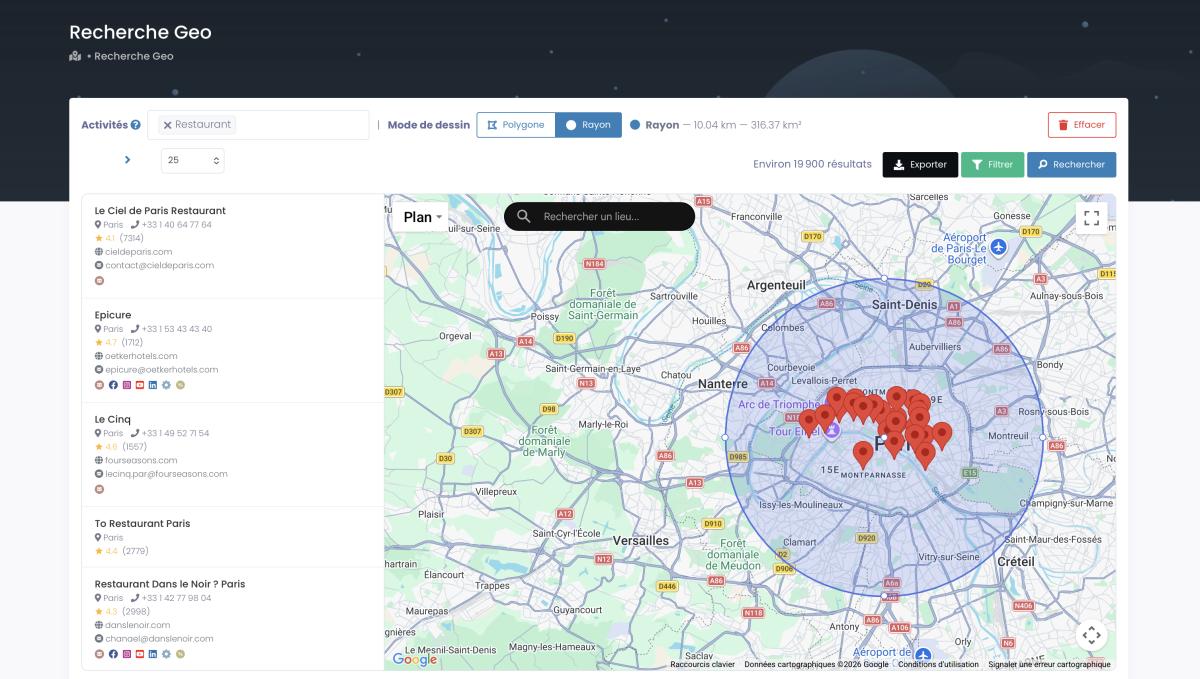
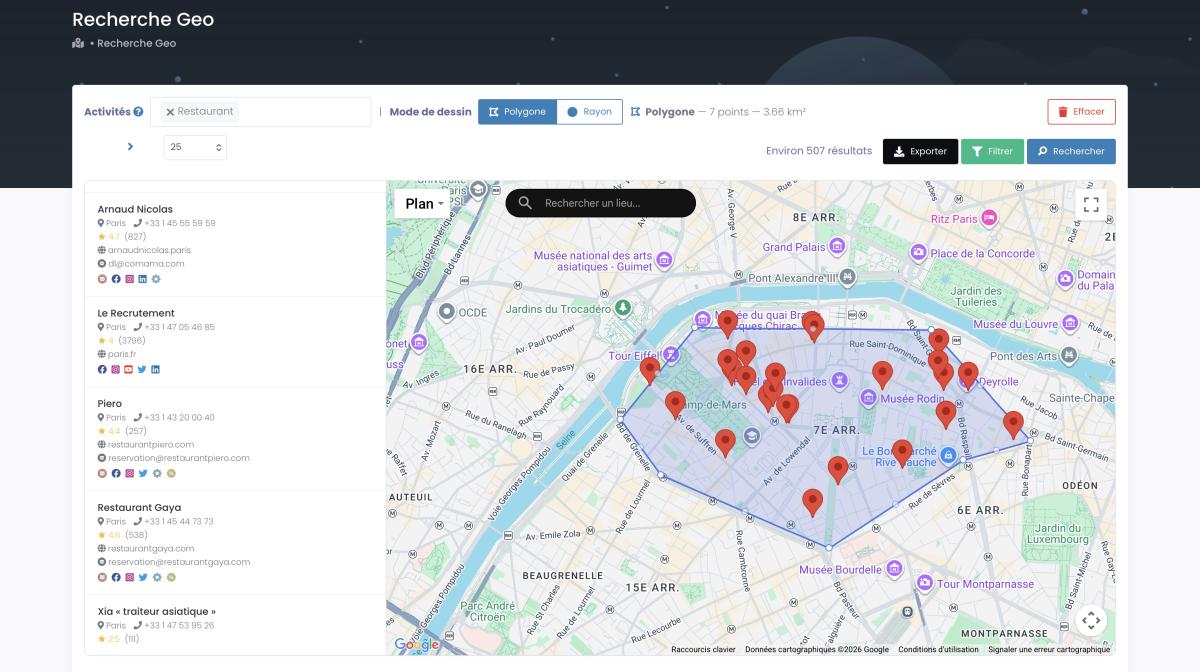
225M+ businesses across 195 countries, trusted by 50,000+ pros. Filter by email, phone type, rating and 15+ more criteria — then export only the contacts you actually want. See the live data — free for 7 days, 100 leads included.
One honest note on pricing so you can compare apples to apples. Scrap.io is a flat subscription: Basic $35/mo (annual) for 10,000 credits, up to Company $350/mo for 100,000. One credit = one business exported, and re-exporting the same business within 30 days costs nothing. All filters and all export columns are on every plan. If you want the deeper face-off, we wrote a dedicated Outscraper alternative deep-dive too.
Which one should you choose?
So, who actually wins? It depends on exactly one thing: who you are.
No tool is "best" in a vacuum — the best google maps scraper is the one that fits your job. If you want the wider field, we tested and ranked the best Google Maps scrapers head to head. Here's the decision guide by profile:
| Your profile | Your need | Pick |
|---|---|---|
| Developer / data engineer | Custom multi-source pipeline, full control | Apify |
| Someone needing a one-off, multi-platform scrape | Quick pay-as-you-go job, no subscription | Outscraper |
| Marketer / agency / sales team | Clean local lead lists, no code, predictable cost | Scrap.io |
If you write code and you're stitching Google Maps into a bigger data machine, Apify earns its keep. If you need a fast one-time list and never want to see a monthly charge, Outscraper is a fair shout. But if you just want clean local leads without code — and you want to know the bill before you commit — start your free Scrap.io trial. Seven days, 100 leads on us.
Is it legal? Compliance in 2026
"Is this even legal?" is the question everyone Googles at 2am after their first export. Whether it's is outscraper legit or is apify legal, the honest answer is the same, and it's mostly reassuring.
Scraping publicly available business data — names, addresses, phone numbers, ratings — is broadly legal in the US and the EU. In the US, the hiQ Labs v. LinkedIn ruling established that accessing public data doesn't violate the Computer Fraud and Abuse Act. In Europe, GDPR distinguishes personal data from business data; standard B2B listing info is typically processable under legitimate interest. And under California's CCPA, publicly available business information is carved out of scope. We wrote the full breakdown on whether it is legal to scrape Google Maps, court rulings and all.
The nuance: your use determines your risk. Blasting personal emails with no opt-out is a different animal from contacting a business at its public address. Reputable tools stay GDPR and CCPA compliant and keep every data point traceable to its source — Scrap.io does, and only extracts public business data. If real money's on the line, talk to an actual lawyer, not a blog post. (Yes, even this one.) You can sanity-check the broader picture against neutral sources like G2's web scraping category.
Is Apify legal?
Yes. Apify is a general automation platform, and using it to collect publicly available Google Maps data is legal in the US and EU. The tool isn't the risk factor. Your data handling is. Stay logged out where possible, target public business fields, keep an opt-out on outreach, and you're on solid ground.
Is Outscraper legit?
Yes, Outscraper is a legitimate, established company, not a scam. It bills through a normal account, publishes its pricing, and pulls the same public business data everyone else does. The common gripe isn't legitimacy. It's surprise invoices from add-ons and no default spending cap. Legit tool, watch the meter.
FAQ
Is Outscraper or Apify better for Google Maps leads?
Outscraper is better for fast, no-code, pay-as-you-go lead lists. Apify is better for developers who need custom, multi-source pipelines. For clean local lead lists at a predictable price, a purpose-built tool like Scrap.io often beats both — it filters before you spend credits and extracts at country level without code.
How much does Outscraper cost vs Apify in 2026?
Outscraper is pay-as-you-go: about $3 per 1,000 basic records, rising to roughly $9–11 per 1,000 once you add emails, with no monthly fee. Apify is about $1.50 per 1,000 base, plus a platform subscription (from ~$39/month), plus compute units and per-actor fees — landing around $9–14 per 1,000 at scale. Both get less predictable the more you scrape.
Is there a free alternative to Outscraper and Apify?
Both have limited free tiers (Outscraper gives 500 records; Apify a small monthly credit). If you're after an outscraper free alternative or a way to test a real market segment, Scrap.io offers a 7-day free trial with up to 50 searches and 100 export credits, with full access to every filter.
Is scraping Google Maps legal?
Scraping public business data is generally legal in the US and EU when you respect privacy law. Court precedent (hiQ v. LinkedIn) protects access to public data, and both GDPR and CCPA treat business listing data differently from personal consumer data. Reputable tools stay GDPR/CCPA compliant — but your specific use case determines your risk.
Outscraper vs Apify vs Scrap.io — which wins?
For the outscraper vs apify vs scrap.io question: Outscraper wins on pay-as-you-go simplicity, Apify wins on developer flexibility, and Scrap.io wins on no-code country-level extraction, filtering before you spend credits, and flat, predictable pricing. Pick the one that matches your profile.
Conclusion
The two pages ranking above this one told you they were the winner. We told you the truth instead: Outscraper and Apify are both solid generalists that happen to charge you in ways you can't predict, and neither was built for the one job most people land here for — a clean, filtered, local lead list.
If you're a developer, go build on Apify. If you want a quick no-subscription scrape, Outscraper's fine. If you want clean leads without code and without the credit-burn learning curve, there's a tool built for exactly that. Once you've got the list, the next move is turning it into a cold email campaign that actually gets replies.
Skip the credit-burn learning curve. Try Scrap.io free for 7 days — 100 leads included, 225M+ businesses across 195 countries, and you see the exact count and price before you export. Start your free trial →
Generate a list of restaurant with Scrap.io