

Reply rates fell off a cliff. From 5.1% in 2024 to 3.43% in 2026. So every few weeks somebody declares cold email dead, cancels their sending tool, and runs off to spam LinkedIn instead.
Here's what they miss. The template was never the problem.
I've watched two reps send the exact same email to the exact same industry. One booked nine meetings. The other booked nothing. Same words. Wildly different lists. That gap is the whole story of this article.
Below: 29 sales email templates, sorted by buying stage. Cold outreach, introductions, follow-up, re-engagement, closing. Copy them. Paste them. Fill the brackets. But read the note under each one, because that little note is where the reply actually comes from.
Ready? Let's get into it.
Video: How to write cold emails that get responses (we fix 4 sequences LIVE)
- Do sales email templates still work in 2026?
- What makes a sales email template convert (the anatomy)
- 29 sales email templates that book meetings
- B2B sales email templates: what actually changes
- The half nobody talks about: your list beats your template
- Personalization at scale: filling the [brackets] with real data
- Make sure your templates land (deliverability and compliance)
- 7 mistakes that kill your reply rate
- FAQ
Do sales email templates still work in 2026?
Reply rate fell from 5.1% (2024) to 3.43% (2026). Are templates dead? Not even close.
Here's the number that reframes everything. That 3.43% is the platform-wide average across billions of emails Instantly analyzed. Average. The top 25% of senders clear 5.5%, and the top 10% blow past 10.7%. Same inboxes. Same buyers. The gap between mediocre and great has literally never been wider.
And a widening gap is an opportunity, not a threat.
So why did the average drop? More people sending more email, plus a flood of lazy AI-generated blasts that all read the same. Inboxes got noisier. Filters got smarter. The bar went up. Good.
The folks over on r/sales put it better than any marketing blog ever could: "Cold email didn't die. Bad cold email did." And the follow-up comment nailed the real issue: "Templates alone can't overcome bad data and broken deliverability." Remember that second half. We'll come back to it.
So do the best sales email templates still work? Yes, when three things line up: a tight list, real personalization, and consistent follow-up. Miss any one and you're back at 2%. Nail all three and you're in double digits. This whole guide, cold email templates for sales and everything after, is built around getting all three right.
What makes a sales email template convert (the anatomy)
The best sales emails in 2026 are 40 to 60 words. Yes, really. Here's why.
Your prospect gets buried in outreach. A named study by Woodpecker across 20 million+ emails found the tight, 40-to-60-word emails outperform the 300-word manifestos every time. Nobody reads your essay. One point. One ask. Get in, get out.
A converting email has five parts, and each one earns its place:
| Part | Its one job | The number behind it |
|---|---|---|
| Subject line | Get the open | Personalized = 46% open rate (Belkins, 5.5M emails) |
| Opening line | Prove it's about them, not you | Personalization = 2x reply rate |
| Value, one sentence | Their outcome, not your feature list | 18% reply vs 9% generic |
| Single CTA | One low-friction ask | Binary questions win |
| Signature | Real name, real identity | Required by law (more below) |
The 5 C's of a sales email
People search this one constantly, so here it is, clean:
- Clear: one idea, no jargon.
- Concise: under 60 words.
- Compelling: a reason to care, right now.
- Credible: proof, not promises.
- Call to action: one ask, easy to answer.
The 30/30/50 rule and the 12-second rule
Two frameworks worth 30 seconds of your time. The 30/30/50 rule: roughly 30% of your result comes from targeting, 30% from deliverability, and 50% from follow-ups. The numbers intentionally add up past 100. It's about relative weight, and it tells you where to spend your energy. Hint: it's not your subject line.
The 12-second rule is simpler. A busy prospect skims. So make your point clear inside the first 12 seconds of reading, or you've lost them. Front-load the value. Bury nothing.
Want the deep version on openers? We wrote a whole guide on how to start a cold email, and the first three lines really do decide everything. And if you want the full framework behind writing one from scratch, here's how to write a cold email that gets replies.
29 sales email templates that book meetings
Copy, paste, fill the brackets. No PDF to download, no Word doc to hunt for, and no gate: these are free to steal. But read the note under each one, that's where the reply comes from. Here's how the 29 map to the buyer's journey:
| Stage | Templates | When to send |
|---|---|---|
| Cold outreach / prospecting | 1–8 | First touch, no prior relationship |
| Sales introduction | 9–13 | Warm handoff, referral, or event |
| Follow-up | 14–21 | After silence, over 14–21 days |
| Re-engagement and breakup | 22–25 | Gone quiet or gone cold |
| Closing / meeting-booking | 26–29 | They're interested, seal the meeting |
Sales cold email templates (1–8)
These are your sales cold email templates for a first touch. No prior relationship. High risk of getting ignored. Which is exactly why the note matters more than the words.
1. The Problem-Solution Bridge.
Subject: Quick question about [Company]'s [specific challenge]
"Hi [First Name], noticed [specific observation about their business]. We helped [similar business] fix that and [specific result]. Worth a quick look for [Company]?"
Note: "I noticed some opportunities" means nothing. "Your booking page 404s on mobile" gets a reply. Be specific or don't send.
2. The Google Maps Discovery.
Subject: Saw [Company] on Google Maps
"Hey [First Name], found you on Google Maps: 47 five-star reviews, but your listing doesn't link to a website. That's lost customers. We fix exactly that for [category] in [city]. Open to it?"
Note: "I found you on Google Maps" is geography, not personalization. The specific detail is the personalization.
3. The Competitor Reference.
Subject: How [Competitor] added 5 leads a week
"Hi [First Name], we recently helped [Competitor] generate 5 extra leads a week. Same approach could work for [Company]. Interested in the two-minute version?"
Note: the jealousy trigger pulls the highest reply rates. Only use a real case in the same weight class. Faking it torches your credibility for good.
4. The One-Metric Opener.
Subject: [Company]'s 3.2 rating
"Hi [First Name], your Google rating slipped to 3.2 over six months. Every prospect who searches you sees it first. We help [category] turn that around. Want the playbook?"
Note: one real number beats three vague adjectives. Brutal? A little. Effective? Very.
5. The Quick Question.
Subject: Question, [First Name]
"Are you still handling [specific task] manually at [Company]? Asking because we cut that from hours to minutes for [similar business]. Two-minute chat?"
Note: a question opens a loop. People want to close loops.
6. The Trigger Event.
Subject: Congrats on [event], quick idea
"Hi [First Name], saw [Company] just [opened a new location / raised funding / hired a head of sales]. Usually that means [relevant pain]. We help with exactly that. Worth 10 minutes?"
Note: timeline hooks ("congrats on 3 years") beat generic problem hooks. They prove you actually looked.
7. The Mutual Connection.
Subject: [Mutual name] suggested I reach out
"Hi [First Name], [Mutual name] mentioned you're working on [goal]. We did something similar for them: [result]. Happy to share how. Free this week?"
Note: warmth plus proof. Only use it if the connection is real and would vouch for you.
8. The Direct Ask.
Subject: [Company] + [your category]?
"Hey [First Name], I'll be direct: we help [category] businesses [outcome]. [Client] saw [result] in [timeframe]. Can you handle [X] more [leads/bookings] this month?"
Note: some buyers, especially at the top, respect the no-games approach. Test it.
Sales introduction email templates (9–13)
These sales introduction email templates are warmer. A referral, an event, a handoff. The trust is partly built, so lean into it.
9. The New Point of Contact.
Subject: Taking over your account, [First Name]
"Hi [First Name], I'm [Your Name], your new point of contact at [Company]. Quick intro call so I understand your priorities before I assume anything?"
Note: don't pitch. Just show up as a human who's paying attention.
10. The Product Launch Intro.
Subject: Built this for [their problem]
"Hi [First Name], we just launched [product] specifically for [category] dealing with [pain]. Thought of [Company] immediately. Want an early look?"
Note: "thought of you immediately" only works if the reason is obvious and specific.
11. The Referral Handoff.
Subject: [Referrer] pointed me your way
"Hi [First Name], [Referrer] said you're the right person for [topic]. We helped them [result]. Would love to do the same for [Company]. Open to it?"
Note: name the referrer in the subject. It's the single strongest signal you've got.
12. The Post-Demo Intro.
Subject: Great chatting, [First Name]
"Hi [First Name], enjoyed the walkthrough. As promised, here's the case study on [relevant result]. What's the best next step on your end?"
Note: reference something specific from the call so it's clearly not a blast.
13. The Event Follow.
Subject: Loved your point about [topic] at [Event]
"Hi [First Name], your take on [topic] at [Event] stuck with me. We're solving that exact thing for [category]. Continue the conversation over coffee or a call?"
Note: a genuine compliment plus real context. Never generic.
Sales follow up email templates (14–21)
This is the section that matters most, and the one almost everyone skips. Nearly half of all reps send a single email and quit. Meanwhile 58% of replies come from the first email and 42% come from follow-ups. So if you stop after one, you're voluntarily throwing away 2 to 3 relances that would have captured up to 42% of your responses.
These sales follow up email templates cover the full 4-to-7-email sequence over 14 to 21 days (a range Mailshake lands on too). For the deep dive on timing and spacing, here are proven cold email follow-up sequences.
14. The Quick Nudge (Day 3).
Subject: Re: [original subject]
"Hey [First Name], my note below probably got buried, happens to me constantly. Still wrestling with [pain]? If so, I've got something. If not, no worries."
Note: the "Re:" looks like an ongoing thread and lifts opens. No links this early, they trip spam filters.
15. The New Value Add.
Subject: Thought you'd find this useful
"Hi [First Name], came across [stat / resource] on [their industry] and thought of [Company]. [One-line insight]. Worth a quick chat?"
Note: never "just checking in." That phrase reduces bookings by 14%. Add something new every time.
16. The Case Study (Day 5).
Subject: How [Similar Company] solved [problem]
"[First Name], [similar company] had the same [challenge]. After [action], they [measurable result]. Worth 15 minutes to see if it maps to [Company]?"
Note: social proof does the selling. Match the industry and the company size.
17. The Different Angle (Day 10).
Subject: Different thought for [Company]
"Hey [First Name], maybe my first angle wasn't it. Here's another: [reframe the problem entirely]. Does that land better?"
Note: what the CEO cares about isn't what the ops lead cares about. Shift the lens.
18. The Bad-Timing Check.
Subject: Did I catch you at a bad time?
"Hi [First Name], totally get it if now's not right. Should I circle back next quarter, or is this just not a fit?"
Note: giving an easy out paradoxically pulls more replies.
19. The Social Proof Bump.
Subject: [Number] [category] businesses this month
"Hi [First Name], we onboarded [number] [category] businesses this month, all with the same [goal] as [Company]. Room for one more conversation. You in?"
Note: specific numbers, not "many clients." Credibility lives in the details.
20. The Resource Drop.
Subject: Made this for [category] like you
"Hi [First Name], put together [checklist / template / teardown] for [category]. Free, no strings. Want me to send it over?"
Note: ask before you send the link. An unrequested link in a cold thread is a red flag.
21. The Follow-Up After No Response.
Subject: Re: [original subject]
"Hi [First Name], following up one more time with something new: [fresh stat or example]. If [pain] is on your radar, I'm around. If not, I'll stop here."
Note: this is the sales follow up after no response people search for. Don't apologize, don't guilt-trip. Show up with new value or don't show up.
Re-engagement and breakup templates (22–25)
22. The Re-Engagement.
Subject: Things changed since we last talked
"Hi [First Name], a lot's shifted since we spoke: [new feature / new result / new pricing]. Worth another look for [Company]?"
Note: give a real reason to reopen the thread. "Just following up again" is not a reason.
23. The Break-Up.
Subject: Should I close your file?
"[First Name], reached out a few times, no reply, totally fine. I'll assume the timing's off and stop here. If [pain] ever becomes a priority, just reply. Good luck with [something specific]."
Note: loss aversion is real. People who ignored three emails suddenly reply to "goodbye." They needed the nudge.
24. The Permission to Close.
Subject: Permission to close the loop?
"Hi [First Name], I don't want to clutter your inbox. Mind if I close this out, or is there a better time to reconnect?"
Note: polite, low-pressure, and it often gets a "actually, let's talk."
25. The Win-Back.
Subject: [First Name], one last idea for [Company]
"Hi [First Name], before I archive this: one specific idea for [Company]. [One concrete suggestion]. Even if we never work together, it's worth trying."
Note: give value on the way out. It's the most memorable email you'll send.
Closing and meeting-booking templates (26–29)
These are the sales email templates that book meetings, the closing moves for a prospect who's warm. The whole point is a scheduled conversation.
26. The Two-Slot Ask.
Subject: Thursday or Friday?
"Hi [First Name], glad this is a fit. Do you have 15 minutes Thursday at 2pm or Friday at 10am to walk through [specific outcome]?"
Note: two concrete times beat "let me know your availability" every single time.
27. The Recap Plus Next Step.
Subject: Recap + one next step
"Hi [First Name], quick recap: you're aiming for [goal], we deliver [result]. Next step is a 20-minute working session. Book it here: [single link]."
Note: now the link is fine. They asked for it.
28. The Objection Pre-Empt.
Subject: The two things people ask me first
"Hi [First Name], before our call, the two questions I always get: [pricing] and [setup time]. Short answers: [X] and [Y]. Still good for [time]?"
Note: kill the friction before it kills the meeting.
29. The Deadline Close.
Subject: [Offer] ends [date]
"Hi [First Name], [specific offer or slot] is open through [date]. Want me to hold a spot while you decide? Just say the word."
Note: real deadlines only. Fake urgency is transparent and it burns trust.
Want dozens more variations, including the framework that generated eight figures? Our full library of cold email templates goes deep on the cold end of the funnel. Treat this article as the full-cycle hub and that one as your cold-outreach deep dive.
B2B sales email templates: what actually changes
Selling to a business, not a person? Three things change, and most reps get all three wrong.
First, you're often writing to a committee, not an individual. So b2b sales email templates need to arm your reader to sell internally. Give them a one-line stat they can forward to their boss. Make them look smart for replying.
Second, the responsive contact isn't always the top of the org chart. Belkins, analyzing 7.5 million emails, found founders and owners reply at 0.57%, beating C-level (0.42%) and crushing VPs (0.32%). Founders don't have an assistant filtering their inbox. So don't reflexively aim for the CEO of a 5,000-person company. Aim for the person who can actually act.
Third, company size flips your expectations. In the same Belkins data, businesses with 0 to 10 employees reply at 0.72%, more than triple the 0.22% from 10,000-plus-employee enterprises. Smaller and sharper wins.
And your industry matters more than you'd think. Cleverly's benchmark data shows legal services replying near 10% while SaaS often sits under 2%. Same channel, wildly different baseline. So benchmark yourself against your vertical, not the global average.
Here's a real one for the b2b sales email examples file. Woodpecker's dataset shows advanced personalization hitting 17 to 18% reply rates versus 7 to 9% for basic templates. And Saleshandy's analysis of 53 million emails found targeting 1 to 2 contacts per company beats blasting 10-plus at the same firm. Fewer, better-chosen humans. Every time.
The half nobody talks about: your list beats your template
The template is the easy 20%. The other 80% is who you send it to.
Let me prove it with two campaigns, straight from Woodpecker's data. Campaign A: 1,000 prospects, generic copy, no targeting. Reply rate around 2.1%. That's 21 replies. Campaign B: 100 tightly targeted, well-researched prospects with personalized copy. Reply rate up to 18%. That's 18 replies from one-tenth the volume, with far less spam risk and a higher share of positive answers.
Same math shows up everywhere. Lists sent to fewer than 50 recipients average 5.8% reply, versus 2.1% for the big blasts (Instantly 2026). Smaller and sharper beats bigger and dumber.
So where does the sharp list come from? This is Scrap.io's whole reason to exist. It pulls real-time business contacts from Google Maps: 225 million-plus indexed establishments, 195 countries, 4,000-plus categories. And it classifies emails automatically, including the Individual Email with First Name and Last Name extracted, plus the Sales Email. Which means the [First Name] and [Company] in every template above get filled with real data, not guesses.
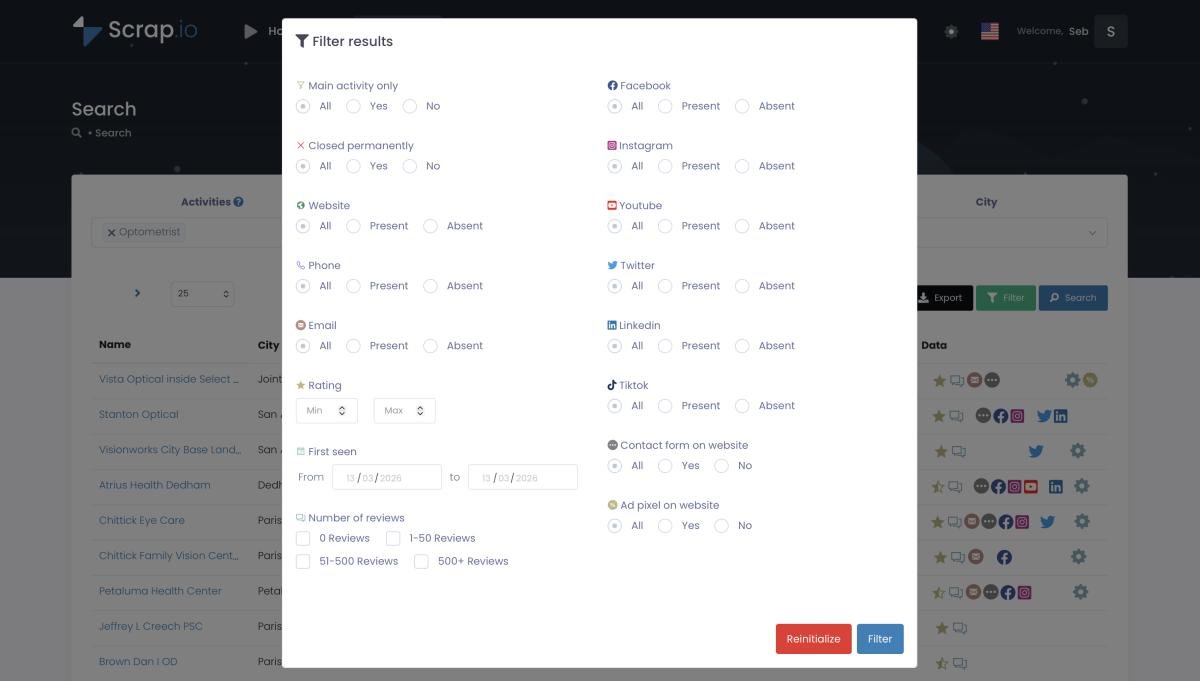
See the filters above? Email present. Star rating. Website. Those apply before extraction, so you only spend a credit on a contact you can actually use. No dead rows. No paying for garbage.
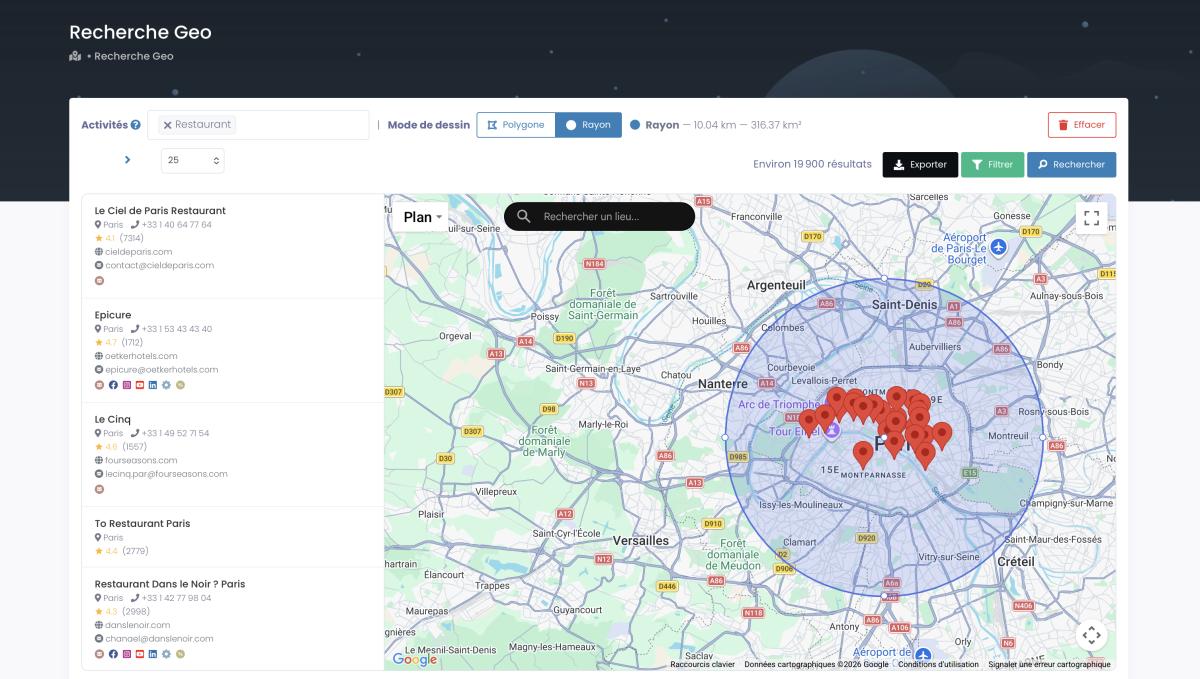
Want a specific catchment area instead of a whole city? GeoSearch draws a radius around any point on the map, so you can target, say, every restaurant within 5 km of a neighborhood you know converts.
Want the full playbook on sourcing? Here's how to build a cold email list that lands in inboxes instead of spam.
Personalization at scale: filling the [brackets] with real data
Personalization = 2x replies. But how do you personalize 500 emails without a week of research?
You don't research 500 people one by one. Nobody has that kind of time. You segment, then let the data write the personalization for you.
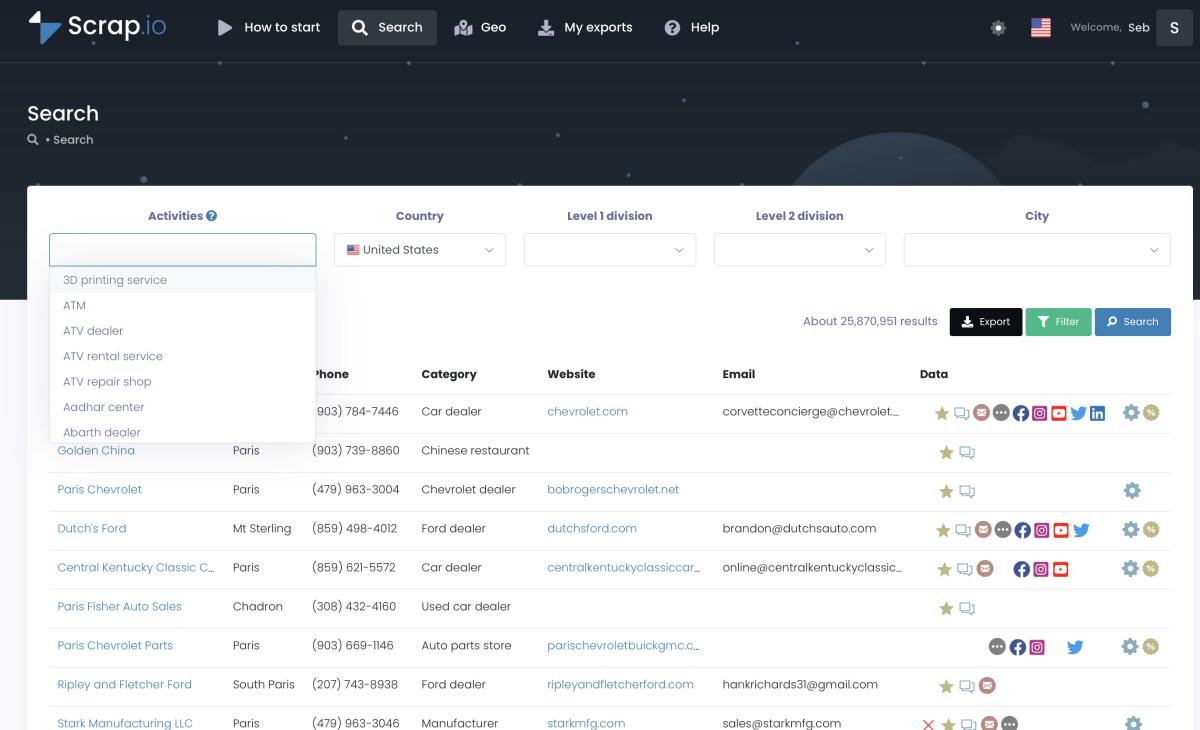
Here's the trick. Every bracket in the templates above maps to a column in a Scrap.io export: first name, last name, company, category, city, star rating, review count, website. Pull a filtered list, drop it into your sending tool, and map the fields. Now "Saw [Company] on Google Maps, [review_count] reviews in [city]" writes itself for every single row, and each one reads like you typed it by hand. Because the data really is specific to that business.
Objects that are personalized get a 46% open rate in Belkins' study of 5.5 million emails. And Autobound, across 85 million emails, measured personalization doubling the reply rate, up to 18% versus 9%. The lift is real. The bottleneck was always the data. Solve the data, and scale stops being the enemy of relevance.
Nail your openers and your email subject lines with real variables, and even a copy-and-paste template stops reading like one.
Make sure your templates land (deliverability and compliance)
Okay, the less fun but non-negotiable part: getting into the inbox, legally.
None of these templates matter if they never arrive. So three quick fundamentals. Set up SPF, DKIM, and DMARC, because Gmail and Yahoo now reject unauthenticated senders outright. Keep your bounce rate under 2%, which comes straight back to list quality. And warm up any new domain before you scale. If your emails are landing in spam, here's how to avoid the spam folder for good.
One more thing: don't send these from Mailchimp or HubSpot. Those platforms are built for opted-in marketing lists, so hubspot sales email templates and the like will flag your cold outreach and can get your account shut down. Use a dedicated cold email tool instead.
Now the legal side, and no, this isn't legal advice. In the US, CAN-SPAM requires accurate headers, a real physical address, and a working opt-out, and it makes no exception for B2B. Each violating email can carry a penalty of up to $53,088, per the FTC, so don't wing it. In the EU, GDPR permits B2B outreach under "legitimate interest," meaning you have a defensible reason to email that specific person, plus an easy opt-out.
Here's what quietly makes all of this simpler. When your contacts come from publicly available business data, like a company's own Google Maps listing, you're standing on solid legal ground. These are details businesses chose to make public.
7 mistakes that kill your reply rate
Did everything right and still got ghosted? One of these seven is probably why.
Video: 7 Common Cold Email Mistakes to Avoid
- Stopping after one email. Nearly half of reps do it. They abandon the 42% of replies that come from follow-ups.
- "Just checking in." It reduces bookings by 14% and trains spam filters. Add new value or don't send.
- Zero personalization. "Hi [First Name]" is a merge tag, not personalization. It fools nobody in 2026.
- Emailing a bought list. Stale, shared, and stuffed with dead addresses that nuke your sender reputation.
- Links in email one. They trip filters. Save them for email three onward, and only after they've asked.
- Two CTAs. One ask per email. Two asks means zero replies, because you made the reader choose.
- The 400-word manifesto. Nobody reads it. Get to 40 to 60 words or get ignored.
The through-line here? Most of these aren't copy problems. They're list and process problems. For the full teardown with examples, here are the 7 cold email mistakes to avoid.
FAQ
What is the best email template for sales?
There's no single best one. It depends on the buying stage. Cold outreach, follow-up, and closing each need a different structure. What they all share: under 60 words, one CTA, and real personalization pulled from actual data.
How do you write a sales email that gets a reply?
Keep it 40 to 60 words. Open about them, not you. Make one value point, then ask one low-friction question. Personalized emails get roughly twice the reply rate of generic ones, so the personalization isn't optional, it's the whole game.
What are the 5 C's of a sales email?
Clear, Concise, Compelling, Credible, and Call to action. If your email nails all five in under 60 words, you're already ahead of most senders.
Is cold email still effective in 2026?
Yes, but the bar is higher. The platform-wide average fell to about 3.43%, yet targeted, personalized campaigns still hit 10 to 18%. Bad-data cold email died. Cold email itself is very much alive.
Is cold emailing legal?
B2B cold email is legal in most regions if you follow the rules. In the US, CAN-SPAM requires accurate headers and a working opt-out. In the EU, GDPR allows it under legitimate interest with an easy opt-out. Using public, traceable business data keeps you compliant. This isn't legal advice, though, so check your local rules.
You've got the templates. You've got the framework. Now the part that decides everything: the list. Templates are ready, but a great email sent to a dead inbox is still a dead email.
Generate a list of restaurant with Scrap.io