

Marcus needed every plumber in Texas. He picked Scrape.do — a genuinely excellent scraping API, 99.98% success rate, 110 million proxies. Three weeks and roughly 4,000 lines of Python later, he had 120 results per city and a pagination bug he still hasn't fixed.
The tool wasn't the problem. The category was.
That's the whole story of this comparison, and I'd rather put it up front than bury it under 600 words of throat-clearing. Scrape.do is a scraping API. Scrap.io is a lead generation platform. People confuse the two constantly, buy the wrong one, and blame the software. So here's the honest version — real July 2026 pricing pulled from the official source, the Google Maps result ceiling nobody mentions, verified user reviews with names and dates, and a section where we hand the win to Scrape.do outright. Because a comparison that concedes nothing is worth nothing.
Table of Contents
- What Scrape.do Actually Is (And Who It's Built For)
- Scrape.do Pricing in 2026: The Full Breakdown
- The 120-Result Ceiling Nobody Talks About
- Two Philosophies: Infrastructure vs. Finished Data
- When Scrape.do Is Genuinely the Better Choice
- What Real Users Say (Verified Reviews)
- Compliance: Both Legal, Different Responsibilities
- Verdict: Pick the Tool That Matches Your Actual Job
- FAQ
What Scrape.do Actually Is (And Who It's Built For)
Scrape.do isn't a lead generation tool. It never claimed to be — and that's exactly why so many people buy it by mistake.
The core promise: unblocked access to any page
Strip away the marketing and Scrape.do — often typed scrapedo in search, which is how a good chunk of you got here — is one thing: a web scraping api that gets you the HTML of a page that doesn't want to give you its HTML. You send a URL, it sends back the content. Everything painful in between — proxy rotation, anti-bot bypass, CAPTCHA handling, dynamic TLS fingerprinting, headless browser rendering — happens on their side.
Geo-targeting covers 240+ country codes and 150+ interface languages, across 84 Google domains. That's serious infrastructure. And the market backs the bet: web scraping is a $1.17 billion industry in 2026, heading to $2.23 billion by 2031 at a 13.78% CAGR (Mordor Intelligence).
The numbers Scrape.do puts forward
From their own pricing page, as of July 2026: 110 million proxies, a 99.98% success rate, over 10 billion requests processed monthly, and a support response time under 5 minutes. Their client wall lists Revolut, TripAdvisor, Expedia, Shopee, Zeo, Otelz and Revenue Grid.
Look at that list again. E-commerce, travel, fintech. Not one local prospecting use case in the bunch. That's not an accident — it's the product finding its actual market.
And here's the part I'll defend loudly: you only pay for successful requests. A timeout, a block, a 500 — none of it burns a credit. That is honest billing, and it is rare in this sector. Most competitors happily charge you for the privilege of failing.
Who's it for? Developers. Growth engineers. People comfortable in Python, Node or Go who already have a pipeline and need it to stop getting blocked. If that's you, Scrape.do is a strong buy. If you want the same category of tooling built around map data specifically, our own Google Maps Scraper API covers that ground.
Scrape.do Pricing in 2026: The Full Breakdown
$29 a month for 250,000 credits sounds unbeatable. Until you learn that one Google Maps call costs 10 of them.
The five plans, side by side
Every scrape.do pricing figure below was verified directly on scrape.do/pricing in July 2026. Not from a directory. Not from a two-year-old blog post. (Search volume for scrapedo pricing questions has tripled in twelve months, and almost everything ranking for it is stale.)
| Plan | Price/mo | Credits | Cost / 1K credits | Concurrent requests | Google Maps API calls |
|---|---|---|---|---|---|
| Free | $0 | 1,000 | — | 5 | 100 |
| Hobby | $29 | 250,000 | $0.11 | 10 | 25,000 |
| Pro | $99 | 1,250,000 | $0.08 | 50 | 125,000 |
| Business | $249 | 3,500,000 | $0.07 | 100 | 350,000 |
| Advanced | $699 | 10,000,000 | $0.06 | 200 | 1,000,000 |
| Enterprise | Custom | ∞ | — | ∞ | ∞ |
Now the correction, and it matters. Several third-party directories — including Salesforge's Scrape.do overview — still claim JavaScript rendering and geo-targeting are Pro-plan features, and residential proxies a Business-plan feature.
That is flatly wrong in July 2026. The official pricing page reads: "Full Power. Every Plan. — No feature gates. Every capability, unlocked from day one." Including on the free tier. If you're doing a google maps scraping api pricing comparison and pulling numbers off a directory, you're comparing fiction.
What a Google Maps call really costs you
So, scrape.do credits explained in one line: a standard request costs 1 credit, but a call to the Google Maps Scraper API costs 10.
Run the math on the Hobby plan. $29 buys you 250,000 credits, which sounds enormous, until it becomes 25,000 Maps calls. And each of those calls returns 20 results. Suddenly "250,000 credits" means "500,000 rows, if nothing goes wrong and you never re-query the same area twice."
Spoiler: you will re-query the same area. A lot. Which brings us to the actual problem.
The 120-Result Ceiling Nobody Talks About
What happens when your target market has 3,000 businesses and Google Maps only hands back 120 of them?
Where the limit comes from
It's in Scrape.do's own product documentation, which is what makes it impossible to argue with. The scrape.do google maps scraper endpoint paginates with start=20, start=40, and so on — 20 results per page, capped at roughly 120 results per query (six pages). Then it stops.
This isn't Scrape.do being lazy. It's Google's own display cap, inherited by anyone who queries the search interface. Every extension, every API, every DIY script hits the same wall. The difference is whether your tool was designed to route around it or not.
The zip-code workaround (and why it breaks)
The standard answer to how to get more than 120 google maps results is: slice your territory into smaller pieces. City by city. Zip code by zip code. Fire a query at each one, merge everything, deduplicate.
In theory, fine. In practice you now own a geographic orchestration problem: overlapping zones producing duplicates, rural areas with no coverage, cities you forgot existed, boundaries that don't match how Google interprets them, and a dedupe routine that has to be smarter than "same business name." That's engineering work. It is not growth work.
What "country-level" actually means
Some real numbers, extracted from the Scrap.io MCP on 19 July 2026:
- 661,588 restaurants listed in the United States
- of which 193,790 have an email address detected on their website — 29.3%
At 120 results per query, covering those 661,588 restaurants would take more than 5,500 perfectly orchestrated geographic queries. Assuming zero overlap, zero gaps, zero retries. Try building that. I'll wait.
With Scrap.io: one search, one "has email" filter, one export. The method is written up in full in our guide on how to extract every business from Google Maps.
Video: How to Scrape Local Leads at the Country Level
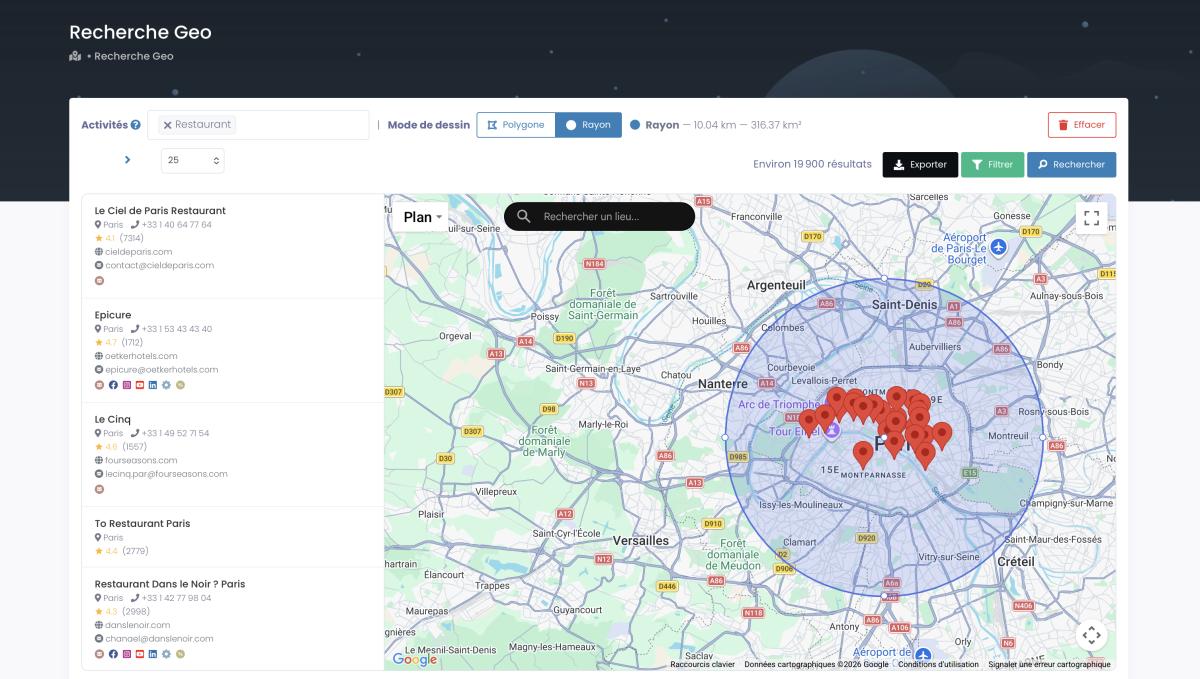
Curious what "no ceiling" actually looks like? Scrap.io returned 661,588 US restaurants on a single search — and counting results is free, no credits consumed. Run the same count for your own category and see the real size of your market before you spend anything.
Two Philosophies: Infrastructure vs. Finished Data
The real comparison isn't Scrape.do vs Scrap.io. It's "do I want to build a data pipeline, or do I want a CSV by Friday?"
That's the whole scraping api vs no-code lead generation tool question, and it has nothing to do with which engineering team is better. It's about where the finished work stops and yours begins.
| Criterion | 🔧 Scrape.do | 🎯 Scrap.io |
|---|---|---|
| Product nature | Scraping infrastructure API | Local lead generation platform |
| Skill required | Code (Python, Node, Go…) | ✅ None — no-code interface |
| Google Maps reach | ⚠️ ~120 results / query | ✅ City, county, region, whole country |
| Country-wide extraction | 🔴 Build it yourself | ✅ Two clicks |
| Search without a category | ❌ No | ✅ Full catchment area |
| Filtering before extraction | ❌ Post-process it yourself | ✅ Filters applied before credits are spent |
| Classified emails | 🔴 Not provided | ✅ Main, individual (+ first/last name), contact, sales, marketing, finance, admin |
| Phone type (landline/mobile) | ❌ No | ✅ Yes (outside US/Canada) |
| Output format | Raw JSON | ✅ Ready-to-use CSV / Excel |
| Data scope | The entire web | Map listings + linked websites (195 countries) |
| Indexed base | N/A (live per request) | ✅ 225,676,406 businesses, 4,000+ categories |
| Free trial | 1,000 credits, no card | 7 days — 50 searches + 100 export credits |
| Entry price | $29/mo | $35/mo (annual) |
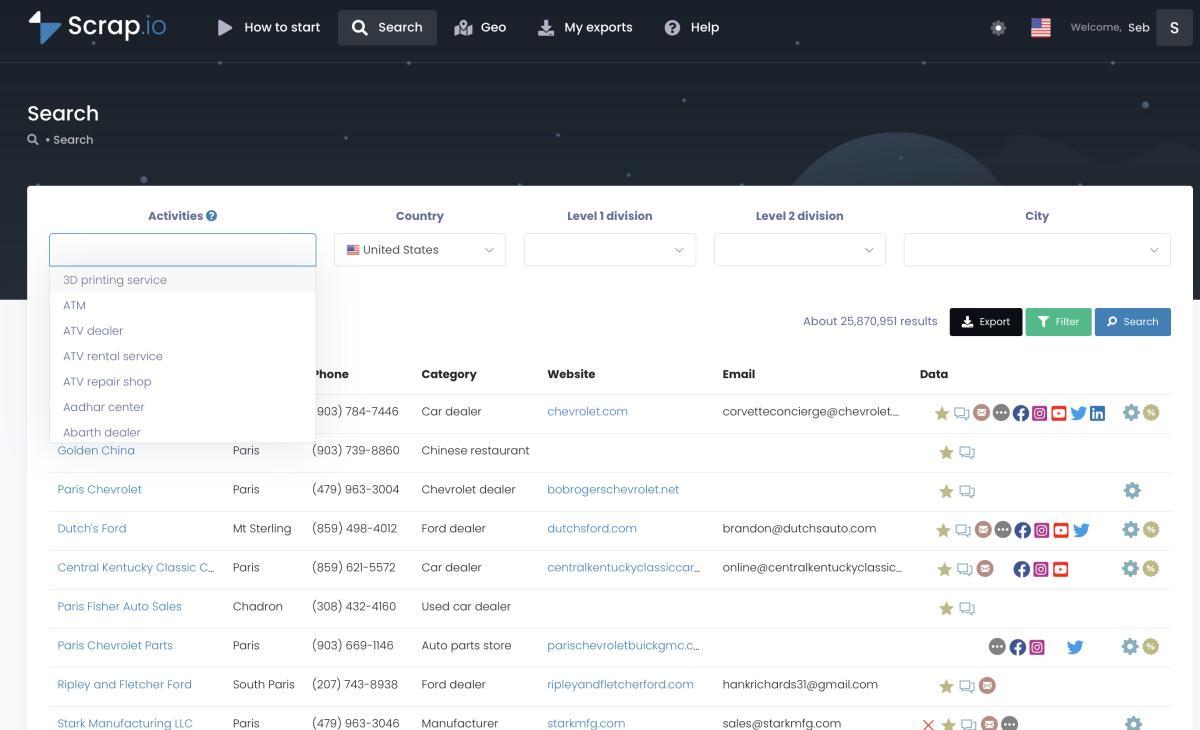
One row on that table is worth more than the other twelve combined: filtering before extraction. With a raw API you pay for every page you pull, then throw away 70% of it. With Scrap.io you filter first — has an email, rating above 4, no website, mobile number only — and credits are consumed only on listings you'd actually contact. On those 661,588 US restaurants, if you only want the ones with an email, you pay for 193,790. Not 661,588.
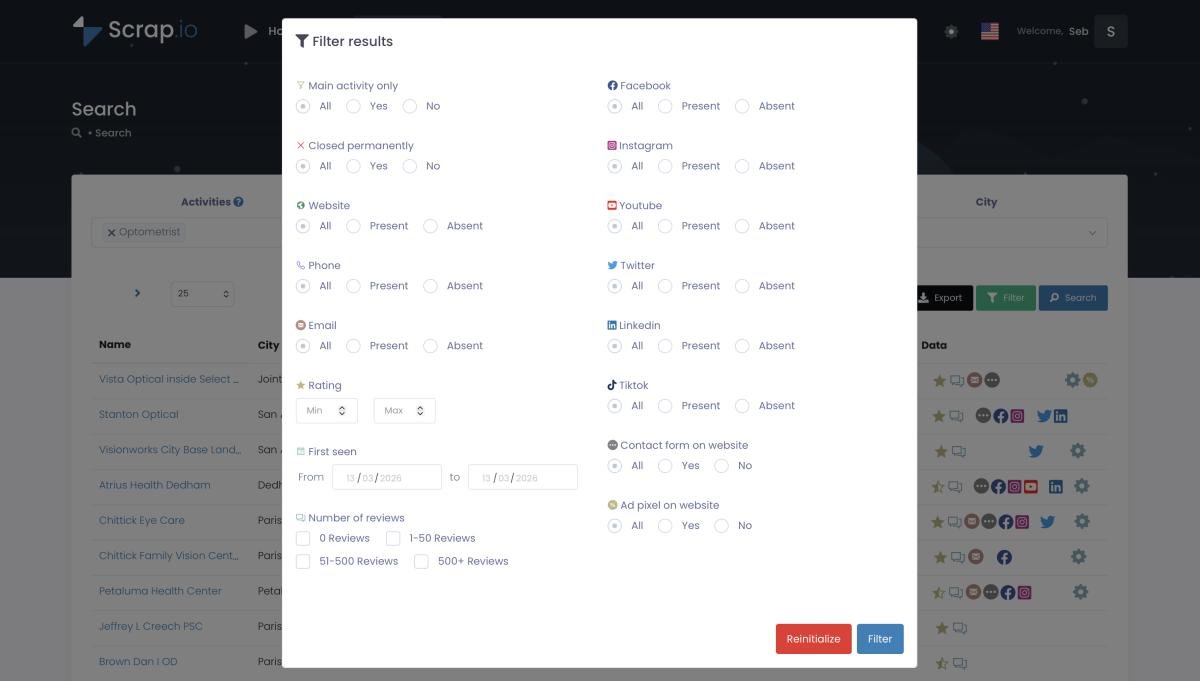
That's the economic argument, and it's why people looking for a scrape.do alternative for lead generation usually aren't looking for a better API at all. They're looking for a different category of product.
Video: Scrap.io - How to Start?
Want the wider field? We ranked the best Google Maps scrapers of 2026 — including the ones that beat us on specific jobs.
50,000+ professionals use Scrap.io — including teams at Revolut, Uber and Decathlon — precisely because the filtering happens before you spend a credit. 225,676,406 businesses indexed across 195 countries and 4,000+ categories. See what your market looks like.
When Scrape.do Is Genuinely the Better Choice
Let's be honest for a second: there are jobs where Scrap.io is the wrong tool and Scrape.do is the right one. Here they are.
- E-commerce scraping — Amazon prices, stock levels, competitive price monitoring. Scrap.io doesn't touch this. Scrape.do is built for it.
- Sites behind aggressive Cloudflare or WAF setups — this is literally the product's core competency.
- Massive volumes of arbitrary web pages, typically to feed an LLM or build a corpus.
- Detailed Google Maps reviews — topics, owner responses, inline translation. Scrap.io gives you the average rating, review count and score distribution: enough to qualify a lead, not enough for semantic review analysis. Scrape.do's Reviews endpoint wins here, no argument.
- A team with developers, an existing pipeline, and a genuine need for custom infrastructure.
One more, and it's a good one. A verified Capterra reviewer uses Scrape.do with Claude Code to pull Google Maps reviews and surface trends. That's a real, smart use case — and it maps almost perfectly onto the Scrap.io MCP for AI agents, which does the same kind of thing without you writing the extraction layer. Different route to the same destination.
And if the answer to can you scrape google maps without coding is what you're really after, we wrote a whole Google Maps scraper without Python walkthrough for exactly that.
Video: How to Scrape Local Leads with Claude & Vibe Prospecting
Bref — if your job is "get me this web page, reliably, at scale," take Scrape.do. If your job is "get me every dentist in Florida with an email," keep reading.
What Real Users Say (Verified Reviews)
49 verified reviews on Capterra. Average rating: a perfect 5.0. So what are the actual complaints?
Let's start with the most flattering one, because burying it would be dishonest. James R., IT Specialist, Real Estate (7 June 2022) tested about ten scraping APIs before settling: "we have tried ScrapingBee, WebScrapingAPI, ZenScrape, ScrapingBot, ScraperBox, Scrapingdog, ScrapingAnt, Scrapestack, ScraperAPI… and Scrape.do is the best!"
That's a strong verdict, and it's earned. On the scrape.do vs scrapingbee question specifically, MD K., Founder, Computer Software (9 April 2026) evaluated ScrapingBee first: "Price is affordable and the speed is noticeably better than other tools I tried." His cons: "Pricing can feel a bit high for heavy usage. Also, occasional retries are needed on very complex sites."
Same pattern from Jamaal M., DeFi Researcher, Financial Services (8 May 2025), who left ZenRows: "This is cheaper and faster than the competitors." Cons: "maybe more concurrency limits."
And the Claude Code user mentioned earlier, a Verified Reviewer, Founder, Internet (25 May 2026): "I am able to do things I could not dream of. I would not be able to do that without a scraper."
Now the recurring friction, in the reviewers' own words:
- Glenn H., CEO, Real Estate (6 December 2024): "Credits don't rollover which can be annoying if you have a lot of variability."
- Attila B., CEO, Computer Software (30 January 2022): "I was afraid to pay the next subscription package because of the limit for concurrent API calls…"
- Sam M., Product, Real Estate (21 May 2026): "There have been occasional cases where a scraper stopped working, but this is expected with web scraping since websites change frequently."
Notice what none of those complaints are about. Not one person says the product is bad. They say credits expire, concurrency is tight on small plans, heavy usage gets pricey, and complex sites need retries. Additional feedback sits on Trustpilot if you want a second source. These are the complaints of people using infrastructure — not people who bought the wrong category.
Compliance: Both Legal, Different Responsibilities
"Is this even legal?" is the question everyone asks third, and should ask first.
Scraping publicly available business data is legal in both the EU and the US. That part isn't controversial. What differs between the two tools is who carries the risk.
With a raw scraping API, you decide which URL to call. You choose the target, the frequency, the data you keep. Which means the compliance exposure is yours — including under the GDPR, where the line between business data and personal data can get thin fast if you're not paying attention.
Scrap.io is GDPR and CCPA compliant by construction. It only collects publicly available business data, and every data point stays traceable to its source. You're not choosing targets — the platform's scope already excludes what it shouldn't touch.
The limit applies to both, and it's worth saying plainly: this data serves B2B commercial prospecting. Not consumer targeting. Not building profiles of private individuals. If you're emailing people, include an opt-out, honour it immediately, and target professional contacts.
The full breakdown lives here: is it legal to scrape Google Maps. (Factual information, not legal advice — if serious money is on the line, talk to an actual lawyer.)
Verdict: Pick the Tool That Matches Your Actual Job
So which one should you pay for? Answer three questions.
- Does anyone on your team write code? If no — Scrap.io. An API without a developer is a subscription to nothing.
- Does your target market go beyond one city? If yes — Scrap.io. Past the 120-result wall, the API route becomes a geography project.
- Are you scraping anything other than business listings? If yes — Scrape.do. It's the better tool and it isn't close.
Most people hunting for the best scrape.do alternative 2026 discover somewhere around question two that they never needed an API in the first place. They needed a file.
Scrape.do is excellent at what it does. We haven't said one false thing about it in this article, and we didn't need to. It's simply a different product for a different job.
Try Scrap.io free for 7 days — 50 searches and 100 export credits, no commitment (card required to activate). Run it on your own territory, export the CSV, and compare it side by side with what your API pipeline gives you today. Start your free trial →
FAQ
Is Scrape.do free?
Yes — Scrape.do has a permanent free plan with 1,000 successful API credits per month and no credit card required. Every feature is unlocked on it, including residential proxies, JavaScript rendering and geo-targeting. Since a Google Maps API call costs 10 credits, that free tier gives you roughly 100 Google Maps calls per month.
How much does Scrape.do cost in 2026?
Scrape.do runs five paid tiers: Hobby at $29/month (250,000 credits), Pro at $99/month (1,250,000), Business at $249/month (3,500,000), Advanced at $699/month (10,000,000), plus a custom Enterprise plan. Effective cost drops from $0.11 to $0.06 per 1,000 credits as you scale.
Can Scrape.do scrape all businesses in a city or country?
Not in one call. Scrape.do's Google Maps Search endpoint returns 20 results per page and caps at roughly 120 results per query. Covering a full territory means orchestrating hundreds of geographic queries and deduplicating the output yourself. Tools like Scrap.io handle city-, region- and country-level coverage natively.
Do I need to know how to code to use Scrape.do?
Yes. The scrape do api is exactly that — an API. You send HTTP requests from Python, Node.js, PHP, Go or another language and parse the JSON response. There's no dashboard for building a lead list. So if you're wondering do i need a developer to use scrape.do: effectively yes, unless you are one. If you need business data without writing code, you need a no-code platform instead.
Scrape.do or Scrap.io — which should I choose?
Choose Scrape.do (also written scrapedo in a lot of searches) if you're a developer scraping arbitrary websites at scale — e-commerce, WAF-protected pages, LLM training data. Choose Scrap.io if you need local business leads with emails, phone types and filters, across a whole city, region or country, without writing code.
Generate a list of restaurant with Scrap.io