

Eleven million.
That's how many businesses in the United States have no website at all right now. Not an outdated one. Not a slow one. None. (Scrap.io pulled the exact figure on July 27, 2026: 11,038,434 — roughly 43% of every business listing in the country.) And here's the part that should keep every agency owner up at night: most of them are reachable by phone or email today. So while you're refreshing your inbox waiting for a referral, your next fifty clients are sitting on a map, unclaimed.
This guide isn't another listicle of "7 growth hacks." It's the actual method for finding web design leads in 2026 — where they hide, how to reach them, and how to turn a raw list into signed contracts.
Table of contents
- What are web design leads?
- The real web design market in 2026
- Where web designers actually find leads
- The overlooked goldmine: businesses without a website
- How to build a targeted list in minutes (Scrap.io)
- Should you buy web design leads?
- Turning leads into clients: outreach that converts
- Staying compliant (CAN-SPAM, GDPR)
- FAQ
What are web design leads?
Here's the uncomfortable truth nobody says loud enough: not every local business is a web design lead. And chasing the ones that aren't is exactly why your pipeline feels empty.
A web design lead is a business or person who needs a new site, a redesign, or ongoing web work — and who is (or can become) open to hiring you. That "can become" part matters. Because there are two flavors here, and treating them the same is a classic rookie mistake.
Cold leads fit your ideal client profile but have never heard of you. The dentist three towns over with a website that looks like it was built during the Obama administration. Warm leads already raised their hand — replied to an email, downloaded your guide, booked a call. Warmer is easier. Obviously. But cold is where the volume lives, and volume is what most freelancers are actually short on.
People search this a dozen ways — "how to find leads for web design," "web design leads list," "how to get leads for web design," "leads for web design companies," even "leads for website development" or "web design sales leads." Same underlying want, every time: a repeatable way to reach businesses that need a website and can pay for one. Those website leads are the whole game. Everything else is decoration.
And geography matters more than most people admit. If you're chasing web design leads in the USA specifically, you're not fishing in one pond — you're fishing in 25 million of them. Warm web design leads (the ones already curious about you) are lovely, but rare. So the real skill is turning cold into warm at scale. That's the whole rest of this guide.
The real web design market in 2026
The US web design industry is worth roughly $48 billion — and there are 202,692 agencies fighting over it. Standing out starts with better leads, not a bigger ad budget.
Honestly? Let me give you the numbers straight, because most competitor articles skip the data entirely and just vibe their way through "the industry is booming." It is booming. But specifics matter when you're deciding where to point your energy.
| Metric (US, 2026) | Figure | Source |
|---|---|---|
| Web design market size | ~$48B (2025), heading to $79.5B by 2032 (7.5% CAGR) | SkyQuest, 2025 |
| Web design businesses | 202,692 (+3.6% YoY) | IBISWorld, 2025 |
| Web designers employed | ~890,000 (+2.2%) | IBISWorld, 2025 |
| US businesses with no website | 11,038,434 (~43%) | Scrap.io, July 2026 |
Read that table top to bottom and the story tells itself. A big, growing market. A crowded supply side (200K+ agencies). And a demand pool so large it barely feels real — eleven million businesses with no site. The competition is real. But so is the opportunity, and it's lopsided in your favor if you know where to look. Most agencies are all elbowing for the same handful of "obviously ready" clients while ignoring the millions who need the most basic thing you offer. The best web design leads aren't hiding — they're just unglamorous.
Where web designers actually find leads
Referrals are great — until the month they dry up. And they always dry up. Every agency that survives long term has one thing in common: a repeatable way to generate web design leads on demand, not a prayer that last year's client sends a friend.
Look. Sound familiar? You're not alone. Go read the threads on r/webdesign ("Really struggling to find clients for my web design company") or r/DigitalMarketing ("How do web design studios get leads / clients?"). Hundreds of designers describing the exact same dry-pipeline panic. The answers that actually land? Outbound. Multi-channel. On purpose.
Here's the honest comparison of the main channels, warts and all.
| Channel | Speed | Cost | You own it? |
|---|---|---|---|
| Referrals & word of mouth | 🔴 Unpredictable | 🟢 Free | ❌ No |
| PPC / paid ads | 🟢 Fast | 🔴 $51+ CPC on "web design leads" | ❌ No |
| Content / SEO | 🔴 Slow (months) | 🟡 Time | ✅ Yes |
| Directories & freelance sites | 🟡 Medium | 🟡 Fees/commission | ❌ No |
| Targeted outbound (Google Maps) | 🟢 Fast | 🟢 Cents per lead | ✅ Yes |
Web design lead generation: inbound vs outbound
Real web design lead generation isn't one channel — it's a stack. Inbound (SEO, content, a portfolio that doesn't embarrass you) builds a slow, compounding trickle. The agencies quoted on SEOptimer lean hard on this: PixelChefs (founder Alex Alexakis) drops a "designed by PixelChefs" link in every client footer for passive exposure. The Wit Group (Sarah Walters) curates a portfolio stacked with client testimonials as social proof. Jamersan runs a whole YouTube channel — "eCommerceAholic" — as a content engine.
All smart. All slow. Outbound is the other half — and it's the half you control. You pick the category, you pick the city, you decide who gets an email tomorrow morning. If you want the full playbook on the inbound side, our guide to local business lead generation strategies goes deep. But for pipeline you can turn on this week? Outbound wins. Every time.
The overlooked goldmine: businesses without a website
Right now, 11 million businesses in the US have no website at all. That's not a typo. That's your prospect list.
Think about what that means for a second. A business with no site isn't a hard sell on "why do I need a redesign" — they already know they're invisible online. The plumber whose only web presence is a Google Maps pin. The family restaurant taking reservations by landline. These are the warmest cold web design leads on earth, because the pain is obvious and the fix is exactly what you sell.
And it gets better. Of those 11 million siteless businesses, Scrap.io counts 7,740,533 with a phone number on file — directly callable, no gatekeeper. (Out of 25,826,261 US businesses indexed on Google Maps total.) So this isn't a theoretical pool. It's a contactable one.
The community that does this well knows it too. Over on r/website, "Looking for Website Leads" threads keep circling back to the same move: find the businesses that are missing the basics, then reach out. Even SiteSwan built a whole "Local Prospecting Tool" around finding local businesses without a website — their own users call it "gold." So the filon is no secret. The difference is scale and freshness, which is where the next section comes in. There's a second angle here too: businesses with a website but a lousy reputation. Those businesses with poor online reputation (a 2.8-star listing, no mobile version) are just as ripe.
Video: Finding Clients Through Google Maps Filters
Curious how many businesses without a website are in your city right now? You can check the exact count for free on Scrap.io — counting never costs a credit. Size your market before you spend a cent.
How to build a targeted list in minutes (Scrap.io)
Take Mike, a freelance designer in Austin. He used to spend Sunday nights copy-pasting business names off Google Maps into a spreadsheet — name, guess at the email, next row, repeat. For hours. Here's the 4-click version that replaced his weekend.
Video: Scrap.io — How to Start
Step 1 — Pick your category and area. Choose a business type ("restaurant," "law firm," "contractor") and a location. Scrap.io works from 225,676,406 business listings across 195 countries and 4,000+ categories, so your zone is yours to set — a single city, a county, a state, or (if you're on the Company plan) an entire country in one shot.
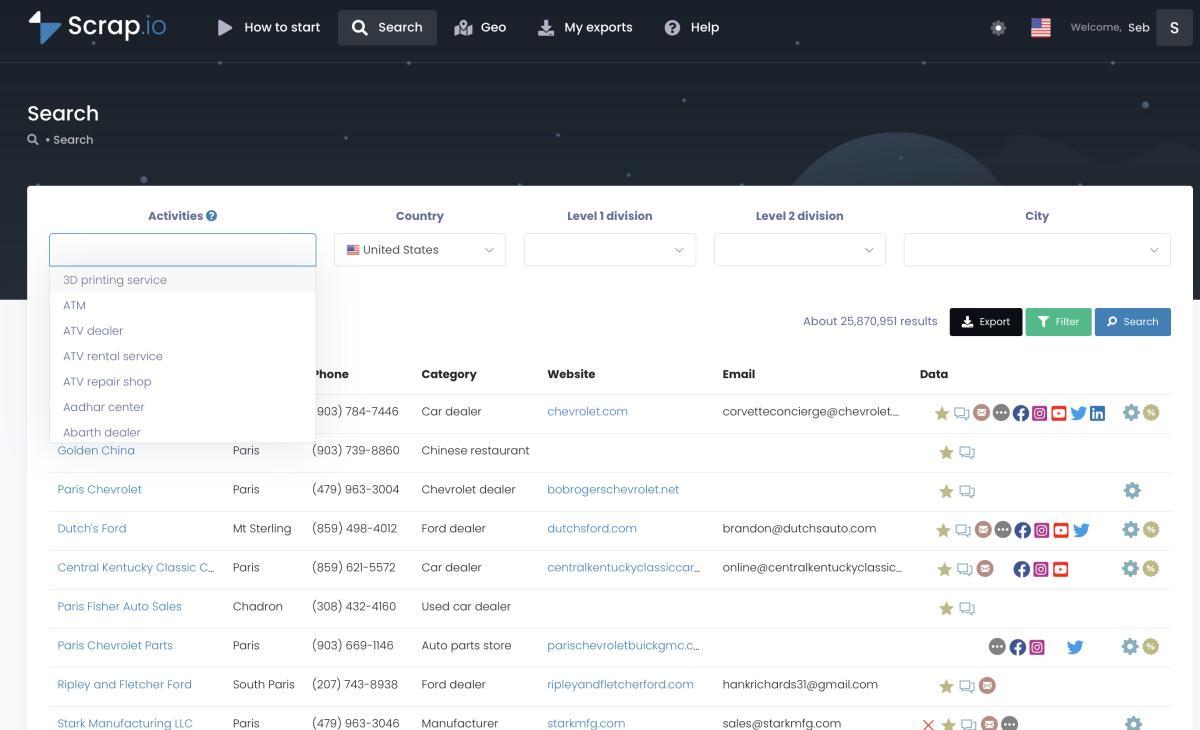
Step 2 — Filter before you extract. This is the part that saves your budget. Toggle "no website" and suddenly your list is nothing but web design leads that literally need what you sell. Stack more: has a phone, minimum rating, a website but no mobile version. Every filter applies before a single credit is consumed. You only pay for contacts you can actually use. (Compare that to buying a raw list where you pay for the 70% of dead rows too.)
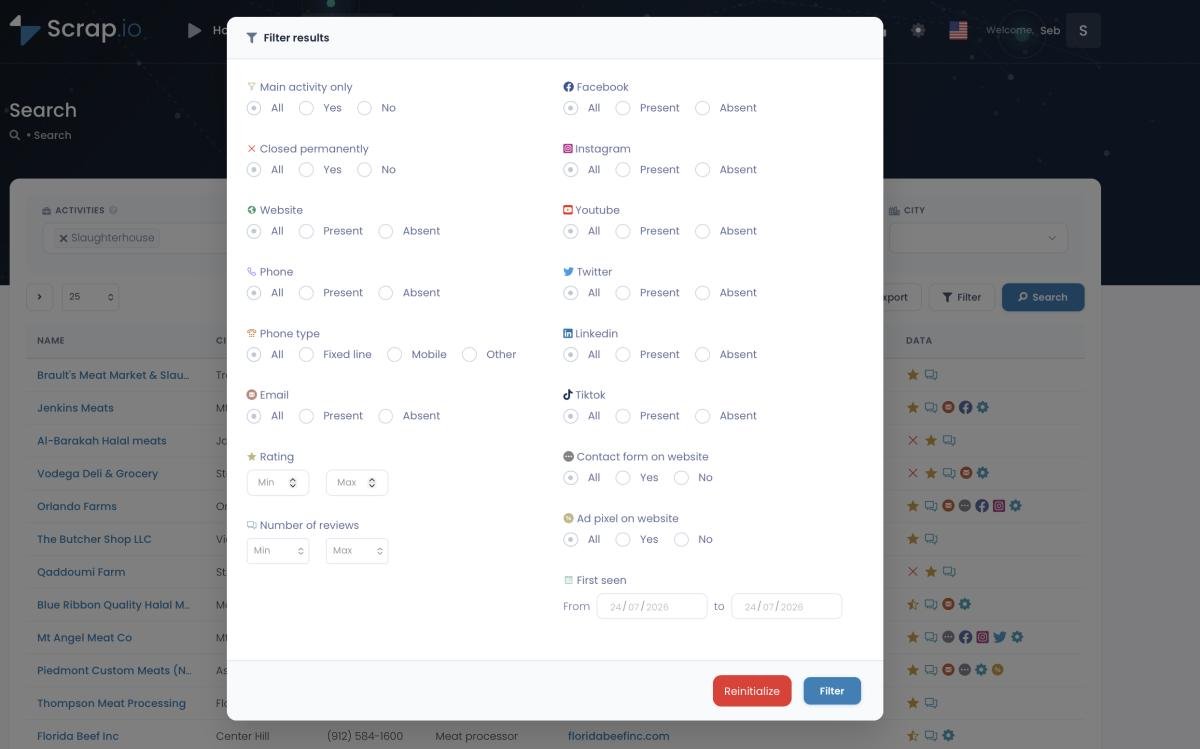
Step 3 — Get the free count, then export. Scrap.io shows the exact number of matching businesses before you commit — counts are always free. Happy with it? Export to CSV or Excel with names, addresses, phone numbers (tagged mobile vs. landline), up to five classified emails per business, and social links. Re-export the same business within 30 days and it costs zero extra credits.
Step 4 — Target the odd shapes. Your service area isn't always a tidy city boundary. GeoSearch lets you draw a radius around your office (up to 500 km) or trace a polygon by hand around a specific neighborhood or corridor. Every filter still works inside the shape.
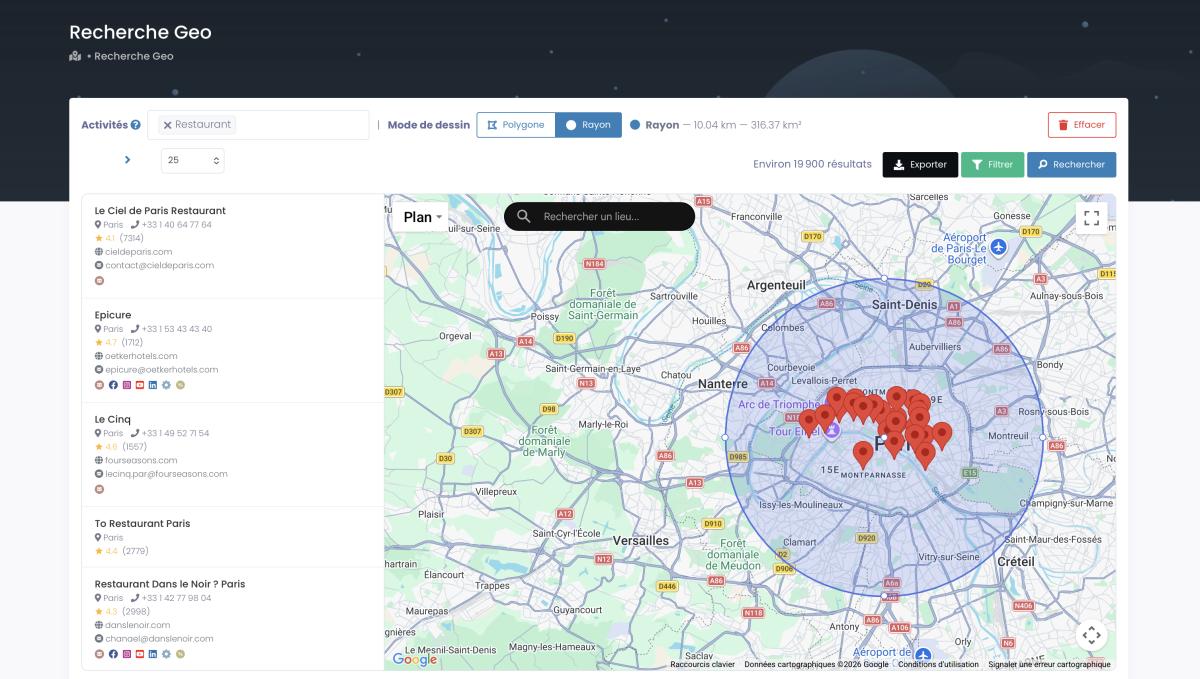
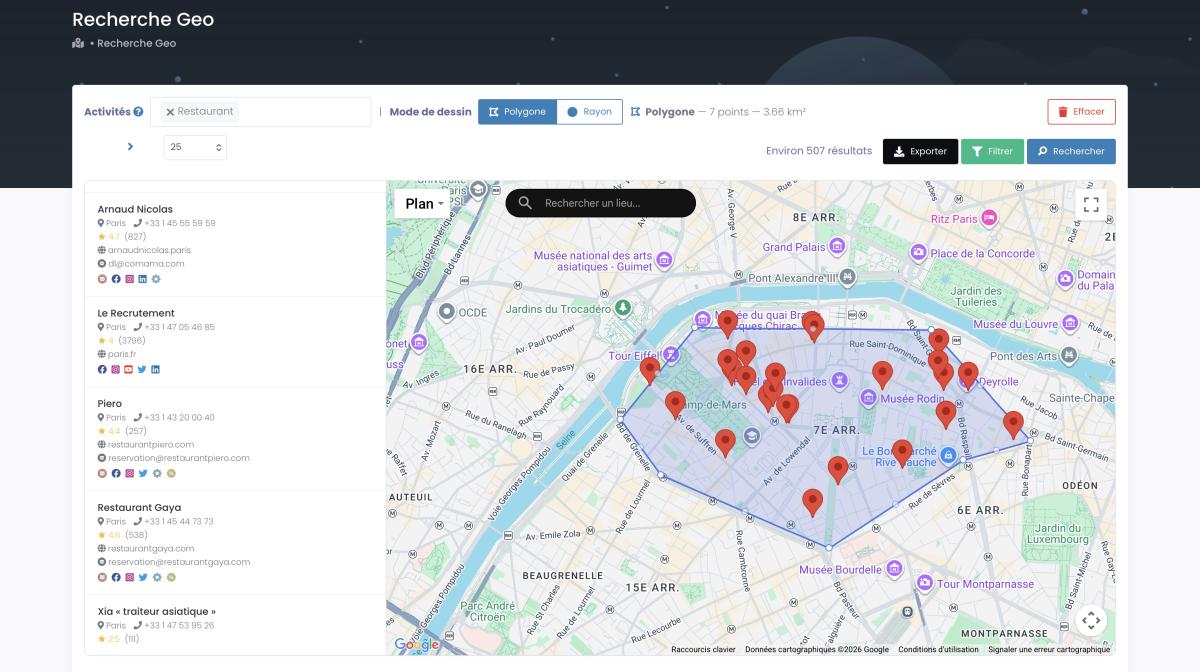
One more trick most people miss: filter by date of first detection to surface businesses that just opened — brand-new commerces that need a website and haven't been pitched by anyone yet. Get to them before your competitors do.
Video: Find Businesses That JUST Opened (Before Your Competitors Do)
Prefer to skip the interface entirely? You can drive the whole thing in plain English through the Scrap.io MCP connector — tell Claude or ChatGPT "find every restaurant in Brooklyn with no website and a phone number" and the agent builds the query for you. Two clicks, no code. For the deep version, our guides on how to get local business leads with contact info and how to scrape local business data from Google Maps cover every knob.
Build your first targeted list of web design leads in 4 clicks. Start your free 7-day Scrap.io trial — 50 searches and 100 export credits included, filtered before you ever spend one. Run it on your own city and see the data quality for yourself.
Should you buy web design leads?
"Verified, exclusive, high-intent web design leads." Sounds perfect. So why do most agencies who buy them regret it?
Here's the thing. "Exclusive" is usually a lie. That $20–$50-per-lead list you just bought? Odds are it was sold to three of your competitors this morning too. So now you're in a foot race to call first, and the business owner is fielding their fifth identical pitch before lunch. They're annoyed before you say hello. That's not a lead. That's a rip-off with a nice landing page.
Even SEOptimer's own guide — written by an agency that could easily upsell you leads — lands here: "you'll be better off finding your own leads." When the people selling adjacent services tell you to DIY, listen.
Here's the math that ends the debate.
| Bought leads | Your own list (Scrap.io) | |
|---|---|---|
| Exclusivity | Resold to 3–5 agencies | 100% yours |
| Freshness | Often months old | Verified at export |
| Targeting | Whatever the seller had | Your exact filters |
| Cost per lead | $20–$50 | Fraction of a cent at scale |
So should you buy web design leads? For verified, exclusive, warm leads that actually fit your niche — no. Build them. You'll pay less and you'll be the only one calling. Your call, but I know which column I'd pick.
Turning leads into clients: outreach that converts
A list of 5,000 businesses is worthless if your first email gets deleted in two seconds. Here's what actually gets a reply.
Start with the numbers, because they explain the whole strategy. 91% of marketers say lead generation is their number-one goal (Ruler Analytics). So everyone's fishing in the same water. The way you stand out isn't volume — it's relevance. And relevance comes from the data you already extracted.
Two more numbers worth tattooing on your monitor. Email marketing still returns $42 for every $1 spent (Litmus/DMA) — no other channel comes close, which is why cold email is the backbone of learning how to generate leads for your web design business. And when you send prospects to a form, multi-step forms convert 86% better than single-step ones (HubSpot). Small tweak, big lift. Don't ignore it.
Need proof this isn't just theory? Agency owner Tristan Parker walks through his exact manual process — hunting Google Maps for businesses with missing or dated sites, then reaching out — in his "3 ways I generate web design leads for my agency" video. It works. It's also a slog. The point of this guide is to give you his results without his Sunday nights.
How to get web design clients who actually pay
Scrap.io classifies every email it finds — individual (with first and last name pulled automatically), contact@, sales@, marketing@. Use it. An email to a named human ("Hey Sarah, noticed your salon has 62 five-star reviews but the listing doesn't link to a website...") reads nothing like a blast to info@. Segment by type, personalize the individual ones with something specific — their rating, their city, a gap on their listing — and send the generic ones a value-first pitch that doesn't assume who's reading.
The agencies that win pair a clean list with a real first email. Twibi's Brenton Thomas opens with a free consultation to surface the prospect's actual pain before pitching anything. That's the move: lead with their problem, not your feature list. For frameworks that convert, steal from our proven cold email templates and the breakdown of how to write a cold email that gets replies. And because your export ships with phone numbers and social profiles too, go multi-channel — email, then a call, then a DM. One channel is fine. Three is better.
Bottom line: relevance beats volume, always.
Then follow up. Most designers send one email and quit. That's leaving money on the table, because the majority of replies come from the second, third, and fourth touch — not the first. If you want the end-to-end system, our guide on how to convert scraped leads into clients walks through every phase. Oh — and grab the emails first: here's how to find business emails on Google Maps.
Quick note on trust, since I write this on behalf of Scrap.io and want to be straight with you: I'm not going to pretend I personally spent a weekend building an email list by hand. But plenty of designers have — Mike from earlier is a composite of dozens of them — and the pattern is always the same. Manual works until it doesn't scale, and then it just eats your weekends.
Staying compliant (CAN-SPAM, GDPR)
Okay, the less fun but absolutely essential part: cold outreach is legal — if you do it right. Here's the short version that keeps you out of trouble.
In the US, CAN-SPAM permits unsolicited commercial email to business addresses. You just need three things: accurate sender info, a real physical mailing address in the footer, and a working unsubscribe link you actually honor. That's the baseline. Don't use deceptive subject lines, and you're fine.
In the EU, GDPR treats most B2B business contact data as fair game under "legitimate interest," as long as every message offers an easy opt-out. California's CCPA carves publicly available business information out of scope almost entirely. The common thread across all three: you're contacting businesses about business, using data those businesses chose to publish. That's a completely different situation from scraping someone's private profile.
This is exactly why the source of your data matters. Scrap.io extracts only publicly available business data, is GDPR and CCPA compliant, and keeps every data point traceable to its source. No private profiles, no sketchy resold consumer lists. None of this is legal advice — if you've got real money at stake, talk to an actual lawyer, not a blog post. But honor opt-outs and stick to public business data, and you're on solid ground.
Stop buying recycled leads
The businesses are right there. Eleven million of them with no website, on a map, most with a phone number attached. The agencies that win in 2026 aren't the ones with the biggest ad spend — they're the ones with the freshest list and the best follow-up. A solo freelancer with a filtered list of web design leads and a decent cold email sequence will out-prospect a shop burning thousands a month on recycled leads. Every time.
Enough reading. Go build your list.
Stop buying recycled leads. Start your free Scrap.io trial today — 7 days, 100 leads on the house. Filter for the businesses that need you (no website, no email, low rating), export to CSV, and start your first real campaign this week. 50,000+ professionals already made the switch.
FAQ
What are web design leads?
Web design leads are businesses or individuals who need a new website, a redesign, or ongoing web services — and are (or can become) open to hiring you. They range from cold leads (a business that fits your profile but hasn't heard of you) to warm leads (someone who already responded to your marketing).
How do I get web design leads for free?
Start with what you already have: referrals, your existing network, a Google Business Profile, and local SEO. Then scale for free-ish by building your own prospect list of local businesses without a website — Scrap.io's counts are free, so you can size your market before spending a single credit.
Where can I find businesses that don't have a website?
On Google Maps. Tools like Scrap.io let you filter every business in a city, county, state or entire country by "no website," then export their phone, email and social links. As of July 2026, there are 11M+ such businesses in the US alone.
Should I buy web design leads?
Usually not. Purchased lists are often resold to multiple agencies, outdated, or poorly targeted. Generating your own exclusive, filtered leads is cheaper per lead and far more relevant.
Is cold emailing web design leads legal?
Yes. B2B cold outreach is legal in the US under CAN-SPAM (and similar rules elsewhere) as long as you identify yourself, don't use deceptive subject lines, and offer an opt-out. Only use publicly available business data.
Generate a list of restaurant with Scrap.io