

A rep I know spent all of last quarter blasting 4,000 companies with the same email. Company name swapped in, one merge tag, everything else identical. His reply rate? Under 2%. Then he did something almost embarrassingly simple. He picked 40 accounts, actually researched them, and worked each one like it was the only deal on his board.
Nine meetings in three weeks.
That gap — 4,000 names versus 40 accounts — is the entire argument for account-based prospecting. Fewer companies. More homework. Real pipeline instead of a full sent folder. And no, before you close the tab, this isn't ABM in a trench coat. It's the outbound engine that runs inside an account-based strategy, and it works whether you sell six-figure SaaS or you're an agency chasing 400 dentists across one metro.
Here's what's ahead: a clear definition (with the ABM and ABS confusion finally sorted), the 2026 data that makes the case, a seven-step playbook you can run this week, and — the part nobody else covers — how account-based prospecting works for local businesses using Google Maps data. Let's go.
Table of Contents
- What is account-based prospecting?
- ABP vs traditional sales prospecting
- Why account-based prospecting works in 2026
- The 7-step account-based prospecting playbook
- Account-based prospecting for local businesses and agencies
- Real account-based prospecting examples that worked
- Staying compliant (CAN-SPAM and GDPR)
- Account-based prospecting tools in 2026
- FAQ
What is account-based prospecting?
Most "account-based" outreach is a mail merge with the company name swapped in. Real ABP is a different sport entirely.
Account-based prospecting (ABP) is a B2B sales approach where you target a small, defined set of high-value accounts — usually 50 to 100 — through deep research and coordinated, multi-stakeholder outreach, instead of blasting a giant list and praying. That's the what is account-based prospecting answer, snippet-ready and all. The keyword is defined. You're not working whoever the list-builder tool spat out this morning. You picked these companies on purpose.
The confusion usually starts when three acronyms show up at the same party: ABM, ABP, and ABS. People use them interchangeably. They shouldn't.
ABP vs ABM vs ABS: the 30-second version
Think of it as a relay. Marketing warms the account, prospecting books the first meeting, sales management closes the deal. Here's the ABP vs ABM breakdown, plus account based sales (ABS) so you never mix them up again:
| Discipline | Who leads it | Main job | Success looks like |
|---|---|---|---|
| ABM (account-based marketing) | Marketing | Warm the account with content, ads, events | Engaged, aware accounts |
| ABP (account-based prospecting) | Sales / SDRs | Direct outreach to book the first meeting | New opportunities created |
| ABS (account-based selling) | AEs / sales | Manage the active deal to close | Closed-won revenue |
So what is account-based selling, exactly? It's the closing motion — you already have the meeting, now you're working the deal. ABP creates the opportunity; ABS finishes it. Prospect first, then sell. And ABM? It's the air cover that makes both easier. If you want the full marketing side, our pillar on account-based marketing with Google Maps data goes deep — this article stays focused on the outbound execution.
ABP vs traditional sales prospecting
Traditional sales prospecting is a numbers game. Build a list of ten thousand, spray, and let the law of large numbers do the work. It still generates pipeline. Barely.
Account-based prospecting flips the math. You're playing quality, not quantity. Instead of 10,000 shallow touches, you run 50 to 100 accounts with real depth — you know their industry, their pain, who sits on the buying committee, and why now. It's the difference between a megaphone and a scalpel.
Does that mean traditional prospecting in sales is dead? Nope. High-velocity, low-ACV motions still love volume. But if your deals are big, multi-stakeholder, and slow to close, ABP wins almost every time. If you want to sharpen the fundamentals underneath either approach, our guide to sales prospecting techniques covers the phone and outreach mechanics in detail.
Why account-based prospecting works in 2026
B2B teams using account-based tactics report 81% higher ROI than their peers (Martal, ABM Statistics 2026). Eighty-one percent. That's not a rounding error you can ignore.
And it's not a one-off number. An ITSMA study found 87% of B2B marketers report higher return on investment with an account-based approach than with traditional marketing (via Growth Stage Marketing). More than 70% of B2B marketers now run an active account-based program, up from almost zero a few years ago (Martal). It went from fringe tactic to table stakes fast.
Here's the number that actually explains why it works, though: at any given moment, only about 5% of your target accounts are actively buying. Everyone else is dead weight in a spray-and-pray campaign. ABP is how you concentrate your effort on the accounts that matter and stop burning cycles on the 95% who aren't listening. Teams that align sales and marketing around named accounts end up 67% better at closing deals (Martal). Fewer accounts, far more attention each. That's the trade.
Don't just take the vendors' word for it, either. On r/b2bmarketing, the recurring theme in the account-based threads is the same: the teams that win are the ones where sales and marketing actually agree on the target list. When they don't, ABP collapses into two departments blaming each other. Sound familiar?
The 7-step account-based prospecting playbook
Fifty companies you've researched beat five hundred names you scraped and prayed over. Here's how to run those fifty, step by step. This is your account based prospecting framework — steal it.
Step 1 — Align sales and marketing
ABP dies in the gap between "the accounts marketing thinks we're targeting" and "the accounts sales actually calls." Close that gap first. Get both teams in a room, agree on the tier-1 list, agree on who owns which touch, and write it down.
This isn't a soft, kumbaya step. Remember that 67% close-rate lift? It comes from alignment, not from a better email template. Any account-based sales strategy that skips this is building on sand — everything downstream wobbles.
Step 2 — Build your target account list
Are you building a list of 50 accounts… or 500? Because the answer determines whether this whole thing works.
Start with your ICP. If you don't have a documented one, fix that before anything else — here's what ICP means in sales and how to build one that isn't just a LinkedIn Sales Nav filter. Then translate that ICP into hard criteria: industry, size, geography, tech signals, buying signals. That's your target account list (TAL).
For local and mid-market plays, this is where Google Maps data becomes a weapon most of your competitors have never touched. You can define your ICP with Google Maps geographic data and pull a filtered account list in minutes — by category, location, rating, review count, website presence, whatever matches your profile.
Video: Scrap.io — How to Start (building your first target account list)
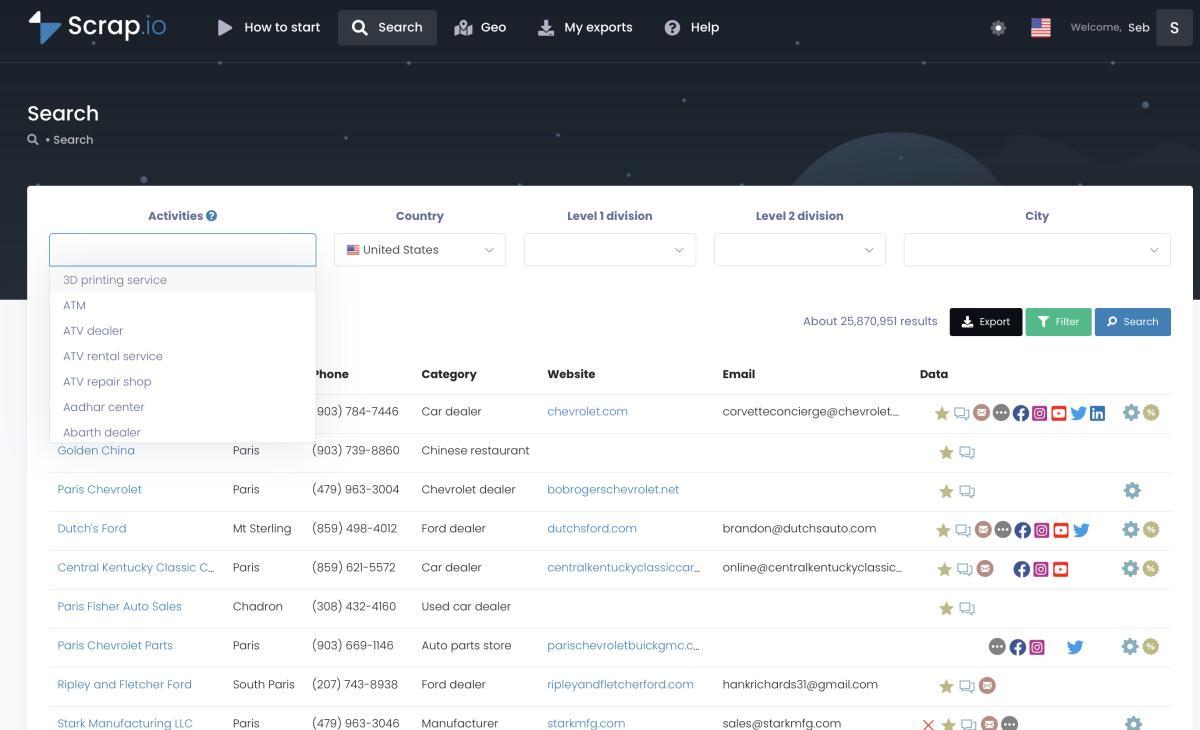
The trick is to filter before you extract, so your TAL arrives pre-qualified — email present, website present, rating above a threshold, whatever your criteria are. And if you want to prioritize the list you just built, our framework for lead scoring for local leads ranks accounts by fit, digital maturity, and urgency.
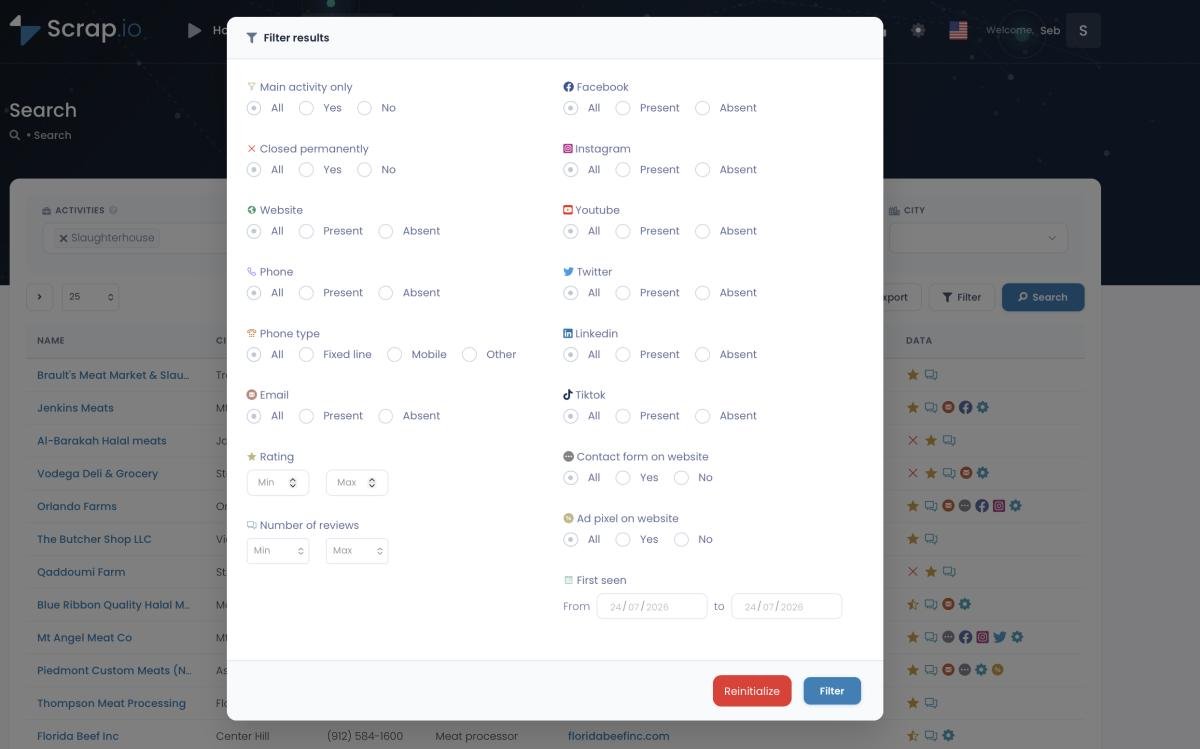
Building a local target account list? Scrap.io lets you count every matching account in a category and zone for free — zero credits — before you spend a thing. Comptage is free in the app, the API, and the MCP. See how many accounts match your ICP.
Step 3 — Research each account
This is the step everybody skips. Don't. The whole edge of ABP is that you show up knowing something the account didn't expect you to know.
What are you looking for? A trigger. New funding, a new exec hire, an office move, a competitor switch, a growth signal. For local businesses the triggers are hiding in plain sight: a recently opened listing, a sudden spike in reviews, a bad rating that's clearly hurting them, no website at all. Those are buying signals, and they beat generic intent scores because they're concrete. Our guide to buying signals and signal-based selling breaks down how to read them at scale.
Two or three minutes per account. That's it. It's the difference between "Hi, is this the decision-maker?" and a first line that actually earns you the next thirty seconds.
Step 4 — Map the buying committee
You're not selling to a company. You're selling to a committee. And B2B buying committees now run anywhere from 3 to 27 people (UserGems). Twenty-seven. Try closing a deal by talking to one of them and hoping.
The r/b2bmarketing crowd learned this the hard way — one widely-shared thread is basically a group therapy session about single-threaded deals dying when the one champion leaves. So you multi-thread. You map the committee, then you reach several roles at once. Here's a starter map:
| Role | What they care about | Best channel |
|---|---|---|
| Economic buyer (VP / C-level) | ROI, risk, strategic fit | LinkedIn + a sharp email |
| Technical evaluator (IT / Ops) | Integration, security, workload | Email with specifics |
| End-user champion | Does it make their day easier? | LinkedIn, phone |
| Procurement | Price, terms, compliance | Email, late-stage |
Multi-threading isn't optional at these committee sizes. It's the whole game.
Step 5 — Coordinated, personalized outreach
Now you reach out. Email, LinkedIn, phone — coordinated, not random. And personalized, because the data is brutally clear on this: emails with personalized body copy get a 32.7% higher response rate than the generic kind (Backlinko's 12-million-email study).
The signal you found in Step 3 is your opener. New listing? "Congrats on the opening — here's how we help new [category] owners with [specific pain]." Growth spike? "Noticed [Company] is scaling fast — here's how teams like yours handle [X] without the growing pains." No merge-tag theatre. An actual reason to reply. If your cold emails need work, our walkthrough on how to write a cold email that gets replies lays out the problem-first framework that consistently beats the "let me tell you my life story" opener.
One more nudge: nurtured, sequenced outreach shortens the cycle by roughly 23% versus one-and-done sends (Salesgenie). Follow up. Then follow up again.
Step 6 — Give the CRM real visibility
Here's a gap most ABP guides ignore. Your competitors write beautiful playbooks and then run them on a CRM full of blanks and dead phone numbers. Roughly 30% of CRM data goes stale every year. Your target list decays while you work it.
So keep the account data fresh and visible. Log every touch, tag every stakeholder, and enrich records automatically instead of by hand. You can automate CRM enrichment with Google Maps data so every account in your pipeline carries current contact info, socials, review data, and website intel — no rep copy-pasting addresses into fields in 2026. (Yes, people still do that. I've watched it happen.)
Step 7 — Measure pipeline, not activity
Dials and sends feel productive. They're vanity metrics. In ABP you measure account-level outcomes, because that's what actually moves the number.
| Metric | Why it matters |
|---|---|
| Account engagement score | Which accounts are actually warming up |
| Pipeline per named account | Ties effort to real revenue |
| Meetings booked from the TAL | The core ABP output |
| Deal velocity | Aligned, multi-threaded deals close faster |
If your dashboard only tracks activity, you'll optimize for busywork. Track pipeline. Optimize for pipeline.
Account-based prospecting for local businesses and agencies
Every ABP guide assumes you sell six-figure SaaS to enterprises. But what if your best accounts are 400 dentists, roofers, or law firms within 50 miles?
Then the enterprise playbook mostly doesn't apply — and that's fine, because a better one exists. The logic of ABP (fewer accounts, more research, coordinated outreach) works beautifully for local. The only thing that changes is where your target account list comes from. Not LinkedIn. Google Maps.
Think about it. For a web agency, "every business in Austin without a website" is a target account list. For a reputation-management tool, "every clinic under 3.5 stars in the metro" is a target account list. Those signals are account selection, and they're impossible to fake with a generic scraper. This is the angle nobody in the SERP covers — account based prospecting for small business, done with map data.
Video: How to Scrape Local Leads with Claude and Vibe Prospecting
Two features make local ABP practical. First, the chalandise (trade-area) search — pull every business in a zone without even specifying a category. Second, GeoSearch: draw a radius around a point, or hand-draw a polygon to carve out exactly the neighborhood you want. "Every dental practice within 30 km of this city, no website" becomes one query.
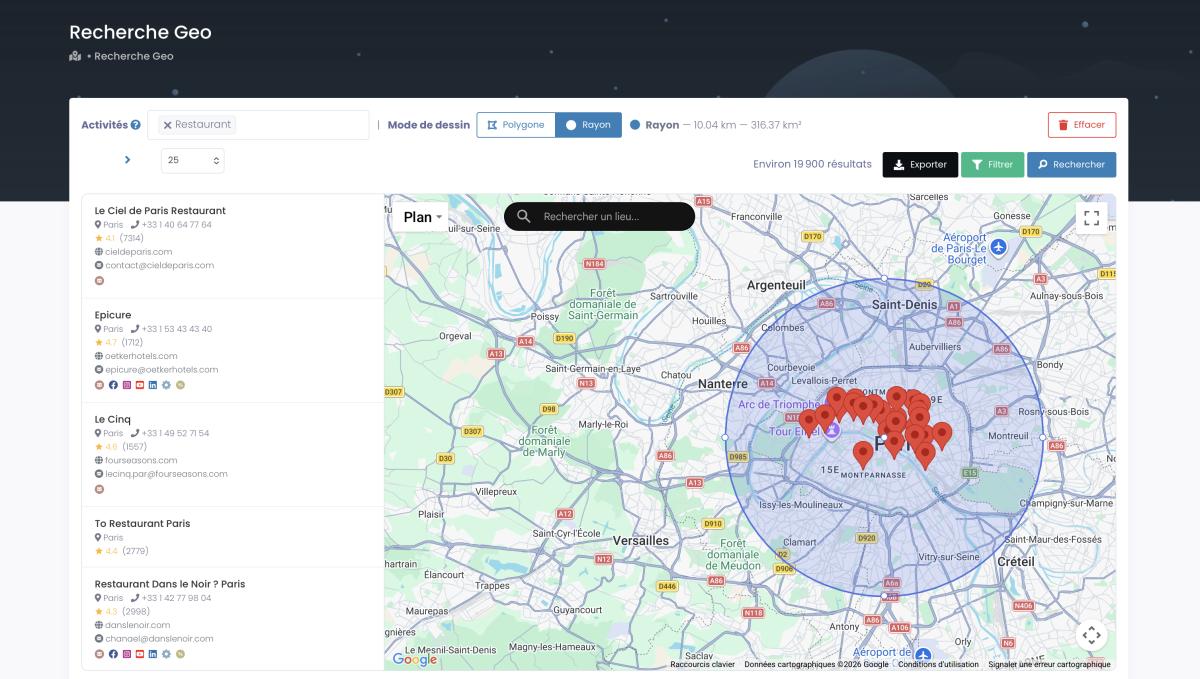
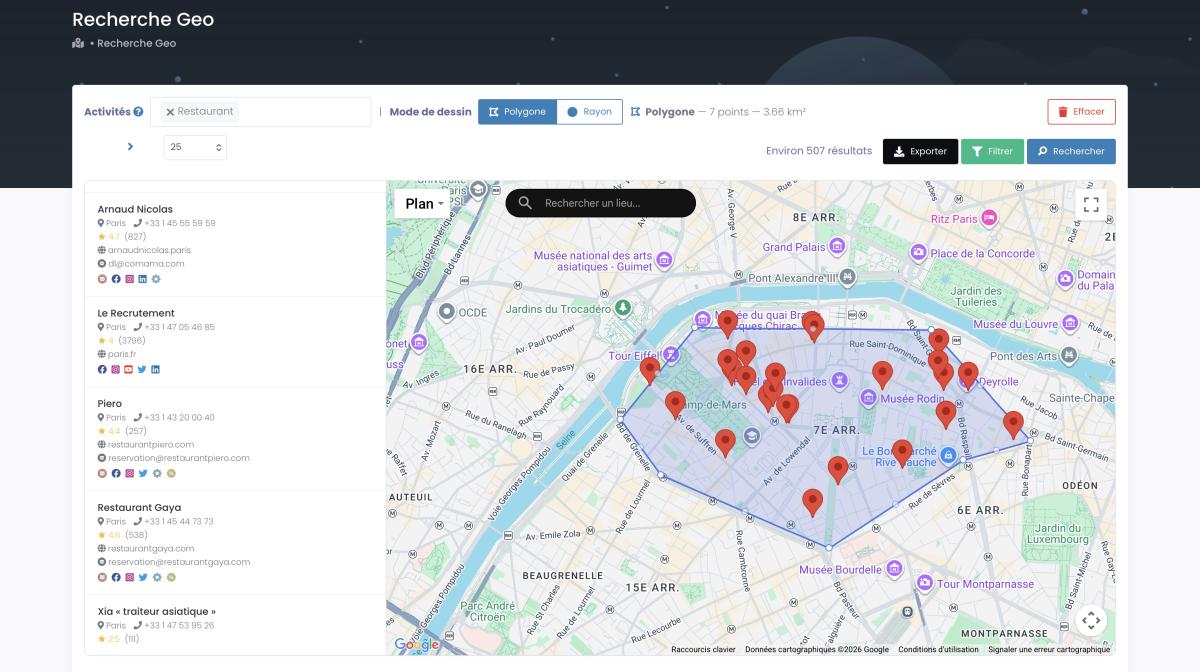
Building a list by hand takes hours. This doesn't. One Scrap.io user pulled 11,734 businesses in 45 minutes — filtered down to email-only, ready to work. With 225+ million establishments indexed across 195 countries and 4,000+ categories, your local TAL is a couple of clicks away. Try it free — 100 export credits included.
Real account-based prospecting examples that worked
Theory is nice. Receipts are better. Here are five account based marketing examples and prospecting plays that actually moved numbers.
Adobe — Named Account Marketing. Adobe's Marketing Cloud built personalized experiences for named enterprise accounts — custom landing pages, account-specific content. Result: a 19% increase in cross-sell and upsell and a 4x lift in website engagement (Growth Stage Marketing).
Mindtickle — the COVID pivot. When the pandemic torched their old lead-gen motion, Mindtickle picked their accounts and ran their first account-based campaign. $1M in additional pipeline within seven weeks, a 600% lift in conversion rates, and 15x engagement (Growth Stage Marketing). Seven weeks.
Snowflake — 1:1 at scale. Under CMO Denise Persson, a small team ran roughly 500 simultaneous 1-to-1 campaigns, each built with the account's sales owner. They saw a 150% improvement in click-through on 1:1 ads, growth north of 300%, and raised $500M along the way (Growth Stage Marketing).
LinkedIn — Account Prioritizer. LinkedIn's own account-based tooling, tested via A/B, drove an 8.08% lift in renewal bookings (Warmly). Small percentage, enormous base. Do that math.
SeekOut and Outreach. Both, as UserGems customers running signal-driven account plays, reported outsized first-year returns — SeekOut around 5x ROI and Outreach roughly 8x ROI in year one (UserGems). The through-line across all five? Fewer accounts, deeper personalization, coordinated teams.
Staying compliant (CAN-SPAM and GDPR)
OK, the slightly-less-fun but absolutely necessary part.
If your ABP drives cold outreach — and it does — you play by the rules. In the US, CAN-SPAM means every email needs a real physical address, an honest subject line, and a working opt-out you honor fast. In the EU, GDPR wants a legitimate-interest basis; B2B contact data for professional purposes generally qualifies, but document your reasoning anyway. Don't wing it.
The safe foundation is publicly available business data — company names, business emails from websites, phone numbers from map listings — not personal info scraped from someone's social profile. That's the line. Scrap.io only pulls publicly available business data, each point traceable to its source, GDPR and CCPA compliant. Which keeps the "is this legal" conversation short. Honor opt-outs immediately, verify emails before you send, and you're in good shape.
Account-based prospecting tools in 2026
You do not need a $30,000-a-year intent platform to run ABP. You need a way to build a sharp list, enrich it, reach the committee, and track pipeline. Here's an honest look at the account based prospecting tools landscape — including where each one actually fits.
| Job | Tool type | Best for |
|---|---|---|
| Local / SMB account selection | Google Maps data (Scrap.io) | Agencies, local B2B, mid-market |
| Enterprise intent data | Bombora / 6sense | Large-account ABM programs |
| Contact enrichment | Apollo, Cognism | Mid-market outbound |
| Outreach sequencing | Instantly, Lemlist | Cold email at scale |
| Pipeline tracking | HubSpot, Salesforce | Everyone |
Honest take: if your accounts are enterprise, the pricey intent platforms earn their keep. If your accounts are local or mid-market — restaurants, clinics, contractors, agencies' clients — Google Maps knows more about them than ZoomInfo ever will, at a fraction of the cost. Different tools, different targets. Here's a head-to-head on exactly that trade-off:
Video: Scrap.io vs Apollo — Which Tool for Which Type of Prospecting
Whatever stack you land on, filtering before extraction is the money move — you only pay for accounts that fit, so your credits go to your actual TAL instead of junk. Try Scrap.io free and filter your first target account list in minutes.
Look, you don't have to take just one source's word for any of this. Woodpecker's own account-based prospecting guide walks through a similar focused-list approach if you want a second angle before you commit to a best account based sales strategy for your team.
The bottom line on account-based prospecting
Here's the whole thing in one breath. Account-based prospecting isn't a fancier way to spam — it's a discipline. Pick fewer accounts. Research them like they matter. Multi-thread the committee. Coordinate the outreach. Measure pipeline, not dials.
That's the entire account-based prospecting strategy. Chasing enterprise logos? Same playbook. Chasing 400 local businesses down the road? Same playbook. The enterprise crowd has intent platforms. You have Google Maps — a live, filterable map of 225+ million businesses — which turns "build a target account list" from a week of manual work into an afternoon. Fewer, better accounts is also just smarter account-based marketing lead generation: you spend your budget where it converts.
Start small. Pick one niche, one zone, fifty accounts. Run the seven steps. See what happens to your reply rate.
FAQ
What is account-based prospecting?
Account-based prospecting is a B2B sales approach that targets a small set of high-value accounts — usually 50 to 100 — through deep research and coordinated, multi-stakeholder outreach, instead of blasting a large list. Fewer accounts, more homework, more pipeline.
What's the difference between ABP and ABM?
ABP is sales-led: direct outreach to book the first meeting. ABM is marketing-led: content, ads, and events that warm the account. ABP is the outbound execution layer inside a broader ABM program — they work together, not against each other.
ABP vs account-based selling (ABS) — what's the difference?
Account-based prospecting creates new opportunities: get the first meeting. Account-based selling manages an active deal to close. Prospect first, then sell. Same account, two different stages.
How many target accounts should a rep work?
Usually 50 to 100, refreshed quarterly. The whole point of ABP is depth — fifty deeply researched accounts consistently beat five hundred shallow ones. If your list is too big to research, it's too big.
Does account-based prospecting work for small or local businesses?
Yes — arguably better. Build your target account list from Google Maps data (say, dentists in a metro with no website or a low rating), then research and multi-thread the exact same way an enterprise team would. The method scales down cleanly; only the data source changes.
Fifty researched accounts beat five hundred scraped names. Every time. Build your first target account list from 225M+ businesses across 195 countries — filter by category, location, rating, website, and email before you spend a single credit. Try Scrap.io free for 7 days — 50 searches and 100 export credits.
Generate a list of restaurant with Scrap.io