

One in four B2B email addresses in your CRM right now will be dead within twelve months. Gone. Not because you did anything wrong — people change jobs, companies fold, domains lapse. So verification tools exist to catch the corpses before they tank your sender reputation. BillionVerify is one of the newer ones, and it showed up in 2026 swinging a slogan you can't ignore: "Verify Billions of Emails. At 1% the Cost."
Bold. Also a little suspicious.
So we ran an honest look at it. What it does, what it actually costs, whether the 99.9% accuracy claim means anything, and how it stacks up against ZeroBounce and NeverBounce. And then the part nobody in the email verification tool space wants to say out loud: a verifier doesn't create a single lead. It cleans what you feed it. If your source is garbage, you're paying to polish garbage. We'll get there.
Table of Contents
What Is BillionVerify?
BillionVerify is an email verification tool that launched in 2026, built around real-time SMTP checks, bulk list cleaning, and an API. Its whole pitch is price: verify at "1% the cost" of the established players. The homepage throws around big numbers too — 1 billion+ emails processed, 10,000+ businesses served, 200+ countries covered. Those are the vendor's own claims, not third-party audited figures, so read them the way you'd read any startup's landing page. With one eyebrow raised.
Still, it's a functioning verifier, not vaporware. Here's what's actually under the hood.
What it does
Three modes, really. Single email checks (you paste an address, it returns status, SMTP result, MX records, a deliverability score). Bulk verification (upload a CSV, get back a validity distribution). And a real-time API for signup forms, enrichment flows, and AI agent workflows. The verifier runs the usual email validation chain — syntax, domain, SMTP mailbox confirmation — and flags disposables, role-based addresses, spam traps, and catch-all domains. Standard stuff for an email checker, done at a low price point.
If you want the deeper mechanics of how any tool confirms an address exists, we broke that down in our guide on how to verify an email address without sending one — worth a read before you trust any accuracy number.
Who's behind it
A young company. That's the honest summary. BillionVerify is a 2026 startup, and it markets itself hard on being "the only email verifier with native AI agent integration" — a native MCP server, so Claude, ChatGPT, and other agents can call it directly. Neat feature. Genuinely ahead of most competitors on that front. But new brand means thin track record, and that matters when you're handing over your contact lists. More on the trust question later.
Why Email Verification Matters in 2026
Quick gut-punch of a number: campaigns sent to real-time verified lists land around a 0.3% bounce rate with roughly 95% inbox placement. Skip the cleaning step and you're looking at 6.5%+ bounces, with about a third of your mail rotting in spam. Same email, same offer. The only variable is data quality.
Why verify emails before sending? Because mailbox providers score you on bounces. Send to enough dead addresses and Gmail, Yahoo, and Microsoft stop trusting your domain — and they don't just punish the bad emails, they route all of your mail to spam. Your good contacts get buried alongside the ghosts. That's the whole case for email verification in one sentence.
And the decay is relentless. B2B contact data goes stale at 22–25% per year — call it 2–3% every month. A list you cleaned in January is already noticeably rotten by spring. Cold email lists bounce even harder, often 7–8% (roughly four times an opt-in list), because nobody on them ever raised their hand. If you've never dug into why a bounce is a bounce, the difference between a soft bounce vs a hard bounce is the difference between "retry later" and "delete forever." Learn it. It saves reputations.
The market agrees this is a real problem, by the way. Email verification software was worth around $1.28 billion in 2026 and is projected to hit roughly $2.46 billion by 2035 — a 7.47% CAGR, per Business Research Insights. People don't spend that kind of money on a fake problem.
Video: Why Your Google Maps Emails Don't Get Replies?
One more thing that trips people up: verification only protects you if your authentication is already solid. If SPF, DKIM, and DMARC aren't configured, a clean list still won't save you. Get the SPF, DKIM & DMARC setup right first, then worry about list hygiene.
Before you pay to verify a list, make sure it's worth verifying. See how Scrap.io pulls fresh, filtered emails straight from Google Maps — 225,676,406 businesses indexed, verified in real time at the moment of export. Free trial, 100 leads included.
BillionVerify Features
So what do you actually get for the low price? A fuller feature set than you'd expect from a tool this cheap, honestly. Here's the breakdown.
Detections: invalid addresses, disposable/throwaway domains, role-based addresses (info@, sales@, support@), spam traps, and catch-all domains with a confidence score. That last one matters — catch-all handling is where most cheap verifiers fall apart. Modes: single check, bulk CSV/Excel upload, and a real-time API that the vendor clocks at under 300ms. Extras: 25+ integrations (Mailchimp, HubSpot, Salesforce, Zapier, Make, and so on), a native MCP server for AI agents, a white-label portal for agencies, browser extensions for Chrome and Firefox, a WordPress plugin, and a pile of free tools — SPF, DKIM, and DMARC generators, MX lookup, blacklist checker.
That's a lot of surface area for a newcomer. Here's the tidy version.
| Category | What You Get |
|---|---|
| Detections | Invalid, disposable, role-based, spam traps, catch-all (with score) |
| Modes | Single check, bulk CSV/Excel, real-time API |
| API speed | Under 300ms (vendor claim) |
| Integrations | 25+ (Mailchimp, HubSpot, Salesforce, Zapier, Make…) |
| AI / automation | Native MCP server, white-label portal |
| Add-ons | Chrome & Firefox extension, WordPress plugin, free SPF/DKIM/DMARC tools |
| Free tier | 100 checks (vendor claim: no card, non-expiring) |
The bulk email verification flow is the one most people will live in: drop a file, watch the validity distribution populate, export clean segments. It does the job. And if you just want to sanity-check a single address before a big send, our walkthrough on how to check if an email is valid covers the manual methods too, no tool required.
Pricing: Is "1% of the Cost" Real?
Here's where BillionVerify earns its attention. The pricing is genuinely aggressive.
It's credit-based, starting around $20 for 20,000 emails — that's roughly $0.001 per email. At scale the vendor quotes $0.00014 per email, and there's a free tier of 100 checks (which they say needs no credit card and never expires). Compare that to the establishment: ZeroBounce runs about $0.0195 per email, and NeverBounce sits around $0.008 per email under 10K — with the catch that NeverBounce credits expire 12 months after purchase. BillionVerify undercuts both by a wide margin. On raw cost per email, it's not close.
| Tool | Indicative price | Credits expire? |
|---|---|---|
| BillionVerify | ~$0.001/email (~$20/20k) | No (vendor claim) |
| ZeroBounce | ~$0.0195/email | No |
| NeverBounce | ~$0.008/email (under 10k) | Yes (12 months) |
So is "1% of the cost" real? Directionally, yes — the price gap is huge and it's not marketing fiction. But cost per email isn't the whole story. A young company can price low to buy market share, and there's a real question about whether that pricing (and the support behind it) survives past the launch hype. Cheap is great until the tool you built a workflow around quietly disappears. Test the free tier, run a paid batch, watch how support responds before you route your whole pipeline through it. Prudence, not paranoia.
The 99.9% Accuracy Claim
Let's talk about that 99.9% number. BillionVerify advertises it everywhere.
Here's the uncomfortable truth: so does almost every competitor. ZeroBounce, NeverBounce, Verifalia — walk down the row and you'll see 99%, 99.5%, 99.9% plastered across every homepage. When everyone claims the same near-perfect figure, the number stops meaning anything. It's table stakes marketing, not a differentiator. Treat "99.9% email verification accuracy" the way you treat "world's best coffee" on a diner sign.
What actually varies between tools? Three things. How they handle catch-all domains (nobody can truly confirm those — anyone who says otherwise is selling something). What share of results come back "unknown" (the honest tools admit to more unknowns; the sketchy ones force a guess). And raw speed. Those are the metrics worth comparing, and none of them fit on a billboard.
The community has poked at this. On the r/BillionVerify subreddit — which, fair warning, is the brand's own official community, so weight it accordingly — a benchmark thread reported "accuracy ranged from 92% (Verifalia) to 99.9% (BillionVerify)... differences come down to verification depth" (r/BillionVerify). Independent third-party testing tells a broader story — Instantly's 2026 benchmark of 8 top tools is a better neutral reference than any vendor's self-report.
My advice? Ignore the badges entirely. Take the same 100-email sample, run it through two or three tools including BillionVerify, and compare the outputs yourself. Ten minutes. It'll tell you more than every accuracy claim combined.
BillionVerify vs the Competition
The email verifier market is crowded and, frankly, a bit samey. Everyone checks syntax, MX, and SMTP. Everyone flags disposables and role-based addresses. So the fight comes down to price, trust, and a handful of differentiating features. Here's where BillionVerify lands against the usual suspects.
| Tool | Indicative price | Credits expire? | Third-party reputation | Position |
|---|---|---|---|---|
| 🟢 BillionVerify | ~$0.001/email (~$20/20k) | ❌ No (claim) | 🟡 Thin (young brand) | Rock-bottom price + AI/MCP |
| 🟡 ZeroBounce | ~$0.0195/email | ❌ No | 🟢 Established | Premium, full-suite |
| 🟡 NeverBounce | ~$0.008/email (under 10k) | ✅ Yes (12 months) | 🟢 Established | Volume tiers |
| 🟡 MillionVerifier | Volume / speed | To verify | 🟢 Good | Batch speed |
| 🟡 Bouncer / Reoon | Mid-range | To verify | 🟢 Good | Solid all-rounders |
The emojis are relative position, not absolute judgment — and always re-check current pricing, since these shift. BillionVerify's strengths: the price, non-expiring credits (a real dig at NeverBounce's 12-month clock), native MCP/AI integration, a white-label tier agencies will love, and a usable free tier. Its limits: it's new, so third-party reviews are scarce. Which brings us to the social-proof problem. Trustpilot shows BillionVerify at 3.7/5 from a single review as of mid-2026 (Trustpilot). One review. That's not a reputation — that's a rounding error. The glowing testimonials on the vendor's own site, meanwhile, use generic first names and job titles that can't be traced, so I wouldn't put weight on them either.
If you're hunting for the best email verification tool in 2026 and weighing BillionVerify alternatives, the established names cost more or attach strings to their credits, but they've got years of track record behind them. That's the trade: price versus proof.
The Blind Spot No Verifier Fixes: Where Do Your Emails Come From?
Okay. Here's the thing nobody selling you a verifier will say.
A verifier does not create a lead. Ever. It's a filter, not a faucet. You still have to find the emails somewhere, and every single verification tool in this article — BillionVerify included — only kicks in after you've already got a list. So the real question isn't "which verifier?" It's "where is this list coming from, and is it any good?"
Think of the actual order of operations: source fresh emails → verify them → send. Most people obsess over step two and completely ignore step one. That's backwards. The single biggest lever on your bounce rate isn't the verifier you pick — it's the freshness of the data you started with. A stale purchased list run through the world's best verifier is still a stale list. You just paid twice.
This is where Scrap.io sits — the upstream layer. Instead of buying a frozen database and then cleaning it, you pull real-time business contacts directly from Google Maps, verified at the moment of export. Three things make that matter:
- Freshness at the source. The data is extracted live every time, not served from a warehouse. That attacks the number-one cause of bounces — decay — before it ever happens.
- Filter before extraction = zero wasted credits. Toggle "email present" and Scrap.io only exports listings that already have an address on file. You never pay to extract a blank. Compare that to buying 10,000 rows and discovering a third have no email.
- Whole country in two clicks, no category needed. Search an entire nation, or a catchment area with no category at all, across 195 countries and 4,000+ business types. Try building that reach manually. I'll wait.
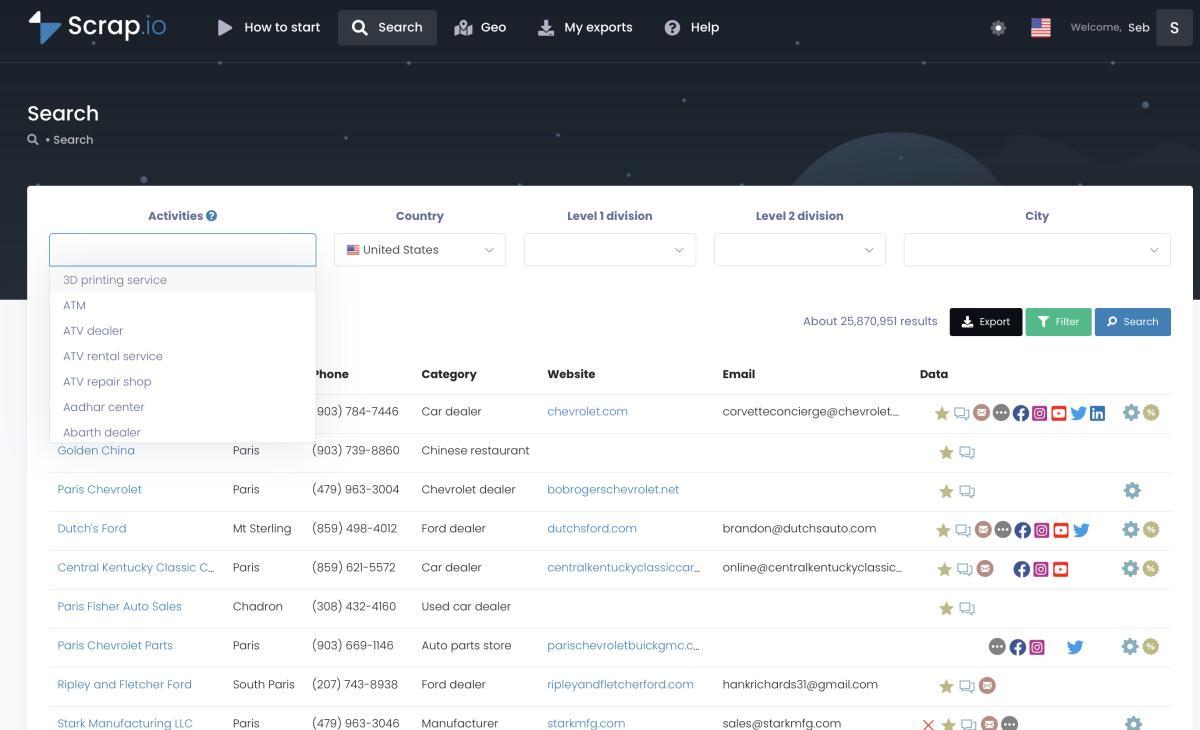
Scrap.io search — pick a category and a zone, from one city to a whole country.
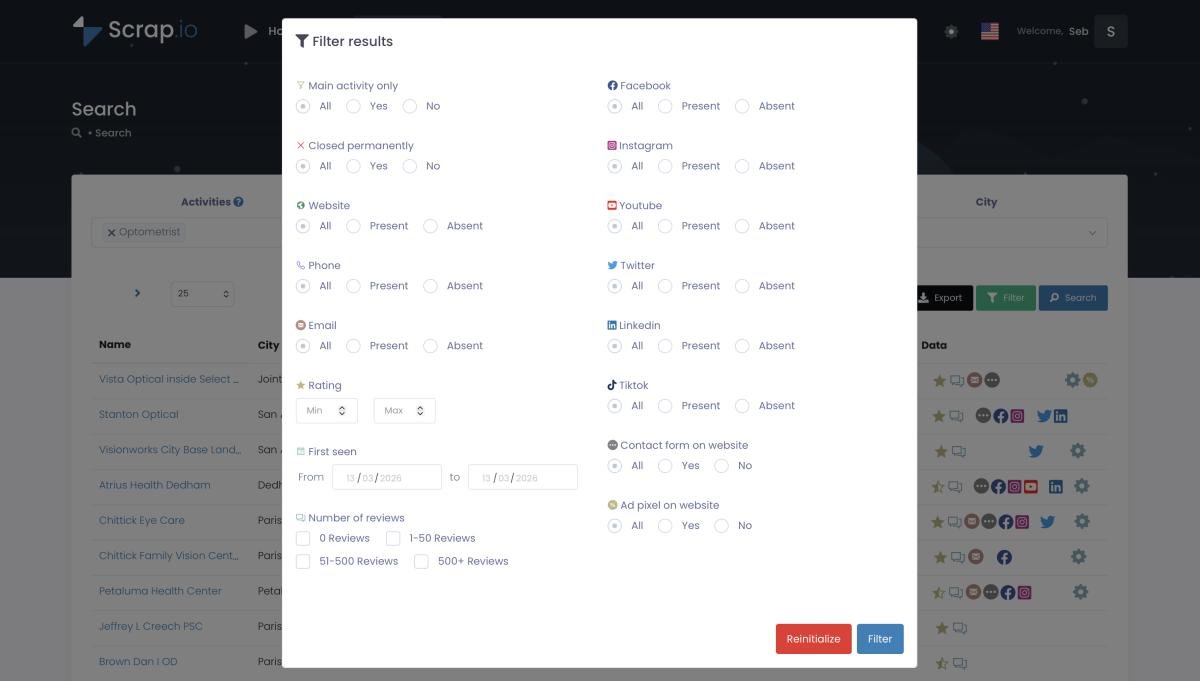
Filter for "email present" before extraction — zero credits wasted on blanks.
Need to target a precise radius or draw an irregular zone on the map? GeoSearch does both.
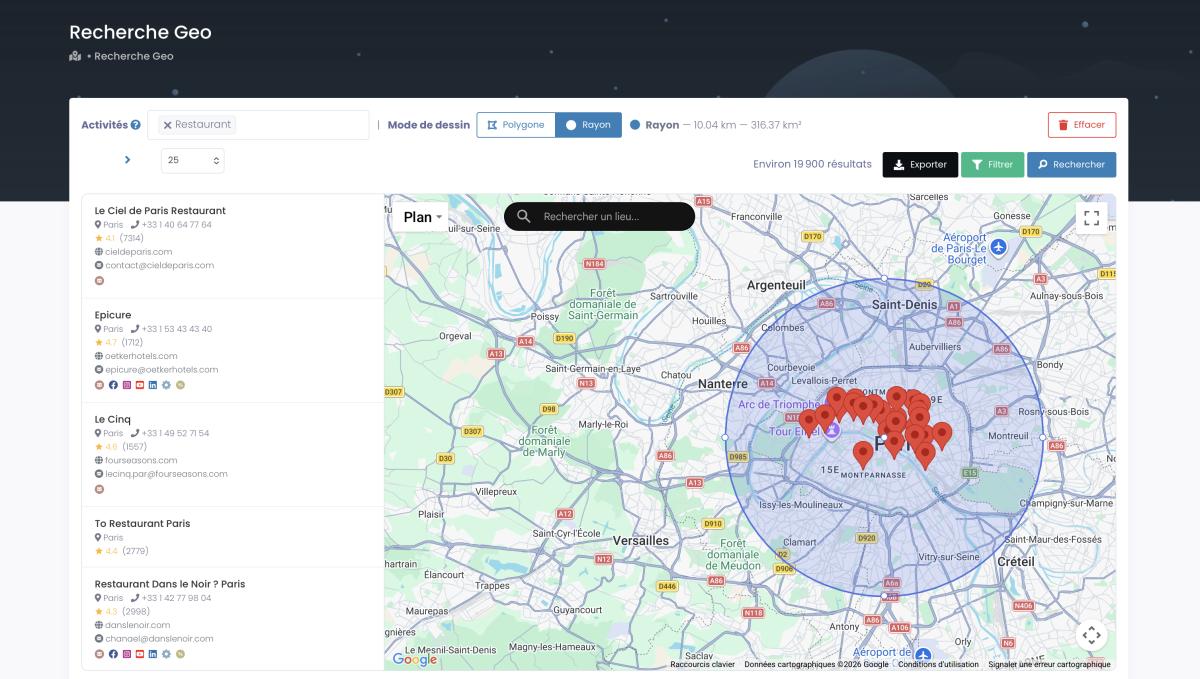
GeoSearch radius — target a circle around any point.
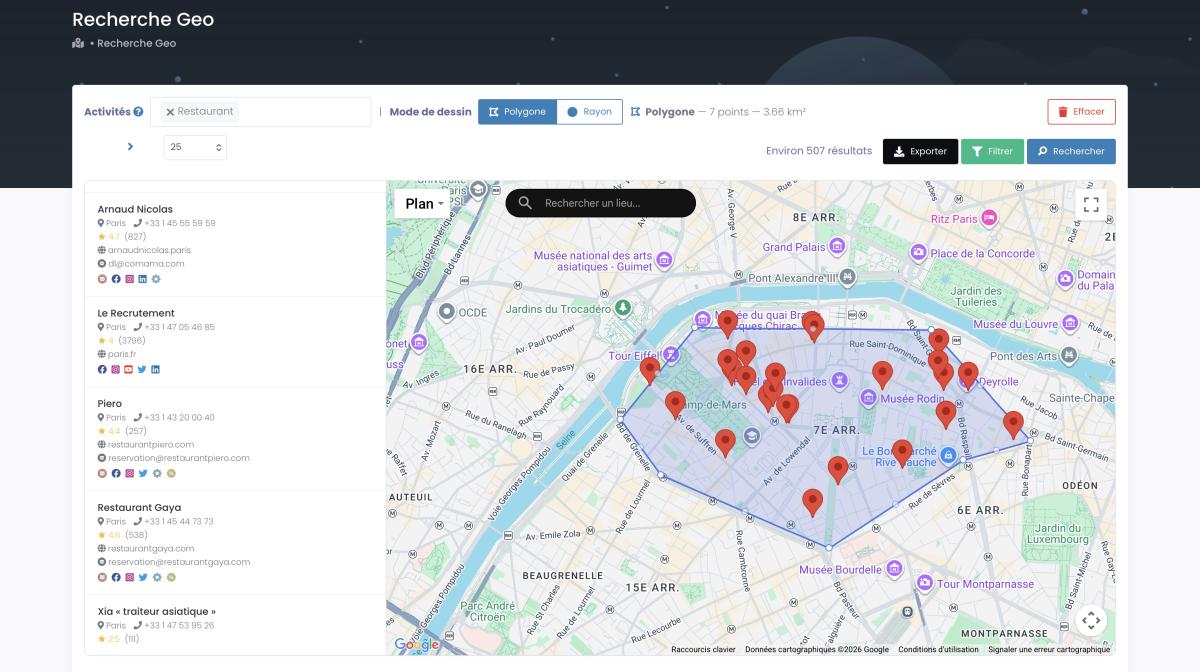
GeoSearch polygon — draw any shape that admin borders can't.
And here's the part that should settle the "are they rivals?" question: BillionVerify itself publishes a Scrap.io email verification page. The verifier's own site treats Scrap.io as the source layer that feeds it. They're not competitors — they're two halves of one workflow. Source with Scrap.io, verify with whatever tool you like, then send.
Video: How to Scrape Local Leads at the Country Level?
If you want the practical side, here's how to find emails on Google Maps and how to build a cold email list that's fresh from day one. For the full technical picture, the complete Google Maps scraping guide covers everything.
Start upstream. Try Scrap.io free for 7 days — 100 leads included, no category needed. Pull fresh, filtered, email-present contacts from any zone, then verify and send. The verifier cleans your list; Scrap.io builds you a better one to begin with.
Who Should Use BillionVerify (and Who Shouldn't)
So, verdict time. Who's this actually for?
Use it if: you're on a tight budget and cost per email is your deciding factor. You process big volumes where that price gap compounds. You're building AI or MCP-driven workflows and want native agent integration. Or you're an agency that needs a white-label verifier to resell. On all four counts, BillionVerify makes a strong case.
Skip it if: you need an established brand with a proven SLA and years of uptime behind it — the thin review history is a real risk for enterprise buyers. Or — and this is the big one — if you don't actually have a list yet. If you're staring at an empty spreadsheet, a verifier solves nothing. You need a source first. Start there, build the list, then clean it.
Video: Scrap.io - How to Start?
Either way, verification is only one piece of the machine. If you want the whole outbound picture — sourcing, sending, follow-ups — our cold emailing strategy guide wires it all together.
FAQ
Is BillionVerify legit and safe to use?
Yes — it's a functioning email verification tool launched in 2026, with SMTP checks, bulk verification, and an API. The caveat is that it's a young brand with limited third-party reviews (a single Trustpilot rating as of mid-2026). It works, but test it on a small sample using the 100 free credits before you route your whole pipeline through it. Prove it on your own data.
How much does BillionVerify cost?
It's credit-based, starting around $20 for 20,000 emails (roughly $0.001 per email), with a free tier of 100 checks that the vendor says needs no card and never expires. That undercuts ZeroBounce (~$0.0195/email) and NeverBounce (~$0.008/email under 10K, credits expiring in 12 months) by a wide margin. On price alone, it's the cheapest of the bunch.
Is the 99.9% accuracy claim real?
Nearly every verifier advertises 99.9%, so treat it as marketing rather than a differentiator. What actually varies is catch-all handling and the share of "unknown" results a tool returns. Run the same 100-email sample through two or three tools — including BillionVerify — and compare. That real test beats any badge.
Do I need to verify emails scraped from Google Maps?
It's good practice, but the bigger lever is the source. Emails extracted in real time (like Scrap.io does at export) are fresher and bounce far less than a static list, because they're pulled live rather than served from an aging database. Source first, verify second — in that order.
What are the best BillionVerify alternatives in 2026?
ZeroBounce, NeverBounce, MillionVerifier, Bouncer, and Reoon are the usual names. They cost more or attach expiry to their credits, but they carry longer track records and more independent reviews. The right pick depends on your volume, budget, and whether you need AI/MCP integration or white-label features.
The Verdict
BillionVerify is a legitimately cheap, feature-rich email verification tool with a clever AI-first angle. The price is real. The features punch above the price. The catch is trust — it's new, the third-party proof is thin, and you should verify it on your own data before betting a pipeline on it.
But zoom out. The best verifier on earth can't fix a bad list. It can only tell you how bad it is. Bad data costs more than any tool you'll ever buy — so the smartest move isn't picking the perfect cleaner, it's starting with contacts that don't need much cleaning in the first place.
Get fresh leads first. Try Scrap.io free for 7 days — 100 leads included. Pull real-time, email-present business contacts from Google Maps across 195 countries, then verify with the tool of your choice. Source right, and the verifier barely has anything left to catch.
Generate a list of restaurant with Scrap.io