

Direct mail pulls a 4.4% response rate. Email pulls 0.12%. That's roughly 36 times more responses for every piece you drop in the mail — and it's the whole reason the keyword "buy a mailing list" carries a $68 cost-per-click (ANA/DMA Response Rate benchmarks, via MPA, 2026). People pay that because postal still lands.
Here's the part the brokers leave out of the pitch. Most of the lists you can buy are quietly rotting. You pay once, you mail once, and a slice of those addresses were dead before the envelopes hit the truck.
So this is the honest version. What a mailing list really costs in 2026, the traps nobody puts on the invoice, and how to build your own targeted postal list from data that's public and current — for a fraction of the price. No fluff. If something's a bad deal, I'll say it plainly.
What's inside
- What buying a mailing list actually means in 2026
- Mailing list vs. email list: the difference that changes everything
- How much does a mailing list cost in 2026?
- Where to buy a mailing list: 7 providers compared
- The 5 hidden risks of buying a pre-made mailing list
- How to build your own B2B mailing list (without a broker)
- Buying vs. building: the real cost comparison
- Is it legal to buy a mailing list in the US?
- Making your mailing list actually deliver
- FAQ
What Buying a Mailing List Actually Means in 2026
When you "buy" a mailing list, most of the time you're not buying anything. You're renting it. Once.
That distinction trips up almost every first-time buyer, so let's kill the confusion before you spend a dollar. A purchased list usually comes with a one-time use license, and the provider knows exactly whether you obeyed it. Understanding that changes how you think about the whole transaction.
Rent vs. buy: the license nobody reads
Most purchased lists ship with a one-time use license. Mail it twice and you're in breach of contract. How do they catch you? Seed addresses — decoy names the provider slips into the file so they can watch whether a second mailing shows up in their own mailbox. Sneaky. Effective. And completely standard.
Want to mail the same audience again next quarter? You'll need an unlimited-use license, which typically runs 2 to 3 times the one-time rate (MPA, 2026). Buy four separate one-time licenses across a year and you'll pay 30 to 50% more than a single unlimited one. Read the license. Actually read it.
Compiled lists vs. response lists
There are two kinds of list, and they are not the same animal. Compiled lists are stitched together from public records, business registrations, property data, and directories. Comprehensive, cheap, passive — nobody on them raised a hand for anything. Response lists contain people who took an action: bought something, donated, subscribed. They cost 30 to 100% more, and they usually outperform, because behavior beats a demographic guess every time.
For B2B direct mail, most of what you'll be offered is compiled data. Fine. Just know what you're paying for before you sign.
Mailing List vs. Email List: The Difference That Changes Everything
Same word, two completely different products — and two completely different legal regimes. Which one are you actually buying?
This matters more than any pricing table in this article. A postal mailing list and an email list get lumped together in every "buy a list" conversation, and they shouldn't be. If it's email addresses you're after, that's a very different discussion, and we cover it in the guide to buying email lists is a whole other conversation. This article stays strictly on physical mail: postcards, letters, real addresses. A postal mailing list — often called a direct mail list — exists to reach a physical mailbox; an email list doesn't. So the very first decision, before you purchase a mailing list of any kind, is which of these two products you actually need.
| Criterion | Postal mailing list | Email list |
|---|---|---|
| Governing US law | 🟢 No CAN-SPAM equivalent for postal | 🔴 CAN-SPAM applies to every send |
| Cold outreach to businesses | 🟢 Legal and routine | 🟡 Legal but heavily constrained |
| Deliverability risk | 🟡 Return mail wastes postage | 🔴 Spam traps torch your domain |
| Cost of a bad address | 🟡 One wasted mailer | 🔴 Reputation damage across all sends |
| Physical footprint targeting | 🟢 The whole point | 🟡 Secondary |
| Best for local B2B | 🟢 Excellent | 🟡 Depends on data quality |
The takeaway sits in that first row. Buying a postal list for physical direct mail is legal and operational in the US. Buying an email list for cold email drags you into a far more constrained world. Different products. Don't let a broker blur them.
How Much Does a Mailing List Cost in 2026?
A 5,000-record B2B list with title targeting runs $1,000 to $1,750. The same 5,000 records as a saturation list? Around $75. That's not a rounding error — that's a 20x spread, and it depends entirely on how tightly you slice the data.
Mailing lists are priced per thousand records, a metric called CPM (cost per thousand). The more filters you stack, the higher the CPM climbs. Here's what the actual 2026 numbers look like.
B2B mailing list pricing
| List type | Cost per 1,000 (CPM) | Typical minimum |
|---|---|---|
| Business by SIC/NAICS code | $100 – $200 | 500 records |
| Business with contact name | $150 – $300 | 500 records |
| Title-specific (C-suite, VP) | $200 – $350 | 250 records |
| Healthcare professionals | $250 – $400+ | 250 records |
Source: MPA Mailing List Pricing Guide, updated July 2026. B2B runs pricier than consumer for one reason: the data is harder to keep alive. Titles change, people quit, companies fold — so somebody has to keep verifying it, and that cost lands in the CPM.
Consumer mailing list pricing
| List type | Cost per 1,000 (CPM) | Typical minimum |
|---|---|---|
| Resident/occupant (saturation) | $15 – $35 | 500 records |
| Consumer demographic (basic) | $50 – $85 | 1,000 records |
| Consumer targeted (income, age, home value) | $75 – $150 | 1,000 records |
| New movers / new homeowners | $85 – $200 | 500 records |
Notice how the cheap saturation list — every address on a carrier route — carries zero targeting. You mail everyone. That's the trade.
What drives the price up
Three levers move the number. Selects: every filter you add (income, title, industry) bumps the CPM. Freshness: a monthly-verified list costs more than a quarterly one, and NCOA processing adds $3 to $8 per thousand. License: one-time use is the floor; unlimited use is 2 to 3 times that. Want to know what qualified prospects genuinely cost to reach across channels? We ran the numbers on what qualified leads actually cost to generate.
Where the list sits in your total campaign budget
The list is rarely your biggest line item — postage is. On a typical 5,000-piece postcard campaign, the mailing list runs about 10 to 18% of total spend (MPA, 2026). Which is exactly why cheaping out on the list to save $200 is a false economy. That $200 is the one line item with the most leverage over whether anyone responds at all.
Curious what a list of your target category would even look like before you commit a budget? Running the count is free on Scrap.io — it never burns a single credit, even across an entire state. Pick a category, size the market, then decide.
Where to Buy a Mailing List: 7 Providers Compared
Here's the uncomfortable truth about this market: the companies ranking for "buy a mailing list" mostly sell you the same underlying data. The difference is what they charge to slice it, and how much they'll tell you before you're on the phone with a rep.
| Provider | Coverage claimed | Entry price | Weak spot |
|---|---|---|---|
| Data Axle USA | Major US compiler | Quote only | No public pricing |
| Experian | 200M+ consumers, 14M businesses | Quote only | Only 14M businesses vs 25.78M on the map |
| Melissa | 200M+ consumers, 14M businesses | Self-serve | Consumer-first tooling |
| DirectMail.com | 14M+ businesses, monthly updated | From 3.5¢/name (consumer) | Selects billed per record |
| LeadsPlease | Consumer + business | Per-record online | Thin B2B depth |
| PostcardMania | List + print bundled | Bundled with mailing | Data tied to their print service |
| Wise Pelican | Radius / polygon targeting | Per-record online | Fine geo targeting is consumer-side, rare for B2B |
So where can I buy a mailing list, in practice? Any of the seven above will sell you business mailing lists online, and a handful — the best mailing list companies for a small-business budget — let you buy a targeted mailing list self-serve, no sales call required. But whether you buy business mailing list files by industry (SIC/NAICS) or buy a mailing list online in two clicks, you're landing on the same compiled data, with the same license and decay caveats baked in. These are the mailing list providers for small business owners keep circling back to — and every one of them is still a vendor.
If you're comparing where to buy a mailing list, that last column is the real story. Every one of these is a vendor with something to sell you, which is fine — just don't expect any of them to warn you about the license or the decay. That's not their job. It's ours.
Need proof the market is starved for straight talk? The thread ranking #3 on Google for this exact question is a 13-year-old r/marketing discussion where the standout suggestion is basically "skip the paid list, use EDDM." Thirteen years old. Still ranking. That tells you how little genuinely useful content exists on buying a mailing list — and how much of the advice floating around predates half the tools in this guide.
Can you buy a mailing list from the Post Office?
No. The USPS does not sell mailing lists and doesn't keep a database of residents or businesses to sell. Straight from their own "Get an Address List" guidance: it points you to private list brokers — literally suggests you "look in the yellow pages under lists." What the Postal Service does offer is Every Door Direct Mail (EDDM), which lets you mail every address on a carrier route with no list purchase at all. You pay postage and printing only. Zero demographic targeting, though. It's a blunt instrument.
The 5 Hidden Risks of Buying a Pre-Made Mailing List
Mark bought 5,000 names for his HVAC business. Six weeks later, 740 postcards came back stamped "Return to Sender." That's not bad luck. That's math — and it's the first of five risks nobody puts in the sales deck.
Let's count them.
1. Data decay. B2B contact data rots at roughly 2.1% per month — about 22.5% a year (Cleanlist, 2026). In faster industries it hits 30 to 40%. And B2B titles and companies churn around 30% annually on their own. So the "premium" file you bought in January is measurably fiction by summer. Those old databases are stuffed with closed businesses still sitting in old records, and every one is a wasted mailer.
Video: Find Businesses That JUST Opened (Before Your Competitors Do)
2. Zero exclusivity. The list you just bought? Your competitor can buy the identical file tomorrow. The same 5,000 HVAC prospects get five postcards from five contractors in the same week, and by the third one they hate all of you. Shared data is a race nobody wins.
3. The one-time use trap. Remember the seed addresses. That list is licensed for a single mailing, and mailing it again without an unlimited license is a breach they can prove. You're renting, not owning.
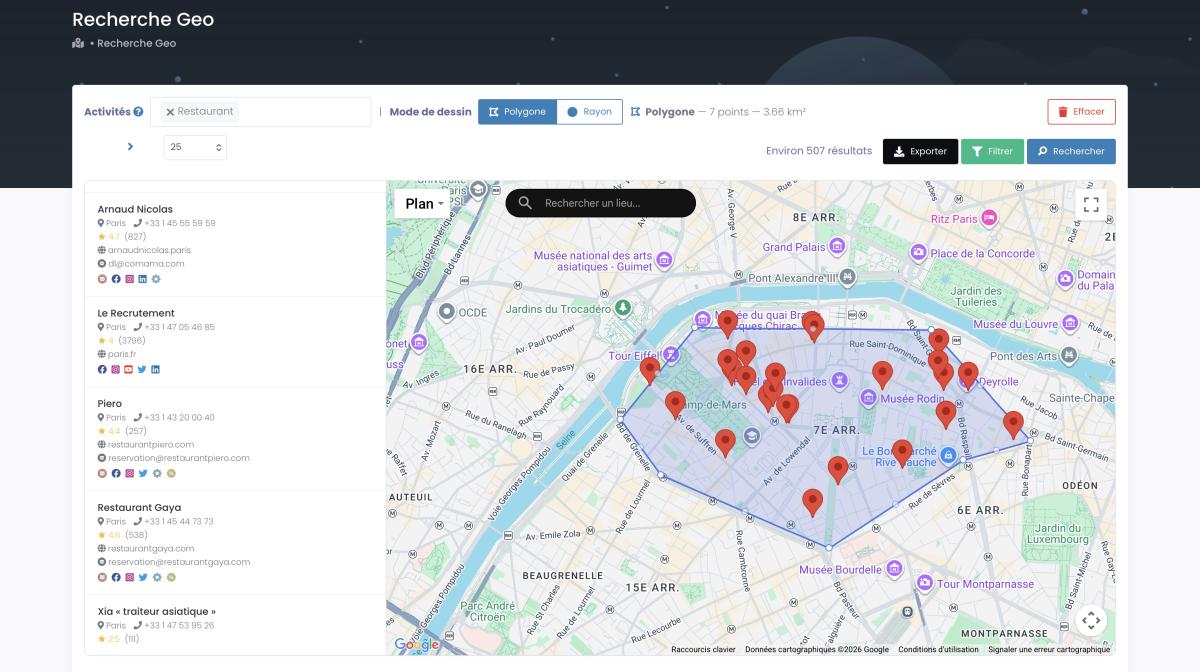
4. Coarse geo targeting. Most brokers will sell you a ZIP code. Try asking for a real radius around your shop, or a hand-drawn boundary that follows your actual service area. B2B side? Almost nobody offers it. You get a postal code and a shrug.
5. You can't see it before you pay. Brokers give you counts, not data. You'll know how many records match your criteria — but you won't see a single actual address until the money clears. You're buying blind, and hoping the deliverability guarantee (if there even is one) makes up the difference. Cheap data always costs more in the end, which is the exact same math behind the real cost of "free" lists.
This is exactly why 50,000+ professionals pull their lists fresh instead of buying a snapshot: with Scrap.io, the data is re-verified at the moment you export it — not 18 months ago in someone's warehouse. Here's how the data is refreshed in real time.
How to Build Your Own B2B Mailing List (Without a Broker)
There are 25,781,381 businesses on Google Maps in the United States right now, and every single one has a verified physical address attached. You don't need a broker to reach them. You need a category, a map, and about ten minutes.
The whole thing takes four steps.
Here's the part that should really land: nobody can sell you "the 154,943 American dental practices that don't have a website." That's not a select in any broker's catalog. On Scrap.io it's a checkbox — out of 342,797 US dentists, 45.2% have no site, and every one of them is a direct-mail target a broker can't segment. Before you touch a single step, watch how the tool works from a cold start.
Video: Scrap.io - How to Start?
Step 1 — Pick your category
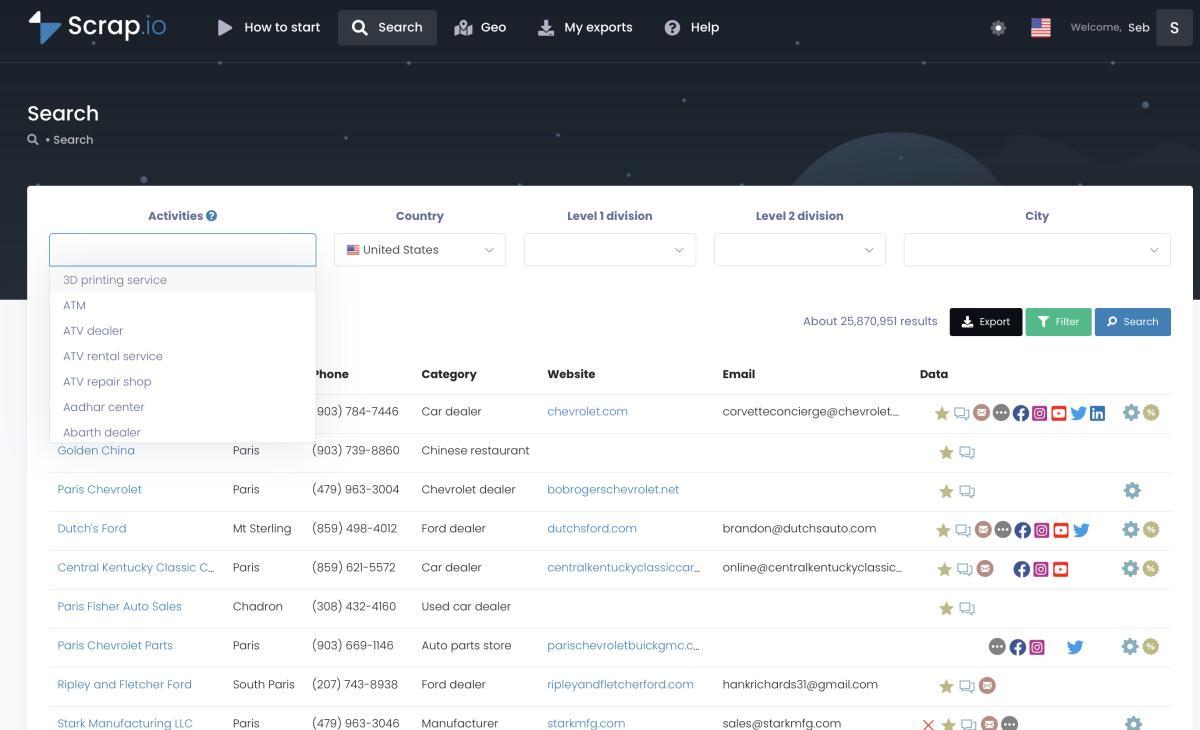
Start with what you sell to. Scrap.io mirrors Google Maps directly, so you're choosing from 4,000+ real business categories — dentists, roofers, law firms, gyms, whatever your ICP is. Cross several at once if you need to. No vague buckets, no "professional services, sort it out yourself."
Step 2 — Draw your geography
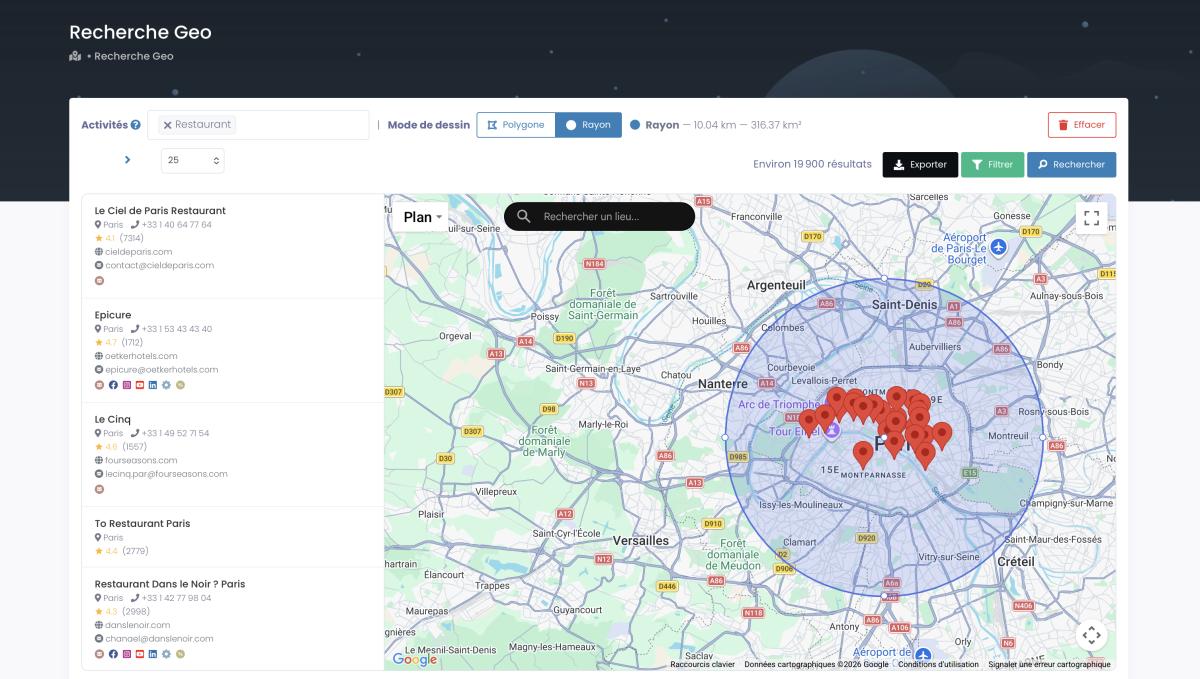
This is where "buy a mailing list by zip code" gets embarrassed. You can target a ZIP, sure — but also a radius around a point, a hand-drawn polygon over an exact neighborhood, a county, a state, or the entire country in two clicks. Every filter still applies inside the shape you draw. That national file a broker sells you? You can just pull it yourself, current, whenever you want. This is how you build targeted mailing lists by radius, or a business mailing list by industry, without ever touching a ZIP-only broker menu — and it's the honest answer to "how do I make my own mailing list."
Video: How to Scrape Local Leads at the Country Level
Step 3 — Filter before you pay, not after
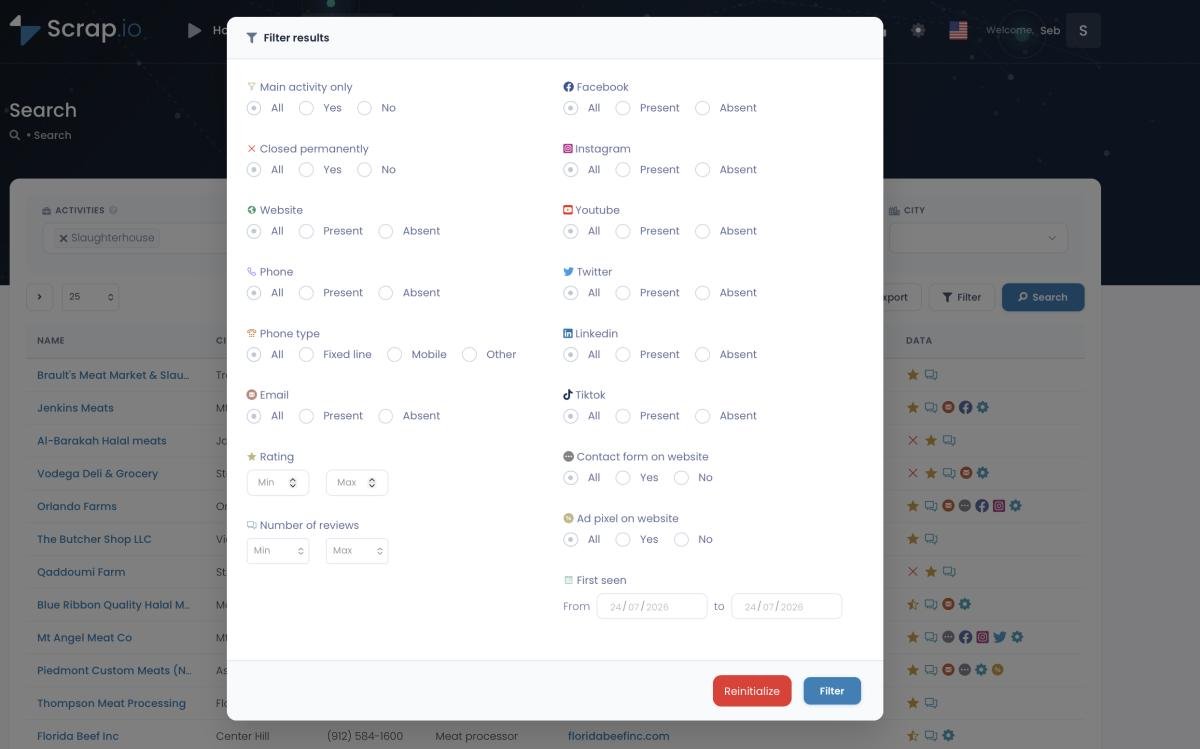
This is the move that flips the whole economics. The broker model makes you pay the CPM first and discover the dead addresses later. Scrap.io does the opposite: filters apply before a single credit is spent. Want only businesses that are still open? Toggle "permanently closed: no." Only a minimum rating, or a specific claim status? Stack it. You never pay for a record you can't use. And you can extract every business in a territory the same way, category or no category.
Step 4 — Export addresses and hand the file to your mail house
Hit export and you get a clean CSV or Excel file — business name, full street address, city, ZIP, phone, category, the works. One real client pulled 11,734 businesses in 45 minutes. Then you hand that file to your mail house for NCOA, CASS, printing, and the drop. You're not replacing your printer here. You're replacing the broker.
Try Scrap.io free for 7 days — 100 export credits included. Pick a category, draw your ZIP codes, filter to open businesses only, and see your entire list before you spend a dollar on postage. That's 25,781,381 US businesses to choose from, every one with a verified physical address.
Buying vs. Building: The Real Cost Comparison
Buying 20,000 B2B records once costs more than a full year of building them yourself, on demand, as many times as you want. That's not a slogan. It's arithmetic, and here it is laid out.
| Factor | 🔴 Buy from a broker | 🟢 Build it yourself (Scrap.io) |
|---|---|---|
| Cost for 20,000 B2B records | $3,000 – $6,000 (one-time use) | $69/mo, 20,000 credits, reusable |
| License | One-time, seed-tracked | Yours, re-export anytime |
| Data freshness | Aging from day one | Re-verified at export |
| Exclusivity | Sold to your competitors too | 100% yours |
| Geo targeting | ZIP code, mostly | Radius, polygon, county, country |
| Filter before paying | No — pay first, sort later | Yes — filters apply pre-credit |
| See data before paying | Counts only | Free counts + preview |
| Local businesses covered | Patchy for small local firms | Anything on the map |
Do the math on a single number. A broker charges roughly $150 to $300 per thousand for 20,000 B2B records — that's $3,000 to $6,000 for one mailing you can't legally reuse. The Scrap.io Professional plan is $69 a month for 20,000 credits, and you can pull a fresh file every month. One is a purchase that expires. The other is a tap you can turn on whenever. If you want the full channel-by-channel breakdown, the lead generation cost benchmarks spell it out. And yes — we've watched a client spend two hours clicking through listings by hand to build a file manually, then export thousands in the time it took to grab lunch. Don't be that client.
Is It Legal to Buy a Mailing List in the US?
Short answer: yes for postal, and it's not even close to the same conversation as email. Here's the line.
Postal mail vs CAN-SPAM
CAN-SPAM governs commercial email. Not postal mail. So a bought postal list sits in a far less constrained legal regime than a bought email list — there's no postal equivalent of the opt-out-or-get-fined machinery that email carries. That single fact is why direct mail to businesses stays operationally simple where cold email gets complicated fast.
CCPA and business address data in California
California's CCPA gives residents rights over their personal information. But publicly available business data — a company's name, address, and category — largely sits outside its heaviest provisions. You're processing commercial information, not building consumer profiles. The safest ground, always, is data that's public and traceable to its source.
What "publicly available business data" covers
This is the clean footing. A business's name, physical address, phone, and category, published by the business itself on a public map, is about as defensible as source data gets. Scrap.io is GDPR and CCPA compliant, works exclusively from publicly available business data, and keeps every record traceable to where it came from. One honest caveat, though: this is not legal advice. Talk to your own counsel before a big campaign.
Making Your Mailing List Actually Deliver
A 12-month-old list can be close to 9% undeliverable before you even print. That's postage you're setting on fire — and it's avoidable.
Roughly 8 to 9% of Americans move every year (Census CPS, via MPA, 2026), which is why deliverability isn't a nice-to-have. It's the whole ballgame. The USPS itself pegs list quality at 40% of the reason a direct mail campaign succeeds or fails (USPS Delivers, Direct Mail 101). And 84% of consumers read their mail the same day it arrives (Postalytics, 2026) — but only if it actually reaches them.
So before any drop, your mail house should run the file through three checks: NCOA (matched against the USPS 48-month change-of-address file), CASS (address standardization for postal discounts), and DPV (confirming the address is a real delivery point). Add deduplication so you're not paying to mail the same household twice.
Here's the waste, quantified. A $30-per-thousand list that's 18 months old with no NCOA runs 12 to 18% undeliverable. On 5,000 Marketing Mail pieces at $0.467 each, that's $258 to $387 in burned postage — and $1,033 to $1,548 once you add the wasted printing (MPA, 2026). The list "savings" evaporate on the first drop.
How often should you refresh your list?
Refresh a purchased list at least every six months, and run NCOA before every single mailing. The USPS Move Update standard actually requires your list to have been updated within the last 95 days to qualify for automation postage rates. Six months between refreshes is the ceiling, not the target. Build-your-own sidesteps most of this, because the data is verified at the moment you export it — there's no aging snapshot to refresh in the first place.
FAQ
How much does it cost to buy a mailing list?
Mailing lists are priced per thousand records (CPM). In 2026, expect $15–$35/M for saturation lists, $50–$150/M for targeted consumer lists, $100–$200/M for B2B lists filtered by SIC/NAICS code, and $200–$350/M for title-specific B2B lists. A 5,000-record B2B list with title targeting typically runs $1,000–$1,750. Most providers set a minimum order between 250 and 1,000 records.
Can you buy a mailing list from the Post Office?
No. The USPS does not sell mailing lists. It points businesses to private list brokers instead. What the Postal Service does offer is Every Door Direct Mail (EDDM), which lets you mail every address on a chosen carrier route without buying a list at all — you pay postage and printing only, with no demographic targeting.
Is it legal to buy a mailing list?
Buying a mailing list for physical direct mail is legal in the United States. CAN-SPAM governs commercial email, not postal mail, so a bought postal list sits in a far less constrained legal regime than a bought email list. That said, California's CCPA gives residents rights over their personal information, and the safest ground is business data that is publicly available and traceable to its source.
How often should you update a mailing list?
Refresh a purchased list at least every six months, and run NCOA processing before every single mailing. B2B contact data decays around 2.1% per month, and 8–9% of Americans move each year. USPS Move Update rules require your list to have been updated within the last 95 days to qualify for automation postage rates.
Is it better to buy a mailing list or build your own?
Buy when you need consumer data with demographic overlays you cannot compile yourself. Build when you are targeting businesses: a Google Maps extraction gives you a verified physical address, a category, ratings and a website status for every business in your area, refreshed at the moment of export, with no one-time use license. For B2B direct mail, building is usually cheaper, fresher and exclusive to you.
The Bottom Line
Four things to walk away with. One: a bought postal list is legal and it works — but it's rented, shared, and rotting from the day it's compiled. Two: the real cost isn't the CPM, it's the burned postage on dead addresses. Three: for local B2B, you can build a fresher, exclusive list yourself from public data for a fraction of the price. Four: whatever you do, run NCOA before you print.
Buying isn't a scam. Sometimes it's the right call — a specialized consumer overlay you genuinely can't compile. But for reaching businesses on a map, the honest answer is that you can do it better yourself.
Fresh, exclusive, and current beats bought and frozen.
Before you sign a broker's order form, spend ten minutes running the same search yourself. Try Scrap.io free for 7 days — 100 leads on us. Pick a category, draw your ZIP codes, filter to open businesses only, and see your list before you spend a dollar on postage.
Generate a list of restaurant with Scrap.io